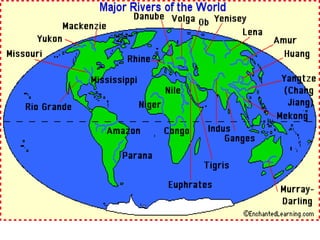
Rivers
Learning Intention
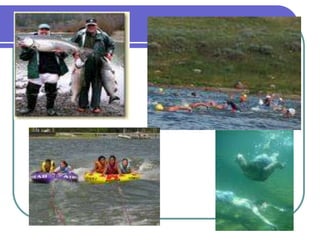
 How people use rivers?
 Why is water and rivers important?
 Why study rivers?
 What is the hydrological cycle?
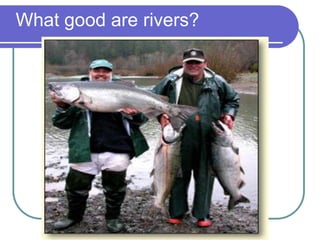
What good are rivers?
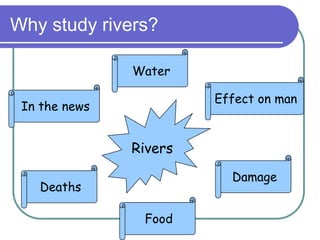
Why study rivers?
Rivers
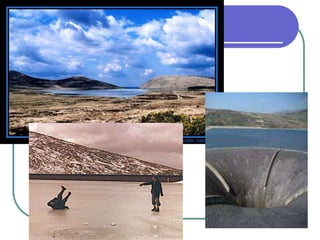
In the news
Deaths
Damage
Effect on man
Food
Water
Rivers
 Water is an important resource we all need to
live and survive. 70% of our bodies are water.
 We see water all around us in the
sea, lakes, ponds and rivers.
 We are now going to take you on a journey to
find where our water comes from and how
rivers affect our lives.
List of Water Uses
 In pairs discuss each persons list of uses
for rivers
 Has people’s reliance on rivers
changed? How?
Uses of rivers
Make a spider diagram
 Washing
 Wash hands
 Drinking water
 Swimming
 Bath
 Cooking
 Fishing
 Water sports
 Dams
 Electricity (HEP)
 Crops
 Transport (move things
and people) eg boats
 Sprinklers
 Factories
 Bread
 Water golf courses
Top uses of water
Put list of uses for rivers in order of
importance for:
1. Today
2. The past
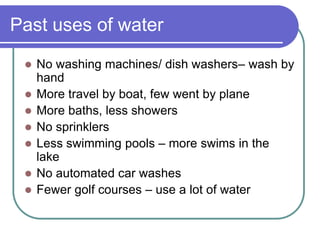
Past uses of water
 No washing machines/ dish washers– wash by
hand
 More travel by boat, few went by plane
 More baths, less showers
 No sprinklers
 Less swimming pools – more swims in the
lake
 No automated car washes
 Fewer golf courses – use a lot of water
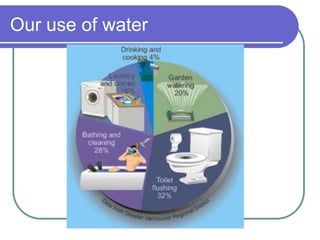
Our use of water
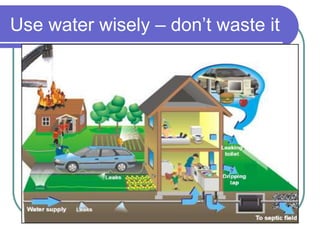
Use water wisely – don’t waste it
Write an account
Write an account of your group
discussion. Write about how our use of
rivers has changed over time.
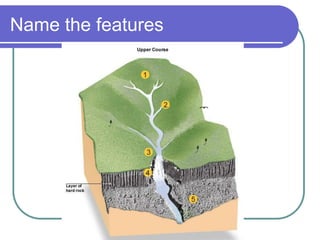
Name the features
 1. Source: the point at which the river
starts.
 2. Interlocking spurs: where the river
winds between ridges.
 3. Gorge: deep valley caused by
wearing back of a waterfall.
 4. Waterfall: often where the river
crosses a band of harder rock.
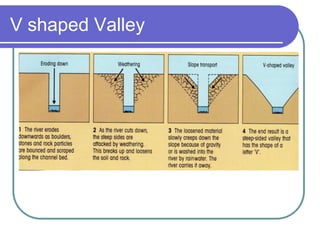
 5. 'V' shaped valley: produced in
upper course because the river cuts
down more quickly than the
surrounding slopes are eroded.
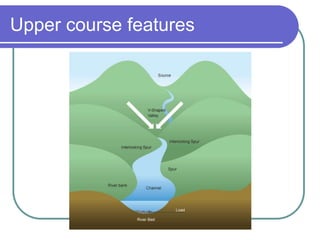
Upper course features
V shaped Valley
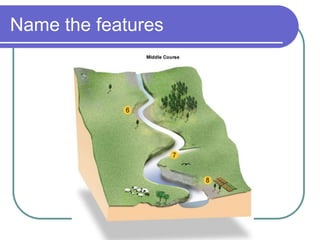
Name the features
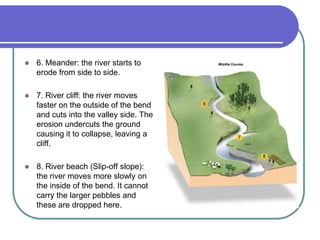
 6. Meander: the river starts to
erode from side to side.
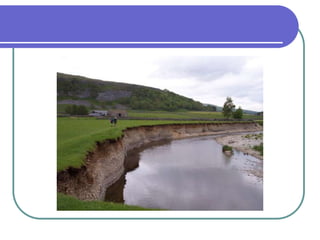
 7. River cliff: the river moves
faster on the outside of the bend
and cuts into the valley side. The
erosion undercuts the ground
causing it to collapse, leaving a
cliff.
 8. River beach (Slip-off slope):
the river moves more slowly on
the inside of the bend. It cannot
carry the larger pebbles and
these are dropped here.
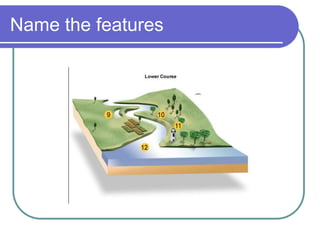
Name the features
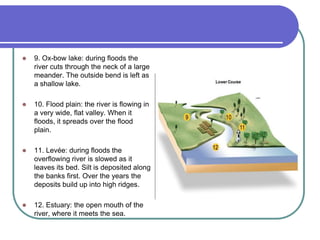
 9. Ox-bow lake: during floods the
river cuts through the neck of a large
meander. The outside bend is left as
a shallow lake.
 10. Flood plain: the river is flowing in
a very wide, flat valley. When it
floods, it spreads over the flood
plain.
 11. Levée: during floods the
overflowing river is slowed as it
leaves its bed. Silt is deposited along
the banks first. Over the years the
deposits build up into high ridges.
 12. Estuary: the open mouth of the
river, where it meets the sea.
River channel
 A river is fresh water flowing across the
surface of the land, usually to the sea. It
flows in a channel. The bottom of the
channel is called the bed and the sides
of the channel are called the banks.
The drainage basin of a river
River terms
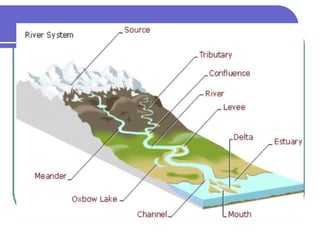
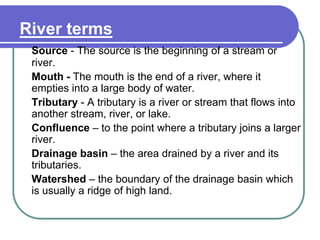
Source - The source is the beginning of a stream or
river.
Mouth - The mouth is the end of a river, where it
empties into a large body of water.
Tributary - A tributary is a river or stream that flows into
another stream, river, or lake.
Confluence – to the point where a tributary joins a larger
river.
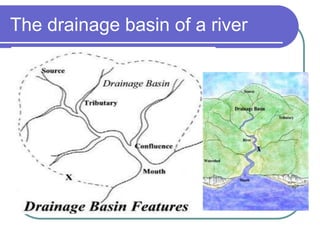
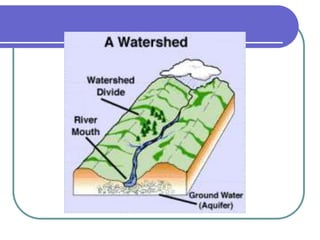
Drainage basin – the area drained by a river and its
tributaries.
Watershed – the boundary of the drainage basin which
is usually a ridge of high land.
Give the meanings of these
words
SOURCE
WATERSHED
TRIBUTARY
CONFLUENCE
MOUTH
RIVER CHANNEL
DRAINAGE BASIN
DELTA
Answe
rs
SOURCE
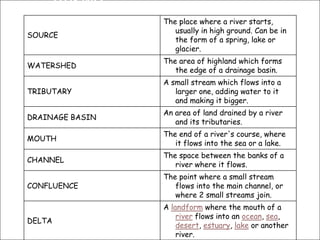
The place where a river starts,
usually in high ground. Can be in
the form of a spring, lake or
glacier.
WATERSHED
The area of highland which forms
the edge of a drainage basin.
TRIBUTARY
A small stream which flows into a
larger one, adding water to it
and making it bigger.
DRAINAGE BASIN
An area of land drained by a river
and its tributaries.
MOUTH
The end of a river's course, where
it flows into the sea or a lake.
CHANNEL
The space between the banks of a
river where it flows.
CONFLUENCE
The point where a small stream
flows into the main channel, or
where 2 small streams join.
DELTA
A landform where the mouth of a
river flows into an ocean, sea,
desert, estuary, lake or another
river.
Fill in the spaces putting in the missing
terms and the missing definitions
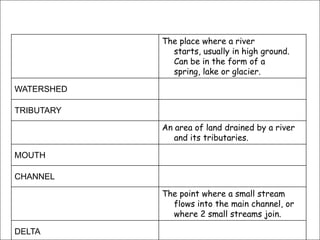
The place where a river
starts, usually in high ground.
Can be in the form of a
spring, lake or glacier.
WATERSHED
TRIBUTARY
An area of land drained by a river
and its tributaries.
MOUTH
CHANNEL
The point where a small stream
flows into the main channel, or
where 2 small streams join.
DELTA
Shaping the land
 The river works to shape the land. It
does it in 3 ways:
1. Erosion – wears away the land
2. Transportation – moves the material from one
place to another
3. Deposition – drops the material and builds new
landforms
What is erosion?
 Erosion is the wearing away of the land
(like sandpaper)
 Weathering breaks up and weakens the
surface of the rocks while erosion wears
away and removes the loosened material
Processes of erosion
http://www.bbc.co.uk/schools/gcsebitesize/geography/riverswat
er/river_processesrev1.shtml
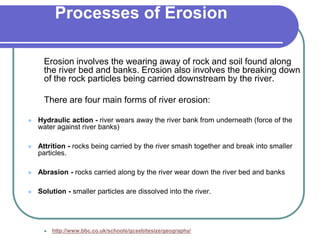
Processes of Erosion
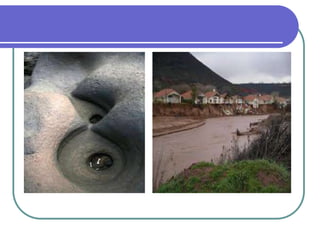
Erosion involves the wearing away of rock and soil found along
the river bed and banks. Erosion also involves the breaking down
of the rock particles being carried downstream by the river.
There are four main forms of river erosion:
 Hydraulic action - river wears away the river bank from underneath (force of the
water against river banks)
 Attrition - rocks being carried by the river smash together and break into smaller
particles.
 Abrasion - rocks carried along by the river wear down the river bed and banks
 Solution - smaller particles are dissolved into the river.
 http://www.bbc.co.uk/schools/gcsebitesize/geography/
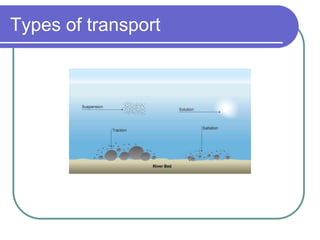
Types of transport
Transport
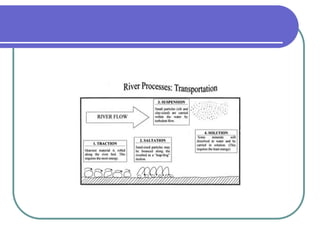
Rivers pick up and carry material as they flow downstream. A river
may transport material in four different ways:
 Solution - minerals are dissolved in the water and carried along
in solution.
 Suspension - fine light material is carried along in the water.
 Saltation - small pebbles and stones are bounced along the river
bed.
 Traction - large boulders and rocks are rolled along the river bed.
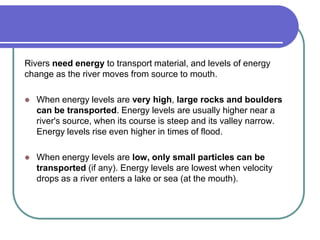
Rivers need energy to transport material, and levels of energy
change as the river moves from source to mouth.
 When energy levels are very high, large rocks and boulders
can be transported. Energy levels are usually higher near a
river's source, when its course is steep and its valley narrow.
Energy levels rise even higher in times of flood.
 When energy levels are low, only small particles can be
transported (if any). Energy levels are lowest when velocity
drops as a river enters a lake or sea (at the mouth).
Deposition
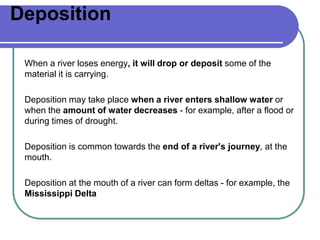
When a river loses energy, it will drop or deposit some of the
material it is carrying.
Deposition may take place when a river enters shallow water or
when the amount of water decreases - for example, after a flood or
during times of drought.
Deposition is common towards the end of a river's journey, at the
mouth.
Deposition at the mouth of a river can form deltas - for example, the
Mississippi Delta
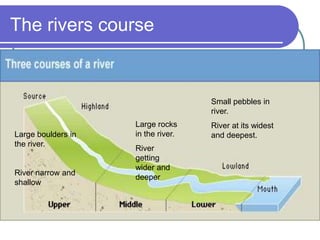
The rivers course
Large boulders in
the river.
River narrow and
shallow
Large rocks
in the river.
River
getting
wider and
deeper
Small pebbles in
river.
River at its widest
and deepest.
3 stages of the river
The journey of river from source (where the
river begins) to mouth (where the river ends) is
sometimes called the course of the river. The
course of a river can be divided into three
main sections:
 upper course
 middle course
 lower course
Rivers always flow downwards from
highland areas to lowland areas, through
the upper, middle, and finally the lower
course.
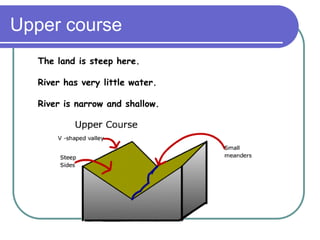
Upper course
The land is steep here.
River has very little water.
River is narrow and shallow.
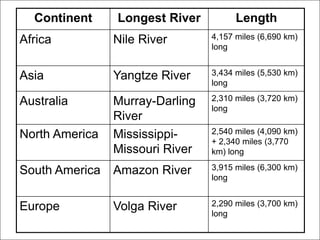
Continent Longest River Length
Africa Nile River 4,157 miles (6,690 km)
long
Asia Yangtze River 3,434 miles (5,530 km)
long
Australia Murray-Darling
River
2,310 miles (3,720 km)
long
North America Mississippi-
Missouri River
2,540 miles (4,090 km)
+ 2,340 miles (3,770
km) long
South America Amazon River 3,915 miles (6,300 km)
long
Europe Volga River 2,290 miles (3,700 km)
long
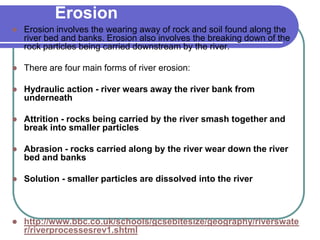
Erosion
 Erosion involves the wearing away of rock and soil found along the
river bed and banks. Erosion also involves the breaking down of the
rock particles being carried downstream by the river.
 There are four main forms of river erosion:
 Hydraulic action - river wears away the river bank from
underneath
 Attrition - rocks being carried by the river smash together and
break into smaller particles
 Abrasion - rocks carried along by the river wear down the river
bed and banks
 Solution - smaller particles are dissolved into the river
 http://www.bbc.co.uk/schools/gcsebitesize/geography/riverswate
r/riverprocessesrev1.shtml

rivers-1-140414001131-phpapp02 geo slides.pdf

  • 1.
  • 2.
    Learning Intention  Howpeople use rivers?  Why is water and rivers important?  Why study rivers?  What is the hydrological cycle?
  • 4.
  • 7.
    Why study rivers? Rivers Inthe news Deaths Damage Effect on man Food Water
  • 8.
    Rivers  Water isan important resource we all need to live and survive. 70% of our bodies are water.  We see water all around us in the sea, lakes, ponds and rivers.  We are now going to take you on a journey to find where our water comes from and how rivers affect our lives.
  • 11.
    List of WaterUses  In pairs discuss each persons list of uses for rivers  Has people’s reliance on rivers changed? How?
  • 12.
    Uses of rivers Makea spider diagram  Washing  Wash hands  Drinking water  Swimming  Bath  Cooking  Fishing  Water sports  Dams  Electricity (HEP)  Crops  Transport (move things and people) eg boats  Sprinklers  Factories  Bread  Water golf courses
  • 13.
    Top uses ofwater Put list of uses for rivers in order of importance for: 1. Today 2. The past
  • 14.
    Past uses ofwater  No washing machines/ dish washers– wash by hand  More travel by boat, few went by plane  More baths, less showers  No sprinklers  Less swimming pools – more swims in the lake  No automated car washes  Fewer golf courses – use a lot of water
  • 15.
  • 16.
    Use water wisely– don’t waste it
  • 17.
    Write an account Writean account of your group discussion. Write about how our use of rivers has changed over time.
  • 18.
  • 19.
     1. Source:the point at which the river starts.  2. Interlocking spurs: where the river winds between ridges.  3. Gorge: deep valley caused by wearing back of a waterfall.  4. Waterfall: often where the river crosses a band of harder rock.  5. 'V' shaped valley: produced in upper course because the river cuts down more quickly than the surrounding slopes are eroded.
  • 20.
  • 21.
  • 22.
  • 23.
     6. Meander:the river starts to erode from side to side.  7. River cliff: the river moves faster on the outside of the bend and cuts into the valley side. The erosion undercuts the ground causing it to collapse, leaving a cliff.  8. River beach (Slip-off slope): the river moves more slowly on the inside of the bend. It cannot carry the larger pebbles and these are dropped here.
  • 24.
  • 25.
     9. Ox-bowlake: during floods the river cuts through the neck of a large meander. The outside bend is left as a shallow lake.  10. Flood plain: the river is flowing in a very wide, flat valley. When it floods, it spreads over the flood plain.  11. Levée: during floods the overflowing river is slowed as it leaves its bed. Silt is deposited along the banks first. Over the years the deposits build up into high ridges.  12. Estuary: the open mouth of the river, where it meets the sea.
  • 26.
    River channel  Ariver is fresh water flowing across the surface of the land, usually to the sea. It flows in a channel. The bottom of the channel is called the bed and the sides of the channel are called the banks.
  • 28.
  • 29.
    River terms Source -The source is the beginning of a stream or river. Mouth - The mouth is the end of a river, where it empties into a large body of water. Tributary - A tributary is a river or stream that flows into another stream, river, or lake. Confluence – to the point where a tributary joins a larger river. Drainage basin – the area drained by a river and its tributaries. Watershed – the boundary of the drainage basin which is usually a ridge of high land.
  • 31.
    Give the meaningsof these words SOURCE WATERSHED TRIBUTARY CONFLUENCE MOUTH RIVER CHANNEL DRAINAGE BASIN DELTA
  • 32.
    Answe rs SOURCE The place wherea river starts, usually in high ground. Can be in the form of a spring, lake or glacier. WATERSHED The area of highland which forms the edge of a drainage basin. TRIBUTARY A small stream which flows into a larger one, adding water to it and making it bigger. DRAINAGE BASIN An area of land drained by a river and its tributaries. MOUTH The end of a river's course, where it flows into the sea or a lake. CHANNEL The space between the banks of a river where it flows. CONFLUENCE The point where a small stream flows into the main channel, or where 2 small streams join. DELTA A landform where the mouth of a river flows into an ocean, sea, desert, estuary, lake or another river.
  • 33.
    Fill in thespaces putting in the missing terms and the missing definitions The place where a river starts, usually in high ground. Can be in the form of a spring, lake or glacier. WATERSHED TRIBUTARY An area of land drained by a river and its tributaries. MOUTH CHANNEL The point where a small stream flows into the main channel, or where 2 small streams join. DELTA
  • 34.
    Shaping the land The river works to shape the land. It does it in 3 ways: 1. Erosion – wears away the land 2. Transportation – moves the material from one place to another 3. Deposition – drops the material and builds new landforms
  • 35.
    What is erosion? Erosion is the wearing away of the land (like sandpaper)  Weathering breaks up and weakens the surface of the rocks while erosion wears away and removes the loosened material
  • 38.
  • 39.
    Processes of Erosion Erosioninvolves the wearing away of rock and soil found along the river bed and banks. Erosion also involves the breaking down of the rock particles being carried downstream by the river. There are four main forms of river erosion:  Hydraulic action - river wears away the river bank from underneath (force of the water against river banks)  Attrition - rocks being carried by the river smash together and break into smaller particles.  Abrasion - rocks carried along by the river wear down the river bed and banks  Solution - smaller particles are dissolved into the river.  http://www.bbc.co.uk/schools/gcsebitesize/geography/
  • 40.
  • 42.
    Transport Rivers pick upand carry material as they flow downstream. A river may transport material in four different ways:  Solution - minerals are dissolved in the water and carried along in solution.  Suspension - fine light material is carried along in the water.  Saltation - small pebbles and stones are bounced along the river bed.  Traction - large boulders and rocks are rolled along the river bed.
  • 43.
    Rivers need energyto transport material, and levels of energy change as the river moves from source to mouth.  When energy levels are very high, large rocks and boulders can be transported. Energy levels are usually higher near a river's source, when its course is steep and its valley narrow. Energy levels rise even higher in times of flood.  When energy levels are low, only small particles can be transported (if any). Energy levels are lowest when velocity drops as a river enters a lake or sea (at the mouth).
  • 44.
    Deposition When a riverloses energy, it will drop or deposit some of the material it is carrying. Deposition may take place when a river enters shallow water or when the amount of water decreases - for example, after a flood or during times of drought. Deposition is common towards the end of a river's journey, at the mouth. Deposition at the mouth of a river can form deltas - for example, the Mississippi Delta
  • 45.
    The rivers course Largeboulders in the river. River narrow and shallow Large rocks in the river. River getting wider and deeper Small pebbles in river. River at its widest and deepest.
  • 46.
    3 stages ofthe river The journey of river from source (where the river begins) to mouth (where the river ends) is sometimes called the course of the river. The course of a river can be divided into three main sections:  upper course  middle course  lower course
  • 47.
    Rivers always flowdownwards from highland areas to lowland areas, through the upper, middle, and finally the lower course.
  • 48.
    Upper course The landis steep here. River has very little water. River is narrow and shallow.
  • 50.
    Continent Longest RiverLength Africa Nile River 4,157 miles (6,690 km) long Asia Yangtze River 3,434 miles (5,530 km) long Australia Murray-Darling River 2,310 miles (3,720 km) long North America Mississippi- Missouri River 2,540 miles (4,090 km) + 2,340 miles (3,770 km) long South America Amazon River 3,915 miles (6,300 km) long Europe Volga River 2,290 miles (3,700 km) long
  • 51.
    Erosion  Erosion involvesthe wearing away of rock and soil found along the river bed and banks. Erosion also involves the breaking down of the rock particles being carried downstream by the river.  There are four main forms of river erosion:  Hydraulic action - river wears away the river bank from underneath  Attrition - rocks being carried by the river smash together and break into smaller particles  Abrasion - rocks carried along by the river wear down the river bed and banks  Solution - smaller particles are dissolved into the river  http://www.bbc.co.uk/schools/gcsebitesize/geography/riverswate r/riverprocessesrev1.shtml