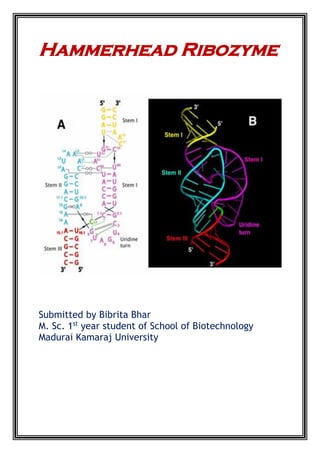
Hammerhead Ribozyme
Submitted by Bibrita Bhar
M. Sc. 1st
year student of School of Biotechnology
Madurai Kamaraj University
1
CONTENTS
INTRODUCTION .....................................................................................................................2
DISCOVERY OF RIBOZYMES ..............................................................................................2
HAMMERHEAD RIBOZYME.................................................................................................3
DISCOVERY OF THE HHR IN INFECTIOUS CIRCULAR RNAS OF PLANTS................5
THE MINIMAL SEQUENCE...................................................................................................5
ENZYMOLOGY....................................................................................................................5
Rate enhancement...............................................................................................................5
Metal ions and catalysis:.....................................................................................................5
Acid–base chemistry: .........................................................................................................6
Kinetics:..............................................................................................................................6
CRYSTAL STRUCTURE .....................................................................................................7
EXPERIMENTAL DISCORD...............................................................................................7
THE FULL-LENGTH SEQUENCE..........................................................................................8
BIOLOGICAL CONTEXT....................................................................................................8
ENZYMOLOGY....................................................................................................................8
CRYSTAL STRUCTURE .....................................................................................................9
RESOLUTION OF EXPERIMENTAL DISCORD ............................................................10
MECHANISTIC PROPOSALS...........................................................................................10
TRANS RNA CLEAVAGE USING A MINIMAL HHR MOTIF: TOO MINIMAL AS A
MODEL ...................................................................................................................................11
TERTIARY INTERACTIONS OF THE HHR ALLOW FOR A MORE EFFICIENT SELF-
CLEAVAGE IN VIVO............................................................................................................13
THE COMPLETE STRUCTURE OF HHR............................................................................13
WIDESPREAD OCCURRENCE OF THE HHR ALONG THE TREE OF LIFE .................15
HAMMERHEAD RIBOZYMES IN MAMMALIAN GENE REGULATION......................18
RNA SELF-CLEAVAGE CATALYSIS IN BIOLOGY: FROM MOBILE GENETIC
ELEMENTS TO DOMESTICATED NEW FUNCTIONS.....................................................22
CONCLUSION........................................................................................................................23
REFERENCE...........................................................................................................................23
2
INTRODUCTION
A ribozyme is a ribonucleic acid (RNA) enzyme that catalyses specific reactions in a similar
way to that of protein enzymes; it also known as catalytic RNA, ribozymes are found in the
ribosome for protein formation and play a role in other vital mechanisms such as RNA splicing,
transfer RNA biosynthesis, and viral replication. Discovery of catalytic RNA contributed to
the hypothesis of prebiotic RNA world i.e. how life may have originated from an “RNA World”
inhabited by self-replicating ribozymes. The ribosome is indeed a ribozyme underlines the
relevance of RNA catalysis in today’s protein-dominated world.
The recent discoveries of RNA interference and micro-RNA associated mechanisms of gene
regulation further emphasize the central importance of RNA to understanding gene regulation
and leads to design new RNA-based technologies for gene manipulation and silencing.
The discovery that riboswitches and in some cases ribozymes, including a variant of the
hammerhead ribozyme are also involved in regulating gene expression explains how intimately
RNA structure, function, and catalysis are involved in many aspects of biological control.
DISCOVERY OF RIBOZYMES
Proteins were the only known biological catalysts before the discovery of ribozymes. In 1967,
Carl Woese, Francis Crick, and Leslie Orgel were the first suggested that RNA might have
catalytic activity based upon the discovery that RNA can form complex secondary structures.
The term ribozyme was first introduced by Kelly Kruger et al. in 1982 in a paper published in
Cell. In 1989, Thomas R. Cech and Sidney Altman shared the Nobel Prize in chemistry for
their "discovery of catalytic properties of RNA."
So, the idea of RNA catalysis insisted to revise the concept of the origin of life: Which comes
first, enzymes that do all the work of the cell or nucleic acids that carry the information required
to produce the enzymes? The concept of "ribonucleic acids as catalysts" depicts that RNA, in
essence, can be both the chicken and the egg.
In the 1980s Thomas Cech, at the University of Colorado at Boulder, was studying the excision
of introns in a ribosomal RNA gene in Tetrahymena thermophila. While trying to purify the
enzyme responsible for the splicing reaction, he found that the intron could be spliced out in
the absence of any added cell extract. As much as they tried, Cech and his colleagues could not
identify any protein associated with the splicing reaction. After much work, Cech proposed
that the intron sequence portion of the RNA could break and reform phosphodiester bonds. In
1982, the self-splicing Group I intron was reported as the first discovered catalytic RNA.
At about the same time, Sidney Altman, a professor at Yale University, was studying the way
tRNA molecules are processed in the cell when he and his colleagues isolated an enzyme called
3
RNase-P, which is responsible for conversion of a precursor tRNA into the active tRNA. They
found that RNase-P contained RNA in addition to protein and that RNA was an essential
component of the active enzyme. It was such an alien idea that they faced difficulty in
publishing their findings. The following year, Altman demonstrated that RNA can act as a
catalyst by showing that the RNase-P RNA subunit could catalyze the cleavage of precursor
tRNA into active tRNA in the absence of any protein component.
The third reported catalytic RNA was a tiny ribozyme (~50 nt), the self-cleaving hammerhead
ribozyme (HHR), which was found in a group of atypical plant pathogens with small circular
RNA (circRNA) genomes such as viral satellite RNAs and viroids. Other investigators started
to discover other examples of self-cleaving RNA or catalytic RNA molecules. These catalytic
RNA may have pharmaceutical applications. For example, a ribozyme has been designed to
cleave the RNA of HIV to fight against HIV infection.
HAMMERHEAD RIBOZYME
Nucleolytic ribozymes are able to catalyze RNA cleavage at a rate only a few-fold slower than
their protein counterparts, which are thought to enhance the uncatalyzed rate of unspecific
cleavage about 1011
-fold. Among all known ribozymes, there is the enigmatic family of small
(<200 nt) self-cleaving RNAs, which catalyse a simple intramolecular transesterification in a
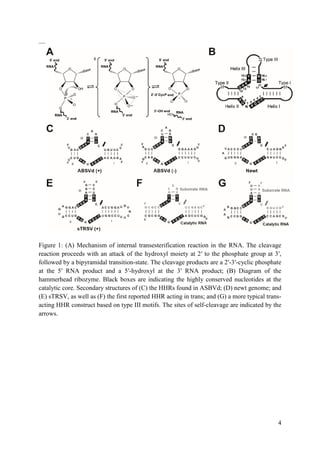
highly sequence-specific manner (Figure 1). About nine classes of naturally-occurring small
autocatalytic self-cleaving ribozymes have been found: the hammerhead, hairpin, human
Hepatitis-δ, Varkud-satellite, GlmS, twister, twister sister, hatchet and pistol ribozymes.
After its discovery HHR has been extensively used as a model ribozyme for structural,
biochemical and biological studies. A slight modification, separating the hammerhead RNA
into an enzyme strand and a substrate strand by removing a nonessential connecting loop,
creates a true catalyst capable of multiple turnover. Hence the terms “hammerhead RNA” and
“hammerhead ribozyme” tend to be used interchangeably.It is composed of a catalytic centre
comprising 15 highly conserved nucleotides surrounded by three double helixes (I to III),
which adopt a secondary structure that resembles the shape of a hammerhead shark head.
Depending on the open-ended helix, there are three possible circularly permuted forms, named
type I, II or III. The HHR motif, like other small ribozymes such as hairpin and Hepatitis-δ,
has been historically regarded as a biological peculiarity of subviral circRNA genomes. The
small catalytic RNAs such as the HHR can occur numerously in DNA genomes from bacteria
to eukaryotes, including our own genome, and carrying out diverse biological functions.
4
––
Figure 1: (A) Mechanism of internal transesterification reaction in the RNA. The cleavage
reaction proceeds with an attack of the hydroxyl moiety at 2′ to the phosphate group at 3′,
followed by a bipyramidal transition-state. The cleavage products are a 2′-3′-cyclic phosphate
at the 5′ RNA product and a 5′-hydroxyl at the 3′ RNA product; (B) Diagram of the
hammerhead ribozyme. Black boxes are indicating the highly conserved nucleotides at the
catalytic core. Secondary structures of (C) the HHRs found in ASBVd; (D) newt genome; and
(E) sTRSV, as well as (F) the first reported HHR acting in trans; and (G) a more typical trans-
acting HHR construct based on type III motifs. The sites of self-cleavage are indicated by the
arrows.
5
DISCOVERY OF THE HHR IN INFECTIOUS CIRCULAR RNAS OF PLANTS
In 1986, RNA self-cleaving activity was independently reported for the satellite RNA of the
Tobacco Ringspot virus (sTRSV) and the Avocado Sunblotch viroid (ASBVd). Based on the
ASBVd sequence, comparison studies allowed to propose the first model of the hammerhead
fold, which in the case of this viroid can be regarded as a kind of type I HHRs with a relatively
unstable helix III. Curiously, ASBVd HHRs are among the most atypical motifs known for this
ribozyme, with no clearly delimited helix I and II. Self-cleaving activity due to a type I HHR
was reported in a radically different environment: the so-called satellite DNA of newt genomes.
Biochemical analysis of both newt and viroid motifs showed a dimeric mechanism for self-
cleavage catalysis, where two tandem copies of the HHR in the same RNA molecule adopt a
conformation with an elongated helix III that licenses much higher self-cleaving efficiency in
vitro than the monomeric form of the ribozyme. The type III HHR fold was defined by analysis
of diverse satellite RNAs. In contrast with the observed behaviour for type I motifs, type III
HHRs self-cleave in vitro with high efficiency as monomers. Since then the continuous
discovery of newer members made a collection of more than 20 different examples of HHRs,
many of them with their own structural and biochemical peculiarities.
THE MINIMAL SEQUENCE
The minimal hammerhead ribozyme (Fig. 1.1A and B) consists of a core region of 15 conserved
nucleotides flanked by three helical stems. The optimal activity requires the presence of a
tertiary interaction between stem(s) I and II. Although there is little apparent sequence
variation, the contact appears to be present in most if not all hammerhead sequences. Although
the minimal hammerhead has a turnover rate of approximately 1 min−1
, full-length sequences
that include a tertiary structure are up to 1000-fold more active.
ENZYMOLOGY
Rate enhancement: The rate of non-site-specific, spontaneous decay of RNA is highly
dependent upon the secondary structural context, but is on average about 10−6 min−1.22.
Hence, the rate enhancement provided by an optimized minimal hammerhead is on the order
of 106, and for the full-length natural hammerhead can be as much as 109. To achieve this
magnitude of rate enhancement, not to mention site specificity, the hammerhead ribozyme must
adopt several effective catalytic strategies simultaneously.
Metal ions and catalysis: Originally, it was believed that all ribozymes, including the
hammerhead ribozyme, were obligate metalloenzymes. Mg2+ ion is assumed to be the
biologically relevant divalent cation, although the hammerhead is active in the presence of a
variety of divalent cations.The proposed roles for Mg2+ ion in catalysis included both acid and
base catalysis as well as direct coordination of the pro-R nonbridging phosphate oxygen of the
scissile phosphate for transition-state stabilization. Mg2+ ion has also been implicated in
structural roles that facilitate formation of the active ribozyme.
In 1998, it was demonstrated that the hammerhead, along with the hairpin and Varkud satellite
(VS) ribozymes (but not the hepatitis delta virus HDV ribozyme) could also function in the
6
absence of divalent metal ions as long as a high enough concentration of positive charge was present
(molar quantities of Li+, Na+, or even the non-metallic NH4+ ion permit cleavage to take place). The
study suggested that ribozymes were not strictly metalloenzymes. At least three of the four small
naturally occurring ribozymes can function reasonably efficiently in the absence of divalent metal ions;
a fact that was discovered in the course of performing experimental controls for time-resolved
crystallographic freeze trapping experiments in crystals of the minimal hammerhead ribozyme. It now
appears that RNA folding and nonspecific electrostatic transition state stabilization accounts for much,
if not all, of the catalytic enhancement over background rates found with these ribozymes.
For example, hammerhead 16.1, which is considered to be an optimized hammerhead ribozyme
sequence for single-turnover reactions, cleaves only threefold faster in the presence of 10 mM MgCl2
and 2 M Li2SO4 than it does in the presence of 2 M Li2SO4 alone. The rates of hairpin and VS
ribozymes in 2 M Li2SO4 actually exceed those measured under “standard” low ionic strength
conditions, and the rate of cleavage for the non-optimized hammerhead sequence used for
crystallization is fivefold enhanced in 2 M Li2SO4 alone versus standard reaction conditions. The non-
optimized sequence used for crystallization tends to form alternative, inactive structures in solution,
such as a dimer of the enzyme strands, which dominate at lower ionic strength. This result implied that
any chemical role of Mg2+ ion in the ribozyme reaction was likely to be one of comparatively
nonspecific electrostatic stabilization rather than more direct participation in the chemical step of
catalysis. Moreover, the result implied that the RNA itself was an active member in the chemistry of
catalysis rather than serving as a passive scaffold for binding metal ions that served the roles of general
acid and base catalysts. With the subsequent structural elucidation of the hairpin and full-length
hammerhead structures, it was, in fact, revealed that RNA bases and other functional groups were
positioned to provide the moieties likely responsible for acid–base catalysis.
Acid–base chemistry: Originally, hydrated Mg2+ and other hydrated divalent metal ions were thought
to play the direct chemical role of general base and general acid in ribozyme catalysis, with the RNA
itself serving as an ancillary and passive scaffold upon which metal ions would bind and would be
positioned in the active site. With the discovery that the hairpin, hammerhead, and VS ribozymes were
not strictly metalloenzymes, it became apparent that in at least these three cases, the RNA itself must
be an active participant in the chemistry of catalysis rather than serving merely as a metal ion-binding
scaffold. The crystal structure of the hairpin ribozyme, in contrast to the HDV ribozyme that is in fact
a metalloenzyme, soon validated this prediction.
However, it was not apparent from the crystal structure of the minimal hammerhead what functional
groups might be involved in acid–base catalysis. Consequently, the focus of biochemical mechanistic
investigations in the hammerhead turned to this problem. The invariant core residues G12 and G8 in
the hammerhead ribozyme were finally identified in 2005 as likely candidates for participation in acid–
base chemistry by careful purine modification studies conducted by John Burke and coworkers.
Substitution of G12 (pKa 9.5) with inosine (pKa 8.7), 2,6-diaminopurine (pKa 5.1) or 2-aminopurine
(pKa 3.8) shifts the reaction rate profile in a manner consistent with G12’s suggested role in general
base (or acid) catalysis without significantly perturbing ribozyme folding.45 Similar substitutions at G8
also implicated this invariant residue in acid–base catalysis, but in this case, the modifications also
partially inhibited ribozyme folding.45 These experiments could not determine specifically whether an
individual nucleotide, such as G12, was the general acid or the general base, but clearly implicated G12
and G8 in acid–base catalysis.
Kinetics: The minimal hammerhead ribozyme, under “standard” reaction conditions (10 mM Tris, pH
7.5, 10 mM MgCl2) has a turnover rate on the order of 1 min−1, a Km of about 10 mm, and a log-linear
7
dependence of rate on pH with a slope of 0.7. Above pH 8.5–9.0 (depending upon reaction conditions),
the rate becomes pH independent, suggesting an apparent kinetic pKa of about 8.5–9.0. This observation
is consistent with both Mg2+ and guanine-mediated acid–base chemistry. The full-length hammerhead
ribozyme shows similar pH dependence, but the cleavage rate is up to 1000-fold enhanced. There exists
no compelling evidence that the reaction is sequential rather than concerted, although this remains an
issue for debate. It is perplexing that the pH dependence of the rate-limiting step is similar in both the
minimal and full-length ribozymes, despite the remarkable reaction rate difference.
CRYSTAL STRUCTURE
The crystal structure of a minimal hammerhead ribozyme was the first near atomic resolution
structure of a ribozyme to be determined. However, the minimal hammerhead ribozyme
sequence crystallizes in what is now recognized as an “open,” apparently precatalytic
conformation50,51 in which four of the invariant residues (C3, U4, G5, and A6) form a uridine
turn structuresimilar to that found in the anticodon loop of tRNA, and the remaining conserved
residues augment or extend stem II via stacked sheered GA pairs.14,15 Together, these residues
form a three-strand junction, in which the augmented stem II stacks upon stem II, and stem(s)
I branches out via the uridine turn and the cleavagesite nucleotide.
McKay and coworkers in 1994 first solved a minimal hammerhead RNA enzyme strand bound
to a DNA substrate-analogue inhibitor, and in 1995 a different all-RNA hammerhead construct
having a 2′-OMe inhibitory substitution of the nucleophilic 2′-OH of C17 appeared.
Subsequently, structures of minimal hammerheads without modified nucleophiles appeared in
various precatalytic conformational states, and finally a structure of the cleavage product
appeared53 in 2000, providing the opportunity to construct the first “molecular movie” of
ribozyme catalysis.
EXPERIMENTAL DISCORD
It was immediately apparent from the first hammerhead crystal structures that a conformational
change would need to take place to position the attacking nucleophile in line for activation of
the cleavage reaction. The requirement for this conformational change motivated subsequent
crystallographic freeze-trapping experiments. Meanwhile, a growing list of discrepancies
between the minimal hammerhead ribozyme structure and mechanistic biochemical
experiments designed to probe transition-state interactions began to accumulate. The observed
hydrogen-bonding patterns within the minimal hammerhead crystal structures could not
explain the immutability of G8, G12, G5, C3, and a number of other core residues. Even more
concerning was evidence that the phosphate of A9 and the scissile phosphate, separated by 18
Å in the minimal hammerhead crystal structures, might bind a single metal ion in the transition
state of the reaction.54 Such an interaction would require the two phosphates to approach each
other within about 4.4 Å, but this requirement could be demonstrated to be incompatible with
the minimal hammerhead crystal structure unless significant unwinding or base-unpairing were
to take place in one or more of the helices.
8
THE FULL-LENGTH SEQUENCE
At the time of HHR discovery, it was observed to be embedded within a 370 nucleotide single-
stranded genomic satellite RNA, most of which could be deleted while preserving the RNA’s
catalytic properties. Eventually, it was found that about 13 core nucleotides and a minimal
number of flanking helical nucleotides were all that was required for a respectable catalytic
turnover rate of 1 to 10 min−1
, and this “minimal” hammerhead construct became the focus of
attention. It thus came as a great surprise to most in the field when in 2003 it was finally
discovered that for optimal activity the hammerhead ribozyme in actuality requires the
presence of sequences in stem(s) I and II. These sequences interact to form tertiary contacts
(Fig. 1.1C), but were removed in the process of eliminating seemingly superfluous sequences
from the hammerhead ribozyme; the standard reductionist approach often employed in
molecular biology. Once the full ramifications of this revelation became apparent, that is, that
the entire field had been studying the residual catalytic activity of an overzealously truncated
version of the fulllength ribozyme, attention shifted away from the minimal constructs. It also
quickly became apparent that a crystal structure of the full-length hammerhead ribozyme, in
which these distal tertiary contacts were present, might be of considerable interest.
BIOLOGICAL CONTEXT
Apparently, all naturally occurring, biologically active hammerhead RNA sequences possess a
tertiary contact that enhances their ability to fold into a catalytically competent structure.
ENZYMOLOGY
Many of the biochemical experiments designed to probe the nature of catalysis in the minimal
hammerhead ribozyme structure attempted to measure the effects of structural alterations upon
the rate-limiting step (presumed to be the chemical step) of the self-cleavage reaction. In
general, the observations made in the context of the minimal hammerhead ribozyme are also
relevant to the full-length hammerhead. The most direct explanation of this fact is that both the
minimal and full-length hammerhead structures are believed to pass through what is essentially
the same transition state. The full-length hammerhead is thus believed to accelerate the self-
cleavage reaction primarily by stabilizing the precatalytic structure in a manner that is
unavailable to the minimal hammerhead due to a lack of the tertiary contact between stem(s) I
and II. The hammerhead ribozyme sequence derived from Schistosoma Sma1 is arguably the
most extensively characterized of full-length hammerhead sequences. The cleavage kinetics
and internal equilibrium have been thoroughly investigated, revealing significant surprises. The
apparent cleavage rate at pH 8.5 in 200 mM Mg2+
is at least 870 min−1
, which in actuality is a
lower bound as there is also a significant rate of ligation under these conditions. In contrast to
minimal hammerheads that show a log-linear dependence of rate on pH up to about pH 8.5, the
Sma1 hammerhead has a lower apparent pKa that is dependent upon Mg2+
concentration. At
100 mM Mg2+, the apparent pKa is about 7.5–8. The Sma1 hammerhead is also a rather
efficient ligase, revealing internal equilibrium constants (Kint1/4[EP]/[ES]) as small as 0.5 in
the presence of high concentrations of Mg2+, and as small as 1.3 under physiological
concentrations of Mg2+. Cleavage and ligation reaction rates are also highly dependent upon
the identity of the divalent cation present, with Mn2+
accelerating the reaction almost two orders
9
of magnitude relative to Mg2+. This suggests that the ability to coordinate soft ligands (perhaps
including the N7 of G10.1) optimizes catalysis, whereas simply folding the RNA is only weakly
dependent upon the identity of the divalent cation present.
CRYSTAL STRUCTURE
The full-length hammerhead structure (Fig. 1.1D) reveals how tertiary interactions occurring remotely
from the active site prime the ribozyme for catalysis. G12 and G8, two invariant residues previously
identified in biochemical studies to be potential acid–base catalysts, are in fact positioned in a way that
is consistent with their suggested roles. In contrast to the minimal hammerhead structure, the
nucleophile in the full-length structure is aligned with the scissile phosphate which in turn is positioned
proximal to the A9 phosphate, and previously unexplained roles of other conserved nucleotides become
apparent within the context of a distinctly new fold that nonetheless accommodates the previous
structural studies. These interactions allow us to explain the previously irreconcilable sets of
experimental results in a unified, consistent, and unambiguous manner.
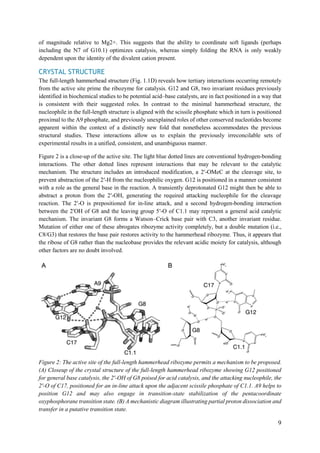
Figure 2 is a close-up of the active site. The light blue dotted lines are conventional hydrogen-bonding
interactions. The other dotted lines represent interactions that may be relevant to the catalytic
mechanism. The structure includes an introduced modification, a 2′-OMeC at the cleavage site, to
prevent abstraction of the 2′-H from the nucleophilic oxygen. G12 is positioned in a manner consistent
with a role as the general base in the reaction. A transiently deprotonated G12 might then be able to
abstract a proton from the 2′-OH, generating the required attacking nucleophile for the cleavage
reaction. The 2′-O is prepositioned for in-line attack, and a second hydrogen-bonding interaction
between the 2′OH of G8 and the leaving group 5′-O of C1.1 may represent a general acid catalytic
mechanism. The invariant G8 forms a Watson–Crick base pair with C3, another invariant residue.
Mutation of either one of these abrogates ribozyme activity completely, but a double mutation (i.e.,
C8/G3) that restores the base pair restores activity to the hammerhead ribozyme. Thus, it appears that
the ribose of G8 rather than the nucleobase provides the relevant acidic moiety for catalysis, although
other factors are no doubt involved.
Figure 2: The active site of the full-length hammerhead ribozyme permits a mechanism to be proposed.
(A) Closeup of the crystal structure of the full-length hammerhead ribozyme showing G12 positioned
for general base catalysis, the 2′-OH of G8 poised for acid catalysis, and the attacking nucleophile, the
2′-O of C17, positioned for an in-line attack upon the adjacent scissile phosphate of C1.1. A9 helps to
position G12 and may also engage in transition-state stabilization of the pentacoordinate
oxyphosphorane transition state. (B) A mechanistic diagram illustrating partial proton dissociation and
transfer in a putative transition state.
10
RESOLUTION OF EXPERIMENTAL DISCORD
Many of the biochemical experiments designed to probe transition-state interactions and the chemistry
of catalysis appeared to be irreconcilable with the minimal hammerhead crystal structures. For example,
the invariant core residues G5, G8, G12, and C3 in the minimal hammerhead ribozyme were each
observed to be so fragile that changing even a single exocyclic functional group on any one of these
nucleotides resulted in abolition of catalytic activity, yet few of these residues appeared to form
hydrogen bonds involving the Watson–Crick faces of the nucleobases. A particularly striking and only
recently observed example consisted of G8 and G12, which had been identified as possible participants
in acid–base catalysis. After it was demonstrated that the hammerhead ribozyme does not require
divalent metal ions for catalysis, it gradually became apparent that the RNA itself, rather than passively
bound divalent metal ions, must play a direct chemical role in any acid–base chemistry within the
hammerhead active site. However, it was completely unclear how G12 and G8 could accomplish this,
given the original structures of the minimal hammerhead ribozyme. In addition, the attacking
nucleophile in the original structures, that is, the 2′-OH of C17, was not in a position amenable to in-
line attack upon the adjacent scissile phosphate.16 Perhaps most worrisome were experiments that
suggested the A9 and scissile phosphates must come within about 4 Å of one another in the transition
state based upon double phosphorothioate substitution and soft metal ion rescue experiments. The
distance between these phosphates in the crystal structure was about 18 Å, with no clear mechanism for
close approach if the stem II and stem(s)I A-form helices were treated as rigid bodies. Taken together,
these results appeared to suggest that a fairly large-scale conformational change must take place to reach
the transition state within the minimal hammerhead ribozyme structure. For these reasons, results from
the two sets of experiments (biochemical vs. crystallographic) appeared not only to be at odds, but
completely and hopelessly irreconcilable, and they generated a substantial amount of discord in the
field. No compelling evidence for dismissing either set of experimental results was ever successfully
made, although some claims to the contrary were made in favor of each. The resolution of this vexing
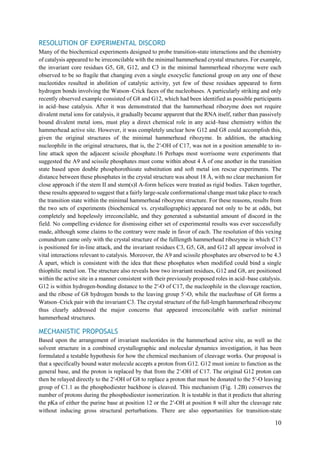
conundrum came only with the crystal structure of the fulllength hammerhead ribozyme in which C17
is positioned for in-line attack, and the invariant residues C3, G5, G8, and G12 all appear involved in
vital interactions relevant to catalysis. Moreover, the A9 and scissile phosphates are observed to be 4.3
Å apart, which is consistent with the idea that these phosphates when modified could bind a single
thiophilic metal ion. The structure also reveals how two invariant residues, G12 and G8, are positioned
within the active site in a manner consistent with their previously proposed roles in acid–base catalysis.
G12 is within hydrogen-bonding distance to the 2′-O of C17, the nucleophile in the cleavage reaction,
and the ribose of G8 hydrogen bonds to the leaving group 5′-O, while the nucleobase of G8 forms a
Watson–Crick pair with the invariant C3. The crystal structure of the full-length hammerhead ribozyme
thus clearly addressed the major concerns that appeared irreconcilable with earlier minimal
hammerhead structures.
MECHANISTIC PROPOSALS
Based upon the arrangement of invariant nucleotides in the hammerhead active site, as well as the
solvent structure in a combined crystallographic and molecular dynamics investigation, it has been
formulated a testable hypothesis for how the chemical mechanism of cleavage works. Our proposal is
that a specifically bound water molecule accepts a proton from G12. G12 must ionize to function as the
general base, and the proton is replaced by that from the 2′-OH of C17. The original G12 proton can
then be relayed directly to the 2′-OH of G8 to replace a proton that must be donated to the 5′-O leaving
group of C1.1 as the phosphodiester backbone is cleaved. This mechanism (Fig. 1.2B) conserves the
number of protons during the phosphodiester isomerization. It is testable in that it predicts that altering
the pKa of either the purine base at position 12 or the 2′-OH at position 8 will alter the cleavage rate
without inducing gross structural perturbations. There are also opportunities for transition-state
11
stabilization of the accumulating negative charges in the pentacoordinate oxyphosphorane. It has been
proposed that either the exocyclic amine of A9 or a divalent cation can perform this function. The roles
of G12 and G8 in general base and general acid catalysis, respectively, have been examined using
chemical modification strategies in a hammerhead RNA sequence closely resembling that of the crystal
structure. To test the hypothesis that G12 is the general base, an affinity label was synthesized to identify
the relevant functionality. The full-length hammerhead ribozyme was titrated with a substrate analogue
possessing a 2′bromoacetamide group at C17. The electrophilic 2′- bromoacetamide group alkylated
the general base, which was then identified as N1 of G12 by footprinting analysis. In addition, the
experiment provided evidence that the pKa of G12 is perturbed downward to about 8.5 in the context
of the hammerhead active site structure relative to unstructured RNA.
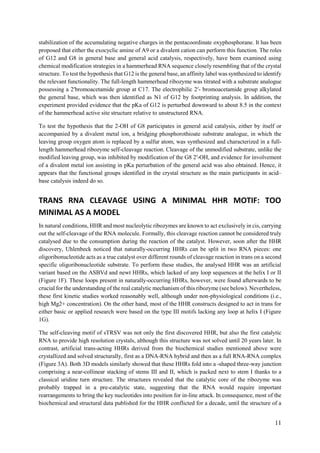
To test the hypothesis that the 2-OH of G8 participates in general acid catalysis, either by itself or
accompanied by a divalent metal ion, a bridging phosphorothioate substrate analogue, in which the
leaving group oxygen atom is replaced by a sulfur atom, was synthesized and characterized in a full-
length hammerhead ribozyme self-cleavage reaction. Cleavage of the unmodified substrate, unlike the
modified leaving group, was inhibited by modification of the G8 2′-OH, and evidence for involvement
of a divalent metal ion assisting in pKa perturbation of the general acid was also obtained. Hence, it
appears that the functional groups identified in the crystal structure as the main participants in acid–
base catalysis indeed do so.
TRANS RNA CLEAVAGE USING A MINIMAL HHR MOTIF: TOO
MINIMAL AS A MODEL
In natural conditions, HHR and most nucleolytic ribozymes are known to act exclusively in cis, carrying
out the self-cleavage of the RNA molecule. Formally, this cleavage reaction cannot be considered truly
catalysed due to the consumption during the reaction of the catalyst. However, soon after the HHR
discovery, Uhlenbeck noticed that naturally-occurring HHRs can be split in two RNA pieces: one
oligoribonucleotide acts as a true catalyst over different rounds of cleavage reaction in trans on a second
specific oligoribonucleotide substrate. To perform these studies, the analysed HHR was an artificial
variant based on the ASBVd and newt HHRs, which lacked of any loop sequences at the helix I or II
(Figure 1F). These loops present in naturally-occurring HHRs, however, were found afterwards to be
crucial for the understanding of the real catalytic mechanism of this ribozyme (see below). Nevertheless,
these first kinetic studies worked reasonably well, although under non-physiological conditions (i.e.,
high Mg2+ concentration). On the other hand, most of the HHR constructs designed to act in trans for
either basic or applied research were based on the type III motifs lacking any loop at helix I (Figure
1G).
The self-cleaving motif of sTRSV was not only the first discovered HHR, but also the first catalytic
RNA to provide high resolution crystals, although this structure was not solved until 20 years later. In
contrast, artificial trans-acting HHRs derived from the biochemical studies mentioned above were
crystallized and solved structurally, first as a DNA-RNA hybrid and then as a full RNA-RNA complex
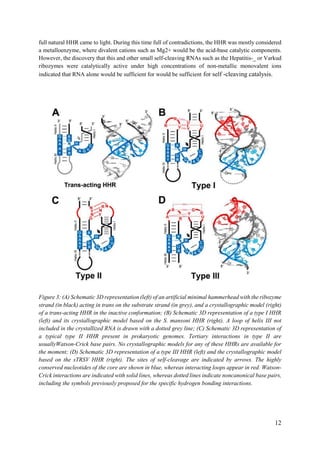
(Figure 3A). Both 3D models similarly showed that these HHRs fold into a -shaped three-way junction
comprising a near-collinear stacking of stems III and II, which is packed next to stem I thanks to a
classical uridine turn structure. The structures revealed that the catalytic core of the ribozyme was
probably trapped in a pre-catalytic state, suggesting that the RNA would require important
rearrangements to bring the key nucleotides into position for in-line attack. In consequence, most of the
biochemical and structural data published for the HHR conflicted for a decade, until the structure of a
12
full natural HHR came to light. During this time full of contradictions, the HHR was mostly considered
a metalloenzyme, where divalent cations such as Mg2+ would be the acid-base catalytic components.
However, the discovery that this and other small self-cleaving RNAs such as the Hepatitis-_ or Varkud
ribozymes were catalytically active under high concentrations of non-metallic monovalent ions
indicated that RNA alone would be sufficient for would be sufficient for self -cleaving catalysis.
Figure 3: (A) Schematic 3D representation (left) of an artificial minimal hammerhead with the ribozyme
strand (in black) acting in trans on the substrate strand (in grey), and a crystallographic model (right)
of a trans-acting HHR in the inactive conformation; (B) Schematic 3D representation of a type I HHR
(left) and its crystallographic model based on the S. mansoni HHR (right). A loop of helix III not
included in the crystallized RNA is drawn with a dotted grey line; (C) Schematic 3D representation of
a typical type II HHR present in prokaryotic genomes. Tertiary interactions in type II are
usuallyWatson-Crick base pairs. No crystallographic models for any of these HHRs are available for
the moment; (D) Schematic 3D representation of a type III HHR (left) and the crystallographic model
based on the sTRSV HHR (right). The sites of self-cleavage are indicated by arrows. The highly
conserved nucleotides of the core are shown in blue, whereas interacting loops appear in red. Watson-
Crick interactions are indicated with solid lines, whereas dotted lines indicate noncanonical base pairs,
including the symbols previously proposed for the specific hydrogen bonding interactions.
13
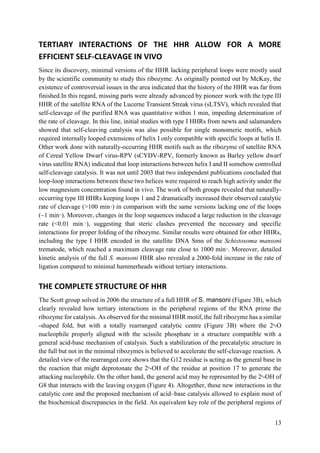
TERTIARY INTERACTIONS OF THE HHR ALLOW FOR A MORE
EFFICIENT SELF-CLEAVAGE IN VIVO
Since its discovery, minimal versions of the HHR lacking peripheral loops were mostly used
by the scientific community to study this ribozyme. As originally pointed out by McKay, the
existence of controversial issues in the area indicated that the history of the HHR was far from
finished.In this regard, missing parts were already advanced by pioneer work with the type III
HHR of the satellite RNA of the Lucerne Transient Streak virus (sLTSV), which revealed that
self-cleavage of the purified RNA was quantitative within 1 min, impeding determination of
the rate of cleavage. In this line, initial studies with type I HHRs from newts and salamanders
showed that self-cleaving catalysis was also possible for single monomeric motifs, which
required internally looped extensions of helix I only compatible with specific loops at helix II.
Other work done with naturally-occurring HHR motifs such as the ribozyme of satellite RNA
of Cereal Yellow Dwarf virus-RPV (sCYDV-RPV, formerly known as Barley yellow dwarf
virus satellite RNA) indicated that loop interactions between helix I and II somehow controlled
self-cleavage catalysis. It was not until 2003 that two independent publications concluded that
loop-loop interactions between these two helices were required to reach high activity under the
low magnesium concentration found in vivo. The work of both groups revealed that naturally-
occurring type III HHRs keeping loops 1 and 2 dramatically increased their observed catalytic
rate of cleavage (>100 min-1
) in comparison with the same versions lacking one of the loops
(~1 min-1
). Moreover, changes in the loop sequences induced a large reduction in the cleavage
rate (<0.01 min 􀀀1
), suggesting that steric clashes prevented the necessary and specific
interactions for proper folding of the ribozyme. Similar results were obtained for other HHRs,
including the type I HHR encoded in the satellite DNA Smα of the Schistosoma mansoni
trematode, which reached a maximum cleavage rate close to 1000 min-1
. Moreover, detailed
kinetic analysis of the full S. mansoni HHR also revealed a 2000-fold increase in the rate of
ligation compared to minimal hammerheads without tertiary interactions.
THE COMPLETE STRUCTURE OF HHR
The Scott group solved in 2006 the structure of a full HHR of S. mansoni (Figure 3B), which
clearly revealed how tertiary interactions in the peripheral regions of the RNA prime the
ribozyme for catalysis. As observed for the minimal HHR motif, the full ribozyme has a similar
-shaped fold, but with a totally rearranged catalytic centre (Figure 3B) where the 20
-O
nucleophile properly aligned with the scissile phosphate in a structure compatible with a
general acid-base mechanism of catalysis. Such a stabilization of the precatalytic structure in
the full but not in the minimal ribozymes is believed to accelerate the self-cleavage reaction. A
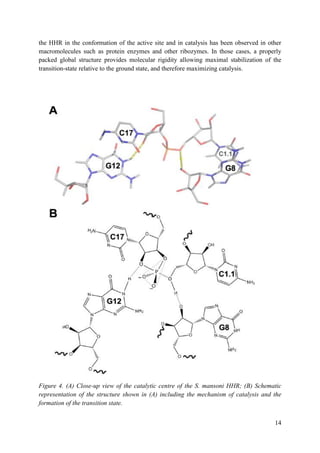
detailed view of the rearranged core shows that the G12 residue is acting as the general base in
the reaction that might deprotonate the 20
-OH of the residue at position 17 to generate the
attacking nucleophile. On the other hand, the general acid may be represented by the 20
-OH of
G8 that interacts with the leaving oxygen (Figure 4). Altogether, these new interactions in the
catalytic core and the proposed mechanism of acid–base catalysis allowed to explain most of
the biochemical discrepancies in the field. An equivalent key role of the peripheral regions of
14
the HHR in the conformation of the active site and in catalysis has been observed in other
macromolecules such as protein enzymes and other ribozymes. In those cases, a properly
packed global structure provides molecular rigidity allowing maximal stabilization of the
transition-state relative to the ground state, and therefore maximizing catalysis.
Figure 4. (A) Close-up view of the catalytic centre of the S. mansoni HHR; (B) Schematic
representation of the structure shown in (A) including the mechanism of catalysis and the
formation of the transition state.
15
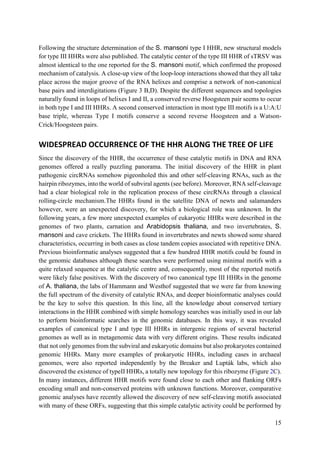
Following the structure determination of the S. mansoni type I HHR, new structural models
for type III HHRs were also published. The catalytic center of the type III HHR of sTRSV was
almost identical to the one reported for the S. mansoni motif, which confirmed the proposed
mechanism of catalysis. A close-up view of the loop-loop interactions showed that they all take
place across the major groove of the RNA helixes and comprise a network of non-canonical
base pairs and interdigitations (Figure 3 B,D). Despite the different sequences and topologies
naturally found in loops of helixes I and II, a conserved reverse Hoogsteen pair seems to occur
in both type I and III HHRs. A second conserved interaction in most type III motifs is a U:A:U
base triple, whereas Type I motifs conserve a second reverse Hoogsteen and a Watson-
Crick/Hoogsteen pairs.
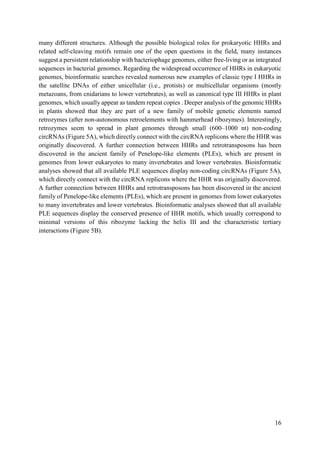
WIDESPREAD OCCURRENCE OF THE HHR ALONG THE TREE OF LIFE
Since the discovery of the HHR, the occurrence of these catalytic motifs in DNA and RNA
genomes offered a really puzzling panorama. The initial discovery of the HHR in plant
pathogenic circRNAs somehow pigeonholed this and other self-cleaving RNAs, such as the
hairpin ribozymes, into the world of subviral agents (see before). Moreover, RNA self-cleavage
had a clear biological role in the replication process of these circRNAs through a classical
rolling-circle mechanism.The HHRs found in the satellite DNA of newts and salamanders
however, were an unexpected discovery, for which a biological role was unknown. In the
following years, a few more unexpected examples of eukaryotic HHRs were described in the
genomes of two plants, carnation and Arabidopsis thaliana, and two invertebrates, S.
mansoni and cave crickets. The HHRs found in invertebrates and newts showed some shared
characteristics, occurring in both cases as close tandem copies associated with repetitive DNA.
Previous bioinformatic analyses suggested that a few hundred HHR motifs could be found in
the genomic databases although these searches were performed using minimal motifs with a
quite relaxed sequence at the catalytic centre and, consequently, most of the reported motifs
were likely false positives. With the discovery of two canonical type III HHRs in the genome
of A. thaliana, the labs of Hammann and Westhof suggested that we were far from knowing
the full spectrum of the diversity of catalytic RNAs, and deeper bioinformatic analyses could
be the key to solve this question. In this line, all the knowledge about conserved tertiary
interactions in the HHR combined with simple homology searches was initially used in our lab
to perform bioinformatic searches in the genomic databases. In this way, it was revealed
examples of canonical type I and type III HHRs in intergenic regions of several bacterial
genomes as well as in metagenomic data with very different origins. These results indicated
that not only genomes from the subviral and eukaryotic domains but also prokaryotes contained
genomic HHRs. Many more examples of prokaryotic HHRs, including cases in archaeal
genomes, were also reported independently by the Breaker and Lupták labs, which also
discovered the existence of typeII HHRs, a totally new topology for this ribozyme (Figure 2C).
In many instances, different HHR motifs were found close to each other and flanking ORFs
encoding small and non-conserved proteins with unknown functions. Moreover, comparative
genomic analyses have recently allowed the discovery of new self-cleaving motifs associated
with many of these ORFs, suggesting that this simple catalytic activity could be performed by
16
many different structures. Although the possible biological roles for prokaryotic HHRs and
related self-cleaving motifs remain one of the open questions in the field, many instances
suggest a persistent relationship with bacteriophage genomes, either free-living or as integrated
sequences in bacterial genomes. Regarding the widespread occurrence of HHRs in eukaryotic
genomes, bioinformatic searches revealed numerous new examples of classic type I HHRs in
the satellite DNAs of either unicellular (i.e., protists) or multicellular organisms (mostly
metazoans, from cnidarians to lower vertebrates), as well as canonical type III HHRs in plant
genomes, which usually appear as tandem repeat copies . Deeper analysis of the genomic HHRs
in plants showed that they are part of a new family of mobile genetic elements named
retrozymes (after non-autonomous retroelements with hammerhead ribozymes). Interestingly,
retrozymes seem to spread in plant genomes through small (600–1000 nt) non-coding
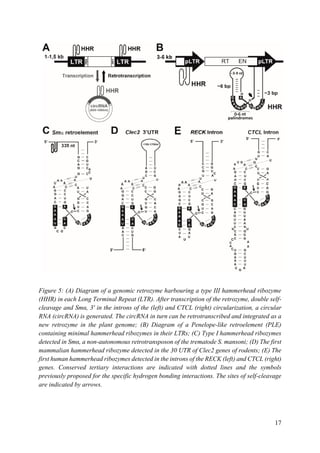
circRNAs (Figure 5A), which directly connect with the circRNA replicons where the HHR was
originally discovered. A further connection between HHRs and retrotransposons has been
discovered in the ancient family of Penelope-like elements (PLEs), which are present in
genomes from lower eukaryotes to many invertebrates and lower vertebrates. Bioinformatic
analyses showed that all available PLE sequences display non-coding circRNAs (Figure 5A),
which directly connect with the circRNA replicons where the HHR was originally discovered.
A further connection between HHRs and retrotransposons has been discovered in the ancient
family of Penelope-like elements (PLEs), which are present in genomes from lower eukaryotes
to many invertebrates and lower vertebrates. Bioinformatic analyses showed that all available
PLE sequences display the conserved presence of HHR motifs, which usually correspond to
minimal versions of this ribozyme lacking the helix III and the characteristic tertiary
interactions (Figure 5B).
17
Figure 5: (A) Diagram of a genomic retrozyme harbouring a type III hammerhead ribozyme
(HHR) in each Long Terminal Repeat (LTR). After transcription of the retrozyme, double self-
cleavage and Smα, 3′ in the introns of the (left) and CTCL (right) circularization, a circular
RNA (circRNA) is generated. The circRNA in turn can be retrotranscribed and integrated as a
new retrozyme in the plant genome; (B) Diagram of a Penelope-like retroelement (PLE)
containing minimal hammerhead ribozymes in their LTRs; (C) Type I hammerhead ribozymes
detected in Smα, a non-autonomous retrotransposon of the trematode S. mansoni; (D) The first
mammalian hammerhead ribozyme detected in the 30 UTR of Clec2 genes of rodents; (E) The
first human hammerhead ribozymes detected in the introns of the RECK (left) and CTCL (right)
genes. Conserved tertiary interactions are indicated with dotted lines and the symbols
previously proposed for the specific hydrogen bonding interactions. The sites of self-cleavage
are indicated by arrows.
18
HAMMERHEAD RIBOZYMES IN MAMMALIAN GENE REGULATION
Discovery of conserved mammalian hammerhead ribozymes suggests that the hammerhead
motif’s biological role extends beyond processing of satellite RNA and viroid replication
products, and into the dominion of cellular functions.9,10 Uncovered by bioinformatics
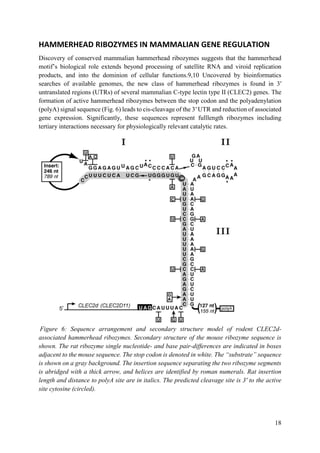
searches of available genomes, the new class of hammerhead ribozymes is found in 3′
untranslated regions (UTRs) of several mammalian C-type lectin type II (CLEC2) genes. The
formation of active hammerhead ribozymes between the stop codon and the polyadenylation
(polyA) signal sequence (Fig. 6) leads to cis-cleavage of the 3′ UTR and reduction of associated
gene expression. Significantly, these sequences represent fulllength ribozymes including
tertiary interactions necessary for physiologically relevant catalytic rates.
Figure 6: Sequence arrangement and secondary structure model of rodent CLEC2d-
associated hammerhead ribozymes. Secondary structure of the mouse ribozyme sequence is
shown. The rat ribozyme single nucleotide- and base pair-differences are indicated in boxes
adjacent to the mouse sequence. The stop codon is denoted in white. The “substrate” sequence
is shown on a gray background. The insertion sequence separating the two ribozyme segments
is abridged with a thick arrow, and helices are identified by roman numerals. Rat insertion
length and distance to polyA site are in italics. The predicted cleavage site is 3′ to the active
site cytosine (circled).
19
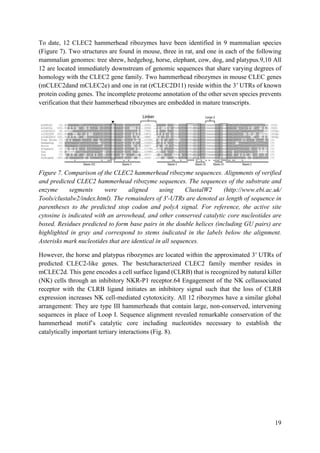
To date, 12 CLEC2 hammerhead ribozymes have been identified in 9 mammalian species
(Figure 7). Two structures are found in mouse, three in rat, and one in each of the following
mammalian genomes: tree shrew, hedgehog, horse, elephant, cow, dog, and platypus.9,10 All
12 are located immediately downstream of genomic sequences that share varying degrees of
homology with the CLEC2 gene family. Two hammerhead ribozymes in mouse CLEC genes
(mCLEC2dand mCLEC2e) and one in rat (rCLEC2D11) reside within the 3′ UTRs of known
protein coding genes. The incomplete proteome annotation of the other seven species prevents
verification that their hammerhead ribozymes are embedded in mature transcripts.
Figure 7. Comparison of the CLEC2 hammerhead ribozyme sequences. Alignments of verified
and predicted CLEC2 hammerhead ribozyme sequences. The sequences of the substrate and
enzyme segments were aligned using ClustalW2 (http://www.ebi.ac.uk/
Tools/clustalw2/index.html). The remainders of 3′-UTRs are denoted as length of sequence in
parentheses to the predicted stop codon and polyA signal. For reference, the active site
cytosine is indicated with an arrowhead, and other conserved catalytic core nucleotides are
boxed. Residues predicted to form base pairs in the double helices (including GU pairs) are
highlighted in gray and correspond to stems indicated in the labels below the alignment.
Asterisks mark nucleotides that are identical in all sequences.
However, the horse and platypus ribozymes are located within the approximated 3′ UTRs of
predicted CLEC2-like genes. The bestcharacterized CLEC2 family member resides in
mCLEC2d. This gene encodes a cell surface ligand (CLRB) that is recognized by natural killer
(NK) cells through an inhibitory NKR-P1 receptor.64 Engagement of the NK cellassociated
receptor with the CLRB ligand initiates an inhibitory signal such that the loss of CLRB
expression increases NK cell-mediated cytotoxicity. All 12 ribozymes have a similar global
arrangement: They are type III hammerheads that contain large, non-conserved, intervening
sequences in place of Loop I. Sequence alignment revealed remarkable conservation of the
hammerhead motif’s catalytic core including nucleotides necessary to establish the
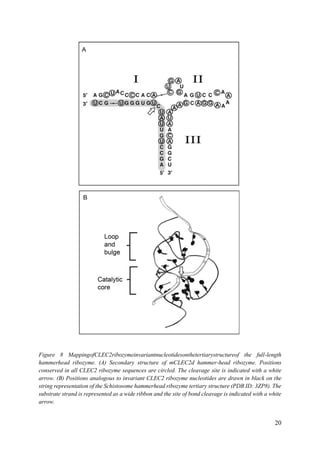
catalytically important tertiary interactions (Fig. 8).
20
Figure 8 MappingofCLEC2ribozymeinvariantnucleotidesonthetertiarystructureof the full-length
hammerhead ribozyme. (A) Secondary structure of mCLEC2d hammer-head ribozyme. Positions
conserved in all CLEC2 ribozyme sequences are circled. The cleavage site is indicated with a white
arrow. (B) Positions analogous to invariant CLEC2 ribozyme nucleotides are drawn in black on the
string representation of the Schistosome hammerhead ribozyme tertiary structure (PDB ID: 3ZP8). The
substrate strand is represented as a wide ribbon and the site of bond cleavage is indicated with a white
arrow.
21
Additional conservation is observable in the secondary structure in the form of compensatory
mutations that maintain the hammerhead’s secondary structure (Fig. 1.4). Structural similarity
and specific association with orthologous genes, including CLEC-like sequence in the platypus
genome, imply that all 12 CLEC2 ribozymes share a common ancestor that arose before
monotreme divergence from other therian lineages about 2’0 million years ago. A large
insertion between substrate and enzyme strands distinguishes the CLEC2 ribozymes not only
from other hammerhead ribozymes, but also from most known self-cleaving sequences. In
rodent CLEC2 hammerheads, the length of the sequence separating the two critical ribozyme
domains ranges from 246 to 789 nt. Nevertheless, the substrate and enzyme segments pair to
form a structurally and catalytically accurate hammerhead ribozyme. More specifically,
CLEC2 ribozymes contain the signature core of 15 invariant nucleotides flanked by three
helices with distal rate-enhancing interactions, and they produce two strands by self-cleaving
(Fig. 1.4). Even though compact sequences dominate the collection of all known ribozymes,
the discontinuous format of the CLEC2 ribozymes is not without precedent. The widespread
nonanimal self-splicing group I and II introns span hundreds to thousands of nucleotides. The
CLEC2 ribozyme demonstrates that interruption of functional domains with long sequences
does not impede hammerhead ribozyme activity. Further investigation will determine whether
these sequence intervals play a role in the regulation of ribozyme function and gene expression.
The mCLEC2d-associated ribozyme is very similar to the well-studied full-length Schistosome
ribozyme that is active in physiological conditions. The catalytic core is strictly conserved with
a single change in position 7, a well-documented variable nucleotide, while the lengths and
base pairing of stem(s) I and II preserve the overall architecture of the secondary structure
observed in full-length hammerhead ribozymes. More remarkable, the 16 nucleotides of stem
II are also identical between the Schistosome and the mCLEC2dassociated ribozymes except
for a single-base deviation in the loop region. In fulllength hammerhead ribozymes, interaction
between the stem II loop and stem(s) I bulge confers a catalytic rate enhancement to the active
site through tertiary structure changes and enables activity in physiologically relevant
conditions. Considering that nucleotides in the stem(s) I bulge are also conserved between these
two hammerhead ribozymes from phylogenetically distant organisms, it is reasonable to expect
that CLEC2 ribozyme tertiary structure corresponds to that of the Schistosome hammerhead
ribozyme and functions at physiological conditions with similar kinetics.20,41,66 Consistent
with these comparisons, cell-based assays using reporter gene constructs conjugated to CLEC2
3′ UTRs demonstrated that the embedded ribozymes significantly reduce expression of the
upstream gene by effectively cleaving and destabilizing the mRNA.
Additional features of the CLEC2 hammerhead ribozyme are universally conserved among all
hammerhead ribozymes from diverse origins highlighting the importance of these elements to
ribozyme activity in vivo. Naturally occurring hammerheads as well as artificially selected
motifs have rather variable sequences in the loop and bulge regions with specific combinations
particular to different ribozyme sources.67–69 One exception to this is the widely conserved
adenosine in the sixth position of Loop II of type I and III ribozymes. In the full-length
ribozyme tertiary structure, this base is involved in a noncanonical interaction with the
conserved uridine from the substrate strand. Preservation of this specific combination in the
CLEC2 ribozymes emphasizes its importance to activity within the cellular environment. A
22
less appreciated structural element, the CG base pair adjacent to Loop II, is conserved in 11
out of 12 CLEC2 ribozymes. This interaction exists in identical orientation in all but one natural
hammerhead ribozyme analyzed to date and in most artificially selected species.67 Preferential
CG base pairing emphasizes the need for a reinforced helix at this position possibly due to the
nature of the adjacent loop–bulge interaction. However underappreciated, this interaction may
play an important role in finetuning ribozyme function. Homology between CLEC2 ribozymes
and hammerheads used in structural and biochemical studies can explain mechanistic roles of
most nucleotides that are conserved within the CLEC2 ribozyme group (Fig. 1.5). However,
other features that are unique to CLEC2 ribozymes suggest roles intrinsic to function in their
specific genomic contexts. For example, CLEC2 ribozymes characteristically possess a long
$25 bp stem III adjoining the motif to the remainder of the 3′ UTR. Such elongated stems are
uncommon in other naturally occurring hammerhead ribozymes even though they can stabilize
catalytic structures in vivo.71 Instead, the long stem III may reflect a function specific to the
location or particular mode of regulation of CLEC2 ribozyme.
Although ribozyme sequences have been found throughout divergent genomes, few are known
to change levels of gene expression. A single example of ribozyme-mediated gene regulation
via a UTR is found in prokaryotes. The bacterial GlmS ribozyme represents one class of
riboswitches that responds to a variety of small molecule cues. The ribozyme is encoded within
the 5′ UTR of the polycistronic mRNA, and by cleaving within this region abrogates expression
of downstream genes. In contrast, CLEC2 hammerhead ribozymes are encoded in 3′ UTRs that
are eukaryotic hotspots for motifs that posttranscriptionally regulate gene expression. miRNAs
and a variety of RNA-binding proteins target the 3′ UTR and cause changes in transcript
processing, abundance, or localization.74 Moreover, several causes of aberrant regulation of
messenger RNA can be traced to the 3′ UTR.75
RNA SELF-CLEAVAGE CATALYSIS IN BIOLOGY: FROM MOBILE
GENETIC ELEMENTS TO DOMESTICATED NEW FUNCTIONS
Most of the recent data on the biology of the genomic HHRs suggest a common role of this
ribozyme in the propagation of diverse retrotransposons. This view is in agreement with similar
results observed for other self-cleaving RNAs such as Group I/II introns, Hepatitis- or Varkud
ribozymes among others. Mobile genetic elements such as retrotransposons are major
components of eukaryotic genomes, which have been historically regarded as junk DNA. More
recent data, however, indicate that mobile genetic elements, besides being genomic parasites,
are major players in genome evolution responsible for the development of many aspects of
eukaryotic complexity. Molecular domestication would be just a consequence of the main idea
that evolution co-opts what is already present in the genomes as the building blocks for novel
molecular systems. In this regard, some HHRs of retroelements in lower eukaryotes (Figure
5C) seem to have been domesticated in the genomes of complex animals, such as reptiles, birds
and mammals, to perform new biological functions. In 2008, the first example of a likely co-
opted HHR in mammalian genomes was found in the 3’ UTR of the Clec2 genes of different
mammals, including some rodents and platypus, but not humans. This self-cleaving motif was
a very atypical type III HHR, the so called discontinuous HHR, characterized by a very large
23
helix I (from 150 to 1500 nt, depending on the mammalian species) (Figure 5D). Although the
biological function of this self-cleaving motif is still unknown, a role in the control of the site
of polyadenylation could be suggested. In 2010, very similar type I HHRs were found
conserved in the introns of some genes of all amniotes analysed (reptiles, birds and mammals)
(Figure 5E). As the most striking case, one of these intronic HHRs was found totally conserved
in the RECK gene of all warm-blooded animals (birds and mammals), whereas some other
HHR motifs mapped in the introns of the CTCL gene of most mammals or the DTNB gene of
birds and reptiles, suggesting a role in the biogenesis of the mRNAs harbouring these
ribozymes. The high sequence and structural similarity between intronic HHRs in amniotes
and those found in the retroelements of diverse metazoans from trematodes to lower
vertebrates, such as coelacanth fishes or amphibians, suggests that these ribozymes would have
been domesticated during evolution to perform new and conserved functions in complex
metazoans such as amniotes. As a feasible hypothesis, highly conserved HHRs in the introns
of diverse genes of amniotes could represent a new form or regulation of the alternative
splicing, which in some cases may result in the production of crucial gene isoforms for these
organisms. Most likely, future bioinformatic analysis will reveal more examples of genomic
HHRs conserved either in different non-coding regions, which will help us to better understand
all the capabilities of these small ribozymes as gene regulatory elements.
CONCLUSION
The current age of genomics has opened many new entrances in the biological knowledge, and
one of these is the renaissance of the interest in self-cleaving ribozymes and RNA catalysis in
general. The extreme simplicity and little sequence conservation of small ribozymes, together
with the huge sequence space available for bioinformatics searches, make the identification of
these small motifs a hard task, usually hindered by a large collection of false positives, which
require more detailed evolutionary and/or structural analyses to be filtered out. Hence, the
hammerhead ribozyme appears to reside in an important regulatory region that provides the
possibility that the ribozyme itself can be regulated. More recent findings have demonstrated
that the hammerhead ribozyme sequence is found to be ubiquitous throughout the tree of life
and is possibly the most common ribozyme sequence apart from RNase P and the peptidyl
transferase of the ribosome. The recent discoveries of totally new self-cleaving motifs indicate
that it is just a beginning of knowing about the ribozyme and we have to go long way to
understand their importance.
REFERENCE
1. Hammann, C.; Westhof, E. Searching genomes for ribozymes and riboswitches. Genome Biol.
2007, 8, 210. [Google Scholar] [CrossRef] [PubMed]
2. De la Peña, M.; García-Robles, I. Ubiquitous presence of the hammerhead ribozyme motif
along the tree of life. RNA 2010, 16, 1943–1950. [Google Scholar] [CrossRef] [PubMed]
3. Jimenez, R.M.; Delwart, E.; Lupták, A. Structure-based search reveals hammerhead ribozymes
in the human microbiome. J. Biol. Chem. 2011, 286, 7737–7743. [Google Scholar] [CrossRef]
[PubMed]
24
4. Perreault, J.; Weinberg, Z.; Roth, A.; Popescu, O.; Chartrand, P.; Ferbeyre, G.; Breaker, R.R.
Identification of hammerhead ribozymes in all domains of life reveals novel structural
variations. PLoS Comput. Biol. 2011, 7, e1002031. [Google Scholar] [CrossRef] [PubMed]
5. Seehafer, C.; Kalweit, A.; Steger, G.; Gräf, S.; Hammann, C. From alpaca to zebrafish:
Hammerhead ribozymes wherever you look. RNA 2011, 17, 21–26. [Google Scholar]
[CrossRef] [PubMed]
6. De la Peña, M.; García-Robles, I. Intronic hammerhead ribozymes are ultraconserved in the
human genome. EMBO Rep. 2010, 11, 711–716. [Google Scholar] [CrossRef] [PubMed]
7. Cervera, A.; Urbina, D.; De la Peña, M. Retrozymes are a unique family of non-autonomous
retrotransposons with hammerhead ribozymes that propagate in plants through circular RNAs.
Genome Biol. 2016, 17, 135. [Google Scholar] [CrossRef] [PubMed]
8. Evgen’ev, M.B.; Zelentsova, H.; Shostak, N.; Kozitsina, M.; Barskyi, V.; Lankenau, D.H.;
Corces, V.G. Penelope, a new family of transposable elements and its possible role in hybrid
dysgenesis in Drosophila virilis. Proc. Natl. Acad. Sci. USA 1997, 94, 196–201. [Google
Scholar] [CrossRef] [PubMed]
9. Gladyshev, E.A.; Arkhipova, I.R. Telomere-associated endonuclease-deficient Penelope-like
retroelements in diverse eukaryotes. Proc. Natl. Acad. Sci. USA 2007, 104, 9352–9357.
10. Ruminski, D.J.; Webb, C.H.; Riccitelli, N.J.; Lupták, A. Processing and translation initiation of
non-long terminal repeat retrotransposons by hepatitis delta virus (HDV)-like self-cleaving
ribozymes. J. Biol. Chem. 2011, 286, 41286–41295. [Google Scholar] [CrossRef] [PubMed]
11. Eickbush, D.G.; Eickbush, T.H. R2 retrotransposons encode a self-cleaving ribozyme for
processing from an rRNA cotranscript. Mol. Cell. Biol. 2010, 30, 3142–3150. [Google Scholar]
[CrossRef] [PubMed]
12. Kennell, J.C.; Saville, B.J.; Mohr, S.; Kuiper, M.T.; Sabourin, J.R.; Collins, R.A.; Lambowitz,
A.M. The VS catalytic RNA replicates by reverse transcription as a satellite of a retroplasmid.
Genes Dev. 1995, 9, 294–303. [Google Scholar] [CrossRef] [PubMed]
13. Martick, M.; Horan, L.H.; Noller, H.F.; Scott, W.G. A discontinuous hammerhead ribozyme
embedded in a mammalian messenger RNA. Nature 2008, 454, 899–902. [Google Scholar]
[CrossRef] [PubMed]
14. Scott, W.G.; Horan, L.H.; Martick, M. The hammerhead ribozyme: Structure, catalysis, and
gene regulation. Prog. Mol. Biol. Transl. Sci. 2013, 120, 1–23. [Google Scholar] [PubMed]
15. García-Robles, I.; Sánchez-Navarro, J.; De la Peña, M. Intronic hammerhead ribozymes in
mRNA biogenesis. Biol. Chem. 2012, 393, 1317–1326.
16. Marcos de la Peña, Inmaculada García-Robles and Amelia Cervera. The Hammerhead
Ribozyme: A Long History for a Short RNA. Molecules 2017, 22(1), 78.

Hammerhead ribozyme

  • 1.
    Hammerhead Ribozyme Submitted byBibrita Bhar M. Sc. 1st year student of School of Biotechnology Madurai Kamaraj University
  • 2.
    1 CONTENTS INTRODUCTION .....................................................................................................................2 DISCOVERY OFRIBOZYMES ..............................................................................................2 HAMMERHEAD RIBOZYME.................................................................................................3 DISCOVERY OF THE HHR IN INFECTIOUS CIRCULAR RNAS OF PLANTS................5 THE MINIMAL SEQUENCE...................................................................................................5 ENZYMOLOGY....................................................................................................................5 Rate enhancement...............................................................................................................5 Metal ions and catalysis:.....................................................................................................5 Acid–base chemistry: .........................................................................................................6 Kinetics:..............................................................................................................................6 CRYSTAL STRUCTURE .....................................................................................................7 EXPERIMENTAL DISCORD...............................................................................................7 THE FULL-LENGTH SEQUENCE..........................................................................................8 BIOLOGICAL CONTEXT....................................................................................................8 ENZYMOLOGY....................................................................................................................8 CRYSTAL STRUCTURE .....................................................................................................9 RESOLUTION OF EXPERIMENTAL DISCORD ............................................................10 MECHANISTIC PROPOSALS...........................................................................................10 TRANS RNA CLEAVAGE USING A MINIMAL HHR MOTIF: TOO MINIMAL AS A MODEL ...................................................................................................................................11 TERTIARY INTERACTIONS OF THE HHR ALLOW FOR A MORE EFFICIENT SELF- CLEAVAGE IN VIVO............................................................................................................13 THE COMPLETE STRUCTURE OF HHR............................................................................13 WIDESPREAD OCCURRENCE OF THE HHR ALONG THE TREE OF LIFE .................15 HAMMERHEAD RIBOZYMES IN MAMMALIAN GENE REGULATION......................18 RNA SELF-CLEAVAGE CATALYSIS IN BIOLOGY: FROM MOBILE GENETIC ELEMENTS TO DOMESTICATED NEW FUNCTIONS.....................................................22 CONCLUSION........................................................................................................................23 REFERENCE...........................................................................................................................23
  • 3.
    2 INTRODUCTION A ribozyme isa ribonucleic acid (RNA) enzyme that catalyses specific reactions in a similar way to that of protein enzymes; it also known as catalytic RNA, ribozymes are found in the ribosome for protein formation and play a role in other vital mechanisms such as RNA splicing, transfer RNA biosynthesis, and viral replication. Discovery of catalytic RNA contributed to the hypothesis of prebiotic RNA world i.e. how life may have originated from an “RNA World” inhabited by self-replicating ribozymes. The ribosome is indeed a ribozyme underlines the relevance of RNA catalysis in today’s protein-dominated world. The recent discoveries of RNA interference and micro-RNA associated mechanisms of gene regulation further emphasize the central importance of RNA to understanding gene regulation and leads to design new RNA-based technologies for gene manipulation and silencing. The discovery that riboswitches and in some cases ribozymes, including a variant of the hammerhead ribozyme are also involved in regulating gene expression explains how intimately RNA structure, function, and catalysis are involved in many aspects of biological control. DISCOVERY OF RIBOZYMES Proteins were the only known biological catalysts before the discovery of ribozymes. In 1967, Carl Woese, Francis Crick, and Leslie Orgel were the first suggested that RNA might have catalytic activity based upon the discovery that RNA can form complex secondary structures. The term ribozyme was first introduced by Kelly Kruger et al. in 1982 in a paper published in Cell. In 1989, Thomas R. Cech and Sidney Altman shared the Nobel Prize in chemistry for their "discovery of catalytic properties of RNA." So, the idea of RNA catalysis insisted to revise the concept of the origin of life: Which comes first, enzymes that do all the work of the cell or nucleic acids that carry the information required to produce the enzymes? The concept of "ribonucleic acids as catalysts" depicts that RNA, in essence, can be both the chicken and the egg. In the 1980s Thomas Cech, at the University of Colorado at Boulder, was studying the excision of introns in a ribosomal RNA gene in Tetrahymena thermophila. While trying to purify the enzyme responsible for the splicing reaction, he found that the intron could be spliced out in the absence of any added cell extract. As much as they tried, Cech and his colleagues could not identify any protein associated with the splicing reaction. After much work, Cech proposed that the intron sequence portion of the RNA could break and reform phosphodiester bonds. In 1982, the self-splicing Group I intron was reported as the first discovered catalytic RNA. At about the same time, Sidney Altman, a professor at Yale University, was studying the way tRNA molecules are processed in the cell when he and his colleagues isolated an enzyme called
  • 4.
    3 RNase-P, which isresponsible for conversion of a precursor tRNA into the active tRNA. They found that RNase-P contained RNA in addition to protein and that RNA was an essential component of the active enzyme. It was such an alien idea that they faced difficulty in publishing their findings. The following year, Altman demonstrated that RNA can act as a catalyst by showing that the RNase-P RNA subunit could catalyze the cleavage of precursor tRNA into active tRNA in the absence of any protein component. The third reported catalytic RNA was a tiny ribozyme (~50 nt), the self-cleaving hammerhead ribozyme (HHR), which was found in a group of atypical plant pathogens with small circular RNA (circRNA) genomes such as viral satellite RNAs and viroids. Other investigators started to discover other examples of self-cleaving RNA or catalytic RNA molecules. These catalytic RNA may have pharmaceutical applications. For example, a ribozyme has been designed to cleave the RNA of HIV to fight against HIV infection. HAMMERHEAD RIBOZYME Nucleolytic ribozymes are able to catalyze RNA cleavage at a rate only a few-fold slower than their protein counterparts, which are thought to enhance the uncatalyzed rate of unspecific cleavage about 1011 -fold. Among all known ribozymes, there is the enigmatic family of small (<200 nt) self-cleaving RNAs, which catalyse a simple intramolecular transesterification in a highly sequence-specific manner (Figure 1). About nine classes of naturally-occurring small autocatalytic self-cleaving ribozymes have been found: the hammerhead, hairpin, human Hepatitis-δ, Varkud-satellite, GlmS, twister, twister sister, hatchet and pistol ribozymes. After its discovery HHR has been extensively used as a model ribozyme for structural, biochemical and biological studies. A slight modification, separating the hammerhead RNA into an enzyme strand and a substrate strand by removing a nonessential connecting loop, creates a true catalyst capable of multiple turnover. Hence the terms “hammerhead RNA” and “hammerhead ribozyme” tend to be used interchangeably.It is composed of a catalytic centre comprising 15 highly conserved nucleotides surrounded by three double helixes (I to III), which adopt a secondary structure that resembles the shape of a hammerhead shark head. Depending on the open-ended helix, there are three possible circularly permuted forms, named type I, II or III. The HHR motif, like other small ribozymes such as hairpin and Hepatitis-δ, has been historically regarded as a biological peculiarity of subviral circRNA genomes. The small catalytic RNAs such as the HHR can occur numerously in DNA genomes from bacteria to eukaryotes, including our own genome, and carrying out diverse biological functions.
  • 5.
    4 –– Figure 1: (A)Mechanism of internal transesterification reaction in the RNA. The cleavage reaction proceeds with an attack of the hydroxyl moiety at 2′ to the phosphate group at 3′, followed by a bipyramidal transition-state. The cleavage products are a 2′-3′-cyclic phosphate at the 5′ RNA product and a 5′-hydroxyl at the 3′ RNA product; (B) Diagram of the hammerhead ribozyme. Black boxes are indicating the highly conserved nucleotides at the catalytic core. Secondary structures of (C) the HHRs found in ASBVd; (D) newt genome; and (E) sTRSV, as well as (F) the first reported HHR acting in trans; and (G) a more typical trans- acting HHR construct based on type III motifs. The sites of self-cleavage are indicated by the arrows.
  • 6.
    5 DISCOVERY OF THEHHR IN INFECTIOUS CIRCULAR RNAS OF PLANTS In 1986, RNA self-cleaving activity was independently reported for the satellite RNA of the Tobacco Ringspot virus (sTRSV) and the Avocado Sunblotch viroid (ASBVd). Based on the ASBVd sequence, comparison studies allowed to propose the first model of the hammerhead fold, which in the case of this viroid can be regarded as a kind of type I HHRs with a relatively unstable helix III. Curiously, ASBVd HHRs are among the most atypical motifs known for this ribozyme, with no clearly delimited helix I and II. Self-cleaving activity due to a type I HHR was reported in a radically different environment: the so-called satellite DNA of newt genomes. Biochemical analysis of both newt and viroid motifs showed a dimeric mechanism for self- cleavage catalysis, where two tandem copies of the HHR in the same RNA molecule adopt a conformation with an elongated helix III that licenses much higher self-cleaving efficiency in vitro than the monomeric form of the ribozyme. The type III HHR fold was defined by analysis of diverse satellite RNAs. In contrast with the observed behaviour for type I motifs, type III HHRs self-cleave in vitro with high efficiency as monomers. Since then the continuous discovery of newer members made a collection of more than 20 different examples of HHRs, many of them with their own structural and biochemical peculiarities. THE MINIMAL SEQUENCE The minimal hammerhead ribozyme (Fig. 1.1A and B) consists of a core region of 15 conserved nucleotides flanked by three helical stems. The optimal activity requires the presence of a tertiary interaction between stem(s) I and II. Although there is little apparent sequence variation, the contact appears to be present in most if not all hammerhead sequences. Although the minimal hammerhead has a turnover rate of approximately 1 min−1 , full-length sequences that include a tertiary structure are up to 1000-fold more active. ENZYMOLOGY Rate enhancement: The rate of non-site-specific, spontaneous decay of RNA is highly dependent upon the secondary structural context, but is on average about 10−6 min−1.22. Hence, the rate enhancement provided by an optimized minimal hammerhead is on the order of 106, and for the full-length natural hammerhead can be as much as 109. To achieve this magnitude of rate enhancement, not to mention site specificity, the hammerhead ribozyme must adopt several effective catalytic strategies simultaneously. Metal ions and catalysis: Originally, it was believed that all ribozymes, including the hammerhead ribozyme, were obligate metalloenzymes. Mg2+ ion is assumed to be the biologically relevant divalent cation, although the hammerhead is active in the presence of a variety of divalent cations.The proposed roles for Mg2+ ion in catalysis included both acid and base catalysis as well as direct coordination of the pro-R nonbridging phosphate oxygen of the scissile phosphate for transition-state stabilization. Mg2+ ion has also been implicated in structural roles that facilitate formation of the active ribozyme. In 1998, it was demonstrated that the hammerhead, along with the hairpin and Varkud satellite (VS) ribozymes (but not the hepatitis delta virus HDV ribozyme) could also function in the
  • 7.
    6 absence of divalentmetal ions as long as a high enough concentration of positive charge was present (molar quantities of Li+, Na+, or even the non-metallic NH4+ ion permit cleavage to take place). The study suggested that ribozymes were not strictly metalloenzymes. At least three of the four small naturally occurring ribozymes can function reasonably efficiently in the absence of divalent metal ions; a fact that was discovered in the course of performing experimental controls for time-resolved crystallographic freeze trapping experiments in crystals of the minimal hammerhead ribozyme. It now appears that RNA folding and nonspecific electrostatic transition state stabilization accounts for much, if not all, of the catalytic enhancement over background rates found with these ribozymes. For example, hammerhead 16.1, which is considered to be an optimized hammerhead ribozyme sequence for single-turnover reactions, cleaves only threefold faster in the presence of 10 mM MgCl2 and 2 M Li2SO4 than it does in the presence of 2 M Li2SO4 alone. The rates of hairpin and VS ribozymes in 2 M Li2SO4 actually exceed those measured under “standard” low ionic strength conditions, and the rate of cleavage for the non-optimized hammerhead sequence used for crystallization is fivefold enhanced in 2 M Li2SO4 alone versus standard reaction conditions. The non- optimized sequence used for crystallization tends to form alternative, inactive structures in solution, such as a dimer of the enzyme strands, which dominate at lower ionic strength. This result implied that any chemical role of Mg2+ ion in the ribozyme reaction was likely to be one of comparatively nonspecific electrostatic stabilization rather than more direct participation in the chemical step of catalysis. Moreover, the result implied that the RNA itself was an active member in the chemistry of catalysis rather than serving as a passive scaffold for binding metal ions that served the roles of general acid and base catalysts. With the subsequent structural elucidation of the hairpin and full-length hammerhead structures, it was, in fact, revealed that RNA bases and other functional groups were positioned to provide the moieties likely responsible for acid–base catalysis. Acid–base chemistry: Originally, hydrated Mg2+ and other hydrated divalent metal ions were thought to play the direct chemical role of general base and general acid in ribozyme catalysis, with the RNA itself serving as an ancillary and passive scaffold upon which metal ions would bind and would be positioned in the active site. With the discovery that the hairpin, hammerhead, and VS ribozymes were not strictly metalloenzymes, it became apparent that in at least these three cases, the RNA itself must be an active participant in the chemistry of catalysis rather than serving merely as a metal ion-binding scaffold. The crystal structure of the hairpin ribozyme, in contrast to the HDV ribozyme that is in fact a metalloenzyme, soon validated this prediction. However, it was not apparent from the crystal structure of the minimal hammerhead what functional groups might be involved in acid–base catalysis. Consequently, the focus of biochemical mechanistic investigations in the hammerhead turned to this problem. The invariant core residues G12 and G8 in the hammerhead ribozyme were finally identified in 2005 as likely candidates for participation in acid– base chemistry by careful purine modification studies conducted by John Burke and coworkers. Substitution of G12 (pKa 9.5) with inosine (pKa 8.7), 2,6-diaminopurine (pKa 5.1) or 2-aminopurine (pKa 3.8) shifts the reaction rate profile in a manner consistent with G12’s suggested role in general base (or acid) catalysis without significantly perturbing ribozyme folding.45 Similar substitutions at G8 also implicated this invariant residue in acid–base catalysis, but in this case, the modifications also partially inhibited ribozyme folding.45 These experiments could not determine specifically whether an individual nucleotide, such as G12, was the general acid or the general base, but clearly implicated G12 and G8 in acid–base catalysis. Kinetics: The minimal hammerhead ribozyme, under “standard” reaction conditions (10 mM Tris, pH 7.5, 10 mM MgCl2) has a turnover rate on the order of 1 min−1, a Km of about 10 mm, and a log-linear
  • 8.
    7 dependence of rateon pH with a slope of 0.7. Above pH 8.5–9.0 (depending upon reaction conditions), the rate becomes pH independent, suggesting an apparent kinetic pKa of about 8.5–9.0. This observation is consistent with both Mg2+ and guanine-mediated acid–base chemistry. The full-length hammerhead ribozyme shows similar pH dependence, but the cleavage rate is up to 1000-fold enhanced. There exists no compelling evidence that the reaction is sequential rather than concerted, although this remains an issue for debate. It is perplexing that the pH dependence of the rate-limiting step is similar in both the minimal and full-length ribozymes, despite the remarkable reaction rate difference. CRYSTAL STRUCTURE The crystal structure of a minimal hammerhead ribozyme was the first near atomic resolution structure of a ribozyme to be determined. However, the minimal hammerhead ribozyme sequence crystallizes in what is now recognized as an “open,” apparently precatalytic conformation50,51 in which four of the invariant residues (C3, U4, G5, and A6) form a uridine turn structuresimilar to that found in the anticodon loop of tRNA, and the remaining conserved residues augment or extend stem II via stacked sheered GA pairs.14,15 Together, these residues form a three-strand junction, in which the augmented stem II stacks upon stem II, and stem(s) I branches out via the uridine turn and the cleavagesite nucleotide. McKay and coworkers in 1994 first solved a minimal hammerhead RNA enzyme strand bound to a DNA substrate-analogue inhibitor, and in 1995 a different all-RNA hammerhead construct having a 2′-OMe inhibitory substitution of the nucleophilic 2′-OH of C17 appeared. Subsequently, structures of minimal hammerheads without modified nucleophiles appeared in various precatalytic conformational states, and finally a structure of the cleavage product appeared53 in 2000, providing the opportunity to construct the first “molecular movie” of ribozyme catalysis. EXPERIMENTAL DISCORD It was immediately apparent from the first hammerhead crystal structures that a conformational change would need to take place to position the attacking nucleophile in line for activation of the cleavage reaction. The requirement for this conformational change motivated subsequent crystallographic freeze-trapping experiments. Meanwhile, a growing list of discrepancies between the minimal hammerhead ribozyme structure and mechanistic biochemical experiments designed to probe transition-state interactions began to accumulate. The observed hydrogen-bonding patterns within the minimal hammerhead crystal structures could not explain the immutability of G8, G12, G5, C3, and a number of other core residues. Even more concerning was evidence that the phosphate of A9 and the scissile phosphate, separated by 18 Å in the minimal hammerhead crystal structures, might bind a single metal ion in the transition state of the reaction.54 Such an interaction would require the two phosphates to approach each other within about 4.4 Å, but this requirement could be demonstrated to be incompatible with the minimal hammerhead crystal structure unless significant unwinding or base-unpairing were to take place in one or more of the helices.
  • 9.
    8 THE FULL-LENGTH SEQUENCE Atthe time of HHR discovery, it was observed to be embedded within a 370 nucleotide single- stranded genomic satellite RNA, most of which could be deleted while preserving the RNA’s catalytic properties. Eventually, it was found that about 13 core nucleotides and a minimal number of flanking helical nucleotides were all that was required for a respectable catalytic turnover rate of 1 to 10 min−1 , and this “minimal” hammerhead construct became the focus of attention. It thus came as a great surprise to most in the field when in 2003 it was finally discovered that for optimal activity the hammerhead ribozyme in actuality requires the presence of sequences in stem(s) I and II. These sequences interact to form tertiary contacts (Fig. 1.1C), but were removed in the process of eliminating seemingly superfluous sequences from the hammerhead ribozyme; the standard reductionist approach often employed in molecular biology. Once the full ramifications of this revelation became apparent, that is, that the entire field had been studying the residual catalytic activity of an overzealously truncated version of the fulllength ribozyme, attention shifted away from the minimal constructs. It also quickly became apparent that a crystal structure of the full-length hammerhead ribozyme, in which these distal tertiary contacts were present, might be of considerable interest. BIOLOGICAL CONTEXT Apparently, all naturally occurring, biologically active hammerhead RNA sequences possess a tertiary contact that enhances their ability to fold into a catalytically competent structure. ENZYMOLOGY Many of the biochemical experiments designed to probe the nature of catalysis in the minimal hammerhead ribozyme structure attempted to measure the effects of structural alterations upon the rate-limiting step (presumed to be the chemical step) of the self-cleavage reaction. In general, the observations made in the context of the minimal hammerhead ribozyme are also relevant to the full-length hammerhead. The most direct explanation of this fact is that both the minimal and full-length hammerhead structures are believed to pass through what is essentially the same transition state. The full-length hammerhead is thus believed to accelerate the self- cleavage reaction primarily by stabilizing the precatalytic structure in a manner that is unavailable to the minimal hammerhead due to a lack of the tertiary contact between stem(s) I and II. The hammerhead ribozyme sequence derived from Schistosoma Sma1 is arguably the most extensively characterized of full-length hammerhead sequences. The cleavage kinetics and internal equilibrium have been thoroughly investigated, revealing significant surprises. The apparent cleavage rate at pH 8.5 in 200 mM Mg2+ is at least 870 min−1 , which in actuality is a lower bound as there is also a significant rate of ligation under these conditions. In contrast to minimal hammerheads that show a log-linear dependence of rate on pH up to about pH 8.5, the Sma1 hammerhead has a lower apparent pKa that is dependent upon Mg2+ concentration. At 100 mM Mg2+, the apparent pKa is about 7.5–8. The Sma1 hammerhead is also a rather efficient ligase, revealing internal equilibrium constants (Kint1/4[EP]/[ES]) as small as 0.5 in the presence of high concentrations of Mg2+, and as small as 1.3 under physiological concentrations of Mg2+. Cleavage and ligation reaction rates are also highly dependent upon the identity of the divalent cation present, with Mn2+ accelerating the reaction almost two orders
  • 10.
    9 of magnitude relativeto Mg2+. This suggests that the ability to coordinate soft ligands (perhaps including the N7 of G10.1) optimizes catalysis, whereas simply folding the RNA is only weakly dependent upon the identity of the divalent cation present. CRYSTAL STRUCTURE The full-length hammerhead structure (Fig. 1.1D) reveals how tertiary interactions occurring remotely from the active site prime the ribozyme for catalysis. G12 and G8, two invariant residues previously identified in biochemical studies to be potential acid–base catalysts, are in fact positioned in a way that is consistent with their suggested roles. In contrast to the minimal hammerhead structure, the nucleophile in the full-length structure is aligned with the scissile phosphate which in turn is positioned proximal to the A9 phosphate, and previously unexplained roles of other conserved nucleotides become apparent within the context of a distinctly new fold that nonetheless accommodates the previous structural studies. These interactions allow us to explain the previously irreconcilable sets of experimental results in a unified, consistent, and unambiguous manner. Figure 2 is a close-up of the active site. The light blue dotted lines are conventional hydrogen-bonding interactions. The other dotted lines represent interactions that may be relevant to the catalytic mechanism. The structure includes an introduced modification, a 2′-OMeC at the cleavage site, to prevent abstraction of the 2′-H from the nucleophilic oxygen. G12 is positioned in a manner consistent with a role as the general base in the reaction. A transiently deprotonated G12 might then be able to abstract a proton from the 2′-OH, generating the required attacking nucleophile for the cleavage reaction. The 2′-O is prepositioned for in-line attack, and a second hydrogen-bonding interaction between the 2′OH of G8 and the leaving group 5′-O of C1.1 may represent a general acid catalytic mechanism. The invariant G8 forms a Watson–Crick base pair with C3, another invariant residue. Mutation of either one of these abrogates ribozyme activity completely, but a double mutation (i.e., C8/G3) that restores the base pair restores activity to the hammerhead ribozyme. Thus, it appears that the ribose of G8 rather than the nucleobase provides the relevant acidic moiety for catalysis, although other factors are no doubt involved. Figure 2: The active site of the full-length hammerhead ribozyme permits a mechanism to be proposed. (A) Closeup of the crystal structure of the full-length hammerhead ribozyme showing G12 positioned for general base catalysis, the 2′-OH of G8 poised for acid catalysis, and the attacking nucleophile, the 2′-O of C17, positioned for an in-line attack upon the adjacent scissile phosphate of C1.1. A9 helps to position G12 and may also engage in transition-state stabilization of the pentacoordinate oxyphosphorane transition state. (B) A mechanistic diagram illustrating partial proton dissociation and transfer in a putative transition state.
  • 11.
    10 RESOLUTION OF EXPERIMENTALDISCORD Many of the biochemical experiments designed to probe transition-state interactions and the chemistry of catalysis appeared to be irreconcilable with the minimal hammerhead crystal structures. For example, the invariant core residues G5, G8, G12, and C3 in the minimal hammerhead ribozyme were each observed to be so fragile that changing even a single exocyclic functional group on any one of these nucleotides resulted in abolition of catalytic activity, yet few of these residues appeared to form hydrogen bonds involving the Watson–Crick faces of the nucleobases. A particularly striking and only recently observed example consisted of G8 and G12, which had been identified as possible participants in acid–base catalysis. After it was demonstrated that the hammerhead ribozyme does not require divalent metal ions for catalysis, it gradually became apparent that the RNA itself, rather than passively bound divalent metal ions, must play a direct chemical role in any acid–base chemistry within the hammerhead active site. However, it was completely unclear how G12 and G8 could accomplish this, given the original structures of the minimal hammerhead ribozyme. In addition, the attacking nucleophile in the original structures, that is, the 2′-OH of C17, was not in a position amenable to in- line attack upon the adjacent scissile phosphate.16 Perhaps most worrisome were experiments that suggested the A9 and scissile phosphates must come within about 4 Å of one another in the transition state based upon double phosphorothioate substitution and soft metal ion rescue experiments. The distance between these phosphates in the crystal structure was about 18 Å, with no clear mechanism for close approach if the stem II and stem(s)I A-form helices were treated as rigid bodies. Taken together, these results appeared to suggest that a fairly large-scale conformational change must take place to reach the transition state within the minimal hammerhead ribozyme structure. For these reasons, results from the two sets of experiments (biochemical vs. crystallographic) appeared not only to be at odds, but completely and hopelessly irreconcilable, and they generated a substantial amount of discord in the field. No compelling evidence for dismissing either set of experimental results was ever successfully made, although some claims to the contrary were made in favor of each. The resolution of this vexing conundrum came only with the crystal structure of the fulllength hammerhead ribozyme in which C17 is positioned for in-line attack, and the invariant residues C3, G5, G8, and G12 all appear involved in vital interactions relevant to catalysis. Moreover, the A9 and scissile phosphates are observed to be 4.3 Å apart, which is consistent with the idea that these phosphates when modified could bind a single thiophilic metal ion. The structure also reveals how two invariant residues, G12 and G8, are positioned within the active site in a manner consistent with their previously proposed roles in acid–base catalysis. G12 is within hydrogen-bonding distance to the 2′-O of C17, the nucleophile in the cleavage reaction, and the ribose of G8 hydrogen bonds to the leaving group 5′-O, while the nucleobase of G8 forms a Watson–Crick pair with the invariant C3. The crystal structure of the full-length hammerhead ribozyme thus clearly addressed the major concerns that appeared irreconcilable with earlier minimal hammerhead structures. MECHANISTIC PROPOSALS Based upon the arrangement of invariant nucleotides in the hammerhead active site, as well as the solvent structure in a combined crystallographic and molecular dynamics investigation, it has been formulated a testable hypothesis for how the chemical mechanism of cleavage works. Our proposal is that a specifically bound water molecule accepts a proton from G12. G12 must ionize to function as the general base, and the proton is replaced by that from the 2′-OH of C17. The original G12 proton can then be relayed directly to the 2′-OH of G8 to replace a proton that must be donated to the 5′-O leaving group of C1.1 as the phosphodiester backbone is cleaved. This mechanism (Fig. 1.2B) conserves the number of protons during the phosphodiester isomerization. It is testable in that it predicts that altering the pKa of either the purine base at position 12 or the 2′-OH at position 8 will alter the cleavage rate without inducing gross structural perturbations. There are also opportunities for transition-state
  • 12.
    11 stabilization of theaccumulating negative charges in the pentacoordinate oxyphosphorane. It has been proposed that either the exocyclic amine of A9 or a divalent cation can perform this function. The roles of G12 and G8 in general base and general acid catalysis, respectively, have been examined using chemical modification strategies in a hammerhead RNA sequence closely resembling that of the crystal structure. To test the hypothesis that G12 is the general base, an affinity label was synthesized to identify the relevant functionality. The full-length hammerhead ribozyme was titrated with a substrate analogue possessing a 2′bromoacetamide group at C17. The electrophilic 2′- bromoacetamide group alkylated the general base, which was then identified as N1 of G12 by footprinting analysis. In addition, the experiment provided evidence that the pKa of G12 is perturbed downward to about 8.5 in the context of the hammerhead active site structure relative to unstructured RNA. To test the hypothesis that the 2-OH of G8 participates in general acid catalysis, either by itself or accompanied by a divalent metal ion, a bridging phosphorothioate substrate analogue, in which the leaving group oxygen atom is replaced by a sulfur atom, was synthesized and characterized in a full- length hammerhead ribozyme self-cleavage reaction. Cleavage of the unmodified substrate, unlike the modified leaving group, was inhibited by modification of the G8 2′-OH, and evidence for involvement of a divalent metal ion assisting in pKa perturbation of the general acid was also obtained. Hence, it appears that the functional groups identified in the crystal structure as the main participants in acid– base catalysis indeed do so. TRANS RNA CLEAVAGE USING A MINIMAL HHR MOTIF: TOO MINIMAL AS A MODEL In natural conditions, HHR and most nucleolytic ribozymes are known to act exclusively in cis, carrying out the self-cleavage of the RNA molecule. Formally, this cleavage reaction cannot be considered truly catalysed due to the consumption during the reaction of the catalyst. However, soon after the HHR discovery, Uhlenbeck noticed that naturally-occurring HHRs can be split in two RNA pieces: one oligoribonucleotide acts as a true catalyst over different rounds of cleavage reaction in trans on a second specific oligoribonucleotide substrate. To perform these studies, the analysed HHR was an artificial variant based on the ASBVd and newt HHRs, which lacked of any loop sequences at the helix I or II (Figure 1F). These loops present in naturally-occurring HHRs, however, were found afterwards to be crucial for the understanding of the real catalytic mechanism of this ribozyme (see below). Nevertheless, these first kinetic studies worked reasonably well, although under non-physiological conditions (i.e., high Mg2+ concentration). On the other hand, most of the HHR constructs designed to act in trans for either basic or applied research were based on the type III motifs lacking any loop at helix I (Figure 1G). The self-cleaving motif of sTRSV was not only the first discovered HHR, but also the first catalytic RNA to provide high resolution crystals, although this structure was not solved until 20 years later. In contrast, artificial trans-acting HHRs derived from the biochemical studies mentioned above were crystallized and solved structurally, first as a DNA-RNA hybrid and then as a full RNA-RNA complex (Figure 3A). Both 3D models similarly showed that these HHRs fold into a -shaped three-way junction comprising a near-collinear stacking of stems III and II, which is packed next to stem I thanks to a classical uridine turn structure. The structures revealed that the catalytic core of the ribozyme was probably trapped in a pre-catalytic state, suggesting that the RNA would require important rearrangements to bring the key nucleotides into position for in-line attack. In consequence, most of the biochemical and structural data published for the HHR conflicted for a decade, until the structure of a
  • 13.
    12 full natural HHRcame to light. During this time full of contradictions, the HHR was mostly considered a metalloenzyme, where divalent cations such as Mg2+ would be the acid-base catalytic components. However, the discovery that this and other small self-cleaving RNAs such as the Hepatitis-_ or Varkud ribozymes were catalytically active under high concentrations of non-metallic monovalent ions indicated that RNA alone would be sufficient for would be sufficient for self -cleaving catalysis. Figure 3: (A) Schematic 3D representation (left) of an artificial minimal hammerhead with the ribozyme strand (in black) acting in trans on the substrate strand (in grey), and a crystallographic model (right) of a trans-acting HHR in the inactive conformation; (B) Schematic 3D representation of a type I HHR (left) and its crystallographic model based on the S. mansoni HHR (right). A loop of helix III not included in the crystallized RNA is drawn with a dotted grey line; (C) Schematic 3D representation of a typical type II HHR present in prokaryotic genomes. Tertiary interactions in type II are usuallyWatson-Crick base pairs. No crystallographic models for any of these HHRs are available for the moment; (D) Schematic 3D representation of a type III HHR (left) and the crystallographic model based on the sTRSV HHR (right). The sites of self-cleavage are indicated by arrows. The highly conserved nucleotides of the core are shown in blue, whereas interacting loops appear in red. Watson- Crick interactions are indicated with solid lines, whereas dotted lines indicate noncanonical base pairs, including the symbols previously proposed for the specific hydrogen bonding interactions.
  • 14.
    13 TERTIARY INTERACTIONS OFTHE HHR ALLOW FOR A MORE EFFICIENT SELF-CLEAVAGE IN VIVO Since its discovery, minimal versions of the HHR lacking peripheral loops were mostly used by the scientific community to study this ribozyme. As originally pointed out by McKay, the existence of controversial issues in the area indicated that the history of the HHR was far from finished.In this regard, missing parts were already advanced by pioneer work with the type III HHR of the satellite RNA of the Lucerne Transient Streak virus (sLTSV), which revealed that self-cleavage of the purified RNA was quantitative within 1 min, impeding determination of the rate of cleavage. In this line, initial studies with type I HHRs from newts and salamanders showed that self-cleaving catalysis was also possible for single monomeric motifs, which required internally looped extensions of helix I only compatible with specific loops at helix II. Other work done with naturally-occurring HHR motifs such as the ribozyme of satellite RNA of Cereal Yellow Dwarf virus-RPV (sCYDV-RPV, formerly known as Barley yellow dwarf virus satellite RNA) indicated that loop interactions between helix I and II somehow controlled self-cleavage catalysis. It was not until 2003 that two independent publications concluded that loop-loop interactions between these two helices were required to reach high activity under the low magnesium concentration found in vivo. The work of both groups revealed that naturally- occurring type III HHRs keeping loops 1 and 2 dramatically increased their observed catalytic rate of cleavage (>100 min-1 ) in comparison with the same versions lacking one of the loops (~1 min-1 ). Moreover, changes in the loop sequences induced a large reduction in the cleavage rate (<0.01 min 􀀀1 ), suggesting that steric clashes prevented the necessary and specific interactions for proper folding of the ribozyme. Similar results were obtained for other HHRs, including the type I HHR encoded in the satellite DNA Smα of the Schistosoma mansoni trematode, which reached a maximum cleavage rate close to 1000 min-1 . Moreover, detailed kinetic analysis of the full S. mansoni HHR also revealed a 2000-fold increase in the rate of ligation compared to minimal hammerheads without tertiary interactions. THE COMPLETE STRUCTURE OF HHR The Scott group solved in 2006 the structure of a full HHR of S. mansoni (Figure 3B), which clearly revealed how tertiary interactions in the peripheral regions of the RNA prime the ribozyme for catalysis. As observed for the minimal HHR motif, the full ribozyme has a similar -shaped fold, but with a totally rearranged catalytic centre (Figure 3B) where the 20 -O nucleophile properly aligned with the scissile phosphate in a structure compatible with a general acid-base mechanism of catalysis. Such a stabilization of the precatalytic structure in the full but not in the minimal ribozymes is believed to accelerate the self-cleavage reaction. A detailed view of the rearranged core shows that the G12 residue is acting as the general base in the reaction that might deprotonate the 20 -OH of the residue at position 17 to generate the attacking nucleophile. On the other hand, the general acid may be represented by the 20 -OH of G8 that interacts with the leaving oxygen (Figure 4). Altogether, these new interactions in the catalytic core and the proposed mechanism of acid–base catalysis allowed to explain most of the biochemical discrepancies in the field. An equivalent key role of the peripheral regions of
  • 15.
    14 the HHR inthe conformation of the active site and in catalysis has been observed in other macromolecules such as protein enzymes and other ribozymes. In those cases, a properly packed global structure provides molecular rigidity allowing maximal stabilization of the transition-state relative to the ground state, and therefore maximizing catalysis. Figure 4. (A) Close-up view of the catalytic centre of the S. mansoni HHR; (B) Schematic representation of the structure shown in (A) including the mechanism of catalysis and the formation of the transition state.
  • 16.
    15 Following the structuredetermination of the S. mansoni type I HHR, new structural models for type III HHRs were also published. The catalytic center of the type III HHR of sTRSV was almost identical to the one reported for the S. mansoni motif, which confirmed the proposed mechanism of catalysis. A close-up view of the loop-loop interactions showed that they all take place across the major groove of the RNA helixes and comprise a network of non-canonical base pairs and interdigitations (Figure 3 B,D). Despite the different sequences and topologies naturally found in loops of helixes I and II, a conserved reverse Hoogsteen pair seems to occur in both type I and III HHRs. A second conserved interaction in most type III motifs is a U:A:U base triple, whereas Type I motifs conserve a second reverse Hoogsteen and a Watson- Crick/Hoogsteen pairs. WIDESPREAD OCCURRENCE OF THE HHR ALONG THE TREE OF LIFE Since the discovery of the HHR, the occurrence of these catalytic motifs in DNA and RNA genomes offered a really puzzling panorama. The initial discovery of the HHR in plant pathogenic circRNAs somehow pigeonholed this and other self-cleaving RNAs, such as the hairpin ribozymes, into the world of subviral agents (see before). Moreover, RNA self-cleavage had a clear biological role in the replication process of these circRNAs through a classical rolling-circle mechanism.The HHRs found in the satellite DNA of newts and salamanders however, were an unexpected discovery, for which a biological role was unknown. In the following years, a few more unexpected examples of eukaryotic HHRs were described in the genomes of two plants, carnation and Arabidopsis thaliana, and two invertebrates, S. mansoni and cave crickets. The HHRs found in invertebrates and newts showed some shared characteristics, occurring in both cases as close tandem copies associated with repetitive DNA. Previous bioinformatic analyses suggested that a few hundred HHR motifs could be found in the genomic databases although these searches were performed using minimal motifs with a quite relaxed sequence at the catalytic centre and, consequently, most of the reported motifs were likely false positives. With the discovery of two canonical type III HHRs in the genome of A. thaliana, the labs of Hammann and Westhof suggested that we were far from knowing the full spectrum of the diversity of catalytic RNAs, and deeper bioinformatic analyses could be the key to solve this question. In this line, all the knowledge about conserved tertiary interactions in the HHR combined with simple homology searches was initially used in our lab to perform bioinformatic searches in the genomic databases. In this way, it was revealed examples of canonical type I and type III HHRs in intergenic regions of several bacterial genomes as well as in metagenomic data with very different origins. These results indicated that not only genomes from the subviral and eukaryotic domains but also prokaryotes contained genomic HHRs. Many more examples of prokaryotic HHRs, including cases in archaeal genomes, were also reported independently by the Breaker and Lupták labs, which also discovered the existence of typeII HHRs, a totally new topology for this ribozyme (Figure 2C). In many instances, different HHR motifs were found close to each other and flanking ORFs encoding small and non-conserved proteins with unknown functions. Moreover, comparative genomic analyses have recently allowed the discovery of new self-cleaving motifs associated with many of these ORFs, suggesting that this simple catalytic activity could be performed by
  • 17.
    16 many different structures.Although the possible biological roles for prokaryotic HHRs and related self-cleaving motifs remain one of the open questions in the field, many instances suggest a persistent relationship with bacteriophage genomes, either free-living or as integrated sequences in bacterial genomes. Regarding the widespread occurrence of HHRs in eukaryotic genomes, bioinformatic searches revealed numerous new examples of classic type I HHRs in the satellite DNAs of either unicellular (i.e., protists) or multicellular organisms (mostly metazoans, from cnidarians to lower vertebrates), as well as canonical type III HHRs in plant genomes, which usually appear as tandem repeat copies . Deeper analysis of the genomic HHRs in plants showed that they are part of a new family of mobile genetic elements named retrozymes (after non-autonomous retroelements with hammerhead ribozymes). Interestingly, retrozymes seem to spread in plant genomes through small (600–1000 nt) non-coding circRNAs (Figure 5A), which directly connect with the circRNA replicons where the HHR was originally discovered. A further connection between HHRs and retrotransposons has been discovered in the ancient family of Penelope-like elements (PLEs), which are present in genomes from lower eukaryotes to many invertebrates and lower vertebrates. Bioinformatic analyses showed that all available PLE sequences display non-coding circRNAs (Figure 5A), which directly connect with the circRNA replicons where the HHR was originally discovered. A further connection between HHRs and retrotransposons has been discovered in the ancient family of Penelope-like elements (PLEs), which are present in genomes from lower eukaryotes to many invertebrates and lower vertebrates. Bioinformatic analyses showed that all available PLE sequences display the conserved presence of HHR motifs, which usually correspond to minimal versions of this ribozyme lacking the helix III and the characteristic tertiary interactions (Figure 5B).
  • 18.
    17 Figure 5: (A)Diagram of a genomic retrozyme harbouring a type III hammerhead ribozyme (HHR) in each Long Terminal Repeat (LTR). After transcription of the retrozyme, double self- cleavage and Smα, 3′ in the introns of the (left) and CTCL (right) circularization, a circular RNA (circRNA) is generated. The circRNA in turn can be retrotranscribed and integrated as a new retrozyme in the plant genome; (B) Diagram of a Penelope-like retroelement (PLE) containing minimal hammerhead ribozymes in their LTRs; (C) Type I hammerhead ribozymes detected in Smα, a non-autonomous retrotransposon of the trematode S. mansoni; (D) The first mammalian hammerhead ribozyme detected in the 30 UTR of Clec2 genes of rodents; (E) The first human hammerhead ribozymes detected in the introns of the RECK (left) and CTCL (right) genes. Conserved tertiary interactions are indicated with dotted lines and the symbols previously proposed for the specific hydrogen bonding interactions. The sites of self-cleavage are indicated by arrows.
  • 19.
    18 HAMMERHEAD RIBOZYMES INMAMMALIAN GENE REGULATION Discovery of conserved mammalian hammerhead ribozymes suggests that the hammerhead motif’s biological role extends beyond processing of satellite RNA and viroid replication products, and into the dominion of cellular functions.9,10 Uncovered by bioinformatics searches of available genomes, the new class of hammerhead ribozymes is found in 3′ untranslated regions (UTRs) of several mammalian C-type lectin type II (CLEC2) genes. The formation of active hammerhead ribozymes between the stop codon and the polyadenylation (polyA) signal sequence (Fig. 6) leads to cis-cleavage of the 3′ UTR and reduction of associated gene expression. Significantly, these sequences represent fulllength ribozymes including tertiary interactions necessary for physiologically relevant catalytic rates. Figure 6: Sequence arrangement and secondary structure model of rodent CLEC2d- associated hammerhead ribozymes. Secondary structure of the mouse ribozyme sequence is shown. The rat ribozyme single nucleotide- and base pair-differences are indicated in boxes adjacent to the mouse sequence. The stop codon is denoted in white. The “substrate” sequence is shown on a gray background. The insertion sequence separating the two ribozyme segments is abridged with a thick arrow, and helices are identified by roman numerals. Rat insertion length and distance to polyA site are in italics. The predicted cleavage site is 3′ to the active site cytosine (circled).
  • 20.
    19 To date, 12CLEC2 hammerhead ribozymes have been identified in 9 mammalian species (Figure 7). Two structures are found in mouse, three in rat, and one in each of the following mammalian genomes: tree shrew, hedgehog, horse, elephant, cow, dog, and platypus.9,10 All 12 are located immediately downstream of genomic sequences that share varying degrees of homology with the CLEC2 gene family. Two hammerhead ribozymes in mouse CLEC genes (mCLEC2dand mCLEC2e) and one in rat (rCLEC2D11) reside within the 3′ UTRs of known protein coding genes. The incomplete proteome annotation of the other seven species prevents verification that their hammerhead ribozymes are embedded in mature transcripts. Figure 7. Comparison of the CLEC2 hammerhead ribozyme sequences. Alignments of verified and predicted CLEC2 hammerhead ribozyme sequences. The sequences of the substrate and enzyme segments were aligned using ClustalW2 (http://www.ebi.ac.uk/ Tools/clustalw2/index.html). The remainders of 3′-UTRs are denoted as length of sequence in parentheses to the predicted stop codon and polyA signal. For reference, the active site cytosine is indicated with an arrowhead, and other conserved catalytic core nucleotides are boxed. Residues predicted to form base pairs in the double helices (including GU pairs) are highlighted in gray and correspond to stems indicated in the labels below the alignment. Asterisks mark nucleotides that are identical in all sequences. However, the horse and platypus ribozymes are located within the approximated 3′ UTRs of predicted CLEC2-like genes. The bestcharacterized CLEC2 family member resides in mCLEC2d. This gene encodes a cell surface ligand (CLRB) that is recognized by natural killer (NK) cells through an inhibitory NKR-P1 receptor.64 Engagement of the NK cellassociated receptor with the CLRB ligand initiates an inhibitory signal such that the loss of CLRB expression increases NK cell-mediated cytotoxicity. All 12 ribozymes have a similar global arrangement: They are type III hammerheads that contain large, non-conserved, intervening sequences in place of Loop I. Sequence alignment revealed remarkable conservation of the hammerhead motif’s catalytic core including nucleotides necessary to establish the catalytically important tertiary interactions (Fig. 8).
  • 21.
    20 Figure 8 MappingofCLEC2ribozymeinvariantnucleotidesonthetertiarystructureofthe full-length hammerhead ribozyme. (A) Secondary structure of mCLEC2d hammer-head ribozyme. Positions conserved in all CLEC2 ribozyme sequences are circled. The cleavage site is indicated with a white arrow. (B) Positions analogous to invariant CLEC2 ribozyme nucleotides are drawn in black on the string representation of the Schistosome hammerhead ribozyme tertiary structure (PDB ID: 3ZP8). The substrate strand is represented as a wide ribbon and the site of bond cleavage is indicated with a white arrow.
  • 22.
    21 Additional conservation isobservable in the secondary structure in the form of compensatory mutations that maintain the hammerhead’s secondary structure (Fig. 1.4). Structural similarity and specific association with orthologous genes, including CLEC-like sequence in the platypus genome, imply that all 12 CLEC2 ribozymes share a common ancestor that arose before monotreme divergence from other therian lineages about 2’0 million years ago. A large insertion between substrate and enzyme strands distinguishes the CLEC2 ribozymes not only from other hammerhead ribozymes, but also from most known self-cleaving sequences. In rodent CLEC2 hammerheads, the length of the sequence separating the two critical ribozyme domains ranges from 246 to 789 nt. Nevertheless, the substrate and enzyme segments pair to form a structurally and catalytically accurate hammerhead ribozyme. More specifically, CLEC2 ribozymes contain the signature core of 15 invariant nucleotides flanked by three helices with distal rate-enhancing interactions, and they produce two strands by self-cleaving (Fig. 1.4). Even though compact sequences dominate the collection of all known ribozymes, the discontinuous format of the CLEC2 ribozymes is not without precedent. The widespread nonanimal self-splicing group I and II introns span hundreds to thousands of nucleotides. The CLEC2 ribozyme demonstrates that interruption of functional domains with long sequences does not impede hammerhead ribozyme activity. Further investigation will determine whether these sequence intervals play a role in the regulation of ribozyme function and gene expression. The mCLEC2d-associated ribozyme is very similar to the well-studied full-length Schistosome ribozyme that is active in physiological conditions. The catalytic core is strictly conserved with a single change in position 7, a well-documented variable nucleotide, while the lengths and base pairing of stem(s) I and II preserve the overall architecture of the secondary structure observed in full-length hammerhead ribozymes. More remarkable, the 16 nucleotides of stem II are also identical between the Schistosome and the mCLEC2dassociated ribozymes except for a single-base deviation in the loop region. In fulllength hammerhead ribozymes, interaction between the stem II loop and stem(s) I bulge confers a catalytic rate enhancement to the active site through tertiary structure changes and enables activity in physiologically relevant conditions. Considering that nucleotides in the stem(s) I bulge are also conserved between these two hammerhead ribozymes from phylogenetically distant organisms, it is reasonable to expect that CLEC2 ribozyme tertiary structure corresponds to that of the Schistosome hammerhead ribozyme and functions at physiological conditions with similar kinetics.20,41,66 Consistent with these comparisons, cell-based assays using reporter gene constructs conjugated to CLEC2 3′ UTRs demonstrated that the embedded ribozymes significantly reduce expression of the upstream gene by effectively cleaving and destabilizing the mRNA. Additional features of the CLEC2 hammerhead ribozyme are universally conserved among all hammerhead ribozymes from diverse origins highlighting the importance of these elements to ribozyme activity in vivo. Naturally occurring hammerheads as well as artificially selected motifs have rather variable sequences in the loop and bulge regions with specific combinations particular to different ribozyme sources.67–69 One exception to this is the widely conserved adenosine in the sixth position of Loop II of type I and III ribozymes. In the full-length ribozyme tertiary structure, this base is involved in a noncanonical interaction with the conserved uridine from the substrate strand. Preservation of this specific combination in the CLEC2 ribozymes emphasizes its importance to activity within the cellular environment. A
  • 23.
    22 less appreciated structuralelement, the CG base pair adjacent to Loop II, is conserved in 11 out of 12 CLEC2 ribozymes. This interaction exists in identical orientation in all but one natural hammerhead ribozyme analyzed to date and in most artificially selected species.67 Preferential CG base pairing emphasizes the need for a reinforced helix at this position possibly due to the nature of the adjacent loop–bulge interaction. However underappreciated, this interaction may play an important role in finetuning ribozyme function. Homology between CLEC2 ribozymes and hammerheads used in structural and biochemical studies can explain mechanistic roles of most nucleotides that are conserved within the CLEC2 ribozyme group (Fig. 1.5). However, other features that are unique to CLEC2 ribozymes suggest roles intrinsic to function in their specific genomic contexts. For example, CLEC2 ribozymes characteristically possess a long $25 bp stem III adjoining the motif to the remainder of the 3′ UTR. Such elongated stems are uncommon in other naturally occurring hammerhead ribozymes even though they can stabilize catalytic structures in vivo.71 Instead, the long stem III may reflect a function specific to the location or particular mode of regulation of CLEC2 ribozyme. Although ribozyme sequences have been found throughout divergent genomes, few are known to change levels of gene expression. A single example of ribozyme-mediated gene regulation via a UTR is found in prokaryotes. The bacterial GlmS ribozyme represents one class of riboswitches that responds to a variety of small molecule cues. The ribozyme is encoded within the 5′ UTR of the polycistronic mRNA, and by cleaving within this region abrogates expression of downstream genes. In contrast, CLEC2 hammerhead ribozymes are encoded in 3′ UTRs that are eukaryotic hotspots for motifs that posttranscriptionally regulate gene expression. miRNAs and a variety of RNA-binding proteins target the 3′ UTR and cause changes in transcript processing, abundance, or localization.74 Moreover, several causes of aberrant regulation of messenger RNA can be traced to the 3′ UTR.75 RNA SELF-CLEAVAGE CATALYSIS IN BIOLOGY: FROM MOBILE GENETIC ELEMENTS TO DOMESTICATED NEW FUNCTIONS Most of the recent data on the biology of the genomic HHRs suggest a common role of this ribozyme in the propagation of diverse retrotransposons. This view is in agreement with similar results observed for other self-cleaving RNAs such as Group I/II introns, Hepatitis- or Varkud ribozymes among others. Mobile genetic elements such as retrotransposons are major components of eukaryotic genomes, which have been historically regarded as junk DNA. More recent data, however, indicate that mobile genetic elements, besides being genomic parasites, are major players in genome evolution responsible for the development of many aspects of eukaryotic complexity. Molecular domestication would be just a consequence of the main idea that evolution co-opts what is already present in the genomes as the building blocks for novel molecular systems. In this regard, some HHRs of retroelements in lower eukaryotes (Figure 5C) seem to have been domesticated in the genomes of complex animals, such as reptiles, birds and mammals, to perform new biological functions. In 2008, the first example of a likely co- opted HHR in mammalian genomes was found in the 3’ UTR of the Clec2 genes of different mammals, including some rodents and platypus, but not humans. This self-cleaving motif was a very atypical type III HHR, the so called discontinuous HHR, characterized by a very large
  • 24.
    23 helix I (from150 to 1500 nt, depending on the mammalian species) (Figure 5D). Although the biological function of this self-cleaving motif is still unknown, a role in the control of the site of polyadenylation could be suggested. In 2010, very similar type I HHRs were found conserved in the introns of some genes of all amniotes analysed (reptiles, birds and mammals) (Figure 5E). As the most striking case, one of these intronic HHRs was found totally conserved in the RECK gene of all warm-blooded animals (birds and mammals), whereas some other HHR motifs mapped in the introns of the CTCL gene of most mammals or the DTNB gene of birds and reptiles, suggesting a role in the biogenesis of the mRNAs harbouring these ribozymes. The high sequence and structural similarity between intronic HHRs in amniotes and those found in the retroelements of diverse metazoans from trematodes to lower vertebrates, such as coelacanth fishes or amphibians, suggests that these ribozymes would have been domesticated during evolution to perform new and conserved functions in complex metazoans such as amniotes. As a feasible hypothesis, highly conserved HHRs in the introns of diverse genes of amniotes could represent a new form or regulation of the alternative splicing, which in some cases may result in the production of crucial gene isoforms for these organisms. Most likely, future bioinformatic analysis will reveal more examples of genomic HHRs conserved either in different non-coding regions, which will help us to better understand all the capabilities of these small ribozymes as gene regulatory elements. CONCLUSION The current age of genomics has opened many new entrances in the biological knowledge, and one of these is the renaissance of the interest in self-cleaving ribozymes and RNA catalysis in general. The extreme simplicity and little sequence conservation of small ribozymes, together with the huge sequence space available for bioinformatics searches, make the identification of these small motifs a hard task, usually hindered by a large collection of false positives, which require more detailed evolutionary and/or structural analyses to be filtered out. Hence, the hammerhead ribozyme appears to reside in an important regulatory region that provides the possibility that the ribozyme itself can be regulated. More recent findings have demonstrated that the hammerhead ribozyme sequence is found to be ubiquitous throughout the tree of life and is possibly the most common ribozyme sequence apart from RNase P and the peptidyl transferase of the ribosome. The recent discoveries of totally new self-cleaving motifs indicate that it is just a beginning of knowing about the ribozyme and we have to go long way to understand their importance. REFERENCE 1. Hammann, C.; Westhof, E. Searching genomes for ribozymes and riboswitches. Genome Biol. 2007, 8, 210. [Google Scholar] [CrossRef] [PubMed] 2. De la Peña, M.; García-Robles, I. Ubiquitous presence of the hammerhead ribozyme motif along the tree of life. RNA 2010, 16, 1943–1950. [Google Scholar] [CrossRef] [PubMed] 3. Jimenez, R.M.; Delwart, E.; Lupták, A. Structure-based search reveals hammerhead ribozymes in the human microbiome. J. Biol. Chem. 2011, 286, 7737–7743. [Google Scholar] [CrossRef] [PubMed]
  • 25.
    24 4. Perreault, J.;Weinberg, Z.; Roth, A.; Popescu, O.; Chartrand, P.; Ferbeyre, G.; Breaker, R.R. Identification of hammerhead ribozymes in all domains of life reveals novel structural variations. PLoS Comput. Biol. 2011, 7, e1002031. [Google Scholar] [CrossRef] [PubMed] 5. Seehafer, C.; Kalweit, A.; Steger, G.; Gräf, S.; Hammann, C. From alpaca to zebrafish: Hammerhead ribozymes wherever you look. RNA 2011, 17, 21–26. [Google Scholar] [CrossRef] [PubMed] 6. De la Peña, M.; García-Robles, I. Intronic hammerhead ribozymes are ultraconserved in the human genome. EMBO Rep. 2010, 11, 711–716. [Google Scholar] [CrossRef] [PubMed] 7. Cervera, A.; Urbina, D.; De la Peña, M. Retrozymes are a unique family of non-autonomous retrotransposons with hammerhead ribozymes that propagate in plants through circular RNAs. Genome Biol. 2016, 17, 135. [Google Scholar] [CrossRef] [PubMed] 8. Evgen’ev, M.B.; Zelentsova, H.; Shostak, N.; Kozitsina, M.; Barskyi, V.; Lankenau, D.H.; Corces, V.G. Penelope, a new family of transposable elements and its possible role in hybrid dysgenesis in Drosophila virilis. Proc. Natl. Acad. Sci. USA 1997, 94, 196–201. [Google Scholar] [CrossRef] [PubMed] 9. Gladyshev, E.A.; Arkhipova, I.R. Telomere-associated endonuclease-deficient Penelope-like retroelements in diverse eukaryotes. Proc. Natl. Acad. Sci. USA 2007, 104, 9352–9357. 10. Ruminski, D.J.; Webb, C.H.; Riccitelli, N.J.; Lupták, A. Processing and translation initiation of non-long terminal repeat retrotransposons by hepatitis delta virus (HDV)-like self-cleaving ribozymes. J. Biol. Chem. 2011, 286, 41286–41295. [Google Scholar] [CrossRef] [PubMed] 11. Eickbush, D.G.; Eickbush, T.H. R2 retrotransposons encode a self-cleaving ribozyme for processing from an rRNA cotranscript. Mol. Cell. Biol. 2010, 30, 3142–3150. [Google Scholar] [CrossRef] [PubMed] 12. Kennell, J.C.; Saville, B.J.; Mohr, S.; Kuiper, M.T.; Sabourin, J.R.; Collins, R.A.; Lambowitz, A.M. The VS catalytic RNA replicates by reverse transcription as a satellite of a retroplasmid. Genes Dev. 1995, 9, 294–303. [Google Scholar] [CrossRef] [PubMed] 13. Martick, M.; Horan, L.H.; Noller, H.F.; Scott, W.G. A discontinuous hammerhead ribozyme embedded in a mammalian messenger RNA. Nature 2008, 454, 899–902. [Google Scholar] [CrossRef] [PubMed] 14. Scott, W.G.; Horan, L.H.; Martick, M. The hammerhead ribozyme: Structure, catalysis, and gene regulation. Prog. Mol. Biol. Transl. Sci. 2013, 120, 1–23. [Google Scholar] [PubMed] 15. García-Robles, I.; Sánchez-Navarro, J.; De la Peña, M. Intronic hammerhead ribozymes in mRNA biogenesis. Biol. Chem. 2012, 393, 1317–1326. 16. Marcos de la Peña, Inmaculada García-Robles and Amelia Cervera. The Hammerhead Ribozyme: A Long History for a Short RNA. Molecules 2017, 22(1), 78.