Course name: Enzymology
II
Course code: BMB 224
Total credit: 2.0
Presenter:
Mohammad Abul Hasnat
Assistant Professor
Dept. of BMB
SUST
Lec-11
Contents:
Regulatory enzyme: Allosteric enzymes: Properties, pattern of allosteric
regulation (feedback inhibition and feed forward stimulation), kinetics (Hill
equation), cooperativity, Monod and Koshland models of cooperativity, and study
of an allosteric enzyme (aspartate transcarbamoylase).
Covalently modified enzymes: Phosphorylation and dephosphorylation,
adenylylation and deadenylylation, Enzyme activation by proteolysis (Zymogen).
Catalytic Mechanisms of Enzymes: Acid-base catalysis, Covalent catalysis,
Metal ion catalysis, electrostatic catalysis, effect of proximity and orientation,
transition state binding. Significance of enzyme mechanism study in the field of
medicine.
Mechanism of action of specific enzymes: Chymotrypsin, Hexokinase, lysozyme,
ribonuclease A, and carboxypeptidase A.
Isoenzymes: Lactate dehydrogenase, hexokinase with their characteristics and
biological importance.
Membrane bound enzymes: Introduction, properties and biological significance
of these enzymes.
Novel enzymes: Ribozymes.
Cofactors, co-substrate and coenzymes: Nature and source of co-factors and co-
enzymes, examples of reactions using specific co-enzymes and co-factors. Role of
cofactors in the oxidation –reduction reaction.
Novel Enzymes:
Ribozymes
Ribozyme
A ribozyme (ribonucleic acid enzyme) is an
RNA molecule that is capable of performing
specific biochemical reactions, similar to the
action of protein enzymes.
Characteristics of ribozymes:
i. An RNA with enzymatic activity
ii. An enzyme that uses RNA as a substrate
iii. An enzyme that catalyzes the association between the large and
small ribosomal subunits
iv. An enzyme that synthesizes RNA as part of the transcription
process
v. An enzyme that synthesizes RNA primers during DNA replication
vi. Investigators studying the origin of life have produced ribozymes
in
the laboratory that are capable of catalyzing their own synthesis
under very specific conditions, such as an RNA polymerase
ribozyme.
vii. Some ribozymes may play an important role as therapeutic
agents,
as enzymes which target defined RNA sequences for cleavage, as
biosensors, and for applications in functional genomics and gene
discovery.
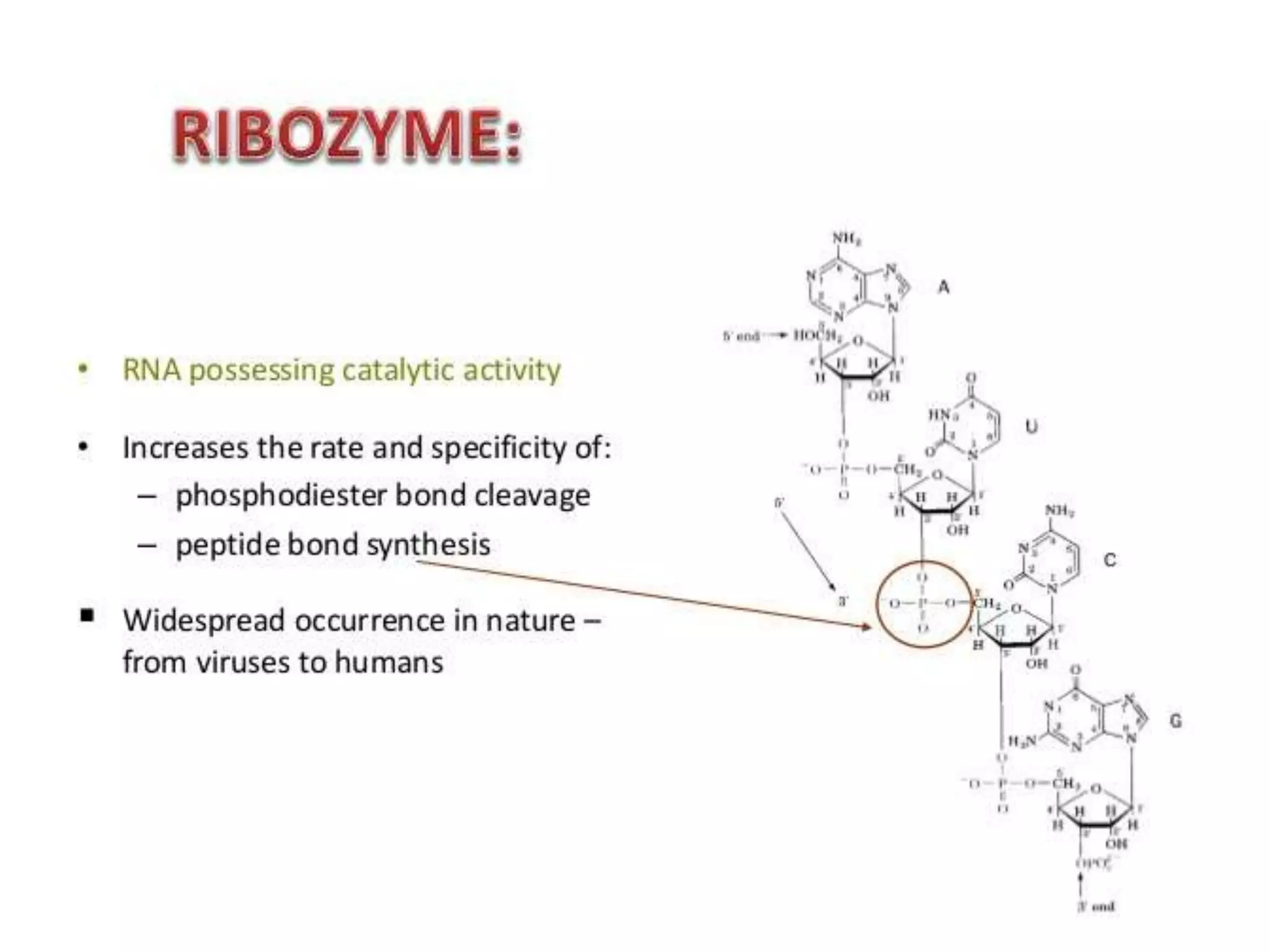
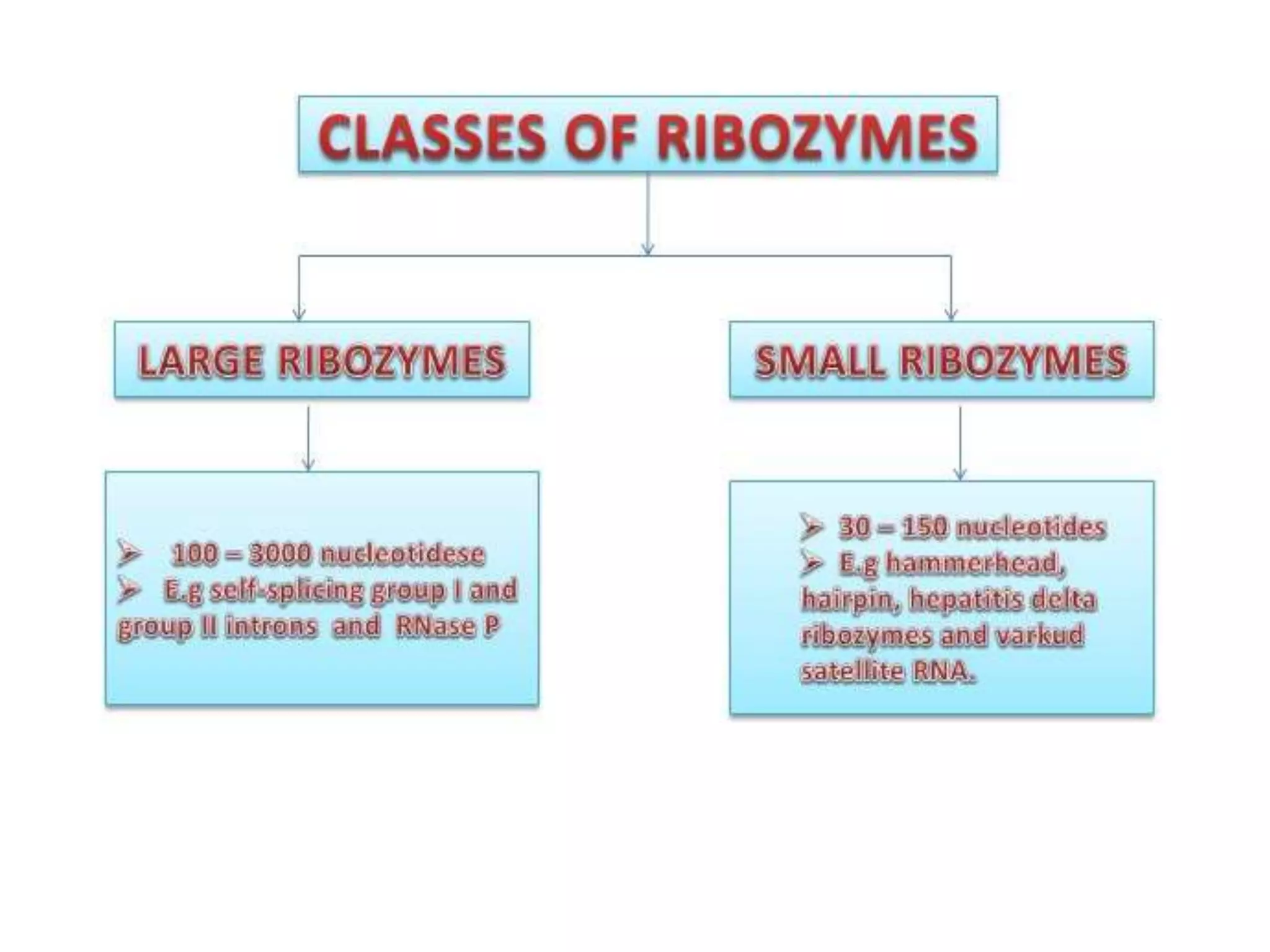
• Self splicing introns: group I and group II
• Rnase P
• Hammerhead ribozyme
• rRNA peptidyl transferase
• Hairpin ribozyme
• Riboswitches
• Hepatitis delta virus
• Varkud satellite ribozyme
• Mammalian CPEB3 ribozyme
Naturally occurring ribozymes:
Artificial ribozyme
Artificial ribozyme are synthesized in the laboratory based on the
dual nature of RNAs as catalyst and an informational polymer.
Synthesis of artificial ribozyme involves the mutation of natural
ribozymes. The ribozymes are mutated by reverse transcribing
them with reverse transcriptase into various cDNA and amplified
with mutagenic PCR.
E.g. of artificial ribozyme include Leadzyme, ligase ribozyme and
allosteric ribozyme.
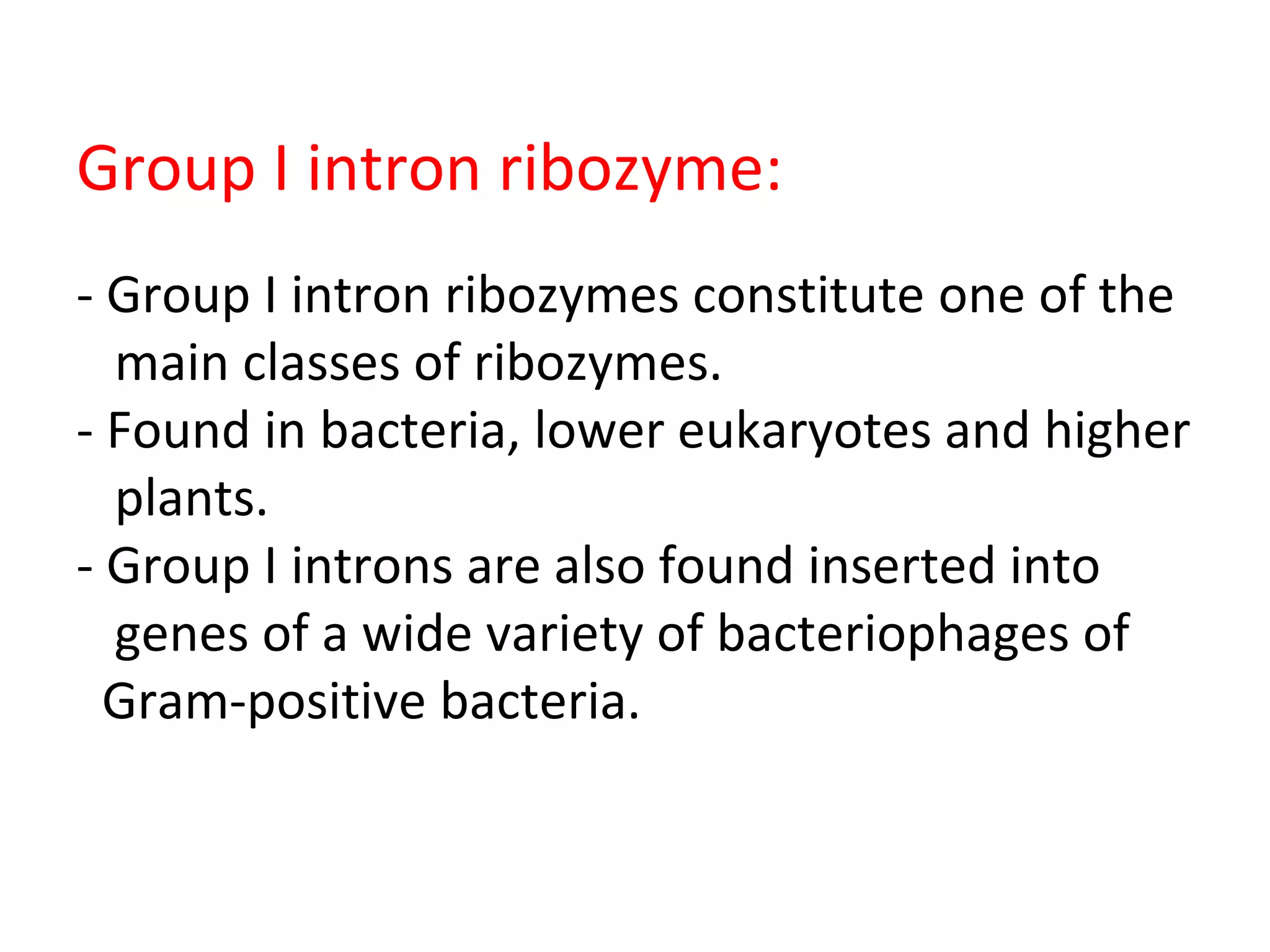
Group I intron ribozyme:
- Group I intron ribozymes constitute one of the
main classes of ribozymes.
- Found in bacteria, lower eukaryotes and higher
plants.
- Group I introns are also found inserted into
genes of a wide variety of bacteriophages of
Gram-positive bacteria.
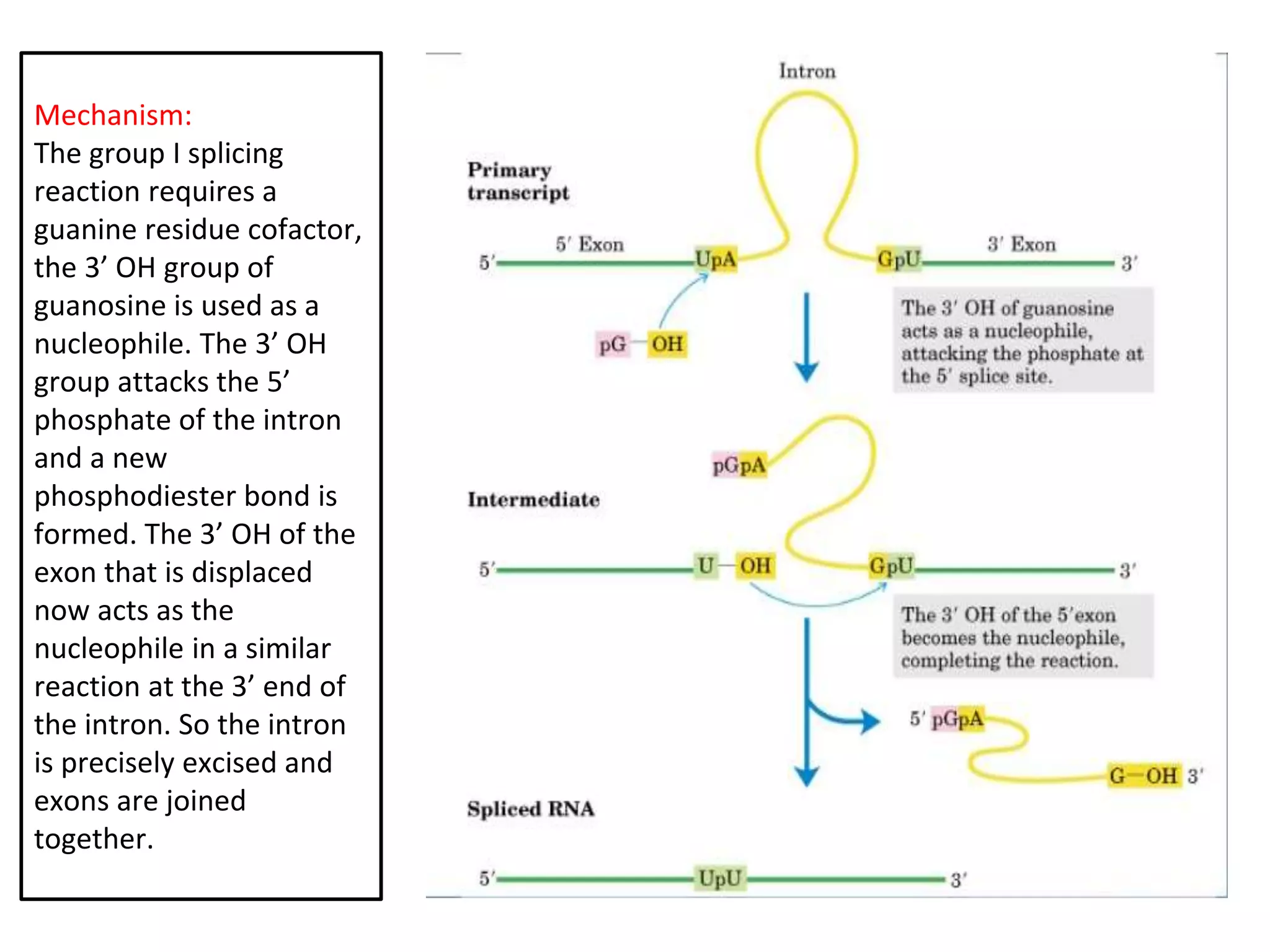
Mechanism:
The group I splicing
reaction requires a
guanine residue cofactor,
the 3’ OH group of
guanosine is used as a
nucleophile. The 3’ OH
group attacks the 5’
phosphate of the intron
and a new
phosphodiester bond is
formed. The 3’ OH of the
exon that is displaced
now acts as the
nucleophile in a similar
reaction at the 3’ end of
the intron. So the intron
is precisely excised and
exons are joined
together.
Group II introns Ribozyme
Group II introns have been
found in bacteria and in
the mitochondrial and
chloroplast genomes of
fungi, plants, protists, and
an annelid
worm.
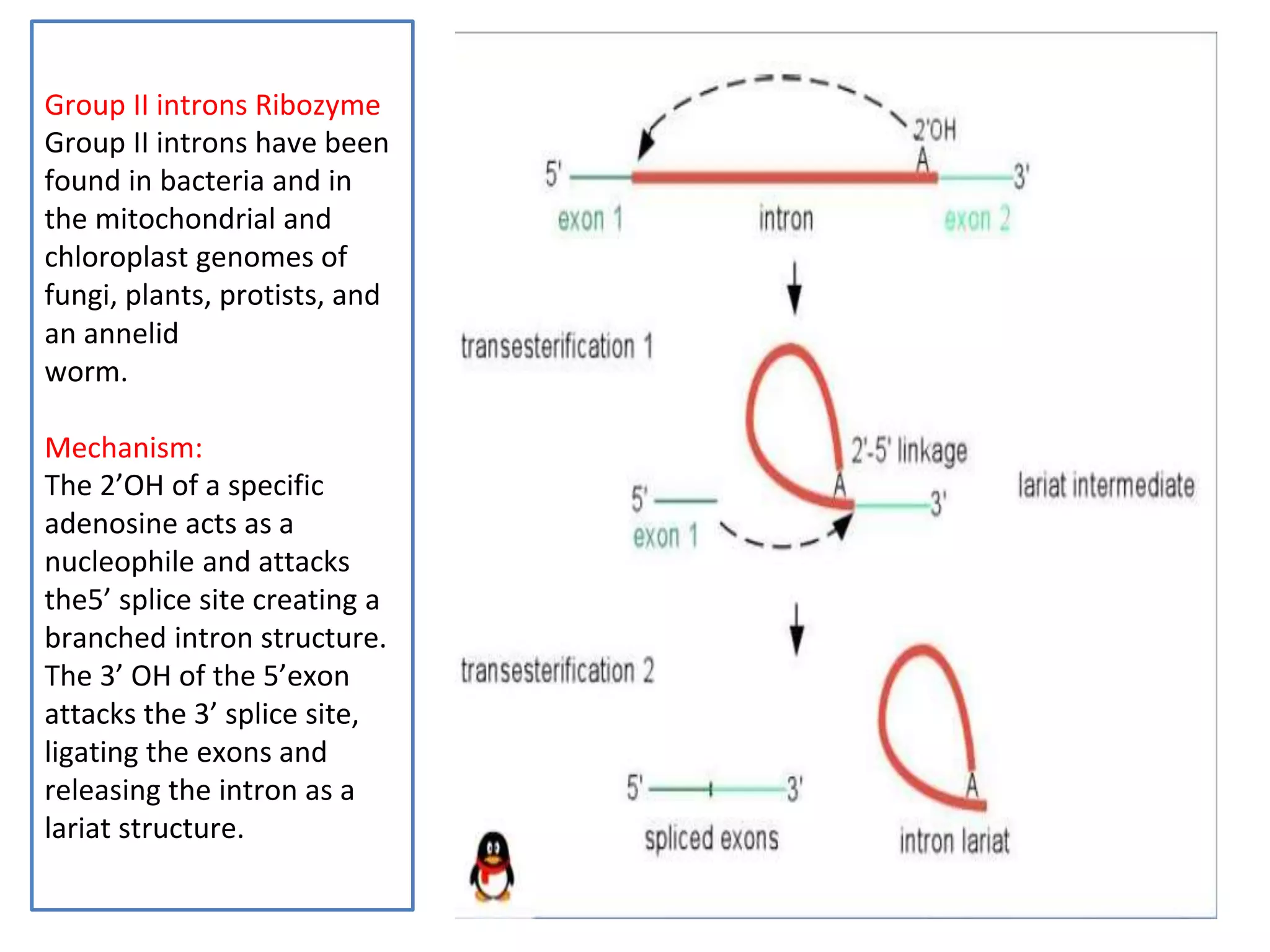
Mechanism:
The 2’OH of a specific
adenosine acts as a
nucleophile and attacks
the5’ splice site creating a
branched intron structure.
The 3’ OH of the 5’exon
attacks the 3’ splice site,
ligating the exons and
releasing the intron as a
lariat structure.
Thank You

Classification of Ribozyme

  • 1.
    Course name: Enzymology II Coursecode: BMB 224 Total credit: 2.0 Presenter: Mohammad Abul Hasnat Assistant Professor Dept. of BMB SUST Lec-11
  • 2.
    Contents: Regulatory enzyme: Allostericenzymes: Properties, pattern of allosteric regulation (feedback inhibition and feed forward stimulation), kinetics (Hill equation), cooperativity, Monod and Koshland models of cooperativity, and study of an allosteric enzyme (aspartate transcarbamoylase). Covalently modified enzymes: Phosphorylation and dephosphorylation, adenylylation and deadenylylation, Enzyme activation by proteolysis (Zymogen). Catalytic Mechanisms of Enzymes: Acid-base catalysis, Covalent catalysis, Metal ion catalysis, electrostatic catalysis, effect of proximity and orientation, transition state binding. Significance of enzyme mechanism study in the field of medicine. Mechanism of action of specific enzymes: Chymotrypsin, Hexokinase, lysozyme, ribonuclease A, and carboxypeptidase A. Isoenzymes: Lactate dehydrogenase, hexokinase with their characteristics and biological importance. Membrane bound enzymes: Introduction, properties and biological significance of these enzymes. Novel enzymes: Ribozymes. Cofactors, co-substrate and coenzymes: Nature and source of co-factors and co- enzymes, examples of reactions using specific co-enzymes and co-factors. Role of cofactors in the oxidation –reduction reaction.
  • 3.
  • 5.
    Ribozyme A ribozyme (ribonucleicacid enzyme) is an RNA molecule that is capable of performing specific biochemical reactions, similar to the action of protein enzymes.
  • 7.
    Characteristics of ribozymes: i.An RNA with enzymatic activity ii. An enzyme that uses RNA as a substrate iii. An enzyme that catalyzes the association between the large and small ribosomal subunits iv. An enzyme that synthesizes RNA as part of the transcription process v. An enzyme that synthesizes RNA primers during DNA replication vi. Investigators studying the origin of life have produced ribozymes in the laboratory that are capable of catalyzing their own synthesis under very specific conditions, such as an RNA polymerase ribozyme. vii. Some ribozymes may play an important role as therapeutic agents, as enzymes which target defined RNA sequences for cleavage, as biosensors, and for applications in functional genomics and gene discovery.
  • 9.
    • Self splicingintrons: group I and group II • Rnase P • Hammerhead ribozyme • rRNA peptidyl transferase • Hairpin ribozyme • Riboswitches • Hepatitis delta virus • Varkud satellite ribozyme • Mammalian CPEB3 ribozyme Naturally occurring ribozymes:
  • 10.
    Artificial ribozyme Artificial ribozymeare synthesized in the laboratory based on the dual nature of RNAs as catalyst and an informational polymer. Synthesis of artificial ribozyme involves the mutation of natural ribozymes. The ribozymes are mutated by reverse transcribing them with reverse transcriptase into various cDNA and amplified with mutagenic PCR. E.g. of artificial ribozyme include Leadzyme, ligase ribozyme and allosteric ribozyme.
  • 11.
    Group I intronribozyme: - Group I intron ribozymes constitute one of the main classes of ribozymes. - Found in bacteria, lower eukaryotes and higher plants. - Group I introns are also found inserted into genes of a wide variety of bacteriophages of Gram-positive bacteria.
  • 13.
    Mechanism: The group Isplicing reaction requires a guanine residue cofactor, the 3’ OH group of guanosine is used as a nucleophile. The 3’ OH group attacks the 5’ phosphate of the intron and a new phosphodiester bond is formed. The 3’ OH of the exon that is displaced now acts as the nucleophile in a similar reaction at the 3’ end of the intron. So the intron is precisely excised and exons are joined together.
  • 15.
    Group II intronsRibozyme Group II introns have been found in bacteria and in the mitochondrial and chloroplast genomes of fungi, plants, protists, and an annelid worm. Mechanism: The 2’OH of a specific adenosine acts as a nucleophile and attacks the5’ splice site creating a branched intron structure. The 3’ OH of the 5’exon attacks the 3’ splice site, ligating the exons and releasing the intron as a lariat structure.
  • 17.