 INTRODUCTION
 AIMS AND OBJECTIVES
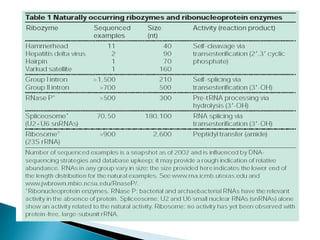
 TYPES OF RIBOZYMES
 APPLICATIONS
 RIBOSOME IS A RIBOZYME
 RNA WORLD HYPOTHESIS
 BIBLIOGRAPHY
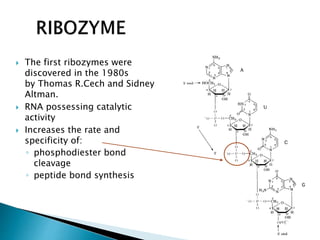
 The first ribozymes were
discovered in the 1980s
by Thomas R.Cech and Sidney
Altman.
 RNA possessing catalytic
activity
 Increases the rate and
specificity of:
◦ phosphodiester bond
cleavage
◦ peptide bond synthesis
 Ribozymes act as catalyst for chemical
reactions.
 Ribozymes has many application in gene
therapy and gene expression.
Group I Introns
 A self-splicing intron in pre-ribosomal RNA of the
ciliateTetrahymena thermophilia was the first catalytic
RNA molecule to be discovered in the early 80s.
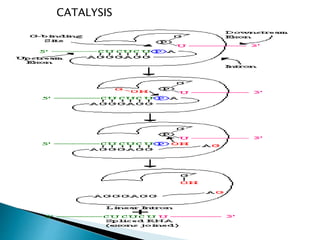
 Group I introns perform a splicing reaction by a two-
step transesterification mechanism.
Group II Introns
 Group II introns have also been found in bacteria and
in organellar genes of eukaryotic cells, but they are
less widely distributed than group I introns.
 They catalyse a self-splicing reaction that group II
introns do not require a guanosine cofactor.
RNase P
 RNase P catalyzes site-specific hydrolysis of precursor
tRNA which is essential for the formation of mature
tRNA.
 Catalytic activity depends on the presence of divalent
cations (Mg2+, Mn2+)
Hammerhead Ribozyme
 It has been found in several plant virus satellite RNAs,
viroids and transcripts of a nuclear satellite DNA .
 This ribozyme is the smallest of the naturally occurring
ribozymes and processes the rolling circle replication.
The glmS ribozyme
 First, it is a ribozyme that is also a riboswitch.
 Second, the regulatory effector of the
ribozyme,glucosamine-6-phosphate (GlcN6P), is
actually a functional group that binds to the ribozyme
active site and participates in the acid-base catalysis
of RNA self-cleavage.
Hepatitis Delta Virus Ribozyme
 The hepatitis delta virus (HDV) ribozyme is a non-
coding RNA and is thought to be the only catalytic
RNA known to be required for viability of a
human pathogen.
 This is the fastest known naturally occurring self-
cleaving RNA.
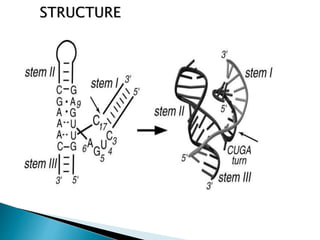
 Hammerhead RNAs are RNAs that self-cleave.
 Hammerhead RNAs are subsets of two classes
of plant pathogenic RNAs: the satellite RNAs of
RNA viruses and the viroids.
 Replication by rolling circle mechanism
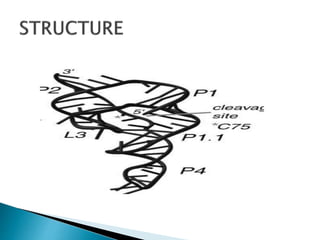
Hammerhead Ribozyme
STRUCTURE
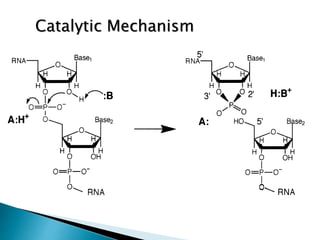
Catalytic Mechanism
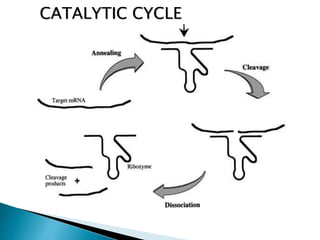
CATALYTIC CYCLE
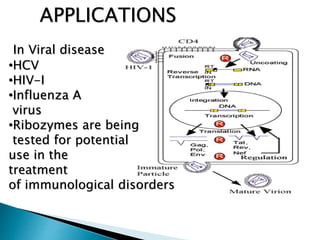
APPLICATIONS
In Viral disease
•HCV
•HIV-I
•Influenza A
virus
•Ribozymes are being
tested for potential
use in the
treatment
of immunological disorders
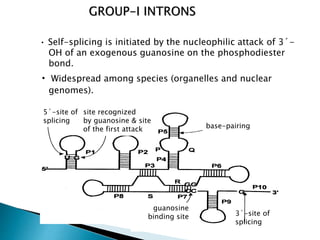
GROUP-I INTRONS
• Self-splicing is initiated by the nucleophilic attack of 3´-
OH of an exogenous guanosine on the phosphodiester
bond.
• Widespread among species (organelles and nuclear
genomes).
5´-site of
splicing
site recognized
by guanosine & site
of the first attack base-pairing
guanosine
binding site 3´-site of
splicing
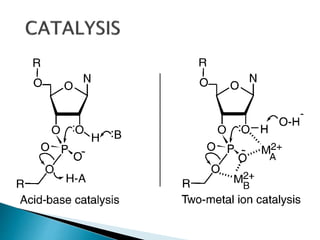
CATALYSIS
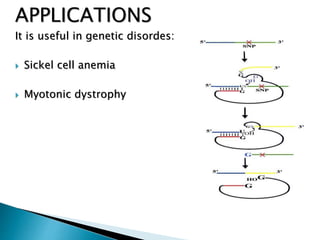
APPLICATIONS
It is useful in genetic disordes:
 Sickel cell anemia
 Myotonic dystrophy
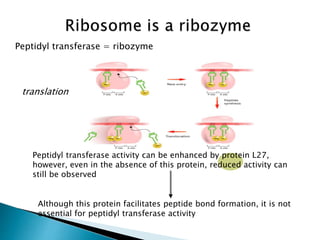
Peptidyl transferase = ribozyme
translation
Peptidyl transferase activity can be enhanced by protein L27,
however, even in the absence of this protein, reduced activity can
still be observed
Although this protein facilitates peptide bond formation, it is not
essential for peptidyl transferase activity
 RNA initially served both as the genetic material and the catalyst.
 Cationic clays such as montmorillonite can promote the
polymerization of RNA-like monomers into „RNA“ chains
 RNA is the primary substance of life, DNA and proteins are later
refinements.
 Cofactors used by ribozymes include e.g.: vit. B12, FMN,
glucosamine-6-phosphate.

 The RNA world hypothesis suggests that RNA in modern cells, in
particular rRNA is an evolutionary remnant of the RNA world.
 Nissen P, Hansen J, Ban N, Moore PB, Steitz TA: The structural
basis of ribosome activity in peptide bond synthesis.Science
2000, 289:920-930.
 Rossi, J. J., Cantin, E. M., Sarver, N., Chang, P. F. (1991) The
potential use of catalytic RNAs in therapy of HIV infection and
other diseases.Pharmacol. Ther. 50, 245–254.
 Schuwirth BS, Borovinskaya MA, Hau CW, Zhang W,
VilaSanjurjo A, Holton JM, Cate JH: Structures of the bacterial
ribosome at 3.5 A˚resolution. Science 2005, 310:827-834.
 Golden BL, Kim H, Chase E: Crystal structure of a phage Twort
group I ribozyme-product complex. Nat Struct Mol Biol 2005,
12:82-89.
 Steitz TA, Steitz JA: A general two-metal-ion mechanism for
catalytic RNA. Proc Natl Acad Sci USA 1993, 90:6498-6502.
THANK YOU

Ribozymes

  • 2.
     INTRODUCTION  AIMSAND OBJECTIVES  TYPES OF RIBOZYMES  APPLICATIONS  RIBOSOME IS A RIBOZYME  RNA WORLD HYPOTHESIS  BIBLIOGRAPHY
  • 3.
     The firstribozymes were discovered in the 1980s by Thomas R.Cech and Sidney Altman.  RNA possessing catalytic activity  Increases the rate and specificity of: ◦ phosphodiester bond cleavage ◦ peptide bond synthesis
  • 4.
     Ribozymes actas catalyst for chemical reactions.  Ribozymes has many application in gene therapy and gene expression.
  • 8.
    Group I Introns A self-splicing intron in pre-ribosomal RNA of the ciliateTetrahymena thermophilia was the first catalytic RNA molecule to be discovered in the early 80s.  Group I introns perform a splicing reaction by a two- step transesterification mechanism. Group II Introns  Group II introns have also been found in bacteria and in organellar genes of eukaryotic cells, but they are less widely distributed than group I introns.  They catalyse a self-splicing reaction that group II introns do not require a guanosine cofactor.
  • 9.
    RNase P  RNaseP catalyzes site-specific hydrolysis of precursor tRNA which is essential for the formation of mature tRNA.  Catalytic activity depends on the presence of divalent cations (Mg2+, Mn2+) Hammerhead Ribozyme  It has been found in several plant virus satellite RNAs, viroids and transcripts of a nuclear satellite DNA .  This ribozyme is the smallest of the naturally occurring ribozymes and processes the rolling circle replication.
  • 10.
    The glmS ribozyme First, it is a ribozyme that is also a riboswitch.  Second, the regulatory effector of the ribozyme,glucosamine-6-phosphate (GlcN6P), is actually a functional group that binds to the ribozyme active site and participates in the acid-base catalysis of RNA self-cleavage. Hepatitis Delta Virus Ribozyme  The hepatitis delta virus (HDV) ribozyme is a non- coding RNA and is thought to be the only catalytic RNA known to be required for viability of a human pathogen.  This is the fastest known naturally occurring self- cleaving RNA.
  • 11.
     Hammerhead RNAsare RNAs that self-cleave.  Hammerhead RNAs are subsets of two classes of plant pathogenic RNAs: the satellite RNAs of RNA viruses and the viroids.  Replication by rolling circle mechanism Hammerhead Ribozyme
  • 12.
  • 13.
  • 14.
  • 15.
    APPLICATIONS In Viral disease •HCV •HIV-I •InfluenzaA virus •Ribozymes are being tested for potential use in the treatment of immunological disorders
  • 16.
    GROUP-I INTRONS • Self-splicingis initiated by the nucleophilic attack of 3´- OH of an exogenous guanosine on the phosphodiester bond. • Widespread among species (organelles and nuclear genomes). 5´-site of splicing site recognized by guanosine & site of the first attack base-pairing guanosine binding site 3´-site of splicing
  • 17.
  • 18.
    APPLICATIONS It is usefulin genetic disordes:  Sickel cell anemia  Myotonic dystrophy
  • 19.
    Peptidyl transferase =ribozyme translation Peptidyl transferase activity can be enhanced by protein L27, however, even in the absence of this protein, reduced activity can still be observed Although this protein facilitates peptide bond formation, it is not essential for peptidyl transferase activity
  • 20.
     RNA initiallyserved both as the genetic material and the catalyst.  Cationic clays such as montmorillonite can promote the polymerization of RNA-like monomers into „RNA“ chains  RNA is the primary substance of life, DNA and proteins are later refinements.  Cofactors used by ribozymes include e.g.: vit. B12, FMN, glucosamine-6-phosphate.   The RNA world hypothesis suggests that RNA in modern cells, in particular rRNA is an evolutionary remnant of the RNA world.
  • 21.
     Nissen P,Hansen J, Ban N, Moore PB, Steitz TA: The structural basis of ribosome activity in peptide bond synthesis.Science 2000, 289:920-930.  Rossi, J. J., Cantin, E. M., Sarver, N., Chang, P. F. (1991) The potential use of catalytic RNAs in therapy of HIV infection and other diseases.Pharmacol. Ther. 50, 245–254.  Schuwirth BS, Borovinskaya MA, Hau CW, Zhang W, VilaSanjurjo A, Holton JM, Cate JH: Structures of the bacterial ribosome at 3.5 A˚resolution. Science 2005, 310:827-834.  Golden BL, Kim H, Chase E: Crystal structure of a phage Twort group I ribozyme-product complex. Nat Struct Mol Biol 2005, 12:82-89.  Steitz TA, Steitz JA: A general two-metal-ion mechanism for catalytic RNA. Proc Natl Acad Sci USA 1993, 90:6498-6502.
  • 22.

Editor's Notes

  • #7 :B is a general base and H-A is a general acid. Thick dashed lines show direct inner-sphere coordination between divalent cationsMA andMB and oxygen atoms.Nrepresents a purine or pyrimidine base and R denotes chain continuation.