ANTISENSE TECHNOLOGY   Presented By Desh Bandhu Gangwar  M.Tech Biotech (2 year) Concerned Faculty Dr. Gunjan Garg Assistant Professor School of Biotechnology
INTRODUCTION What is Antisense  Technology ?
 
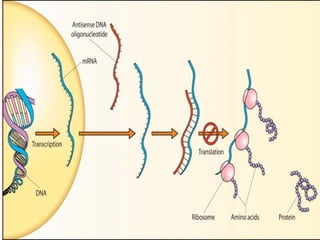
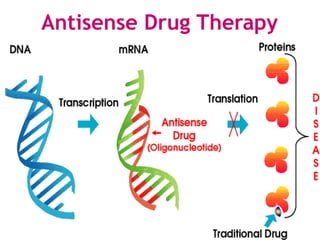
In this technique Short segments of single stranded DNA  called  oligo   de   oxy   nucleotides   are introduced. These oligonucleotides are complementary to the mRNA, which physically bind to the mRNA .
Antisense technology prevent the synthesis of specific protein. Antisense technologies are a suite of techniques that, together form a very powerful weapon for studying  gene function   and for  discovering   more   specific treatments of disease. .
  Antisense Oligonucleotides   What are Antisense  Oligonucleotides?
The antisense effect of a oligonucleotide sequence was first demonstrated in 1970s by  Zamecnik  and  Stephenson , in Rous sarcoma virus. AS-ONs usually consist of  15–20   nucleotides , which are complementary to their target mRNA.
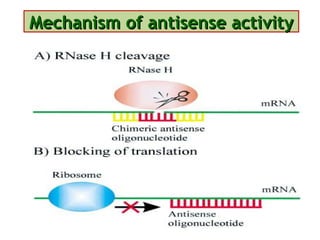
When these AS-ON combined with target mRNA, a  DNA/RNA   hybrid   form,which degraded by the enzyme  RNase H . RNase H
RNase H is a non-specific  endonuclease , catalyzes the cleavage of  RNA  via  hydrolytic mechanism.   RNase H has ribonuclease activity cleaves the 3’-O-P bond of  RNA  in a  DNA/RNA   duplex.
Mechanism of antisense activity
Types Of  AS-ON First generation AS-ON Second generation AS-ON Third generation AS-ON
A successful AS-ON depends on the following characteristics : Unique DNA sequence Efficient cellular uptake Minimal nonspecific binding Target specific hybridization Non-toxic antisense construct Nuclease resistant  to protect  AS-ON
First generation AS-ON  First synthesized  by  Eckstein  and  colleagues . Phosphorothioate - oligo   deoxy nucleotides   are the major representatives of first generation DNA analogs that are the best known.
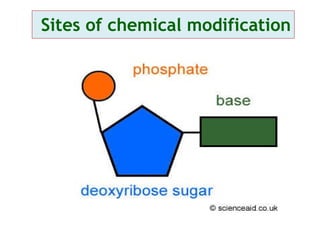
Sites of chemical modification
Phosphorothioate linkages in Ons  primarily used to enhance their  nuclease  resistance . In this class of ONs,  non bridging oxygen atoms in  phopho-diester bond is replaced by sulfur . They first used as AS-ONs for the  inhibition of HIV.
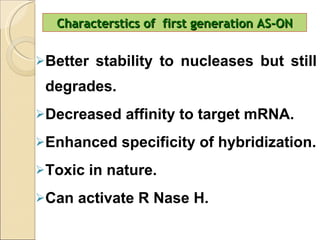
Better stability to nucleases but still degrades. Decreased affinity to target mRNA. Enhanced specificity of hybridization. Toxic in nature. Can activate R Nase H. Characterstics of  first generation AS-ON
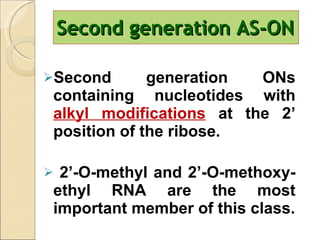
Second generation AS-ON Second generation ONs containing nucleotides with  alkyl modifications   at the 2’ position of the ribose. 2’-O-methyl and 2’-O-methoxy-ethyl RNA are the most important member of this class.
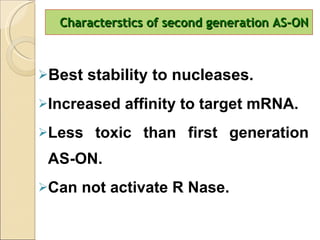
Characterstics of second generation AS-ON Best stability to nucleases. Increased affinity to target mRNA. Less toxic than first generation AS-ON. Can not activate R Nase.
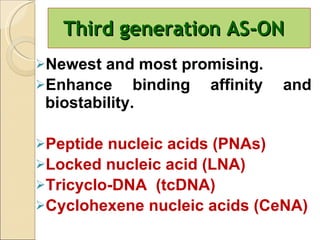
Third generation AS-ON Newest and most promising. Enhance binding affinity and biostability.  Peptide nucleic acids (PNAs) Locked nucleic acid (LNA) Tricyclo-DNA  (tcDNA) Cyclohexene nucleic acids (CeNA)
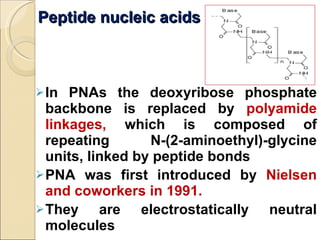
Peptide nucleic acids In PNAs the deoxyribose phosphate backbone is replaced by  polyamide linkages,  which is composed of repeating N-(2-aminoethyl)-glycine units, linked by peptide bonds  PNA was first introduced by  Nielsen and coworkers in 1991. They are electrostatically neutral molecules
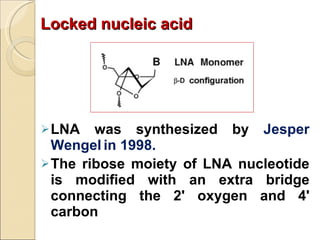
Locked nucleic acid LNA was synthesized by  Jesper Wengel   in 1998. The ribose moiety of LNA nucleotide is modified with an extra bridge connecting the 2' oxygen and 4' carbon
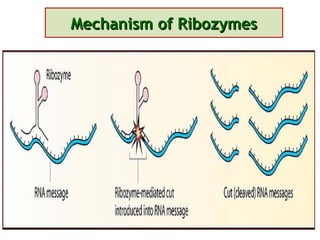
Ribozymes Thomas and coworkers  coined the term ‘ribozymes. Ribozymes are RNA molecules that have  catalytic activity.  Ribozyme Bind to the target RNA moiety and inactivate it by cleaving the phosphodiester backbone at a specific cutting site.
Mechanism of Ribozymes
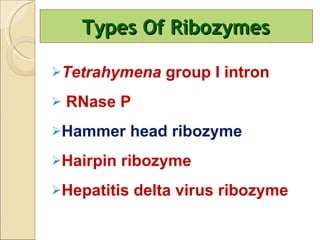
Types Of Ribozymes Tetrahymena  group I intron RNase P Hammer head ribozyme Hairpin ribozyme  Hepatitis delta virus ribozyme
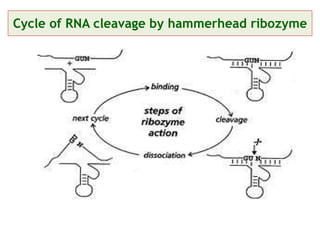
Cycle of RNA cleavage by  hammerhead ribozyme
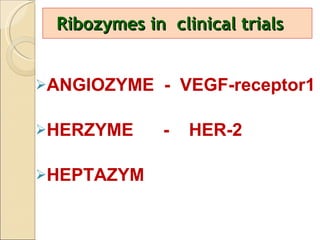
Ribozymes in  clinical trials ANGIOZYME  -  VEGF-receptor1 HERZYME  -  HER-2 HEPTAZYM
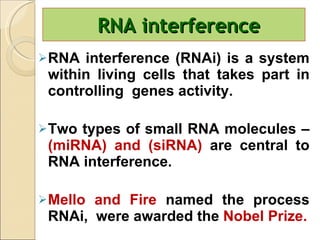
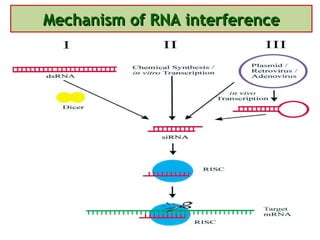
RNA interference RNA interference (RNAi) is a system within living cells that takes part in controlling  genes activity. Two types of small RNA molecules – (miRNA) and (siRNA)  are central to RNA interference.   Mello and Fire  named the process RNAi,  were awarded the  Nobel Prize.
Mechanism of RNA interference
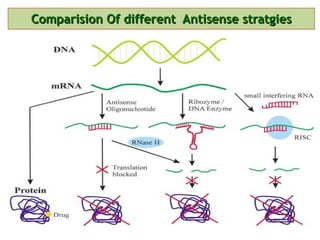
Comparision Of different  Antisense stratgies
Applications Of Antisense technologies Story of Flavr Savr…
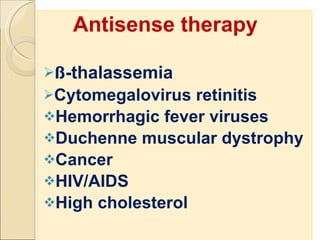
Antisense therapy  ß -thalassemia Cytomegalovirus retinitis Hemorrhagic fever viruses Duchenne muscular dystrophy Cancer HIV/AIDS High cholesterol
Antisense Drug Therapy
REFERENCE Gene cloning and DNA analysis, Fifth edition By T.A Brown Page no. 235 Walton, S. P., Roth, C. M., Yarmush, M. L. “Antisense Technology.”The Biomedical Engineering Handbook: Second Edition. Indian journal of chemistry vol. 48 B December 2009, pp. 1721-1726 Indian journal of biotechnology vol 4,JUL 2005,pp. 316 -322 Eur. J. Biochem. 270,1628–1644 Clinical and Experimental Pharmacology and Physiology (2006) 33, 533–540
QUERIES?
THANK YOU

Desh bandhu gangwar antisense technology

  • 1.
    ANTISENSE TECHNOLOGY Presented By Desh Bandhu Gangwar M.Tech Biotech (2 year) Concerned Faculty Dr. Gunjan Garg Assistant Professor School of Biotechnology
  • 2.
    INTRODUCTION What isAntisense Technology ?
  • 3.
  • 4.
    In this techniqueShort segments of single stranded DNA called oligo de oxy nucleotides are introduced. These oligonucleotides are complementary to the mRNA, which physically bind to the mRNA .
  • 5.
    Antisense technology preventthe synthesis of specific protein. Antisense technologies are a suite of techniques that, together form a very powerful weapon for studying gene function and for discovering more specific treatments of disease. .
  • 6.
    AntisenseOligonucleotides What are Antisense Oligonucleotides?
  • 7.
    The antisense effectof a oligonucleotide sequence was first demonstrated in 1970s by Zamecnik and Stephenson , in Rous sarcoma virus. AS-ONs usually consist of 15–20 nucleotides , which are complementary to their target mRNA.
  • 8.
    When these AS-ONcombined with target mRNA, a DNA/RNA hybrid form,which degraded by the enzyme RNase H . RNase H
  • 9.
    RNase H isa non-specific endonuclease , catalyzes the cleavage of RNA via hydrolytic mechanism. RNase H has ribonuclease activity cleaves the 3’-O-P bond of RNA in a DNA/RNA duplex.
  • 10.
  • 11.
    Types Of AS-ON First generation AS-ON Second generation AS-ON Third generation AS-ON
  • 12.
    A successful AS-ONdepends on the following characteristics : Unique DNA sequence Efficient cellular uptake Minimal nonspecific binding Target specific hybridization Non-toxic antisense construct Nuclease resistant to protect AS-ON
  • 13.
    First generation AS-ON First synthesized by Eckstein and colleagues . Phosphorothioate - oligo deoxy nucleotides are the major representatives of first generation DNA analogs that are the best known.
  • 14.
    Sites of chemicalmodification
  • 15.
    Phosphorothioate linkages inOns primarily used to enhance their nuclease resistance . In this class of ONs, non bridging oxygen atoms in phopho-diester bond is replaced by sulfur . They first used as AS-ONs for the inhibition of HIV.
  • 16.
    Better stability tonucleases but still degrades. Decreased affinity to target mRNA. Enhanced specificity of hybridization. Toxic in nature. Can activate R Nase H. Characterstics of first generation AS-ON
  • 17.
    Second generation AS-ONSecond generation ONs containing nucleotides with alkyl modifications at the 2’ position of the ribose. 2’-O-methyl and 2’-O-methoxy-ethyl RNA are the most important member of this class.
  • 18.
    Characterstics of secondgeneration AS-ON Best stability to nucleases. Increased affinity to target mRNA. Less toxic than first generation AS-ON. Can not activate R Nase.
  • 19.
    Third generation AS-ONNewest and most promising. Enhance binding affinity and biostability. Peptide nucleic acids (PNAs) Locked nucleic acid (LNA) Tricyclo-DNA (tcDNA) Cyclohexene nucleic acids (CeNA)
  • 20.
    Peptide nucleic acidsIn PNAs the deoxyribose phosphate backbone is replaced by polyamide linkages, which is composed of repeating N-(2-aminoethyl)-glycine units, linked by peptide bonds PNA was first introduced by Nielsen and coworkers in 1991. They are electrostatically neutral molecules
  • 21.
    Locked nucleic acidLNA was synthesized by Jesper Wengel in 1998. The ribose moiety of LNA nucleotide is modified with an extra bridge connecting the 2' oxygen and 4' carbon
  • 22.
    Ribozymes Thomas andcoworkers coined the term ‘ribozymes. Ribozymes are RNA molecules that have catalytic activity. Ribozyme Bind to the target RNA moiety and inactivate it by cleaving the phosphodiester backbone at a specific cutting site.
  • 23.
  • 24.
    Types Of RibozymesTetrahymena group I intron RNase P Hammer head ribozyme Hairpin ribozyme Hepatitis delta virus ribozyme
  • 25.
    Cycle of RNAcleavage by hammerhead ribozyme
  • 26.
    Ribozymes in clinical trials ANGIOZYME - VEGF-receptor1 HERZYME - HER-2 HEPTAZYM
  • 27.
    RNA interference RNAinterference (RNAi) is a system within living cells that takes part in controlling genes activity. Two types of small RNA molecules – (miRNA) and (siRNA) are central to RNA interference. Mello and Fire named the process RNAi, were awarded the Nobel Prize.
  • 28.
    Mechanism of RNAinterference
  • 29.
    Comparision Of different Antisense stratgies
  • 30.
    Applications Of Antisensetechnologies Story of Flavr Savr…
  • 31.
    Antisense therapy ß -thalassemia Cytomegalovirus retinitis Hemorrhagic fever viruses Duchenne muscular dystrophy Cancer HIV/AIDS High cholesterol
  • 32.
  • 33.
    REFERENCE Gene cloningand DNA analysis, Fifth edition By T.A Brown Page no. 235 Walton, S. P., Roth, C. M., Yarmush, M. L. “Antisense Technology.”The Biomedical Engineering Handbook: Second Edition. Indian journal of chemistry vol. 48 B December 2009, pp. 1721-1726 Indian journal of biotechnology vol 4,JUL 2005,pp. 316 -322 Eur. J. Biochem. 270,1628–1644 Clinical and Experimental Pharmacology and Physiology (2006) 33, 533–540
  • 34.
  • 35.

Editor's Notes

  • #2 My project is on bioremediation.