Knowledge Creation: An Institutional Capacity
Building Instrument
Capacity Building
process of developing and strengthening
the skills, instincts, abilities, processes
and resources that organizations and
communities need to survive, adapt, and
thrive in the fast-changing world.
(Ann Philbin, Capacity Building in Social Justice Organizations
Ford Foundation, 1996)
Capacity Building (contd.)
Activities which strengthen the knowledge,
abilities, skills and behaviour of individuals
and improve institutional structures and
processes such that the organization can
efficiently meet its mission and goals in a
sustainable way.
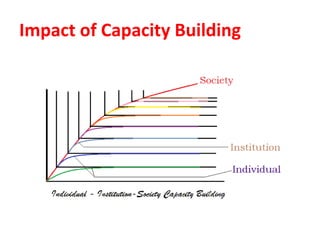
Levels of capacity Building
• Individual level- It also calls for the establishment of
conditions that will allow individuals to engage in the
“process of learning and adapting to change”
• Institutional level- It should not involve creating new
institutions, rather modernizing existing institutions
and supporting them in forming sound policies,
organizational structures, and effective methods of
management and revenue control.
• Societal level- support the establishment of a more
“interactive public administration that learns equally
from its actions and from feedback it receives from the
population at large.”
Impact of Capacity Building
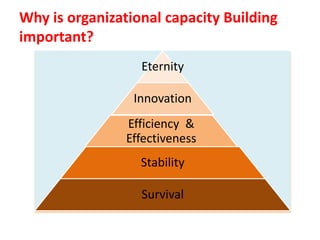
Why is organizational capacity Building
important?
Eternity
Innovation
Efficiency &
Effectiveness
Stability
Survival
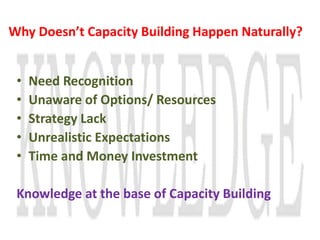
Why Doesn’t Capacity Building Happen Naturally?
• Need Recognition
• Unaware of Options/ Resources
• Strategy Lack
• Unrealistic Expectations
• Time and Money Investment
Knowledge at the base of Capacity Building
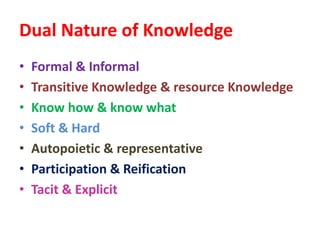
Dual Nature of Knowledge
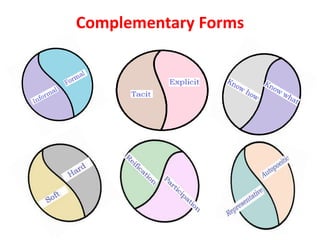
• Formal & Informal
• Transitive Knowledge & resource Knowledge
• Know how & know what
• Soft & Hard
• Autopoietic & representative
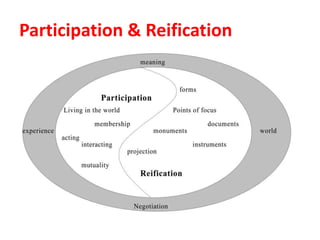
• Participation & Reification
• Tacit & Explicit
Complementary Forms
Participation & Reification
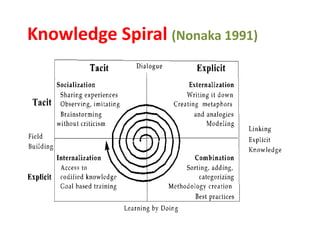
Knowledge Spiral (Nonaka 1991)
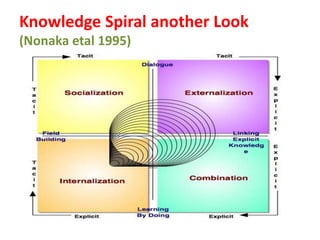
Knowledge Spiral another Look
(Nonaka etal 1995)
Knowledge Spiral in Capacity Building
Needs
• Knowledge Base
– Database, software, records, domestic research
codification, delivery and verification system, MIS
and the like.
• Knowledgeable People
– Willing to learn, Experiment, Take risk, Explore
knowledge avenues, Research patiently, Innovate
and the like
Operation of Knowledge creation in
Educational Institutions
Through
• Curricular Reforms
• Continued Learning and encouragement to
learning ventures
• Domestic Knowledge services: creation and
active involvement
• Dynamic and Static Knowledge bank
• Transparency and accountability
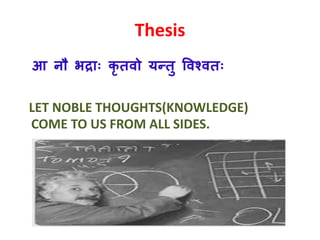
Thesis
आ नौ भद्राः कृ तवो यन्तु ववश्वताः
LET NOBLE THOUGHTS(KNOWLEDGE)
COME TO US FROM ALL SIDES.
Thanks For Kind Attention
Grover Vijay K
D A V College of Education,
Abohar (Punjab)
grovervijayk@gmail.com

Capacity building 2007

  • 1.
    Knowledge Creation: AnInstitutional Capacity Building Instrument
  • 2.
    Capacity Building process ofdeveloping and strengthening the skills, instincts, abilities, processes and resources that organizations and communities need to survive, adapt, and thrive in the fast-changing world. (Ann Philbin, Capacity Building in Social Justice Organizations Ford Foundation, 1996)
  • 3.
    Capacity Building (contd.) Activitieswhich strengthen the knowledge, abilities, skills and behaviour of individuals and improve institutional structures and processes such that the organization can efficiently meet its mission and goals in a sustainable way.
  • 4.
    Levels of capacityBuilding • Individual level- It also calls for the establishment of conditions that will allow individuals to engage in the “process of learning and adapting to change” • Institutional level- It should not involve creating new institutions, rather modernizing existing institutions and supporting them in forming sound policies, organizational structures, and effective methods of management and revenue control. • Societal level- support the establishment of a more “interactive public administration that learns equally from its actions and from feedback it receives from the population at large.”
  • 5.
  • 6.
    Why is organizationalcapacity Building important? Eternity Innovation Efficiency & Effectiveness Stability Survival
  • 7.
    Why Doesn’t CapacityBuilding Happen Naturally? • Need Recognition • Unaware of Options/ Resources • Strategy Lack • Unrealistic Expectations • Time and Money Investment Knowledge at the base of Capacity Building
  • 8.
    Dual Nature ofKnowledge • Formal & Informal • Transitive Knowledge & resource Knowledge • Know how & know what • Soft & Hard • Autopoietic & representative • Participation & Reification • Tacit & Explicit
  • 9.
  • 10.
  • 11.
  • 12.
    Knowledge Spiral anotherLook (Nonaka etal 1995)
  • 13.
    Knowledge Spiral inCapacity Building Needs • Knowledge Base – Database, software, records, domestic research codification, delivery and verification system, MIS and the like. • Knowledgeable People – Willing to learn, Experiment, Take risk, Explore knowledge avenues, Research patiently, Innovate and the like
  • 14.
    Operation of Knowledgecreation in Educational Institutions Through • Curricular Reforms • Continued Learning and encouragement to learning ventures • Domestic Knowledge services: creation and active involvement • Dynamic and Static Knowledge bank • Transparency and accountability
  • 15.
    Thesis आ नौ भद्राःकृ तवो यन्तु ववश्वताः LET NOBLE THOUGHTS(KNOWLEDGE) COME TO US FROM ALL SIDES.
  • 16.
    Thanks For KindAttention Grover Vijay K D A V College of Education, Abohar (Punjab) grovervijayk@gmail.com