Page
To hear the presentation
Creating a Comprehensive and Engaging
                   by phone call:
Volunteer Training Program
                     (470) 200-0302
                                  Access Code: 864-469-821


                                  Jennifer Bennett @JenBennettCVA
                                  CVA, Senior Manager, Education & Training


                                  Matt Wallace @ItsMattWallace
                                  Senior Associate, Nonprofit Relations


Jennifer Bennett, CVA, Senior Manager, Education webinar on Twitter to
                                      Follow this & Training
Sarah Christian, Director, Education &join the conversation!
                                       Training
                                  Hash tag: #VMlearn
                                                                              2
Agenda
• Goals for Good Training Programs

• Determine What Your Volunteers Should Know

• Information Delivery Systems

• Building Your Training Program

• Evaluating Your Training Program

• Things to Think About


                                               3
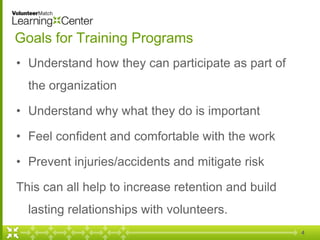
Goals for Training Programs
• Understand how they can participate as part of
  the organization

• Understand why what they do is important

• Feel confident and comfortable with the work

• Prevent injuries/accidents and mitigate risk

This can all help to increase retention and build
  lasting relationships with volunteers.
                                                    4
What do you Want your Volunteers to Know?
• Information about being a volunteer
  – Philosophy, Dos and Don’ts
• Things to know about your organization
  – Mission, History
• How to do the job or work you’re asking them to
  do
  – Program/Organization Specific, or Pro Bono Consultant?
    On the Job, or Classroom Work?
• Professional development or continuing
  education
                                                             5
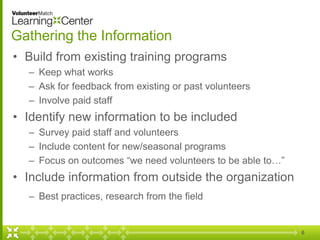
Gathering the Information
• Build from existing training programs
  – Keep what works
  – Ask for feedback from existing or past volunteers
  – Involve paid staff
• Identify new information to be included
  – Survey paid staff and volunteers
  – Include content for new/seasonal programs
  – Focus on outcomes “we need volunteers to be able to…”
• Include information from outside the organization
  – Best practices, research from the field


                                                            6
Presenting the Information
• In-Person Trainings
  – More personalized for each volunteer
  – Answer questions immediately
  – Only happens at a certain time/place


• Recorded Trainings
  – Flexibility for volunteers
  – May be hard to stay engaged
  – No ability to adjust pace


                                           7
Presenting the Information
• Pre- Reading/Homework
  – Can be more in depth
  – Volunteers move at their own pace
  – Hard to ensure material is being read


• On the Job Training
  – Job and Organization specific
  – May be the only way to learn certain actions/processes
  – Potentially variable depending on trainer – the “right” way
    to do something may be different


                                                             8
Presenting the Information
• Reference Binder or Textbook
  – Comprehensive
  – Can be used to identify the proper way to complete tasks
  – Hard to ensure material is being read


• Job Aids – Posters, signs, cheat sheets
  –   Just in time training
  –   Can remind volunteers of procedures
  –   Inherently brief
  –   Easily overlooked


                                                          9
Building your Training Program
• The rules of three
  – Provide three different ways to access information

  – Explain what a volunteer will learn, teach them the information,
    remind them what you’ve taught them
• Understand how much information can be shared in
  and hour
  – About 20 minutes of information at a time

  – Allow time for processing/reflection

  – Using the rules of three 20 min of content = 1 hour of training


                                                                  10
Getting Creative
• Meet your volunteers where they are
  – Think about how you would want to learn
  – Survey them – what do they know, what do they think they
    know
  – Involve leadership volunteers in the process as SMEs or as
    trainers


• Train outside of the box
  – Walk a mile in the client’s shoes
  – Use humor, problem solving, or situational training
  – Using the rules of three 20 min of content = 1 hour of training


                                                                  11
Building your Training Program
• What do your volunteers need to know?
   – What needs to be learned on the job?
   – What can be learned independently?
   – Is team building an important part of the training process?

• Create learning outcomes
   – At the end of this training a volunteer will be able to…

• Remember how much can be learned at one time
   –   Create a tiered curriculum
   –   Use a variety of training methods
   –   Contextual learning, mentoring relationships
   –   Ongoing learning, professional development

                                                                   12
Evaluating your Training Program
• What did your volunteers learn? Ask them
  – Formal v. informal
  – Practical testing – “show me how you would…”
  – Situational testing – Mock tour, phone call

• Ask Paid Staff and Clients

• Evaluate retention of information
  – Tiered learning
  – Build on contextual learning
  – Staggered practical or situational testing at 3 months, 6 months


                                                                 13
Things to Think About
• What are you doing now?
  – What’s working? Where are the holes?
  – What are you doing because you’ve always done it that
    way?

• Investigate new technology and delivery systems

• Engage others
  – Volunteers, paid staff, clients or members


• Build in evaluation points/processes

                                                            14
Resources
Learning Center
Find upcoming webinar dates, how-to videos and more

http://learn.volunteermatch.org
VolunteerMatch Community
Ask and answer questions after the webinar – use keywords Training Program

http://community.volunteermatch.org/volunteer
Related Webinar Topics:
•Where Do I Go From Here? Evolving your Volunteer Program for More
Involvement
•Writing Accurate and Useful Volunteer Position Descriptions
•Walking the Walk: Engage Volunteers in your Volunteer Engagement Program


                                                                             15
Thanks for attending!
Join us online:

        Like us on Facebook: www.Facebook.com/VolunteerMatch
        Follow us on Twitter: @VolunteerMatch
        Visit Engaging Volunteers, our nonprofit blog:
          blogs.volunteermatch.org/engagingvolunteers/


For any questions contact:
Jennifer Bennett
(415) 321-3639
@JenBennettCVA
jbennett@volunteermatch.org

                                                               16

Creating a Comprehensive & Engaging Volunteer Training Program

  • 1.
  • 2.
    To hear thepresentation Creating a Comprehensive and Engaging by phone call: Volunteer Training Program (470) 200-0302 Access Code: 864-469-821 Jennifer Bennett @JenBennettCVA CVA, Senior Manager, Education & Training Matt Wallace @ItsMattWallace Senior Associate, Nonprofit Relations Jennifer Bennett, CVA, Senior Manager, Education webinar on Twitter to Follow this & Training Sarah Christian, Director, Education &join the conversation! Training Hash tag: #VMlearn 2
  • 3.
    Agenda • Goals forGood Training Programs • Determine What Your Volunteers Should Know • Information Delivery Systems • Building Your Training Program • Evaluating Your Training Program • Things to Think About 3
  • 4.
    Goals for TrainingPrograms • Understand how they can participate as part of the organization • Understand why what they do is important • Feel confident and comfortable with the work • Prevent injuries/accidents and mitigate risk This can all help to increase retention and build lasting relationships with volunteers. 4
  • 5.
    What do youWant your Volunteers to Know? • Information about being a volunteer – Philosophy, Dos and Don’ts • Things to know about your organization – Mission, History • How to do the job or work you’re asking them to do – Program/Organization Specific, or Pro Bono Consultant? On the Job, or Classroom Work? • Professional development or continuing education 5
  • 6.
    Gathering the Information •Build from existing training programs – Keep what works – Ask for feedback from existing or past volunteers – Involve paid staff • Identify new information to be included – Survey paid staff and volunteers – Include content for new/seasonal programs – Focus on outcomes “we need volunteers to be able to…” • Include information from outside the organization – Best practices, research from the field 6
  • 7.
    Presenting the Information •In-Person Trainings – More personalized for each volunteer – Answer questions immediately – Only happens at a certain time/place • Recorded Trainings – Flexibility for volunteers – May be hard to stay engaged – No ability to adjust pace 7
  • 8.
    Presenting the Information •Pre- Reading/Homework – Can be more in depth – Volunteers move at their own pace – Hard to ensure material is being read • On the Job Training – Job and Organization specific – May be the only way to learn certain actions/processes – Potentially variable depending on trainer – the “right” way to do something may be different 8
  • 9.
    Presenting the Information •Reference Binder or Textbook – Comprehensive – Can be used to identify the proper way to complete tasks – Hard to ensure material is being read • Job Aids – Posters, signs, cheat sheets – Just in time training – Can remind volunteers of procedures – Inherently brief – Easily overlooked 9
  • 10.
    Building your TrainingProgram • The rules of three – Provide three different ways to access information – Explain what a volunteer will learn, teach them the information, remind them what you’ve taught them • Understand how much information can be shared in and hour – About 20 minutes of information at a time – Allow time for processing/reflection – Using the rules of three 20 min of content = 1 hour of training 10
  • 11.
    Getting Creative • Meetyour volunteers where they are – Think about how you would want to learn – Survey them – what do they know, what do they think they know – Involve leadership volunteers in the process as SMEs or as trainers • Train outside of the box – Walk a mile in the client’s shoes – Use humor, problem solving, or situational training – Using the rules of three 20 min of content = 1 hour of training 11
  • 12.
    Building your TrainingProgram • What do your volunteers need to know? – What needs to be learned on the job? – What can be learned independently? – Is team building an important part of the training process? • Create learning outcomes – At the end of this training a volunteer will be able to… • Remember how much can be learned at one time – Create a tiered curriculum – Use a variety of training methods – Contextual learning, mentoring relationships – Ongoing learning, professional development 12
  • 13.
    Evaluating your TrainingProgram • What did your volunteers learn? Ask them – Formal v. informal – Practical testing – “show me how you would…” – Situational testing – Mock tour, phone call • Ask Paid Staff and Clients • Evaluate retention of information – Tiered learning – Build on contextual learning – Staggered practical or situational testing at 3 months, 6 months 13
  • 14.
    Things to ThinkAbout • What are you doing now? – What’s working? Where are the holes? – What are you doing because you’ve always done it that way? • Investigate new technology and delivery systems • Engage others – Volunteers, paid staff, clients or members • Build in evaluation points/processes 14
  • 15.
    Resources Learning Center Find upcomingwebinar dates, how-to videos and more http://learn.volunteermatch.org VolunteerMatch Community Ask and answer questions after the webinar – use keywords Training Program http://community.volunteermatch.org/volunteer Related Webinar Topics: •Where Do I Go From Here? Evolving your Volunteer Program for More Involvement •Writing Accurate and Useful Volunteer Position Descriptions •Walking the Walk: Engage Volunteers in your Volunteer Engagement Program 15
  • 16.
    Thanks for attending! Joinus online: Like us on Facebook: www.Facebook.com/VolunteerMatch Follow us on Twitter: @VolunteerMatch Visit Engaging Volunteers, our nonprofit blog: blogs.volunteermatch.org/engagingvolunteers/ For any questions contact: Jennifer Bennett (415) 321-3639 @JenBennettCVA jbennett@volunteermatch.org 16