
The views expressed in this publication are those of the author(s) and do not necessarily reflect the views and policies of the Asian
Development Bank (ADB) or its Board of Governors or the governments they represent. By making any designation of or reference to a
particular territory or geographic area, or by using the term "country" in this document, ADB does not intend to make any judgments as to the
legal or other status of any territory or area.
Building on Values
Olivier Serrat
2016
Selling Corporate Values
Advertising strong, positive corporate values is
à la mode. In a globalizing world, we are told
they can instill a sense of identity and purpose
in organizations; add spirit to the workplace;
align and unify people; promote employee
ownership; attract newcomers; create
consistency; simplify decision making;
energize endeavors; raise efficiency; hearten
client trust, loyalty, and forgiveness for
mistakes; build resilience to shocks; and
contribute to society at large.
However, corporate
values can backfire
with glare when
management or
personnel fail to live
up to the messages,
a sure recipe for
disenchantment or
cynicism all round.
Lest they become debased, corporate values should not be platitudes,
orders of preference expressed in operational jargon, or even simple
aspirations. They should not be politically correct. To serve as real guidance
systems, living values that spring from integrity, morality, and ethics must be
internalized and reviewed to maintain relevance in changing contexts.
Brainy Quotes: Core Values
Men acquire a
particular quality by
constantly acting in a
particular way.—
Aristotle
Effectiveness without
values is a tool
without a purpose.—
Edward de Bono
It's not hard to make
decisions when you
know what your
values are.—Roy
Disney
Try not to become a
man of success but
rather try to become
a man of value.—
Albert Einstein
Happiness is that
state of
consciousness which
proceeds from the
achievement of one's
values.—Ayn Rand
Anything that
changes your values
changes your
behavior.—George
Sheehan
The Neuroscience of Corporate
Values
In The Neuroscience
of Leadership, David
Rock and Jeffrey
Schwartz share a
few home truths on
organizational
transformation.
They bear relevance
since change is
what the
introduction of
corporate values
usually purports, at
least from the
outset:
• Change is pain. Organizational change is
unexpectedly difficult because it provokes
sensations of physiological discomfort.
• Behaviorism does not work. Change efforts
based on incentive and threat (the carrot and
the stick) rarely succeed in the long run.
• Humanism is overrated. In practice, the
conventional empathic approach of connection
and persuasion does not sufficiently engage
people.
• Focus is power. The act of paying attention
creates chemical and physical changes in the
brain.
• Expectation shapes reality. The preconceptions
of people significant impact what they perceive.
• Attention density shapes identity. Repeated,
purposeful, and focused attention can lead to
long-lasting personal evolution.
The Meaning of Corporate Values
Corporate values do
not equate with
organizational
culture: that
describes the
attitudes,
experiences, beliefs,
and values of the
organization,
acquired through
social learning,
which control the
way individuals and
groups interact with
one another and
with parties outside
the organization.
Corporate values are first-
order operating philosophies
or principles, to be acted
upon, that guide an
organization's internal
conduct and its relationship
with the external world. They
do not drive the business;
however, if they are imbedded
in business processes—and
made credible to skeptics—
they inspire the people who
deliver the business, with a
healthy balance between
work and life and between the
short term and the long term.
The ultimate
glue that
bonds,
corporate
values are
usually
formalized in
explicit—often
espoused, not
just
embedded—
mission
statements,
tag lines, and
branding
material.
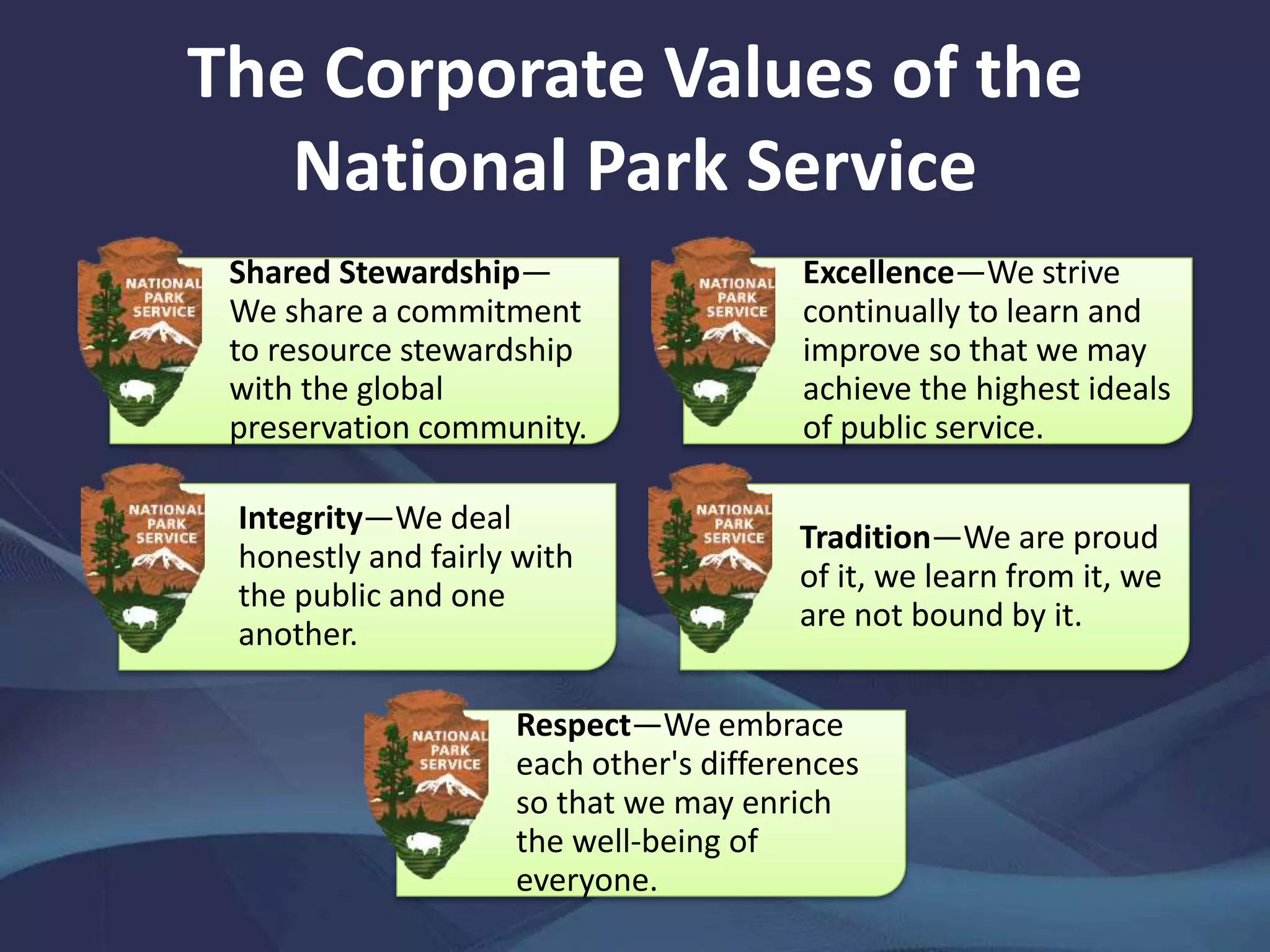
The Corporate Values of the
National Park Service
Shared Stewardship—
We share a commitment
to resource stewardship
with the global
preservation community.
Excellence—We strive
continually to learn and
improve so that we may
achieve the highest ideals
of public service.
Integrity—We deal
honestly and fairly with
the public and one
another.
Tradition—We are proud
of it, we learn from it, we
are not bound by it.
Respect—We embrace
each other's differences
so that we may enrich
the well-being of
everyone.
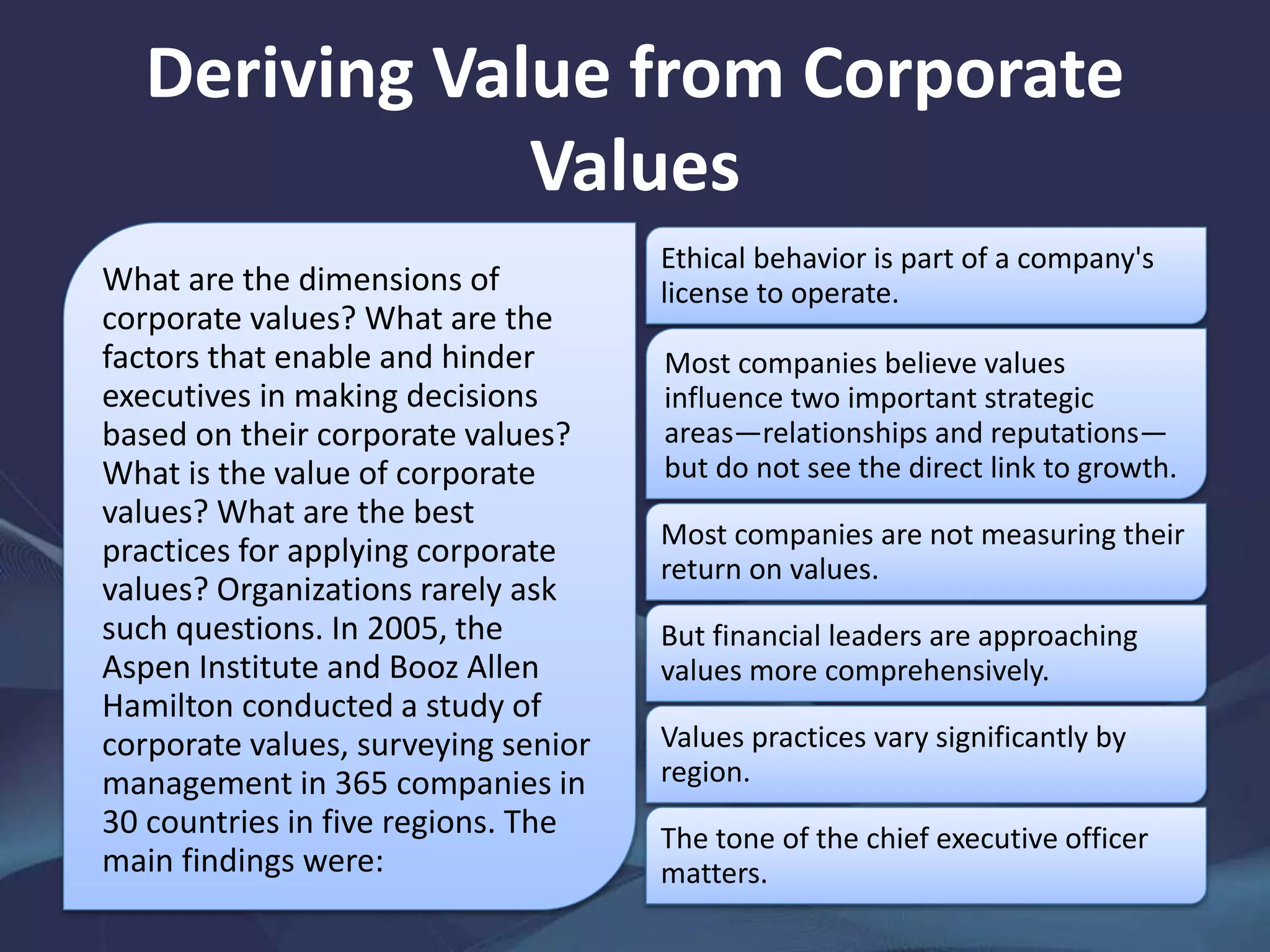
Deriving Value from Corporate
Values
What are the dimensions of
corporate values? What are the
factors that enable and hinder
executives in making decisions
based on their corporate values?
What is the value of corporate
values? What are the best
practices for applying corporate
values? Organizations rarely ask
such questions. In 2005, the
Aspen Institute and Booz Allen
Hamilton conducted a study of
corporate values, surveying senior
management in 365 companies in
30 countries in five regions. The
main findings were:
Ethical behavior is part of a company's
license to operate.
Most companies believe values
influence two important strategic
areas—relationships and reputations—
but do not see the direct link to growth.
Most companies are not measuring their
return on values.
But financial leaders are approaching
values more comprehensively.
Values practices vary significantly by
region.
The tone of the chief executive officer
matters.
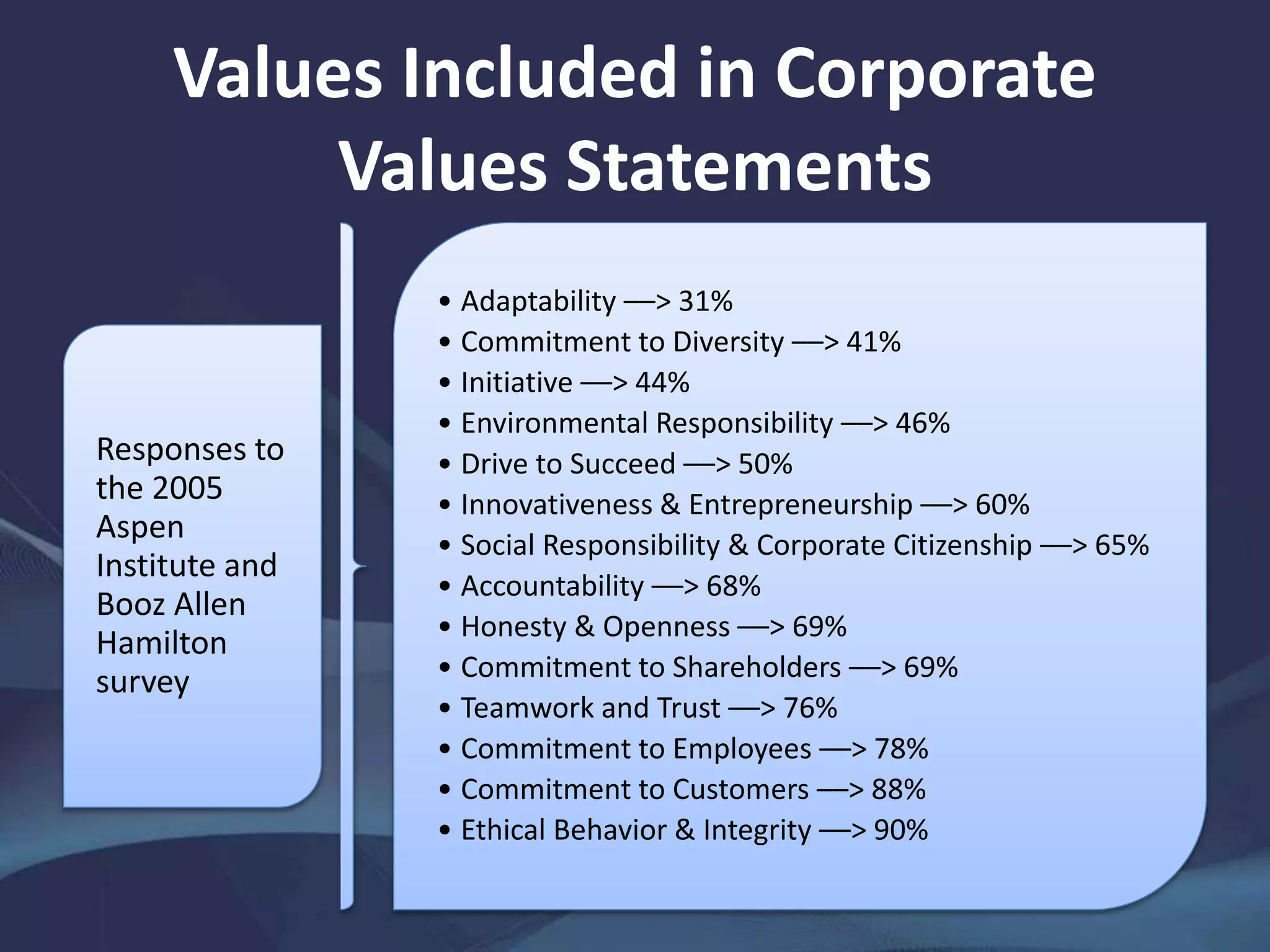
Values Included in Corporate
Values Statements
Source:
Responses to
the 2005
Aspen
Institute and
Booz Allen
Hamilton
survey.
• Adaptability ––> 31%
• Commitment to Diversity ––> 41%
• Initiative ––> 44%
• Environmental Responsibility ––> 46%
• Drive to Succeed ––> 50%
• Innovativeness & Entrepreneurship ––> 60%
• Social Responsibility & Corporate Citizenship ––> 65%
• Accountability ––> 68%
• Honesty & Openness ––> 69%
• Commitment to Shareholders ––> 69%
• Teamwork and Trust ––> 76%
• Commitment to Employees ––> 78%
• Commitment to Customers ––> 88%
• Ethical Behavior & Integrity ––> 90%
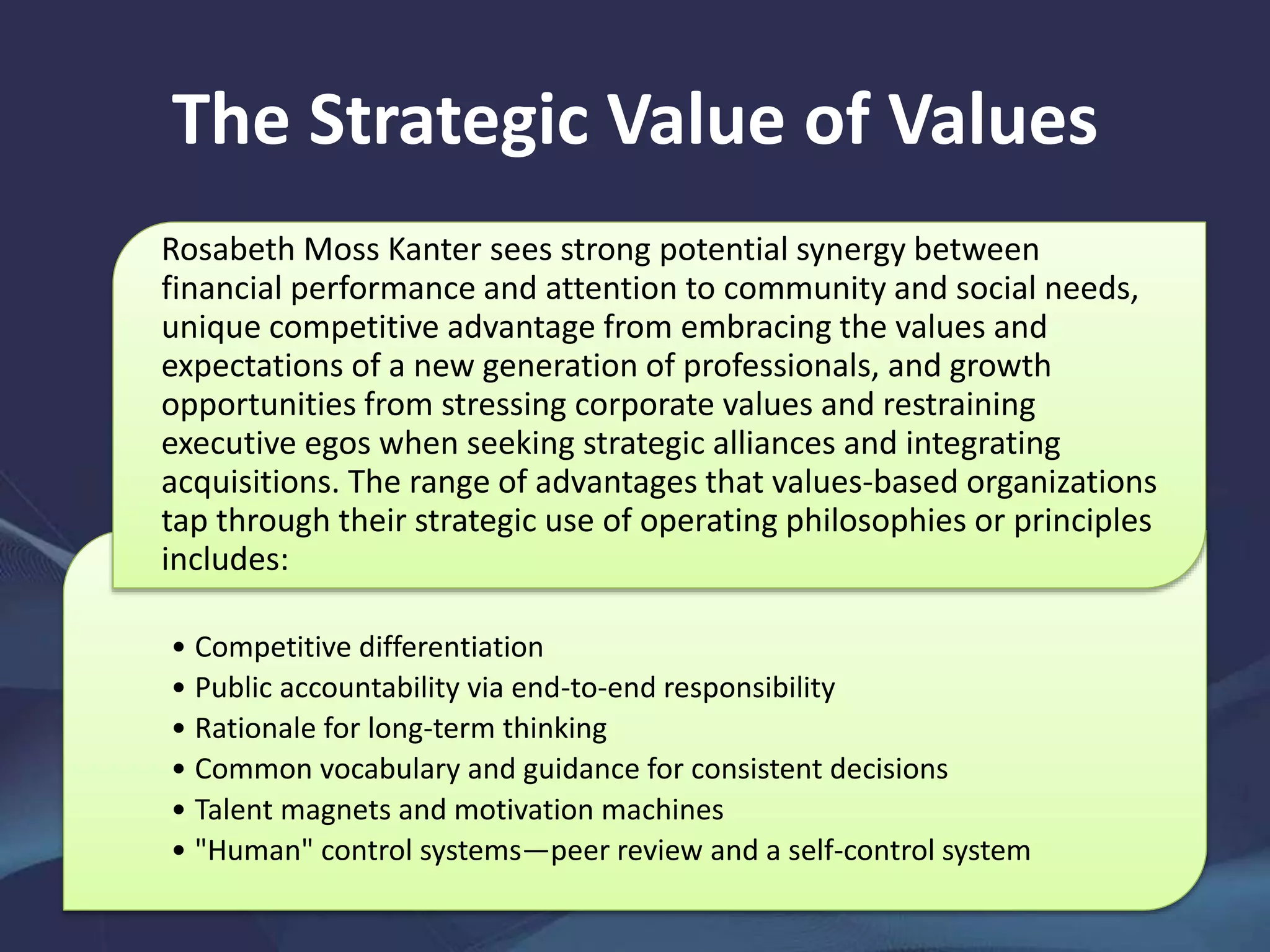
The Strategic Value of Values
• Competitive differentiation
• Public accountability via end-to-end responsibility
• Rationale for long-term thinking
• Common vocabulary and guidance for consistent decisions
• Talent magnets and motivation machines
• "Human" control systems—peer review and a self-control system
Rosabeth Moss Kanter sees strong potential synergy between
financial performance and attention to community and social needs,
unique competitive advantage from embracing the values and
expectations of a new generation of professionals, and growth
opportunities from stressing corporate values and restraining
executive egos when seeking strategic alliances and integrating
acquisitions. The range of advantages that values-based organizations
tap through their strategic use of operating philosophies or principles
includes:
A Corporate Values Start-Up Kit
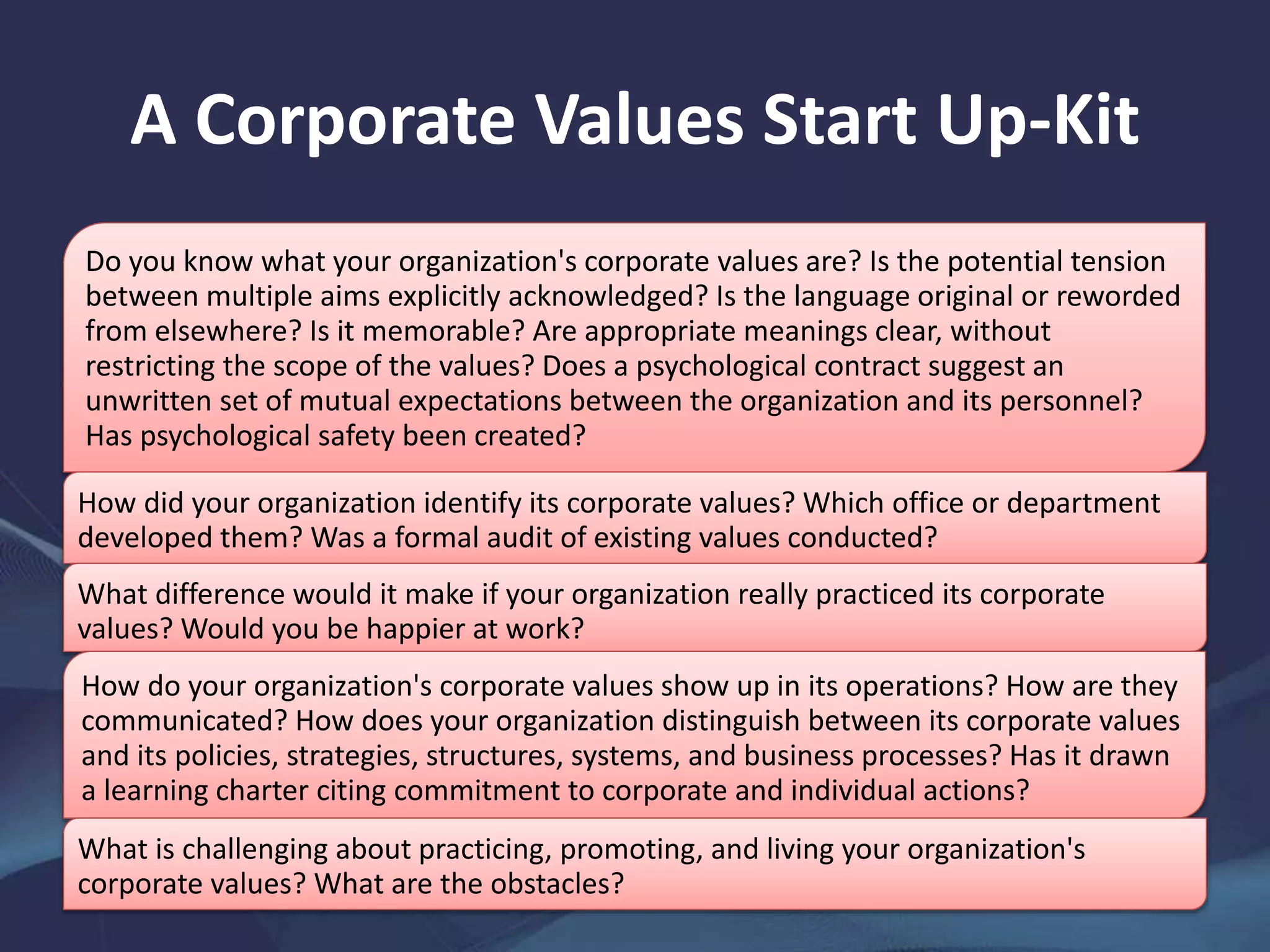
Do you know what your organization's corporate values are? Is the potential tension
between multiple aims explicitly acknowledged? Is the language original or reworded
from elsewhere? Is it memorable? Are appropriate meanings clear, without
restricting the scope of the values? Does a psychological contract suggest an
unwritten set of mutual expectations between the organization and its personnel?
Has psychological safety been created?
How did your organization identify its corporate values? Which office or department
developed them? Was a formal audit of existing values conducted?
What difference would it make if your organization really practiced its corporate
values? Would you be happier at work?
How do your organization's corporate values show up in its operations? How are they
communicated? How does your organization distinguish between its corporate values
and its policies, strategies, structures, systems, and business processes? Has it drawn
a learning charter citing commitment to corporate and individual actions?
What is challenging about practicing, promoting, and living your organization's
corporate values? What are the obstacles?
A Corporate Values Start-Up Kit
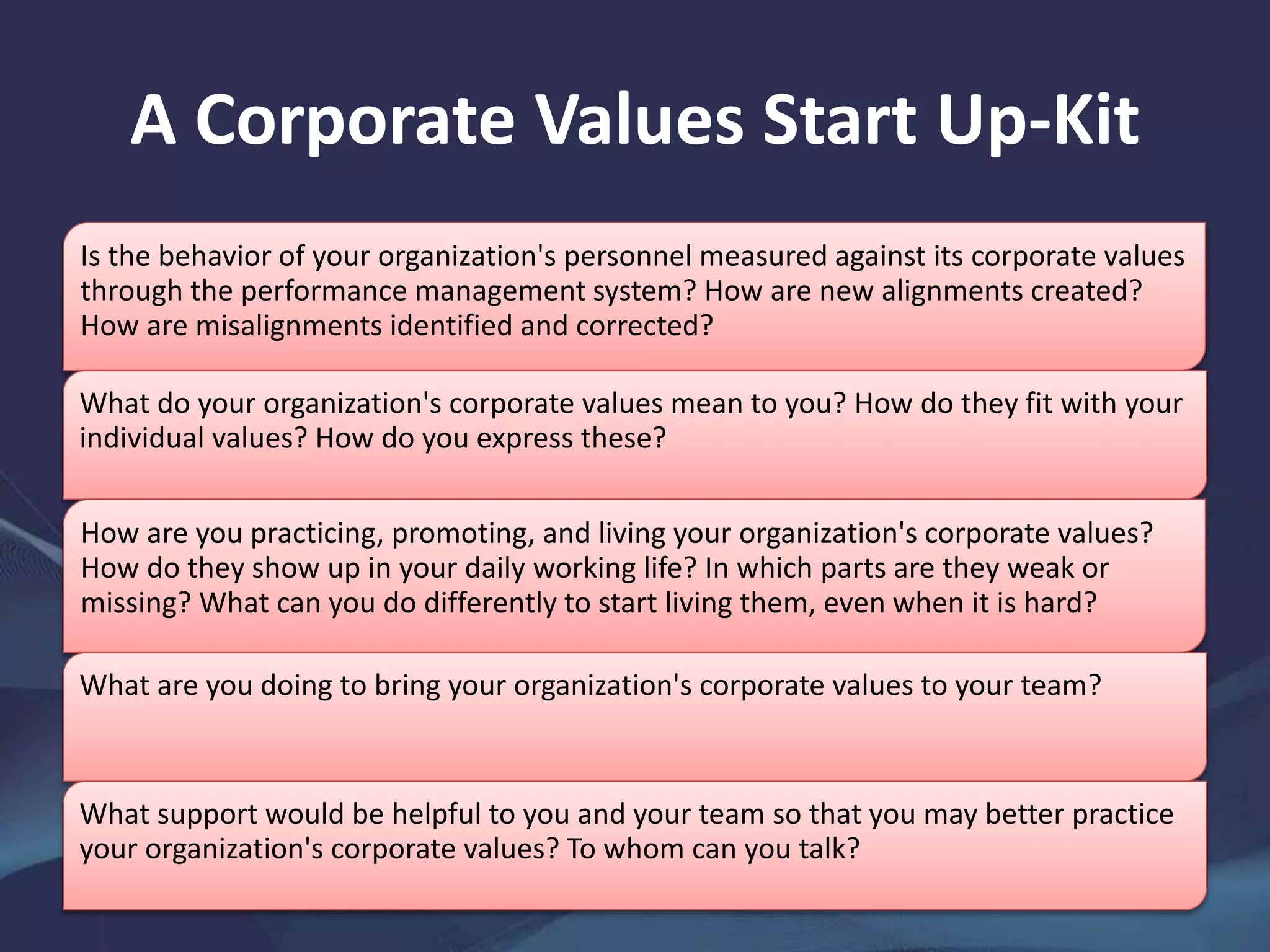
Is the behavior of your organization's personnel measured against its corporate values
through the performance management system? How are new alignments created?
How are misalignments identified and corrected?
What do your organization's corporate values mean to you? How do they fit with your
individual values? How do you express these?
How are you practicing, promoting, and living your organization's corporate values?
How do they show up in your daily working life? In which parts are they weak or
missing? What can you do differently to start living them, even when it is hard?
What are you doing to bring your organization's corporate values to your team?
What support would be helpful to you and your team so that you may better practice
your organization's corporate values? To whom can you talk?
Further Reading
• ADB. 2009. Building Trust in the Workplace. Manila.
www.adb.org/publications/building-trust-workplace
• ――. 2009. Drawing Learning Charters. Manila.
www.adb.org/publications/drawing-learning-charters
• ――. 2009. A Primer on Organizational Culture. Manila.
www.adb.org/publications/primer-organizational-culture
• ――. 2010. New-Age Branding and the Public Sector. Manila.
www.adb.org/publications/new-age-branding-and-public-
sector
• ――. 2010. A Primer on Talent Management. Manila.
www.adb.org/publications/primer-talent-management
Further Reading
• ADB. 2010. Engaging Staff in the Workplace. Manila.
www.adb.org/publications/engaging-staff-workplace
• ――. 2010. Our People Strategy: Skills and Passion to Improve
Lives in Asia and the Pacific. Manila.
www.adb.org/publications/our-people-strategy-skills-and-
passion-improve-lives-asia-and-pacific
• ――. 2011. Forestalling Change Fatigue. Manila.
www.adb.org/publications/forestalling-change-fatigue
• ――. 2011. A Primer on Corporate Governance. Manila.
www.adb.org/publications/primer-corporate-governance
• ――. 2012. On Organizational Configurations. Manila.
www.adb.org/publications/organizational-configurations
Further Reading
• ADB. 2012. Knowledge as Culture. Manila.
www.adb.org/publications/knowledge-culture
• ――. 2012. On Knowledge Behaviors. Manila.
www.adb.org/publications/knowledge-behaviors
• Rosabeth Moss Kanter. 2009. SuperCorp: How Vanguard
Companies Create Innovation, Profits, Growth, and Social
Good. Crown Business.
• Chris Kelly, Paul Kocourek, Nancy McGaw, and Judith
Samuelson. 2005. Deriving Value from Corporate Values. The
Aspen Institute and Booz Allen Hamilton.
• David Rock and Jeffrey Schwartz. 2006. The Neuroscience of
Leadership. strategy+business. Vol. 43.
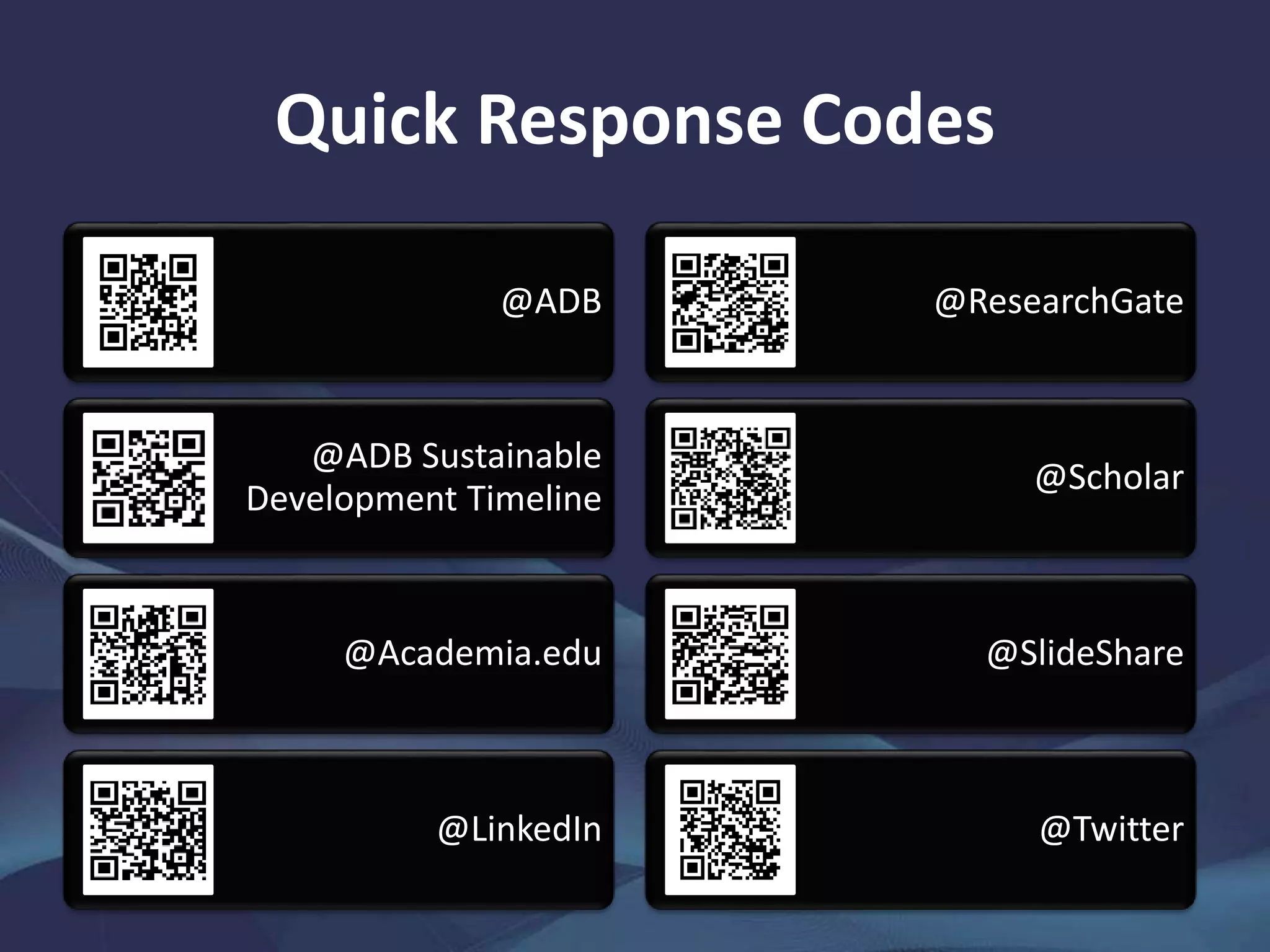
Quick Response Codes
@ADB
@ADB Sustainable
Development Timeline
@Academia.edu
@LinkedIn
@ResearchGate
@Scholar
@SlideShare
@Twitter

Building on Values

  • 1.
    The views expressedin this publication are those of the author(s) and do not necessarily reflect the views and policies of the Asian Development Bank (ADB) or its Board of Governors or the governments they represent. By making any designation of or reference to a particular territory or geographic area, or by using the term "country" in this document, ADB does not intend to make any judgments as to the legal or other status of any territory or area. Building on Values Olivier Serrat 2016
  • 2.
    Selling Corporate Values Advertisingstrong, positive corporate values is à la mode. In a globalizing world, we are told they can instill a sense of identity and purpose in organizations; add spirit to the workplace; align and unify people; promote employee ownership; attract newcomers; create consistency; simplify decision making; energize endeavors; raise efficiency; hearten client trust, loyalty, and forgiveness for mistakes; build resilience to shocks; and contribute to society at large. However, corporate values can backfire with glare when management or personnel fail to live up to the messages, a sure recipe for disenchantment or cynicism all round. Lest they become debased, corporate values should not be platitudes, orders of preference expressed in operational jargon, or even simple aspirations. They should not be politically correct. To serve as real guidance systems, living values that spring from integrity, morality, and ethics must be internalized and reviewed to maintain relevance in changing contexts.
  • 3.
    Brainy Quotes: CoreValues Men acquire a particular quality by constantly acting in a particular way.— Aristotle Effectiveness without values is a tool without a purpose.— Edward de Bono It's not hard to make decisions when you know what your values are.—Roy Disney Try not to become a man of success but rather try to become a man of value.— Albert Einstein Happiness is that state of consciousness which proceeds from the achievement of one's values.—Ayn Rand Anything that changes your values changes your behavior.—George Sheehan
  • 4.
    The Neuroscience ofCorporate Values In The Neuroscience of Leadership, David Rock and Jeffrey Schwartz share a few home truths on organizational transformation. They bear relevance since change is what the introduction of corporate values usually purports, at least from the outset: • Change is pain. Organizational change is unexpectedly difficult because it provokes sensations of physiological discomfort. • Behaviorism does not work. Change efforts based on incentive and threat (the carrot and the stick) rarely succeed in the long run. • Humanism is overrated. In practice, the conventional empathic approach of connection and persuasion does not sufficiently engage people. • Focus is power. The act of paying attention creates chemical and physical changes in the brain. • Expectation shapes reality. The preconceptions of people significant impact what they perceive. • Attention density shapes identity. Repeated, purposeful, and focused attention can lead to long-lasting personal evolution.
  • 5.
    The Meaning ofCorporate Values Corporate values do not equate with organizational culture: that describes the attitudes, experiences, beliefs, and values of the organization, acquired through social learning, which control the way individuals and groups interact with one another and with parties outside the organization. Corporate values are first- order operating philosophies or principles, to be acted upon, that guide an organization's internal conduct and its relationship with the external world. They do not drive the business; however, if they are imbedded in business processes—and made credible to skeptics— they inspire the people who deliver the business, with a healthy balance between work and life and between the short term and the long term. The ultimate glue that bonds, corporate values are usually formalized in explicit—often espoused, not just embedded— mission statements, tag lines, and branding material.
  • 6.
    The Corporate Valuesof the National Park Service Shared Stewardship— We share a commitment to resource stewardship with the global preservation community. Excellence—We strive continually to learn and improve so that we may achieve the highest ideals of public service. Integrity—We deal honestly and fairly with the public and one another. Tradition—We are proud of it, we learn from it, we are not bound by it. Respect—We embrace each other's differences so that we may enrich the well-being of everyone.
  • 7.
    Deriving Value fromCorporate Values What are the dimensions of corporate values? What are the factors that enable and hinder executives in making decisions based on their corporate values? What is the value of corporate values? What are the best practices for applying corporate values? Organizations rarely ask such questions. In 2005, the Aspen Institute and Booz Allen Hamilton conducted a study of corporate values, surveying senior management in 365 companies in 30 countries in five regions. The main findings were: Ethical behavior is part of a company's license to operate. Most companies believe values influence two important strategic areas—relationships and reputations— but do not see the direct link to growth. Most companies are not measuring their return on values. But financial leaders are approaching values more comprehensively. Values practices vary significantly by region. The tone of the chief executive officer matters.
  • 8.
    Values Included inCorporate Values Statements Source: Responses to the 2005 Aspen Institute and Booz Allen Hamilton survey. • Adaptability ––> 31% • Commitment to Diversity ––> 41% • Initiative ––> 44% • Environmental Responsibility ––> 46% • Drive to Succeed ––> 50% • Innovativeness & Entrepreneurship ––> 60% • Social Responsibility & Corporate Citizenship ––> 65% • Accountability ––> 68% • Honesty & Openness ––> 69% • Commitment to Shareholders ––> 69% • Teamwork and Trust ––> 76% • Commitment to Employees ––> 78% • Commitment to Customers ––> 88% • Ethical Behavior & Integrity ––> 90%
  • 9.
    The Strategic Valueof Values • Competitive differentiation • Public accountability via end-to-end responsibility • Rationale for long-term thinking • Common vocabulary and guidance for consistent decisions • Talent magnets and motivation machines • "Human" control systems—peer review and a self-control system Rosabeth Moss Kanter sees strong potential synergy between financial performance and attention to community and social needs, unique competitive advantage from embracing the values and expectations of a new generation of professionals, and growth opportunities from stressing corporate values and restraining executive egos when seeking strategic alliances and integrating acquisitions. The range of advantages that values-based organizations tap through their strategic use of operating philosophies or principles includes:
  • 10.
    A Corporate ValuesStart-Up Kit Do you know what your organization's corporate values are? Is the potential tension between multiple aims explicitly acknowledged? Is the language original or reworded from elsewhere? Is it memorable? Are appropriate meanings clear, without restricting the scope of the values? Does a psychological contract suggest an unwritten set of mutual expectations between the organization and its personnel? Has psychological safety been created? How did your organization identify its corporate values? Which office or department developed them? Was a formal audit of existing values conducted? What difference would it make if your organization really practiced its corporate values? Would you be happier at work? How do your organization's corporate values show up in its operations? How are they communicated? How does your organization distinguish between its corporate values and its policies, strategies, structures, systems, and business processes? Has it drawn a learning charter citing commitment to corporate and individual actions? What is challenging about practicing, promoting, and living your organization's corporate values? What are the obstacles?
  • 11.
    A Corporate ValuesStart-Up Kit Is the behavior of your organization's personnel measured against its corporate values through the performance management system? How are new alignments created? How are misalignments identified and corrected? What do your organization's corporate values mean to you? How do they fit with your individual values? How do you express these? How are you practicing, promoting, and living your organization's corporate values? How do they show up in your daily working life? In which parts are they weak or missing? What can you do differently to start living them, even when it is hard? What are you doing to bring your organization's corporate values to your team? What support would be helpful to you and your team so that you may better practice your organization's corporate values? To whom can you talk?
  • 12.
    Further Reading • ADB.2009. Building Trust in the Workplace. Manila. www.adb.org/publications/building-trust-workplace • ――. 2009. Drawing Learning Charters. Manila. www.adb.org/publications/drawing-learning-charters • ――. 2009. A Primer on Organizational Culture. Manila. www.adb.org/publications/primer-organizational-culture • ――. 2010. New-Age Branding and the Public Sector. Manila. www.adb.org/publications/new-age-branding-and-public- sector • ――. 2010. A Primer on Talent Management. Manila. www.adb.org/publications/primer-talent-management
  • 13.
    Further Reading • ADB.2010. Engaging Staff in the Workplace. Manila. www.adb.org/publications/engaging-staff-workplace • ――. 2010. Our People Strategy: Skills and Passion to Improve Lives in Asia and the Pacific. Manila. www.adb.org/publications/our-people-strategy-skills-and- passion-improve-lives-asia-and-pacific • ――. 2011. Forestalling Change Fatigue. Manila. www.adb.org/publications/forestalling-change-fatigue • ――. 2011. A Primer on Corporate Governance. Manila. www.adb.org/publications/primer-corporate-governance • ――. 2012. On Organizational Configurations. Manila. www.adb.org/publications/organizational-configurations
  • 14.
    Further Reading • ADB.2012. Knowledge as Culture. Manila. www.adb.org/publications/knowledge-culture • ――. 2012. On Knowledge Behaviors. Manila. www.adb.org/publications/knowledge-behaviors • Rosabeth Moss Kanter. 2009. SuperCorp: How Vanguard Companies Create Innovation, Profits, Growth, and Social Good. Crown Business. • Chris Kelly, Paul Kocourek, Nancy McGaw, and Judith Samuelson. 2005. Deriving Value from Corporate Values. The Aspen Institute and Booz Allen Hamilton. • David Rock and Jeffrey Schwartz. 2006. The Neuroscience of Leadership. strategy+business. Vol. 43.
  • 15.
    Quick Response Codes @ADB @ADBSustainable Development Timeline @Academia.edu @LinkedIn @ResearchGate @Scholar @SlideShare @Twitter