Executive Leadership Development Through Service on Nonprofit Boards A Joint Study by American Express Company &The Volunteer Consulting Group © VCG, Inc. 2000  David LaGreca, Executive Director [email_address]
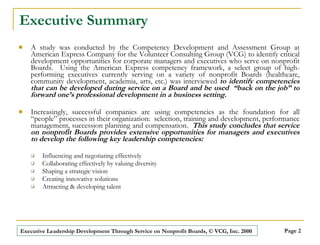
Executive Summary A study was conducted by the Competency Development and Assessment Group at American Express Company for the Volunteer Consulting Group (VCG) to identify critical development opportunities for corporate managers and executives who serve on nonprofit Boards.  Using the American Express competency framework, a select group of high-performing executives currently serving on a variety of nonprofit Boards (healthcare, community development, academia, arts, etc.) was interviewed  to identify competencies that can be developed during service on a Board and be used  “back on the job” to forward one’s professional development in a business setting. Increasingly, successful companies are using competencies as the foundation for all “people” processes in their organization:  selection, training and development, performance management, succession planning and compensation.  This study concludes that service on nonprofit Boards provides extensive opportunities for managers and executives to develop the following key leadership competencies: Influencing and negotiating effectively Collaborating effectively by valuing diversity Shaping a strategic vision Creating innovative solutions Attracting & developing talent
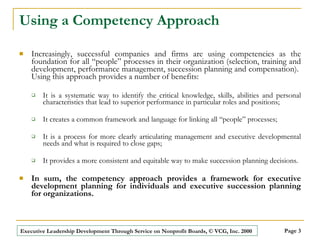
Using a Competency Approach Increasingly, successful companies and firms are using competencies as the foundation for all “people” processes in their organization (selection, training and development, performance management, succession planning and compensation).  Using this approach provides a number of benefits:  It is a systematic way to identify the critical knowledge, skills, abilities and personal characteristics that lead to superior performance in particular roles and positions; It creates a common framework and language for linking all “people” processes; It is a process for more clearly articulating management and executive developmental needs and what is required to close gaps; It provides a more consistent and equitable way to make succession planning decisions. In sum, the competency approach provides a framework for executive development planning for individuals and executive succession planning for organizations.
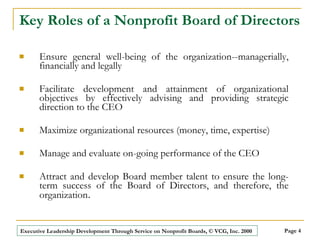
Key Roles of a Nonprofit Board of Directors Ensure general well-being of the organization--managerially, financially and legally Facilitate development and attainment of organizational objectives by effectively advising and providing strategic direction to the CEO Maximize organizational resources (money, time, expertise) Manage and evaluate on-going performance of the CEO Attract and develop Board member talent to ensure the long-term success of the Board of Directors, and therefore, the organization .
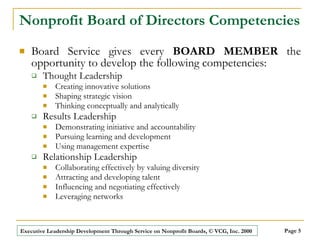
Nonprofit Board of Directors Competencies Board Service gives every  BOARD MEMBER  the opportunity to develop the following competencies:   Thought Leadership Creating innovative solutions Shaping strategic vision Thinking conceptually and analytically Results Leadership Demonstrating initiative and accountability  Pursuing learning and development Using management expertise Relationship Leadership Collaborating effectively by valuing diversity  Attracting and developing talent Influencing and negotiating effectively Leveraging networks
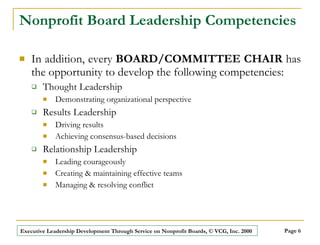
Nonprofit Board Leadership Competencies In addition, every  BOARD/COMMITTEE CHAIR  has the opportunity to develop the following competencies: Thought Leadership Demonstrating organizational perspective Results Leadership Driving results Achieving consensus-based decisions Relationship Leadership Leading courageously Creating & maintaining effective teams Managing & resolving conflict
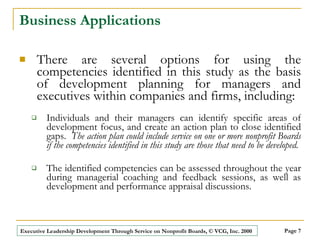
Business Applications There are several options for using the competencies identified in this study as the basis of development planning for managers and executives within companies and firms, including: Individuals and their managers can identify specific areas of development focus, and create an action plan to close identified gaps.  The action plan could include service on one or more nonprofit Boards if the competencies identified in this study are those that need to be developed.  The identified competencies can be assessed throughout the year during managerial coaching and feedback sessions, as well as development and performance appraisal discussions.
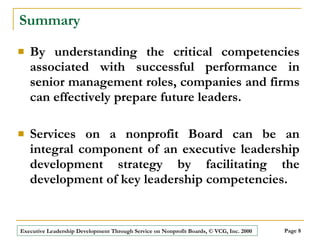
Summary By understanding the critical competencies associated with successful performance in senior management roles, companies and firms can effectively prepare future leaders.  Services on a nonprofit Board can be an integral component of an executive leadership development strategy by facilitating the development of key leadership competencies.

VCG - American Express Study

  • 1.
    ExecutiveLeadership Development Through Service on Nonprofit Boards A Joint Study by American Express Company &The Volunteer Consulting Group © VCG, Inc. 2000 David LaGreca, Executive Director [email_address]
  • 2.
    Executive Summary Astudy was conducted by the Competency Development and Assessment Group at American Express Company for the Volunteer Consulting Group (VCG) to identify critical development opportunities for corporate managers and executives who serve on nonprofit Boards. Using the American Express competency framework, a select group of high-performing executives currently serving on a variety of nonprofit Boards (healthcare, community development, academia, arts, etc.) was interviewed to identify competencies that can be developed during service on a Board and be used “back on the job” to forward one’s professional development in a business setting. Increasingly, successful companies are using competencies as the foundation for all “people” processes in their organization: selection, training and development, performance management, succession planning and compensation. This study concludes that service on nonprofit Boards provides extensive opportunities for managers and executives to develop the following key leadership competencies: Influencing and negotiating effectively Collaborating effectively by valuing diversity Shaping a strategic vision Creating innovative solutions Attracting & developing talent
  • 3.
    Using a CompetencyApproach Increasingly, successful companies and firms are using competencies as the foundation for all “people” processes in their organization (selection, training and development, performance management, succession planning and compensation). Using this approach provides a number of benefits: It is a systematic way to identify the critical knowledge, skills, abilities and personal characteristics that lead to superior performance in particular roles and positions; It creates a common framework and language for linking all “people” processes; It is a process for more clearly articulating management and executive developmental needs and what is required to close gaps; It provides a more consistent and equitable way to make succession planning decisions. In sum, the competency approach provides a framework for executive development planning for individuals and executive succession planning for organizations.
  • 4.
    Key Roles ofa Nonprofit Board of Directors Ensure general well-being of the organization--managerially, financially and legally Facilitate development and attainment of organizational objectives by effectively advising and providing strategic direction to the CEO Maximize organizational resources (money, time, expertise) Manage and evaluate on-going performance of the CEO Attract and develop Board member talent to ensure the long-term success of the Board of Directors, and therefore, the organization .
  • 5.
    Nonprofit Board ofDirectors Competencies Board Service gives every BOARD MEMBER the opportunity to develop the following competencies: Thought Leadership Creating innovative solutions Shaping strategic vision Thinking conceptually and analytically Results Leadership Demonstrating initiative and accountability Pursuing learning and development Using management expertise Relationship Leadership Collaborating effectively by valuing diversity Attracting and developing talent Influencing and negotiating effectively Leveraging networks
  • 6.
    Nonprofit Board LeadershipCompetencies In addition, every BOARD/COMMITTEE CHAIR has the opportunity to develop the following competencies: Thought Leadership Demonstrating organizational perspective Results Leadership Driving results Achieving consensus-based decisions Relationship Leadership Leading courageously Creating & maintaining effective teams Managing & resolving conflict
  • 7.
    Business Applications Thereare several options for using the competencies identified in this study as the basis of development planning for managers and executives within companies and firms, including: Individuals and their managers can identify specific areas of development focus, and create an action plan to close identified gaps. The action plan could include service on one or more nonprofit Boards if the competencies identified in this study are those that need to be developed. The identified competencies can be assessed throughout the year during managerial coaching and feedback sessions, as well as development and performance appraisal discussions.
  • 8.
    Summary By understandingthe critical competencies associated with successful performance in senior management roles, companies and firms can effectively prepare future leaders. Services on a nonprofit Board can be an integral component of an executive leadership development strategy by facilitating the development of key leadership competencies.