TRUSTEE RECRUITMENT
DAN FRANCIS
GOVERNANCE CONSULTANT, NCVO
IAN JOSEPH
CHIEF EXECUTIVE - TRUSTEES UNLIMITED
MANAGING DIRECTOR - RUSSAM GMS
How many trustees are there in the UK?
Over 1,000,000
What proportion of charities have a trustee
vacancy?
Almost 50%
THIS SESSION
In this session we will cover…
• Why is trustee recruitment important
• Diversity and its value
• Preparing for new trustees
• Adverting and recruiting to vacancies
• Answer any questions
WHY IS RECRUITMENT IMPORTANT
4
WHO ARE THE TRUSTEES?
The persons having the general control
and management of the administration
of a charity.
Section 177 of the Charities Act 2011
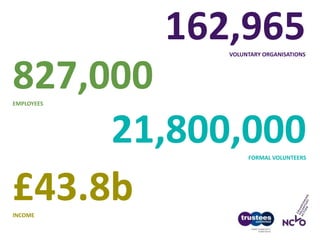
162,965VOLUNTARY ORGANISATIONS
21,800,000FORMAL VOLUNTEERS
827,000EMPLOYEES
£43.8bINCOME
CURRENT CHALLENGES
FINDING NEW TRUSTEES
CC30: Trustees matter a great deal to any organisation. It is very important for any
charity to have trustees committed to their task and with the skills, knowledge and
experience that the charity needs.
In more detail
Trustees play an essential role in the governance of charities. They also have a lot to
contribute to their success. For example they can:
• Serve as a means of communication with communities that a charity exists to
serve
• Bring valuable professional or other experience to charities
• Help to ensure that charities are well-managed through the appointment of senior
executive staff
BOARD COMPOSITION
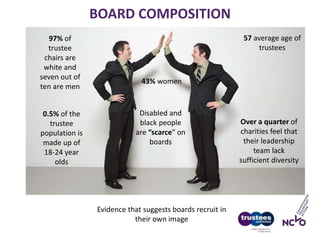
97% of
trustee
chairs are
white and
seven out of
ten are men
0.5% of the
trustee
population is
made up of
18-24 year
olds
43% women
Disabled and
black people
are “scarce” on
boards
Over a quarter of
charities feel that
their leadership
team lack
sufficient diversity
57 average age of
trustees
Evidence that suggests boards recruit in
their own image
WHY IS IT IMPORTANT
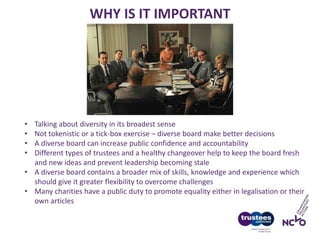
• Talking about diversity in its broadest sense
• Not tokenistic or a tick-box exercise – diverse board make better decisions
• A diverse board can increase public confidence and accountability
• Different types of trustees and a healthy changeover help to keep the board fresh
and new ideas and prevent leadership becoming stale
• A diverse board contains a broader mix of skills, knowledge and experience which
should give it greater flexibility to overcome challenges
• Many charities have a public duty to promote equality either in legalisation or their
own articles
PREPARING FOR NEW TRUSTEES
11
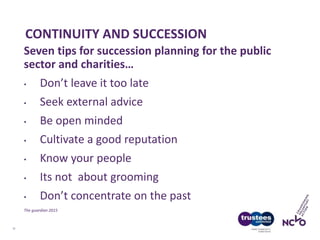
CONTINUITY AND SUCCESSION
12
Seven tips for succession planning for the public
sector and charities…
• Don’t leave it too late
• Seek external advice
• Be open minded
• Cultivate a good reputation
• Know your people
• Its not about grooming
• Don’t concentrate on the past
The guardian 2015
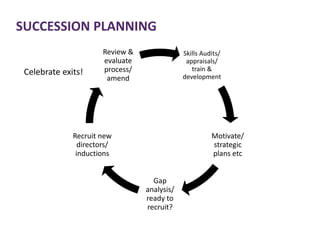
SUCCESSION PLANNING
Skills Audits/
appraisals/
train &
development
Motivate/
strategic
plans etc
Gap
analysis/
ready to
recruit?
Recruit new
directors/
inductions
Review &
evaluate
process/
amend
Celebrate exits!
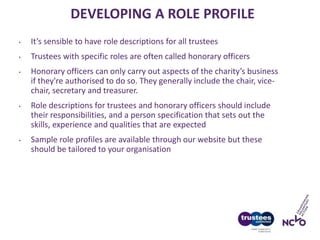
DEVELOPING A ROLE PROFILE
• It’s sensible to have role descriptions for all trustees
• Trustees with specific roles are often called honorary officers
• Honorary officers can only carry out aspects of the charity’s business
if they're authorised to do so. They generally include the chair, vice-
chair, secretary and treasurer.
• Role descriptions for trustees and honorary officers should include
their responsibilities, and a person specification that sets out the
skills, experience and qualities that are expected
• Sample role profiles are available through our website but these
should be tailored to your organisation
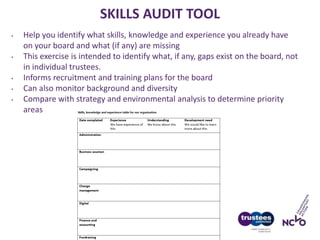
SKILLS AUDIT TOOL
• Help you identify what skills, knowledge and experience you already have
on your board and what (if any) are missing
• This exercise is intended to identify what, if any, gaps exist on the board, not
in individual trustees.
• Informs recruitment and training plans for the board
• Can also monitor background and diversity
• Compare with strategy and environmental analysis to determine priority
areas
INDUCTION PLANNING
• Induction is an opportunity for new trustees to learn about their role
and the charity
• It should be a planned as there’s considerable risk in getting it wrong
Five key things to think about in induction:
1. What training needs for the individual?
2. What information do you need to provide the new trustee with?
3. How do you build relationships and trust between board members?
4. Who does the new trustee need to meet?
5. How is this new trustees time best used?
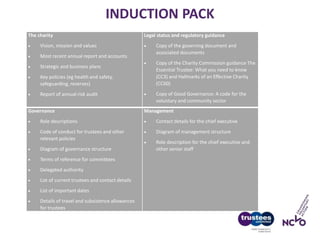
INDUCTION PACK
The charity
 Vision, mission and values
 Most recent annual report and accounts
 Strategic and business plans
 Key policies (eg health and safety,
safeguarding, reserves)
 Report of annual risk audit
Legal status and regulatory guidance
 Copy of the governing document and
associated documents
 Copy of the Charity Commission guidance The
Essential Trustee: What you need to know
(CC3) and Hallmarks of an Effective Charity
(CC60)
 Copy of Good Governance: A code for the
voluntary and community sector
Governance
 Role descriptions
 Code of conduct for trustees and other
relevant policies
 Diagram of governance structure
 Terms of reference for committees
 Delegated authority
 List of current trustees and contact details
 List of important dates
 Details of travel and subsistence allowances
for trustees
Management
 Contact details for the chief executive
 Diagram of management structure
 Role description for the chief executive and
other senior staff
ADVERTISING AND RECRUITING
18
TESTING THE MARKET
• Refer to your constitution about process!
• Engage the whole board in the process
• Create a role description and person specification
• Create a compelling candidate pack
• Write a punchy advertisement!
• Use social media and other channels to promote your opportunity
• Consider using a professional recruitment firm with a track record of
recruiting trustees.
• Have a clear process for informal meetings, tours of services and
interviews
• Interviews should be evidenced based to test motivation as well as
skills and experience
• Take references – always verbal
ROLE DESCRIPTION
• Remuneration
• Location
• Commitment
• Key responsibilities e.g. Ensuring the charity has a clear vision,
mission and strategic direction, Being responsible for the
performance of the charity and for its culture
• Statutory duties (part 2 of CC3) e.g. Ensure your charity is carrying
out its purposes for the public benefit
• Additional duties
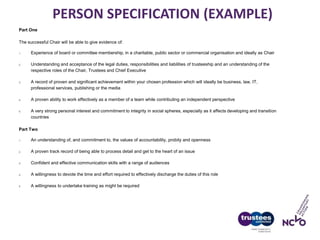
PERSON SPECIFICATION (EXAMPLE)
Part One
The successful Chair will be able to give evidence of:
1. Experience of board or committee membership, in a charitable, public sector or commercial organisation and ideally as Chair
2. Understanding and acceptance of the legal duties, responsibilities and liabilities of trusteeship and an understanding of the
respective roles of the Chair, Trustees and Chief Executive
3. A record of proven and significant achievement within your chosen profession which will ideally be business, law, IT,
professional services, publishing or the media
4. A proven ability to work effectively as a member of a team while contributing an independent perspective
5. A very strong personal interest and commitment to integrity in social spheres, especially as it affects developing and transition
countries
Part Two
1. An understanding of, and commitment to, the values of accountability, probity and openness
2. A proven track record of being able to process detail and get to the heart of an issue
3. Confident and effective communication skills with a range of audiences
4. A willingness to devote the time and effort required to effectively discharge the duties of this role
5. A willingness to undertake training as might be required
CHANNELS
• LinkedIn (direct or groups e.g. Young Charity Trustees or alumni)
• ICAEWVolunteer
• Do-it.org
• Charityjob
• Jobsincharities
• Guardian
• Broadsheets (online or print)
• Local CVS
• Word of mouth!
• Engaging recruiters
TESTING THE MARKET
• Have a clear process for informal meetings, tours of services and
interviews
• Interviews should be evidenced based to test motivation as well as
skills and experience
• Take references – always verbal
FOR MORE…
WWW.KNOWHOWNONPRO
FIT.ORG/TOOLS-
RESOURCES/BOARD-BASICS/
24
THANK YOU
Dan.francis@ncvo.org.uk
25

Recruiting Trustees to your charity

  • 1.
    TRUSTEE RECRUITMENT DAN FRANCIS GOVERNANCECONSULTANT, NCVO IAN JOSEPH CHIEF EXECUTIVE - TRUSTEES UNLIMITED MANAGING DIRECTOR - RUSSAM GMS
  • 2.
    How many trusteesare there in the UK? Over 1,000,000 What proportion of charities have a trustee vacancy? Almost 50%
  • 3.
    THIS SESSION In thissession we will cover… • Why is trustee recruitment important • Diversity and its value • Preparing for new trustees • Adverting and recruiting to vacancies • Answer any questions
  • 4.
    WHY IS RECRUITMENTIMPORTANT 4
  • 5.
    WHO ARE THETRUSTEES? The persons having the general control and management of the administration of a charity. Section 177 of the Charities Act 2011
  • 6.
  • 7.
  • 8.
    FINDING NEW TRUSTEES CC30:Trustees matter a great deal to any organisation. It is very important for any charity to have trustees committed to their task and with the skills, knowledge and experience that the charity needs. In more detail Trustees play an essential role in the governance of charities. They also have a lot to contribute to their success. For example they can: • Serve as a means of communication with communities that a charity exists to serve • Bring valuable professional or other experience to charities • Help to ensure that charities are well-managed through the appointment of senior executive staff
  • 9.
    BOARD COMPOSITION 97% of trustee chairsare white and seven out of ten are men 0.5% of the trustee population is made up of 18-24 year olds 43% women Disabled and black people are “scarce” on boards Over a quarter of charities feel that their leadership team lack sufficient diversity 57 average age of trustees Evidence that suggests boards recruit in their own image
  • 10.
    WHY IS ITIMPORTANT • Talking about diversity in its broadest sense • Not tokenistic or a tick-box exercise – diverse board make better decisions • A diverse board can increase public confidence and accountability • Different types of trustees and a healthy changeover help to keep the board fresh and new ideas and prevent leadership becoming stale • A diverse board contains a broader mix of skills, knowledge and experience which should give it greater flexibility to overcome challenges • Many charities have a public duty to promote equality either in legalisation or their own articles
  • 11.
    PREPARING FOR NEWTRUSTEES 11
  • 12.
    CONTINUITY AND SUCCESSION 12 Seventips for succession planning for the public sector and charities… • Don’t leave it too late • Seek external advice • Be open minded • Cultivate a good reputation • Know your people • Its not about grooming • Don’t concentrate on the past The guardian 2015
  • 13.
    SUCCESSION PLANNING Skills Audits/ appraisals/ train& development Motivate/ strategic plans etc Gap analysis/ ready to recruit? Recruit new directors/ inductions Review & evaluate process/ amend Celebrate exits!
  • 14.
    DEVELOPING A ROLEPROFILE • It’s sensible to have role descriptions for all trustees • Trustees with specific roles are often called honorary officers • Honorary officers can only carry out aspects of the charity’s business if they're authorised to do so. They generally include the chair, vice- chair, secretary and treasurer. • Role descriptions for trustees and honorary officers should include their responsibilities, and a person specification that sets out the skills, experience and qualities that are expected • Sample role profiles are available through our website but these should be tailored to your organisation
  • 15.
    SKILLS AUDIT TOOL •Help you identify what skills, knowledge and experience you already have on your board and what (if any) are missing • This exercise is intended to identify what, if any, gaps exist on the board, not in individual trustees. • Informs recruitment and training plans for the board • Can also monitor background and diversity • Compare with strategy and environmental analysis to determine priority areas
  • 16.
    INDUCTION PLANNING • Inductionis an opportunity for new trustees to learn about their role and the charity • It should be a planned as there’s considerable risk in getting it wrong Five key things to think about in induction: 1. What training needs for the individual? 2. What information do you need to provide the new trustee with? 3. How do you build relationships and trust between board members? 4. Who does the new trustee need to meet? 5. How is this new trustees time best used?
  • 17.
    INDUCTION PACK The charity Vision, mission and values  Most recent annual report and accounts  Strategic and business plans  Key policies (eg health and safety, safeguarding, reserves)  Report of annual risk audit Legal status and regulatory guidance  Copy of the governing document and associated documents  Copy of the Charity Commission guidance The Essential Trustee: What you need to know (CC3) and Hallmarks of an Effective Charity (CC60)  Copy of Good Governance: A code for the voluntary and community sector Governance  Role descriptions  Code of conduct for trustees and other relevant policies  Diagram of governance structure  Terms of reference for committees  Delegated authority  List of current trustees and contact details  List of important dates  Details of travel and subsistence allowances for trustees Management  Contact details for the chief executive  Diagram of management structure  Role description for the chief executive and other senior staff
  • 18.
  • 19.
    TESTING THE MARKET •Refer to your constitution about process! • Engage the whole board in the process • Create a role description and person specification • Create a compelling candidate pack • Write a punchy advertisement! • Use social media and other channels to promote your opportunity • Consider using a professional recruitment firm with a track record of recruiting trustees. • Have a clear process for informal meetings, tours of services and interviews • Interviews should be evidenced based to test motivation as well as skills and experience • Take references – always verbal
  • 20.
    ROLE DESCRIPTION • Remuneration •Location • Commitment • Key responsibilities e.g. Ensuring the charity has a clear vision, mission and strategic direction, Being responsible for the performance of the charity and for its culture • Statutory duties (part 2 of CC3) e.g. Ensure your charity is carrying out its purposes for the public benefit • Additional duties
  • 21.
    PERSON SPECIFICATION (EXAMPLE) PartOne The successful Chair will be able to give evidence of: 1. Experience of board or committee membership, in a charitable, public sector or commercial organisation and ideally as Chair 2. Understanding and acceptance of the legal duties, responsibilities and liabilities of trusteeship and an understanding of the respective roles of the Chair, Trustees and Chief Executive 3. A record of proven and significant achievement within your chosen profession which will ideally be business, law, IT, professional services, publishing or the media 4. A proven ability to work effectively as a member of a team while contributing an independent perspective 5. A very strong personal interest and commitment to integrity in social spheres, especially as it affects developing and transition countries Part Two 1. An understanding of, and commitment to, the values of accountability, probity and openness 2. A proven track record of being able to process detail and get to the heart of an issue 3. Confident and effective communication skills with a range of audiences 4. A willingness to devote the time and effort required to effectively discharge the duties of this role 5. A willingness to undertake training as might be required
  • 22.
    CHANNELS • LinkedIn (director groups e.g. Young Charity Trustees or alumni) • ICAEWVolunteer • Do-it.org • Charityjob • Jobsincharities • Guardian • Broadsheets (online or print) • Local CVS • Word of mouth! • Engaging recruiters
  • 23.
    TESTING THE MARKET •Have a clear process for informal meetings, tours of services and interviews • Interviews should be evidenced based to test motivation as well as skills and experience • Take references – always verbal
  • 24.
  • 25.

Editor's Notes

  • #10 Sources: ACEVO 97% Charity Commission 0.5%
  • #11 Sources: ACEVO 97% Charity Commission 0.5%
  • #15 Sources: ACEVO 97% Charity Commission 0.5%
  • #16 Sources: ACEVO 97% Charity Commission 0.5%
  • #17 Sources: ACEVO 97% Charity Commission 0.5%
  • #18 Sources: ACEVO 97% Charity Commission 0.5%
  • #20 The report stated that the reasons behind the recruitment challenges were that the role of a trustee was considered time consuming, that people lacked of commitment and feared too much responsibility. Whilst these issues might ring true, there are other contributing factors. Many of the trustees we questioned had lacked awareness of trustee opportunities and said this had been a barrier to them becoming trustees.
  • #22 Others split into 2 sections: experience and knowledge, skills & understanding
  • #23 Others split into 2 sections: experience and knowledge, skills & understanding
  • #24 The report stated that the reasons behind the recruitment challenges were that the role of a trustee was considered time consuming, that people lacked of commitment and feared too much responsibility. Whilst these issues might ring true, there are other contributing factors. Many of the trustees we questioned had lacked awareness of trustee opportunities and said this had been a barrier to them becoming trustees.