Governance Leadership Succession:
Profiling the Board You Need in 2020 and
Recruiting Them to Run
© Signature Resources 2015
Les Wallace, Ph.D.
Signatureresources.com 1
Today’s topics
 What is leadership succession?
 What is governance leadership succession?
 How do you plan for it?
 Active recruitment of board members.
 Selection processes.
 Board development to enhance competency.
© Signature Resources 2015
2
Who is this guy?
Ideal 21C job: Grandparent!
 University professor / administrator
 Hospital administrator—traditional Board
 International consulting company…
Touch 20,000 people yr. / Coach 28 Execs / 17 Boards a year
 50% for-profit / 50% government & not-for-profit clients
 Served on a regional Bank Board of Directors
 Served on Counterpart International Board
 Serving on World Future Society Board
© Signature Resources 2015
3
The Vital Few Building blocks of
Governance Excellence
 Talent: board with experience and competencies to
oversee a complex organization.
Does this leave out other member voices?
 Strategic focus: envisioning, positioning and re-
positioning the Credit Union to remain viable, valuable and
vibrant. EVERYTHING FLOWS FROM STRATEGY!
 Clarity on organizational performance and risk—the
vital few performance and risk domains a board should
track.
 Clarity on governance process: effective then efficient.
© Signature Resources 2015
4
What is leadership
succession?
 Leadership succession is the responsibility of boards
and organizational leaders to assure that a leadership
development plan is in place to prepare future key
leaders.
 An emergency succession policy is commonplace:
who will take charge should a key leader suddenly
become not available?
 Investing in leadership succession in-house does not
come with any promise of succession from the board
or organization—both entities should always conduct a
wide search for replacing key leadership.
© Signature Resources 2015
5
What is Governance leadership
succession?
 Governance leadership succession is
the responsibility a board has to assure
board makeup and future appointments
meet the changing needs of the
organization.
 Leadership succession implies
advanced thinking, recruiting and
assessment of board members before
they are needed.
 Maintaining / improving competencies
of current board members is also
“competency succession.” Est.
average 1 hr./month.
© Signature Resources 2015
6
My Job Today
© Signature Resources 2015
 A look @ high performance governance practices as
assembled from BoardSource, National Association of
Corporate Directors, CUES, The Conference Board
and others.
 Candid opinions based on work with 300+ boards:
For-profit, non-profit, international, financial,
healthcare, community, national associations.
 Open dialogue—your question is not an interruption!
7
© Signature Resources 2015
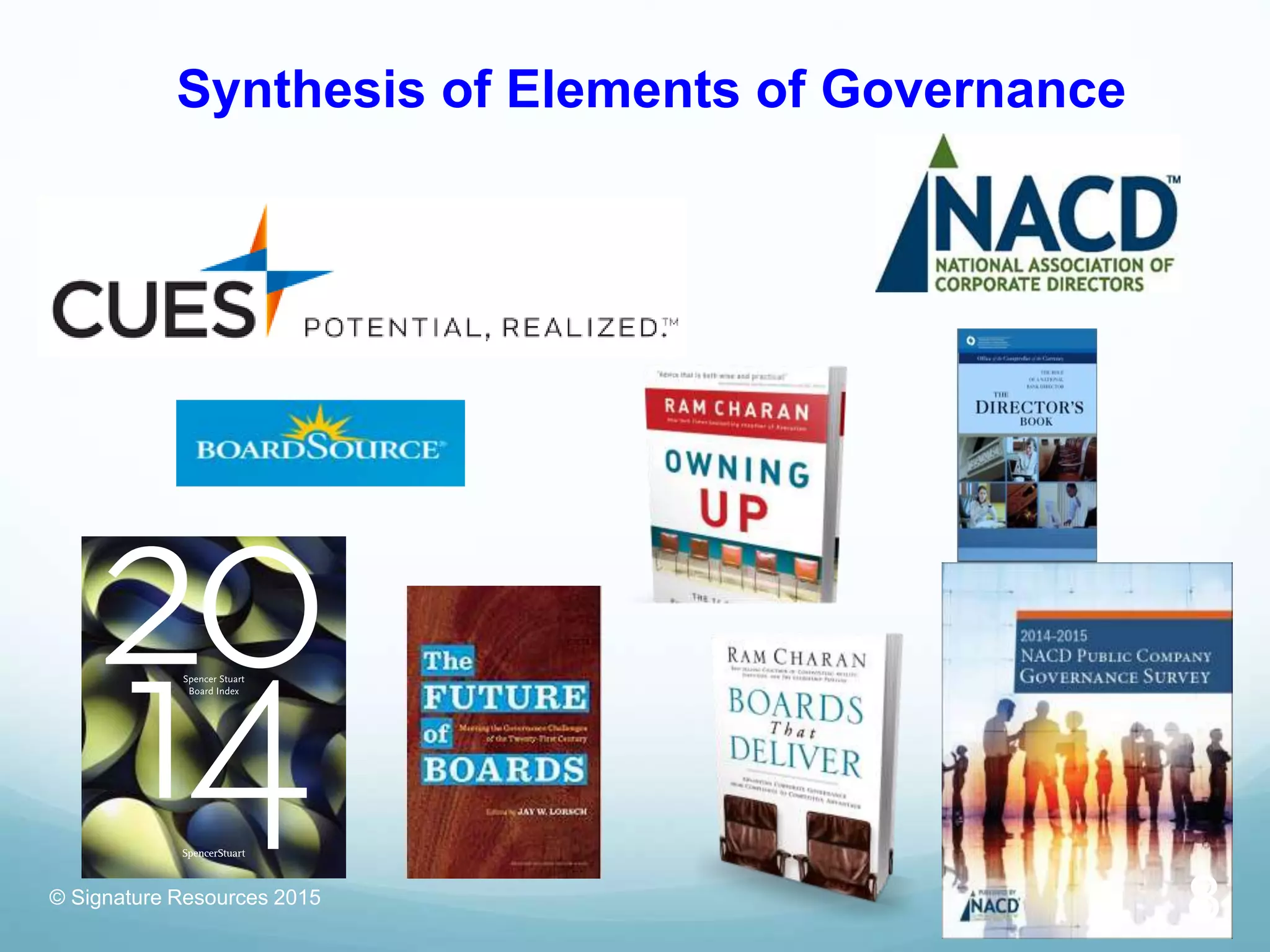
Synthesis of Elements of Governance
8
Your Job Today:
Final Exam
© Signature Resources 2015
 What might you take back to your board to start the
conversation about the board of the future?
9
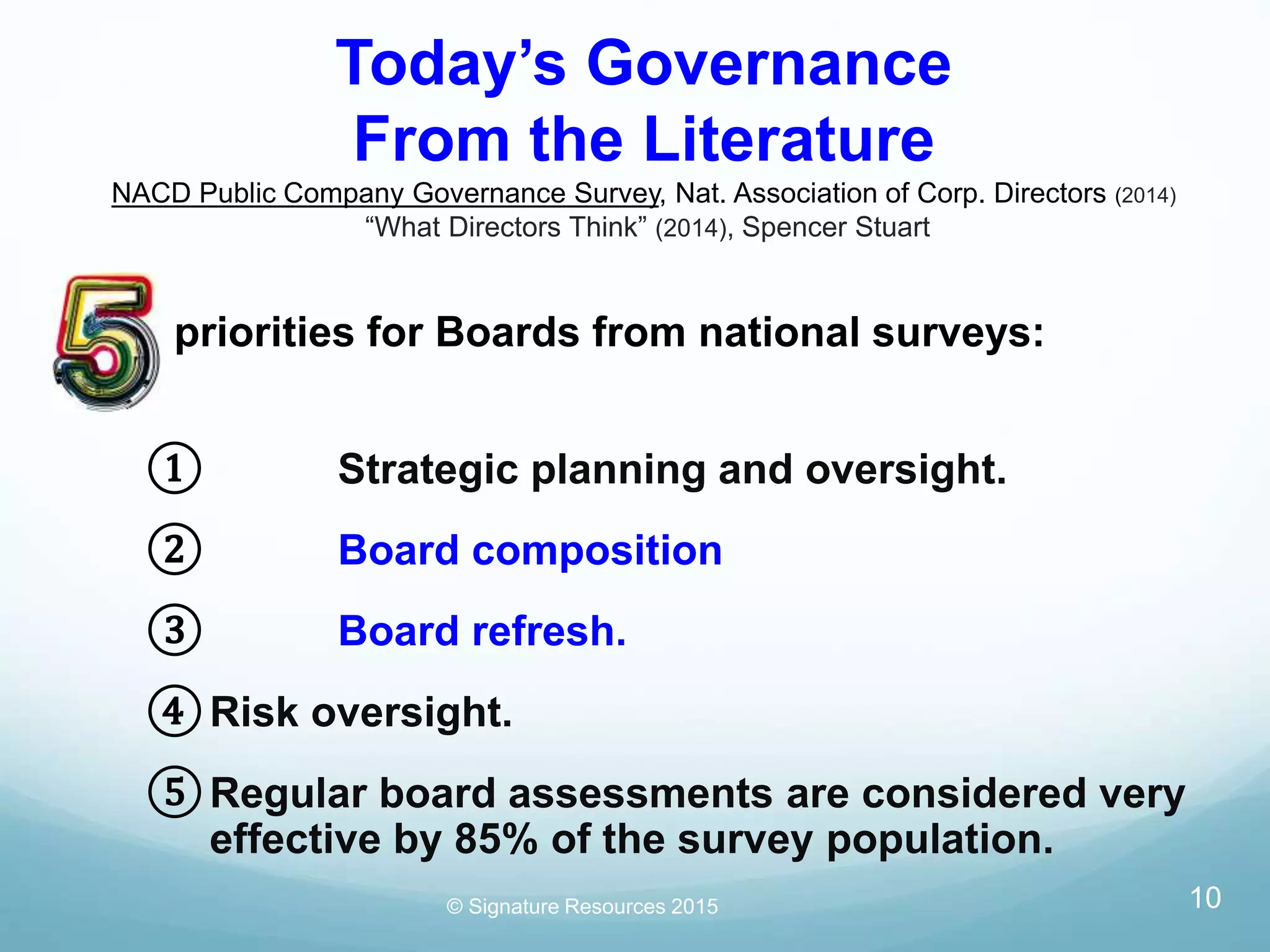
Today’s Governance
From the Literature
NACD Public Company Governance Survey, Nat. Association of Corp. Directors (2014)
“What Directors Think” (2014), Spencer Stuart
© Signature Resources 2015
priorities for Boards from national surveys:
① Strategic planning and oversight.
② Board composition
③ Board refresh.
④Risk oversight.
⑤Regular board assessments are considered very
effective by 85% of the survey population.
10
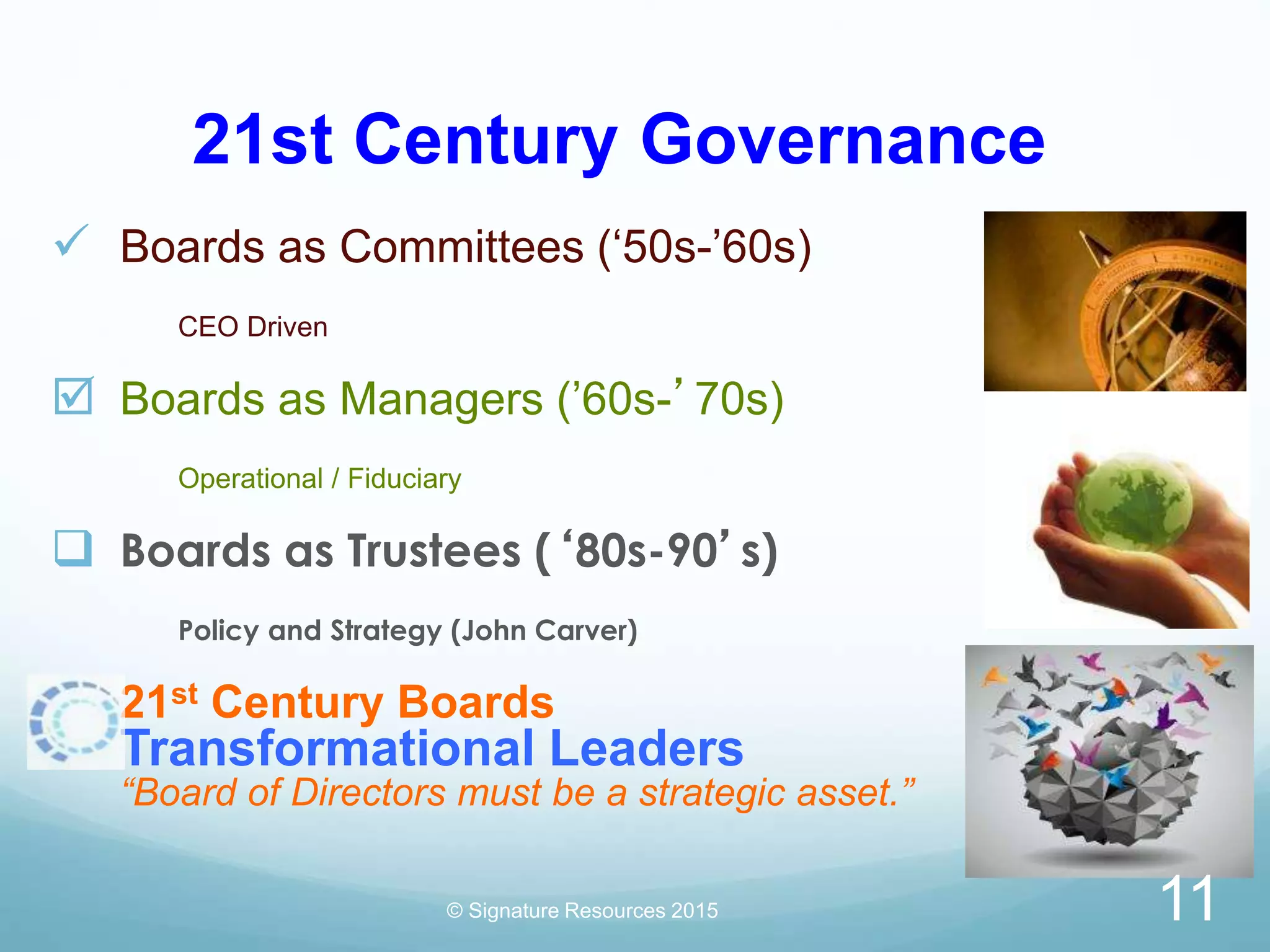
21st Century Governance
 Boards as Committees (‘50s-’60s)
CEO Driven
 Boards as Managers (’60s-’70s)
Operational / Fiduciary
 Boards as Trustees (‘80s-90’s)
Policy and Strategy (John Carver)
21st Century Boards
Transformational Leaders
“Board of Directors must be a strategic asset.”
© Signature Resources 2015 11
© Signature Resources 2015
Strategy is about Transforming
the Organization to Remain…
Viable
Valuable
Vibrant!
12
21st Century Governance
and Strategy
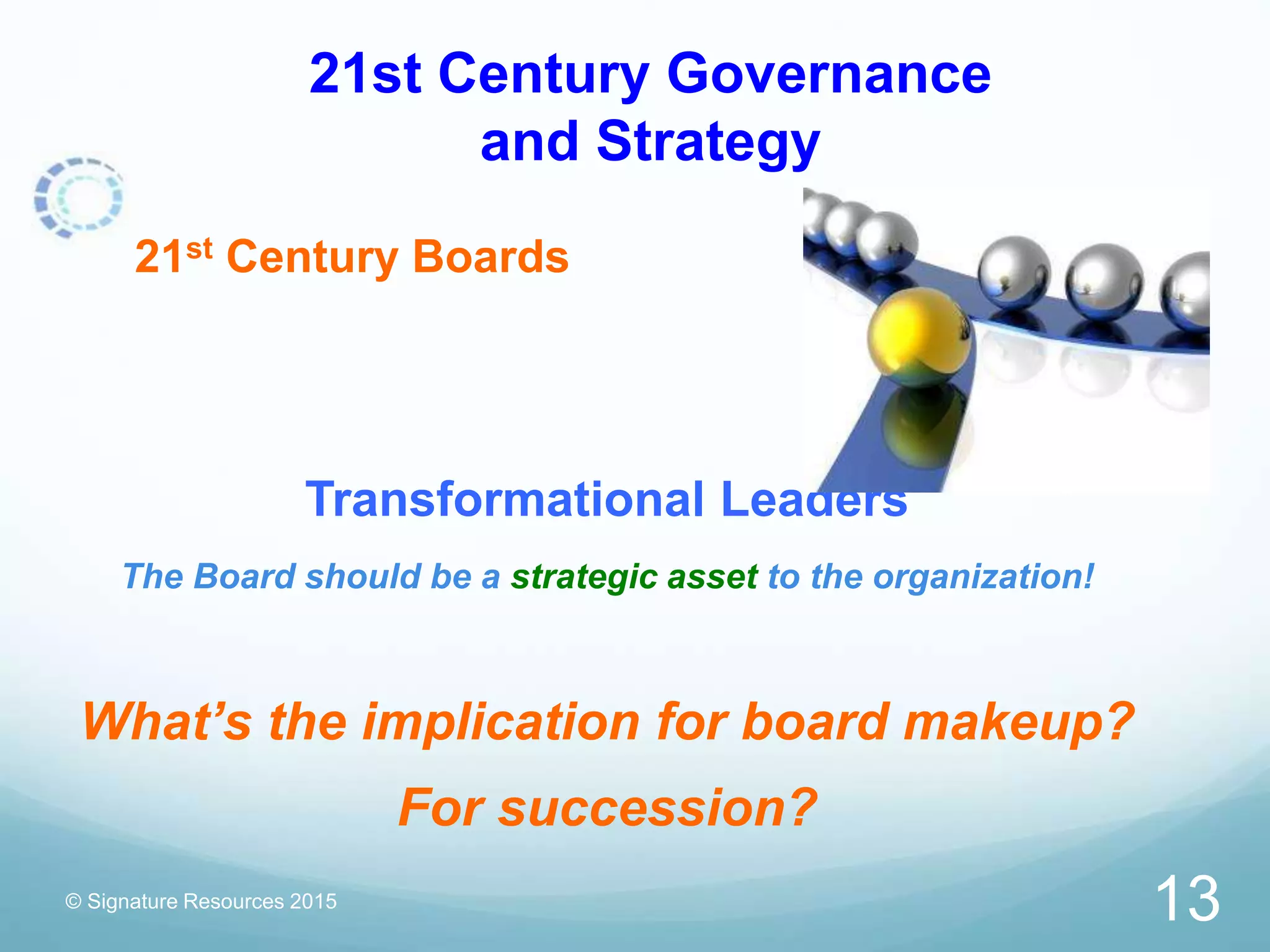
21st Century Boards
Transformational Leaders
The Board should be a strategic asset to the organization!
What’s the implication for board makeup?
For succession?
© Signature Resources 2015
13
© Signature Resources 2015
Strategy is about Transforming the
Organization to Remain Viable, Valuable,
and Vibrant!
So your board needs to be…
 Strategic thinkers.
 Change compatible.
 Focused on transformation of the enterprise.
 Effectively navigating changing customer,
regulatory and constituent demands.
 Strategic planning looking three to five years out.
 Annually refreshing the strategic plan.
14
High Performance
Governance: Competence
 Board job descriptions identify leadership competencies required.
Nominations, interviews, screening confirm competencies.
 Term limits (officers and board seats) assures governance refresh and
infusion of fresh eyes / new competencies.
 Governance Leadership succession program in place develops
future leaders from the field early… 1-3 years out:
and future board officers.
 No emeritus status board members.
 Board members failing the involvement / attendance / conduct
standards are removed for cause: bylaws are specific to these
expectations.
© Signature Resources 2015
15
Governance Leadership Succession
© Signature Resources 2015
① Profile the ideal board member for where you’re
going—not where you are.
② Identify a pool of candidates.
③ Engage, Develop, Cultivate the pool.
④ Narrow the pool by giving the most capable and
Committed greater immersion and development.
① Encourage the best to stand for board appointment.
Create a Board Makeup Dashboard:
Current and Desired in the Future
16
Board Profile:
Today - Tomorrow
 Gender
 Age
 Ethnicity
 Length of board service
 Leadership experience and competencies
 Special competencies / experience / networks
© Signature Resources 2015
17
Governance Leadership Succession
Timeline?
Board of Directors makes annual commitment to
identify and develop potential new board members
ahead of vacancies.
A minimum 12 months before a known vacancy, a
pool of potential candidates are identified and
screened as to interests and qualifications.
 Preferable:
2-3 years in advance of a board appointment the
Board of Directors has identified people with
potential and is involving them in some way in
governance development and/or volunteer efforts
for the enterprise.© Signature Resources 2015
18
Planning for a Future Board
 Chair and Vice Chair have crucial conversations with
board members who should move on.
 Term limits assure opportunity for new appointments
without having to have difficult conversations.
 Three year terms with one reappointment is typical.
 Create a “board profile” of what you will need 3-5
years out.
 Create a pool of potential candidates and actively
screen them for competency and mission alignment.
 Actively recruit.
© Signature Resources 2015
19
Planning for a Future Board
 Crucial conversations regarding legacy moves:
“Based upon our profile of future board needs we would like
to act quickly on refreshing our makeup.”
“You’ve given valuable service however we would like you to
consider relinquishing your board seat for a new
appointment.”
The CEO should not be involved in these conversations
with board members who need to move on!
© Signature Resources 2015
20
Who Guides Board Recruitment?
 Governance and Nominating committee
 Executive Committee
© Signature Resources 2015
What’s the role of the CEO?
 Involved in conversations about potential future
board needs
 Involved in end of screening interviews with
potential candidates
 Heavily involved in new board orientation
21
Where / How do you find folks who
might fit the ideal profile?
 Board & past Board know some in the community.
 The Executive / Management team knows some.
 Your networks of community and business leader
contacts know some.
 You can research names from the university,
community leadership & chamber lists for potential.
© Signature Resources 2015
22
Finding Competent Board
Members
 88% Ask for board member recommendations.
 69% evaluate board composition via a gap analysis or
matrix.
 63% invite non board members to serve on committees.
 63% cultivate relationships with colleagues or
community leaders.
 41% cultivate relationships with corporations or other
organizations.
BoardSource Nonprofit Government Index 2012.
© Signature Resources 2015
23
Board Members:
Where do you Find Them?
© Signature Resources 2015
 Colleges and Universities—faculty and graduate students
 Chambers of Commerce
 Specialty Chambers—Black, Latino, Asian, Native American
 Young Professional Groups
 Professional Associations
 Small Business Alliance Groups
 Specialty Legal Societies
 State not-profit societies
 Mid-to upper managers of business in your area
 Your network of high performance leaders!
24
Selection
 You will end up with a number of highly qualified
candidates who might serve your CU.
 Narrowing the group to the vital few must align with all
the goals of your new board profile: competencies,
experience, demographic addition, networks.
 Don’t be afraid to add a board member with which the
current board was not familiar before the search.
 “Fresh eyes” will be a valuable contribution to your
board.
 “Associate members” has become a popular new
board member recruitment and decision mode.
© Signature Resources 2015
25
Future Governing Boards
© Signature Resources 2015
“In the not to distant future, new
board members, at all levels of
enterprise--from community
organization to corporations--will be
required to ‘certify governance
competency’ to quality for an
appointment / election.”
Les Wallace 
26
Future Governing Boards
© Signature Resources 2015
 Term limits the norm.
 Recruitment focuses on competencies and connections.
 Compensation for not-for-profit board will support increased
competencies.
 Diverse board makeup will become the norm rather than the
exception.
 Board officer development will become a higher priority
investment.
 Board coaches will be commonplace.
27
Sustaining Competency
 Annual self assessment guides board improvement
 Special emphasis on environmental scanning,
benchmarking, board tutorials (e.g. regulation,
quality, supply chain, etc.), keep eyes on the
changing horizon.
 Officers and future officers need specific
development about their roles, functions and
leadership approaches.
© Signature Resources 2015
28
Governance Diversity
and
Youth Movement
© Signature Resources 2015
“Suddenly—Age is a Diversity Issue”
www.cues.org/article/view/id/Good-governance-age-is-board-diversity-issue
29
Governance Youth Movement
(As seen by some)
© Signature Resources 2015
30
Questions?
© Signature Resources 2015
31
Final Exam:
What might you take back to your board to start the conversation
about the board of the future?
Extra Credit
On Boarding the New Board Member
Make the proper investment!
© Signature Resources 2015
32
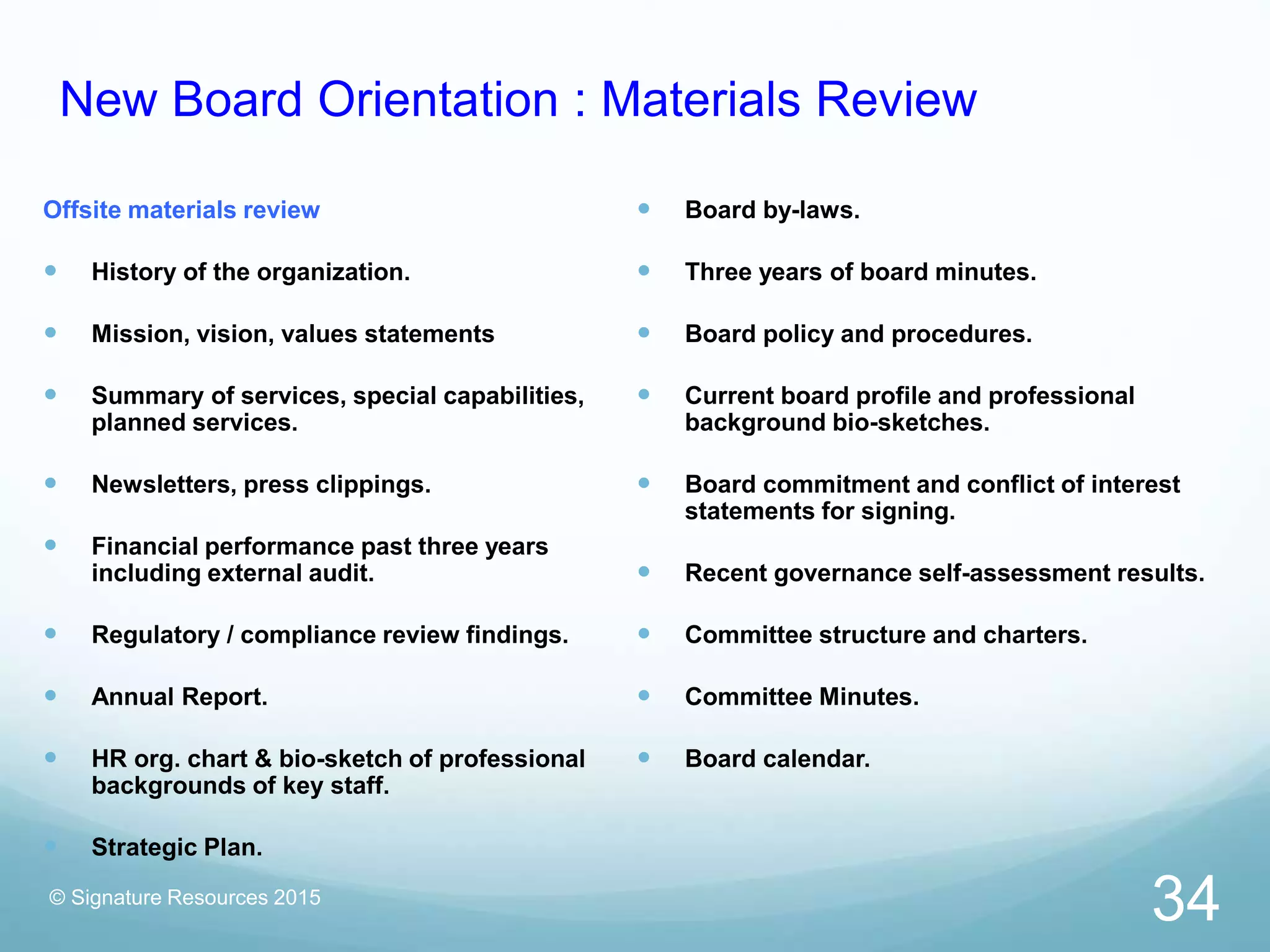
Onboarding
 Adequate orientation is critical to helping the new
board member to a fast start.
 Based upon an hourly value of board service for you
@ $500/hr. and an estimated 62+ hours of service a
year—you’re bringing on the equivalent of a $31,000
investment (first year value).
 One day on site with the executive team and key
staff for briefings and dialogue is a minimum.
 Another 3+ hours with Board Chair, Reviewing
committee minutes, strategic plan and other
documents is a minimum.
© Signature Resources 2015
33
New Board Orientation : Materials Review
Offsite materials review
 History of the organization.
 Mission, vision, values statements
 Summary of services, special capabilities,
planned services.
 Newsletters, press clippings.
 Financial performance past three years
including external audit.
 Regulatory / compliance review findings.
 Annual Report.
 HR org. chart & bio-sketch of professional
backgrounds of key staff.
 Strategic Plan.
 Board by-laws.
 Three years of board minutes.
 Board policy and procedures.
 Current board profile and professional
background bio-sketches.
 Board commitment and conflict of interest
statements for signing.
 Recent governance self-assessment results.
 Committee structure and charters.
 Committee Minutes.
 Board calendar.
© Signature Resources 2015
34
New Board Orientation II
Onsite introductions and briefings
 Staff leadership welcome meeting
and introductions.
 Key programmatic one on one
meetings.
 Financial briefing from CFO and
review of board financial dashboard.
 ERM briefing from the Chief Risk
Officer or Supervisory committee
chair.
 Human resources briefing including
review of board “organizational
climate” dashboard.
 Customer briefing including last
twelve months satisfaction and value
survey results.
 Board Chair briefing: Board
composition philosophy and
leadership succession.
 Recent board self-assessment
results.
 Board committee assignment.
© Signature Resources 2015
35
New Board Orientation III
Governance Education
 Digest assigned articles and booklets—even better, require
specific reading prior to the appointment—voluntary pre-
certification.
 Phone consultation with Governance committee chair upon
completion of reading and orientation.
 Discuss annual calendar of conferences and expectations for
attendance and learning commitments.
© Signature Resources 2015
36
© Signature Resources 2015
37
Who is this guy?
© Signature Resources 2015
38
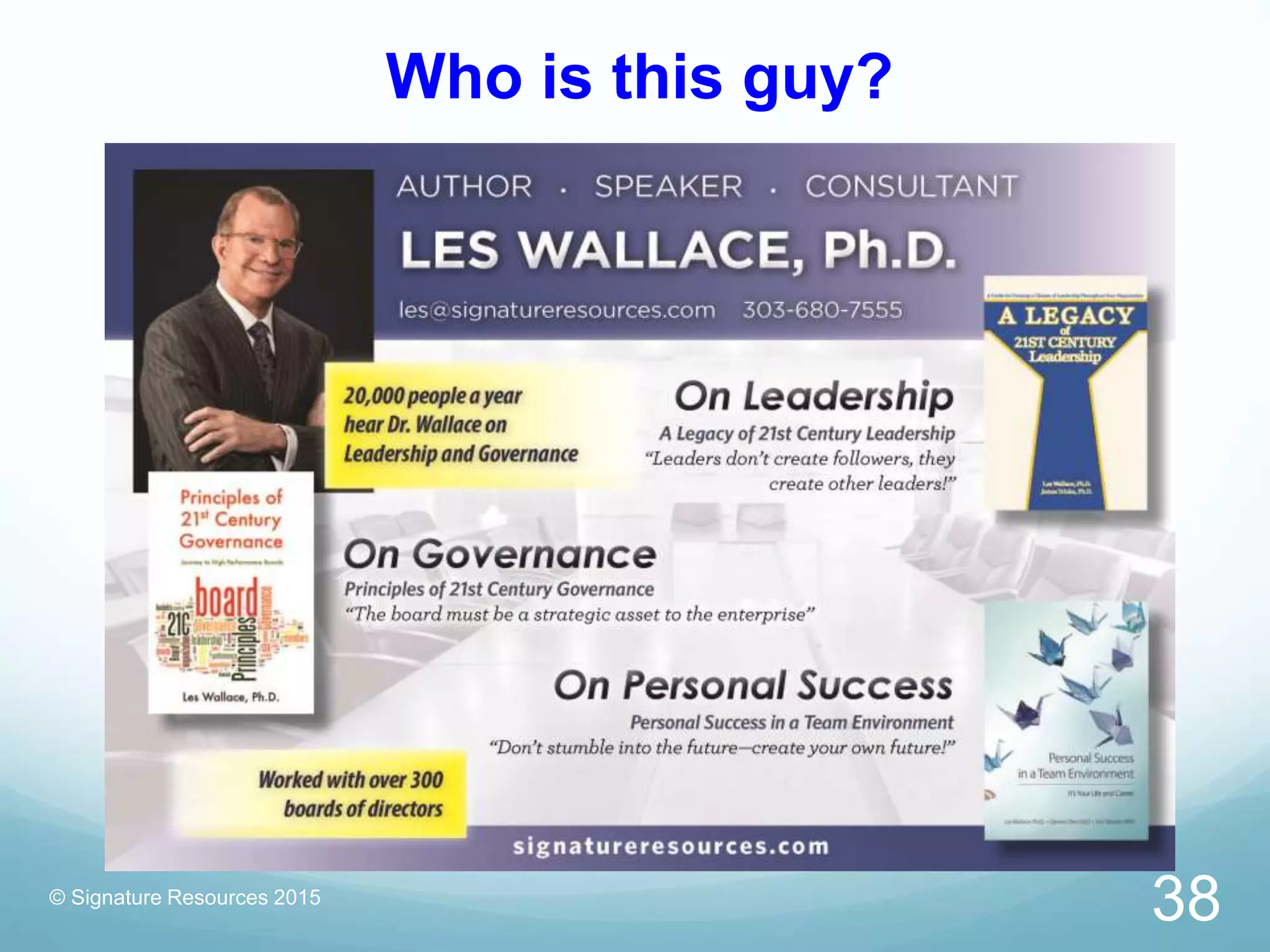
Les Wallace, Ph.D.
President, Signature Resources Inc.
Les@signatureresources.com
 Dr. Wallace is recognized for tracking business environment and workplace trends and their impact
upon business and government. His publications have appeared in Leadership Excellence,
Personnel Journal, Credit Union Management, Public Management, and Nation's Business as well
as numerous research and conference proceedings. His latest book, co-authored with Dr. Jim
Trinka, A Legacy of 21st Century Leadership, outlines the leadership organizations need in a global,
fast moving business environment. His book, Principles of 21st Century Governance (2013) is being
used by many boards in the profit and not-for-profit sectors to design governance development
approaches.
 His new book, Personal Success in a Team Environment (2014) is used by individuals and
organizations to improve teamwork, career building and success at work.
 Les is a frequent consultant and speaker on issues of organizational transformation and leadership,
employee engagement, strategic thinking and board of directors development and governance. His
clients include Fortune 100 businesses, Government agencies, and not-for-profit organizations
world-wide. Dr. Wallace is also the host resource on the 9Minute Mentor, a series short video
tutorials governance.
 Les has served on the Board of Security First Bank and currently serves on the international Boards
of the World Future Society and Counterpart International. He is a member of the National
Association of Corporate Directors. Les writes an on-line column for CUES Center for Credit Union
Board Education.
 Preview his video series on governance: www.signatureresources “Dr. Wallace on Camera.”
 https://twitter.com/9MinuteMentor
© Signature Resources 2015 39

Board succession planning

  • 1.
    Governance Leadership Succession: Profilingthe Board You Need in 2020 and Recruiting Them to Run © Signature Resources 2015 Les Wallace, Ph.D. Signatureresources.com 1
  • 2.
    Today’s topics  Whatis leadership succession?  What is governance leadership succession?  How do you plan for it?  Active recruitment of board members.  Selection processes.  Board development to enhance competency. © Signature Resources 2015 2
  • 3.
    Who is thisguy? Ideal 21C job: Grandparent!  University professor / administrator  Hospital administrator—traditional Board  International consulting company… Touch 20,000 people yr. / Coach 28 Execs / 17 Boards a year  50% for-profit / 50% government & not-for-profit clients  Served on a regional Bank Board of Directors  Served on Counterpart International Board  Serving on World Future Society Board © Signature Resources 2015 3
  • 4.
    The Vital FewBuilding blocks of Governance Excellence  Talent: board with experience and competencies to oversee a complex organization. Does this leave out other member voices?  Strategic focus: envisioning, positioning and re- positioning the Credit Union to remain viable, valuable and vibrant. EVERYTHING FLOWS FROM STRATEGY!  Clarity on organizational performance and risk—the vital few performance and risk domains a board should track.  Clarity on governance process: effective then efficient. © Signature Resources 2015 4
  • 5.
    What is leadership succession? Leadership succession is the responsibility of boards and organizational leaders to assure that a leadership development plan is in place to prepare future key leaders.  An emergency succession policy is commonplace: who will take charge should a key leader suddenly become not available?  Investing in leadership succession in-house does not come with any promise of succession from the board or organization—both entities should always conduct a wide search for replacing key leadership. © Signature Resources 2015 5
  • 6.
    What is Governanceleadership succession?  Governance leadership succession is the responsibility a board has to assure board makeup and future appointments meet the changing needs of the organization.  Leadership succession implies advanced thinking, recruiting and assessment of board members before they are needed.  Maintaining / improving competencies of current board members is also “competency succession.” Est. average 1 hr./month. © Signature Resources 2015 6
  • 7.
    My Job Today ©Signature Resources 2015  A look @ high performance governance practices as assembled from BoardSource, National Association of Corporate Directors, CUES, The Conference Board and others.  Candid opinions based on work with 300+ boards: For-profit, non-profit, international, financial, healthcare, community, national associations.  Open dialogue—your question is not an interruption! 7
  • 8.
    © Signature Resources2015 Synthesis of Elements of Governance 8
  • 9.
    Your Job Today: FinalExam © Signature Resources 2015  What might you take back to your board to start the conversation about the board of the future? 9
  • 10.
    Today’s Governance From theLiterature NACD Public Company Governance Survey, Nat. Association of Corp. Directors (2014) “What Directors Think” (2014), Spencer Stuart © Signature Resources 2015 priorities for Boards from national surveys: ① Strategic planning and oversight. ② Board composition ③ Board refresh. ④Risk oversight. ⑤Regular board assessments are considered very effective by 85% of the survey population. 10
  • 11.
    21st Century Governance Boards as Committees (‘50s-’60s) CEO Driven  Boards as Managers (’60s-’70s) Operational / Fiduciary  Boards as Trustees (‘80s-90’s) Policy and Strategy (John Carver) 21st Century Boards Transformational Leaders “Board of Directors must be a strategic asset.” © Signature Resources 2015 11
  • 12.
    © Signature Resources2015 Strategy is about Transforming the Organization to Remain… Viable Valuable Vibrant! 12
  • 13.
    21st Century Governance andStrategy 21st Century Boards Transformational Leaders The Board should be a strategic asset to the organization! What’s the implication for board makeup? For succession? © Signature Resources 2015 13
  • 14.
    © Signature Resources2015 Strategy is about Transforming the Organization to Remain Viable, Valuable, and Vibrant! So your board needs to be…  Strategic thinkers.  Change compatible.  Focused on transformation of the enterprise.  Effectively navigating changing customer, regulatory and constituent demands.  Strategic planning looking three to five years out.  Annually refreshing the strategic plan. 14
  • 15.
    High Performance Governance: Competence Board job descriptions identify leadership competencies required. Nominations, interviews, screening confirm competencies.  Term limits (officers and board seats) assures governance refresh and infusion of fresh eyes / new competencies.  Governance Leadership succession program in place develops future leaders from the field early… 1-3 years out: and future board officers.  No emeritus status board members.  Board members failing the involvement / attendance / conduct standards are removed for cause: bylaws are specific to these expectations. © Signature Resources 2015 15
  • 16.
    Governance Leadership Succession ©Signature Resources 2015 ① Profile the ideal board member for where you’re going—not where you are. ② Identify a pool of candidates. ③ Engage, Develop, Cultivate the pool. ④ Narrow the pool by giving the most capable and Committed greater immersion and development. ① Encourage the best to stand for board appointment. Create a Board Makeup Dashboard: Current and Desired in the Future 16
  • 17.
    Board Profile: Today -Tomorrow  Gender  Age  Ethnicity  Length of board service  Leadership experience and competencies  Special competencies / experience / networks © Signature Resources 2015 17
  • 18.
    Governance Leadership Succession Timeline? Boardof Directors makes annual commitment to identify and develop potential new board members ahead of vacancies. A minimum 12 months before a known vacancy, a pool of potential candidates are identified and screened as to interests and qualifications.  Preferable: 2-3 years in advance of a board appointment the Board of Directors has identified people with potential and is involving them in some way in governance development and/or volunteer efforts for the enterprise.© Signature Resources 2015 18
  • 19.
    Planning for aFuture Board  Chair and Vice Chair have crucial conversations with board members who should move on.  Term limits assure opportunity for new appointments without having to have difficult conversations.  Three year terms with one reappointment is typical.  Create a “board profile” of what you will need 3-5 years out.  Create a pool of potential candidates and actively screen them for competency and mission alignment.  Actively recruit. © Signature Resources 2015 19
  • 20.
    Planning for aFuture Board  Crucial conversations regarding legacy moves: “Based upon our profile of future board needs we would like to act quickly on refreshing our makeup.” “You’ve given valuable service however we would like you to consider relinquishing your board seat for a new appointment.” The CEO should not be involved in these conversations with board members who need to move on! © Signature Resources 2015 20
  • 21.
    Who Guides BoardRecruitment?  Governance and Nominating committee  Executive Committee © Signature Resources 2015 What’s the role of the CEO?  Involved in conversations about potential future board needs  Involved in end of screening interviews with potential candidates  Heavily involved in new board orientation 21
  • 22.
    Where / Howdo you find folks who might fit the ideal profile?  Board & past Board know some in the community.  The Executive / Management team knows some.  Your networks of community and business leader contacts know some.  You can research names from the university, community leadership & chamber lists for potential. © Signature Resources 2015 22
  • 23.
    Finding Competent Board Members 88% Ask for board member recommendations.  69% evaluate board composition via a gap analysis or matrix.  63% invite non board members to serve on committees.  63% cultivate relationships with colleagues or community leaders.  41% cultivate relationships with corporations or other organizations. BoardSource Nonprofit Government Index 2012. © Signature Resources 2015 23
  • 24.
    Board Members: Where doyou Find Them? © Signature Resources 2015  Colleges and Universities—faculty and graduate students  Chambers of Commerce  Specialty Chambers—Black, Latino, Asian, Native American  Young Professional Groups  Professional Associations  Small Business Alliance Groups  Specialty Legal Societies  State not-profit societies  Mid-to upper managers of business in your area  Your network of high performance leaders! 24
  • 25.
    Selection  You willend up with a number of highly qualified candidates who might serve your CU.  Narrowing the group to the vital few must align with all the goals of your new board profile: competencies, experience, demographic addition, networks.  Don’t be afraid to add a board member with which the current board was not familiar before the search.  “Fresh eyes” will be a valuable contribution to your board.  “Associate members” has become a popular new board member recruitment and decision mode. © Signature Resources 2015 25
  • 26.
    Future Governing Boards ©Signature Resources 2015 “In the not to distant future, new board members, at all levels of enterprise--from community organization to corporations--will be required to ‘certify governance competency’ to quality for an appointment / election.” Les Wallace  26
  • 27.
    Future Governing Boards ©Signature Resources 2015  Term limits the norm.  Recruitment focuses on competencies and connections.  Compensation for not-for-profit board will support increased competencies.  Diverse board makeup will become the norm rather than the exception.  Board officer development will become a higher priority investment.  Board coaches will be commonplace. 27
  • 28.
    Sustaining Competency  Annualself assessment guides board improvement  Special emphasis on environmental scanning, benchmarking, board tutorials (e.g. regulation, quality, supply chain, etc.), keep eyes on the changing horizon.  Officers and future officers need specific development about their roles, functions and leadership approaches. © Signature Resources 2015 28
  • 29.
    Governance Diversity and Youth Movement ©Signature Resources 2015 “Suddenly—Age is a Diversity Issue” www.cues.org/article/view/id/Good-governance-age-is-board-diversity-issue 29
  • 30.
    Governance Youth Movement (Asseen by some) © Signature Resources 2015 30
  • 31.
    Questions? © Signature Resources2015 31 Final Exam: What might you take back to your board to start the conversation about the board of the future?
  • 32.
    Extra Credit On Boardingthe New Board Member Make the proper investment! © Signature Resources 2015 32
  • 33.
    Onboarding  Adequate orientationis critical to helping the new board member to a fast start.  Based upon an hourly value of board service for you @ $500/hr. and an estimated 62+ hours of service a year—you’re bringing on the equivalent of a $31,000 investment (first year value).  One day on site with the executive team and key staff for briefings and dialogue is a minimum.  Another 3+ hours with Board Chair, Reviewing committee minutes, strategic plan and other documents is a minimum. © Signature Resources 2015 33
  • 34.
    New Board Orientation: Materials Review Offsite materials review  History of the organization.  Mission, vision, values statements  Summary of services, special capabilities, planned services.  Newsletters, press clippings.  Financial performance past three years including external audit.  Regulatory / compliance review findings.  Annual Report.  HR org. chart & bio-sketch of professional backgrounds of key staff.  Strategic Plan.  Board by-laws.  Three years of board minutes.  Board policy and procedures.  Current board profile and professional background bio-sketches.  Board commitment and conflict of interest statements for signing.  Recent governance self-assessment results.  Committee structure and charters.  Committee Minutes.  Board calendar. © Signature Resources 2015 34
  • 35.
    New Board OrientationII Onsite introductions and briefings  Staff leadership welcome meeting and introductions.  Key programmatic one on one meetings.  Financial briefing from CFO and review of board financial dashboard.  ERM briefing from the Chief Risk Officer or Supervisory committee chair.  Human resources briefing including review of board “organizational climate” dashboard.  Customer briefing including last twelve months satisfaction and value survey results.  Board Chair briefing: Board composition philosophy and leadership succession.  Recent board self-assessment results.  Board committee assignment. © Signature Resources 2015 35
  • 36.
    New Board OrientationIII Governance Education  Digest assigned articles and booklets—even better, require specific reading prior to the appointment—voluntary pre- certification.  Phone consultation with Governance committee chair upon completion of reading and orientation.  Discuss annual calendar of conferences and expectations for attendance and learning commitments. © Signature Resources 2015 36
  • 37.
  • 38.
    Who is thisguy? © Signature Resources 2015 38
  • 39.
    Les Wallace, Ph.D. President,Signature Resources Inc. Les@signatureresources.com  Dr. Wallace is recognized for tracking business environment and workplace trends and their impact upon business and government. His publications have appeared in Leadership Excellence, Personnel Journal, Credit Union Management, Public Management, and Nation's Business as well as numerous research and conference proceedings. His latest book, co-authored with Dr. Jim Trinka, A Legacy of 21st Century Leadership, outlines the leadership organizations need in a global, fast moving business environment. His book, Principles of 21st Century Governance (2013) is being used by many boards in the profit and not-for-profit sectors to design governance development approaches.  His new book, Personal Success in a Team Environment (2014) is used by individuals and organizations to improve teamwork, career building and success at work.  Les is a frequent consultant and speaker on issues of organizational transformation and leadership, employee engagement, strategic thinking and board of directors development and governance. His clients include Fortune 100 businesses, Government agencies, and not-for-profit organizations world-wide. Dr. Wallace is also the host resource on the 9Minute Mentor, a series short video tutorials governance.  Les has served on the Board of Security First Bank and currently serves on the international Boards of the World Future Society and Counterpart International. He is a member of the National Association of Corporate Directors. Les writes an on-line column for CUES Center for Credit Union Board Education.  Preview his video series on governance: www.signatureresources “Dr. Wallace on Camera.”  https://twitter.com/9MinuteMentor © Signature Resources 2015 39