
Managing Volunteers,  Successfully.  Jordan Thompson Programme Director Student Volunteer Connections University of Guelph Guelph, Ontario esurio 2009 Volunteer Recruitment & Management
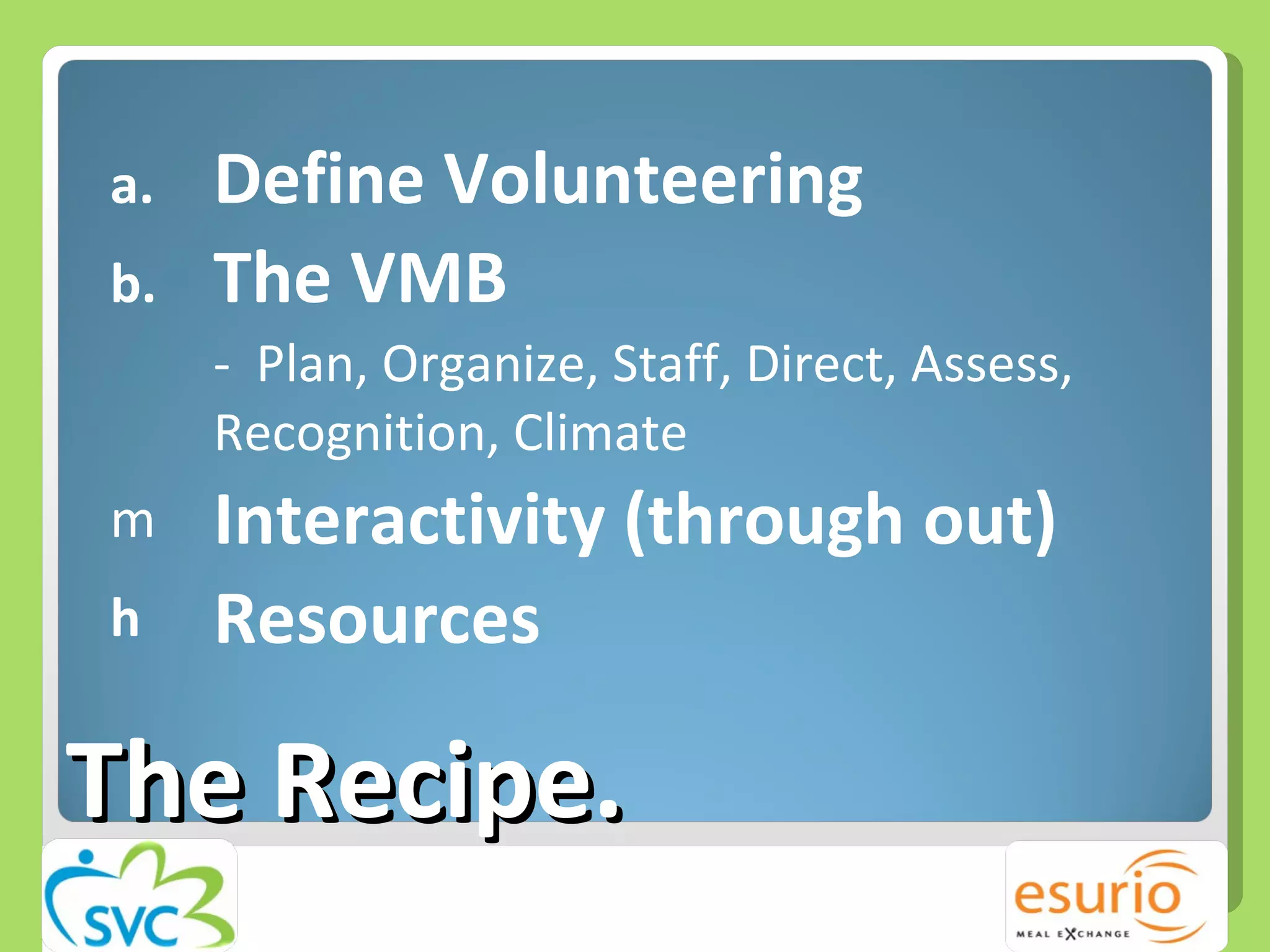
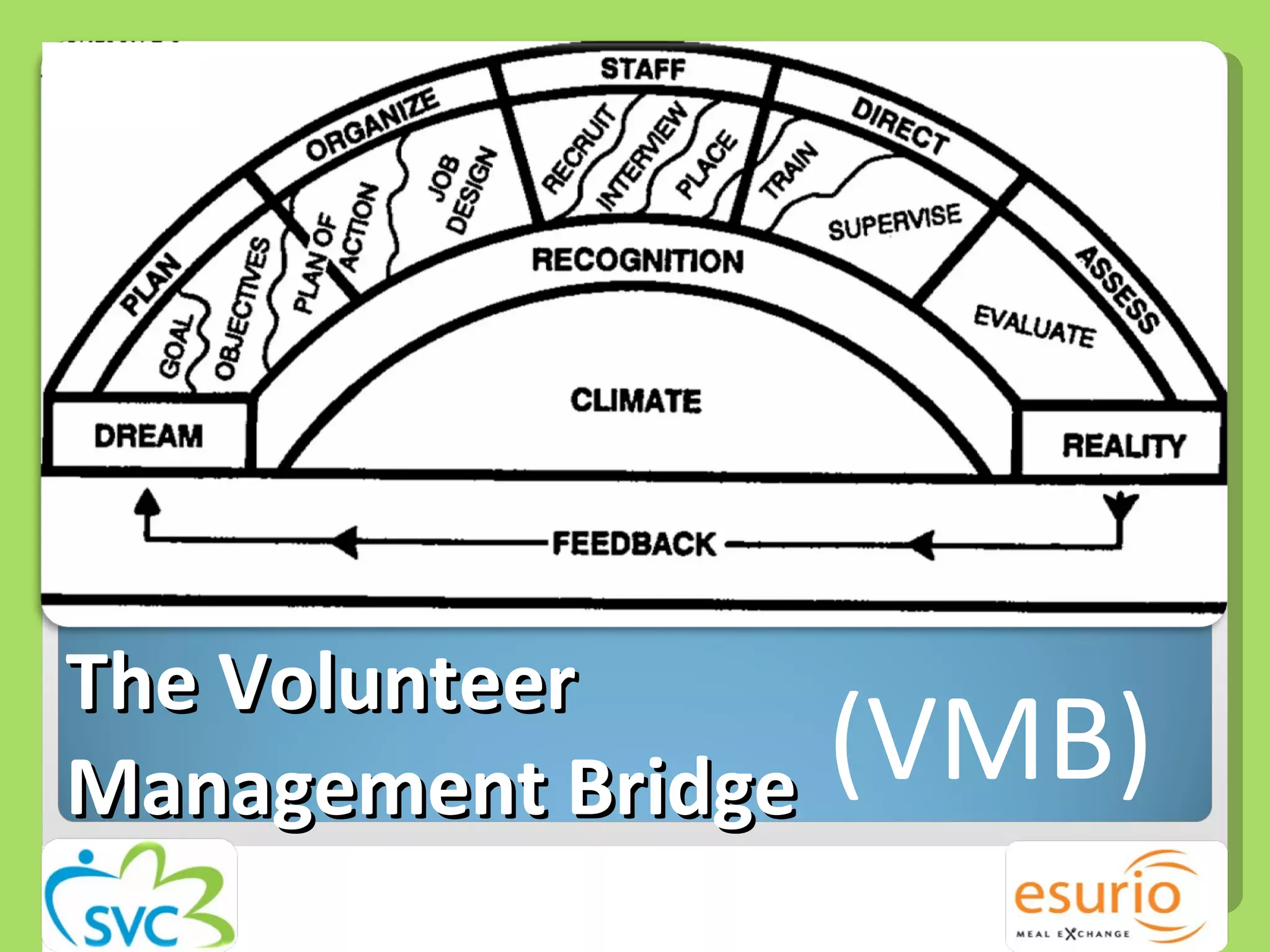
The Recipe. Define Volunteering The VMB -  Plan, Organize, Staff, Direct, Assess, Recognition, Climate  Interactivity (through out) Resources
Defining Volunteer.  what is a volunteer?
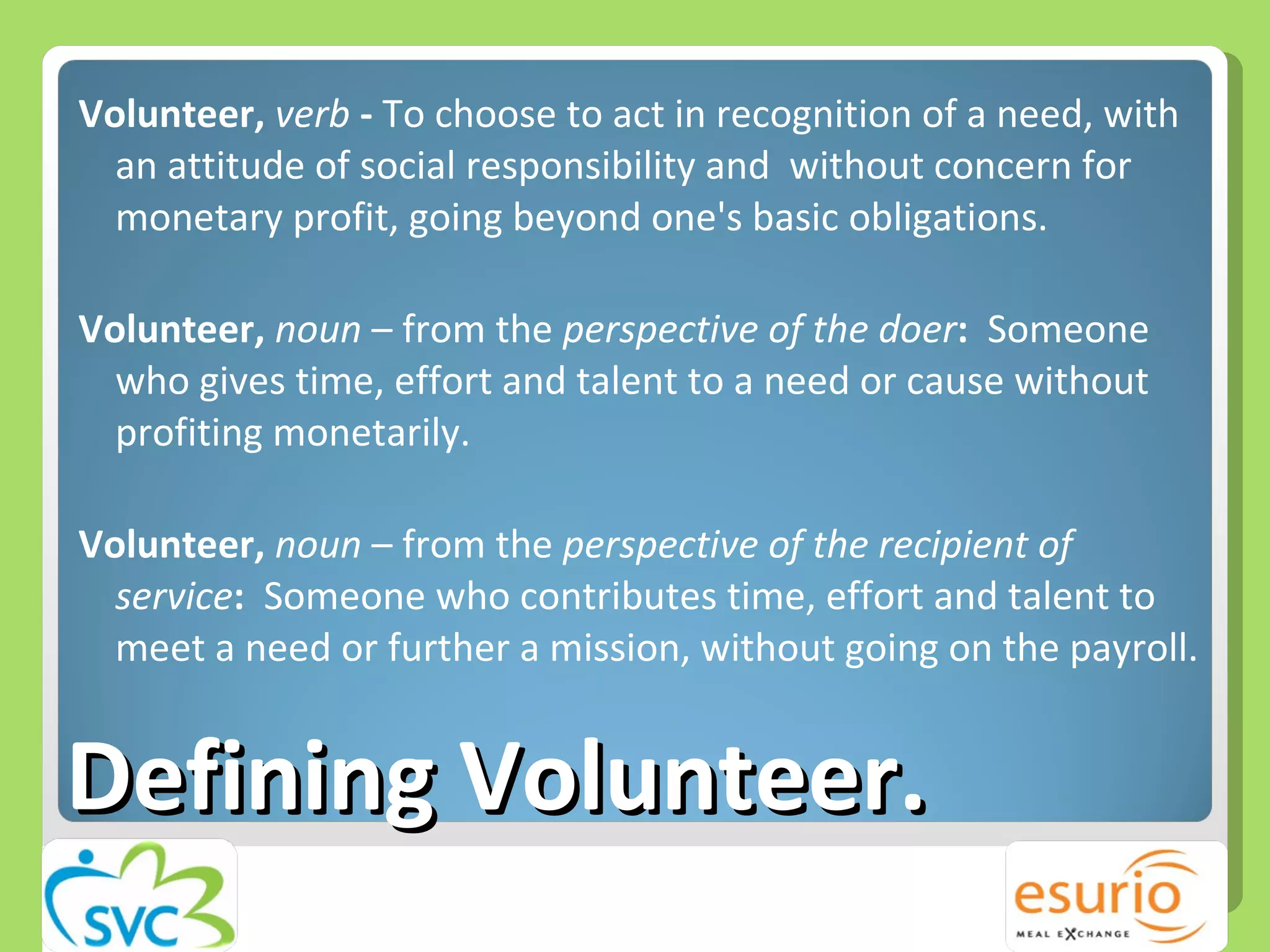
Defining Volunteer.  Volunteer,  verb  -  To choose to act in recognition of a need, with an attitude of social responsibility and  without concern for monetary profit, going beyond one's basic obligations.  Volunteer,  noun  – from the  perspective of the doer :   Someone who gives time, effort and talent to a need or cause without profiting monetarily. Volunteer,  noun  – from the  perspective of the recipient of service :   Someone who contributes time, effort and talent to meet a need or further a mission, without going on the payroll.
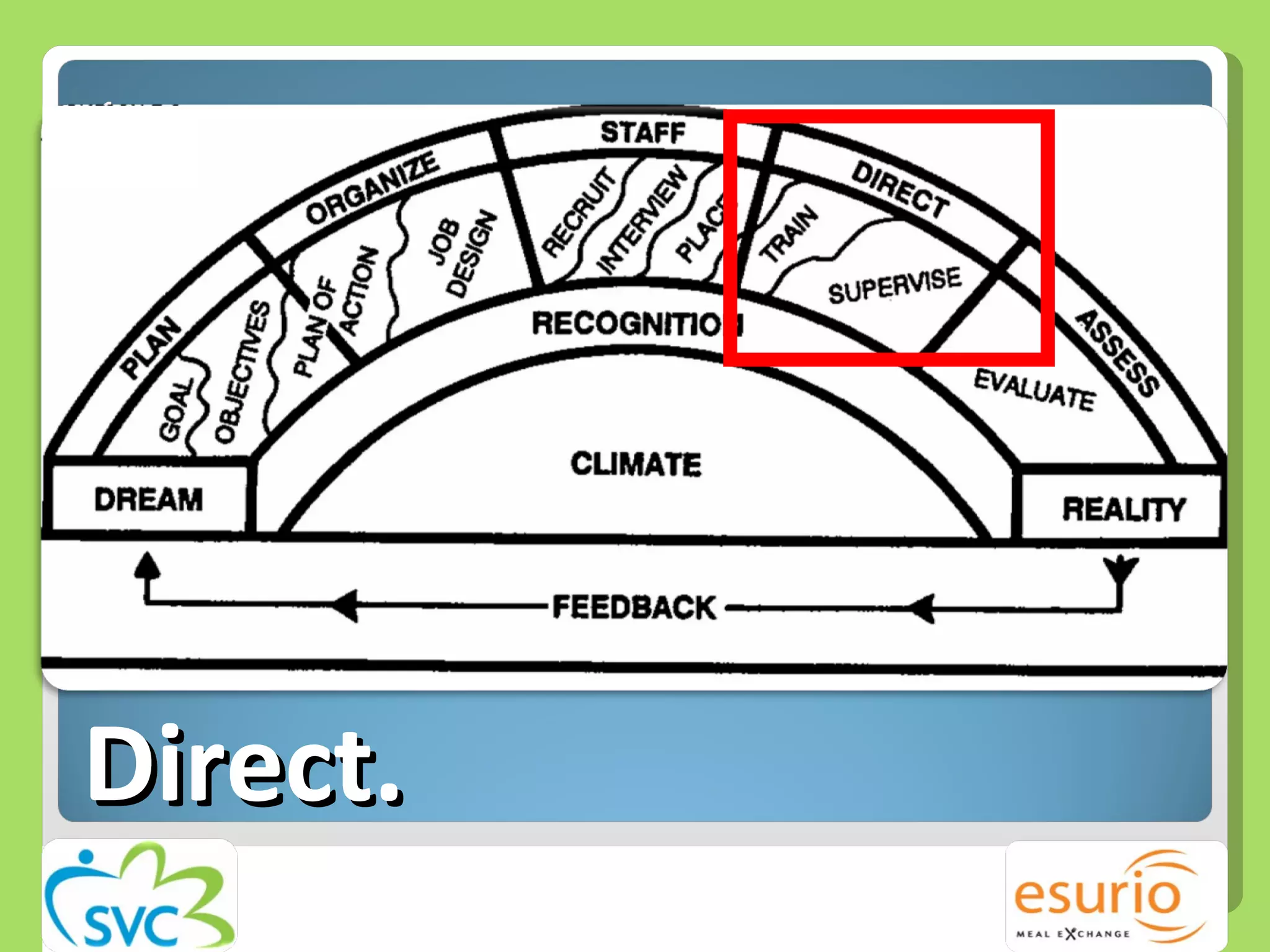
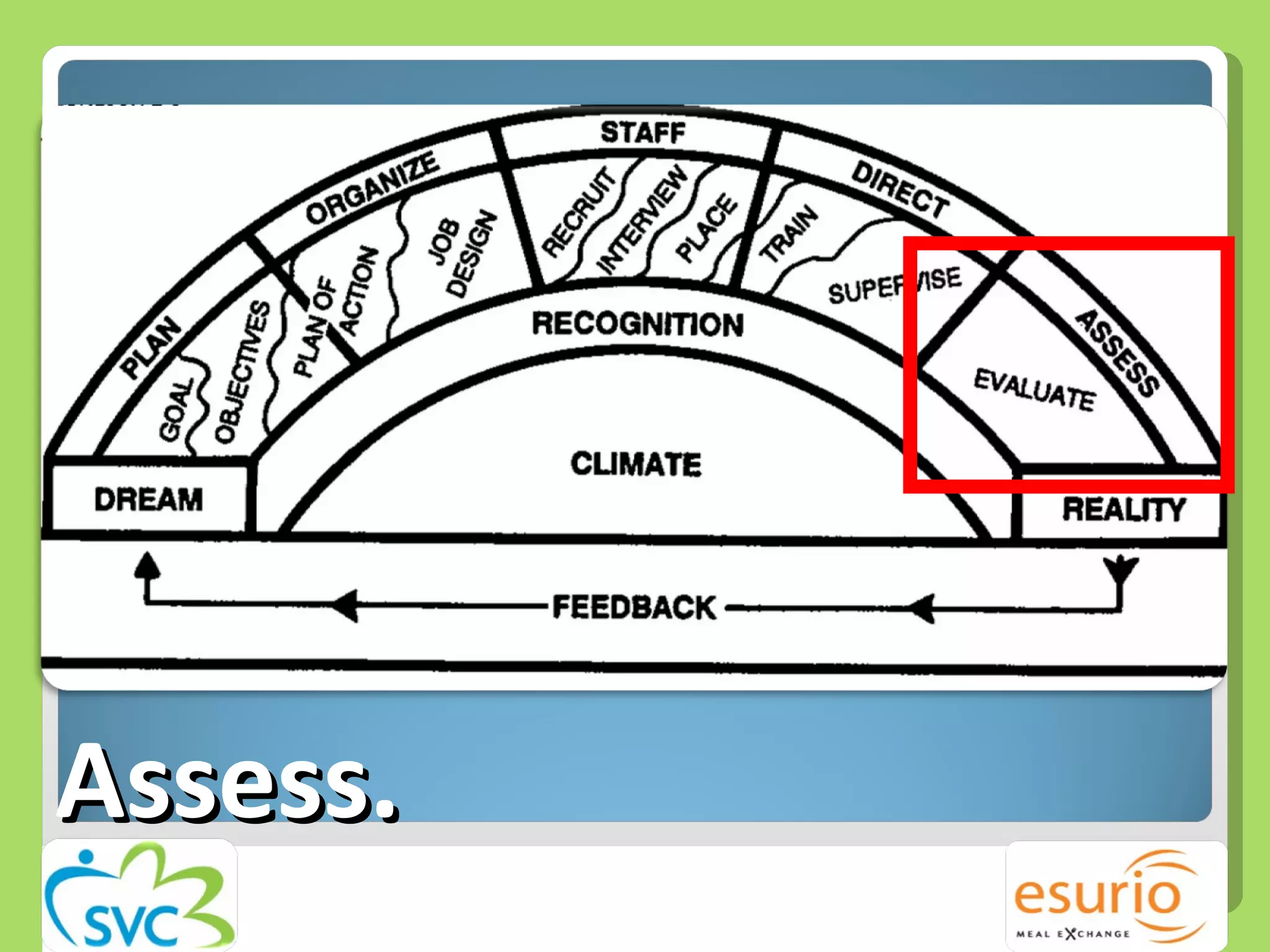
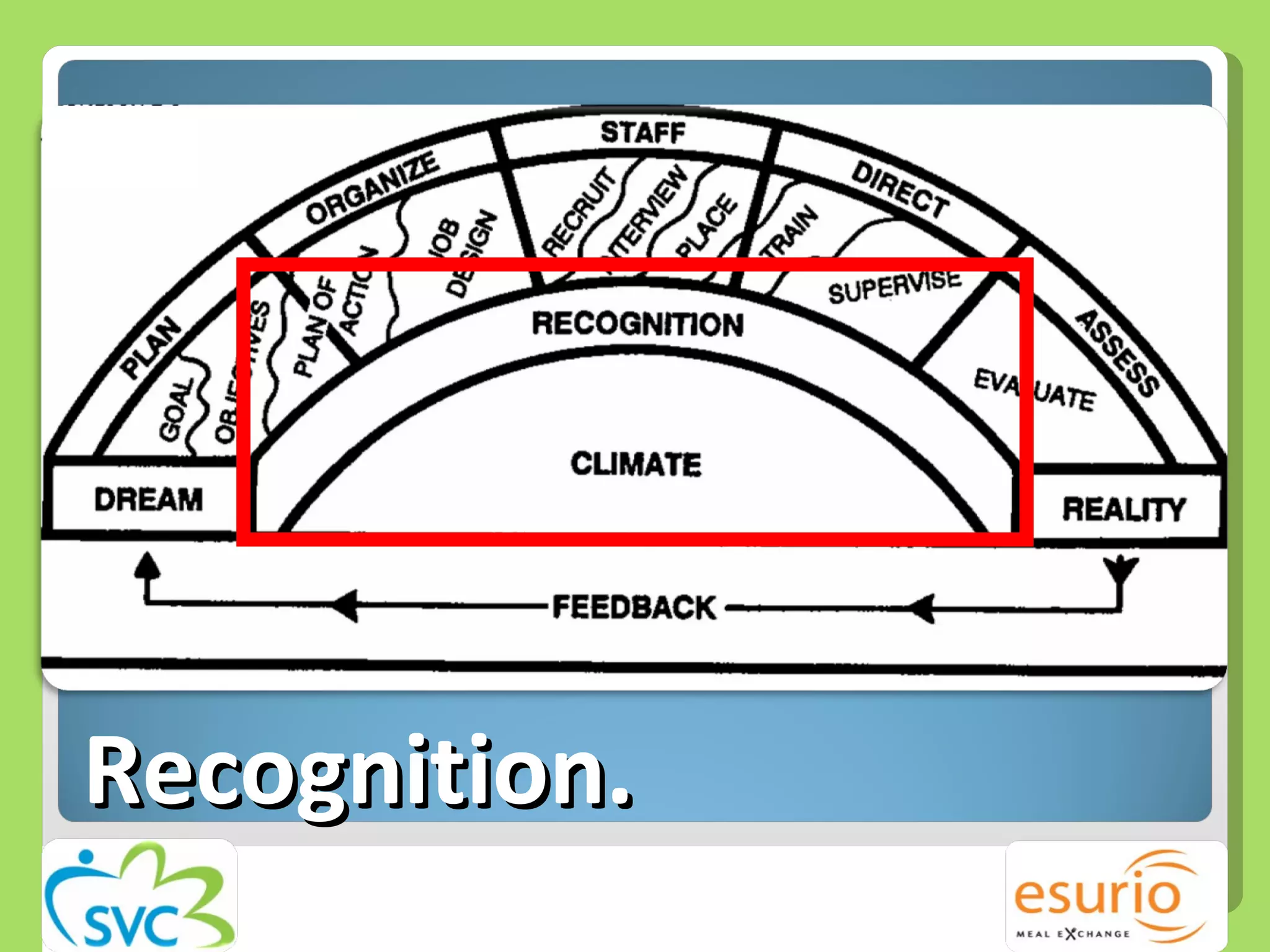
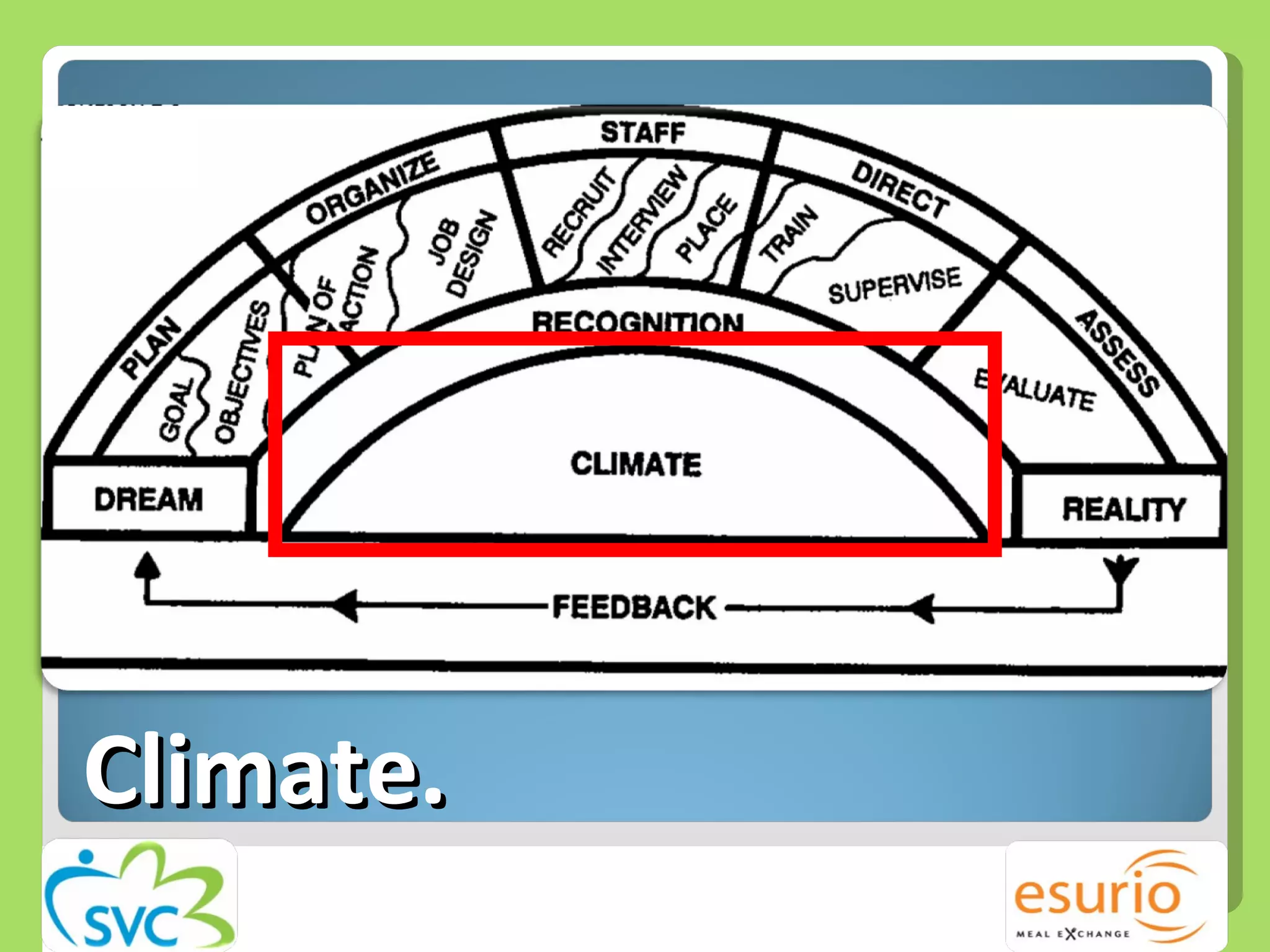
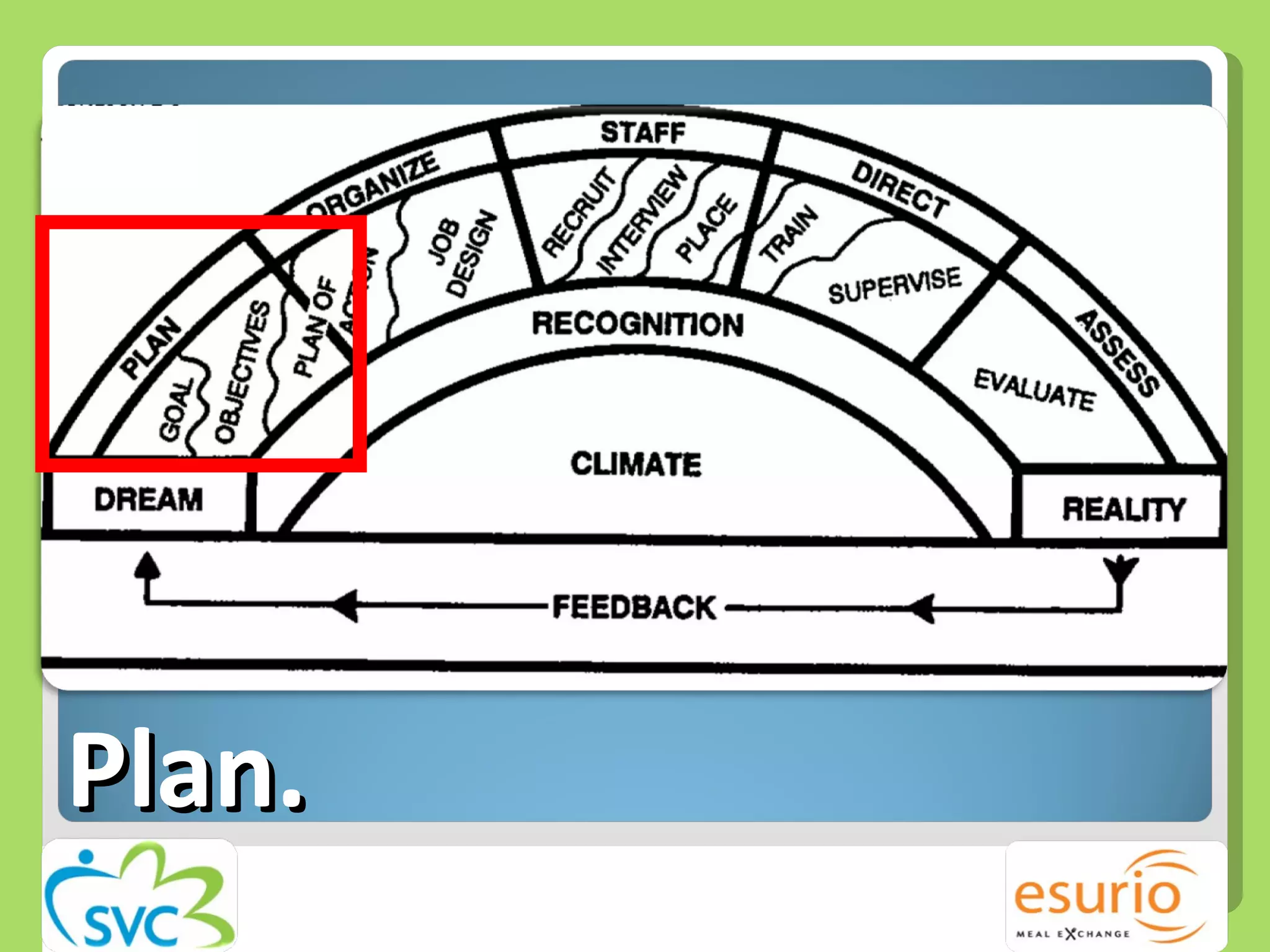
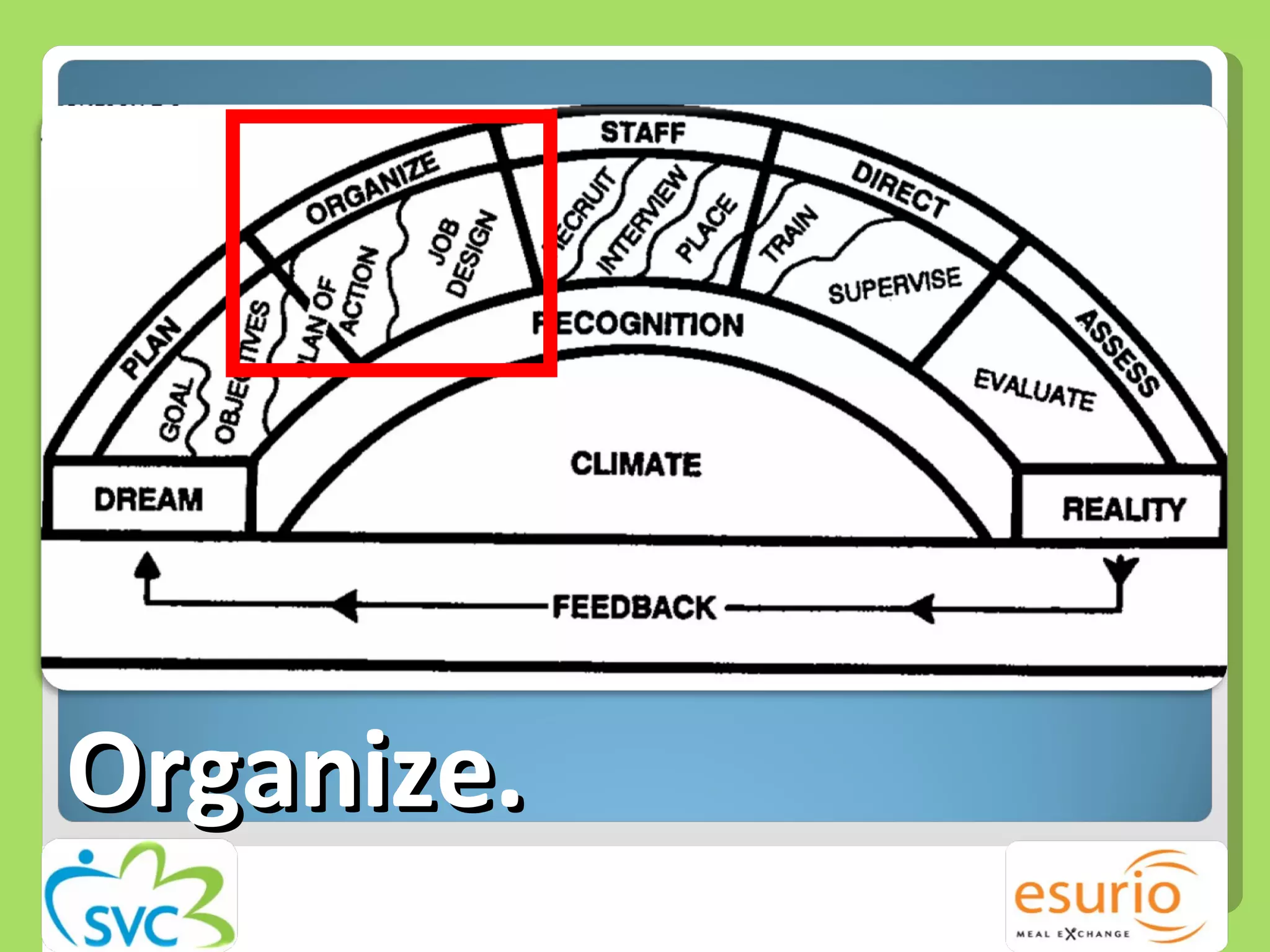
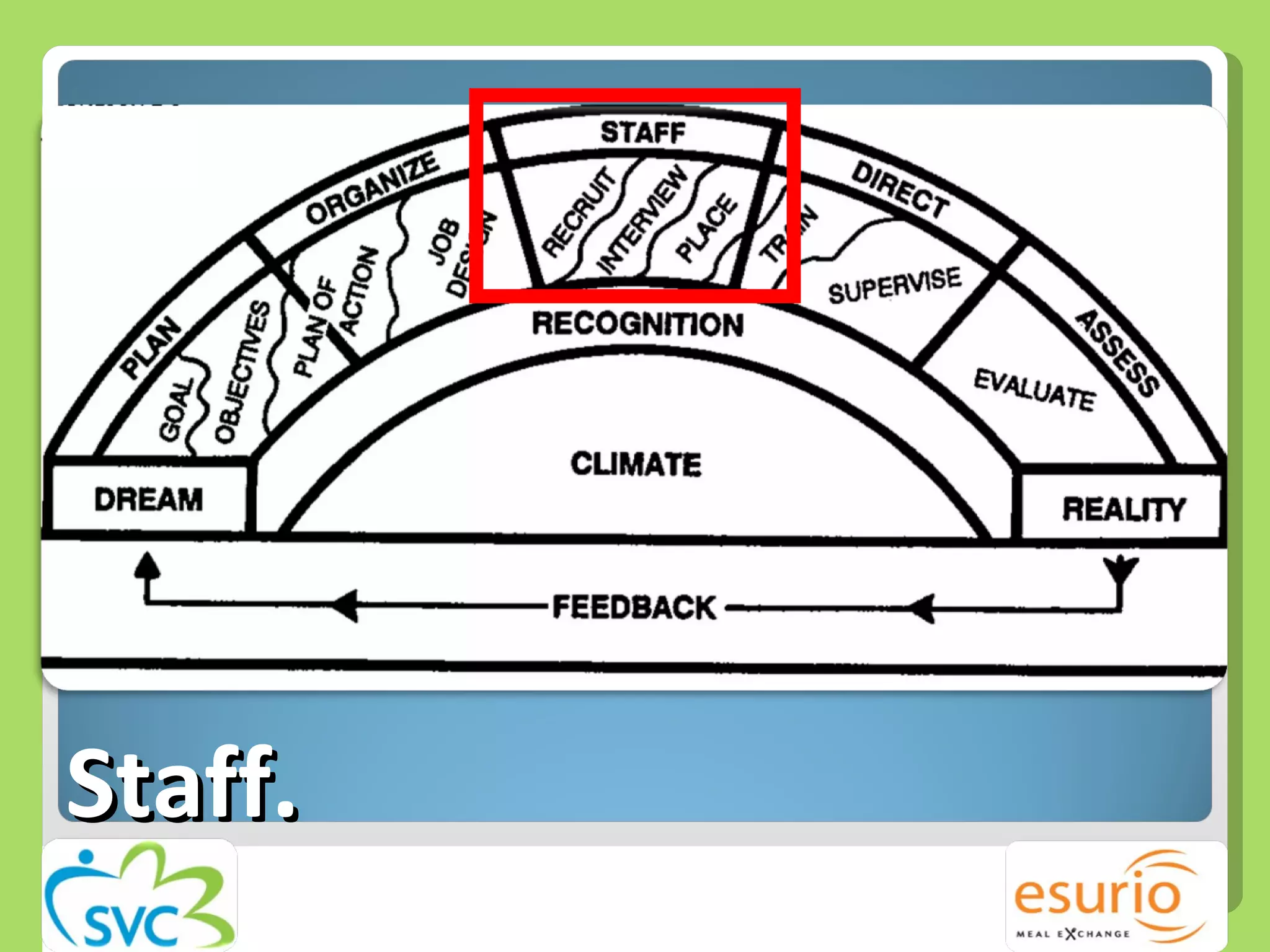
The Volunteer  Management Bridge (VMB)
Plan.
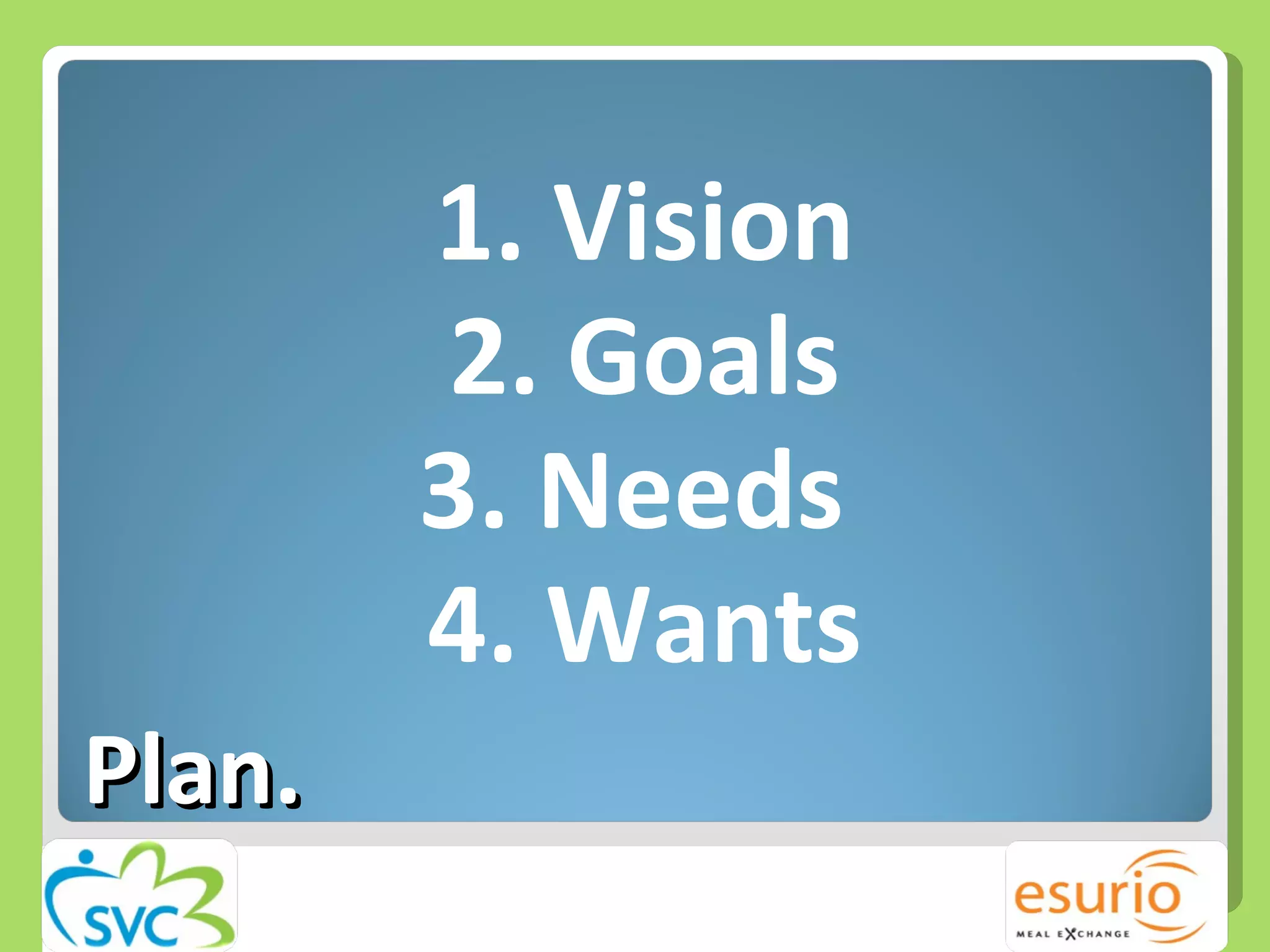
Plan. 1. Vision 2. Goals 3. Needs  4. Wants
BUT HOW? Help with  Volunteers You are only as strong as your volunteers. Develop roles/ job descriptions Plan.
Organize.
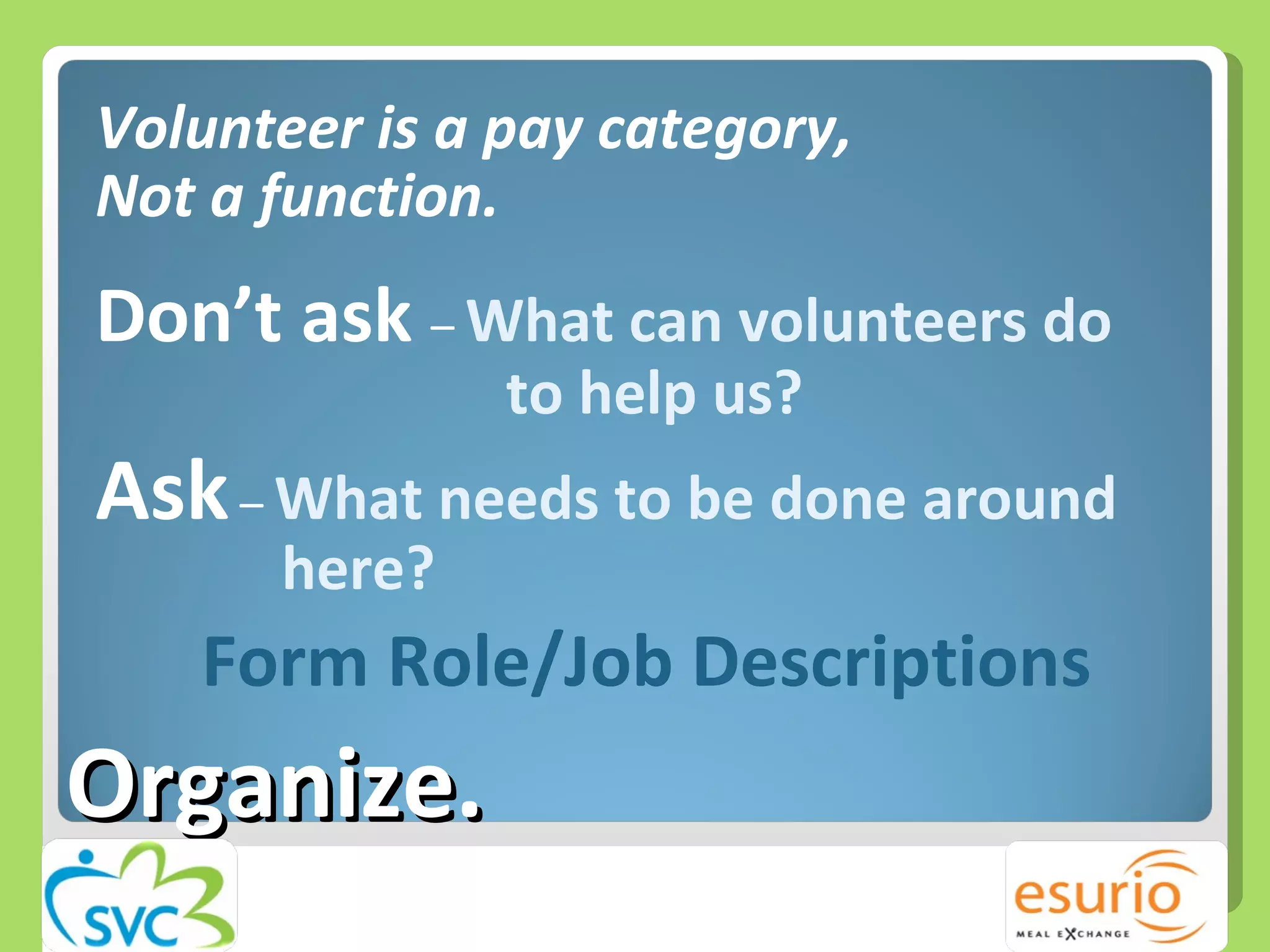
Volunteer is a pay category,  Not a function. Don’t ask  –  What can volunteers do    to help us? Ask  –  What needs to be done around    here? Form Role/Job Descriptions  Organize.
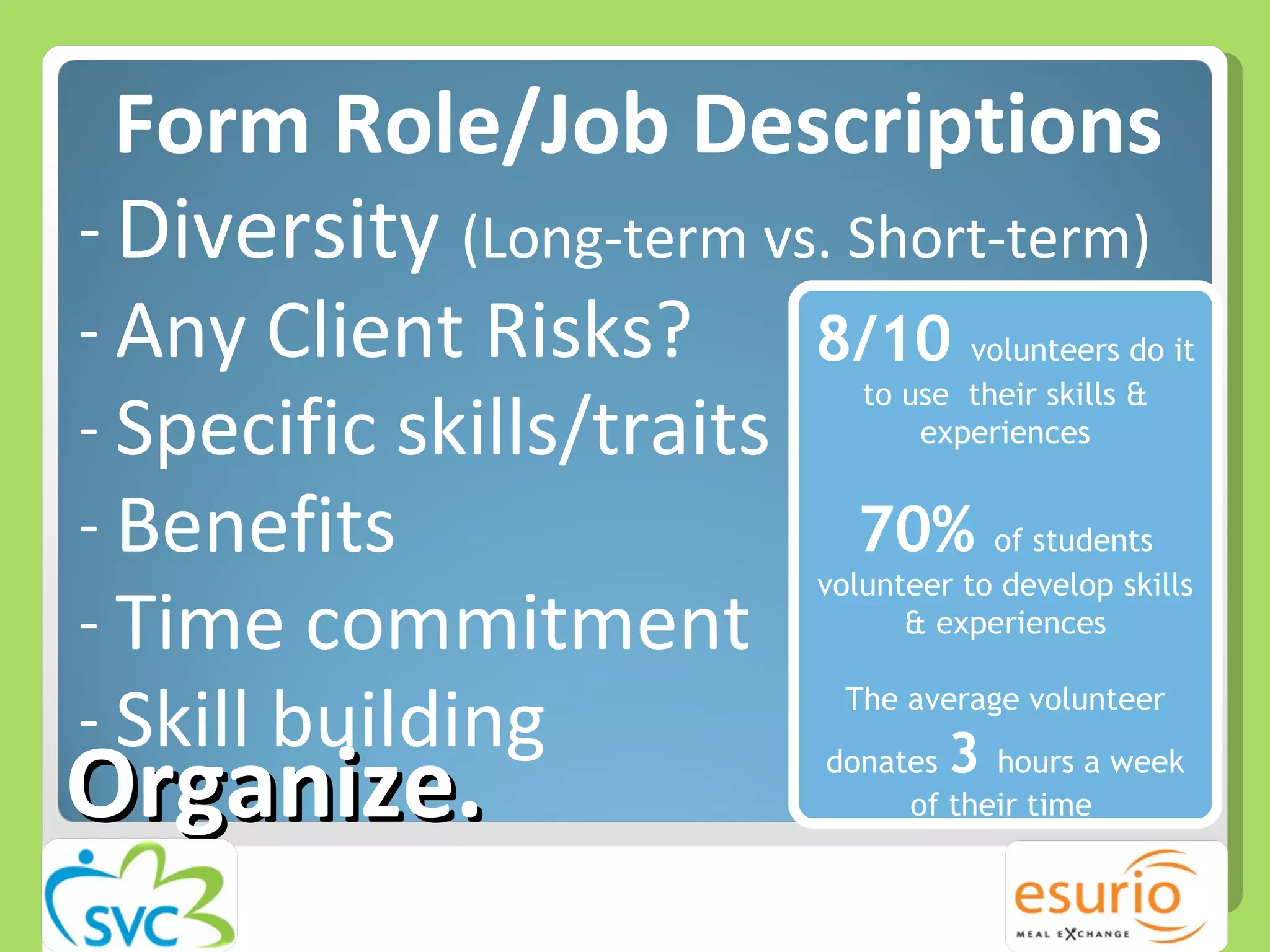
Form Role/Job Descriptions Diversity  (Long-term vs. Short-term) Any Client Risks? Specific skills/traits Benefits  Time commitment Skill building Organize. 8/10  volunteers do it to use  their skills & experiences 70%  of students volunteer to develop skills & experiences The average volunteer donates  3  hours a week of their time
Form Role/Job Descriptions -  Staff.
Staff | Recruitment 1. How 2.When 3.Where 4. Who 5. Why  [if you did the planning, This is common sense.]
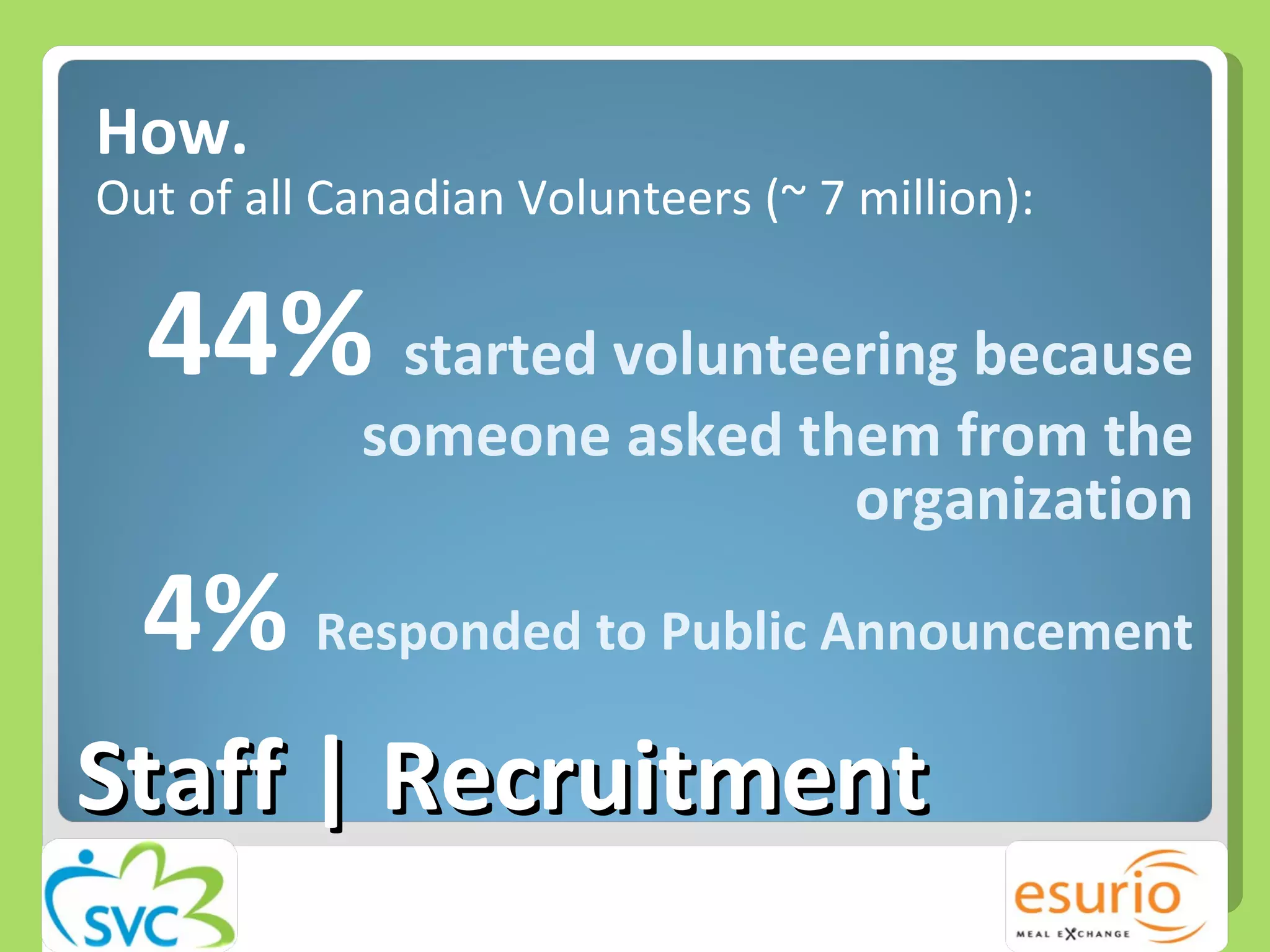
How. Out of all Canadian Volunteers (~ 7 million): 44%  started volunteering because someone asked them from the organization 4%  Resp onded to Public Announcement Staff | Recruitment
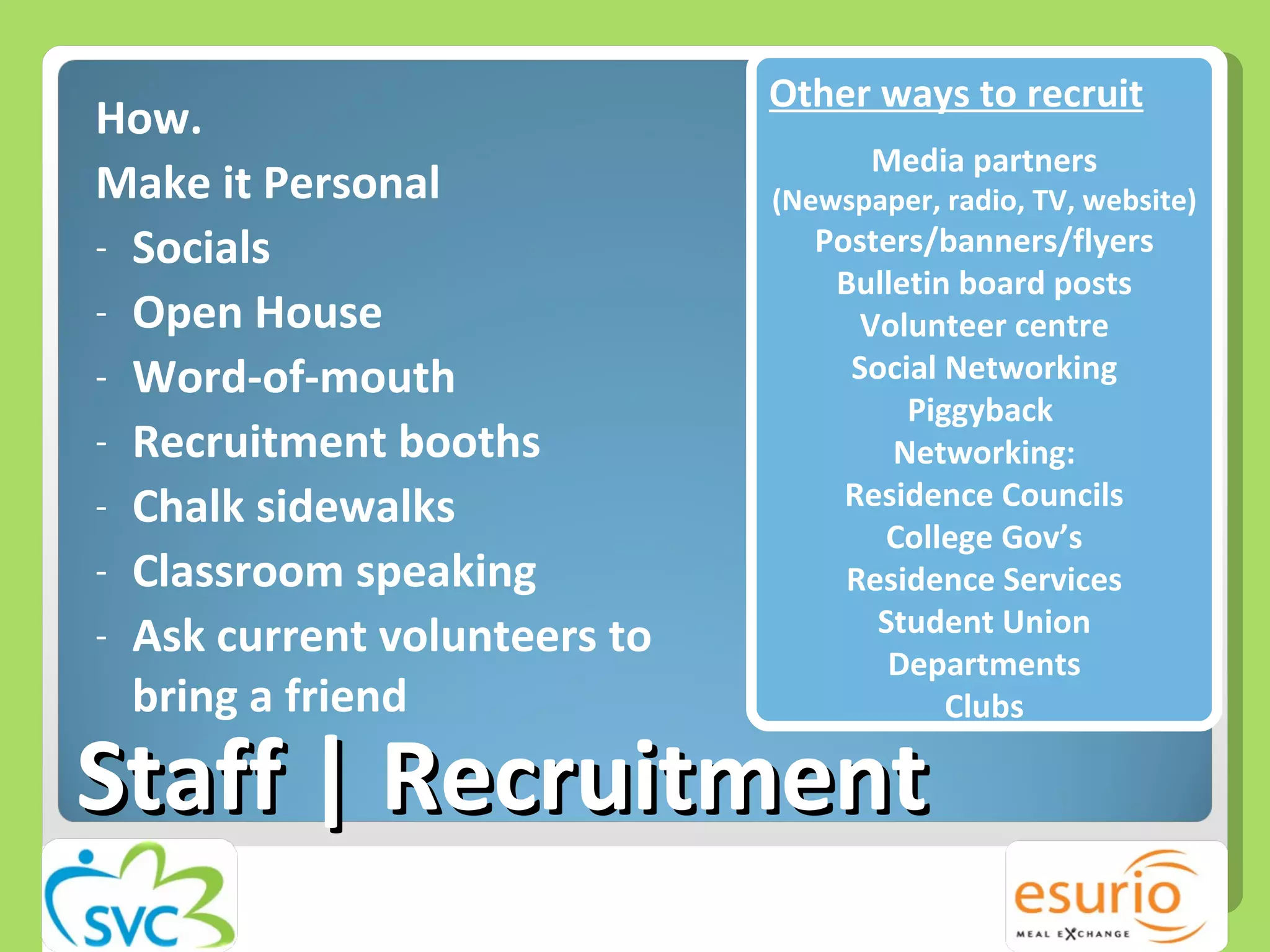
How. Make it Personal  Socials Open House Word-of-mouth Recruitment booths Chalk sidewalks Classroom speaking Ask current volunteers to bring a friend  Staff | Recruitment Other ways to recruit Media partners (Newspaper, radio, TV, website) Posters/banners/flyers Bulletin board posts Volunteer centre Social Networking Piggyback  Networking: Residence Councils College Gov’s Residence Services Student Union Departments Clubs
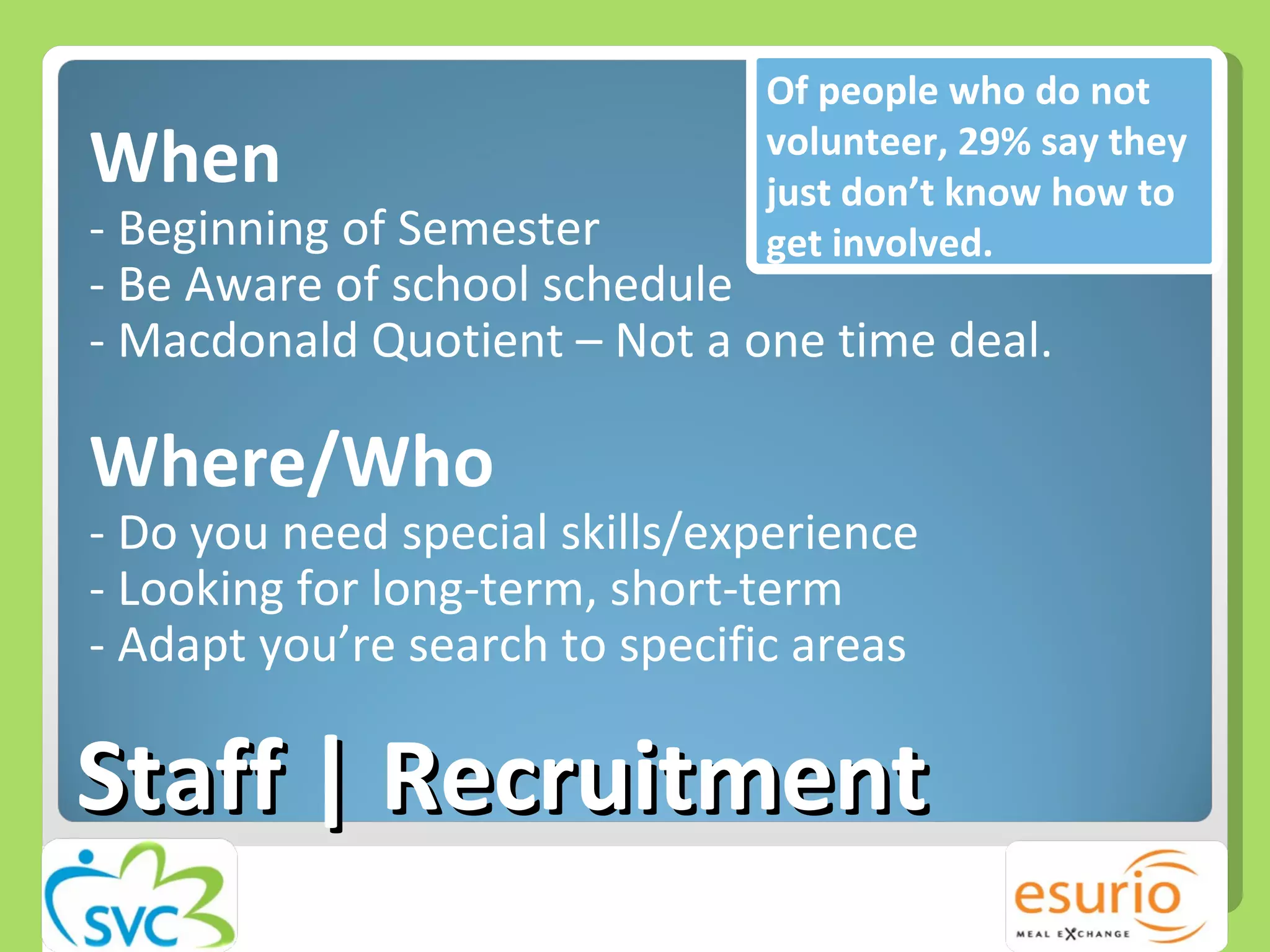
When - Beginning of Semester - Be Aware of school schedule - Macdonald Quotient – Not a one time deal.  Where/Who - Do you need special skills/experience - Looking for long-term, short-term - Adapt you’re search to specific areas Staff | Recruitment Of people who do not volunteer, 29% say they just don’t know how to get involved.
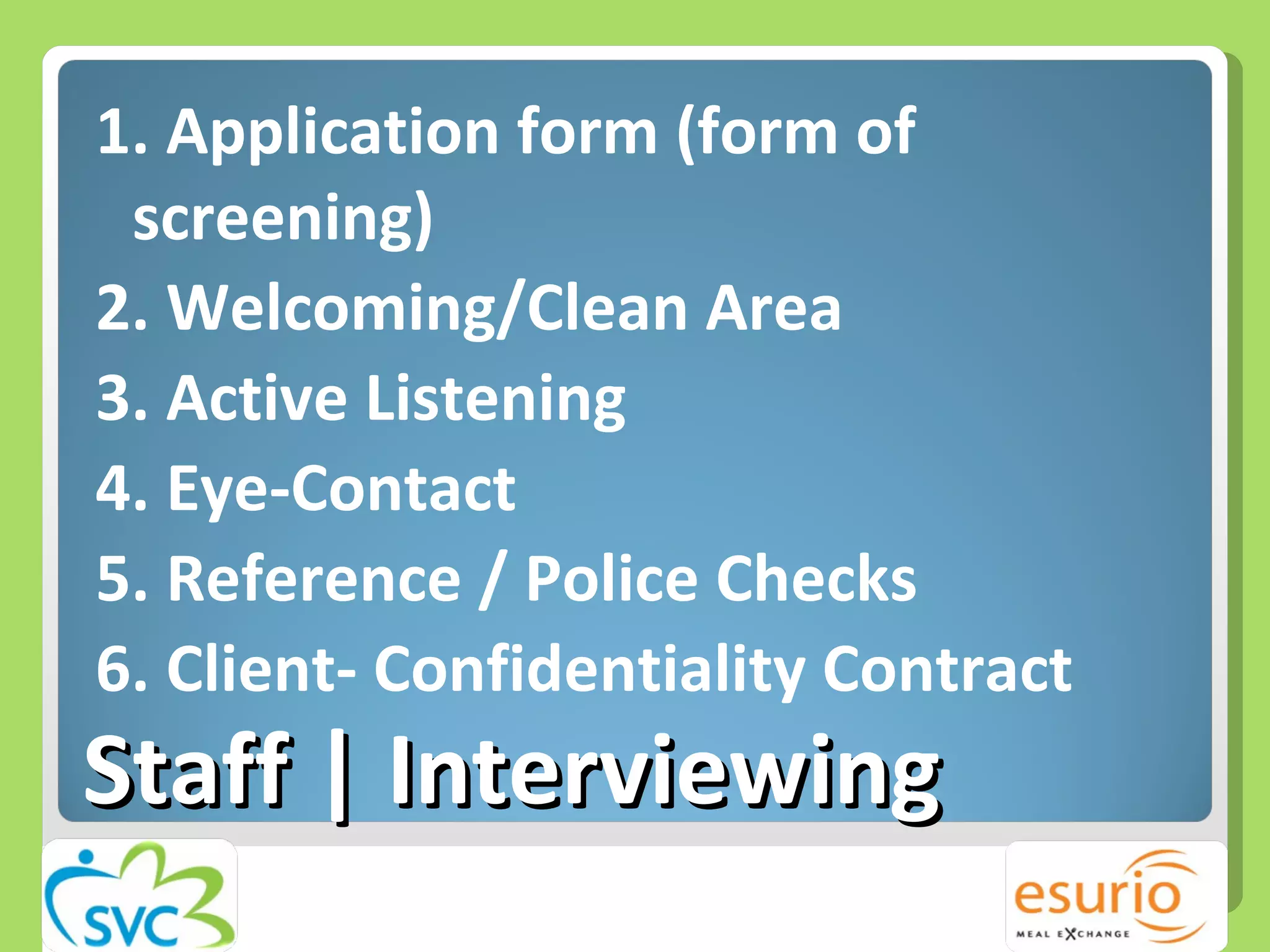
Staff | Interviewing 1. Application form (form of screening) 2. Welcoming/Clean Area 3. Active Listening 4. Eye-Contact 5. Reference / Police Checks 6. Client- Confidentiality Contract
Direct. 1. 2. 3. 4.
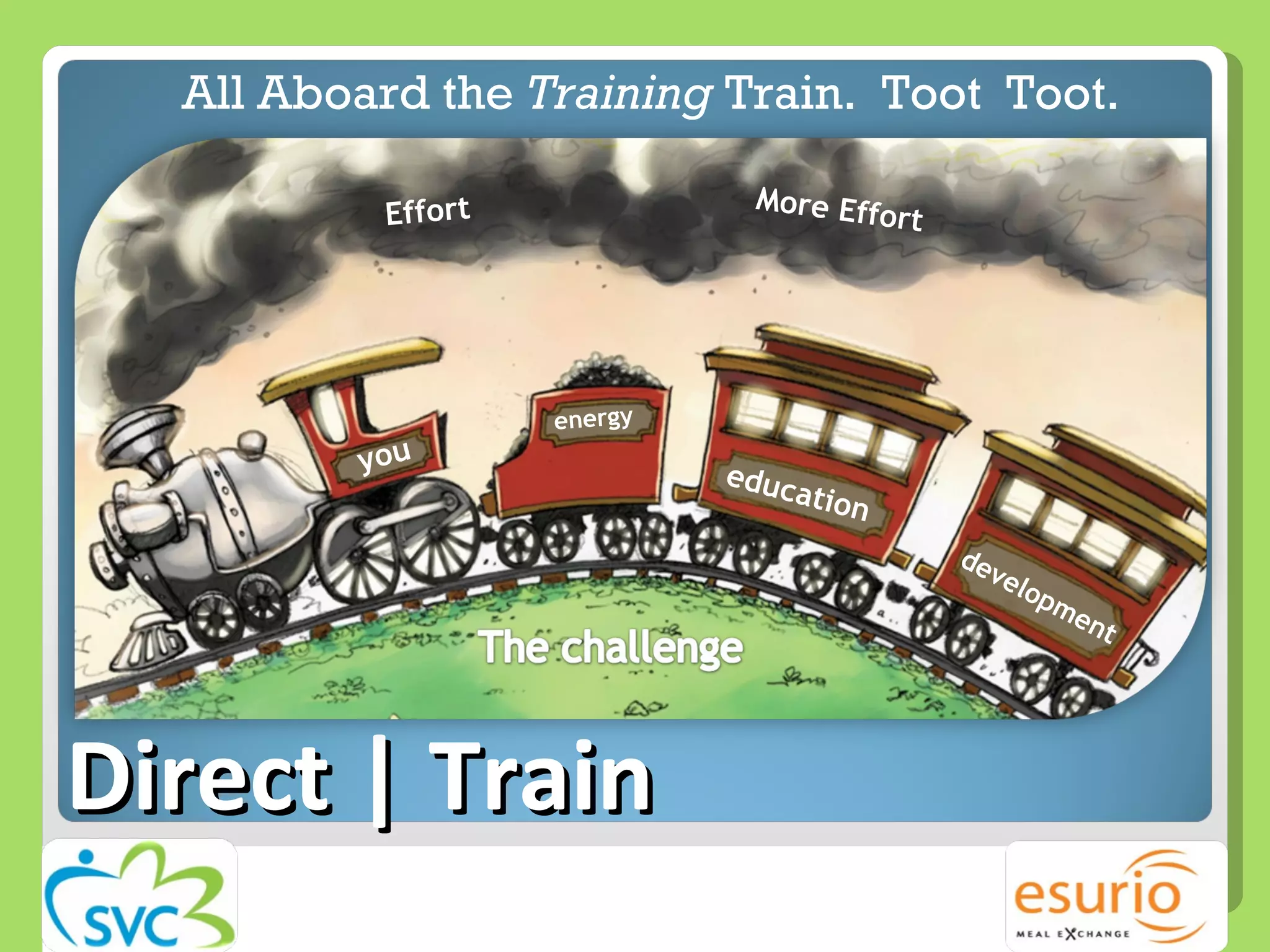
Direct | Train education development energy you More Effort Effort All Aboard the  Training  Train.  Toot  Toot.
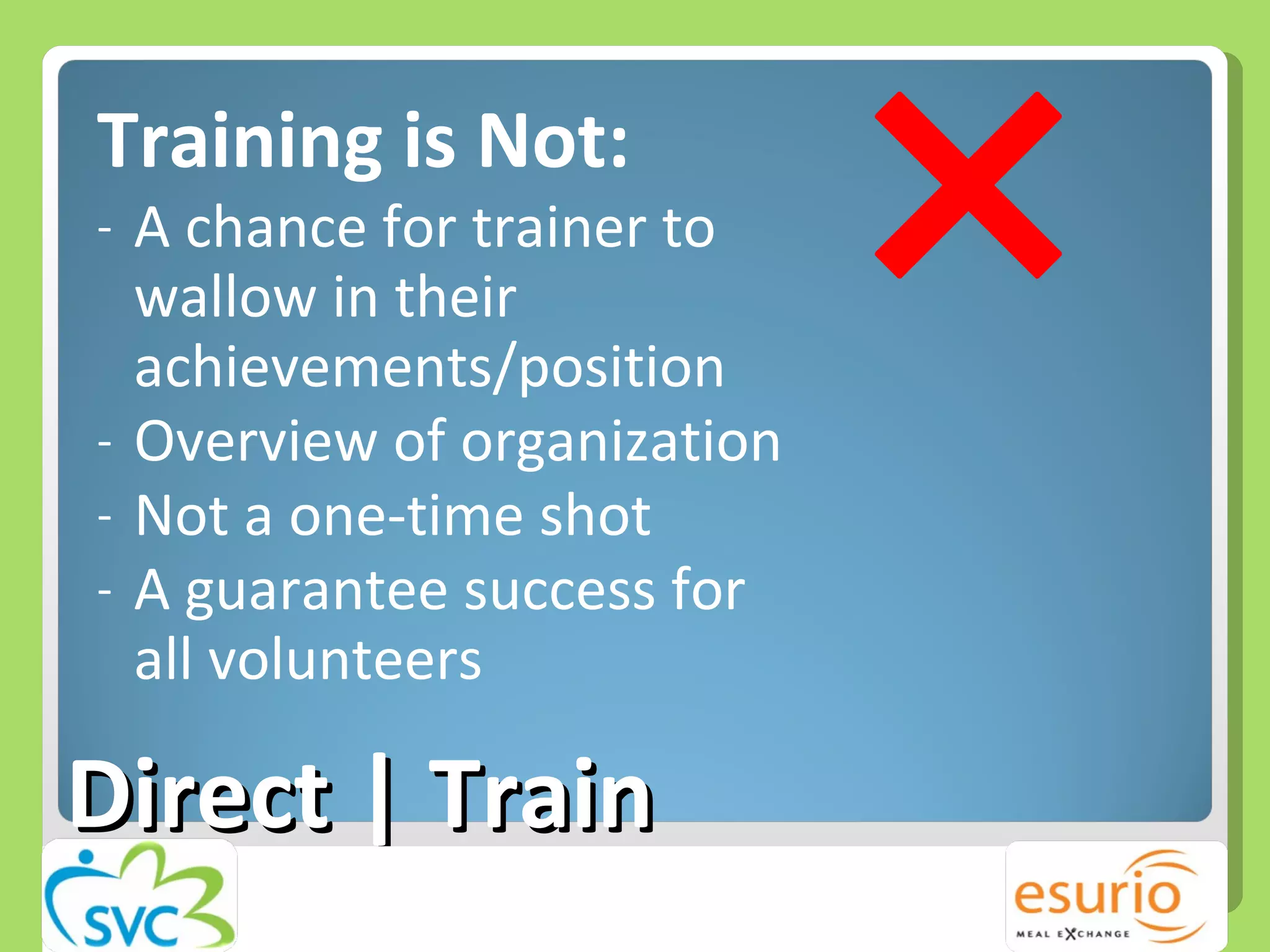
Training is Not: A chance for trainer to wallow in their achievements/position Overview of organization Not a one-time shot A guarantee success for all volunteers Direct | Train
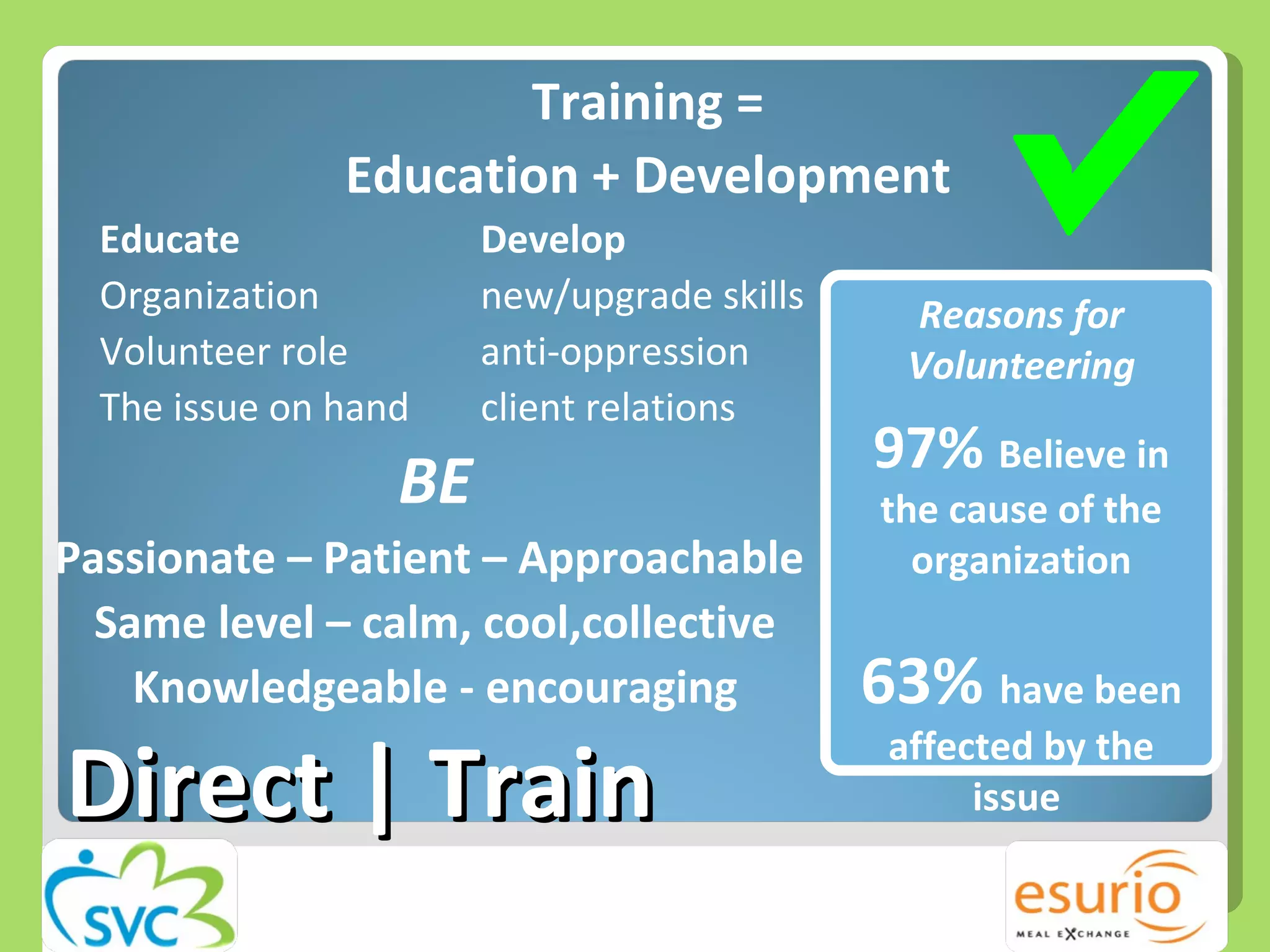
Training = Education + Development Educate Develop Organization new/upgrade skills Volunteer role anti-oppression The issue on hand client relations BE Passionate – Patient – Approachable  Same level – calm, cool,collective Knowledgeable - encouraging Direct | Train Reasons for Volunteering 97%  Believe in the cause of the organization 63%  have been affected by the issue
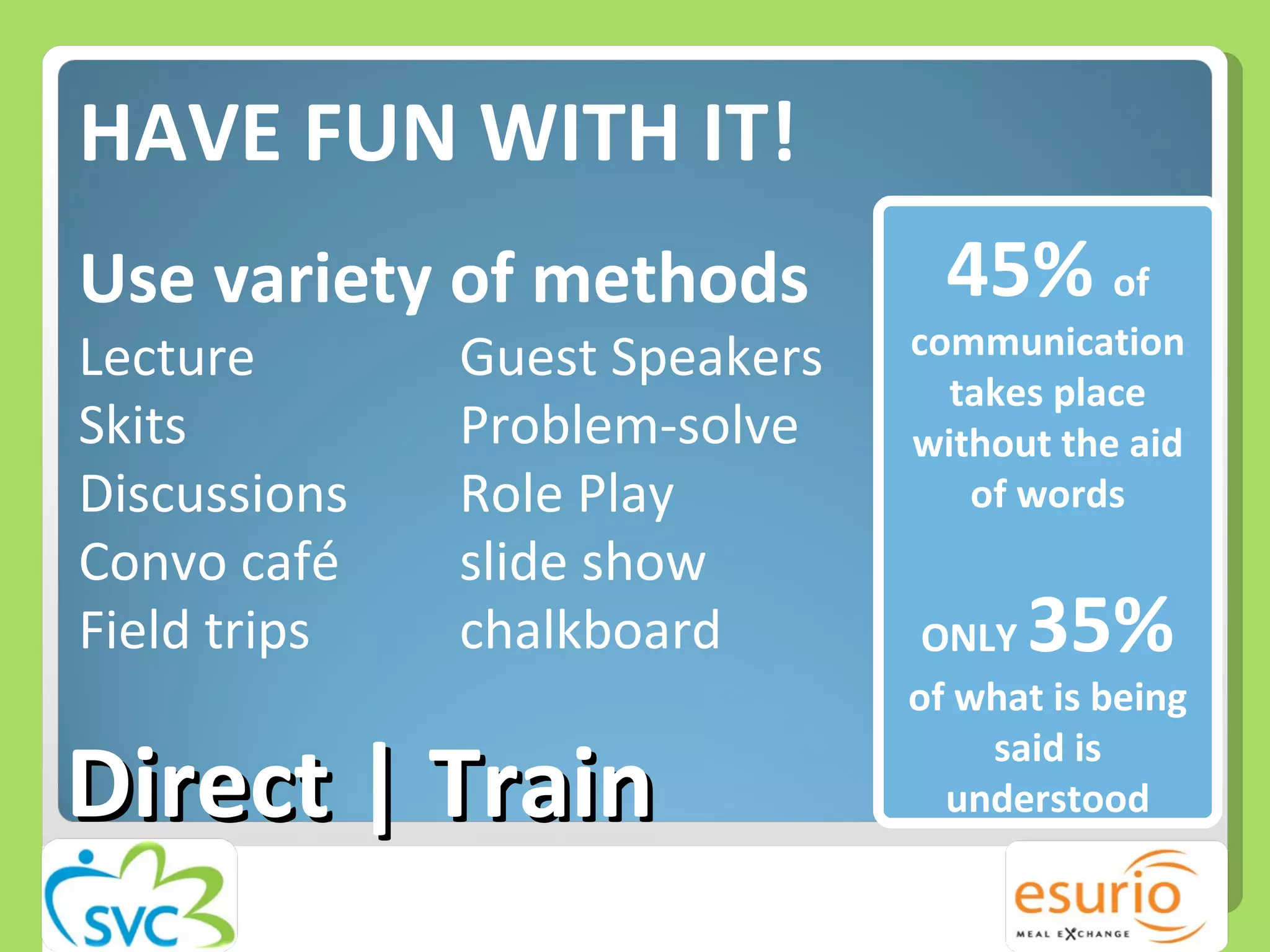
HAVE FUN WITH IT! Use variety of methods Lecture Guest Speakers Skits Problem-solve Discussions Role Play Convo café slide show Field trips chalkboard Direct | Train 45%  of communication takes place without the aid of words ONLY  35%  of what is being said is understood
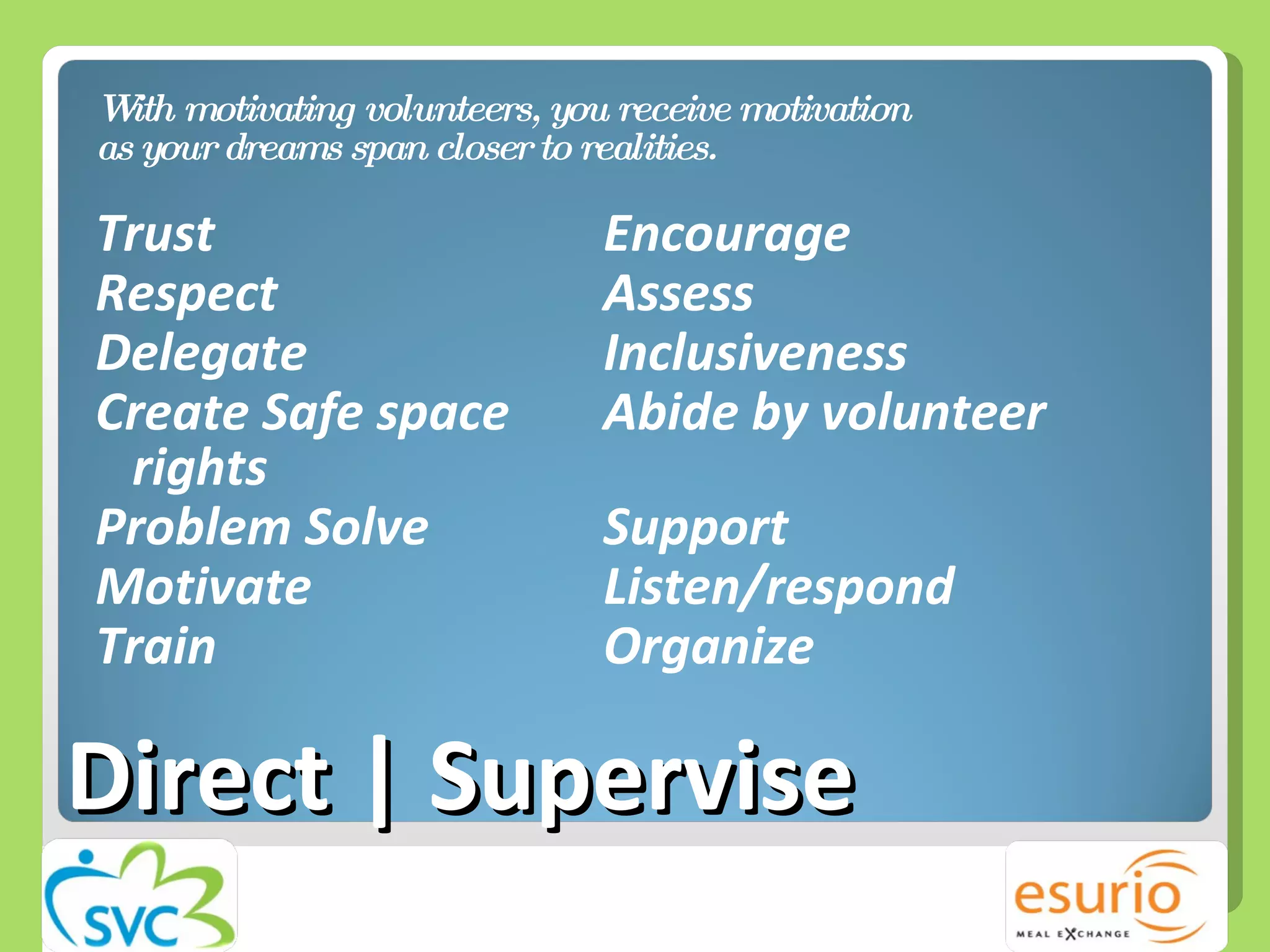
Direct | Supervise With motivating volunteers, you receive motivation as your dreams span closer to realities.  Trust Encourage Respect Assess Delegate Inclusiveness Create Safe space Abide by volunteer rights Problem Solve Support Motivate Listen/respond Train Organize
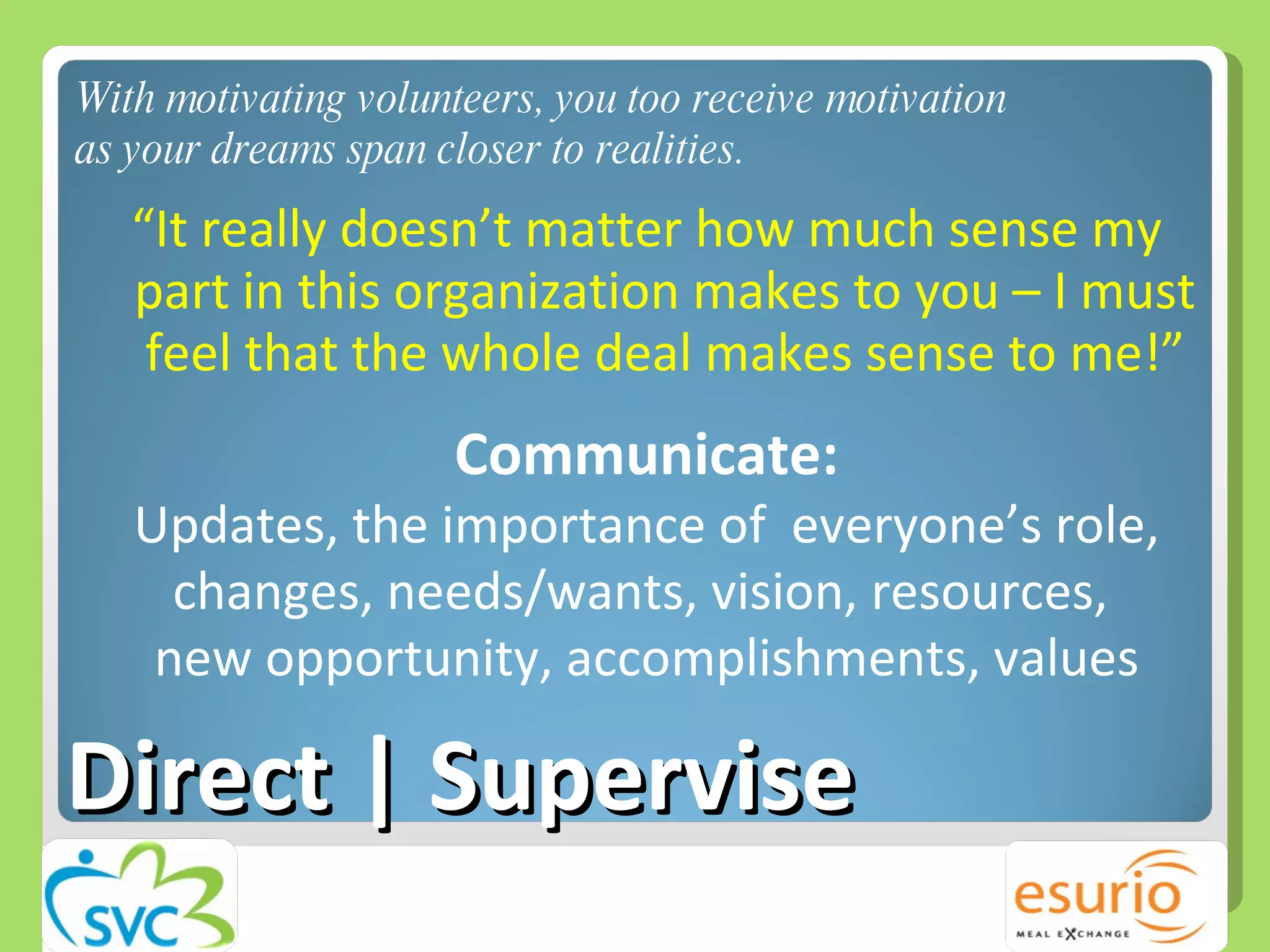
Direct | Supervise “ It really doesn’t matter how much sense my part in this organization makes to you – I must feel that the whole deal makes sense to me!” Communicate: Updates, the importance of  everyone’s role, changes, needs/wants, vision, resources,  new opportunity, accomplishments, values With motivating volunteers, you too receive motivation as your dreams span closer to realities.
Direct | Supervise Conflicts. Because not everything is going to always be cupcakes and sprinkles.
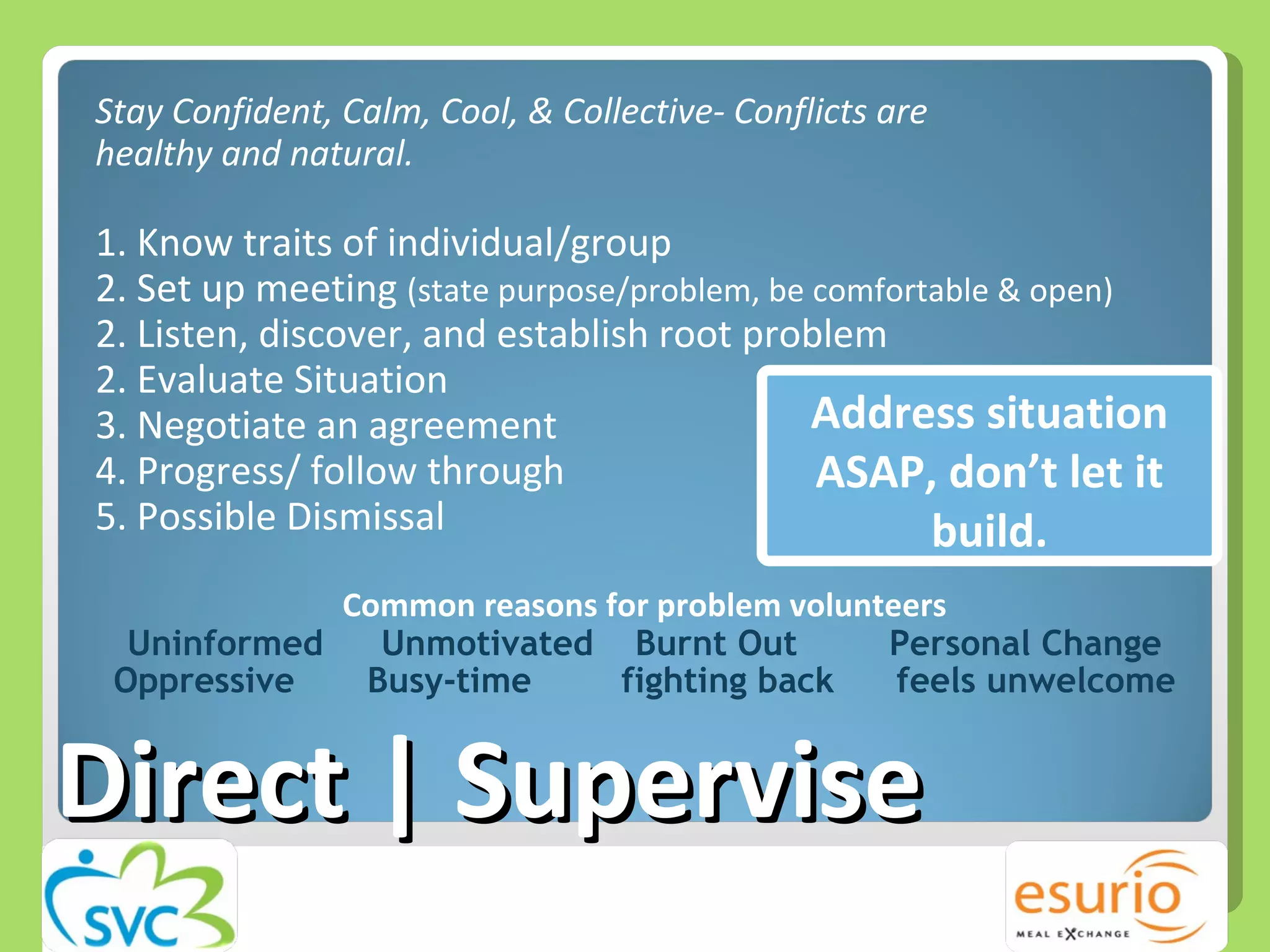
Direct | Supervise Stay Confident, Calm, Cool, & Collective- Conflicts are  healthy and natural. 1. Know traits of individual/group 2. Set up meeting  (state purpose/problem, be comfortable & open) 2. Listen, discover, and establish root problem 2. Evaluate Situation  3. Negotiate an agreement 4. Progress/ follow through 5. Possible Dismissal  Common reasons for problem volunteers Uninformed Unmotivated Burnt Out Personal Change Oppressive Busy-time fighting back   feels unwelcome Address situation ASAP, don’t let it build.
Assess.
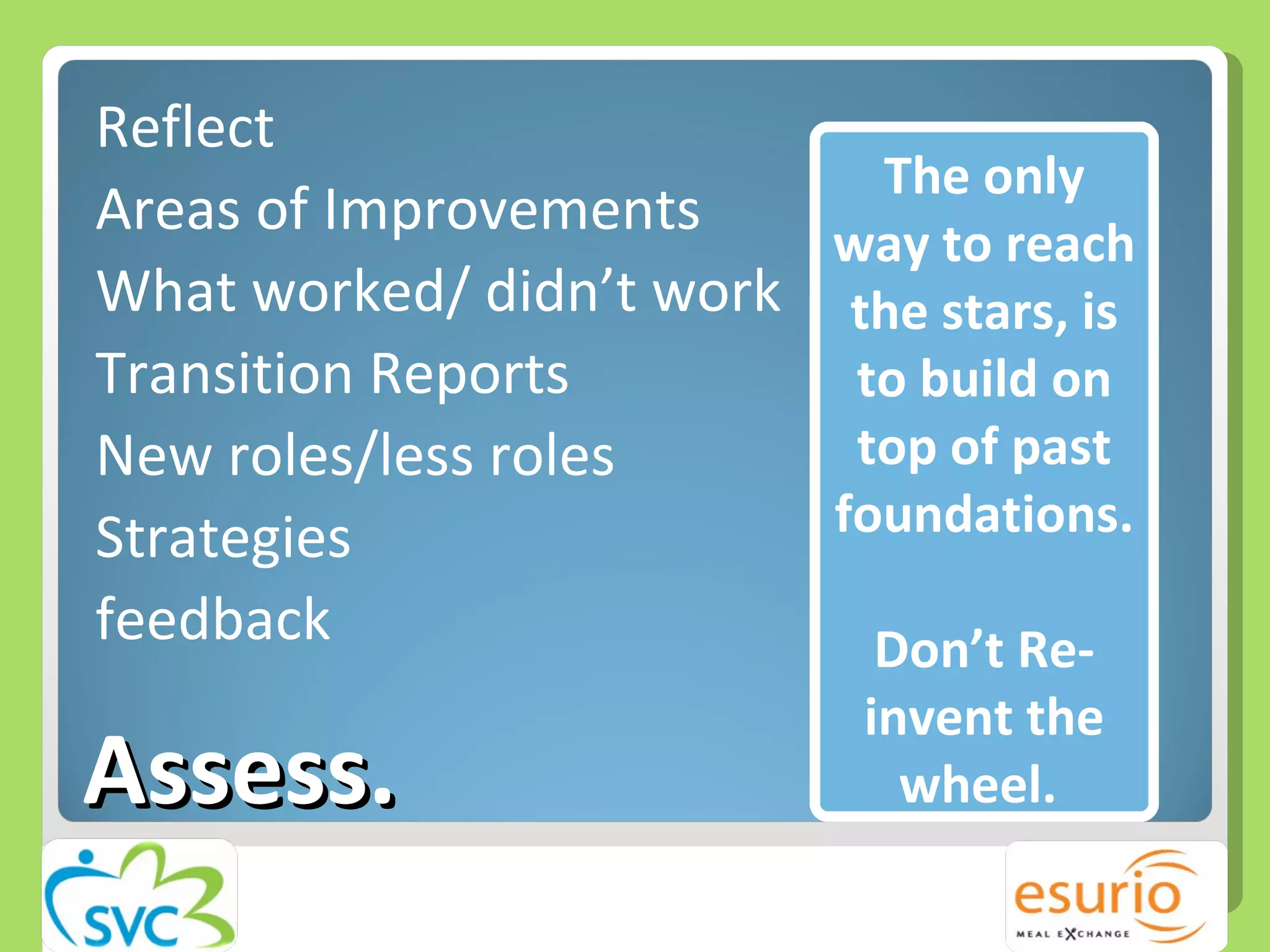
Assess. Reflect Areas of Improvements What worked/ didn’t work Transition Reports  New roles/less roles Strategies feedback The only way to reach the stars, is to build on top of past foundations. Don’t Re-invent the wheel.
Recognition.
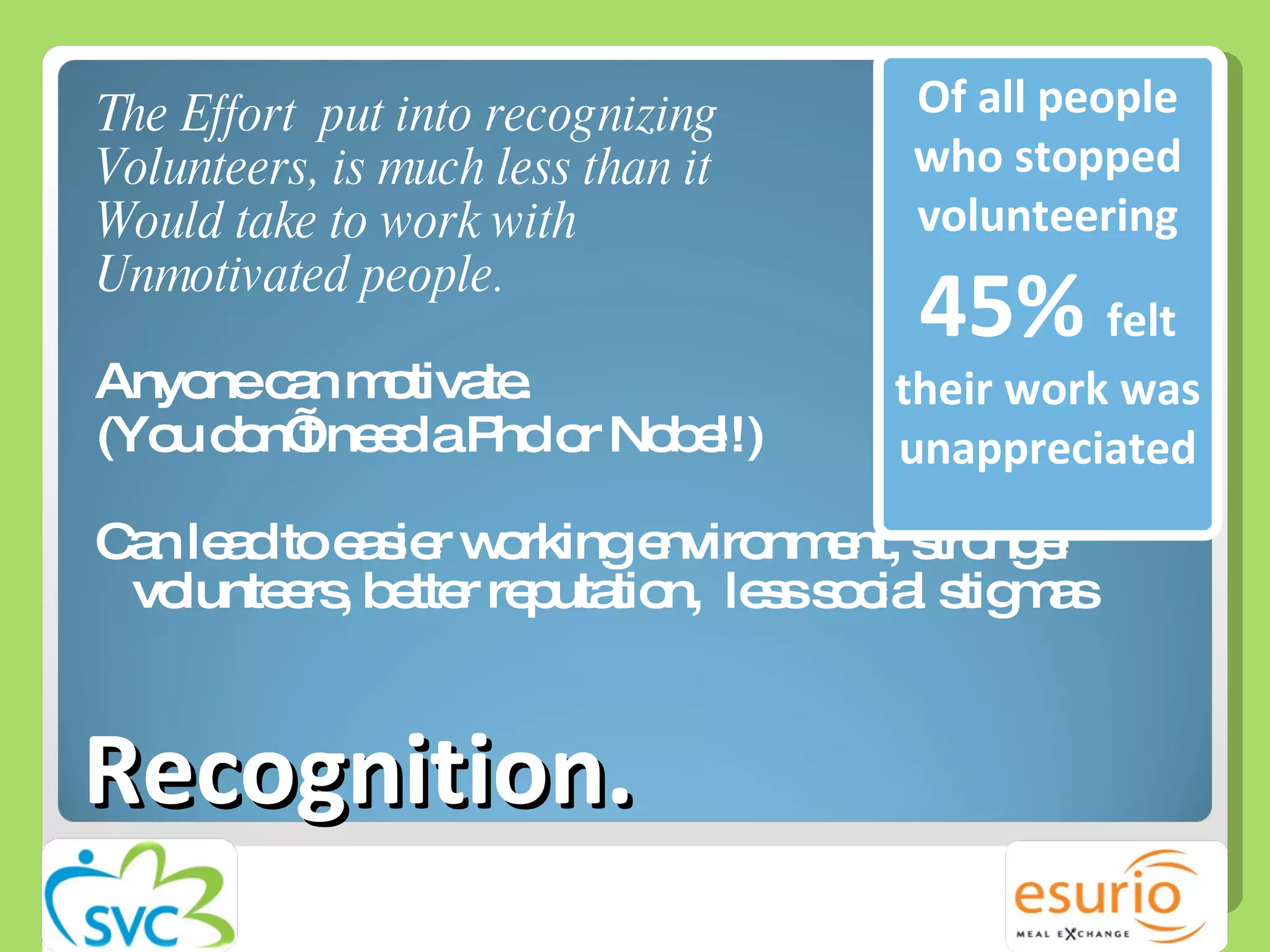
Recognition. The Effort  put into recognizing  Volunteers, is much less than it  Would take to work with  Unmotivated people. Anyone can motivate. (You don’t need a Phd or Nobel!) Can lead to easier working environment, stronger volunteers, better reputation,  less social stigmas  Of all people who stopped volunteering  45%  felt their work was unappreciated
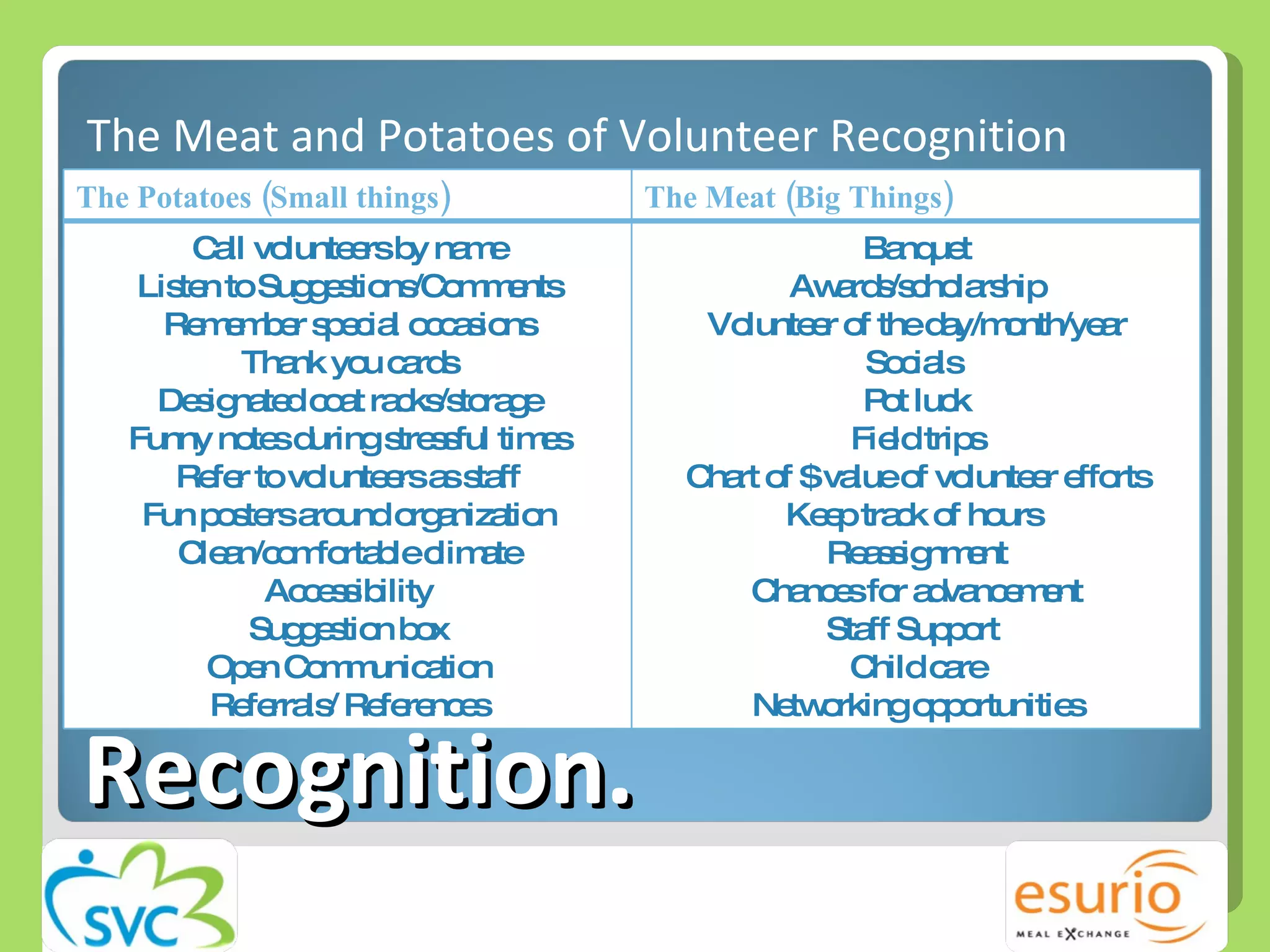
Recognition. The Meat and Potatoes of Volunteer Recognition The Potatoes (Small things) The Meat (Big Things) Call volunteers by name Listen to Suggestions/Comments Remember special occasions Thank you cards Designated coat racks/storage Funny notes during stressful times Refer to volunteers as staff Fun posters around organization Clean/comfortable climate Accessibility Suggestion box Open Communication Referrals/ References Banquet Awards/scholarship Volunteer of the day/month/year Socials  Pot luck Field trips Chart of $ value of volunteer efforts Keep track of hours  Reassignment Chances for advancement Staff Support  Child care Networking opportunities
Climate.
Climate. Space Should be: Comfortable Safe Respectful Anti-Oppressive Abideful of Client-Confidentiality Clean
Resources. USE YOUR RESOURCES! Online - www.energizeinc.com www.volunteer.ca www.imaginecanada.ca www.charityvillage.org Check out your local Volunteer Centre or Student Leadership outlets on-campus

Managing volunteers, successfully

  • 1.
    Managing Volunteers, Successfully. Jordan Thompson Programme Director Student Volunteer Connections University of Guelph Guelph, Ontario esurio 2009 Volunteer Recruitment & Management
  • 2.
    The Recipe. DefineVolunteering The VMB - Plan, Organize, Staff, Direct, Assess, Recognition, Climate Interactivity (through out) Resources
  • 3.
    Defining Volunteer. what is a volunteer?
  • 4.
    Defining Volunteer. Volunteer, verb - To choose to act in recognition of a need, with an attitude of social responsibility and  without concern for monetary profit, going beyond one's basic obligations.  Volunteer, noun – from the perspective of the doer :  Someone who gives time, effort and talent to a need or cause without profiting monetarily. Volunteer, noun – from the perspective of the recipient of service :  Someone who contributes time, effort and talent to meet a need or further a mission, without going on the payroll.
  • 5.
    The Volunteer Management Bridge (VMB)
  • 6.
  • 7.
    Plan. 1. Vision2. Goals 3. Needs 4. Wants
  • 8.
    BUT HOW? Helpwith Volunteers You are only as strong as your volunteers. Develop roles/ job descriptions Plan.
  • 9.
  • 10.
    Volunteer is apay category, Not a function. Don’t ask – What can volunteers do to help us? Ask – What needs to be done around here? Form Role/Job Descriptions Organize.
  • 11.
    Form Role/Job DescriptionsDiversity (Long-term vs. Short-term) Any Client Risks? Specific skills/traits Benefits Time commitment Skill building Organize. 8/10 volunteers do it to use their skills & experiences 70% of students volunteer to develop skills & experiences The average volunteer donates 3 hours a week of their time
  • 12.
  • 13.
    Staff | Recruitment1. How 2.When 3.Where 4. Who 5. Why [if you did the planning, This is common sense.]
  • 14.
    How. Out ofall Canadian Volunteers (~ 7 million): 44% started volunteering because someone asked them from the organization 4% Resp onded to Public Announcement Staff | Recruitment
  • 15.
    How. Make itPersonal Socials Open House Word-of-mouth Recruitment booths Chalk sidewalks Classroom speaking Ask current volunteers to bring a friend Staff | Recruitment Other ways to recruit Media partners (Newspaper, radio, TV, website) Posters/banners/flyers Bulletin board posts Volunteer centre Social Networking Piggyback Networking: Residence Councils College Gov’s Residence Services Student Union Departments Clubs
  • 16.
    When - Beginningof Semester - Be Aware of school schedule - Macdonald Quotient – Not a one time deal. Where/Who - Do you need special skills/experience - Looking for long-term, short-term - Adapt you’re search to specific areas Staff | Recruitment Of people who do not volunteer, 29% say they just don’t know how to get involved.
  • 17.
    Staff | Interviewing1. Application form (form of screening) 2. Welcoming/Clean Area 3. Active Listening 4. Eye-Contact 5. Reference / Police Checks 6. Client- Confidentiality Contract
  • 18.
  • 19.
    Direct | Traineducation development energy you More Effort Effort All Aboard the Training Train. Toot Toot.
  • 20.
    Training is Not:A chance for trainer to wallow in their achievements/position Overview of organization Not a one-time shot A guarantee success for all volunteers Direct | Train
  • 21.
    Training = Education+ Development Educate Develop Organization new/upgrade skills Volunteer role anti-oppression The issue on hand client relations BE Passionate – Patient – Approachable Same level – calm, cool,collective Knowledgeable - encouraging Direct | Train Reasons for Volunteering 97% Believe in the cause of the organization 63% have been affected by the issue
  • 22.
    HAVE FUN WITHIT! Use variety of methods Lecture Guest Speakers Skits Problem-solve Discussions Role Play Convo café slide show Field trips chalkboard Direct | Train 45% of communication takes place without the aid of words ONLY 35% of what is being said is understood
  • 23.
    Direct | SuperviseWith motivating volunteers, you receive motivation as your dreams span closer to realities. Trust Encourage Respect Assess Delegate Inclusiveness Create Safe space Abide by volunteer rights Problem Solve Support Motivate Listen/respond Train Organize
  • 24.
    Direct | Supervise“ It really doesn’t matter how much sense my part in this organization makes to you – I must feel that the whole deal makes sense to me!” Communicate: Updates, the importance of everyone’s role, changes, needs/wants, vision, resources, new opportunity, accomplishments, values With motivating volunteers, you too receive motivation as your dreams span closer to realities.
  • 25.
    Direct | SuperviseConflicts. Because not everything is going to always be cupcakes and sprinkles.
  • 26.
    Direct | SuperviseStay Confident, Calm, Cool, & Collective- Conflicts are healthy and natural. 1. Know traits of individual/group 2. Set up meeting (state purpose/problem, be comfortable & open) 2. Listen, discover, and establish root problem 2. Evaluate Situation 3. Negotiate an agreement 4. Progress/ follow through 5. Possible Dismissal Common reasons for problem volunteers Uninformed Unmotivated Burnt Out Personal Change Oppressive Busy-time fighting back feels unwelcome Address situation ASAP, don’t let it build.
  • 27.
  • 28.
    Assess. Reflect Areasof Improvements What worked/ didn’t work Transition Reports New roles/less roles Strategies feedback The only way to reach the stars, is to build on top of past foundations. Don’t Re-invent the wheel.
  • 29.
  • 30.
    Recognition. The Effort put into recognizing Volunteers, is much less than it Would take to work with Unmotivated people. Anyone can motivate. (You don’t need a Phd or Nobel!) Can lead to easier working environment, stronger volunteers, better reputation, less social stigmas Of all people who stopped volunteering 45% felt their work was unappreciated
  • 31.
    Recognition. The Meatand Potatoes of Volunteer Recognition The Potatoes (Small things) The Meat (Big Things) Call volunteers by name Listen to Suggestions/Comments Remember special occasions Thank you cards Designated coat racks/storage Funny notes during stressful times Refer to volunteers as staff Fun posters around organization Clean/comfortable climate Accessibility Suggestion box Open Communication Referrals/ References Banquet Awards/scholarship Volunteer of the day/month/year Socials Pot luck Field trips Chart of $ value of volunteer efforts Keep track of hours Reassignment Chances for advancement Staff Support Child care Networking opportunities
  • 32.
  • 33.
    Climate. Space Shouldbe: Comfortable Safe Respectful Anti-Oppressive Abideful of Client-Confidentiality Clean
  • 34.
    Resources. USE YOURRESOURCES! Online - www.energizeinc.com www.volunteer.ca www.imaginecanada.ca www.charityvillage.org Check out your local Volunteer Centre or Student Leadership outlets on-campus