Plain Sedimentation,
Sedimentation tank , Aeration
• Two types of sedimentation :
1. Plain sedimentation
2. Sedimentation with coagulation
Plain sedimentation :
When impurities are seperated from suspending fluid
by action of natural force alone, without aid of any coagulant,
is called plain sedimentation.
Advantage of plain sedimentation
• It lightens load on subsequent processes.
• The operation of subsequent process can be controlled in a
better way.
• The cost of cleaning the chemical coagulation basin is reduced.
• Less quantity of chemicals are required.
Theory of sedimentation
• The particle heavier than water are naturally likely to settle
down due to force of gravity.
1. Inorganic suspended solids sp. Gravity 2.65
2. Organic suspended solids sp. Gravity 1.04
• The phenomena of settling of particles at bottom of
sedimentation tank is called hydraulic subsidence.
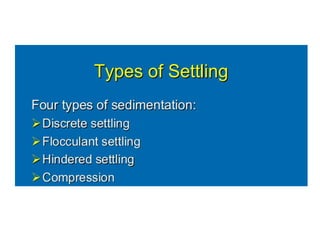
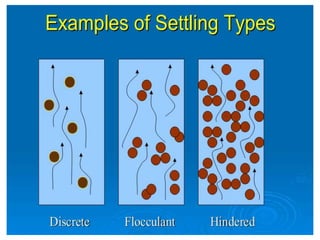
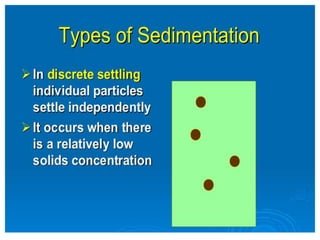
Settling of discrete particle
• A particle that does not alter its shape, size and weight while
settling or rising in water is called discrete particle
• The discrete particle will accelerate until drag force becomes
equal to gravitational force.
• At this stage particle attains uniform velocity called settling
velocity.
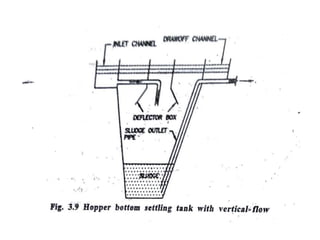
Types of sedimentation tanks
• Based on method of operation :
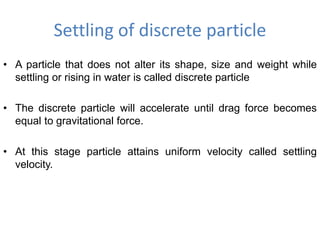
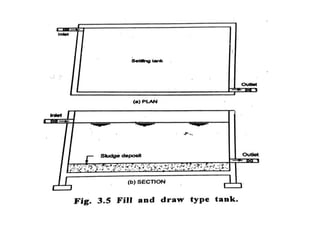
1. Fill and draw type tanks
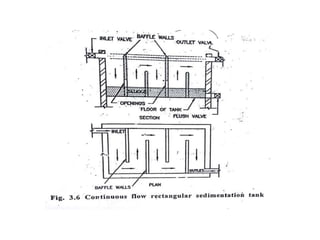
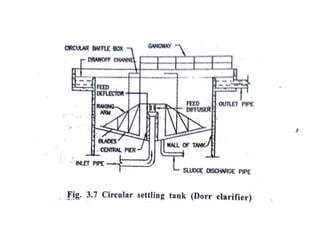
2. Continuous flow type tank
• Depending upon shape :
1. Rectangular tanks
2. Circular tanks
3. Hopper bottom tanks
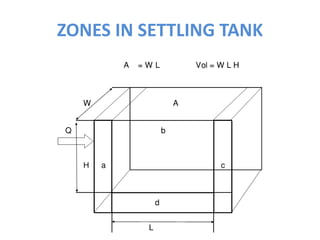
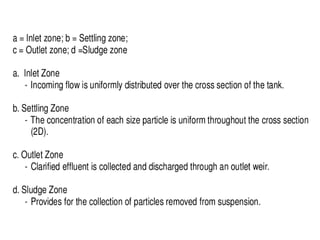
ZONES IN SETTLING TANK
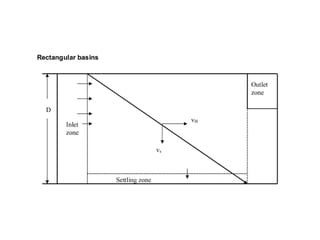
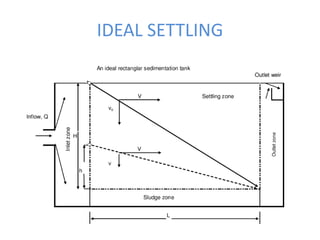
IDEAL SETTLING
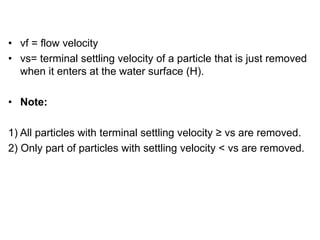
• vf = flow velocity
• vs= terminal settling velocity of a particle that is just removed
when it enters at the water surface (H).
• Note:
1) All particles with terminal settling velocity ≥ vs are removed.
2) Only part of particles with settling velocity < vs are removed.
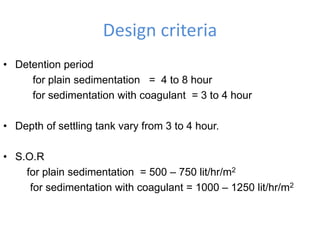
Design criteria
• Detention period
for plain sedimentation = 4 to 8 hour
for sedimentation with coagulant = 3 to 4 hour
• Depth of settling tank vary from 3 to 4 hour.
• S.O.R
for plain sedimentation = 500 – 750 lit/hr/m2
for sedimentation with coagulant = 1000 – 1250 lit/hr/m2
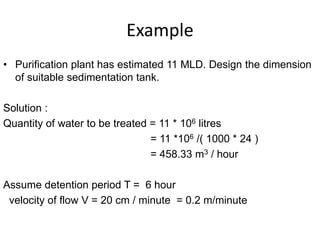
Example
• Purification plant has estimated 11 MLD. Design the dimension
of suitable sedimentation tank.
Solution :
Quantity of water to be treated = 11 * 106 litres
= 11 *106 /( 1000 * 24 )
= 458.33 m3 / hour
Assume detention period T = 6 hour
velocity of flow V = 20 cm / minute = 0.2 m/minute
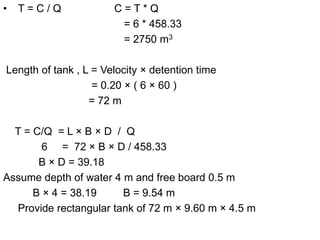
• T = C / Q C = T * Q
= 6 * 458.33
= 2750 m3
Length of tank , L = Velocity × detention time
= 0.20 × ( 6 × 60 )
= 72 m
T = C/Q = L × B × D / Q
6 = 72 × B × D / 458.33
B × D = 39.18
Assume depth of water 4 m and free board 0.5 m
B × 4 = 38.19 B = 9.54 m
Provide rectangular tank of 72 m × 9.60 m × 4.5 m
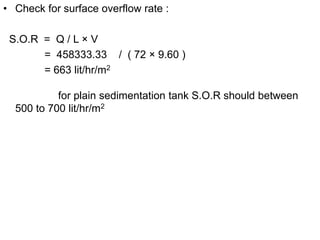
• Check for surface overflow rate :
S.O.R = Q / L × V
= 458333.33 / ( 72 × 9.60 )
= 663 lit/hr/m2
for plain sedimentation tank S.O.R should between
500 to 700 lit/hr/m2
AERATION
Purpose of Aeration in water
Treatment
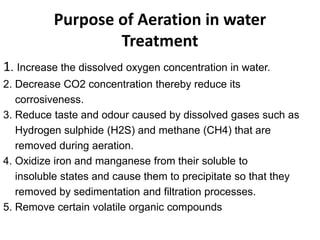
1. Increase the dissolved oxygen concentration in water.
2. Decrease CO2 concentration thereby reduce its
corrosiveness.
3. Reduce taste and odour caused by dissolved gases such as
Hydrogen sulphide (H2S) and methane (CH4) that are
removed during aeration.
4. Oxidize iron and manganese from their soluble to
insoluble states and cause them to precipitate so that they
removed by sedimentation and filtration processes.
5. Remove certain volatile organic compounds
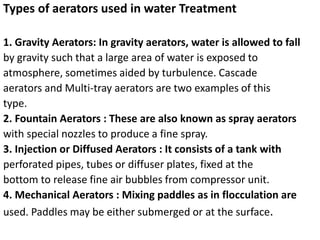
Types of aerators used in water Treatment
1. Gravity Aerators: In gravity aerators, water is allowed to fall
by gravity such that a large area of water is exposed to
atmosphere, sometimes aided by turbulence. Cascade
aerators and Multi‐tray aerators are two examples of this
type.
2. Fountain Aerators : These are also known as spray aerators
with special nozzles to produce a fine spray.
3. Injection or Diffused Aerators : It consists of a tank with
perforated pipes, tubes or diffuser plates, fixed at the
bottom to release fine air bubbles from compressor unit.
4. Mechanical Aerators : Mixing paddles as in flocculation are
used. Paddles may be either submerged or at the surface.
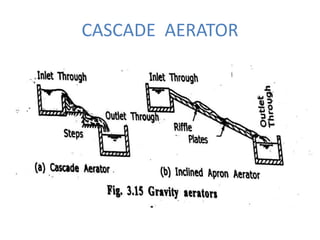
CASCADE AERATOR
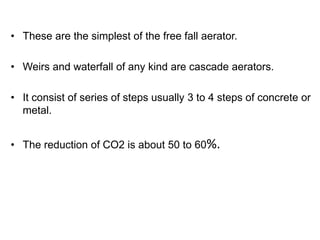
• These are the simplest of the free fall aerator.
• Weirs and waterfall of any kind are cascade aerators.
• It consist of series of steps usually 3 to 4 steps of concrete or
metal.
• The reduction of CO2 is about 50 to 60%.
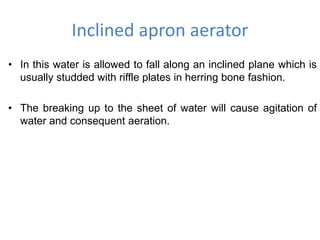
Inclined apron aerator
• In this water is allowed to fall along an inclined plane which is
usually studded with riffle plates in herring bone fashion.
• The breaking up to the sheet of water will cause agitation of
water and consequent aeration.
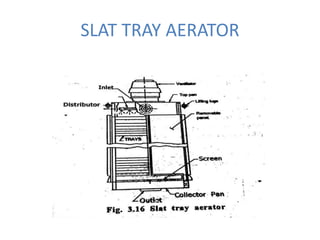
SLAT TRAY AERATOR
• It consist of a closed round or square containing a series of
closely stacked superimposed wood slat trays.
• Water enters the top of aerator and is evenly distributed of top
most tray.
• Air is supplied to bottom of aerator which discharges air and
gases to the atm.
SPRAY AERATOR
• In this method water is sprinkled in air through
special nozzle which breaks the water into droplets
thus permitting the escape of dissolved gases.
AIR DIFFUSION
• In this perforated pipe network is installed at
bottom of aeration tank, and compressed air is
blown through the pipe.
• Air diffuser basin have a detention period of about
15 minutes and a depth of 2 to 5 meter.
THANK YOU

Plain sedimentation

  • 1.
  • 3.
    • Two typesof sedimentation : 1. Plain sedimentation 2. Sedimentation with coagulation Plain sedimentation : When impurities are seperated from suspending fluid by action of natural force alone, without aid of any coagulant, is called plain sedimentation.
  • 4.
    Advantage of plainsedimentation • It lightens load on subsequent processes. • The operation of subsequent process can be controlled in a better way. • The cost of cleaning the chemical coagulation basin is reduced. • Less quantity of chemicals are required.
  • 12.
    Theory of sedimentation •The particle heavier than water are naturally likely to settle down due to force of gravity. 1. Inorganic suspended solids sp. Gravity 2.65 2. Organic suspended solids sp. Gravity 1.04 • The phenomena of settling of particles at bottom of sedimentation tank is called hydraulic subsidence.
  • 13.
    Settling of discreteparticle • A particle that does not alter its shape, size and weight while settling or rising in water is called discrete particle • The discrete particle will accelerate until drag force becomes equal to gravitational force. • At this stage particle attains uniform velocity called settling velocity.
  • 14.
    Types of sedimentationtanks • Based on method of operation : 1. Fill and draw type tanks 2. Continuous flow type tank • Depending upon shape : 1. Rectangular tanks 2. Circular tanks 3. Hopper bottom tanks
  • 19.
  • 22.
  • 23.
    • vf =flow velocity • vs= terminal settling velocity of a particle that is just removed when it enters at the water surface (H). • Note: 1) All particles with terminal settling velocity ≥ vs are removed. 2) Only part of particles with settling velocity < vs are removed.
  • 24.
    Design criteria • Detentionperiod for plain sedimentation = 4 to 8 hour for sedimentation with coagulant = 3 to 4 hour • Depth of settling tank vary from 3 to 4 hour. • S.O.R for plain sedimentation = 500 – 750 lit/hr/m2 for sedimentation with coagulant = 1000 – 1250 lit/hr/m2
  • 25.
    Example • Purification planthas estimated 11 MLD. Design the dimension of suitable sedimentation tank. Solution : Quantity of water to be treated = 11 * 106 litres = 11 *106 /( 1000 * 24 ) = 458.33 m3 / hour Assume detention period T = 6 hour velocity of flow V = 20 cm / minute = 0.2 m/minute
  • 26.
    • T =C / Q C = T * Q = 6 * 458.33 = 2750 m3 Length of tank , L = Velocity × detention time = 0.20 × ( 6 × 60 ) = 72 m T = C/Q = L × B × D / Q 6 = 72 × B × D / 458.33 B × D = 39.18 Assume depth of water 4 m and free board 0.5 m B × 4 = 38.19 B = 9.54 m Provide rectangular tank of 72 m × 9.60 m × 4.5 m
  • 27.
    • Check forsurface overflow rate : S.O.R = Q / L × V = 458333.33 / ( 72 × 9.60 ) = 663 lit/hr/m2 for plain sedimentation tank S.O.R should between 500 to 700 lit/hr/m2
  • 28.
  • 29.
    Purpose of Aerationin water Treatment 1. Increase the dissolved oxygen concentration in water. 2. Decrease CO2 concentration thereby reduce its corrosiveness. 3. Reduce taste and odour caused by dissolved gases such as Hydrogen sulphide (H2S) and methane (CH4) that are removed during aeration. 4. Oxidize iron and manganese from their soluble to insoluble states and cause them to precipitate so that they removed by sedimentation and filtration processes. 5. Remove certain volatile organic compounds
  • 30.
    Types of aeratorsused in water Treatment 1. Gravity Aerators: In gravity aerators, water is allowed to fall by gravity such that a large area of water is exposed to atmosphere, sometimes aided by turbulence. Cascade aerators and Multi‐tray aerators are two examples of this type. 2. Fountain Aerators : These are also known as spray aerators with special nozzles to produce a fine spray. 3. Injection or Diffused Aerators : It consists of a tank with perforated pipes, tubes or diffuser plates, fixed at the bottom to release fine air bubbles from compressor unit. 4. Mechanical Aerators : Mixing paddles as in flocculation are used. Paddles may be either submerged or at the surface.

  • 31.
  • 32.
    • These arethe simplest of the free fall aerator. • Weirs and waterfall of any kind are cascade aerators. • It consist of series of steps usually 3 to 4 steps of concrete or metal. • The reduction of CO2 is about 50 to 60%.
  • 33.
    Inclined apron aerator •In this water is allowed to fall along an inclined plane which is usually studded with riffle plates in herring bone fashion. • The breaking up to the sheet of water will cause agitation of water and consequent aeration.
  • 34.
  • 35.
    • It consistof a closed round or square containing a series of closely stacked superimposed wood slat trays. • Water enters the top of aerator and is evenly distributed of top most tray. • Air is supplied to bottom of aerator which discharges air and gases to the atm.
  • 36.
    SPRAY AERATOR • Inthis method water is sprinkled in air through special nozzle which breaks the water into droplets thus permitting the escape of dissolved gases.
  • 37.
    AIR DIFFUSION • Inthis perforated pipe network is installed at bottom of aeration tank, and compressed air is blown through the pipe. • Air diffuser basin have a detention period of about 15 minutes and a depth of 2 to 5 meter.
  • 38.

Editor's Notes