DESIGN OF REINFORCED
CONCRETE RETAINING WALL
Dr. Zainorizuan Mohd Jaini
Faculty of Civil and Environmental Engneering
Universiti Tun Hussein Onn Malaysia
86400 Parit Raja, Batu Pahat, Johor, Malaysia
Semester 2 2017/2018
Introduction
2
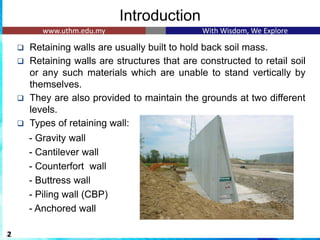
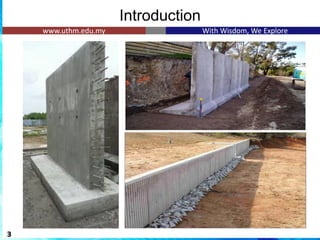
❑ Retaining walls are usually built to hold back soil mass.
❑ Retaining walls are structures that are constructed to retail soil
or any such materials which are unable to stand vertically by
themselves.
❑ They are also provided to maintain the grounds at two different
levels.
❑ Types of retaining wall:
- Gravity wall
- Cantilever wall
- Counterfort wall
- Buttress wall
- Piling wall (CBP)
- Anchored wall
Introduction
3
Introduction
4
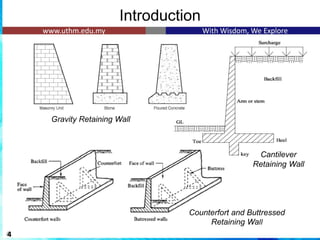
Gravity Retaining Wall
Cantilever
Retaining Wall
Counterfort and Buttressed
Retaining Wall
Introduction
5
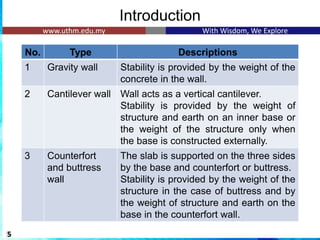
No. Type Descriptions
1 Gravity wall Stability is provided by the weight of the
concrete in the wall.
2 Cantilever wall Wall acts as a vertical cantilever.
Stability is provided by the weight of
structure and earth on an inner base or
the weight of the structure only when
the base is constructed externally.
3 Counterfort
and buttress
wall
The slab is supported on the three sides
by the base and counterfort or buttress.
Stability is provided by the weight of the
structure in the case of buttress and by
the weight of structure and earth on the
base in the counterfort wall.
Design Consideration
6
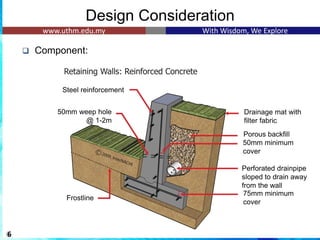
❑ Component:
Steel reinforcement
50mm weep hole
@ 1-2m
Frostline
Drainage mat with
filter fabric
Porous backfill
50mm minimum
cover
Perforated drainpipe
sloped to drain away
from the wall
75mm minimum
cover
Design Consideration
7
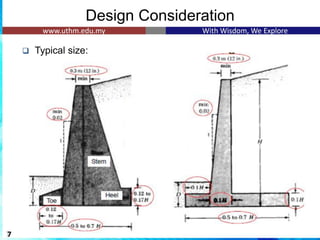
❑ Typical size:
Design Consideration
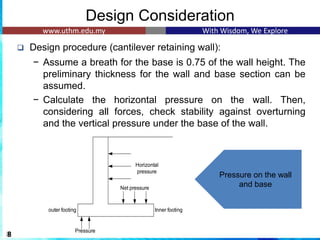
❑ Design procedure (cantilever retaining wall):
− Assume a breath for the base is 0.75 of the wall height. The
preliminary thickness for the wall and base section can be
assumed.
− Calculate the horizontal pressure on the wall. Then,
considering all forces, check stability against overturning
and the vertical pressure under the base of the wall.
8
Horizontal
pressure
Net pressure
Pressure
Inner footing
outer footing
Pressure on the wall
and base
Design Consideration
− Calculate and check the resistance to sliding. Use γf = 1.4
to the horizontal loads for the overturning and sliding check.
The maximum vertical pressure is calculated using service
load and should not exceed safe bearing pressure.
− Reinforced concrete design for the wall is conducted by
using the ultimate load. For the wall and earth pressure, use
γf = 1.4.
− Surcharge if present may be classed as either dead or
imposed load depending on its nature.
− For the wall, calculate shear force and moments caused by
the horizontal earth pressure.
− Design the vertical moment steel for the inner face and
check the shear stresses.
9
Design Consideration
− Minimum secondary steel is provided in the horizontal
direction for the inner face and both vertically and
horizontally for the outer face.
− The net moment due to earth pressure on the top and
bottom faces of the inner footing causes tension in the top
and reinforcement is designed for this position.
− The moment due to earth pressure causes tension in the
bottom face of the outer footing.
10
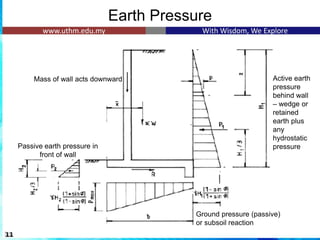
Earth Pressure
11
Ground pressure (passive)
or subsoil reaction
Active earth
pressure
behind wall
– wedge or
retained
earth plus
any
hydrostatic
pressure
Passive earth pressure in
front of wall
Mass of wall acts downward
Earth Pressure
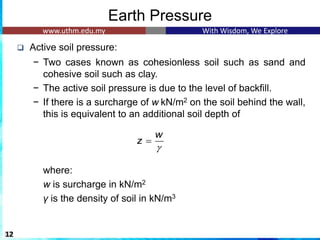
❑ Active soil pressure:
− Two cases known as cohesionless soil such as sand and
cohesive soil such as clay.
− The active soil pressure is due to the level of backfill.
− If there is a surcharge of w.kN/m2 on the soil behind the wall,
this is equivalent to an additional soil depth of
where:
w is surcharge in kN/m2
γ is the density of soil in kN/m3
12
w
z

=
Earth Pressure
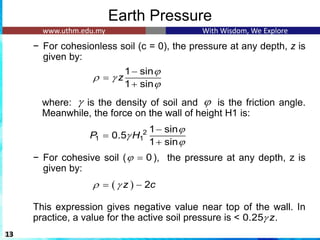
− For cohesionless soil (c = 0), the pressure at any depth, z is
given by:
where: is the density of soil and is the friction angle.
Meanwhile, the force on the wall of height H1 is:
− For cohesive soil ( ), the pressure at any depth, z is
given by:
This expression gives negative value near top of the wall. In
practice, a value for the active soil pressure is < .
13
1 sin
1 sin
z

 

−
=
+
2
1 1
1 sin
0.5
1 sin
P H



−
=
+
 
0
 =
( ) 2
z c
 
= −
0.25 z

Earth Pressure
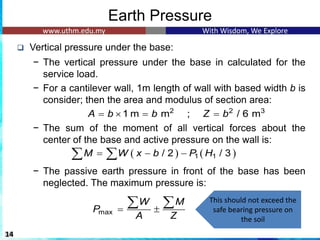
❑ Vertical pressure under the base:
− The vertical pressure under the base in calculated for the
service load.
− For a cantilever wall, 1m length of wall with based width b is
consider; then the area and modulus of section area:
− The sum of the moment of all vertical forces about the
center of the base and active pressure on the wall is:
− The passive earth pressure in front of the base has been
neglected. The maximum pressure is:
14
( ) ( )
1 1
/ 2 / 3
M W x b P H
= − −
 
2 2 3
1 m m ; / 6 m
A b b Z b
=  = =
max
W M
P
A Z
= 
  This should not exceed the
safe bearing pressure on
the soil
Stability
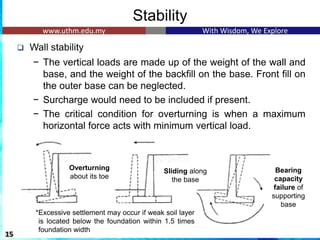
❑ Wall stability
− The vertical loads are made up of the weight of the wall and
base, and the weight of the backfill on the base. Front fill on
the outer base can be neglected.
− Surcharge would need to be included if present.
− The critical condition for overturning is when a maximum
horizontal force acts with minimum vertical load.
15
Overturning
about its toe
Sliding along
the base
Bearing
capacity
failure of
supporting
base
*Excessive settlement may occur if weak soil layer
*is located below the foundation within 1.5 times
*foundation width
Stability
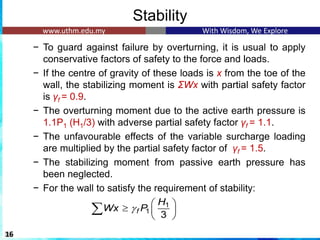
− To guard against failure by overturning, it is usual to apply
conservative factors of safety to the force and loads.
− If the centre of gravity of these loads is x from the toe of the
wall, the stabilizing moment is ΣWx with partial safety factor
is γf = 0.9.
− The overturning moment due to the active earth pressure is
1.1P1 (H1/3) with adverse partial safety factor γf = 1.1.
− The unfavourable effects of the variable surcharge loading
are multiplied by the partial safety factor of γf = 1.5.
− The stabilizing moment from passive earth pressure has
been neglected.
− For the wall to satisfy the requirement of stability:
16
1
1
3
f
H
Wx P
  
  
 

Stability
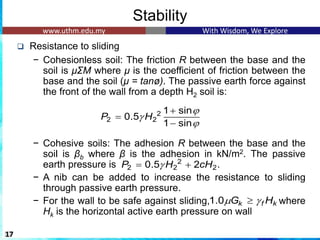
❑ Resistance to sliding
− Cohesionless soil: The friction R between the base and the
soil is μΣM where μ is the coefficient of friction between the
base and the soil (μ = tanø). The passive earth force against
the front of the wall from a depth H2 soil is:
− Cohesive soils: The adhesion R between the base and the
soil is βb where β is the adhesion in kN/m2. The passive
earth pressure is .
− A nib can be added to increase the resistance to sliding
through passive earth pressure.
− For the wall to be safe against sliding, where
Hk is the horizontal active earth pressure on wall
17
2
2 2
1 sin
0.5
1 sin
P H



+
=
−
2
2 2 2
0.5 2
P H cH

= +
1.0 k f k
G H
 

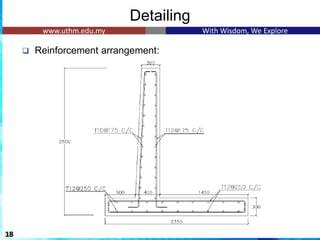
Detailing
18
❑ Reinforcement arrangement:
Detailing
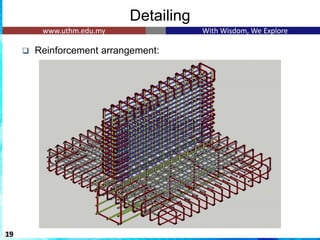
19
❑ Reinforcement arrangement:
Design of Retaining Wall
20
Example 5.1:
Cantilever Retaining Wall
Example 5.1
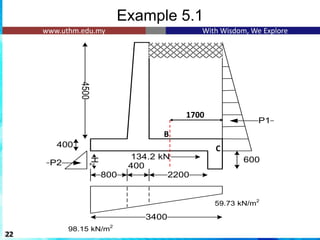
❑ Cantilever retaining walls as in Figure 1 support a bank of earth
4.5m height. The soil behind the wall is well-drained sand with
the following properties:
- Density, γsoil = 2000 kg/m3 = 20 kN/m3
- Angle of internal friction, ø = 30o
The material under the wall has a safe bearing pressure of
110 kN/m2. The coefficient of friction between the base and the
soil is 0.45.
Design the wall using grade 30 concrete and grade 500
reinforcement.
21
Example 5.1
22
P1
H
2
P2
98.15 kN/m2
59.73 kN/m2
2200
800
400
400
4500
600
3400
134.2 kN
B
C
1700
Example 5.1
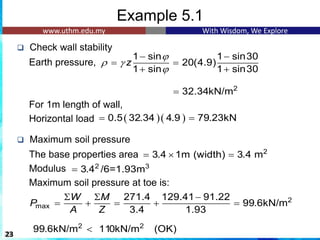
❑ Check wall stability
Earth pressure,
For 1m length of wall,
Horizontal load
❑ Maximum soil pressure
The base properties area
Modulus
Maximum soil pressure at toe is:
23
1 sin 1 sin30
20(4.9)
1 sin 1 sin30
z

 

− −
= =
+ +
2
32.34kN/m
=
( )( )
0.5 32.34 4.9 79.23kN
= =
2
3.4 1m (width) 3.4 m
=  =
2 2
99.6kN/m 110kN/m (OK)

2 3
3.4 /6=1.93m
=
2
max
271.4 129.41 91.22
99.6kN/m
3.4 1.93
W M
P
A Z
  −
= + = + =
Example 5.1
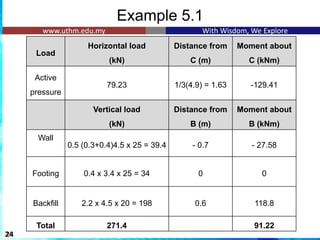
24
Load
Horizontal load
(kN)
Distance from
C (m)
Moment about
C (kNm)
Active
pressure
79.23 1/3(4.9) = 1.63 -129.41
Vertical load
(kN)
Distance from
B (m)
Moment about
B (kNm)
Wall
0.5 (0.3+0.4)4.5 x 25 = 39.4 - 0.7 - 27.58
Footing 0.4 x 3.4 x 25 = 34 0 0
Backfill 2.2 x 4.5 x 20 = 198 0.6 118.8
Total 271.4 91.22
Example 5.1
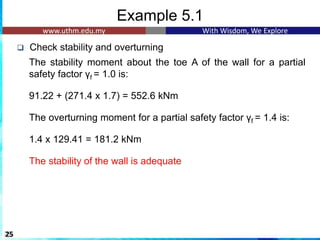
❑ Check stability and overturning
The stability moment about the toe A of the wall for a partial
safety factor γf = 1.0 is:
1
91.22 + (271.4 x 1.7) = 552.6 kNm
1
The overturning moment for a partial safety factor γf = 1.4 is:
1
1.4 x 129.41 = 181.2 kNm
1
The stability of the wall is adequate
25
Example 5.1
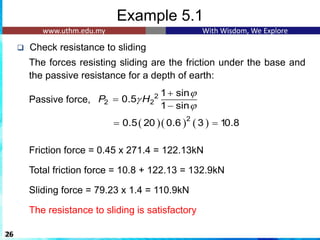
❑ Check resistance to sliding
The forces resisting sliding are the friction under the base and
the passive resistance for a depth of earth:
Passive force,
Friction force = 0.45 x 271.4 = 122.13kN
Total friction force = 10.8 + 122.13 = 132.9kN
Sliding force = 79.23 x 1.4 = 110.9kN
The resistance to sliding is satisfactory
26
2
2 2
1 sin
0.5
1 sin
P H



+
=
−
( )( ) ( )
2
0.5 20 0.6 3 10.8
= =
Example 5.1
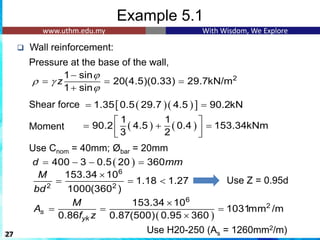
❑ Wall reinforcement:
Pressure at the base of the wall,
Shear force
Moment
1
Use Cnom = 40mm; Øbar = 20mm
27
2
1 sin
20(4.5)(0.33) 29.7kN/m
1 sin
z

 

−
= = =
+
6
2 2
153.34 10
1.18 1.27
1000(360 )
M
bd

= =  Use Z = 0.95d
( )
6
2
153.34 10
1031mm /m
0.86 0.87(500) 0.95 360
s
yk
M
A
f z

= = =

Use H20-250 (As = 1260mm2/m)
( )( )
 
1.35 0.5 29.7 4.5 90.2kN
= =
( ) ( )
1 1
90.2 4.5 0.4 153.34kNm
3 2
 
= + =
 
 
( )
400 3 0.5 20 360
d mm
= − − =
Example 5.1
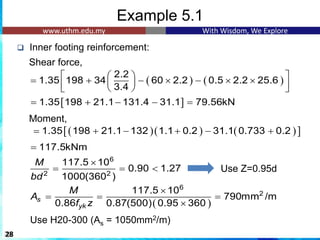
❑ Inner footing reinforcement:
Shear force,
Moment,
28
( ) ( )
2.2
1.35 198 34 60 2.2 0.5 2.2 25.6
3.4
   
= + −  −  
 
 
   
6
2 2
117.5 10
0.90 1.27
1000(360 )
M
bd

= =  Use Z=0.95d
( )
6
2
117.5 10
790mm /m
0.86 0.87(500) 0.95 360
s
yk
M
A
f z

= = =

Use H20-300 (As = 1050mm2/m)
 
1.35 198 21.1 131.4 31.1 79.56kN
= + − − =
( )( ) ( )
 
1.35 198 21.1 132 1.1 0.2 31.1 0.733 0.2
= + − + − +
117.5kNm
=
Example 5.1
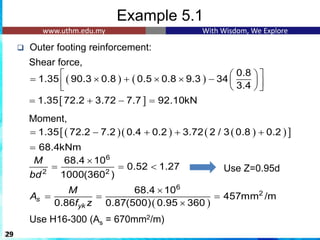
❑ Outer footing reinforcement:
Shear force,
Moment,
29
( ) ( )
0.8
1.35 90.3 0.8 0.5 0.8 9.3 34
3.4
   
=  +   −  
 
   
6
2 2
68.4 10
0.52 1.27
1000(360 )
M
bd

= =  Use Z=0.95d
( )
6
2
68.4 10
457mm /m
0.86 0.87(500) 0.95 360
s
yk
M
A
f z

= = =

Use H16-300 (As = 670mm2/m)
 
1.35 72.2 3.72 7.7 92.10kN
= + − =
( )( ) ( )
( )
 
1.35 72.2 7.2 0.4 0.2 3.72 2 / 3 0.8 0.2
= − + + +
68.4kNm
=
Design of Retaining Wall
30
Example 5.2:
Cantilever Retaining Wall
(Include Surcharge Loading)
Example 5.2
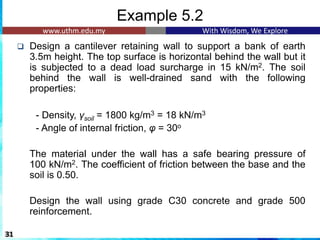
❑ Design a cantilever retaining wall to support a bank of earth
3.5m height. The top surface is horizontal behind the wall but it
is subjected to a dead load surcharge in 15 kN/m2. The soil
behind the wall is well-drained sand with the following
properties:
- Density, γsoil = 1800 kg/m3 = 18 kN/m3
- Angle of internal friction, φ = 30o
The material under the wall has a safe bearing pressure of
100 kN/m2. The coefficient of friction between the base and the
soil is 0.50.
Design the wall using grade C30 concrete and grade 500
reinforcement.
31
Example 5.2
32
Example 5.2
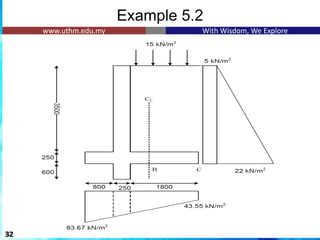
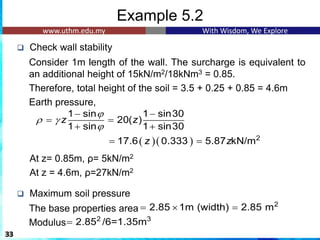
❑ Check wall stability
Consider 1m length of the wall. The surcharge is equivalent to
an additional height of 15kN/m2/18kNm3 = 0.85.
Therefore, total height of the soil = 3.5 + 0.25 + 0.85 = 4.6m
Earth pressure,
At z= 0.85m, ρ= 5kN/m2
At z = 4.6m, ρ=27kN/m2
❑ Maximum soil pressure
The base properties area
Modulus
33
1 sin 1 sin30
20( )
1 sin 1 sin30
z z

 

− −
= =
+ +
( )( ) 2
17.6 0.333 5.87 kN/m
z z
= =
2
2.85 1m (width) 2.85 m
=  =
2 3
2.85 /6=1.35m
=
Example 5.2
34
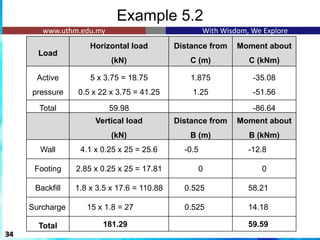
Load
Horizontal load
(kN)
Distance from
C (m)
Moment about
C (kNm)
Active
pressure
5 x 3.75 = 18.75
0.5 x 22 x 3.75 = 41.25
1.875
1.25
-35.08
-51.56
Total 59.98 -86.64
Vertical load
(kN)
Distance from
B (m)
Moment about
B (kNm)
Wall 4.1 x 0.25 x 25 = 25.6 -0.5 -12.8
Footing 2.85 x 0.25 x 25 = 17.81 0 0
Backfill 1.8 x 3.5 x 17.6 = 110.88 0.525 58.21
Surcharge 15 x 1.8 = 27 0.525 14.18
Total 181.29 59.59
Example 5.2
Maximum soil pressure at service load:
❑ Check stability and overturning
The stability moment about the toe A of the wall for a partial
safety factor γf = 0.9 is:
1
59.59 + [181.29 x (2.85/2)] = 317.9 x 0.9 = 286.11 kNm
1
The overturning moment for a partial safety factor γf = 1.1 is:
1
1.1 x 86.64 = 95.3 kNm 1
The stability of the wall is adequate
35
2 2
83.76kN/m 110kN/m (OK)

2
max
181.29 86.67 59.59
83.76kN/m
2.85 1.35
W M
P
A Z
  −
= + = + =
Example 5.1
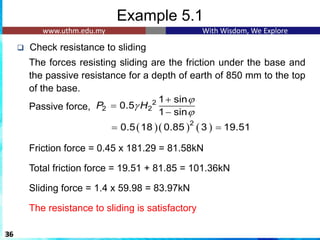
❑ Check resistance to sliding
The forces resisting sliding are the friction under the base and
the passive resistance for a depth of earth of 850 mm to the top
of the base.
Passive force,
Friction force = 0.45 x 181.29 = 81.58kN
Total friction force = 19.51 + 81.85 = 101.36kN
Sliding force = 1.4 x 59.98 = 83.97kN
The resistance to sliding is satisfactory
36
2
2 2
1 sin
0.5
1 sin
P H



+
=
−
( )( ) ( )
2
0.5 18 0.85 3 19.51
= =

Retaining wall analysis and design according to aci

  • 1.
    DESIGN OF REINFORCED CONCRETERETAINING WALL Dr. Zainorizuan Mohd Jaini Faculty of Civil and Environmental Engneering Universiti Tun Hussein Onn Malaysia 86400 Parit Raja, Batu Pahat, Johor, Malaysia Semester 2 2017/2018
  • 2.
    Introduction 2 ❑ Retaining wallsare usually built to hold back soil mass. ❑ Retaining walls are structures that are constructed to retail soil or any such materials which are unable to stand vertically by themselves. ❑ They are also provided to maintain the grounds at two different levels. ❑ Types of retaining wall: - Gravity wall - Cantilever wall - Counterfort wall - Buttress wall - Piling wall (CBP) - Anchored wall
  • 3.
  • 4.
    Introduction 4 Gravity Retaining Wall Cantilever RetainingWall Counterfort and Buttressed Retaining Wall
  • 5.
    Introduction 5 No. Type Descriptions 1Gravity wall Stability is provided by the weight of the concrete in the wall. 2 Cantilever wall Wall acts as a vertical cantilever. Stability is provided by the weight of structure and earth on an inner base or the weight of the structure only when the base is constructed externally. 3 Counterfort and buttress wall The slab is supported on the three sides by the base and counterfort or buttress. Stability is provided by the weight of the structure in the case of buttress and by the weight of structure and earth on the base in the counterfort wall.
  • 6.
    Design Consideration 6 ❑ Component: Steelreinforcement 50mm weep hole @ 1-2m Frostline Drainage mat with filter fabric Porous backfill 50mm minimum cover Perforated drainpipe sloped to drain away from the wall 75mm minimum cover
  • 7.
  • 8.
    Design Consideration ❑ Designprocedure (cantilever retaining wall): − Assume a breath for the base is 0.75 of the wall height. The preliminary thickness for the wall and base section can be assumed. − Calculate the horizontal pressure on the wall. Then, considering all forces, check stability against overturning and the vertical pressure under the base of the wall. 8 Horizontal pressure Net pressure Pressure Inner footing outer footing Pressure on the wall and base
  • 9.
    Design Consideration − Calculateand check the resistance to sliding. Use γf = 1.4 to the horizontal loads for the overturning and sliding check. The maximum vertical pressure is calculated using service load and should not exceed safe bearing pressure. − Reinforced concrete design for the wall is conducted by using the ultimate load. For the wall and earth pressure, use γf = 1.4. − Surcharge if present may be classed as either dead or imposed load depending on its nature. − For the wall, calculate shear force and moments caused by the horizontal earth pressure. − Design the vertical moment steel for the inner face and check the shear stresses. 9
  • 10.
    Design Consideration − Minimumsecondary steel is provided in the horizontal direction for the inner face and both vertically and horizontally for the outer face. − The net moment due to earth pressure on the top and bottom faces of the inner footing causes tension in the top and reinforcement is designed for this position. − The moment due to earth pressure causes tension in the bottom face of the outer footing. 10
  • 11.
    Earth Pressure 11 Ground pressure(passive) or subsoil reaction Active earth pressure behind wall – wedge or retained earth plus any hydrostatic pressure Passive earth pressure in front of wall Mass of wall acts downward
  • 12.
    Earth Pressure ❑ Activesoil pressure: − Two cases known as cohesionless soil such as sand and cohesive soil such as clay. − The active soil pressure is due to the level of backfill. − If there is a surcharge of w.kN/m2 on the soil behind the wall, this is equivalent to an additional soil depth of where: w is surcharge in kN/m2 γ is the density of soil in kN/m3 12 w z  =
  • 13.
    Earth Pressure − Forcohesionless soil (c = 0), the pressure at any depth, z is given by: where: is the density of soil and is the friction angle. Meanwhile, the force on the wall of height H1 is: − For cohesive soil ( ), the pressure at any depth, z is given by: This expression gives negative value near top of the wall. In practice, a value for the active soil pressure is < . 13 1 sin 1 sin z     − = + 2 1 1 1 sin 0.5 1 sin P H    − = +   0  = ( ) 2 z c   = − 0.25 z 
  • 14.
    Earth Pressure ❑ Verticalpressure under the base: − The vertical pressure under the base in calculated for the service load. − For a cantilever wall, 1m length of wall with based width b is consider; then the area and modulus of section area: − The sum of the moment of all vertical forces about the center of the base and active pressure on the wall is: − The passive earth pressure in front of the base has been neglected. The maximum pressure is: 14 ( ) ( ) 1 1 / 2 / 3 M W x b P H = − −   2 2 3 1 m m ; / 6 m A b b Z b =  = = max W M P A Z =    This should not exceed the safe bearing pressure on the soil
  • 15.
    Stability ❑ Wall stability −The vertical loads are made up of the weight of the wall and base, and the weight of the backfill on the base. Front fill on the outer base can be neglected. − Surcharge would need to be included if present. − The critical condition for overturning is when a maximum horizontal force acts with minimum vertical load. 15 Overturning about its toe Sliding along the base Bearing capacity failure of supporting base *Excessive settlement may occur if weak soil layer *is located below the foundation within 1.5 times *foundation width
  • 16.
    Stability − To guardagainst failure by overturning, it is usual to apply conservative factors of safety to the force and loads. − If the centre of gravity of these loads is x from the toe of the wall, the stabilizing moment is ΣWx with partial safety factor is γf = 0.9. − The overturning moment due to the active earth pressure is 1.1P1 (H1/3) with adverse partial safety factor γf = 1.1. − The unfavourable effects of the variable surcharge loading are multiplied by the partial safety factor of γf = 1.5. − The stabilizing moment from passive earth pressure has been neglected. − For the wall to satisfy the requirement of stability: 16 1 1 3 f H Wx P         
  • 17.
    Stability ❑ Resistance tosliding − Cohesionless soil: The friction R between the base and the soil is μΣM where μ is the coefficient of friction between the base and the soil (μ = tanø). The passive earth force against the front of the wall from a depth H2 soil is: − Cohesive soils: The adhesion R between the base and the soil is βb where β is the adhesion in kN/m2. The passive earth pressure is . − A nib can be added to increase the resistance to sliding through passive earth pressure. − For the wall to be safe against sliding, where Hk is the horizontal active earth pressure on wall 17 2 2 2 1 sin 0.5 1 sin P H    + = − 2 2 2 2 0.5 2 P H cH  = + 1.0 k f k G H   
  • 18.
  • 19.
  • 20.
    Design of RetainingWall 20 Example 5.1: Cantilever Retaining Wall
  • 21.
    Example 5.1 ❑ Cantileverretaining walls as in Figure 1 support a bank of earth 4.5m height. The soil behind the wall is well-drained sand with the following properties: - Density, γsoil = 2000 kg/m3 = 20 kN/m3 - Angle of internal friction, ø = 30o The material under the wall has a safe bearing pressure of 110 kN/m2. The coefficient of friction between the base and the soil is 0.45. Design the wall using grade 30 concrete and grade 500 reinforcement. 21
  • 22.
    Example 5.1 22 P1 H 2 P2 98.15 kN/m2 59.73kN/m2 2200 800 400 400 4500 600 3400 134.2 kN B C 1700
  • 23.
    Example 5.1 ❑ Checkwall stability Earth pressure, For 1m length of wall, Horizontal load ❑ Maximum soil pressure The base properties area Modulus Maximum soil pressure at toe is: 23 1 sin 1 sin30 20(4.9) 1 sin 1 sin30 z     − − = = + + 2 32.34kN/m = ( )( ) 0.5 32.34 4.9 79.23kN = = 2 3.4 1m (width) 3.4 m =  = 2 2 99.6kN/m 110kN/m (OK)  2 3 3.4 /6=1.93m = 2 max 271.4 129.41 91.22 99.6kN/m 3.4 1.93 W M P A Z   − = + = + =
  • 24.
    Example 5.1 24 Load Horizontal load (kN) Distancefrom C (m) Moment about C (kNm) Active pressure 79.23 1/3(4.9) = 1.63 -129.41 Vertical load (kN) Distance from B (m) Moment about B (kNm) Wall 0.5 (0.3+0.4)4.5 x 25 = 39.4 - 0.7 - 27.58 Footing 0.4 x 3.4 x 25 = 34 0 0 Backfill 2.2 x 4.5 x 20 = 198 0.6 118.8 Total 271.4 91.22
  • 25.
    Example 5.1 ❑ Checkstability and overturning The stability moment about the toe A of the wall for a partial safety factor γf = 1.0 is: 1 91.22 + (271.4 x 1.7) = 552.6 kNm 1 The overturning moment for a partial safety factor γf = 1.4 is: 1 1.4 x 129.41 = 181.2 kNm 1 The stability of the wall is adequate 25
  • 26.
    Example 5.1 ❑ Checkresistance to sliding The forces resisting sliding are the friction under the base and the passive resistance for a depth of earth: Passive force, Friction force = 0.45 x 271.4 = 122.13kN Total friction force = 10.8 + 122.13 = 132.9kN Sliding force = 79.23 x 1.4 = 110.9kN The resistance to sliding is satisfactory 26 2 2 2 1 sin 0.5 1 sin P H    + = − ( )( ) ( ) 2 0.5 20 0.6 3 10.8 = =
  • 27.
    Example 5.1 ❑ Wallreinforcement: Pressure at the base of the wall, Shear force Moment 1 Use Cnom = 40mm; Øbar = 20mm 27 2 1 sin 20(4.5)(0.33) 29.7kN/m 1 sin z     − = = = + 6 2 2 153.34 10 1.18 1.27 1000(360 ) M bd  = =  Use Z = 0.95d ( ) 6 2 153.34 10 1031mm /m 0.86 0.87(500) 0.95 360 s yk M A f z  = = =  Use H20-250 (As = 1260mm2/m) ( )( )   1.35 0.5 29.7 4.5 90.2kN = = ( ) ( ) 1 1 90.2 4.5 0.4 153.34kNm 3 2   = + =     ( ) 400 3 0.5 20 360 d mm = − − =
  • 28.
    Example 5.1 ❑ Innerfooting reinforcement: Shear force, Moment, 28 ( ) ( ) 2.2 1.35 198 34 60 2.2 0.5 2.2 25.6 3.4     = + −  −           6 2 2 117.5 10 0.90 1.27 1000(360 ) M bd  = =  Use Z=0.95d ( ) 6 2 117.5 10 790mm /m 0.86 0.87(500) 0.95 360 s yk M A f z  = = =  Use H20-300 (As = 1050mm2/m)   1.35 198 21.1 131.4 31.1 79.56kN = + − − = ( )( ) ( )   1.35 198 21.1 132 1.1 0.2 31.1 0.733 0.2 = + − + − + 117.5kNm =
  • 29.
    Example 5.1 ❑ Outerfooting reinforcement: Shear force, Moment, 29 ( ) ( ) 0.8 1.35 90.3 0.8 0.5 0.8 9.3 34 3.4     =  +   −         6 2 2 68.4 10 0.52 1.27 1000(360 ) M bd  = =  Use Z=0.95d ( ) 6 2 68.4 10 457mm /m 0.86 0.87(500) 0.95 360 s yk M A f z  = = =  Use H16-300 (As = 670mm2/m)   1.35 72.2 3.72 7.7 92.10kN = + − = ( )( ) ( ) ( )   1.35 72.2 7.2 0.4 0.2 3.72 2 / 3 0.8 0.2 = − + + + 68.4kNm =
  • 30.
    Design of RetainingWall 30 Example 5.2: Cantilever Retaining Wall (Include Surcharge Loading)
  • 31.
    Example 5.2 ❑ Designa cantilever retaining wall to support a bank of earth 3.5m height. The top surface is horizontal behind the wall but it is subjected to a dead load surcharge in 15 kN/m2. The soil behind the wall is well-drained sand with the following properties: - Density, γsoil = 1800 kg/m3 = 18 kN/m3 - Angle of internal friction, φ = 30o The material under the wall has a safe bearing pressure of 100 kN/m2. The coefficient of friction between the base and the soil is 0.50. Design the wall using grade C30 concrete and grade 500 reinforcement. 31
  • 32.
  • 33.
    Example 5.2 ❑ Checkwall stability Consider 1m length of the wall. The surcharge is equivalent to an additional height of 15kN/m2/18kNm3 = 0.85. Therefore, total height of the soil = 3.5 + 0.25 + 0.85 = 4.6m Earth pressure, At z= 0.85m, ρ= 5kN/m2 At z = 4.6m, ρ=27kN/m2 ❑ Maximum soil pressure The base properties area Modulus 33 1 sin 1 sin30 20( ) 1 sin 1 sin30 z z     − − = = + + ( )( ) 2 17.6 0.333 5.87 kN/m z z = = 2 2.85 1m (width) 2.85 m =  = 2 3 2.85 /6=1.35m =
  • 34.
    Example 5.2 34 Load Horizontal load (kN) Distancefrom C (m) Moment about C (kNm) Active pressure 5 x 3.75 = 18.75 0.5 x 22 x 3.75 = 41.25 1.875 1.25 -35.08 -51.56 Total 59.98 -86.64 Vertical load (kN) Distance from B (m) Moment about B (kNm) Wall 4.1 x 0.25 x 25 = 25.6 -0.5 -12.8 Footing 2.85 x 0.25 x 25 = 17.81 0 0 Backfill 1.8 x 3.5 x 17.6 = 110.88 0.525 58.21 Surcharge 15 x 1.8 = 27 0.525 14.18 Total 181.29 59.59
  • 35.
    Example 5.2 Maximum soilpressure at service load: ❑ Check stability and overturning The stability moment about the toe A of the wall for a partial safety factor γf = 0.9 is: 1 59.59 + [181.29 x (2.85/2)] = 317.9 x 0.9 = 286.11 kNm 1 The overturning moment for a partial safety factor γf = 1.1 is: 1 1.1 x 86.64 = 95.3 kNm 1 The stability of the wall is adequate 35 2 2 83.76kN/m 110kN/m (OK)  2 max 181.29 86.67 59.59 83.76kN/m 2.85 1.35 W M P A Z   − = + = + =
  • 36.
    Example 5.1 ❑ Checkresistance to sliding The forces resisting sliding are the friction under the base and the passive resistance for a depth of earth of 850 mm to the top of the base. Passive force, Friction force = 0.45 x 181.29 = 81.58kN Total friction force = 19.51 + 81.85 = 101.36kN Sliding force = 1.4 x 59.98 = 83.97kN The resistance to sliding is satisfactory 36 2 2 2 1 sin 0.5 1 sin P H    + = − ( )( ) ( ) 2 0.5 18 0.85 3 19.51 = =