Retaining Walls
Retaining walls are used to hold back masses of earth or other
loose material where conditions make it impossible to let those
masses assume their natural slopes.
Function of retaining wall
 Such conditions occur when the width of an excavation, cut,
or embankment is restricted by conditions of ownership, use of
the structure, or economy. For example, in railway or highway
construction the width of the right of way is fixed, and the cut or
embankment must be contained within that width.
Similarly, the basement walls of the buildings must be located
within the property and must retain the soil surrounding the
base.
Free standing retaining walls, as distinct from those that form
parts of structures, such as basement walls, are of various types.
Types of retaining walls
 The gravity retaining wall retains the
earth entirely by its own weight and
generally contains no reinforcement. It
is used up to 10 ft height.
 The reinforced concrete cantilever
retaining wall consists of the vertical arm
that retains the earth and is held in position
by a footing or base slab. In this case, the
weight of the fill on top of the heel, in
addition to the weight of the wall,
contributes to the stability of the structure.
Since the arm represents a vertical
cantilever, its required thickness increase
rapidly, with increasing height. It is used in
the range of 10 to 2 ft height.
In the counterfort wall the
stem and base slab are tied
together by counterforts
which are transverse walls
spaced at intervals and act as
tension ties to support the
stem wall. Counterforts are of
half or larger heights.
Counterfort walls are
economical for heights over
25 ft.
Types of retaining walls
Property rights or other restrictions sometimes make it necessary
to place the wall at the forward edge of the base slab, i.e. to omit
the toe. Whenever it is possible, toe extensions of one-third to
one-fourth of the width of the base provide a more economical
solution.
A buttress wall is similar to a
counterfort wall except that
the transverse support walls
are located on the side of the
stem opposite to the retained
material and act as
compression struts. Buttress,
as compression elements,
are more efficient than the
tension counterforts and are
economical in the same
height range.
Types of retaining walls
A counterfort is more widely used than a buttress because the
counterfort is hidden beneath the retained material, whereas the
buttress occupies what may otherwise be usable space in front of
the wall.
This is an free standing wall category. A wall type bridge abutment
acts similarly to a cantilever retaining wall except that the bridge
deck provides an additional horizontal restraint at the top of the
stem. Thus this abutment is designed as a beam fixed at the
bottom and simply supported or partially restrained at the top.
Types of retaining walls
 w is unit weight of the soil
Earth Pressure
 C0 is a constant known as the coefficient of earth pressure at
rest According to Rankin, the coefficient for active and passive
earth pressure are











 2
2
2
2
Cos
Cos
Cos
Cos
Cos
Cos
Cos
Ca











 2
2
2
2
Cos
Cos
Cos
Cos
Cos
Cos
Cos
Cp
 For the case of horizontal surface =0





sin
1
sin
1
Cah





sin
1
sin
1
Cph
 For liquid P=wwh, ww is the
unit weight of water.
Soil retaining structure Ph=Cowh
Earth pressure for common condition of loading
2
wh
C
2
1
P
3
h
y
ah









Cos
C
For
Cawh
2
1
p
3
h
y
a
2
Earth pressure for common condition of loading
)
h
2
h
(
wh
C
2
1
P
)
h
2
h
(
3
h
h
3
h
y
ah
2








1. Individual parts should be strong enough to resist the applied
forces
Stability Requirement
2. The
wall as
a whole
should
be
stable
against
(i)
Settlem
ent (ii)
Sliding
(iii)
Overtur
ning
Stability Requirement
It is necessary to ensure that the pressure under the footing does
not exceed the “permissible bearing pressure” for the particular
soil.
By the formula
Settlement
I
MC
A
N
q
min
max


 If , compression will act throughout the section
3
a


 
 
   
























v
2
1
2
v
2
2
v
1
2
v
2
v
v
v
2
,
1
3
v
2
v
v
3
v
2
v
v
2
,
1
3
v
v
2
,
1
R
q
q
2
a
when
2
a
6
R
q
&
a
6
4
R
q
a
6
3
R
a
R
6
R
3
R
q
12
4
a
R
2
R
R
12
2
a
R
4
R
R
q
12
2
R
a
2
R
q


































Unit dimension in the direction perpendicular to the paper.
Stability Requirement
Settlement
0
q
&
R
2
q
1
1
R
q
2
R
6
12
1
R
2
R
6
2
3
12
1
R
q
12
2
R
3
2
R
q
2
v
1
v
2
,
1
v
v
v
v
2
,
1
v
v
2
,
1
3
3
3

















































 





























Stability Requirement
Settlement
  
a
3
R
2
q
a
3
q
2
1
R
v
v








Stability Requirement
Settlement
Sliding
F = Rv
Stability Requirement
5
.
1
P
F
h

Overturning
2
moment
g
Overturnin
moment
g
Stabilizin

1. Lateral earth pressure will be considered to be live loads and
a factor of 1.7 applied.
Basis of Structural Design
2. In general, the reactive pressure of the soil under the structure
at the service load stage will be taken equal to 1.7 times the soil
pressure found for service load conditions in the stability
analysis.
3. For cantilever retaining walls, the calculated dead load of the
toe slab, which causes moments acting in the opposite sense to
those produced by the upward soil reaction, will be multiplied by
a factor of 0.9.
4. For the heel slab, the required moment capacity will be based
on the dead load of the heel slab itself, plus the earth directly
above it, both multiplied by 1.4.
5. Surcharge, if resent, will be treated as live load with load
factor of 1.7.
6. The upward pressure of the soil under the heel slab will be
taken equal to zero, recognizing that for severe over load stage
a non linear pressure distribution will probably be obtained, with
most of the reaction concentrated near the toe.
Basis of Structural Design
Drafting after Structural Design
Drainage
 Reduction in bearing capacity.
 Hydrostatic pressure.
 Ice pressure
 Drainage can be provided in various ways
i. Weep holes, 6 to 8 in. 5 to 10 ft horizontally spaced. 1 ft3
stone at rear end at the bottom weep holes to facilitate
drainage and to prevent clogging.
ii. Longitudinal drains embedded in crushed stone or gravel,
along rear face of the wall.
iii. Continuous back drain consisting of a layer of gravel or
crushed stone covering the entire rear face of the wall with
discharge at the ends.
Problem
 A gravity retaining wall consisting of plain concrete w=144
lb/ft3 is shown in fig. The bank of supported earth is
assumed to weigh 110 lb/ft3 ø=300 and to have a coefficient
of friction against sliding on soil of 0.5.
Solution
333
.
0
30
sin
1
30
sin
1
sin
1
sin
1
Ca 








3
30
sin
1
30
sin
1
sin
1
sin
1
Cp 








lb
36
.
2637
)
12
)(
110
)(
333
.
0
(
2
1
wh
C
2
1
P 2
2
a
ah 








lb.ft
4
4
.
10549
3
12
36
.
2637
moment
g
Overturnin 


 Restoring moment:
 Moment about toe
Component
Weights
Force Moment arm Moment
W1 (6)(4)(144) 864 x 3 2592 lb.ft
W2 (1)(11)(144) 1584 x 1 1584 lb.ft
W3 (4)(144)(11) 8976 lb.ft
W4 (4)(11)(110) 10083.33 lb.ft
W5 (0.5)(11)(110) 605 x 5.75 3478.75 lb.ft
Rv = 8641 lb M=26714.08 lb.ft






2
1








 4
3
1
5
.
1
3168
Solution








 4
3
2
5
.
1
2420






2
1
Safety factor against overturning = O.K
2
53
.
2
44
.
10549
08
.
26714


 Distance of resultant from the toe
 Thus resultant is out of kern distance
 The max. soil pressure will be
)
87
.
1
)(
3
(
)
8641
)(
2
(
a
3
R
2
q v


 q = 3080.57 lb/ft2 < 4000 psf
Solution
ft
87
.
1
8641
44
.
10549
08
.
26714
a 


Sliding
 Assuming that soil above footing toe has eroded and thus
the passive pressure is only due to soil depth equal to
footing thickness.
Solution
lb
5
16
)
1
)(
110
)(
3
(
2
1
wh
C
2
1
P 2
2
p
ph 








 Friction force between footing concrete and soil.
 F.O.S. against sliding = O.K
lb
5
.
4320
)
8641
)(
5
.
0
(
R
F v 



5
.
1
7
.
1
36
.
2637
165
5
.
4320



Estimating size of cantilever retaining wall
 The base of footing should be below frost penetration about 3’
or 4’.
Height of Wall
 Stem is thickest at its base. They have thickness in the range
of 8 to 12% of overall height of the retaining wall. The minimum
thickness at the top is 10” but preferably 12”.
Stem Thickness.
 Preferably, total thickness of base fall between 7 and 10% of
the overall wall height. Minimum thickness is at least 10” to 12”
used.
Base Thickness
Estimating size of cantilever retaining wall
 For preliminary estimates, the base length can be taken
about 40 to 60% of the overall wall height.
Base Length
 Another method refer to fig. W is assumed to be equal to
weight of the material within area abcd.
 Take moments about toe and solve for x.
Problem
 Design a cantilever retaining wall to support a bank of earth of
16 ft height above the final level of earth at the toe of the wall.
The backfill is to be level, but a building is to be built on the fill.
 Assume that an 8’ surcharge will approximate the lateral
earth pressure effect.
Weight of retained material = 130 lb/ft3
Angle of internal friction = 35o
Coefficient of friction b/w
concrete and soil = 0.4
fc’=3000 psi
fy=40,000 psi
Maximum soil
pressure
= 5 k/ft2
Solution
 Allowing 4’ for frost penetration to the bottom of footing in
front of the wall, the total height becomes.
Height of Wall
 h = 16 + 4 = 20 ft.
 At this stage, it may be assumed 7 to 10% of the overall
height h.
Thickness of Base
 Assume a uniform thickness t = 2’ ( 10% of h )
 h = 20’ h’ = 8’
Base Length
   
     
 
     
 
ft
148
.
8
8
2
20
3
8
20
3
20
h
2
h
3
h
h
3
h
y
lb
2
.
11707
36
20
120
271
.
0
5
.
0
8
2
20
20
120
sin
1
sin
1
2
1
)
h
2
h
(
wh
C
2
1
P
2
2
ah


































Solution
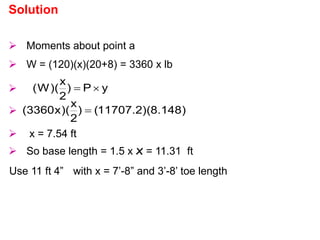
 Moments about point a
 W = (120)(x)(20+8) = 3360 x lb
 y
P
)
2
x
)(
W
( 

 )
148
.
8
)(
2
.
11707
(
)
2
x
)(
x
3360
( 
 x = 7.54 ft
 So base length = 1.5 x x = 11.31 ft
Use 11 ft 4” with x = 7’-8” and 3’-8’ toe length
Solution
Stem Thickness
 Prior computing stability factors, a more accurate
knowledge of the concrete dimensions is necessary.
Solution
 The thickness of the base of the stem is selected with the
regard for bending and shear requirements.
 P for 18’ height and h’ = 8’
   
lb
12
.
9951
)
8
2
18
(
18
120
271
.
0
2
1
)
h
2
h
(
wh
C
2
1
P ah



















ft
412
.
7
)
8
2
18
(
3
)
8
)(
18
)(
3
(
)
18
(
)
h
2
h
(
3
hh
3
h
y
2
2
'
'








 Mu = (1.7) Py = (1.7) (9951.12) (7.412)
= 125388.09 lb.ft
Solution
02784
.
0
75
.
0
03712
.
0
000
,
40
87000
87000
000
,
40
)
3000
)(
85
.
0
)(
85
.
0
(
f
87000
87000
f
f
)
85
.
0
(
b
max
y
y
c
b
1


























For adequate deflection control, choose
686
.
15
3000
85
.
0
000
,
40
f
85
.
0
f
m
)
m
2
1
1
(
f
R
then
c
y
y
n









01392
.
0
2
1
max 



Solution
  
6
7
.
16
d
65
.
3370
496
9
.
0
12
09
.
125388
R
M
R
M
quired
Re
bd
quired
Re
496
)
686
.
15
01392
.
0
2
1
1
)(
000
,
40
)(
01392
.
0
(
m
2
1
1
f
R
n
n
n
n
2
y
n
























 Total thickness = 16.7 + 0.5 + 3 = 20.26”
Try 21” thickness of base of stem and select 12” for top of the wall
Shear at d
d used now = 17.5” = 1.458’
 At 18’ – 1.458’ = 16.542’ from top
    
.
required
is
orcement
inf
re
shear
no
So
,
V
V
Since
lb
7
.
19553
5
.
17
12
3000
2
85
.
0
bd
f
2
V
lb
96
.
17879
P
7
.
1
V
lb
92
.
8752
8
2
542
.
16
542
.
16
120
271
.
0
2
1
)
h
2
h
(
wh
C
2
1
P
u
u
c
u
u
ah


































Solution
F.O.S Against Overturning
Component Force Arm Moment
W1 (5.92)(18)(120)=12787.2 107156.74
W2 (0.75)(18)(150)=1012.5 3.67+1+0.25=4.92 4981.50
W3 (18)(1)(150)=2700 3.67+0.5=4.17 11259
W4 (11.33)(2)(150)=3399.00 19255.34
W5 (18)(0.75)(120)=810 3.67+1+0.5=5.17 4187.7
W6 (6.67)(8)(120)=6403.2 51257.62
Total 27111.9 198097.9
)
2
1
(
)
2
1
(
38
.
8
2
92
.
5
21
67
.
3 "



665
.
5
2
33
.
11

005
.
8
2
67
.
6
1
67
.
3 


Solution
 P = 11707.2 lb y= 8.148 ft
 Overturning Moment = 11707.2 x 8.148 = 95390.27 lb.ft
F.O.S. against overturning O.K
2
077
.
2
27
.
95390
9
.
198097



Location of Resultant & Footing Soil Pressure
 Distance of the resultant from the front edge is

7883
.
3
9
.
27111
27
.
95390
9
.
198097
a
)
righting
(
load
Total
moment
g
Overturnin
moment
Righting
a





Middle third = 3.7778 ft, So resultant is within the middle third.
Solution
 
 
7883
.
3
6
33
.
11
4
33
.
11
9
.
27111
q
)
a
6
4
(
R
q
2
1
v
2
1





 

2
2
2
ft
/
lb
74
.
14
)
2
a
6
(
R
q v


 

q1= 4771.12 lb/ft2 < 5 k/ft2
So O.K against bearing pressure.
Solution
 Passive earth pressure against 2’ height of footing aph
C
wh
2
1 2

Solution
.
required
is
key
So
5
.
1
964
.
0
2
.
11707
442
76
.
10844
.
S
.
O
.
F
lb
82
.
442
sin
1
sin
1
)
2
)(
120
(
2
1






















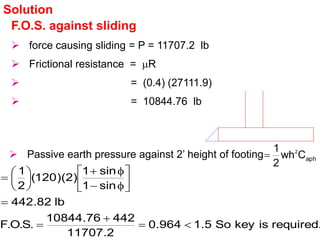
F.O.S. against sliding
 force causing sliding = P = 11707.2 lb
 Frictional resistance = R
 = (0.4) (27111.9)
 = 10844.76 lb
 The front of key is 4” in front of back face of the stem. This
will permit anchoring the stem reinforcement in the key..
ft
/
lb
58
.
2635
ordinate
Total
ft
/
lb
84
.
2620
x
33
.
11
38
.
4756
243
.
6
x


 Frictional resistance between soil to soil = R
lb
17
.
13191
)
087
.
5
(
2
58
.
2635
12
.
4771
)
(tan






 


Solution
 Frictional resistance between heel concrete to soil = R
lb
19
.
3309
)
243
.
6
(
2
74
.
14
58
.
2635
)
4
.
0
(






 

     lb
h
4
.
221
69
.
3
h
120
2
1
C
wh
2
1
pressure
earth
Passive
2
2
ph
2









Solution
 F.O.S. against sliding = 1.5
ft
19
.
2
h
2
.
11707
h
4
.
221
19
.
3309
17
.
13191
5
.
1
2




So use key of height = 2’-3” = 2.25’
Design of Heel Cantilever
Wu = (1.7) (120) (8) + (1.4) [18 x 120 + 2 x 150 ]
= 5076 lb/ft
  
ft
.
lb
76
.
88947
92
.
5
76
.
5
2
1
2
W
M
2
u
2










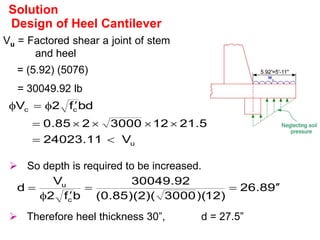
Vu = Factored shear a joint of stem and heel
Solution
When the support reaction introduces compression into
the end region, then critical shear is at a distance d
from face of support. However, the support is not
producing compression, therefore, critical shear is at
joint of stem and heel.
Design of Heel Cantilever
Vu = Factored shear a joint of stem
and heel
= (5.92) (5076)
= 30049.92 lb
Solution
u
c
c
V
11
.
24023
5
.
21
12
3000
2
85
.
0
bd
f
2
V











 So depth is required to be increased.
9
8
.
26
)
12
)(
3000
)(
2
)(
85
.
0
(
92
.
30049
b
f
2
V
d
c
u







 Therefore heel thickness 30”, d = 27.5”
Now Wu=(1.7)(120)(8)+(1.4)[(17.5)(120)+(2.5)(150)] = 5097 lb/ft
.
ft
.
lb
75
.
89315
)
92
.
5
)(
5097
(
2
1
M 2
u 







005
.
0
f
200
00337
.
0
f
mR
2
1
1
m
1
psi
23
.
131
)
5
.
27
)(
12
)(
9
.
0
(
12
89315
bd
M
R
quired
Re
y
min
y
n
u
n 2
2



















Solution
Design of Heel Cantilever
 As = min bd = 1.8 in2
 Use # 8 @ 5” c/c (As = 1.88 in2 )
 Dev. Length required = 23” top bars so 23 × 1.3 = 29.9”
 Available = 5.92’-3” = 68.04” O.K
Design of Toe Slab
33
.
11
66
.
7
38
.
4756
x

x = 3215.7
3215.7 + 14.74 = 3230.44
(6801.33)lb/ft





 

2
12
.
4771
44
.
3230
)
7
.
1
(
Wu
Wu = 3801.33 lb/ft – 270 = 6531.33
Solution
Overload factor = 0.9
{d=24”-3.5”=20.5”
=1.71 ft
Self load=(0.9)(1×2×150)=270 lb/ft
   
3
.
116
5
.
20
12
9
.
0
12
92
.
43984
bd
M
R
quired
Re
ft
.
lb
92
.
43984
2
)
67
.
3
)(
33
.
6531
(
2
W
M
2
2
u
n
u
u
2
2









So min will control
As = (0.005)(12)(20.5) = 1.23 in2
Use # 8 @ c/c (As = 1.26 in2)
2
1
7
 Available dev. Length = 3.76’ – 3” = 41.01” Required = 23”
At a distance d= 20.5” = 1.71’
3.67’ – 1.71’ = 1.96’
3
.
3948
74
.
14
56
.
3933
56
.
3933
x
33
.
11
37
.
9
38
.
4756
x




Solution
Earth pressure lb
55
.
14526
)
7
.
1
)(
96
.
1
(
2
12
.
4771
3
.
3948






 

Vu = 14526.55 – 270 x 1.96 = 13997.37 lb
u
c
c
V
lb
76
.
22905
5
.
20
12
3000
2
85
.
0
bd
)
f
2
(
V











 So no shear reinforcement is required
Reinforcement for stem
Solution
    
   
3
2
.
7
5
.
100
25
.
726
8
2
5
.
17
3
8
5
.
17
3
)
5
.
17
(
h
2
h
3
h
h
3
h
y
lb
43
.
9532
8
2
5
.
17
5
.
17
120
271
.
0
2
1
)
h
2
h
(
wh
C
2
1
P
2
2
ah



























   
)
in
67
.
2
A
(
c
/
c
2
1
4
@
bars
9
#
Use
in
457
.
2
5
.
17
12
0117
.
0
bd
A
0117
.
0
000
,
40
08
.
425
686
.
15
2
1
1
686
.
15
1
686
.
15
3000
85
.
0
000
,
40
f
85
.
0
f
m
f
mR
2
1
1
m
1
psi
08
.
425
)
5
.
17
(
12
9
.
0
12
1
.
117163
bd
M
R
ft
.
lb
1
.
117163
23
.
7
43
.
9532
7
.
1
M
2
s
2
s
c
y
y
n
u
n
u
2
2














 





























Reinforcement for stem
Solution
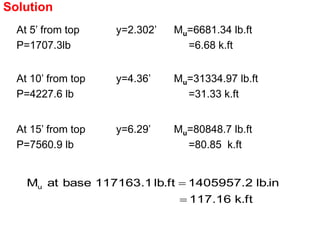
At 5’ from top
P=1707.3lb
y=2.302’ Mu=6681.34 lb.ft
=6.68 k.ft
At 10’ from top
P=4227.6 lb
y=4.36’ Mu=31334.97 lb.ft
=31.33 k.ft
At 15’ from top
P=7560.9 lb
y=6.29’ Mu=80848.7 lb.ft
=80.85 k.ft
Solution
ft
.
k
16
.
117
in
.
lb
2
.
1405957
ft
.
lb
1
.
117163
base
at
Mu


With Full Reinforcement
 C = 0.85fc’ba = 0.85 × 3000 × 12 × a = 30600a lb
 T = Asfy = 2.67 x 40000 = 106800
 a = 3.49 in
 At top of wall d = 8.5”
ft
.
k
11
.
54
.
in
.
lb
6
.
649290
2
49
.
3
5
.
8
)
106800
)(
9
.
0
(
2
a
d
f
A
9
.
0
M y
s
n



















At base of stem d=17.5”
Solution
ft
.
k
2
.
126
.
in
.
lb
6
.
1514370
2
49
.
3
5
.
17
)
106800
)(
9
.
0
(
Mn











With half Reinforcement
 C = 0.85fc’ba = 0.85 × 3000 × 12 × a = 30600a lb
 T = Asfy = 1.335 × 40,000 = 53400 for #9@9” c/c(As=1.33 in2)
 a = 1.745 in
 At top of wall d = 8.5”
ft
.
k
55
.
30
.
in
.
lb
65
.
366577
2
745
.
1
5
.
8
)
53400
)(
9
.
0
(
Mn











At base of stem d=17.5”
Solution
ft
.
k
59
.
66
.
in
.
lb
65
.
799117
2
745
.
1
5
.
17
)
53400
)(
9
.
0
(
Mn











With one-fourth Reinforcement
 C = 0.85fc’ba = 0.85 × 3000 × 12 × a = 30600a lb
 T = Asfy = 0.67 × 40,000 = 26800 for #9@18” c/c(As=0.67 in2)
 a = 0.88 in
 At top of wall d = 8.5”
ft
.
k
2
.
16
.
in
.
lb
2
.
194407
2
88
.
0
5
.
8
)
26800
)(
9
.
0
(
Mn











At base of stem d=17.5”
Solution
ft
.
k
29
.
34
.
in
.
lb
2
.
411487
2
88
.
0
5
.
17
)
26800
)(
9
.
0
(
Mn











 The actual termination point is found by extending beyond the
intersection of capacity moment line with the factored moment
diagram a distance of either the effective depth d or 12 bar
diameters, whichever is greater.
Solution
 Thus half bars should be cut at 4’-8” distance from bottom and
further half bars should be cut 8’-8” theoretically from bottom.
Solution
3
6
.
6
y
5
.
17
9
x
12
5
.
17
9
y
12
x








d at 4.6’ from bottom (y=12.9’)
= 8.5 + 6.63 = 15.13”
15”

8
5
.
4
y
5
.
17
9
x 




d at 8.6’ from bottom (y=8.9’)
= 8.5 + 4.58 = 13.08”
13”
Solution

 bar used # 9 of diameter = 1.128”
 12 db = 13.54” = 14”
 Therefore half bars should be terminated actually at
4’-8”+15”=15’-11” from bottom
 and further half bars should be terminated at
8’-8”+14” =9’10”
 For tension bars to be terminated in the tension zone, one
of the following condition must be satisfied.
2. Continuing bars must provide at last twice the area
required for bending moment at the cut off point.
1. Vu at the cut-off point must not exceed two-thirds of the
shear strength øVn.
3. Excess shear reinforcement is provided.
 at 12.9’ from top
bd
)
f
2
(
V c
c




Solution
 
kips
68
.
9
V
3
2
kips
14.53
1000
1
13
12
3000
2
85
.
0
V
.
satisfied
is
)
1
(
Condition
kips
31
.
10
1000
1
h
2
h
wh
C
2
1
7
.
1
V
kips
11.17
V
3
2
kips
16.76
1000
1
15
12
3000
2
85
.
0
V
c
c
ah
u
c
c


















 













Solution
 
 
kips
13
.
6
1000
1
8
2
9
.
8
9
.
8
120
271
.
0
2
1
7
.
1
1000
1
h
2
h
wh
C
2
1
7
.
1
V ah
u





















 


 Condition (1) satisfied so bars can be terminated.
The above condition are imposed as a check stress concentration.
 Shear at bottom = Vu = 1.7 x 9.53243 = 16.21 kips
Solution
kips
56
.
19
1000
1
5
.
17
12
3000
2
85
.
0
Vc 







Since øVc > Vu so no need of shear reinforcement.
 The  used should not be less than at any point. This
minimum limit, strictly speaking, does not apply to retaining
walls. However, because the integrity of retaining wall
depends absolutely on the vertical walls, it appear prudent to
use this limit un such cases.
y
f
200
 First termination point is 5’-11” from bottom
where d=14.46” As =1.335 in2
 Second termination point is 9’-10” form bottom where
d=12.44” As=0.6675 in2
Solution
005
.
0
f
200
0077
.
0
y




 = 0.0045 ≈ 0.005 Therefore the above condition is satisfied.
 Another requirement is that maximum spacing of the primary
flexural reinforcement exceed neither 3 times the wall thickness
nor 18 in. These restrictions are satisfied as well.
 For splices of deformed bars in tension, at sections where the
ratio of steel provided to steel required is less than 2 and where
no more than 50% of the steel is spliced, the ACI code requires
a class-B splice of length 1.3 ld.
 ld for # 9 bars =29”
 Splice length = 1.3 × 29 = 37.7” or 3’-2” O.K
Solution
Temperature & shrinkage reinforcement
 Total amount of horizontal bars (h is average thickness)
ft
/
in
39
.
0
2
50
.
20
12
12
002
.
0
bh
002
.
0
A 2
s 





 Since front face is more exposed for temperature changes
therefore two third of this amount is placed in front face and one
third in rear face.
Solution
Accordingly # 4 @ 9 in. c/c As=0.26 in.
ft
/
in
26
.
0
A
3
2 2
s 
 Use # 3 @ 10 in. c/c As=0.13 in2.
ft
/
in
13
.
0
A
3
1 2
s 
 For vertical reinforcement on the front face, use any nominal
amount. Use # 3 @ 18 in. c/c
Since base is not subjected to extreme temperature changes,
therefore # 4@ 12” c/c just for spacers will be sufficient.
Solution

Retaining_Wall_UOL.pptx

  • 1.
  • 2.
    Retaining walls areused to hold back masses of earth or other loose material where conditions make it impossible to let those masses assume their natural slopes. Function of retaining wall  Such conditions occur when the width of an excavation, cut, or embankment is restricted by conditions of ownership, use of the structure, or economy. For example, in railway or highway construction the width of the right of way is fixed, and the cut or embankment must be contained within that width. Similarly, the basement walls of the buildings must be located within the property and must retain the soil surrounding the base.
  • 3.
    Free standing retainingwalls, as distinct from those that form parts of structures, such as basement walls, are of various types. Types of retaining walls  The gravity retaining wall retains the earth entirely by its own weight and generally contains no reinforcement. It is used up to 10 ft height.  The reinforced concrete cantilever retaining wall consists of the vertical arm that retains the earth and is held in position by a footing or base slab. In this case, the weight of the fill on top of the heel, in addition to the weight of the wall, contributes to the stability of the structure. Since the arm represents a vertical cantilever, its required thickness increase rapidly, with increasing height. It is used in the range of 10 to 2 ft height.
  • 4.
    In the counterfortwall the stem and base slab are tied together by counterforts which are transverse walls spaced at intervals and act as tension ties to support the stem wall. Counterforts are of half or larger heights. Counterfort walls are economical for heights over 25 ft. Types of retaining walls Property rights or other restrictions sometimes make it necessary to place the wall at the forward edge of the base slab, i.e. to omit the toe. Whenever it is possible, toe extensions of one-third to one-fourth of the width of the base provide a more economical solution.
  • 5.
    A buttress wallis similar to a counterfort wall except that the transverse support walls are located on the side of the stem opposite to the retained material and act as compression struts. Buttress, as compression elements, are more efficient than the tension counterforts and are economical in the same height range. Types of retaining walls A counterfort is more widely used than a buttress because the counterfort is hidden beneath the retained material, whereas the buttress occupies what may otherwise be usable space in front of the wall.
  • 6.
    This is anfree standing wall category. A wall type bridge abutment acts similarly to a cantilever retaining wall except that the bridge deck provides an additional horizontal restraint at the top of the stem. Thus this abutment is designed as a beam fixed at the bottom and simply supported or partially restrained at the top. Types of retaining walls
  • 7.
     w isunit weight of the soil Earth Pressure  C0 is a constant known as the coefficient of earth pressure at rest According to Rankin, the coefficient for active and passive earth pressure are             2 2 2 2 Cos Cos Cos Cos Cos Cos Cos Ca             2 2 2 2 Cos Cos Cos Cos Cos Cos Cos Cp  For the case of horizontal surface =0      sin 1 sin 1 Cah      sin 1 sin 1 Cph  For liquid P=wwh, ww is the unit weight of water. Soil retaining structure Ph=Cowh
  • 8.
    Earth pressure forcommon condition of loading 2 wh C 2 1 P 3 h y ah          Cos C For Cawh 2 1 p 3 h y a 2
  • 9.
    Earth pressure forcommon condition of loading ) h 2 h ( wh C 2 1 P ) h 2 h ( 3 h h 3 h y ah 2        
  • 10.
    1. Individual partsshould be strong enough to resist the applied forces Stability Requirement 2. The wall as a whole should be stable against (i) Settlem ent (ii) Sliding (iii) Overtur ning
  • 11.
    Stability Requirement It isnecessary to ensure that the pressure under the footing does not exceed the “permissible bearing pressure” for the particular soil. By the formula Settlement I MC A N q min max    If , compression will act throughout the section 3 a  
  • 12.
                                   v 2 1 2 v 2 2 v 1 2 v 2 v v v 2 , 1 3 v 2 v v 3 v 2 v v 2 , 1 3 v v 2 , 1 R q q 2 a when 2 a 6 R q & a 6 4 R q a 6 3 R a R 6 R 3 R q 12 4 a R 2 R R 12 2 a R 4 R R q 12 2 R a 2 R q                                   Unit dimension in the direction perpendicular to the paper. Stability Requirement Settlement
  • 13.
  • 14.
  • 15.
    Sliding F = Rv StabilityRequirement 5 . 1 P F h  Overturning 2 moment g Overturnin moment g Stabilizin 
  • 16.
    1. Lateral earthpressure will be considered to be live loads and a factor of 1.7 applied. Basis of Structural Design 2. In general, the reactive pressure of the soil under the structure at the service load stage will be taken equal to 1.7 times the soil pressure found for service load conditions in the stability analysis. 3. For cantilever retaining walls, the calculated dead load of the toe slab, which causes moments acting in the opposite sense to those produced by the upward soil reaction, will be multiplied by a factor of 0.9.
  • 17.
    4. For theheel slab, the required moment capacity will be based on the dead load of the heel slab itself, plus the earth directly above it, both multiplied by 1.4. 5. Surcharge, if resent, will be treated as live load with load factor of 1.7. 6. The upward pressure of the soil under the heel slab will be taken equal to zero, recognizing that for severe over load stage a non linear pressure distribution will probably be obtained, with most of the reaction concentrated near the toe. Basis of Structural Design
  • 20.
  • 21.
    Drainage  Reduction inbearing capacity.  Hydrostatic pressure.  Ice pressure  Drainage can be provided in various ways i. Weep holes, 6 to 8 in. 5 to 10 ft horizontally spaced. 1 ft3 stone at rear end at the bottom weep holes to facilitate drainage and to prevent clogging. ii. Longitudinal drains embedded in crushed stone or gravel, along rear face of the wall. iii. Continuous back drain consisting of a layer of gravel or crushed stone covering the entire rear face of the wall with discharge at the ends.
  • 23.
    Problem  A gravityretaining wall consisting of plain concrete w=144 lb/ft3 is shown in fig. The bank of supported earth is assumed to weigh 110 lb/ft3 ø=300 and to have a coefficient of friction against sliding on soil of 0.5. Solution 333 . 0 30 sin 1 30 sin 1 sin 1 sin 1 Ca          3 30 sin 1 30 sin 1 sin 1 sin 1 Cp          lb 36 . 2637 ) 12 )( 110 )( 333 . 0 ( 2 1 wh C 2 1 P 2 2 a ah          lb.ft 4 4 . 10549 3 12 36 . 2637 moment g Overturnin   
  • 24.
     Restoring moment: Moment about toe Component Weights Force Moment arm Moment W1 (6)(4)(144) 864 x 3 2592 lb.ft W2 (1)(11)(144) 1584 x 1 1584 lb.ft W3 (4)(144)(11) 8976 lb.ft W4 (4)(11)(110) 10083.33 lb.ft W5 (0.5)(11)(110) 605 x 5.75 3478.75 lb.ft Rv = 8641 lb M=26714.08 lb.ft       2 1          4 3 1 5 . 1 3168 Solution          4 3 2 5 . 1 2420       2 1 Safety factor against overturning = O.K 2 53 . 2 44 . 10549 08 . 26714  
  • 25.
     Distance ofresultant from the toe  Thus resultant is out of kern distance  The max. soil pressure will be ) 87 . 1 )( 3 ( ) 8641 )( 2 ( a 3 R 2 q v    q = 3080.57 lb/ft2 < 4000 psf Solution ft 87 . 1 8641 44 . 10549 08 . 26714 a   
  • 26.
    Sliding  Assuming thatsoil above footing toe has eroded and thus the passive pressure is only due to soil depth equal to footing thickness. Solution lb 5 16 ) 1 )( 110 )( 3 ( 2 1 wh C 2 1 P 2 2 p ph           Friction force between footing concrete and soil.  F.O.S. against sliding = O.K lb 5 . 4320 ) 8641 )( 5 . 0 ( R F v     5 . 1 7 . 1 36 . 2637 165 5 . 4320   
  • 27.
    Estimating size ofcantilever retaining wall  The base of footing should be below frost penetration about 3’ or 4’. Height of Wall  Stem is thickest at its base. They have thickness in the range of 8 to 12% of overall height of the retaining wall. The minimum thickness at the top is 10” but preferably 12”. Stem Thickness.  Preferably, total thickness of base fall between 7 and 10% of the overall wall height. Minimum thickness is at least 10” to 12” used. Base Thickness
  • 28.
    Estimating size ofcantilever retaining wall  For preliminary estimates, the base length can be taken about 40 to 60% of the overall wall height. Base Length  Another method refer to fig. W is assumed to be equal to weight of the material within area abcd.  Take moments about toe and solve for x.
  • 29.
    Problem  Design acantilever retaining wall to support a bank of earth of 16 ft height above the final level of earth at the toe of the wall. The backfill is to be level, but a building is to be built on the fill.  Assume that an 8’ surcharge will approximate the lateral earth pressure effect. Weight of retained material = 130 lb/ft3 Angle of internal friction = 35o Coefficient of friction b/w concrete and soil = 0.4 fc’=3000 psi fy=40,000 psi Maximum soil pressure = 5 k/ft2
  • 30.
    Solution  Allowing 4’for frost penetration to the bottom of footing in front of the wall, the total height becomes. Height of Wall  h = 16 + 4 = 20 ft.  At this stage, it may be assumed 7 to 10% of the overall height h. Thickness of Base  Assume a uniform thickness t = 2’ ( 10% of h )  h = 20’ h’ = 8’ Base Length
  • 31.
                       ft 148 . 8 8 2 20 3 8 20 3 20 h 2 h 3 h h 3 h y lb 2 . 11707 36 20 120 271 . 0 5 . 0 8 2 20 20 120 sin 1 sin 1 2 1 ) h 2 h ( wh C 2 1 P 2 2 ah                                   Solution
  • 32.
     Moments aboutpoint a  W = (120)(x)(20+8) = 3360 x lb  y P ) 2 x )( W (    ) 148 . 8 )( 2 . 11707 ( ) 2 x )( x 3360 (   x = 7.54 ft  So base length = 1.5 x x = 11.31 ft Use 11 ft 4” with x = 7’-8” and 3’-8’ toe length Solution
  • 33.
    Stem Thickness  Priorcomputing stability factors, a more accurate knowledge of the concrete dimensions is necessary. Solution  The thickness of the base of the stem is selected with the regard for bending and shear requirements.  P for 18’ height and h’ = 8’     lb 12 . 9951 ) 8 2 18 ( 18 120 271 . 0 2 1 ) h 2 h ( wh C 2 1 P ah                    ft 412 . 7 ) 8 2 18 ( 3 ) 8 )( 18 )( 3 ( ) 18 ( ) h 2 h ( 3 hh 3 h y 2 2 ' '        
  • 34.
     Mu =(1.7) Py = (1.7) (9951.12) (7.412) = 125388.09 lb.ft Solution 02784 . 0 75 . 0 03712 . 0 000 , 40 87000 87000 000 , 40 ) 3000 )( 85 . 0 )( 85 . 0 ( f 87000 87000 f f ) 85 . 0 ( b max y y c b 1                           For adequate deflection control, choose 686 . 15 3000 85 . 0 000 , 40 f 85 . 0 f m ) m 2 1 1 ( f R then c y y n          01392 . 0 2 1 max    
  • 35.
  • 36.
    Shear at d dused now = 17.5” = 1.458’  At 18’ – 1.458’ = 16.542’ from top      . required is orcement inf re shear no So , V V Since lb 7 . 19553 5 . 17 12 3000 2 85 . 0 bd f 2 V lb 96 . 17879 P 7 . 1 V lb 92 . 8752 8 2 542 . 16 542 . 16 120 271 . 0 2 1 ) h 2 h ( wh C 2 1 P u u c u u ah                                   Solution
  • 37.
    F.O.S Against Overturning ComponentForce Arm Moment W1 (5.92)(18)(120)=12787.2 107156.74 W2 (0.75)(18)(150)=1012.5 3.67+1+0.25=4.92 4981.50 W3 (18)(1)(150)=2700 3.67+0.5=4.17 11259 W4 (11.33)(2)(150)=3399.00 19255.34 W5 (18)(0.75)(120)=810 3.67+1+0.5=5.17 4187.7 W6 (6.67)(8)(120)=6403.2 51257.62 Total 27111.9 198097.9 ) 2 1 ( ) 2 1 ( 38 . 8 2 92 . 5 21 67 . 3 "    665 . 5 2 33 . 11  005 . 8 2 67 . 6 1 67 . 3    Solution
  • 38.
     P =11707.2 lb y= 8.148 ft  Overturning Moment = 11707.2 x 8.148 = 95390.27 lb.ft F.O.S. against overturning O.K 2 077 . 2 27 . 95390 9 . 198097    Location of Resultant & Footing Soil Pressure  Distance of the resultant from the front edge is  7883 . 3 9 . 27111 27 . 95390 9 . 198097 a ) righting ( load Total moment g Overturnin moment Righting a      Middle third = 3.7778 ft, So resultant is within the middle third. Solution     7883 . 3 6 33 . 11 4 33 . 11 9 . 27111 q ) a 6 4 ( R q 2 1 v 2 1        
  • 39.
    2 2 2 ft / lb 74 . 14 ) 2 a 6 ( R q v      q1=4771.12 lb/ft2 < 5 k/ft2 So O.K against bearing pressure. Solution
  • 40.
     Passive earthpressure against 2’ height of footing aph C wh 2 1 2  Solution . required is key So 5 . 1 964 . 0 2 . 11707 442 76 . 10844 . S . O . F lb 82 . 442 sin 1 sin 1 ) 2 )( 120 ( 2 1                       F.O.S. against sliding  force causing sliding = P = 11707.2 lb  Frictional resistance = R  = (0.4) (27111.9)  = 10844.76 lb
  • 41.
     The frontof key is 4” in front of back face of the stem. This will permit anchoring the stem reinforcement in the key.. ft / lb 58 . 2635 ordinate Total ft / lb 84 . 2620 x 33 . 11 38 . 4756 243 . 6 x    Frictional resistance between soil to soil = R lb 17 . 13191 ) 087 . 5 ( 2 58 . 2635 12 . 4771 ) (tan           Solution
  • 42.
     Frictional resistancebetween heel concrete to soil = R lb 19 . 3309 ) 243 . 6 ( 2 74 . 14 58 . 2635 ) 4 . 0 (               lb h 4 . 221 69 . 3 h 120 2 1 C wh 2 1 pressure earth Passive 2 2 ph 2          Solution  F.O.S. against sliding = 1.5 ft 19 . 2 h 2 . 11707 h 4 . 221 19 . 3309 17 . 13191 5 . 1 2     So use key of height = 2’-3” = 2.25’
  • 43.
    Design of HeelCantilever Wu = (1.7) (120) (8) + (1.4) [18 x 120 + 2 x 150 ] = 5076 lb/ft    ft . lb 76 . 88947 92 . 5 76 . 5 2 1 2 W M 2 u 2           Vu = Factored shear a joint of stem and heel Solution When the support reaction introduces compression into the end region, then critical shear is at a distance d from face of support. However, the support is not producing compression, therefore, critical shear is at joint of stem and heel.
  • 44.
    Design of HeelCantilever Vu = Factored shear a joint of stem and heel = (5.92) (5076) = 30049.92 lb Solution u c c V 11 . 24023 5 . 21 12 3000 2 85 . 0 bd f 2 V             So depth is required to be increased. 9 8 . 26 ) 12 )( 3000 )( 2 )( 85 . 0 ( 92 . 30049 b f 2 V d c u         Therefore heel thickness 30”, d = 27.5”
  • 45.
    Now Wu=(1.7)(120)(8)+(1.4)[(17.5)(120)+(2.5)(150)] =5097 lb/ft . ft . lb 75 . 89315 ) 92 . 5 )( 5097 ( 2 1 M 2 u         005 . 0 f 200 00337 . 0 f mR 2 1 1 m 1 psi 23 . 131 ) 5 . 27 )( 12 )( 9 . 0 ( 12 89315 bd M R quired Re y min y n u n 2 2                    Solution Design of Heel Cantilever
  • 46.
     As =min bd = 1.8 in2  Use # 8 @ 5” c/c (As = 1.88 in2 )  Dev. Length required = 23” top bars so 23 × 1.3 = 29.9”  Available = 5.92’-3” = 68.04” O.K Design of Toe Slab 33 . 11 66 . 7 38 . 4756 x  x = 3215.7 3215.7 + 14.74 = 3230.44 (6801.33)lb/ft         2 12 . 4771 44 . 3230 ) 7 . 1 ( Wu Wu = 3801.33 lb/ft – 270 = 6531.33 Solution Overload factor = 0.9 {d=24”-3.5”=20.5” =1.71 ft Self load=(0.9)(1×2×150)=270 lb/ft
  • 47.
       3 . 116 5 . 20 12 9 . 0 12 92 . 43984 bd M R quired Re ft . lb 92 . 43984 2 ) 67 . 3 )( 33 . 6531 ( 2 W M 2 2 u n u u 2 2          So min will control As = (0.005)(12)(20.5) = 1.23 in2 Use # 8 @ c/c (As = 1.26 in2) 2 1 7  Available dev. Length = 3.76’ – 3” = 41.01” Required = 23” At a distance d= 20.5” = 1.71’ 3.67’ – 1.71’ = 1.96’ 3 . 3948 74 . 14 56 . 3933 56 . 3933 x 33 . 11 37 . 9 38 . 4756 x     Solution
  • 48.
    Earth pressure lb 55 . 14526 ) 7 . 1 )( 96 . 1 ( 2 12 . 4771 3 . 3948         Vu = 14526.55 – 270 x 1.96 = 13997.37 lb u c c V lb 76 . 22905 5 . 20 12 3000 2 85 . 0 bd ) f 2 ( V             So no shear reinforcement is required Reinforcement for stem Solution          3 2 . 7 5 . 100 25 . 726 8 2 5 . 17 3 8 5 . 17 3 ) 5 . 17 ( h 2 h 3 h h 3 h y lb 43 . 9532 8 2 5 . 17 5 . 17 120 271 . 0 2 1 ) h 2 h ( wh C 2 1 P 2 2 ah                           
  • 49.
       ) in 67 . 2 A ( c / c 2 1 4 @ bars 9 # Use in 457 . 2 5 . 17 12 0117 . 0 bd A 0117 . 0 000 , 40 08 . 425 686 . 15 2 1 1 686 . 15 1 686 . 15 3000 85 . 0 000 , 40 f 85 . 0 f m f mR 2 1 1 m 1 psi 08 . 425 ) 5 . 17 ( 12 9 . 0 12 1 . 117163 bd M R ft . lb 1 . 117163 23 . 7 43 . 9532 7 . 1 M 2 s 2 s c y y n u n u 2 2                                              Reinforcement for stem Solution
  • 50.
    At 5’ fromtop P=1707.3lb y=2.302’ Mu=6681.34 lb.ft =6.68 k.ft At 10’ from top P=4227.6 lb y=4.36’ Mu=31334.97 lb.ft =31.33 k.ft At 15’ from top P=7560.9 lb y=6.29’ Mu=80848.7 lb.ft =80.85 k.ft Solution ft . k 16 . 117 in . lb 2 . 1405957 ft . lb 1 . 117163 base at Mu  
  • 51.
    With Full Reinforcement C = 0.85fc’ba = 0.85 × 3000 × 12 × a = 30600a lb  T = Asfy = 2.67 x 40000 = 106800  a = 3.49 in  At top of wall d = 8.5” ft . k 11 . 54 . in . lb 6 . 649290 2 49 . 3 5 . 8 ) 106800 )( 9 . 0 ( 2 a d f A 9 . 0 M y s n                    At base of stem d=17.5” Solution ft . k 2 . 126 . in . lb 6 . 1514370 2 49 . 3 5 . 17 ) 106800 )( 9 . 0 ( Mn           
  • 52.
    With half Reinforcement C = 0.85fc’ba = 0.85 × 3000 × 12 × a = 30600a lb  T = Asfy = 1.335 × 40,000 = 53400 for #9@9” c/c(As=1.33 in2)  a = 1.745 in  At top of wall d = 8.5” ft . k 55 . 30 . in . lb 65 . 366577 2 745 . 1 5 . 8 ) 53400 )( 9 . 0 ( Mn            At base of stem d=17.5” Solution ft . k 59 . 66 . in . lb 65 . 799117 2 745 . 1 5 . 17 ) 53400 )( 9 . 0 ( Mn           
  • 53.
    With one-fourth Reinforcement C = 0.85fc’ba = 0.85 × 3000 × 12 × a = 30600a lb  T = Asfy = 0.67 × 40,000 = 26800 for #9@18” c/c(As=0.67 in2)  a = 0.88 in  At top of wall d = 8.5” ft . k 2 . 16 . in . lb 2 . 194407 2 88 . 0 5 . 8 ) 26800 )( 9 . 0 ( Mn            At base of stem d=17.5” Solution ft . k 29 . 34 . in . lb 2 . 411487 2 88 . 0 5 . 17 ) 26800 )( 9 . 0 ( Mn           
  • 54.
     The actualtermination point is found by extending beyond the intersection of capacity moment line with the factored moment diagram a distance of either the effective depth d or 12 bar diameters, whichever is greater. Solution  Thus half bars should be cut at 4’-8” distance from bottom and further half bars should be cut 8’-8” theoretically from bottom.
  • 55.
  • 56.
    3 6 . 6 y 5 . 17 9 x 12 5 . 17 9 y 12 x         d at 4.6’from bottom (y=12.9’) = 8.5 + 6.63 = 15.13” 15”  8 5 . 4 y 5 . 17 9 x      d at 8.6’ from bottom (y=8.9’) = 8.5 + 4.58 = 13.08” 13” Solution 
  • 57.
     bar used# 9 of diameter = 1.128”  12 db = 13.54” = 14”  Therefore half bars should be terminated actually at 4’-8”+15”=15’-11” from bottom  and further half bars should be terminated at 8’-8”+14” =9’10”  For tension bars to be terminated in the tension zone, one of the following condition must be satisfied. 2. Continuing bars must provide at last twice the area required for bending moment at the cut off point. 1. Vu at the cut-off point must not exceed two-thirds of the shear strength øVn. 3. Excess shear reinforcement is provided.  at 12.9’ from top bd ) f 2 ( V c c     Solution
  • 58.
  • 59.
        kips 13 . 6 1000 1 8 2 9 . 8 9 . 8 120 271 . 0 2 1 7 . 1 1000 1 h 2 h wh C 2 1 7 . 1 Vah u                           Condition (1) satisfied so bars can be terminated. The above condition are imposed as a check stress concentration.  Shear at bottom = Vu = 1.7 x 9.53243 = 16.21 kips Solution kips 56 . 19 1000 1 5 . 17 12 3000 2 85 . 0 Vc         Since øVc > Vu so no need of shear reinforcement.
  • 60.
     The used should not be less than at any point. This minimum limit, strictly speaking, does not apply to retaining walls. However, because the integrity of retaining wall depends absolutely on the vertical walls, it appear prudent to use this limit un such cases. y f 200  First termination point is 5’-11” from bottom where d=14.46” As =1.335 in2  Second termination point is 9’-10” form bottom where d=12.44” As=0.6675 in2 Solution 005 . 0 f 200 0077 . 0 y      = 0.0045 ≈ 0.005 Therefore the above condition is satisfied.
  • 61.
     Another requirementis that maximum spacing of the primary flexural reinforcement exceed neither 3 times the wall thickness nor 18 in. These restrictions are satisfied as well.  For splices of deformed bars in tension, at sections where the ratio of steel provided to steel required is less than 2 and where no more than 50% of the steel is spliced, the ACI code requires a class-B splice of length 1.3 ld.  ld for # 9 bars =29”  Splice length = 1.3 × 29 = 37.7” or 3’-2” O.K Solution
  • 62.
    Temperature & shrinkagereinforcement  Total amount of horizontal bars (h is average thickness) ft / in 39 . 0 2 50 . 20 12 12 002 . 0 bh 002 . 0 A 2 s        Since front face is more exposed for temperature changes therefore two third of this amount is placed in front face and one third in rear face. Solution Accordingly # 4 @ 9 in. c/c As=0.26 in. ft / in 26 . 0 A 3 2 2 s   Use # 3 @ 10 in. c/c As=0.13 in2. ft / in 13 . 0 A 3 1 2 s   For vertical reinforcement on the front face, use any nominal amount. Use # 3 @ 18 in. c/c Since base is not subjected to extreme temperature changes, therefore # 4@ 12” c/c just for spacers will be sufficient.
  • 63.