Pavement design and
construction
CONTENT :
• Types of pavement
• Function of pavement components
• Factors consider in pavement design
• Flexible pavement design method
• Traffic data
• Joints in the pavement
Pavement refers to the top layer of the road
surface. But it generally includes sub base , base,
surface course.
• Objective :
 To transfer the wheel load to subgrade
To prevent the entry of rain water in subgrade
To provide smooth riding surface
Types of pavements
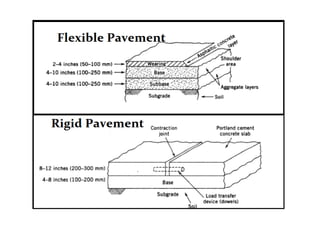
1. Flexible pavement
• It possess low flexural strength and transfer wheel
load to subgrade by deformation action.
• Example : bituminous road , WBM road, Earth or
gravel road
• It reflects the deformation of the lower layer on the
top of the surface.
• There will no temperature stress produced.
2. Rigid pavement
• It possess good flexural strength and transfer
wheel load to subgrade without deformation.
• Example : cement concrete road , RCC road etc.
• Temperature stress are developed.
3. Semi rigid and composite pavement
4. Interlocking cement concrete block pavement
 Function of pavement component
 Subgrade :
The main function of subgrade is to transfer
the load from upper layers to the earth mass
without deformation.
1. CBR test 2. California resisting value
3. Triaxial compression 4. Plate bearing
Sub base :
• To increase bearing capacity
• To improve drainage property
• To prevent subgrade from penetration
• To protect from frost action
 Base coarse :
• To distribute load to lower layer
• To provide level surface for surface layer
• To increase bearing capacity
 Wearing coarse :
• To give a smooth riding surface
• To prevent entry of water to lower surface
• To prevent accumulation of dust on road surface
• To transfer wheel load to base
• To reduce friction between tyre and surface
• Factors consider in pavement design :
1. Design wheel load
2. Subgrade soil
3. Design life
4. Climatic factor
5. Pavement component material
6. Environmental factor
7. Drainage
8. Road geometry
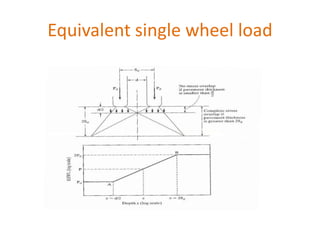
Equivalent single wheel load
Axle Configurations
Single Axle With Single Wheel
(Legal Axle Load = 6t)
Single Axle With Dual Wheel
(Legal Axle Load = 10t)
Tandem Axle
(Legal Axle Load = 18t)
Tridem Axle
(Legal Axle Load = 24t)
An axle is a central shaft for a rotating wheel or gear
Standard Axle
Single axle with dual wheels carrying a load of
80 kN (8 tonnes) is defined as standard axle
80 kN
Standard Axle
Flexible pavement design method
1. Group index method
2. CBR method
3. California resisting value
4. Triaxial method
5. Burmister method
6. Mcleod method
CBR Test
Definition:
It is the ratio of force per unit area required to
penetrate a soil mass with standard circular
piston at the rate of 1.25 mm/min. to that
required for the corresponding penetration of
a standard material.
CBR
• Basis of Design chart:
A material with a given CBR value requires
certain thickness of pavement.
• Chart developed for traffic wheel loads:
Light Traffic - 3175 kg
Heavy traffic – 5443 kg
Medium traffic – 4082 kg
Equipments For CBR Test
Cylindrical mould :
Inside dia 150 mm , height 175 mm,
detachable extension collar 50 mm height
detachable perforated base plate 10 mm thick.
Spacer disc 148 mm in dia and 47.7 mm in height along with handle.
Metal rammers. Weight 2.6 kg with a drop of 310 mm (or) weight 4.89 kg a drop
450 mm.
Weights. One annular metal weight and several slotted weights weighing 2.5 kg
each, 147 mm in dia, with a central hole 53 mm in diameter.
Loading machine.
capacity of atleast 5000 kg , movable head or base that travels at an uniform rate
of 1.25 mm/min.
Metal penetration piston 50 mm dia and minimum of 100 mm in length.
Two dial gauges reading to 0.01 mm.
Sieves. 4.75 mm and 20 mm I.S. Sieves.
• CBR test : It is a property of a grade soil which is measured by
an test designed by California State highways USA. It has been
standardized by IS also.
• It is made on the sample of subgrade soil in a standard
loading device which measures the load required to cause 2.5
mm penetration of the plunger having cross section area
1690 Sq.mm
• The plunger is made to penetrate the sample, at a rate of
1.25mm/min unit a penetration of 2.5 mm is obtained.
• This pressure at 2.5 mm penetration is worked out and it is
expressed as a % ofunit standard pressure. This % is known as
CBR
• The test is repeated for 5 mm penetration & the CBR is
worked out.
• Generally 2.5 mm value is higher
• Standard loads
2.5 mm 1370 kg
5 mm 2055 kg
Load vs Penetration
The standard loads adopted for different penetrations for the standard
material with a C.B.R. value of 100%
Penetration of plunger (mm) Standard load (kg)
2.5
5.0
7.5
10.0
12.5
1370
2055
2630
3180
3600
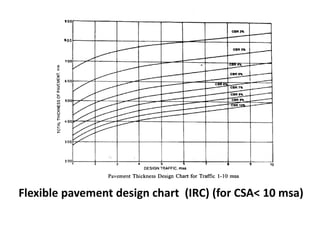
Flexible pavement design chart (IRC) (for CSA< 10 msa)
Traffic Data
Initial data in terms of number of commercial
vehicles per day (CVPD).
Traffic growth rate during design life in %
Design life in number of years.
Distribution of commercial vehicles over the
carriage way
Traffic – In Terms Of CSA (8160 Kg) During Design
Life
• Initial Traffic
 In terms of Cumulative Vehicles/day
 Based on 7 days 24 hours Classified Traffic
• Traffic Growth Rate
Establishing Models Based on Anticipated Future Development
or based on past trends
 Growth Rate of LCVs, Bus, 2 Axle, 3 Axle, Multi axle,
HCVs are different
 7.5 % may be Assumed
Design Life
• National Highways – 15 Years
• Expressways and Urban Roads – 20
Years
• Other Category Roads – 10 – 15
Years
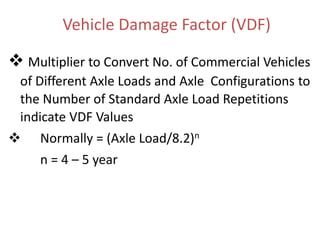
Vehicle Damage Factor (VDF)
 Multiplier to Convert No. of Commercial Vehicles
of Different Axle Loads and Axle Configurations to
the Number of Standard Axle Load Repetitions
indicate VDF Values
 Normally = (Axle Load/8.2)n
n = 4 – 5 year
Computation of Traffic for Use of Pavement Thickness
Design Chart
365 x A[(1+r)n – 1]
N = --------------------------- x D x F
r
N = Cumulative No. of standard axles to be catered for the design in
terms of msa
D = Lane distribution factor
A = Initial traffic, in the year of completion of construction, in terms
of number of commercial vehicles per day
F = Vehicle Damage Factor
n = Design life in years
r = Annual growth rate of commercial vehicles
• Traffic in the year of completion
• A= P(1+r)
• P = Number of commercial vehicles as per day
last count
• n = Number of years between the last count
and the year of the completion of construction
• R = growth rate
Bituminous Surfacing
• Shall consists of either a wearing course or a
binder course with a wearing course depending
upon the traffic to be carried.
• Where the wearing course adopted is premix
carpet of thickness up to 25 mm, the thickness
of surfacing should not be counted towards the
total thickness of the pavement
Advantage :
1. Low cost of construction
2. Low maintanance cost
3. Smooth and durable surface
4. Stage development is possible
• Purpose of joints in Concrete Roads
1. To absorb expansion & contraction due to
variation in temperature. ( horizontal
movements of slabs)
2. To avoid warping of slab edges
3. To grant facility in construction .
CONTRACTION JOINTS
• These are purposely made weakened planes which relieve
the tensile stresses in the concrete
• Caused due to changes in the moisture content (Drying
shrinkage) and/or temperature
• Prevent the formation of irregular cracks due to restraint in
free contraction of concrete .
• They are also provided to
1) Relieve stresses due to warping
2) To permit the contraction of the slab
LONGITUDINAL JOINTS
• Lanes are jointed together by joint known as
Longitudinal joint
• Longitudinal joints are provided in multilane
pavements and also when the pavement is more
than 4.5 m wide.
• They are provided normally at 3.5m c/c to
1) Relieve stresses due to warping.
2) To allow differential shrinkage & swelling due
to changes of sub grade moisture
3) To prevent longitudinal cracking
Expansion joints
• There are full-depth joints provided transversely into
which pavement can expand, thus relieving
compressive stresses due to expansion of concrete
• slabs, and preventing any tendency towards
distortion, buckling, blow-up and spalling.
Low cost roads
The roads consturcted at the low cost
and capable of being maintained at the low cost are
termed as the low cost road.
Classification :
1. Earth road
2. Gravel road
3. Water bound macadam road
4. Moorum road
• High cost roads
The roads constructed at high rate and
being maintained at high cost are termed as high
cost roads.
Example : 1. Bituminous roads
2. Cement concrete roads
Type of bituminous construction :
1. Prime coat
2. Tack coat
3. Seal coat
THANK YOU

Pavement

  • 1.
  • 2.
    CONTENT : • Typesof pavement • Function of pavement components • Factors consider in pavement design • Flexible pavement design method • Traffic data • Joints in the pavement
  • 3.
    Pavement refers tothe top layer of the road surface. But it generally includes sub base , base, surface course. • Objective :  To transfer the wheel load to subgrade To prevent the entry of rain water in subgrade To provide smooth riding surface
  • 4.
    Types of pavements 1.Flexible pavement
  • 5.
    • It possesslow flexural strength and transfer wheel load to subgrade by deformation action. • Example : bituminous road , WBM road, Earth or gravel road • It reflects the deformation of the lower layer on the top of the surface. • There will no temperature stress produced.
  • 7.
    2. Rigid pavement •It possess good flexural strength and transfer wheel load to subgrade without deformation. • Example : cement concrete road , RCC road etc. • Temperature stress are developed. 3. Semi rigid and composite pavement 4. Interlocking cement concrete block pavement
  • 8.
     Function ofpavement component  Subgrade : The main function of subgrade is to transfer the load from upper layers to the earth mass without deformation. 1. CBR test 2. California resisting value 3. Triaxial compression 4. Plate bearing
  • 9.
    Sub base : •To increase bearing capacity • To improve drainage property • To prevent subgrade from penetration • To protect from frost action  Base coarse : • To distribute load to lower layer • To provide level surface for surface layer • To increase bearing capacity
  • 10.
     Wearing coarse: • To give a smooth riding surface • To prevent entry of water to lower surface • To prevent accumulation of dust on road surface • To transfer wheel load to base • To reduce friction between tyre and surface
  • 13.
    • Factors considerin pavement design : 1. Design wheel load 2. Subgrade soil 3. Design life 4. Climatic factor 5. Pavement component material 6. Environmental factor 7. Drainage 8. Road geometry
  • 14.
  • 15.
    Axle Configurations Single AxleWith Single Wheel (Legal Axle Load = 6t) Single Axle With Dual Wheel (Legal Axle Load = 10t) Tandem Axle (Legal Axle Load = 18t) Tridem Axle (Legal Axle Load = 24t) An axle is a central shaft for a rotating wheel or gear
  • 16.
    Standard Axle Single axlewith dual wheels carrying a load of 80 kN (8 tonnes) is defined as standard axle 80 kN Standard Axle
  • 17.
    Flexible pavement designmethod 1. Group index method 2. CBR method 3. California resisting value 4. Triaxial method 5. Burmister method 6. Mcleod method
  • 18.
    CBR Test Definition: It isthe ratio of force per unit area required to penetrate a soil mass with standard circular piston at the rate of 1.25 mm/min. to that required for the corresponding penetration of a standard material.
  • 19.
    CBR • Basis ofDesign chart: A material with a given CBR value requires certain thickness of pavement. • Chart developed for traffic wheel loads: Light Traffic - 3175 kg Heavy traffic – 5443 kg Medium traffic – 4082 kg
  • 20.
    Equipments For CBRTest Cylindrical mould : Inside dia 150 mm , height 175 mm, detachable extension collar 50 mm height detachable perforated base plate 10 mm thick. Spacer disc 148 mm in dia and 47.7 mm in height along with handle. Metal rammers. Weight 2.6 kg with a drop of 310 mm (or) weight 4.89 kg a drop 450 mm. Weights. One annular metal weight and several slotted weights weighing 2.5 kg each, 147 mm in dia, with a central hole 53 mm in diameter. Loading machine. capacity of atleast 5000 kg , movable head or base that travels at an uniform rate of 1.25 mm/min. Metal penetration piston 50 mm dia and minimum of 100 mm in length. Two dial gauges reading to 0.01 mm. Sieves. 4.75 mm and 20 mm I.S. Sieves.
  • 21.
    • CBR test: It is a property of a grade soil which is measured by an test designed by California State highways USA. It has been standardized by IS also. • It is made on the sample of subgrade soil in a standard loading device which measures the load required to cause 2.5 mm penetration of the plunger having cross section area 1690 Sq.mm • The plunger is made to penetrate the sample, at a rate of 1.25mm/min unit a penetration of 2.5 mm is obtained. • This pressure at 2.5 mm penetration is worked out and it is expressed as a % ofunit standard pressure. This % is known as CBR • The test is repeated for 5 mm penetration & the CBR is worked out. • Generally 2.5 mm value is higher • Standard loads 2.5 mm 1370 kg 5 mm 2055 kg
  • 22.
    Load vs Penetration Thestandard loads adopted for different penetrations for the standard material with a C.B.R. value of 100% Penetration of plunger (mm) Standard load (kg) 2.5 5.0 7.5 10.0 12.5 1370 2055 2630 3180 3600
  • 23.
    Flexible pavement designchart (IRC) (for CSA< 10 msa)
  • 24.
    Traffic Data Initial datain terms of number of commercial vehicles per day (CVPD). Traffic growth rate during design life in % Design life in number of years. Distribution of commercial vehicles over the carriage way
  • 25.
    Traffic – InTerms Of CSA (8160 Kg) During Design Life • Initial Traffic  In terms of Cumulative Vehicles/day  Based on 7 days 24 hours Classified Traffic • Traffic Growth Rate Establishing Models Based on Anticipated Future Development or based on past trends  Growth Rate of LCVs, Bus, 2 Axle, 3 Axle, Multi axle, HCVs are different  7.5 % may be Assumed
  • 26.
    Design Life • NationalHighways – 15 Years • Expressways and Urban Roads – 20 Years • Other Category Roads – 10 – 15 Years
  • 27.
    Vehicle Damage Factor(VDF)  Multiplier to Convert No. of Commercial Vehicles of Different Axle Loads and Axle Configurations to the Number of Standard Axle Load Repetitions indicate VDF Values  Normally = (Axle Load/8.2)n n = 4 – 5 year
  • 28.
    Computation of Trafficfor Use of Pavement Thickness Design Chart 365 x A[(1+r)n – 1] N = --------------------------- x D x F r N = Cumulative No. of standard axles to be catered for the design in terms of msa D = Lane distribution factor A = Initial traffic, in the year of completion of construction, in terms of number of commercial vehicles per day F = Vehicle Damage Factor n = Design life in years r = Annual growth rate of commercial vehicles
  • 29.
    • Traffic inthe year of completion • A= P(1+r) • P = Number of commercial vehicles as per day last count • n = Number of years between the last count and the year of the completion of construction • R = growth rate
  • 32.
    Bituminous Surfacing • Shallconsists of either a wearing course or a binder course with a wearing course depending upon the traffic to be carried. • Where the wearing course adopted is premix carpet of thickness up to 25 mm, the thickness of surfacing should not be counted towards the total thickness of the pavement Advantage : 1. Low cost of construction 2. Low maintanance cost 3. Smooth and durable surface 4. Stage development is possible
  • 33.
    • Purpose ofjoints in Concrete Roads 1. To absorb expansion & contraction due to variation in temperature. ( horizontal movements of slabs) 2. To avoid warping of slab edges 3. To grant facility in construction .
  • 35.
    CONTRACTION JOINTS • Theseare purposely made weakened planes which relieve the tensile stresses in the concrete • Caused due to changes in the moisture content (Drying shrinkage) and/or temperature • Prevent the formation of irregular cracks due to restraint in free contraction of concrete . • They are also provided to 1) Relieve stresses due to warping 2) To permit the contraction of the slab
  • 37.
    LONGITUDINAL JOINTS • Lanesare jointed together by joint known as Longitudinal joint • Longitudinal joints are provided in multilane pavements and also when the pavement is more than 4.5 m wide. • They are provided normally at 3.5m c/c to 1) Relieve stresses due to warping. 2) To allow differential shrinkage & swelling due to changes of sub grade moisture 3) To prevent longitudinal cracking
  • 38.
    Expansion joints • Thereare full-depth joints provided transversely into which pavement can expand, thus relieving compressive stresses due to expansion of concrete • slabs, and preventing any tendency towards distortion, buckling, blow-up and spalling.
  • 39.
    Low cost roads Theroads consturcted at the low cost and capable of being maintained at the low cost are termed as the low cost road. Classification : 1. Earth road 2. Gravel road 3. Water bound macadam road 4. Moorum road
  • 40.
    • High costroads The roads constructed at high rate and being maintained at high cost are termed as high cost roads. Example : 1. Bituminous roads 2. Cement concrete roads Type of bituminous construction : 1. Prime coat 2. Tack coat 3. Seal coat
  • 41.