CONTENT
Sr. No. Description
1. Introduction to curing
2. Importance of curing
3. Methods of curing
4. New Techniques of curing
What is curing ?
1
Maintenance of moisture and temperature of freshly placed concrete to ensure proper
hardening of concrete for attainment of desirable strength and durability.
“An efficient curing in the early period of hydration can be compared to a good and
wholesome feeding given to a new born baby.”
curing of concrete
Introduction
• The properties of hardened concrete, especially the durability, are greatly
influenced by curing since it has a remarkable effect on the hydration of the
cement.
• Curing allows continuous hydration of cement and consequently
continuous gain in the strength, once curing stops strength gain of the
concrete also stops.
• Proper moisture conditions are critical because the hydration of the cement
virtually ceases when the relative humidity within the capillaries drops
below 80% .
2curing of concrete
Effect of W/C ratio
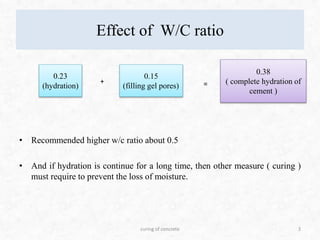
• Recommended higher w/c ratio about 0.5
• And if hydration is continue for a long time, then other measure ( curing )
must require to prevent the loss of moisture.
3
0.23
(hydration)
0.15
(filling gel pores)
+ =
0.38
( complete hydration of
cement )
curing of concrete
Curing period
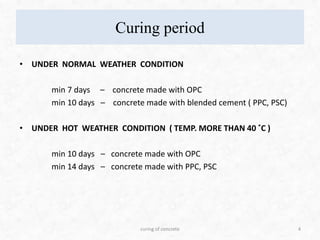
• UNDER NORMAL WEATHER CONDITION
min 7 days – concrete made with OPC
min 10 days – concrete made with blended cement ( PPC, PSC)
• UNDER HOT WEATHER CONDITION ( TEMP. MORE THAN 40 ˚C )
min 10 days – concrete made with OPC
min 14 days – concrete made with PPC, PSC
4curing of concrete
Effect of delayed curing
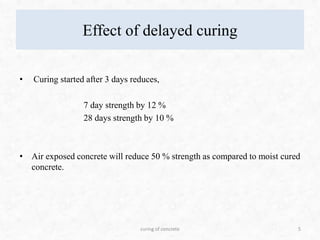
• Curing started after 3 days reduces,
7 day strength by 12 %
28 days strength by 10 %
• Air exposed concrete will reduce 50 % strength as compared to moist cured
concrete.
5curing of concrete
What does curing do ?
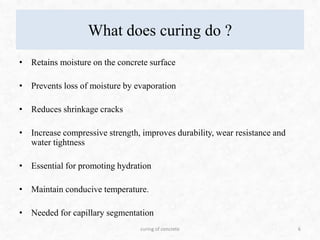
• Retains moisture on the concrete surface
• Prevents loss of moisture by evaporation
• Reduces shrinkage cracks
• Increase compressive strength, improves durability, wear resistance and
water tightness
• Essential for promoting hydration
• Maintain conducive temperature.
• Needed for capillary segmentation
6curing of concrete
DO’s & DONT’s
• Start curing immediate after it get sufficient hardness to take load of person
• Do not walk on freshly laid concrete for sprinkling the water
• Water fit for drinking must be used for curing
• Do curing continuously, intermittent will result in cracking
• During summer, prevent drying the surface of freshly laid concrete.
7curing of concrete
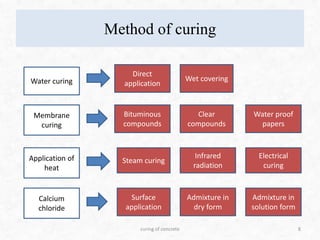
Method of curing
8
Water curing
Membrane
curing
Application of
heat
Calcium
chloride
Direct
application
Wet covering
Bituminous
compounds
Clear
compounds
Water proof
papers
Steam curing
Infrared
radiation
Electrical
curing
Surface
application
Admixture in
dry form
curing of concrete
Admixture in
solution form
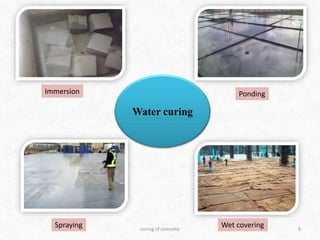
Water curing
Immersion Ponding
Spraying Wet covering 9curing of concrete
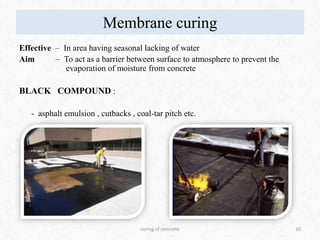
Membrane curing
Effective – In area having seasonal lacking of water
Aim – To act as a barrier between surface to atmosphere to prevent the
evaporation of moisture from concrete
BLACK COMPOUND :
- asphalt emulsion , cutbacks , coal-tar pitch etc.
10curing of concrete
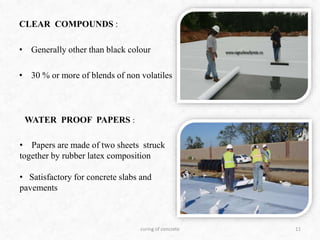
CLEAR COMPOUNDS :
• Generally other than black colour
• 30 % or more of blends of non volatiles
11
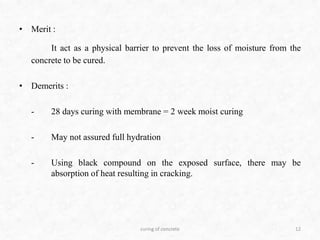
WATER PROOF PAPERS :
curing of concrete
• Papers are made of two sheets struck
together by rubber latex composition
• Satisfactory for concrete slabs and
pavements
• Merit :
It act as a physical barrier to prevent the loss of moisture from the
concrete to be cured.
• Demerits :
- 28 days curing with membrane = 2 week moist curing
- May not assured full hydration
- Using black compound on the exposed surface, there may be
absorption of heat resulting in cracking.
12curing of concrete
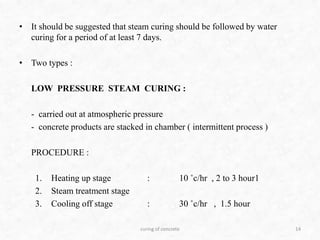
STEAM CURING
• w/c ratio – 0.3 to 0.7
• Low water cement ratio
more effective steam curing
slow temperature rise
13curing of concrete
• It should be suggested that steam curing should be followed by water
curing for a period of at least 7 days.
• Two types :
LOW PRESSURE STEAM CURING :
- carried out at atmospheric pressure
- concrete products are stacked in chamber ( intermittent process )
PROCEDURE :
1. Heating up stage : 10 ˚c/hr , 2 to 3 hour1
2. Steam treatment stage
3. Cooling off stage : 30 ˚c/hr , 1.5 hour
14curing of concrete
• HIGH PRESSURE STEAM CURING :
- example : AUTOCLAVE
- temperature : 185 ˚ C
- time : 7 to 10 hr
ADVANTAGE :
- High early strength
- High durability
- Resistive to sulphate action and freezing and thawing
DISADVANTAGE :
- Reduces the bond strength of concrete.
15curing of concrete
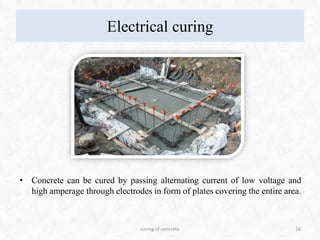
Electrical curing
• Concrete can be cured by passing alternating current of low voltage and
high amperage through electrodes in form of plates covering the entire area.
16curing of concrete
Necessity is the Mother of
Invention
17curing of concrete
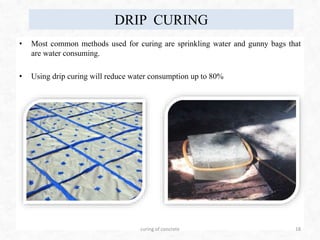
• Most common methods used for curing are sprinkling water and gunny bags that
are water consuming.
• Using drip curing will reduce water consumption up to 80%
18curing of concrete
DRIP CURING
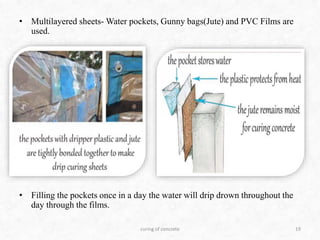
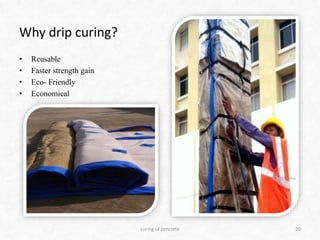
• Multilayered sheets- Water pockets, Gunny bags(Jute) and PVC Films are
used.
• Filling the pockets once in a day the water will drip drown throughout the
day through the films.
curing of concrete 19
Why drip curing?
• Reusable
• Faster strength gain
• Eco- Friendly
• Economical
20curing of concrete
References
• Concrete Technology – M. L. Gambhir
• Concrete Technology – M. S. Shetty
• IS : 456 – 2000 code of practice for plain and reinforced concrete
• IS : 9013 – 1978 Method of making curing and determining compressive
strength of accelerated cured concrete test specimen
• Developing a New Curing Technique-‘Drip Curing’ - (IJRASET) by
Kanchan Ambekar, K.U. Gandhare
22curing of concrete
THANK YOU

Curing

  • 2.
    CONTENT Sr. No. Description 1.Introduction to curing 2. Importance of curing 3. Methods of curing 4. New Techniques of curing
  • 3.
    What is curing? 1 Maintenance of moisture and temperature of freshly placed concrete to ensure proper hardening of concrete for attainment of desirable strength and durability. “An efficient curing in the early period of hydration can be compared to a good and wholesome feeding given to a new born baby.” curing of concrete
  • 4.
    Introduction • The propertiesof hardened concrete, especially the durability, are greatly influenced by curing since it has a remarkable effect on the hydration of the cement. • Curing allows continuous hydration of cement and consequently continuous gain in the strength, once curing stops strength gain of the concrete also stops. • Proper moisture conditions are critical because the hydration of the cement virtually ceases when the relative humidity within the capillaries drops below 80% . 2curing of concrete
  • 5.
    Effect of W/Cratio • Recommended higher w/c ratio about 0.5 • And if hydration is continue for a long time, then other measure ( curing ) must require to prevent the loss of moisture. 3 0.23 (hydration) 0.15 (filling gel pores) + = 0.38 ( complete hydration of cement ) curing of concrete
  • 6.
    Curing period • UNDERNORMAL WEATHER CONDITION min 7 days – concrete made with OPC min 10 days – concrete made with blended cement ( PPC, PSC) • UNDER HOT WEATHER CONDITION ( TEMP. MORE THAN 40 ˚C ) min 10 days – concrete made with OPC min 14 days – concrete made with PPC, PSC 4curing of concrete
  • 7.
    Effect of delayedcuring • Curing started after 3 days reduces, 7 day strength by 12 % 28 days strength by 10 % • Air exposed concrete will reduce 50 % strength as compared to moist cured concrete. 5curing of concrete
  • 8.
    What does curingdo ? • Retains moisture on the concrete surface • Prevents loss of moisture by evaporation • Reduces shrinkage cracks • Increase compressive strength, improves durability, wear resistance and water tightness • Essential for promoting hydration • Maintain conducive temperature. • Needed for capillary segmentation 6curing of concrete
  • 9.
    DO’s & DONT’s •Start curing immediate after it get sufficient hardness to take load of person • Do not walk on freshly laid concrete for sprinkling the water • Water fit for drinking must be used for curing • Do curing continuously, intermittent will result in cracking • During summer, prevent drying the surface of freshly laid concrete. 7curing of concrete
  • 10.
    Method of curing 8 Watercuring Membrane curing Application of heat Calcium chloride Direct application Wet covering Bituminous compounds Clear compounds Water proof papers Steam curing Infrared radiation Electrical curing Surface application Admixture in dry form curing of concrete Admixture in solution form
  • 11.
    Water curing Immersion Ponding SprayingWet covering 9curing of concrete
  • 12.
    Membrane curing Effective –In area having seasonal lacking of water Aim – To act as a barrier between surface to atmosphere to prevent the evaporation of moisture from concrete BLACK COMPOUND : - asphalt emulsion , cutbacks , coal-tar pitch etc. 10curing of concrete
  • 13.
    CLEAR COMPOUNDS : •Generally other than black colour • 30 % or more of blends of non volatiles 11 WATER PROOF PAPERS : curing of concrete • Papers are made of two sheets struck together by rubber latex composition • Satisfactory for concrete slabs and pavements
  • 14.
    • Merit : Itact as a physical barrier to prevent the loss of moisture from the concrete to be cured. • Demerits : - 28 days curing with membrane = 2 week moist curing - May not assured full hydration - Using black compound on the exposed surface, there may be absorption of heat resulting in cracking. 12curing of concrete
  • 15.
    STEAM CURING • w/cratio – 0.3 to 0.7 • Low water cement ratio more effective steam curing slow temperature rise 13curing of concrete
  • 16.
    • It shouldbe suggested that steam curing should be followed by water curing for a period of at least 7 days. • Two types : LOW PRESSURE STEAM CURING : - carried out at atmospheric pressure - concrete products are stacked in chamber ( intermittent process ) PROCEDURE : 1. Heating up stage : 10 ˚c/hr , 2 to 3 hour1 2. Steam treatment stage 3. Cooling off stage : 30 ˚c/hr , 1.5 hour 14curing of concrete
  • 17.
    • HIGH PRESSURESTEAM CURING : - example : AUTOCLAVE - temperature : 185 ˚ C - time : 7 to 10 hr ADVANTAGE : - High early strength - High durability - Resistive to sulphate action and freezing and thawing DISADVANTAGE : - Reduces the bond strength of concrete. 15curing of concrete
  • 18.
    Electrical curing • Concretecan be cured by passing alternating current of low voltage and high amperage through electrodes in form of plates covering the entire area. 16curing of concrete
  • 19.
    Necessity is theMother of Invention 17curing of concrete
  • 20.
    • Most commonmethods used for curing are sprinkling water and gunny bags that are water consuming. • Using drip curing will reduce water consumption up to 80% 18curing of concrete DRIP CURING
  • 21.
    • Multilayered sheets-Water pockets, Gunny bags(Jute) and PVC Films are used. • Filling the pockets once in a day the water will drip drown throughout the day through the films. curing of concrete 19
  • 22.
    Why drip curing? •Reusable • Faster strength gain • Eco- Friendly • Economical 20curing of concrete
  • 23.
  • 24.
    References • Concrete Technology– M. L. Gambhir • Concrete Technology – M. S. Shetty • IS : 456 – 2000 code of practice for plain and reinforced concrete • IS : 9013 – 1978 Method of making curing and determining compressive strength of accelerated cured concrete test specimen • Developing a New Curing Technique-‘Drip Curing’ - (IJRASET) by Kanchan Ambekar, K.U. Gandhare 22curing of concrete
  • 25.