Retail
                       Merchandise
                       Management
                         By-
                                        Anuj Singh
                                        Kapil Dev Aggarwal
                                        Lokesh Khandelwal
                                        Swati Sharma
            Jaipuria Institute of Management, Jaipur-
1/29/2012
                        Retail Management
Basis of Retail Merchandising
• Product and merchandising management is key activity in the
  management of retail business.

•    The primary function of the retailing is to sell Merchandise.

• One of the most strategic aspects of the retail business is to decide
  the merchandise mix and quantity to be purchased .

• Merchandising can be termed as the planning, buying and the
  selling of merchandising


    1/29/2012                 Jaipuria Institute of Management, Jaipur-Retail Management
Retail Merchandise Management

 The analysis, planning, acquisition, handling and control of
  merchandise investments of a retail operation.”

 Analysis: because retailers must be able to correctly identify their
  customers before they can ascertain consumer desires and their
  needs/requirements for making a good buying decision.

 Planning is important because merchandise to be sold in the future
  must be bought now.

 Acquisitions because the merchandise needs to be procured from
  others, either distributors or manufactures.
  1/29/2012                Jaipuria Institute of Management, Jaipur-Retail Management
Retail Merchandise Management


• Handling involves seeing that the merchandise is where It
  is needed and in the proper condition to be sold.
• Control is required since the function of merchandise
  involves spending money for acquiring products it is
  necessary to control the amount of money spent on
  buying
• The planning involved in marketing the right
  merchandise at the right place at the right time in the
  right quantities at the right price.

  1/29/2012              Jaipuria Institute of Management, Jaipur-Retail Management
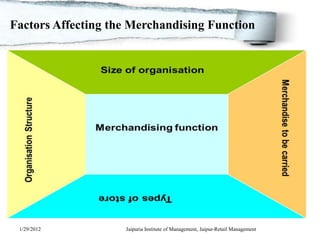
Factors Affecting the Merchandising Function


 1/29/2012          Jaipuria Institute of Management, Jaipur-Retail Management
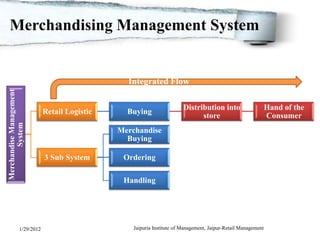
Merchandising Management System


                                              Integrated Flow
Merchandise Management


                                                                      Distribution into                      Hand of the
                          Retail Logistic     Buying
                                                                            store                            Consumer
        System


                                            Merchandise
                                              Buying

                          3 Sub System       Ordering

                                             Handling


              1/29/2012                         Jaipuria Institute of Management, Jaipur-Retail Management
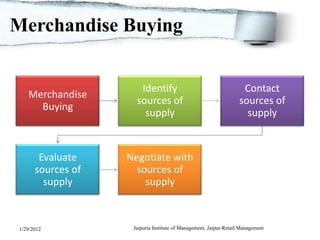
Merchandise Buying


                      Identify                                      Contact
   Merchandise
                     sources of                                    sources of
     Buying
                       supply                                        supply


       Evaluate    Negotiate with
      sources of     sources of
        supply         supply


1/29/2012           Jaipuria Institute of Management, Jaipur-Retail Management
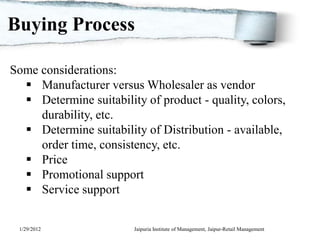
Buying Process

Some considerations:
   Manufacturer versus Wholesaler as vendor
   Determine suitability of product - quality, colors,
     durability, etc.
   Determine suitability of Distribution - available,
     order time, consistency, etc.
   Price
   Promotional support
   Service support


 1/29/2012              Jaipuria Institute of Management, Jaipur-Retail Management
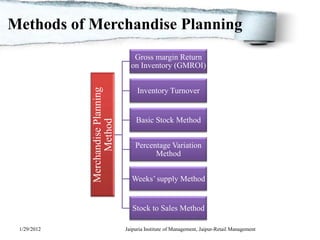
Methods of Merchandise Planning
                                       Gross margin Return
                                      on Inventory (GMROI)


             Merchandise Planning
                                         Inventory Turnover


                                        Basic Stock Method
                   Method


                                        Percentage Variation
                                              Method


                                      Weeks’ supply Method


                                       Stock to Sales Method

 1/29/2012                          Jaipuria Institute of Management, Jaipur-Retail Management
Methods of Merchandise Planning

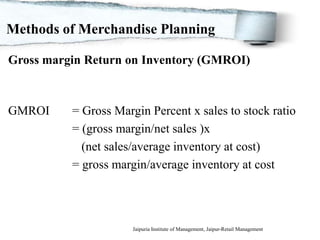
Gross margin Return on Inventory (GMROI)


GMROI        = Gross Margin Percent x sales to stock ratio
             = (gross margin/net sales )x
               (net sales/average inventory at cost)
             = gross margin/average inventory at cost


 1/29/2012               Jaipuria Institute of Management, Jaipur-Retail Management
Methods of Merchandise Planning

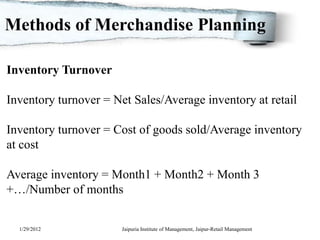
Inventory Turnover

Inventory turnover = Net Sales/Average inventory at retail

Inventory turnover = Cost of goods sold/Average inventory
at cost

Average inventory = Month1 + Month2 + Month 3
+…/Number of months


  1/29/2012            Jaipuria Institute of Management, Jaipur-Retail Management
Methods of Merchandise Planning

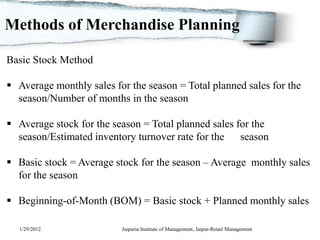
Basic Stock Method

 Average monthly sales for the season = Total planned sales for the
  season/Number of months in the season

 Average stock for the season = Total planned sales for the
  season/Estimated inventory turnover rate for the season

 Basic stock = Average stock for the season – Average monthly sales
  for the season

 Beginning-of-Month (BOM) = Basic stock + Planned monthly sales

  1/29/2012               Jaipuria Institute of Management, Jaipur-Retail Management
Methods of Merchandise Planning


Percentage variation method (PVM)

The (PVM) can be calculated as follows:

BOM stock =Average stock for season X ½[1 + (Planned
           sales for the month/Average monthly sales)]


  1/29/2012           Jaipuria Institute of Management, Jaipur-Retail Management
Methods of Merchandise Planning

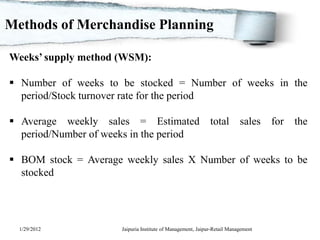
Weeks’ supply method (WSM):

 Number of weeks to be stocked = Number of weeks in the
  period/Stock turnover rate for the period

 Average weekly sales = Estimated                           total        sales    for   the
  period/Number of weeks in the period

 BOM stock = Average weekly sales X Number of weeks to be
  stocked


  1/29/2012           Jaipuria Institute of Management, Jaipur-Retail Management
Methods of Merchandise Planning


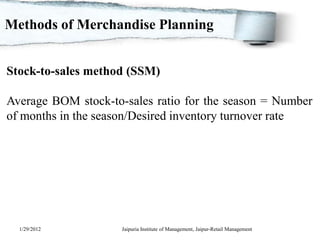
Stock-to-sales method (SSM)

Average BOM stock-to-sales ratio for the season = Number
of months in the season/Desired inventory turnover rate


  1/29/2012          Jaipuria Institute of Management, Jaipur-Retail Management
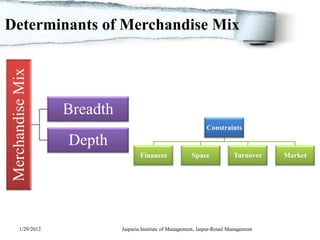
Determinants of Merchandise Mix
 Merchandise Mix


                   Breadth
                                                                  Constraints

                   Depth
                                     Finances               Space             Turnover    Market


       1/29/2012             Jaipuria Institute of Management, Jaipur-Retail Management
Merchandise Ordering

 Traditional Purchase Order System (often adversarial relationship)

 Quick Response System - uses computer technology (partnership
  of vendor and retailer)

 Electronic Data Interchange - technology connecting retailer and
  vendor in a quick response system

 Just-in-Time Delivery Systems - Reduces inventory requirements

 Direct Store Delivery (DSD) - no warehouse; vendor delivers
  directly to store
 1/29/2012               Jaipuria Institute of Management, Jaipur-Retail Management
Merchandise Handling


 Stocking of merchandise can be at store or at warehouse

 In either case, receiving function must inspect, verify and log in
  deliveries and compare to vendor invoice

 Price marking of product must be performed, if required


 1/29/2012                Jaipuria Institute of Management, Jaipur-Retail Management
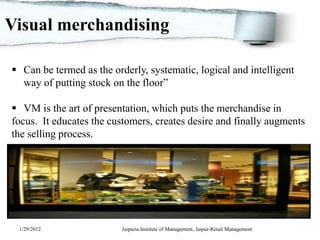
Visual merchandising

 Can be termed as the orderly, systematic, logical and intelligent
  way of putting stock on the floor”

 VM is the art of presentation, which puts the merchandise in
focus. It educates the customers, creates desire and finally augments
the selling process.


 1/29/2012                Jaipuria Institute of Management, Jaipur-Retail Management
Retail Management System


             Retail Management System


 1/29/2012           Jaipuria Institute of Management, Jaipur-Retail Management
Merchandise Planning


 1/29/2012   Jaipuria Institute of Management, Jaipur-Retail Management
Thank you


1/29/2012   Jaipuria Institute of Management, Jaipur-Retail Management

Retail merchandise management

  • 1.
    Retail Merchandise Management By- Anuj Singh Kapil Dev Aggarwal Lokesh Khandelwal Swati Sharma Jaipuria Institute of Management, Jaipur- 1/29/2012 Retail Management
  • 2.
    Basis of RetailMerchandising • Product and merchandising management is key activity in the management of retail business. • The primary function of the retailing is to sell Merchandise. • One of the most strategic aspects of the retail business is to decide the merchandise mix and quantity to be purchased . • Merchandising can be termed as the planning, buying and the selling of merchandising 1/29/2012 Jaipuria Institute of Management, Jaipur-Retail Management
  • 3.
    Retail Merchandise Management The analysis, planning, acquisition, handling and control of merchandise investments of a retail operation.”  Analysis: because retailers must be able to correctly identify their customers before they can ascertain consumer desires and their needs/requirements for making a good buying decision.  Planning is important because merchandise to be sold in the future must be bought now.  Acquisitions because the merchandise needs to be procured from others, either distributors or manufactures. 1/29/2012 Jaipuria Institute of Management, Jaipur-Retail Management
  • 4.
    Retail Merchandise Management •Handling involves seeing that the merchandise is where It is needed and in the proper condition to be sold. • Control is required since the function of merchandise involves spending money for acquiring products it is necessary to control the amount of money spent on buying • The planning involved in marketing the right merchandise at the right place at the right time in the right quantities at the right price. 1/29/2012 Jaipuria Institute of Management, Jaipur-Retail Management
  • 5.
    Factors Affecting theMerchandising Function 1/29/2012 Jaipuria Institute of Management, Jaipur-Retail Management
  • 6.
    Merchandising Management System Integrated Flow Merchandise Management Distribution into Hand of the Retail Logistic Buying store Consumer System Merchandise Buying 3 Sub System Ordering Handling 1/29/2012 Jaipuria Institute of Management, Jaipur-Retail Management
  • 7.
    Merchandise Buying Identify Contact Merchandise sources of sources of Buying supply supply Evaluate Negotiate with sources of sources of supply supply 1/29/2012 Jaipuria Institute of Management, Jaipur-Retail Management
  • 8.
    Buying Process Some considerations:  Manufacturer versus Wholesaler as vendor  Determine suitability of product - quality, colors, durability, etc.  Determine suitability of Distribution - available, order time, consistency, etc.  Price  Promotional support  Service support 1/29/2012 Jaipuria Institute of Management, Jaipur-Retail Management
  • 9.
    Methods of MerchandisePlanning Gross margin Return on Inventory (GMROI) Merchandise Planning Inventory Turnover Basic Stock Method Method Percentage Variation Method Weeks’ supply Method Stock to Sales Method 1/29/2012 Jaipuria Institute of Management, Jaipur-Retail Management
  • 10.
    Methods of MerchandisePlanning Gross margin Return on Inventory (GMROI) GMROI = Gross Margin Percent x sales to stock ratio = (gross margin/net sales )x (net sales/average inventory at cost) = gross margin/average inventory at cost 1/29/2012 Jaipuria Institute of Management, Jaipur-Retail Management
  • 11.
    Methods of MerchandisePlanning Inventory Turnover Inventory turnover = Net Sales/Average inventory at retail Inventory turnover = Cost of goods sold/Average inventory at cost Average inventory = Month1 + Month2 + Month 3 +…/Number of months 1/29/2012 Jaipuria Institute of Management, Jaipur-Retail Management
  • 12.
    Methods of MerchandisePlanning Basic Stock Method  Average monthly sales for the season = Total planned sales for the season/Number of months in the season  Average stock for the season = Total planned sales for the season/Estimated inventory turnover rate for the season  Basic stock = Average stock for the season – Average monthly sales for the season  Beginning-of-Month (BOM) = Basic stock + Planned monthly sales 1/29/2012 Jaipuria Institute of Management, Jaipur-Retail Management
  • 13.
    Methods of MerchandisePlanning Percentage variation method (PVM) The (PVM) can be calculated as follows: BOM stock =Average stock for season X ½[1 + (Planned sales for the month/Average monthly sales)] 1/29/2012 Jaipuria Institute of Management, Jaipur-Retail Management
  • 14.
    Methods of MerchandisePlanning Weeks’ supply method (WSM):  Number of weeks to be stocked = Number of weeks in the period/Stock turnover rate for the period  Average weekly sales = Estimated total sales for the period/Number of weeks in the period  BOM stock = Average weekly sales X Number of weeks to be stocked 1/29/2012 Jaipuria Institute of Management, Jaipur-Retail Management
  • 15.
    Methods of MerchandisePlanning Stock-to-sales method (SSM) Average BOM stock-to-sales ratio for the season = Number of months in the season/Desired inventory turnover rate 1/29/2012 Jaipuria Institute of Management, Jaipur-Retail Management
  • 16.
    Determinants of MerchandiseMix Merchandise Mix Breadth Constraints Depth Finances Space Turnover Market 1/29/2012 Jaipuria Institute of Management, Jaipur-Retail Management
  • 17.
    Merchandise Ordering  TraditionalPurchase Order System (often adversarial relationship)  Quick Response System - uses computer technology (partnership of vendor and retailer)  Electronic Data Interchange - technology connecting retailer and vendor in a quick response system  Just-in-Time Delivery Systems - Reduces inventory requirements  Direct Store Delivery (DSD) - no warehouse; vendor delivers directly to store 1/29/2012 Jaipuria Institute of Management, Jaipur-Retail Management
  • 18.
    Merchandise Handling  Stockingof merchandise can be at store or at warehouse  In either case, receiving function must inspect, verify and log in deliveries and compare to vendor invoice  Price marking of product must be performed, if required 1/29/2012 Jaipuria Institute of Management, Jaipur-Retail Management
  • 19.
    Visual merchandising  Canbe termed as the orderly, systematic, logical and intelligent way of putting stock on the floor”  VM is the art of presentation, which puts the merchandise in focus. It educates the customers, creates desire and finally augments the selling process. 1/29/2012 Jaipuria Institute of Management, Jaipur-Retail Management
  • 20.
    Retail Management System Retail Management System 1/29/2012 Jaipuria Institute of Management, Jaipur-Retail Management
  • 21.
    Merchandise Planning 1/29/2012 Jaipuria Institute of Management, Jaipur-Retail Management
  • 22.
    Thank you 1/29/2012 Jaipuria Institute of Management, Jaipur-Retail Management

Editor's Notes

  • #12 State Bank of India 74% BNP Paribas Assurance --- 26%