This document discusses distribution channels and sales promotion techniques. It defines distribution channels as the interconnected organizations involved in making a product available to consumers. The objectives of distribution include consumer satisfaction and profitability. It also discusses channel design decisions, functions like order processing and inventory management, and channel management considerations like identifying consumer needs and selecting the optimal channel structure.
Discusses the definition, objectives, and structure of distribution management in sales, focusing on efficient goods movement and various distribution channels.
Analyzes distribution channel definitions, functions, and the importance of intermediaries in efficiently connecting producers to consumers.
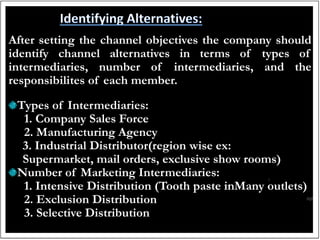
Explores how businesses must adapt their distribution channels to meet consumer needs, including types of intermediaries and channel objectives.
Describes various marketing intermediaries including intensive and selective distribution, focusing on the choice of channels aligned with business objectives.
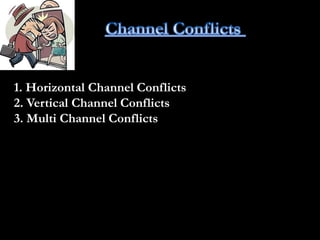
Introduces types of channel conflicts that can occur in distribution, including horizontal, vertical, and multi-channel conflicts.
Distribution Management andSales Promotion:
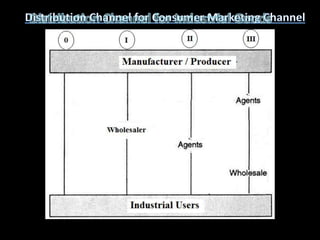
Sales Techniques for Consumer and Industrial Users, Channel
functions and Flows, Channel Levels, Channel Management
Decision- Communication mix- Sales force management-
Promotinal Mix- Communication Strategies.
It includes all activites concerned with the efficient
movement of goods from the place of prodction to the place of
consumption. It includes wide range of inter-related activies
which includes order process, inventory management , storage
and transportation etc.
Main objectives are
1.Consumer satisfaction 2. Profit orientation
Distribution Channels
Definitions:
“ Achannel of distribution or marketing channel is the structure of
intra company organisation units and extra company agents &
dealers, wholesale and retail through which a commodity, product or
service is marketed” ----American Marketing Association
“Distribution Channel is a set of interdependent organisation involved
in the process of making a product or service available for use or
comsumtion by consumer or business use”. ----Phillip Kotler
Producers produce fewer products in large quantities and customers
want more product in smaller quantities and broader assortments
wanted by the customers and break them into smaller and broader
assortments wanted by the customers
5.
Information(Customers, Competitors andothers)
Promotion
Contact(Finding and communicating with
prospective buyers)
Matching
Tranfering
Order (Backward Communication)
Financing
Risk Taking(Take the risks of carying the work)
Physical Flow(Producer to Competitors)
Title
6.
Nature and Importanceof Channels
Most businesses use third parties or intermediaries to bring their
products to market.
They try to forge a "distribution channel" which can be defined as
“All the organizations through which a product must pass between
its point of production and consumption“
Why does a business give the job of selling its products to
intermediaries?
The answer lies in efficiency of distribution costs. Intermediaries
are specialists in selling. They have the contacts, experience and
scale of operation which means that greater sales can be achieved
than if the producing business tried to run a sales operation itself.
8.
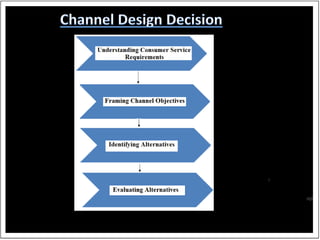
Consumer is interestedin different services from the
company and the channel must deliver value to the
consumer. We need to identify his needs and satisfy it.
Consumer convenience, the mode of delivery, credit,
service, installation, place of purchase, type of product
assorment. All these factors required here.
Nature of the company, product characteristics, type
of channel memebers, competitors and the prevailing
business envornment should be considered by the
company.
Legal conditions and macro ecnomic situation of the
country should also be considered. It is based on PLC
9.
After setting thechannel objectives the company should
identify channel alternatives in terms of types of
intermediaries, number of intermediaries, and the
responsibilites of each member.
Types of Intermediaries:
1. Company Sales Force
2. Manufacturing Agency
3. Industrial Distributor(region wise ex:
Supermarket, mail orders, exclusive show rooms)
Number of Marketing Intermediaries:
1. Intensive Distribution (Tooth paste inMany outlets)
2. Exclusion Distribution
3. Selective Distribution
10.
Number of MarketingIntermediaries:
1. Intensive Distribution (Tooth paste inMany outlets)
2. Exclusion Distribution
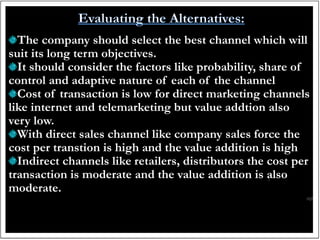
The company shouldselect the best channel which will
suit its long term objectives.
It should consider the factors like probability, share of
control and adaptive nature of each of the channel
Cost of transaction is low for direct marketing channels
like internet and telemarketing but value addtion also
very low.
With direct sales channel like company sales force the
cost per transtion is high and the value addition is high
Indirect channels like retailers, distributors the cost per
transaction is moderate and the value addition is also
moderate.