Merchandise  Assortment Planning
What should a well planned assortment contain? Selection of a particular merchandise classification Whether or not to offer the classification at all Other important factors are –  Quality of the merchandise offered for sale – quality would reflect image of the store.  Price range – quality and price range would interact with each other. There is no specific correlation and a general correlation exists. Choice of national brands or private brands –  Good taste – buyers must decide what is aesthetically pleasing to all customers.
5. Proper timing – buyers need to decide not only what to offer but when to offer, the right time.  6. Product life cycle – maintaining regular stock assortment is important to most types of goods. Research and development Introduction into market Product growth Product maturation Product saturation Product decline Product abandonment
7. Variety of product lines – A product line is defined as a broad category of products having reasonably similar characteristics and similar end uses. The variety of product lines may be limited as in the specialty store or may be numerous as in department stores.  8. Assortment strategies – breadth and depth of assortment.  Assortment Depth = limited number of categories (Narrow) + a number of popular styles (deep) Assortment Breadth = A number of categories (Broad) + Limited number of styles (Shallow) Balanced Assortment = A number of categories (Broad) + A number popular styles (Deep)
Factors Affecting Unit (Assortment) planning decisions –  Type of Retail Institution > Competition > Goods > Trading Area > Capital Past sales > Customer complaints > Returned goods > Sales Lost > Sales Made Consumer wants > Increased Impulse Buying > Greater assortment of goods > More affluent society Types of goods offered> Specialty goods> shopping > Convenience > Seasonal > Fashion Elimination of merchandise lines > Storage space required > Financial investment > more items added – limit to what can be carried.
Unit or Assortment plans are developed in one of two ways. The first method is use of basic stock list  and the second one is use of model stock plan. Planning a basic stock list –  1. Homogeneous and Heterogeneous Staples – staple goods of same type, size, color etc are called homogeneous. If staple goods are alike or not identical, then they are called heterogeneous.  2. Seasonal and non seasonal staples – those staples that are in demand regularly not affected seasonal variations are called non seasonal staples. Some staples may be in demand in particular seasons are called seasonal staples.
Periodic fill ins of staple stocks –  Information required before placing reorder The normal sales rate  The delivery period Reorder period The reserve Stock on hand Merchandise on order Formulas for periodic fill in of staple stocks Maximum staple goods to be on order and on hand
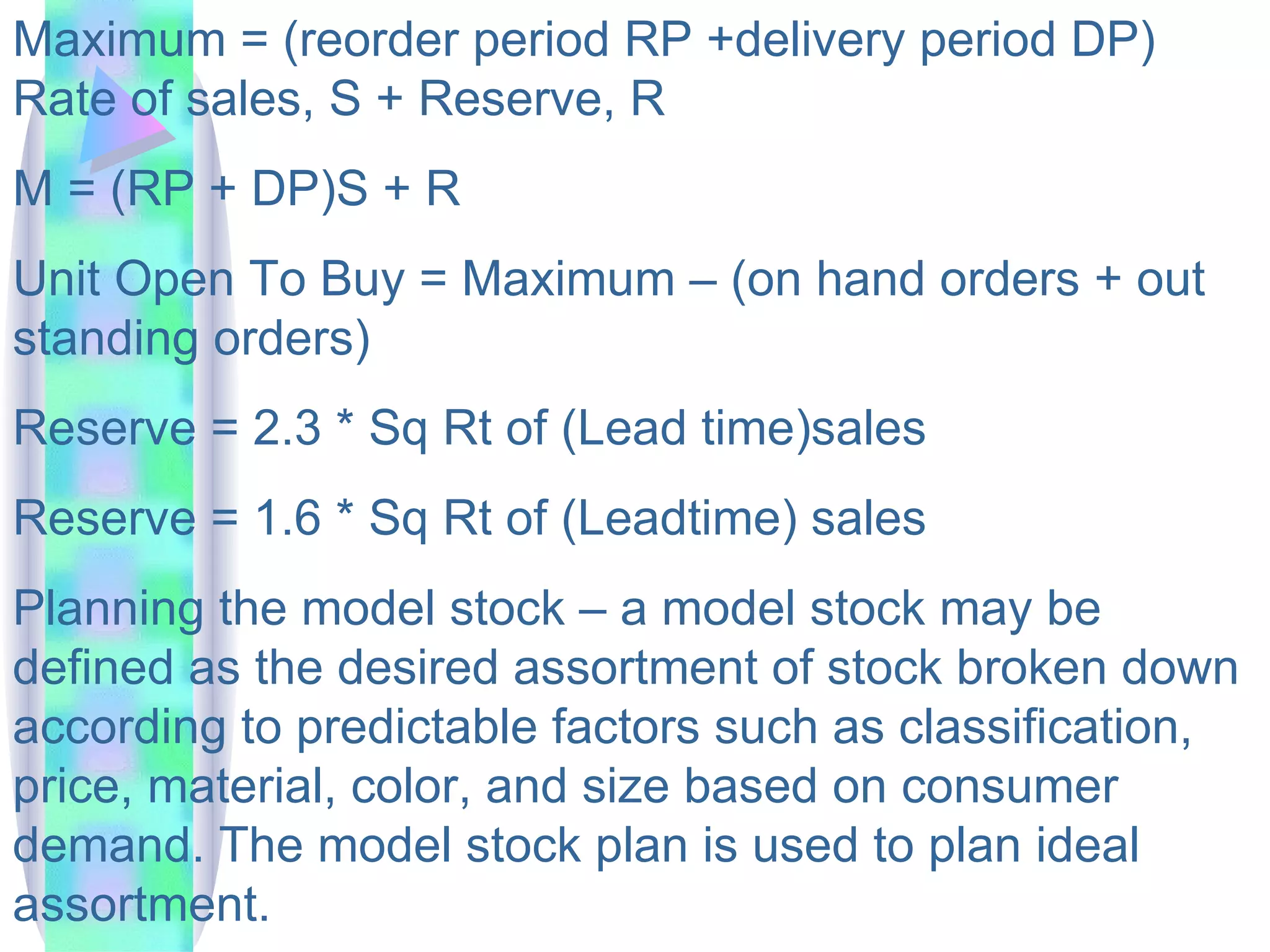
Maximum = (reorder period RP +delivery period DP) Rate of sales, S + Reserve, R M = (RP + DP)S + R Unit Open To Buy = Maximum – (on hand orders + out standing orders) Reserve = 2.3 * Sq Rt of (Lead time)sales Reserve = 1.6 * Sq Rt of (Leadtime) sales Planning the model stock – a model stock may be defined as the desired assortment of stock broken down according to predictable factors such as classification, price, material, color, and size based on consumer demand. The model stock plan is used to plan ideal assortment.
Thus it will include an assortment of staple goods, fashion goods, and seasonal goods.  An assortment of fashion goods – fashion stock in apparels and furnishings is the most difficult of all classes merchandise to plan because of many choices of styles, colors, materials, vendors and manufacturers and many new items available. Since fashion goods have short life cycles risks are also high for buyers. Five characteristics of fashion merchandise will help buyer in determining the fashion assortment. 1. classification 2. price 3. size 4. material and 5. color

Assortment planning

  • 1.
  • 2.
    What should awell planned assortment contain? Selection of a particular merchandise classification Whether or not to offer the classification at all Other important factors are – Quality of the merchandise offered for sale – quality would reflect image of the store. Price range – quality and price range would interact with each other. There is no specific correlation and a general correlation exists. Choice of national brands or private brands – Good taste – buyers must decide what is aesthetically pleasing to all customers.
  • 3.
    5. Proper timing– buyers need to decide not only what to offer but when to offer, the right time. 6. Product life cycle – maintaining regular stock assortment is important to most types of goods. Research and development Introduction into market Product growth Product maturation Product saturation Product decline Product abandonment
  • 4.
    7. Variety ofproduct lines – A product line is defined as a broad category of products having reasonably similar characteristics and similar end uses. The variety of product lines may be limited as in the specialty store or may be numerous as in department stores. 8. Assortment strategies – breadth and depth of assortment. Assortment Depth = limited number of categories (Narrow) + a number of popular styles (deep) Assortment Breadth = A number of categories (Broad) + Limited number of styles (Shallow) Balanced Assortment = A number of categories (Broad) + A number popular styles (Deep)
  • 5.
    Factors Affecting Unit(Assortment) planning decisions – Type of Retail Institution > Competition > Goods > Trading Area > Capital Past sales > Customer complaints > Returned goods > Sales Lost > Sales Made Consumer wants > Increased Impulse Buying > Greater assortment of goods > More affluent society Types of goods offered> Specialty goods> shopping > Convenience > Seasonal > Fashion Elimination of merchandise lines > Storage space required > Financial investment > more items added – limit to what can be carried.
  • 6.
    Unit or Assortmentplans are developed in one of two ways. The first method is use of basic stock list and the second one is use of model stock plan. Planning a basic stock list – 1. Homogeneous and Heterogeneous Staples – staple goods of same type, size, color etc are called homogeneous. If staple goods are alike or not identical, then they are called heterogeneous. 2. Seasonal and non seasonal staples – those staples that are in demand regularly not affected seasonal variations are called non seasonal staples. Some staples may be in demand in particular seasons are called seasonal staples.
  • 7.
    Periodic fill insof staple stocks – Information required before placing reorder The normal sales rate The delivery period Reorder period The reserve Stock on hand Merchandise on order Formulas for periodic fill in of staple stocks Maximum staple goods to be on order and on hand
  • 8.
    Maximum = (reorderperiod RP +delivery period DP) Rate of sales, S + Reserve, R M = (RP + DP)S + R Unit Open To Buy = Maximum – (on hand orders + out standing orders) Reserve = 2.3 * Sq Rt of (Lead time)sales Reserve = 1.6 * Sq Rt of (Leadtime) sales Planning the model stock – a model stock may be defined as the desired assortment of stock broken down according to predictable factors such as classification, price, material, color, and size based on consumer demand. The model stock plan is used to plan ideal assortment.
  • 9.
    Thus it willinclude an assortment of staple goods, fashion goods, and seasonal goods. An assortment of fashion goods – fashion stock in apparels and furnishings is the most difficult of all classes merchandise to plan because of many choices of styles, colors, materials, vendors and manufacturers and many new items available. Since fashion goods have short life cycles risks are also high for buyers. Five characteristics of fashion merchandise will help buyer in determining the fashion assortment. 1. classification 2. price 3. size 4. material and 5. color