FUNCTIONS OF A RETAILERS IN
1.MC DONALD
2.CAFE COFFEE DAY
3.WOODLAND
4.RAYMOND
Noble John
S2 MBA
MEANING OF RETAIL
 Retail is the sale of goods and services
from individuals or businesses to
the end-user.
 Retailers are part of an integrated
system called the supply chain.
 A retailer purchases goods or products
in large quantities
from manufacturers directly or through a
wholesale, and then sells smaller
quantities to the consumer for a profit.
 Retailing can be done in either fixed
Retailing consists of…
 Business activities involved in selling goods &
services to consumers for their personal, family,
or household use.
 In contrast, wholesaling is an intermediate stage
in the distribution process
Impact on economy
 Retailing is a major part of world commerce.
 Retail sales & employment are key economic
contributors.
 Retail trends often mirror trends in a nation’s
overall economy.
 Out of global retail sales of $6.6 trillion U.S retail
accounts for over $3 trillion.
FUNCTIONS OF RETAILER
• Buying:
A retailer buys a wide variety of goods from
different wholesalers after estimat-ing customer
demand. He selects the best merchandise from
each wholesaler and brings all the goods under
one roof. In this way, he performs the twin
functions of buying and assembling of goods.
• Storage:
A retailer maintains a ready stock of goods and
displays them in his shop.
• Selling:
The retailer sells goods in small quantities according
to the demand and choice of consumers. He employs
efficient methods of selling to increase his sales
turnover.
• Grading and Packing:
The retailer grades the goods which are not graded
by manufacturers and wholesalers. He packs goods
in small lots for the convenience of consumers.
• Risk-bearing:
A retailer always keeps stock of goods in anticipation
of demand. He bears the risk of loss due to fire, theft,
spoilage, price fluctuations, etc.
• Transportation:
Retailers often carry goods from wholesalers and
 Financing:
Some retailers grant credit to customers and provide
the facility of return or exchange of goods. In some
cases, home delivery and after sale service are
provided by retailers.
 Sales promotion:
A retailer displays goods. He carries out publicity
through shop decoration, window display, etc. He
maintains direct and personal contacts with
consumers. He persuades consumers to buy goods
through personal selling.
 Information:
Retailers provide knowledge to consumers about new
products and uses of old products. They advise and
guide consumers in better choice of goods. They also
provide market information to wholesalers and
manufacturers.
CDonald’s Introduction
 McDonald’s is the global fast food giant.
 Founded in 15 may 1940 in
CALIFORNIA .
 FOUNDERS –RICHARD AND
MAURICE MACDONALDS.
 Headquarters-oak brook ,illiona us.
 Forty eight years down the line, they are
the world’s largest food-service chain with
more than 31,000 restaurants in 119
countries, serving 47 million customers
every day and employing more than 1.5
million people.
TYPES OF RESTAURANTS
 Mc Drive are the type of which provide drive through
services and offer no counter service or seating.
 Special theme restaurants also exists, such as the
Solid Gold Mcdonald’s, a 1950s rock-n-roll themed
restaurant.
 Mcdonald’s introduced Mc Cafe a café style
accompaniment to Mcdonald’s restaurants in the
style of Starbucks.
 Mc Express are the type of restaurants which are
located in shopping malls.
Café Coffee Day
Different Divisions Include
 Coffee Day Fresh n Ground (which owns
354 Coffee bean and powder retail
outlets)
 Coffee Day Xpress (which owns 341
Coffee Day Kiosk)
 Coffee Day Take away (which owns 7000
Vending Machines)
 Coffee Day Exports and Coffee Day
Perfect (FMCG Packaged Coffee) .
Sub-Brands of Café Coffee
 Coffee Day – Fresh &
Ground
 Café Coffee Day
 Coffee Day – Vending
 Coffee Day - Xpress
 Coffee Day – Exports
 Coffee Day - Perfect
INTRODUCTION
The founder of WOODLAND company is Avtar Gill.
The brand Woodland was introduced to the Indian
market in 1992 through two exclusive outlets in
New Delhi, to resounding success.
Woodland has 3000 multi- brand outlets across the
world.
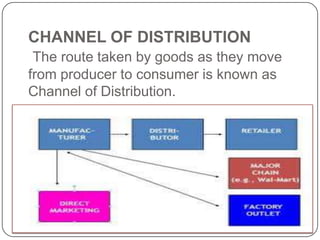
CHANNEL OF DISTRIBUTION
The route taken by goods as they move
from producer to consumer is known as
Channel of Distribution.
RETAILER’S FUNCTIONS
 Buying and Assembling of goods
 Storage of goods
 Credit facility
 Personal services
 Risk bearing
 Display of goods
 Supply of information
About Raymond…
 Eight decades old group, in
operation since 1925
 Head quarters: Mumbai
 One of India's largest
branded fabric and fashion
retailer
 Market leader in the
worsted fabrics business
with over 60% market share
 Second largest branded
apparel business in India
 Owns prestigious award
winning brands like
Raymond, Park
Avenue, Colorplus , Parx
Subsidiaries of Raymond
Limited
Domestic
• Raymond Apparel Limited
• Colorplus Fashions Limited
• Silver Spark Apparel Limited
• Everblue Apparel Limited
• Celebrations Apparel Limited
• Hindustan Files Limited
• JK Talabot Limited
• Scissors Engineering Products Limited
• Ring Plus Aqua Limited
• Pashmina Holdings Limited
Overseas
 Jaykayorg AG
 J K (England) Limited
 Regency Texteis Portuguesa
Limitada, Portugal
 R & A Logistics INC, USA
Exports-
Aggregate exports of all Divisions was Rs. 255
crores.
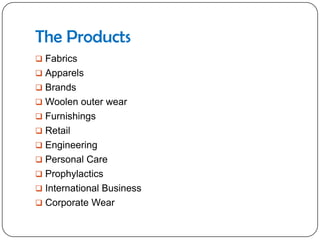
The Products
 Fabrics
 Apparels
 Brands
 Woolen outer wear
 Furnishings
 Retail
 Engineering
 Personal Care
 Prophylactics
 International Business
 Corporate Wear
THANK YOU

Retailers function

  • 1.
    FUNCTIONS OF ARETAILERS IN 1.MC DONALD 2.CAFE COFFEE DAY 3.WOODLAND 4.RAYMOND Noble John S2 MBA
  • 2.
    MEANING OF RETAIL Retail is the sale of goods and services from individuals or businesses to the end-user.  Retailers are part of an integrated system called the supply chain.  A retailer purchases goods or products in large quantities from manufacturers directly or through a wholesale, and then sells smaller quantities to the consumer for a profit.  Retailing can be done in either fixed
  • 3.
    Retailing consists of… Business activities involved in selling goods & services to consumers for their personal, family, or household use.  In contrast, wholesaling is an intermediate stage in the distribution process Impact on economy  Retailing is a major part of world commerce.  Retail sales & employment are key economic contributors.  Retail trends often mirror trends in a nation’s overall economy.  Out of global retail sales of $6.6 trillion U.S retail accounts for over $3 trillion.
  • 4.
    FUNCTIONS OF RETAILER •Buying: A retailer buys a wide variety of goods from different wholesalers after estimat-ing customer demand. He selects the best merchandise from each wholesaler and brings all the goods under one roof. In this way, he performs the twin functions of buying and assembling of goods. • Storage: A retailer maintains a ready stock of goods and displays them in his shop.
  • 5.
    • Selling: The retailersells goods in small quantities according to the demand and choice of consumers. He employs efficient methods of selling to increase his sales turnover. • Grading and Packing: The retailer grades the goods which are not graded by manufacturers and wholesalers. He packs goods in small lots for the convenience of consumers. • Risk-bearing: A retailer always keeps stock of goods in anticipation of demand. He bears the risk of loss due to fire, theft, spoilage, price fluctuations, etc. • Transportation: Retailers often carry goods from wholesalers and
  • 6.
     Financing: Some retailersgrant credit to customers and provide the facility of return or exchange of goods. In some cases, home delivery and after sale service are provided by retailers.  Sales promotion: A retailer displays goods. He carries out publicity through shop decoration, window display, etc. He maintains direct and personal contacts with consumers. He persuades consumers to buy goods through personal selling.  Information: Retailers provide knowledge to consumers about new products and uses of old products. They advise and guide consumers in better choice of goods. They also provide market information to wholesalers and manufacturers.
  • 8.
    CDonald’s Introduction  McDonald’sis the global fast food giant.  Founded in 15 may 1940 in CALIFORNIA .  FOUNDERS –RICHARD AND MAURICE MACDONALDS.  Headquarters-oak brook ,illiona us.  Forty eight years down the line, they are the world’s largest food-service chain with more than 31,000 restaurants in 119 countries, serving 47 million customers every day and employing more than 1.5 million people.
  • 9.
    TYPES OF RESTAURANTS Mc Drive are the type of which provide drive through services and offer no counter service or seating.  Special theme restaurants also exists, such as the Solid Gold Mcdonald’s, a 1950s rock-n-roll themed restaurant.  Mcdonald’s introduced Mc Cafe a café style accompaniment to Mcdonald’s restaurants in the style of Starbucks.  Mc Express are the type of restaurants which are located in shopping malls.
  • 10.
  • 11.
    Different Divisions Include Coffee Day Fresh n Ground (which owns 354 Coffee bean and powder retail outlets)  Coffee Day Xpress (which owns 341 Coffee Day Kiosk)  Coffee Day Take away (which owns 7000 Vending Machines)  Coffee Day Exports and Coffee Day Perfect (FMCG Packaged Coffee) .
  • 12.
    Sub-Brands of CaféCoffee  Coffee Day – Fresh & Ground  Café Coffee Day  Coffee Day – Vending  Coffee Day - Xpress  Coffee Day – Exports  Coffee Day - Perfect
  • 13.
    INTRODUCTION The founder ofWOODLAND company is Avtar Gill. The brand Woodland was introduced to the Indian market in 1992 through two exclusive outlets in New Delhi, to resounding success. Woodland has 3000 multi- brand outlets across the world.
  • 14.
    CHANNEL OF DISTRIBUTION Theroute taken by goods as they move from producer to consumer is known as Channel of Distribution.
  • 15.
    RETAILER’S FUNCTIONS  Buyingand Assembling of goods  Storage of goods  Credit facility  Personal services  Risk bearing  Display of goods  Supply of information
  • 17.
    About Raymond…  Eightdecades old group, in operation since 1925  Head quarters: Mumbai  One of India's largest branded fabric and fashion retailer  Market leader in the worsted fabrics business with over 60% market share  Second largest branded apparel business in India  Owns prestigious award winning brands like Raymond, Park Avenue, Colorplus , Parx
  • 18.
    Subsidiaries of Raymond Limited Domestic •Raymond Apparel Limited • Colorplus Fashions Limited • Silver Spark Apparel Limited • Everblue Apparel Limited • Celebrations Apparel Limited • Hindustan Files Limited • JK Talabot Limited • Scissors Engineering Products Limited • Ring Plus Aqua Limited • Pashmina Holdings Limited
  • 19.
    Overseas  Jaykayorg AG J K (England) Limited  Regency Texteis Portuguesa Limitada, Portugal  R & A Logistics INC, USA Exports- Aggregate exports of all Divisions was Rs. 255 crores.
  • 20.
    The Products  Fabrics Apparels  Brands  Woolen outer wear  Furnishings  Retail  Engineering  Personal Care  Prophylactics  International Business  Corporate Wear
  • 21.