BY MERIN ALICE
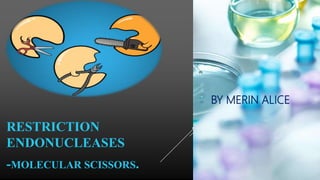
RESTRICTION
ENDONUCLEASES
-MOLECULAR SCISSORS.
A restriction enzyme /restriction endonuclease is an enzyme that
cleaves DNA into fragments at or near specific recognition sites
within molecules known as restriction sites.
Dna cutting enzymes/site specific bacterial endonucleases that
recognize specific sequences of foreign Dna and cleave the Dna to
fragments.
Pioneer – Werner Arber; Discovered by Hamilton Smith & Daniel
Nathans (1970) (1986 Nobel Prize in Physiology & Medicine)
Immune systems of prokaryotes’
Restriction enzymes are so called- they restrict or prevent the intrusion of
foreign Dna from other species into genetic system of a cell.
When foreign Dna gets to bacterial cells it disarms / degrade it
 recognize foreign Dna,
 bind with it
 slash it to pieces
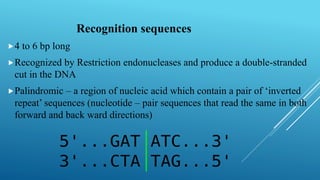
Recognition sequences
4 to 6 bp long
Recognized by Restriction endonucleases and produce a double-stranded
cut in the DNA
Palindromic – a region of nucleic acid which contain a pair of ‘inverted
repeat’ sequences (nucleotide – pair sequences that read the same in both
forward and back ward directions)
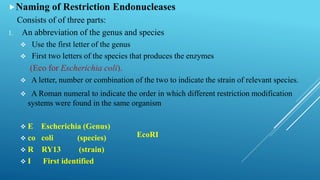
Naming of Restriction Endonucleases
Consists of of three parts:
1. An abbreviation of the genus and species
 Use the first letter of the genus
 First two letters of the species that produces the enzymes
(Eco for Escherichia coli).
 A letter, number or combination of the two to indicate the strain of relevant species.
 A Roman numeral to indicate the order in which different restriction modification
systems were found in the same organism
 E Escherichia (Genus)
 co coli (species)
 R RY13 (strain)
 I First identified
EcoRI
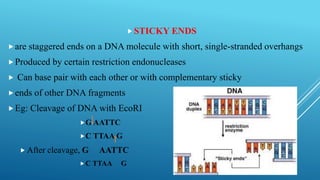
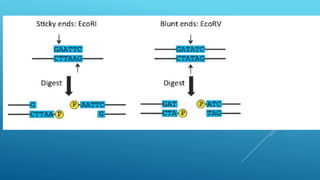
STICKY ENDS
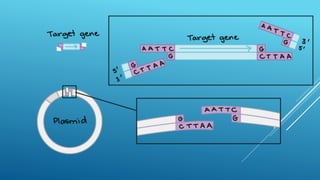
are staggered ends on a DNA molecule with short, single-stranded overhangs
Produced by certain restriction endonucleases
 Can base pair with each other or with complementary sticky
ends of other DNA fragments
Eg: Cleavage of DNA with EcoRI
G AATTC
C TTAA G
 After cleavage, G AATTC
C TTAA G
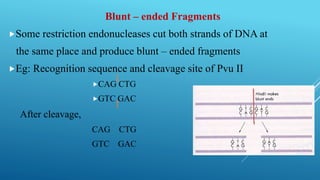
Blunt – ended Fragments
Some restriction endonucleases cut both strands of DNA at
the same place and produce blunt – ended fragments
Eg: Recognition sequence and cleavage site of Pvu II
CAG CTG
GTC GAC
After cleavage,
CAG CTG
GTC GAC
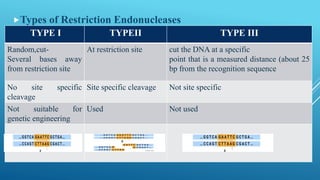
Types of Restriction Endonucleases
TYPE I TYPEII TYPE III
Random,cut-
Several bases away
from restriction site
At restriction site cut the DNA at a specific
point that is a measured distance (about 25
bp from the recognition sequence
No site specific
cleavage
Site specific cleavage Not site specific
Not suitable for
genetic engineering
Used Not used
Restriction endonuclease

Restriction endonuclease

  • 1.
  • 2.
    A restriction enzyme/restriction endonuclease is an enzyme that cleaves DNA into fragments at or near specific recognition sites within molecules known as restriction sites. Dna cutting enzymes/site specific bacterial endonucleases that recognize specific sequences of foreign Dna and cleave the Dna to fragments. Pioneer – Werner Arber; Discovered by Hamilton Smith & Daniel Nathans (1970) (1986 Nobel Prize in Physiology & Medicine)
  • 3.
    Immune systems ofprokaryotes’ Restriction enzymes are so called- they restrict or prevent the intrusion of foreign Dna from other species into genetic system of a cell. When foreign Dna gets to bacterial cells it disarms / degrade it  recognize foreign Dna,  bind with it  slash it to pieces
  • 4.
    Recognition sequences 4 to6 bp long Recognized by Restriction endonucleases and produce a double-stranded cut in the DNA Palindromic – a region of nucleic acid which contain a pair of ‘inverted repeat’ sequences (nucleotide – pair sequences that read the same in both forward and back ward directions)
  • 5.
    Naming of RestrictionEndonucleases Consists of of three parts: 1. An abbreviation of the genus and species  Use the first letter of the genus  First two letters of the species that produces the enzymes (Eco for Escherichia coli).  A letter, number or combination of the two to indicate the strain of relevant species.  A Roman numeral to indicate the order in which different restriction modification systems were found in the same organism  E Escherichia (Genus)  co coli (species)  R RY13 (strain)  I First identified EcoRI
  • 6.
    STICKY ENDS are staggeredends on a DNA molecule with short, single-stranded overhangs Produced by certain restriction endonucleases  Can base pair with each other or with complementary sticky ends of other DNA fragments Eg: Cleavage of DNA with EcoRI G AATTC C TTAA G  After cleavage, G AATTC C TTAA G
  • 8.
    Blunt – endedFragments Some restriction endonucleases cut both strands of DNA at the same place and produce blunt – ended fragments Eg: Recognition sequence and cleavage site of Pvu II CAG CTG GTC GAC After cleavage, CAG CTG GTC GAC
  • 10.
    Types of RestrictionEndonucleases TYPE I TYPEII TYPE III Random,cut- Several bases away from restriction site At restriction site cut the DNA at a specific point that is a measured distance (about 25 bp from the recognition sequence No site specific cleavage Site specific cleavage Not site specific Not suitable for genetic engineering Used Not used