Gene Cloning
MERIN ALICE
What is Gene Cloning?
• The process of producing multiple copies of a gene is
known as gene cloning
OR
Gene cloning (DNA cloning) is defined as the production of
exact copies (clones) of a particular gene or DNA sequence
using genetic engineering techniques.
Steps involved in gene cloning
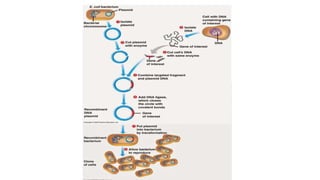
• Isolation of donor DNA fragment or gene
• Selection of suitable vector.
• Incorporation of donor DNA fragment into the vector
• Transformation of recombinant vector into a suitable host cell
• Isolation of recombinant host cell
• Selection of organisms containing recombinant DNA.
• Screening for clones with desired DNA inserts and biological properties.
Why do we clone a Dna?
• To sequence a particular gene of interest.
• Protein/ enzyme functions can be determined
• Mutations can be detected.
• Organisms can be engineered for specific functions like production of
insulin, insect resistance etc.
GENE CLONING STRATEGIES
• A set of techniques adopted for gene cloning for a particular purpose is
known as gene cloning strategies.
• This includes:
Genomic DNA libraries,
cDNA libraries.
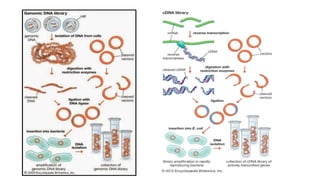
Genomic Dna library
• A collection of clones containing all Dna segments of a genome of an
organism is known as genomic library
or
A genomic library is a collection of the total genomic DNA from a
single organism.
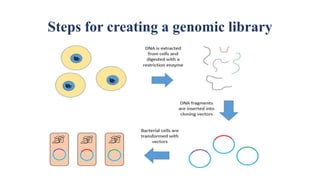
Steps for creating a genomic library
1. Extract and purify DNA.
2. Digest the DNA with a restriction enzyme. This creates fragments that are similar
in size
3. Insert the fragments of DNA into vectors that were cut with the same restriction
enzyme.
4. Use the enzyme DNA ligase to seal the DNA fragments into the vector.
5. These recombinant molecules are taken up by a host bacterium creating a DNA
library.
cDNA libraries
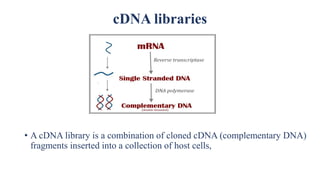
• A cDNA library is a combination of cloned cDNA (complementary DNA)
fragments inserted into a collection of host cells,
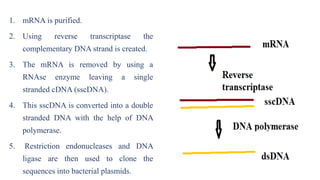
1. mRNA is purified.
2. Using reverse transcriptase the
complementary DNA strand is created.
3. The mRNA is removed by using a
RNAse enzyme leaving a single
stranded cDNA (sscDNA).
4. This sscDNA is converted into a double
stranded DNA with the help of DNA
polymerase.
5. Restriction endonucleases and DNA
ligase are then used to clone the
sequences into bacterial plasmids.
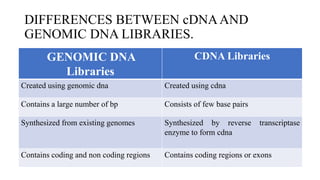
DIFFERENCES BETWEEN cDNAAND
GENOMIC DNA LIBRARIES.
GENOMIC DNA
Libraries
CDNA Libraries
Created using genomic dna Created using cdna
Contains a large number of bp Consists of few base pairs
Synthesized from existing genomes Synthesized by reverse transcriptase
enzyme to form cdna
Contains coding and non coding regions Contains coding regions or exons
QUESTIONS
• Q1. What is meant by gene cloning? What are the steps involved in
cloning of a gene.
OR
Suppose you want to create multiple copies of a particular gene of
interest, what are the steps involved?
Q2. What are the different gene cloning strategies? List them.
Q3. What are the differences between genomic library and cdna library?

Gene cloning

  • 1.
  • 2.
    What is GeneCloning? • The process of producing multiple copies of a gene is known as gene cloning OR Gene cloning (DNA cloning) is defined as the production of exact copies (clones) of a particular gene or DNA sequence using genetic engineering techniques.
  • 3.
    Steps involved ingene cloning • Isolation of donor DNA fragment or gene • Selection of suitable vector. • Incorporation of donor DNA fragment into the vector • Transformation of recombinant vector into a suitable host cell • Isolation of recombinant host cell • Selection of organisms containing recombinant DNA. • Screening for clones with desired DNA inserts and biological properties.
  • 5.
    Why do weclone a Dna? • To sequence a particular gene of interest. • Protein/ enzyme functions can be determined • Mutations can be detected. • Organisms can be engineered for specific functions like production of insulin, insect resistance etc.
  • 6.
    GENE CLONING STRATEGIES •A set of techniques adopted for gene cloning for a particular purpose is known as gene cloning strategies. • This includes: Genomic DNA libraries, cDNA libraries.
  • 7.
    Genomic Dna library •A collection of clones containing all Dna segments of a genome of an organism is known as genomic library or A genomic library is a collection of the total genomic DNA from a single organism.
  • 8.
    Steps for creatinga genomic library
  • 9.
    Steps for creatinga genomic library 1. Extract and purify DNA. 2. Digest the DNA with a restriction enzyme. This creates fragments that are similar in size 3. Insert the fragments of DNA into vectors that were cut with the same restriction enzyme. 4. Use the enzyme DNA ligase to seal the DNA fragments into the vector. 5. These recombinant molecules are taken up by a host bacterium creating a DNA library.
  • 10.
    cDNA libraries • AcDNA library is a combination of cloned cDNA (complementary DNA) fragments inserted into a collection of host cells,
  • 11.
    1. mRNA ispurified. 2. Using reverse transcriptase the complementary DNA strand is created. 3. The mRNA is removed by using a RNAse enzyme leaving a single stranded cDNA (sscDNA). 4. This sscDNA is converted into a double stranded DNA with the help of DNA polymerase. 5. Restriction endonucleases and DNA ligase are then used to clone the sequences into bacterial plasmids.
  • 12.
    DIFFERENCES BETWEEN cDNAAND GENOMICDNA LIBRARIES. GENOMIC DNA Libraries CDNA Libraries Created using genomic dna Created using cdna Contains a large number of bp Consists of few base pairs Synthesized from existing genomes Synthesized by reverse transcriptase enzyme to form cdna Contains coding and non coding regions Contains coding regions or exons
  • 14.
    QUESTIONS • Q1. Whatis meant by gene cloning? What are the steps involved in cloning of a gene. OR Suppose you want to create multiple copies of a particular gene of interest, what are the steps involved? Q2. What are the different gene cloning strategies? List them. Q3. What are the differences between genomic library and cdna library?