


KIDNEY
Introduction
• The closely packed structure and numerous functions of the kidney illustrate the
beautiful workmanship of our creator.
• It not only applies to the kidney but to each and every part of our body
• The kidneys are also called rene’s from which we have the derivative renal; and
nephron from which we have the terms nephron, nephritis, etc
Definition
•Kidneysareapairofexcretoryorganssituatedontheposterior
abdominalwall,oneoneachsideofthevertebralcolumn,behind
theperitoneum.Theyremovewasteproductsofmetabolismand
excessofwaterandsaltsfromtheblood,andmaintainitspH
Location
• The kidneys occupy the epigastric, hypochondriac, lumbar and umbilical regions.
• Vertically, they extend from the upper border of twelfth thoracic vertebra to the
centre of the body of third lumbar vertebra.
• The right kidney is slightly lower than
the left, and the left kidney is a little
nearer to the median plane than the right.
• The transpyloric plane passes through
the upper part of the hilus of the right
kidney, and through the lower part of the
hilus of the left kidney.
Shape, Size, Weight and Orientation
• Each kidney is about 11 cm long, 6 cm broad, and 3 cm thick.
• The left kidney is a little longer and narrower than the right kidney.
• On an average, the kidney weighs 150 g in males and 135 g in females.
• The kidneys are reddish brown in colour
EXTERNAL FEATURES OF KIDNEY
• Each kidney is bean-shaped.
• It has
Upper and lower poles,
Medial and lateral borders, and
Anterior and posterior surfaces.
Pole
• The upper pole is broad and is in
close contact with the
corresponding suprarenal gland.
• The lower pole is pointed
Surfaces
• The anterior surface is said to be
irregular and the posterior surface
flat, but it is often difficult to
recognize the anterior and posterior
aspects of the kidney by looking at
the surfaces.
Borders
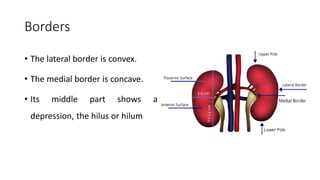
• The lateral border is convex.
• The medial border is concave.
• Its middle part shows a
depression, the hilus or hilum
Hilum
The following structures are seen in the hilum from anterior side to
posterior side.
1. The renal vein
2. The renal artery
3. The renal pelvis, which is the expanded upper end of the ureter
RELATIONS OF THE KIDNEYS
• The kidneys are retroperitoneal organs and are only partly covered by
peritoneum anteriorly.
Relations Common to the Two Kidneys
1. The upper pole of each kidney is related to the corresponding suprarenal gland.
The lower poles lie about 2.5 cm above the iliac crests.
2. The medial border of each kidney is related to:
a) The suprarenal gland, above the hilus, and
b) b. To the ureter below the hilus.
3. Posterior relations: The posterior surfaces of both kidneys are related to the
following.
a) Diaphragm
b) Medial and lateral arcuate ligaments
c) Psoas major
d) Quadratus lumborum
e) Transversus abdominis
f) Subcostal vessels
g) Subcostal, iliohypogastric and ilioinguinal nerves.
• In addition, the right kidney is related to twelfth rib, and the left
kidney to eleventh and twelfth ribs.
4. Hilum
Other Relations of the Right Kidney
Anterior Relations
1. Right suprarenal gland
2. Liver
3. Second part of duodenum
4. Hepatic flexure of colon
5. Small intestine
• Out of these, the hepatic and intestinal surfaces are covered by peritoneum. The
lateral border of the right kidney is related to the right lobe of the liver and to the
hepatic flexure of the colon.
Other Relations of the Left Kidney
Anterior Relations
1. Left suprarenal gland
2. Spleen
3. Stomach
4. Pancreas
5. Splenic vessels
6. Splenic flexure and descending colon
7. Jejunum
• Out of these, the gastric, splenic and jejunal surfaces are covered by peritoneum.
The lateral border of the left kidney is related to the spleen and to the
descending colon.
CAPSULES OR COVERINGS OF
KIDNEY
• This is a thin membrane which closely invests the kidney and lines the
renal sinus.
• Normally, it can be easily stripped off from the kidney, but in certain
diseases, it becomes adherent and cannot be stripped
The Fibrous Capsule
Perirenal or Perinephric Fat
• This is a layer of adipose tissue lying outside the fibrous capsule.
• It is thickest at the borders of the kidney and fills up the extra space in
the renal sinus.
Renal Fascia
• The perirenal fascia was originally described as being made up of two
separate layers
• Posterior layer was called fascia of Zuckerkandal and anterior layer as
fascia of Gerota.
Pararenal or Paranephric Body (Fat)
• It consists of a variable amount of fat lying outside the renal fascia.
• It is more abundant posteriorly and towards the lower pole of the
kidney.
• It fills up the paravertebral gutter and forms a cushion for the kidney
STRUCTURE
An outer—reddish brown cortex.
An inner—pale medulla.
A space—the renal sinus
Naked eye examination of a coronal section of the kidney shows:
• The renal cortex is divisible into two parts.
a) Cortical arches or cortical lobules, which form caps over the bases
of the pyramids.
b) Renal columns, which dip in between the pyramids
• Each pyramid along with the overlying cortical arch forms a lobe of
the kidney.
• The renal sinus is a space that extends into the kidney from the hilus. It contains:
a. Branches of the renal artery.
b. Tributaries of the renal vein
c. The renal pelvis.
• The pelvis divides into 2 to 3 major calyces, and these in their turn divide into 7 to
13 minor calyces. Each minor calyx (kalyx = cup of a flower) ends in an expansion
which is indented by one to three renal papillae
Structure of Uriniferous Tubule
• Each kidney is composed of one to three million uriniferous tubules.
• Each tubule consists of two parts which are embryologically distinct
from each other.
• These are as follows.
• The excretory part, called the nephron, which elaborates urine
• Nephron is the functional unit of the kidney, and comprises:
a. Renal corpuscle or malpighian corpuscle (for filtration of substances from the
plasma) made up of glomerulus (Latin ball), a tuft of capillaries and Bowman’s
capsule.
b. Renal tubule (for selective resorption of substances from the glomerular
filtrate) made up of the proximal convoluted tubule, loop of Henle with its
descending and ascending limbs, and the distal convoluted tubule
• The collecting part begins as a junctional tubule from the distal
convoluted tubule.
• Many tubules unite together to form the ducts of Bellini which open
into the minor calyces through the renal papillae
• Juxtaglomerular apparatus is formed at the vascular pole of glomerulus which is
intimately related to its own ascending limb of the Henle’s loop near the distal
convoluted tubule.
The apparatus consists of:
a. Macula densa, formed by altered cells of the distal convoluted tubule.
b. Juxtaglomerular cells, formed by the epithelioid cells in the media of the
afferent arteriole.
c. Some agranular cells between macula densa and the glomerulus proper.
Blood Supply of Kidney
Venous supply
of kidney
Nerve
supply
Applied anatomy
• Polycystic kidney
• The common diseases of kidney are nephritis, pyelonephritis,
tuberculosis of kidney, renal stones and tumours
FUNCTIONS OF KIDNEY
• Remove waste products from the body.
• Remove drugs from the body.
• Balance the body's fluids.
• Release hormones that regulate blood pressure.
• Produce an active form of vitamin D that promotes strong, healthy bones.
• Control the production of red blood cells.
Question ask
• Structure of kidney
• Relations of kidney
• Function of kidney
THANK YOU

Kidney_Nursing.pptx

  • 1.
  • 2.
    Introduction • The closelypacked structure and numerous functions of the kidney illustrate the beautiful workmanship of our creator. • It not only applies to the kidney but to each and every part of our body • The kidneys are also called rene’s from which we have the derivative renal; and nephron from which we have the terms nephron, nephritis, etc
  • 3.
  • 4.
    Location • The kidneysoccupy the epigastric, hypochondriac, lumbar and umbilical regions. • Vertically, they extend from the upper border of twelfth thoracic vertebra to the centre of the body of third lumbar vertebra.
  • 5.
    • The rightkidney is slightly lower than the left, and the left kidney is a little nearer to the median plane than the right. • The transpyloric plane passes through the upper part of the hilus of the right kidney, and through the lower part of the hilus of the left kidney.
  • 6.
    Shape, Size, Weightand Orientation • Each kidney is about 11 cm long, 6 cm broad, and 3 cm thick. • The left kidney is a little longer and narrower than the right kidney. • On an average, the kidney weighs 150 g in males and 135 g in females. • The kidneys are reddish brown in colour
  • 7.
    EXTERNAL FEATURES OFKIDNEY • Each kidney is bean-shaped. • It has Upper and lower poles, Medial and lateral borders, and Anterior and posterior surfaces.
  • 8.
    Pole • The upperpole is broad and is in close contact with the corresponding suprarenal gland. • The lower pole is pointed
  • 9.
    Surfaces • The anteriorsurface is said to be irregular and the posterior surface flat, but it is often difficult to recognize the anterior and posterior aspects of the kidney by looking at the surfaces.
  • 10.
    Borders • The lateralborder is convex. • The medial border is concave. • Its middle part shows a depression, the hilus or hilum
  • 11.
    Hilum The following structuresare seen in the hilum from anterior side to posterior side. 1. The renal vein 2. The renal artery 3. The renal pelvis, which is the expanded upper end of the ureter
  • 12.
    RELATIONS OF THEKIDNEYS • The kidneys are retroperitoneal organs and are only partly covered by peritoneum anteriorly.
  • 13.
    Relations Common tothe Two Kidneys 1. The upper pole of each kidney is related to the corresponding suprarenal gland. The lower poles lie about 2.5 cm above the iliac crests. 2. The medial border of each kidney is related to: a) The suprarenal gland, above the hilus, and b) b. To the ureter below the hilus.
  • 14.
    3. Posterior relations:The posterior surfaces of both kidneys are related to the following. a) Diaphragm b) Medial and lateral arcuate ligaments c) Psoas major d) Quadratus lumborum e) Transversus abdominis f) Subcostal vessels g) Subcostal, iliohypogastric and ilioinguinal nerves.
  • 16.
    • In addition,the right kidney is related to twelfth rib, and the left kidney to eleventh and twelfth ribs. 4. Hilum
  • 17.
    Other Relations ofthe Right Kidney Anterior Relations 1. Right suprarenal gland 2. Liver 3. Second part of duodenum 4. Hepatic flexure of colon 5. Small intestine • Out of these, the hepatic and intestinal surfaces are covered by peritoneum. The lateral border of the right kidney is related to the right lobe of the liver and to the hepatic flexure of the colon.
  • 18.
    Other Relations ofthe Left Kidney Anterior Relations 1. Left suprarenal gland 2. Spleen 3. Stomach 4. Pancreas 5. Splenic vessels 6. Splenic flexure and descending colon 7. Jejunum • Out of these, the gastric, splenic and jejunal surfaces are covered by peritoneum. The lateral border of the left kidney is related to the spleen and to the descending colon.
  • 21.
    CAPSULES OR COVERINGSOF KIDNEY • This is a thin membrane which closely invests the kidney and lines the renal sinus. • Normally, it can be easily stripped off from the kidney, but in certain diseases, it becomes adherent and cannot be stripped The Fibrous Capsule
  • 22.
    Perirenal or PerinephricFat • This is a layer of adipose tissue lying outside the fibrous capsule. • It is thickest at the borders of the kidney and fills up the extra space in the renal sinus.
  • 23.
    Renal Fascia • Theperirenal fascia was originally described as being made up of two separate layers • Posterior layer was called fascia of Zuckerkandal and anterior layer as fascia of Gerota.
  • 24.
    Pararenal or ParanephricBody (Fat) • It consists of a variable amount of fat lying outside the renal fascia. • It is more abundant posteriorly and towards the lower pole of the kidney. • It fills up the paravertebral gutter and forms a cushion for the kidney
  • 25.
    STRUCTURE An outer—reddish browncortex. An inner—pale medulla. A space—the renal sinus Naked eye examination of a coronal section of the kidney shows:
  • 27.
    • The renalcortex is divisible into two parts. a) Cortical arches or cortical lobules, which form caps over the bases of the pyramids. b) Renal columns, which dip in between the pyramids • Each pyramid along with the overlying cortical arch forms a lobe of the kidney.
  • 28.
    • The renalsinus is a space that extends into the kidney from the hilus. It contains: a. Branches of the renal artery. b. Tributaries of the renal vein c. The renal pelvis. • The pelvis divides into 2 to 3 major calyces, and these in their turn divide into 7 to 13 minor calyces. Each minor calyx (kalyx = cup of a flower) ends in an expansion which is indented by one to three renal papillae
  • 29.
    Structure of UriniferousTubule • Each kidney is composed of one to three million uriniferous tubules. • Each tubule consists of two parts which are embryologically distinct from each other. • These are as follows. • The excretory part, called the nephron, which elaborates urine
  • 31.
    • Nephron isthe functional unit of the kidney, and comprises: a. Renal corpuscle or malpighian corpuscle (for filtration of substances from the plasma) made up of glomerulus (Latin ball), a tuft of capillaries and Bowman’s capsule. b. Renal tubule (for selective resorption of substances from the glomerular filtrate) made up of the proximal convoluted tubule, loop of Henle with its descending and ascending limbs, and the distal convoluted tubule
  • 33.
    • The collectingpart begins as a junctional tubule from the distal convoluted tubule. • Many tubules unite together to form the ducts of Bellini which open into the minor calyces through the renal papillae
  • 34.
    • Juxtaglomerular apparatusis formed at the vascular pole of glomerulus which is intimately related to its own ascending limb of the Henle’s loop near the distal convoluted tubule. The apparatus consists of: a. Macula densa, formed by altered cells of the distal convoluted tubule. b. Juxtaglomerular cells, formed by the epithelioid cells in the media of the afferent arteriole. c. Some agranular cells between macula densa and the glomerulus proper.
  • 35.
  • 36.
  • 37.
  • 38.
    Applied anatomy • Polycystickidney • The common diseases of kidney are nephritis, pyelonephritis, tuberculosis of kidney, renal stones and tumours
  • 39.
    FUNCTIONS OF KIDNEY •Remove waste products from the body. • Remove drugs from the body. • Balance the body's fluids. • Release hormones that regulate blood pressure. • Produce an active form of vitamin D that promotes strong, healthy bones. • Control the production of red blood cells.
  • 40.
    Question ask • Structureof kidney • Relations of kidney • Function of kidney
  • 41.