Size
Separation
By
Yogeshwary Bhongade
Assistant Professor
M. Pharm.
Gondia College of Pharmacy, Gondia
CONTENT
• Objectives, applications & mechanism of size
separation,
• official standards of powders, sieves,
• size separation Principles, construction, working,
uses, merits and demerits of
-Sieve shaker,
-Cyclone separator,
-Air separator,
-Bag filter,
-Elutriation tank.
Size Separation
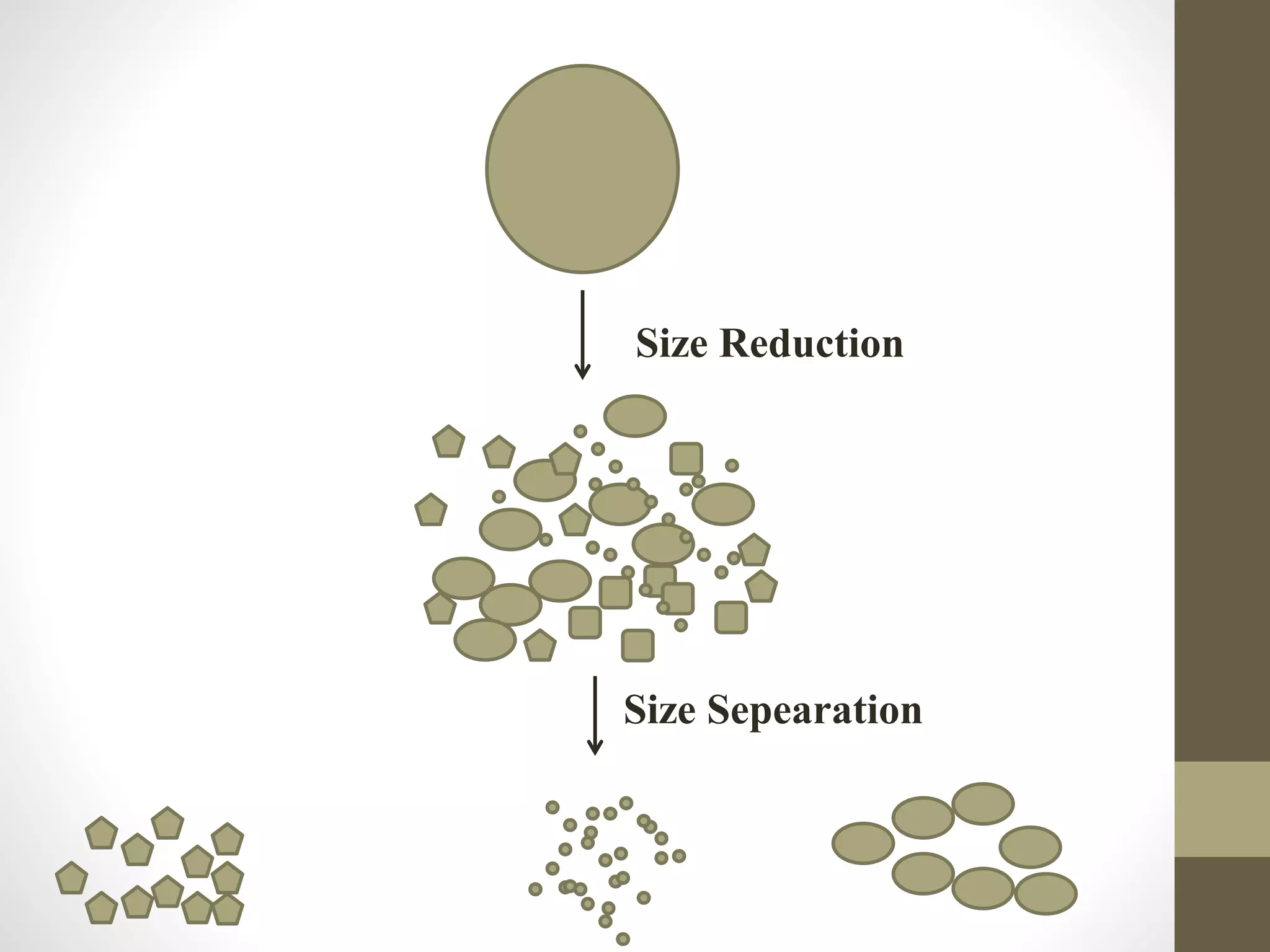
• It is a process of separation of particle of desired
size from mixer of various size particle.
• Size separation is also known as sieving, shifting or
screening.
• It gives the particle of varying size.

• To get narrow particle size sifting is done.
• Reduction of size alone is not sufficient to obtained
the mono size or narrow size range powder so size
reduction followed by size separation should be
combine to obtained powder of desired size.
Size Reduction
Size Sepearation
Objectives
• To determine particle size for production of tablets
and capsule
• To improve mixing of powder.
• To improve solubility and stability of particles
during production.
• To optimize feed rate, agitation, screening during
production.
• Quality control of raw material.
• Useful in production of tablets, capsule, suspension,
ophthalmic preparations, ointments, cream etc.
Application of size separation
• To prepare granules of desired size to ensure good
flow ability.
• To separate undesirable particles.
• To measure particle size and size distribution.
• To know the efficiency of size reduction equipment.
• To get uniform dosage form.
• Mono-size particles undergoes less segregation.
• During filling capsules, the particles must be
uniform in weight and dosade.
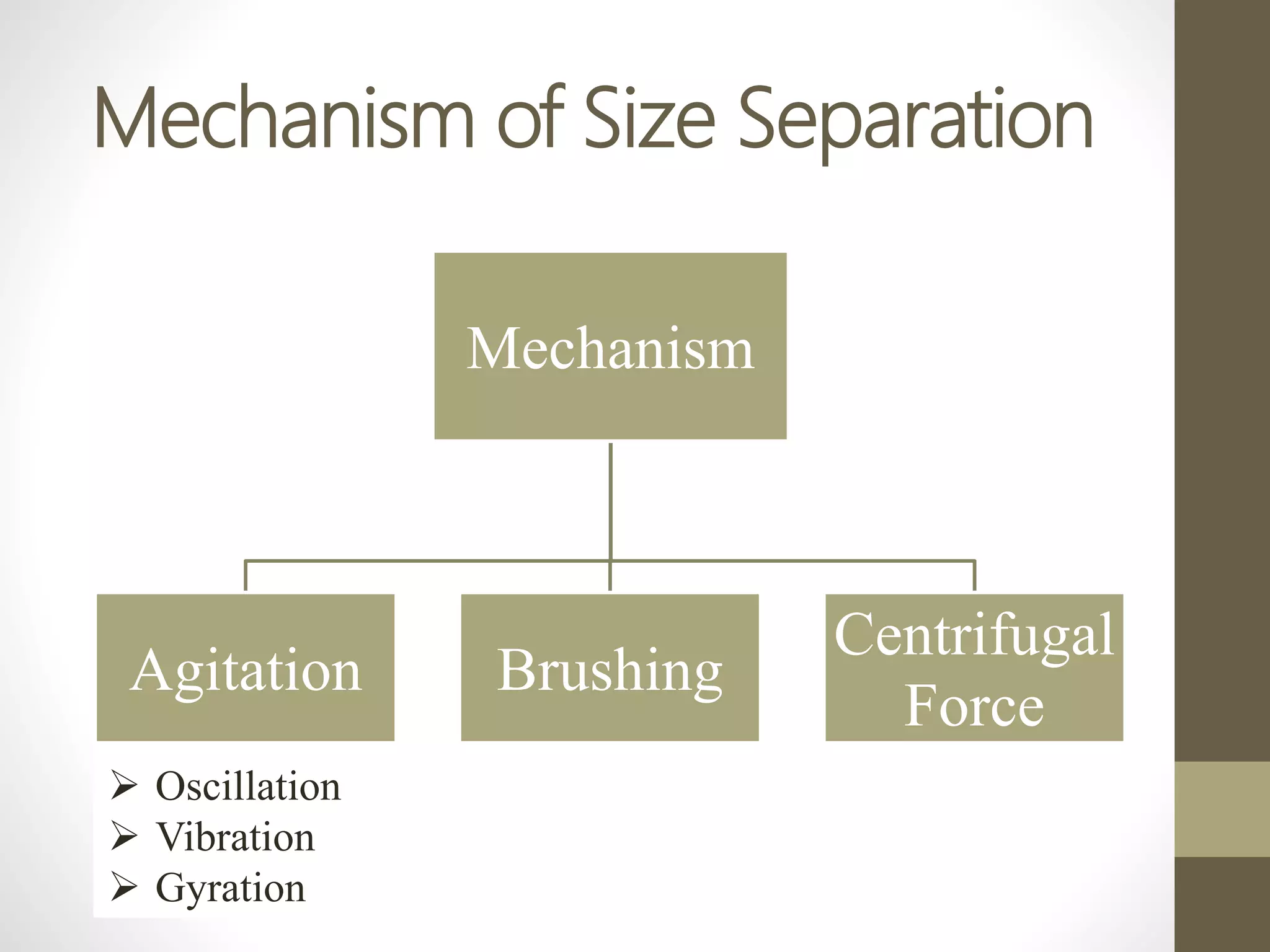
Mechanism of Size Separation
Mechanism
Agitation Brushing
Centrifugal
Force
 Oscillation
 Vibration
 Gyration
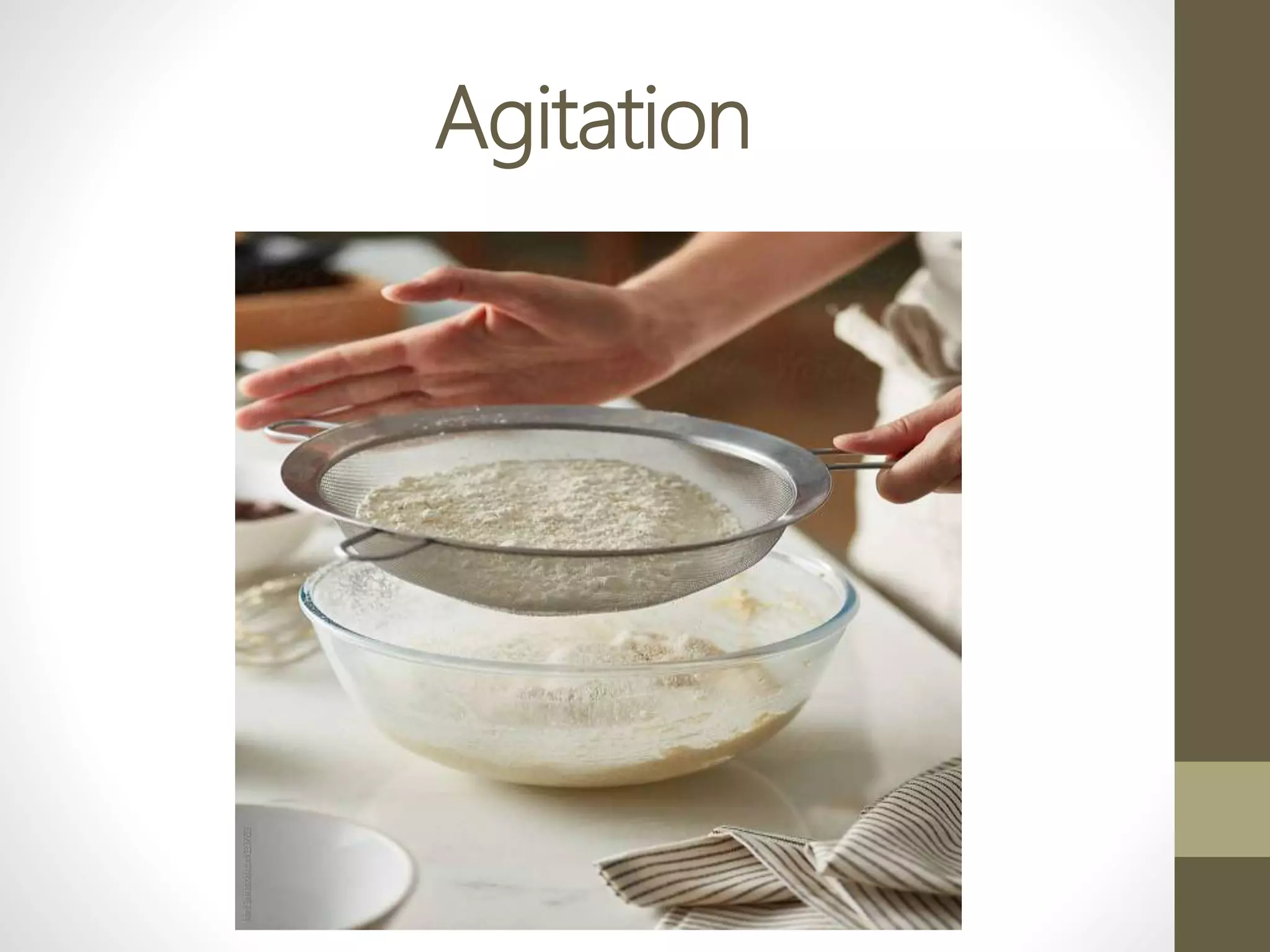
Agitation
• Sieve may be agitated in number of different ways.
Oscillation
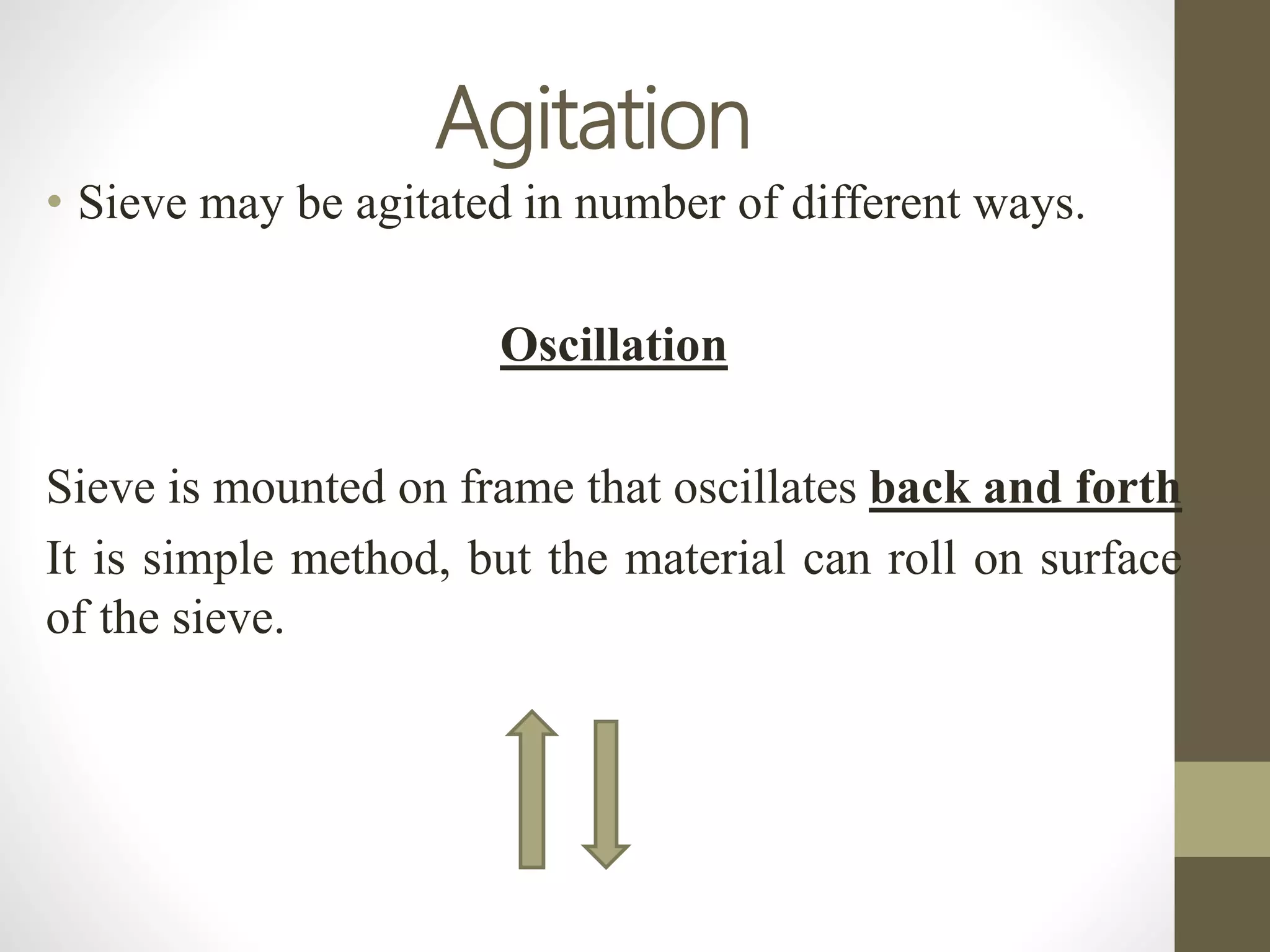
Sieve is mounted on frame that oscillates back and forth
It is simple method, but the material can roll on surface
of the sieve.
Cont.
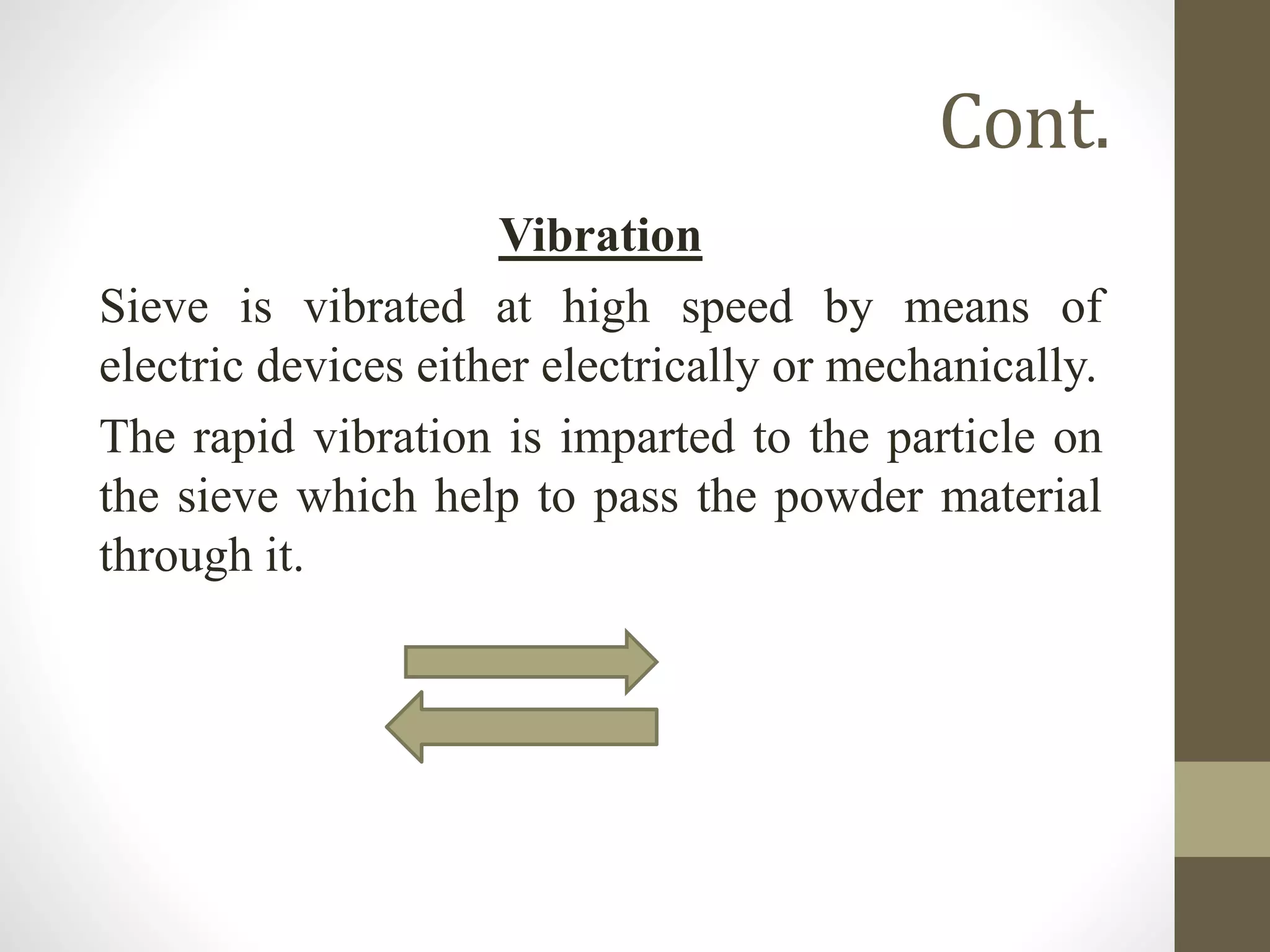
Vibration
Sieve is vibrated at high speed by means of
electric devices either electrically or mechanically.
The rapid vibration is imparted to the particle on
the sieve which help to pass the powder material
through it.
Cont.
Gyration
• In this method sieve is rubber mounted and
connected to an electrical flywheel.
• This gives a rotatory movement of small amplitude
to sieve which in turn gives spinning motion to the
particle that help to pass them through a sieve.
• Agitation methods are not continuous methods but
can be made so by inclination of the sieve and the
provision of separate outlets for undersize and
oversize particle.
Advantages & Disadvantages
Advantages
• Simple method
• Inexpensive method
Disadvantages
• Chance of clogging of sieve if powder is not
dried
• Size reduction occurs due to collision between
particle during agitation
Brushing
• In this method, the brush is used to move the particle
on the surface of sieve and keep the meshes clear.
• The brush is rotated in the centre in the case of
circular sieve, but the spiral brush is rotated in the
longitudinal axis in the case of horizontal cylindrical
sieve
• It is use to separate the size of greasy or sticky
powder.
Centrifugal Force
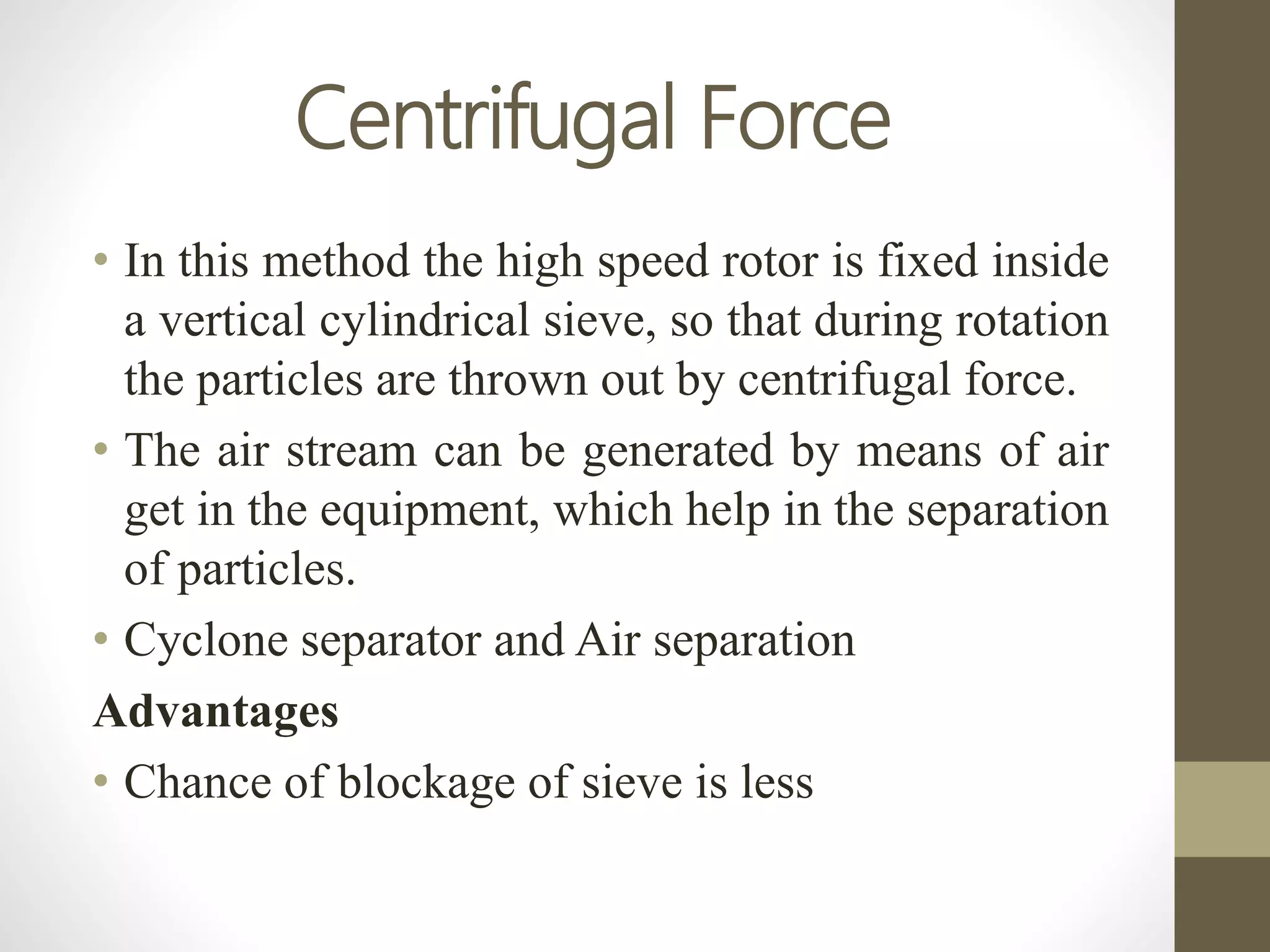
• In this method the high speed rotor is fixed inside
a vertical cylindrical sieve, so that during rotation
the particles are thrown out by centrifugal force.
• The air stream can be generated by means of air
get in the equipment, which help in the separation
of particles.
• Cyclone separator and Air separation
Advantages
• Chance of blockage of sieve is less
Official Standards of powder
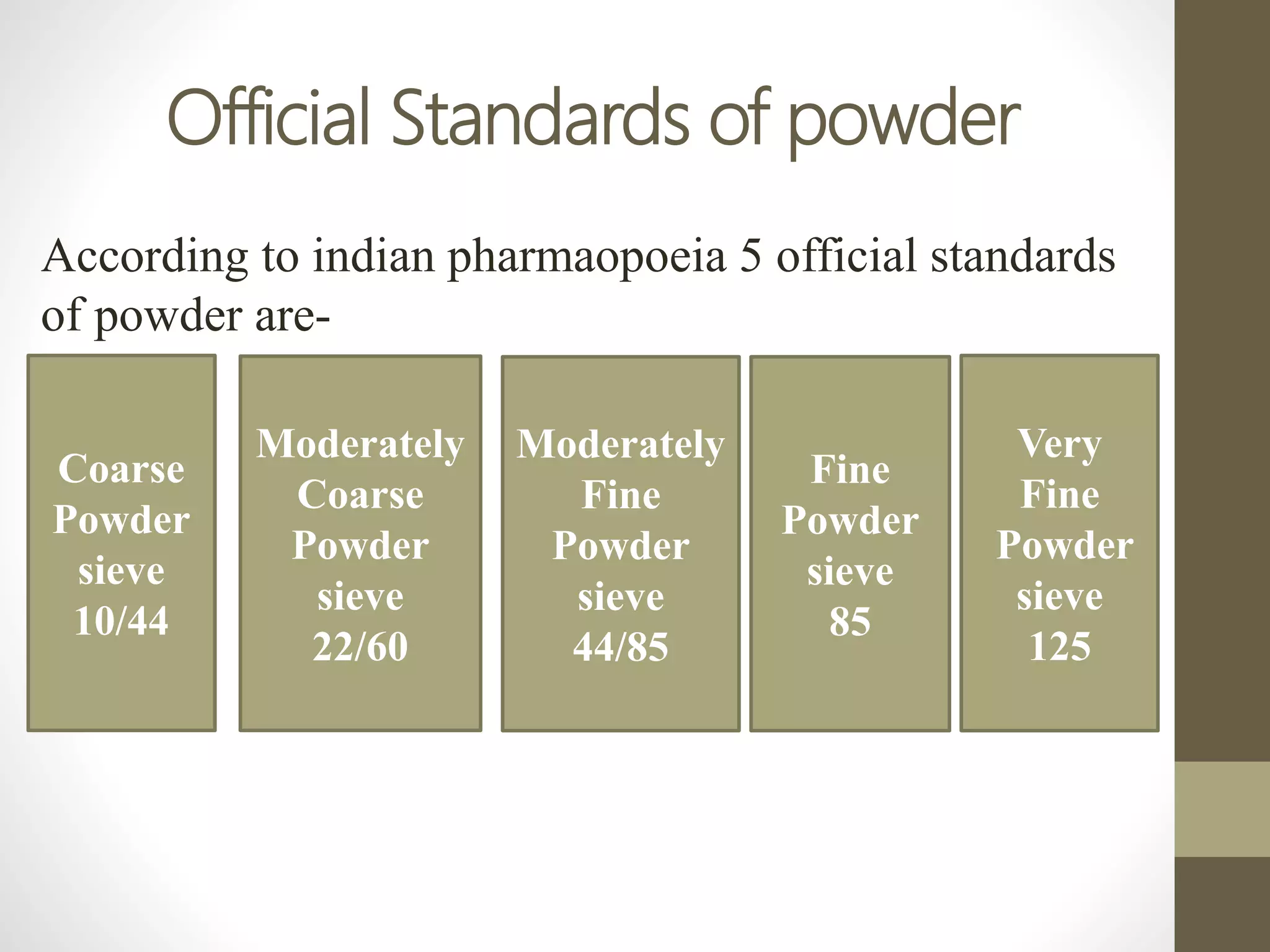
Coarse
Powder
sieve
10/44
Moderately
Coarse
Powder
sieve
22/60
Fine
Powder
sieve
85
Very
Fine
Powder
sieve
125
Moderately
Fine
Powder
sieve
44/85
According to indian pharmaopoeia 5 official standards
of powder are-
Sr.
No
Grade of
powder
sieve
through all
particle pa
ss
Nominal
mesh
aparature
size
sieve
through
which
40% of
particle
pass
Nominal
mesh
aparature
size
1 Coarse 10 1.7mm 44 355mm
2 Moderatel
y Coarse
22 710mm 60 250mm
3 Moderatel
y Fine
44 355mm 85 180mm
4 Fine
Powder
85 180mm - -
5 Very
Fine
120 125mm - -
Sieves
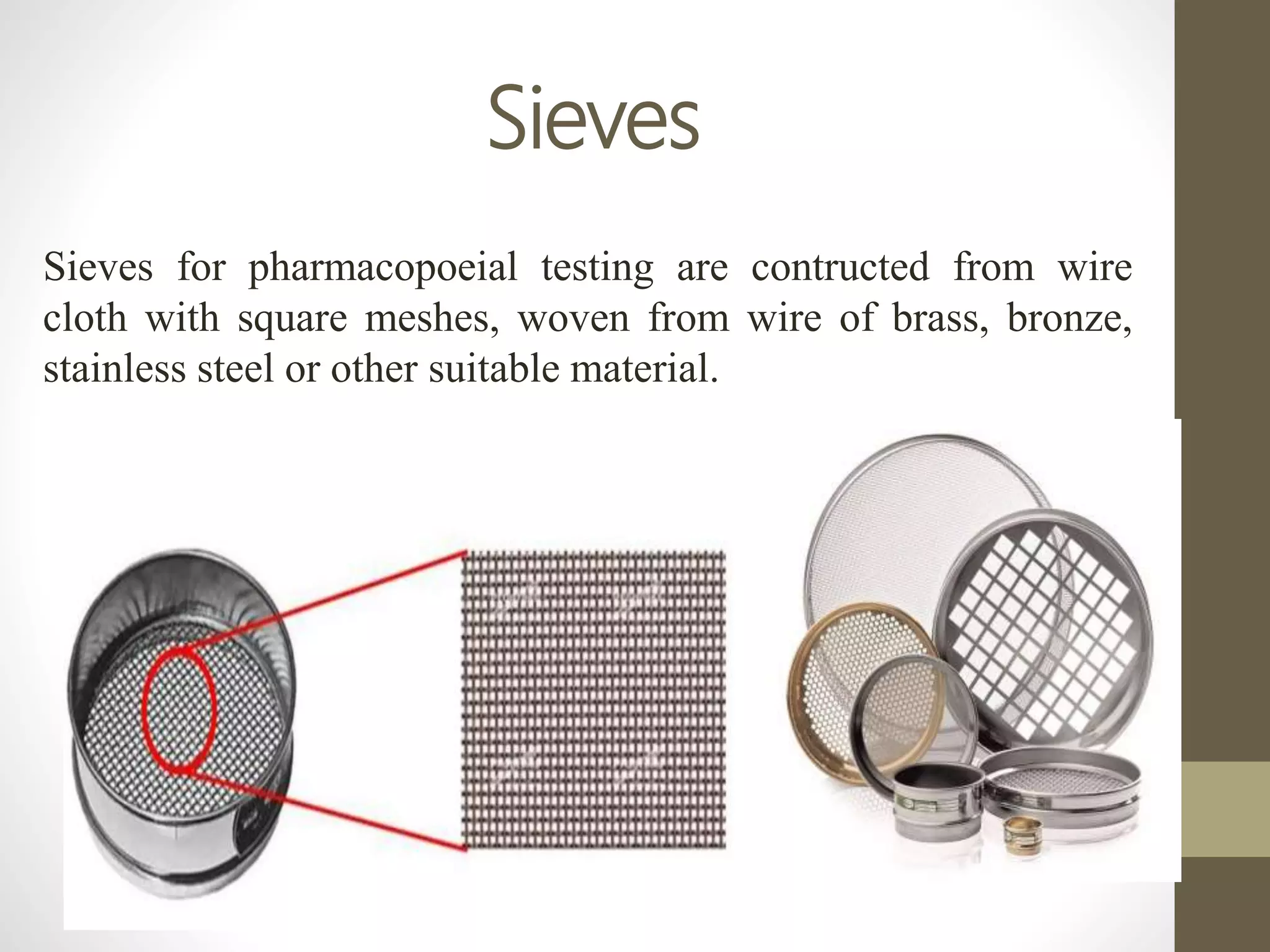
Sieves for pharmacopoeial testing are contructed from wire
cloth with square meshes, woven from wire of brass, bronze,
stainless steel or other suitable material.
Sieves
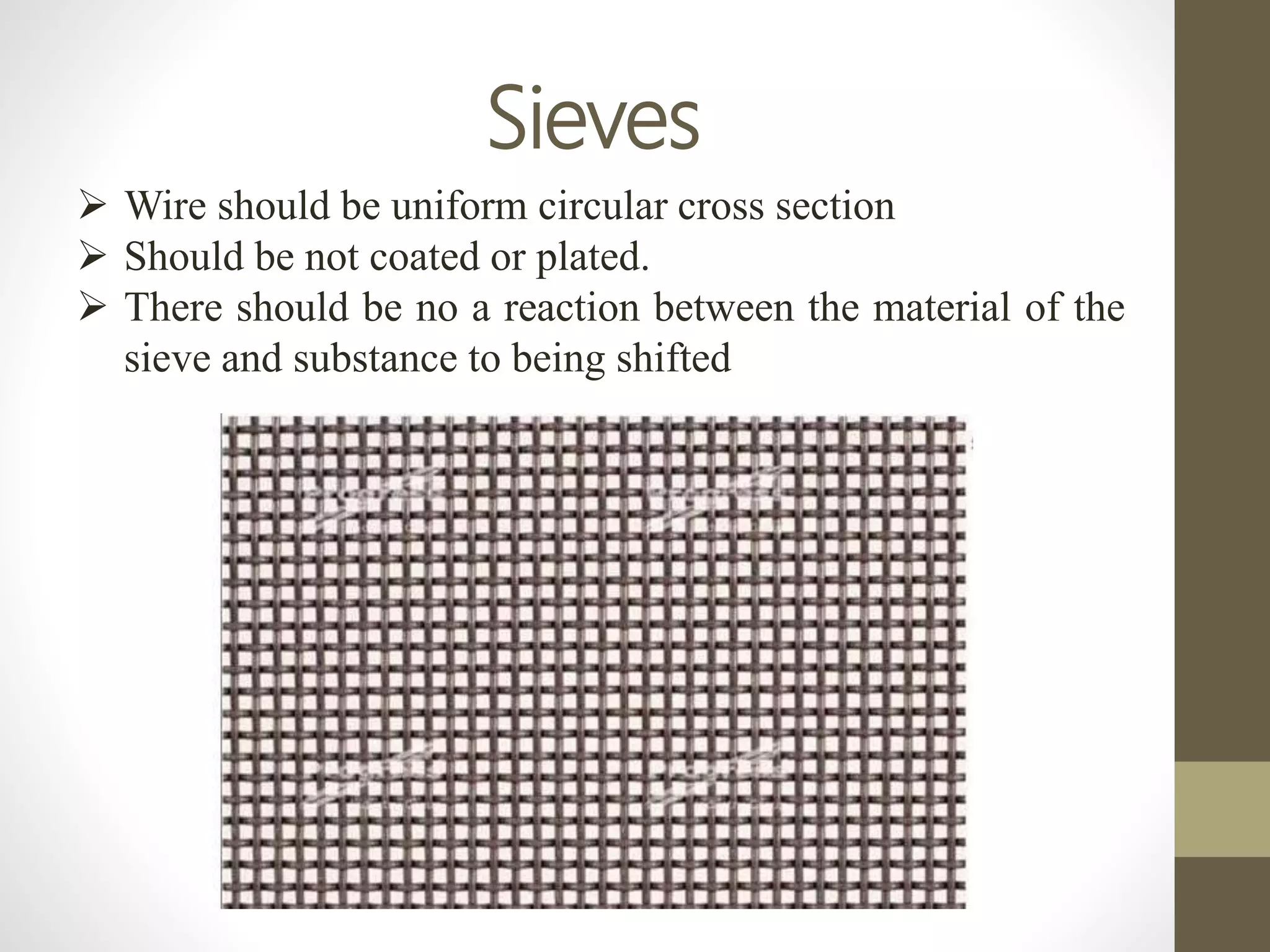
 Wire should be uniform circular cross section
 Should be not coated or plated.
 There should be no a reaction between the material of the
sieve and substance to being shifted
Standards for sieves
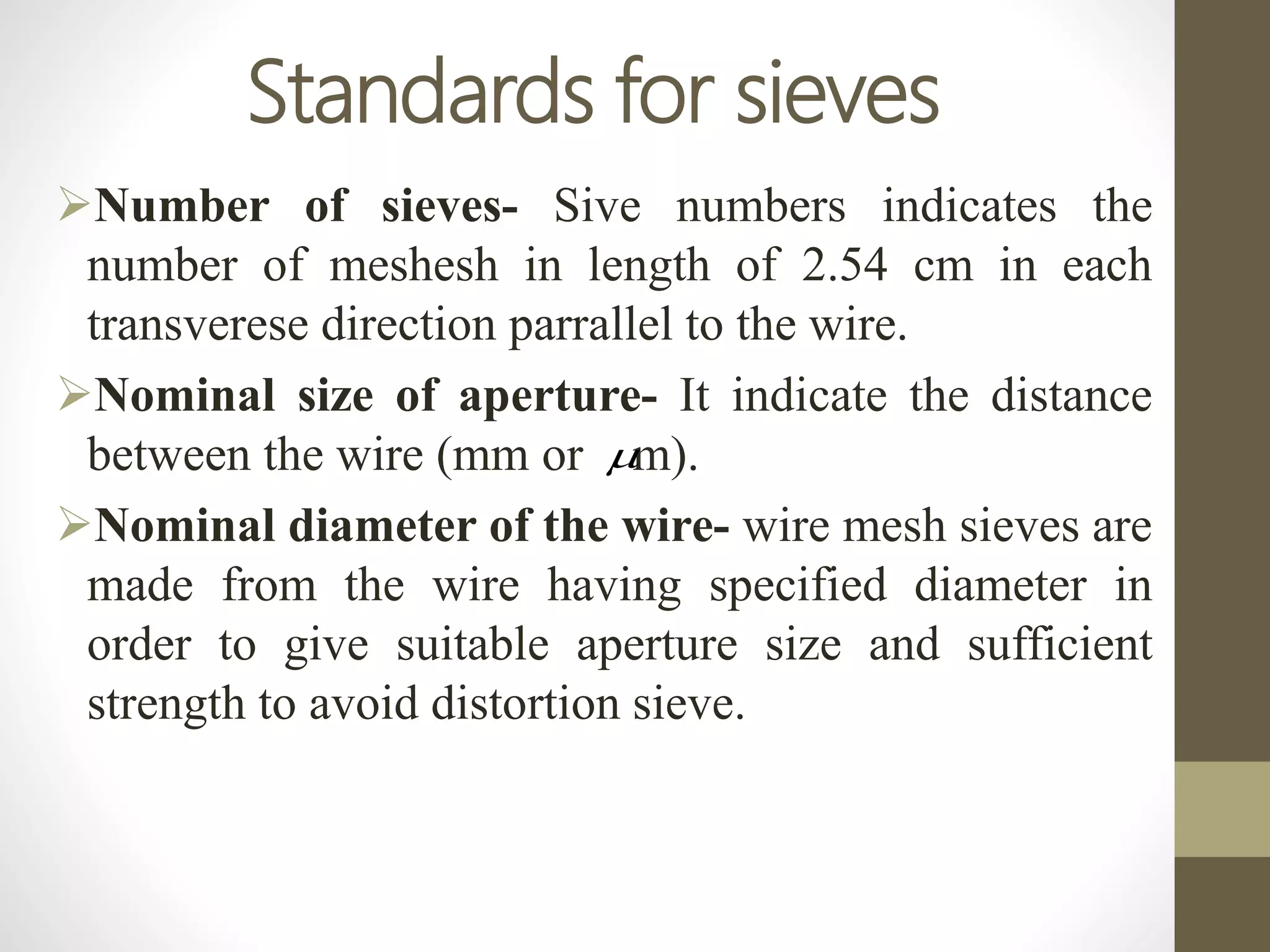
Number of sieves- Sive numbers indicates the
number of meshesh in length of 2.54 cm in each
transverese direction parrallel to the wire.
Nominal size of aperture- It indicate the distance
between the wire (mm or m).
Nominal diameter of the wire- wire mesh sieves are
made from the wire having specified diameter in
order to give suitable aperture size and sufficient
strength to avoid distortion sieve.

Cont.
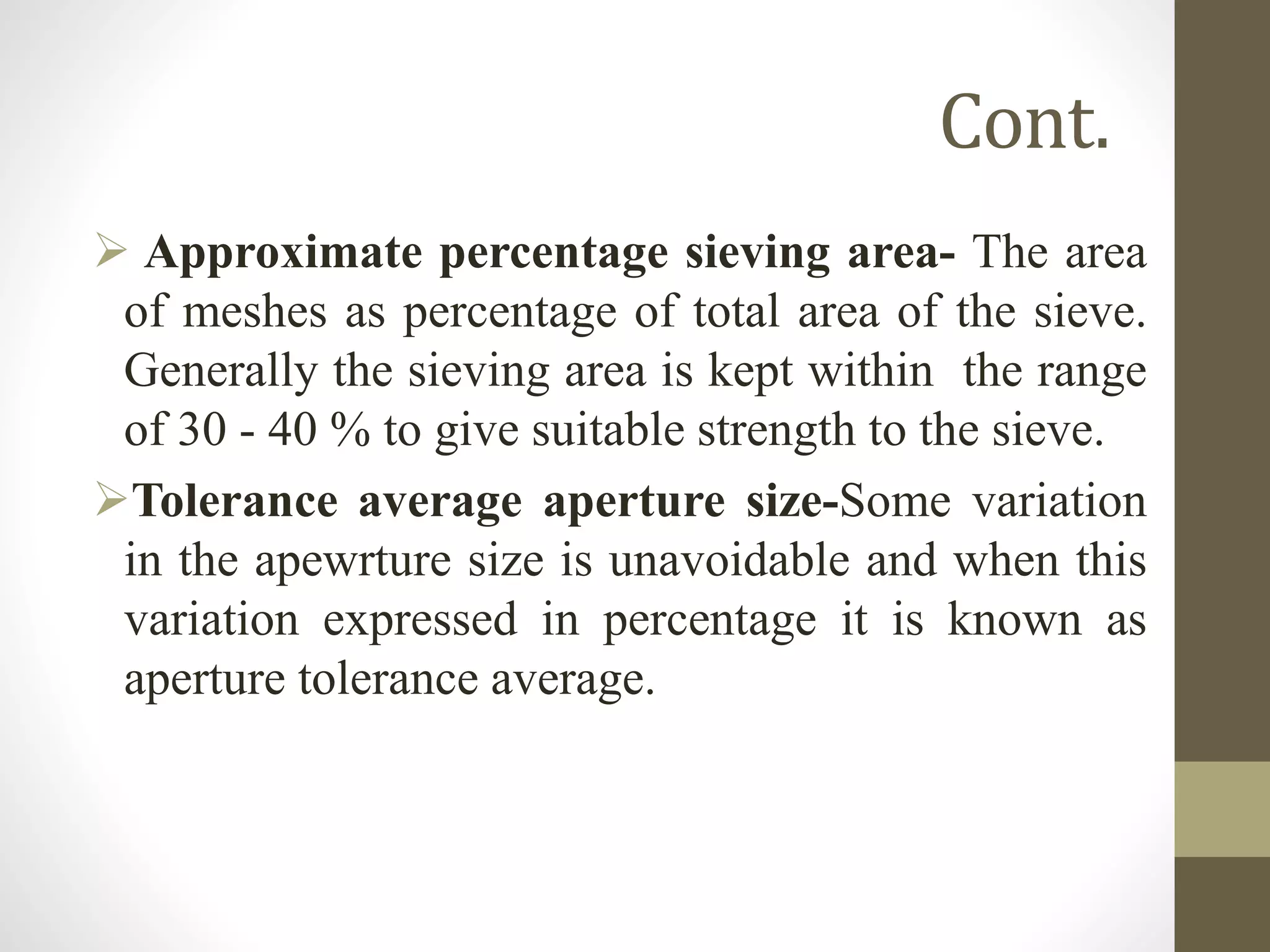
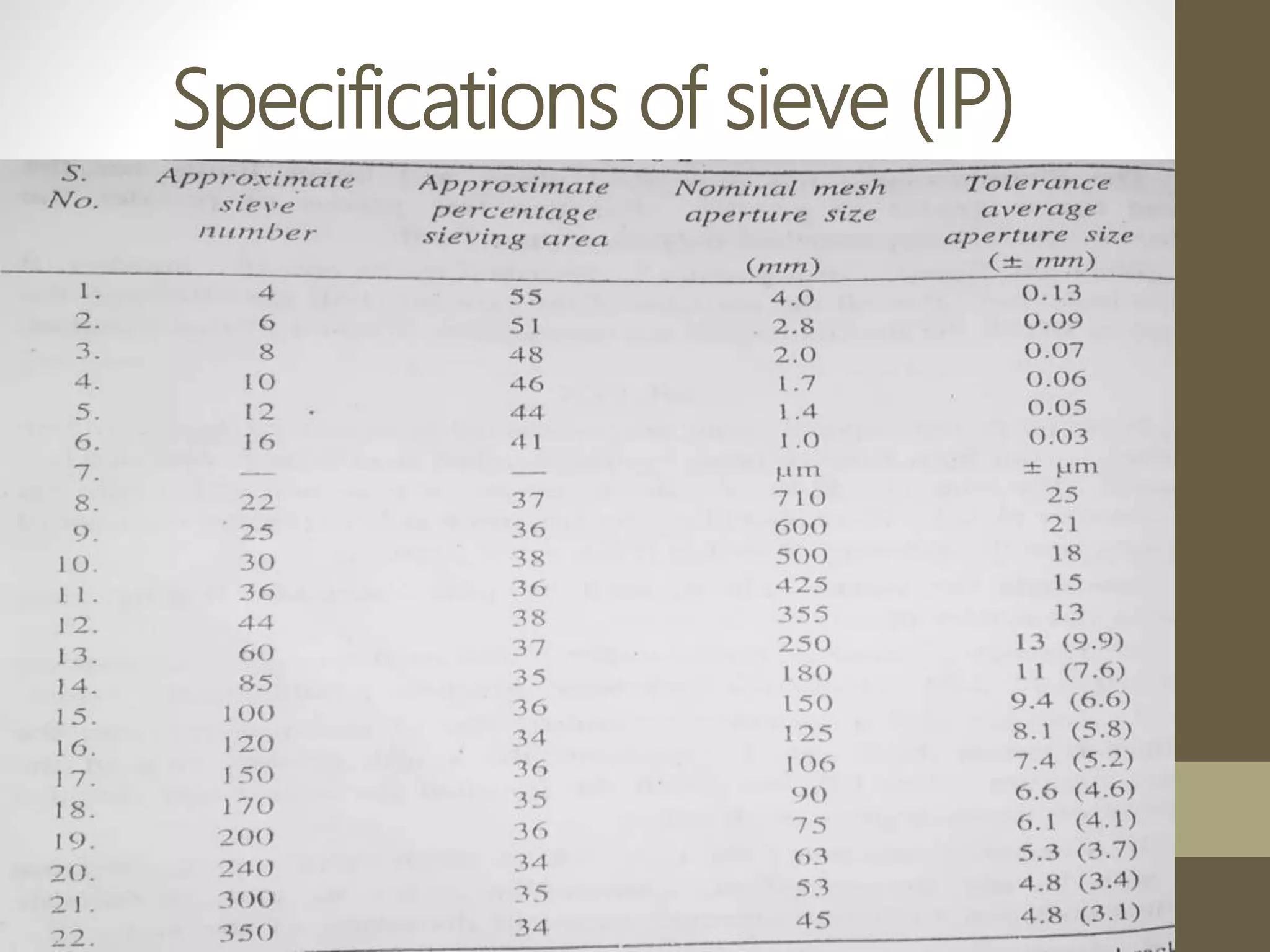
 Approximate percentage sieving area- The area
of meshes as percentage of total area of the sieve.
Generally the sieving area is kept within the range
of 30 - 40 % to give suitable strength to the sieve.
Tolerance average aperture size-Some variation
in the apewrture size is unavoidable and when this
variation expressed in percentage it is known as
aperture tolerance average.
Specifications of sieve (IP)
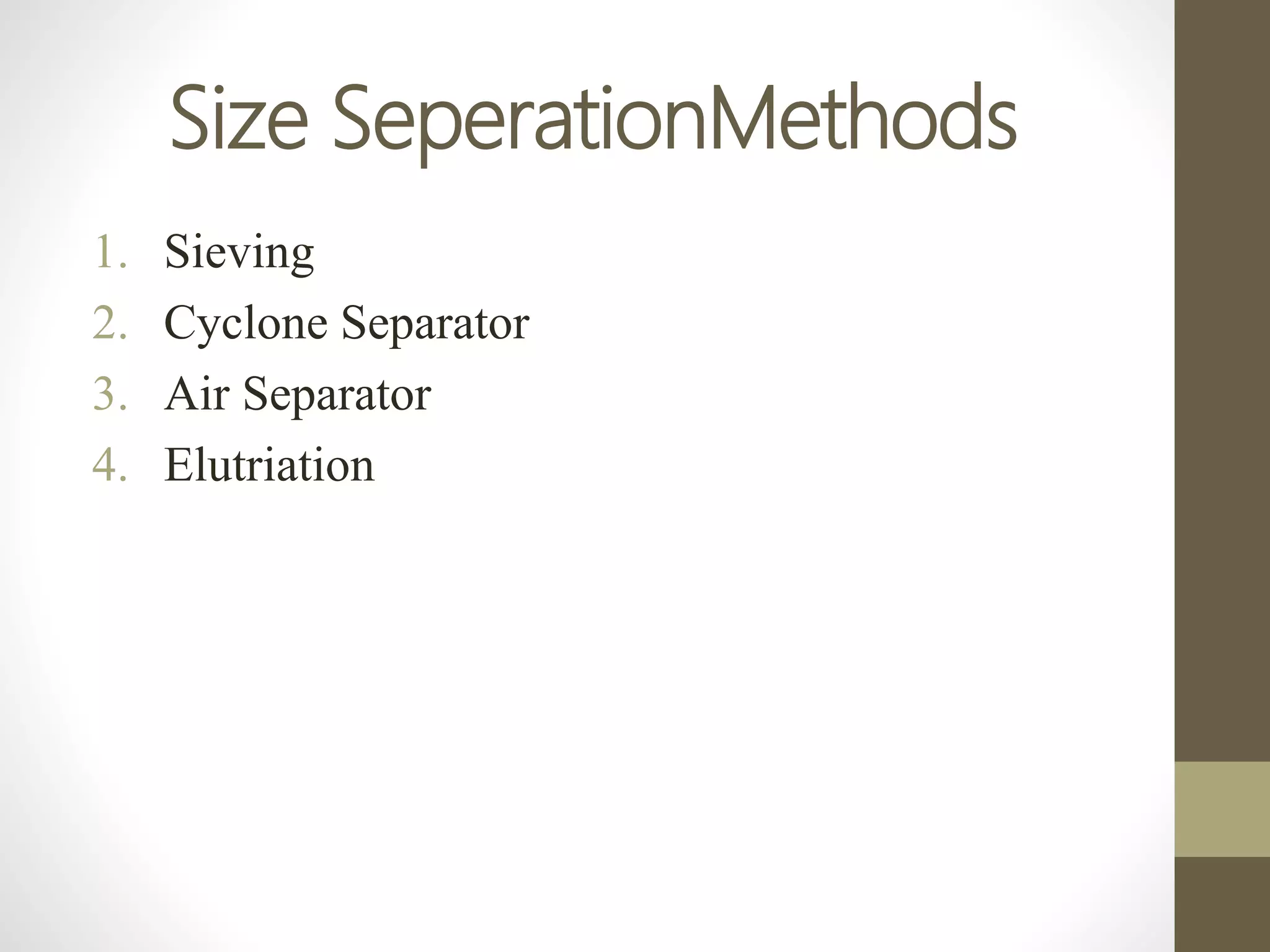
Size SeperationMethods
1. Sieving
2. Cyclone Separator
3. Air Separator
4. Elutriation
Sieving
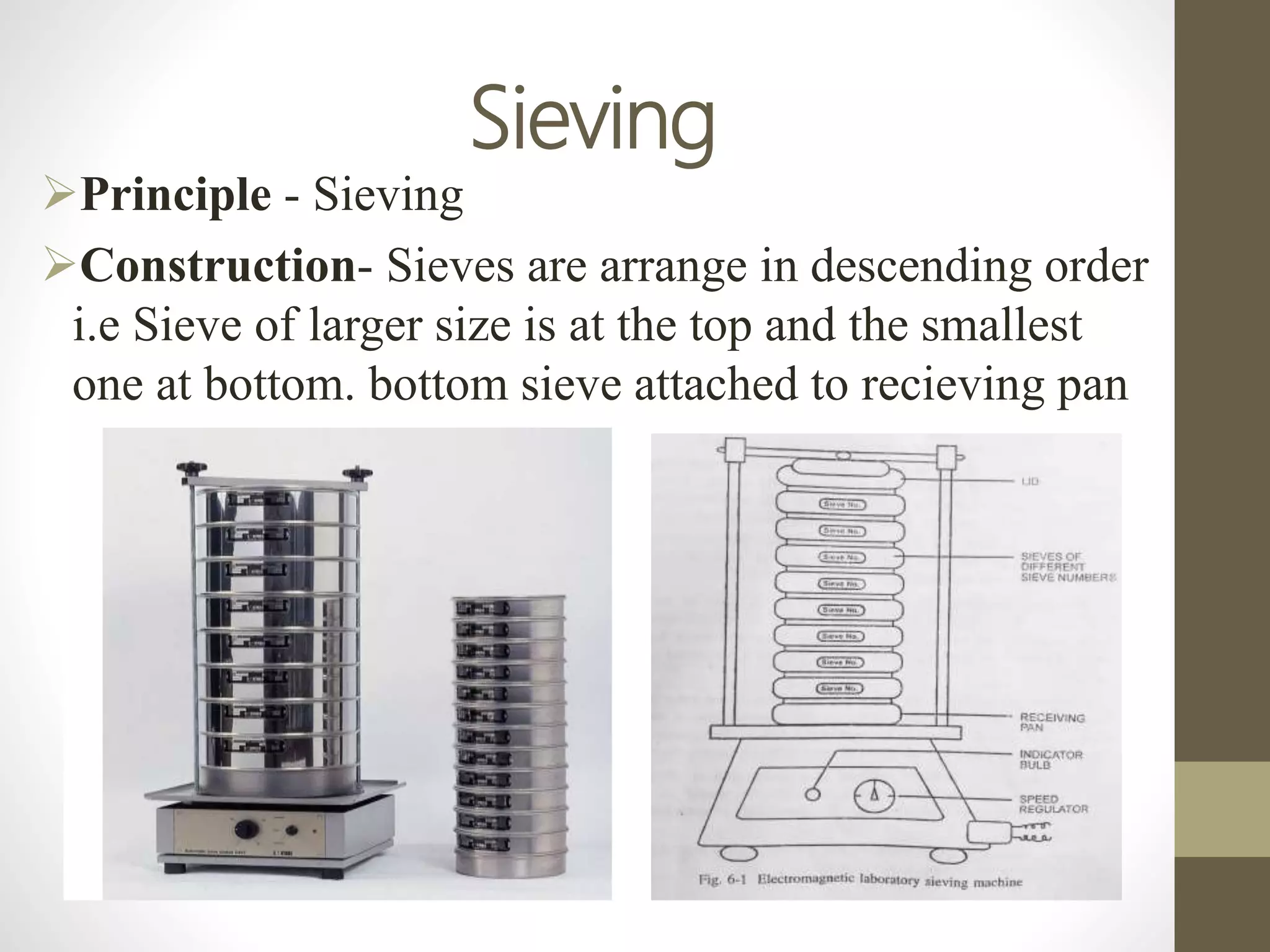
Principle - Sieving
Construction- Sieves are arrange in descending order
i.e Sieve of larger size is at the top and the smallest
one at bottom. bottom sieve attached to recieving pan
Sieving
Working of Mechanical sieving
Working based on
1. Agitation
Oscilation - Back and forth
Vibration - Rapid Rotation
Gyration- Vibration
2. Brushing
3. Centrifugal
Agitation
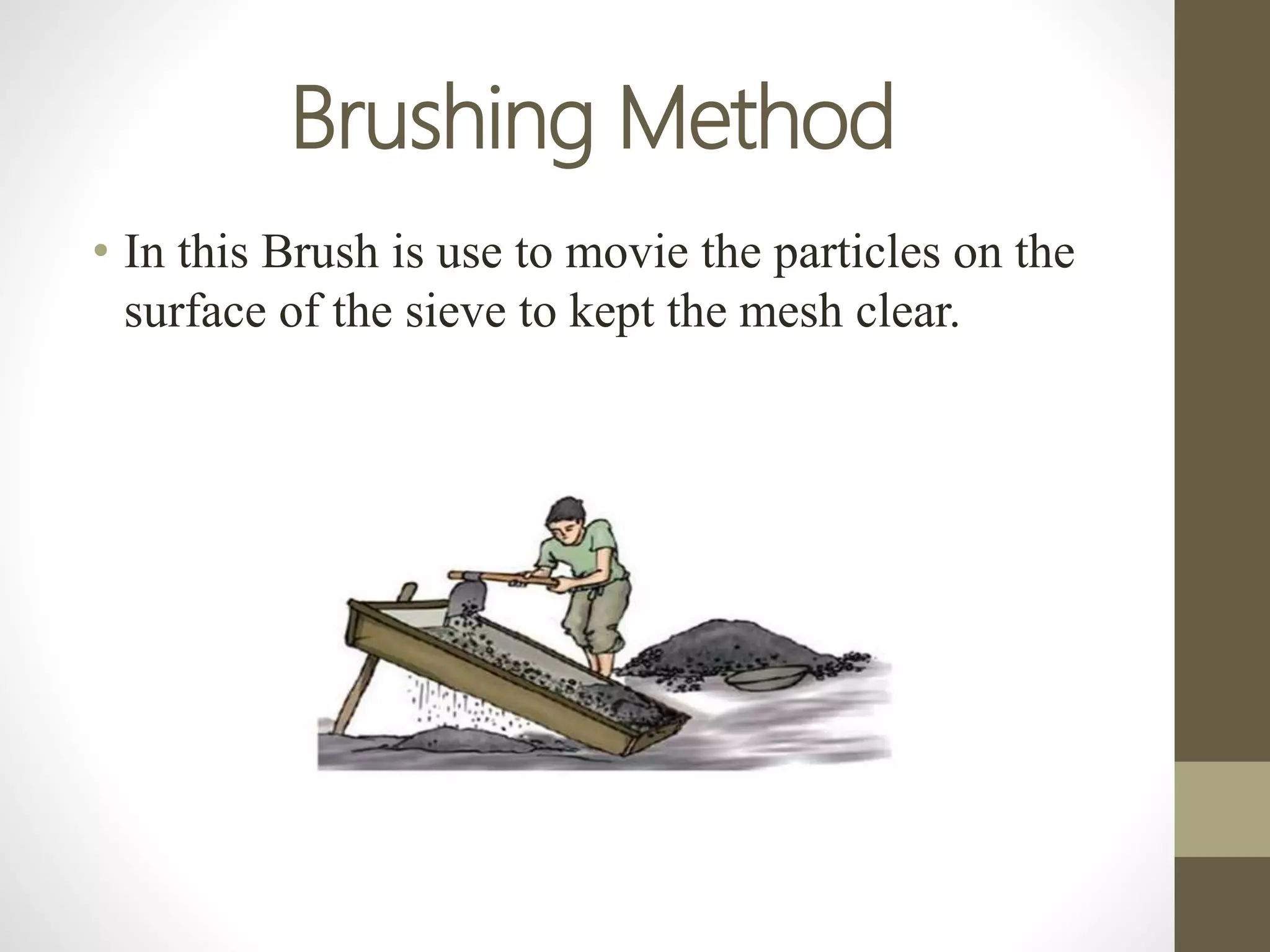
Brushing Method
• In this Brush is use to movie the particles on the
surface of the sieve to kept the mesh clear.
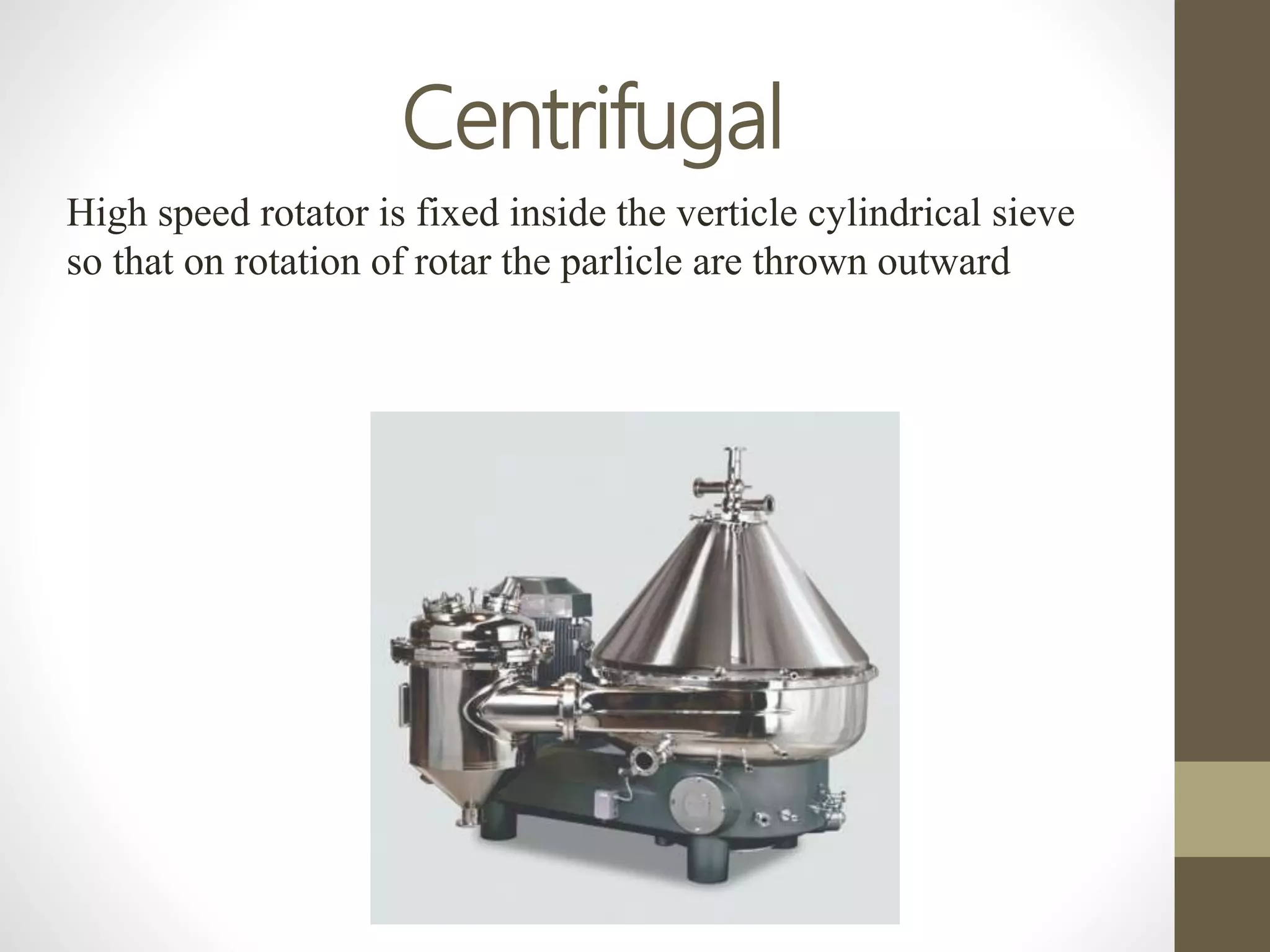
Centrifugal
High speed rotator is fixed inside the verticle cylindrical sieve
so that on rotation of rotar the parlicle are thrown outward
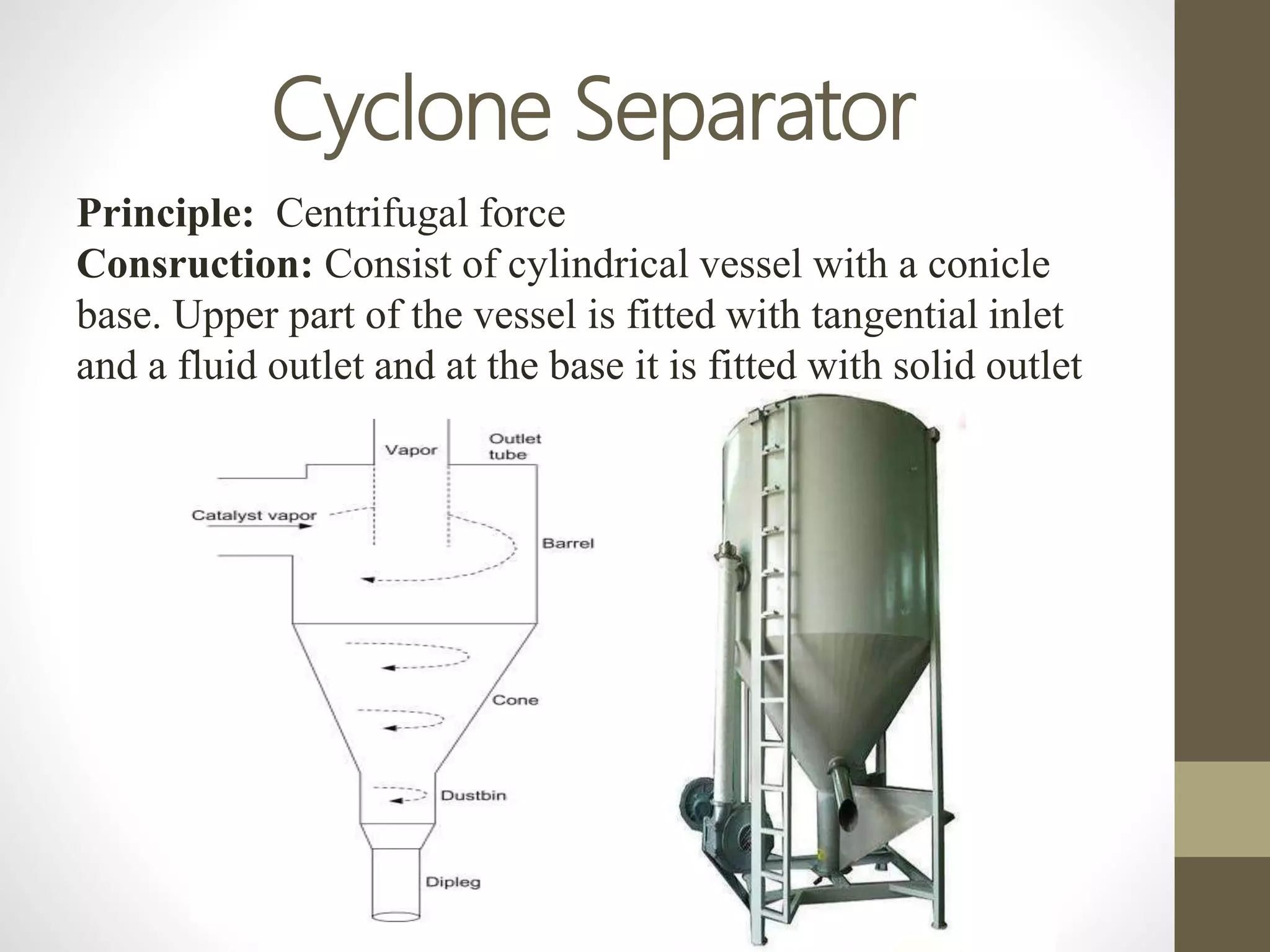
Cyclone Separator
Principle: Centrifugal force
Consruction: Consist of cylindrical vessel with a conicle
base. Upper part of the vessel is fitted with tangential inlet
and a fluid outlet and at the base it is fitted with solid outlet
Cont.
Working: the suspention of a solid in a gas (usually
air) is introud tangentially at th high velocity so that
rotatory movement takes place within the vessel.
The fluid is removed from central outlet at top.
The rotatory flow within the cyclone separator causes
the particle to be acted on by centrifugal force.
The solid are thrown out to th wall, thereafter it falls
to th conical base and dischargr out through solid
outlet.
https://www.youtube.com/watch?v=BrGXXurZers
Cont.
Uses: To separate the suspention of solid in the gas
(air).
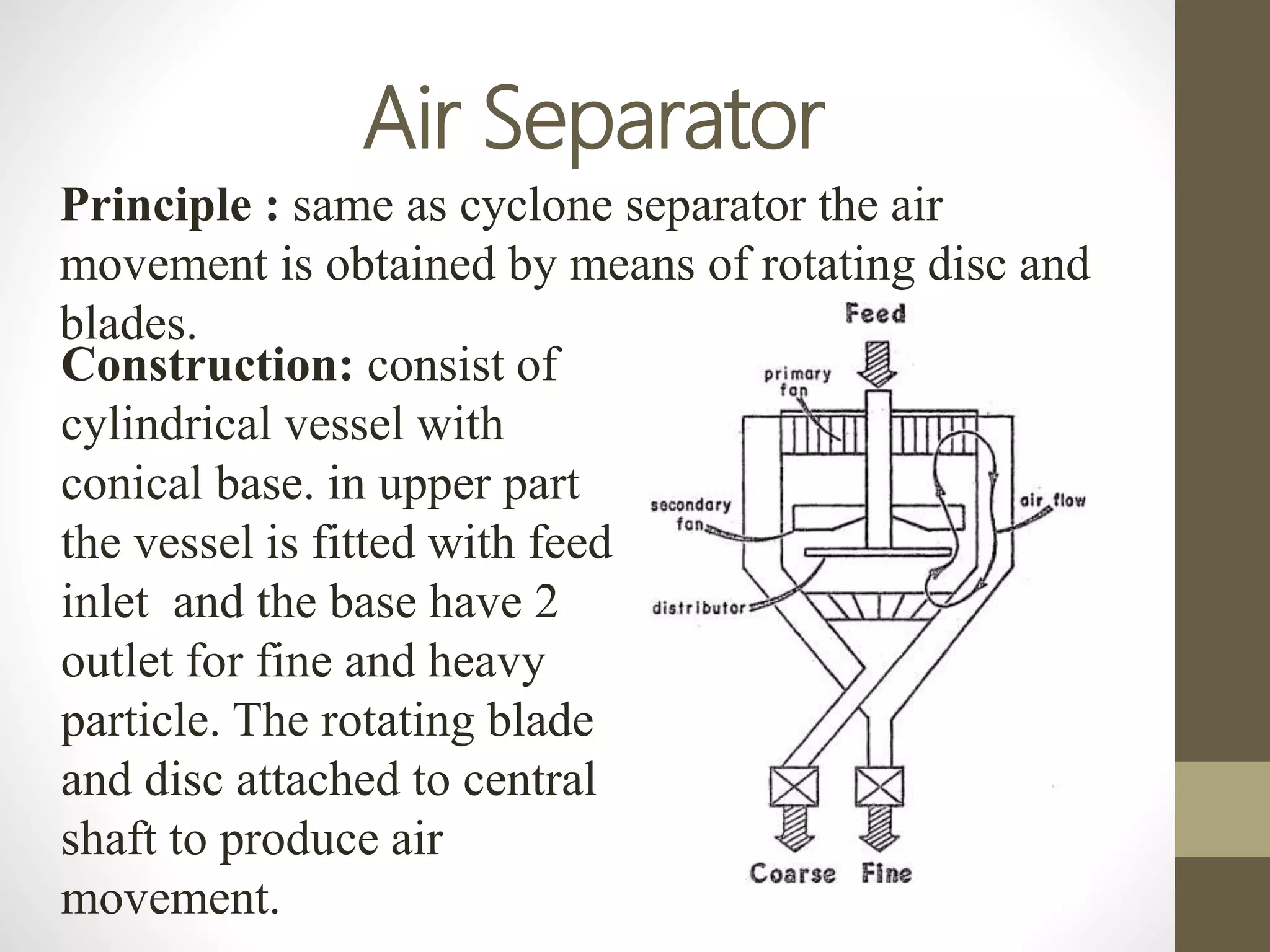
Air Separator
Principle : same as cyclone separator the air
movement is obtained by means of rotating disc and
blades.
Construction: consist of
cylindrical vessel with
conical base. in upper part
the vessel is fitted with feed
inlet and the base have 2
outlet for fine and heavy
particle. The rotating blade
and disc attached to central
shaft to produce air
movement.
Cont.
Working: sample powder pass through the feed inlet
which fall on rotating disc, rotating blade produce
current of air. The fine particles are picked up and are
carried into space, where air velocity is sufficiently
reduced.
the fine particles are dropped and collected into the
oulet of fine particle.
the heavy particles are fall downword are removed
from outlet of heavy particles.
Cont.
Uses: often attached to ball mill or hammer mill to
separate and return over size particles for further
size reduction.
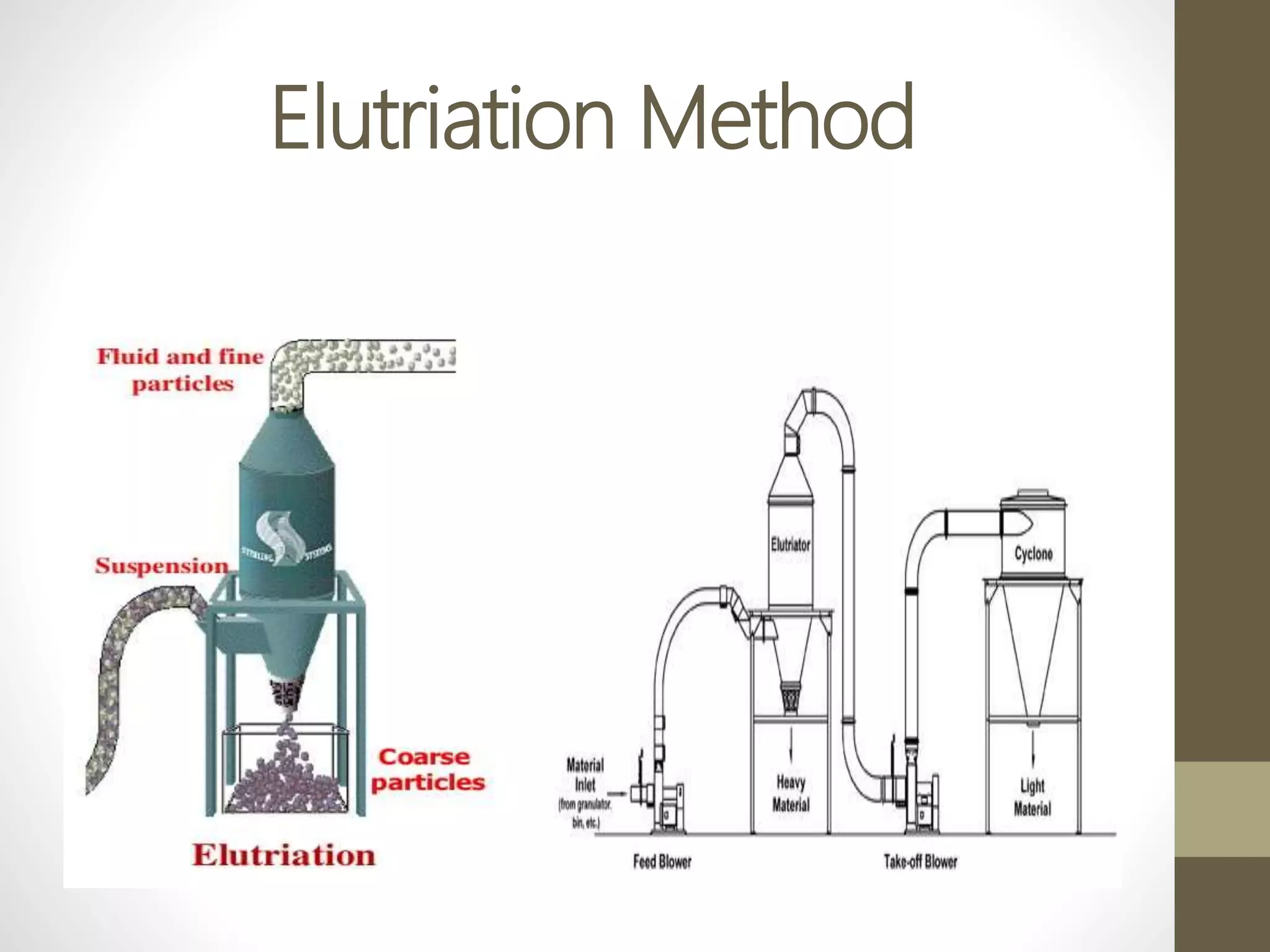
Elutriation Method
Elutriation Method
• The size separation of powder is based on the low
density of fine particles and high density of the
coarse particles. Elutriating tank is used to
separate the coarse and fine particles of powder
after levigation. The dry powder or paste made
by levigation process is kept in an elutriating tank
and mixed with a large quantity of water. The
solid particles are uniformly distributed in the
liquid by stirring and then it is allowed to settle
down. Depending on the density of solid
particles, it will either settle down or remain
suspended in water.
Elutriation Method
• The sample is withdrawn at different heights through the
outlets. These are dried and thus the powder with various size
fractions are collected Nowadays in elutriation process, the
particles are suspended in a moving fluid, generally water or
air. The apparatus consists of a vertical column with an inlet
near the bottom for suspension, an outlet at the base for coarse
particles and an overflow near the top for fluid and fine
articles. One column will give single separation into two
fractions. If more than one fraction is required a number of
tubes of increasing area of cross section can be connected in
series. The velocity of the fluid decreases in succeeding tubes
as the area of cross section increases, thus giving a number of
fractions. These fractions are separated and dried.
Advantages of Elutriation Method
• The process is continuous.
• Depending on the number of fractions required,
the same number of tubes of different area of
cross section can be connected.
• The separation is quick as compare to other
methods of separation.
• The apparatus is more compact than as that used
in sedimentation methods.
Disadvantages
• The main disadvantage of this method is that the
suspension of solid particles has to be diluted which
may not be desired in certain cases.
THANK
YOU

B.Pharm, Sem 3 size separation

  • 1.
    Size Separation By Yogeshwary Bhongade Assistant Professor M.Pharm. Gondia College of Pharmacy, Gondia
  • 2.
    CONTENT • Objectives, applications& mechanism of size separation, • official standards of powders, sieves, • size separation Principles, construction, working, uses, merits and demerits of -Sieve shaker, -Cyclone separator, -Air separator, -Bag filter, -Elutriation tank.
  • 3.
    Size Separation • Itis a process of separation of particle of desired size from mixer of various size particle. • Size separation is also known as sieving, shifting or screening. • It gives the particle of varying size. • To get narrow particle size sifting is done. • Reduction of size alone is not sufficient to obtained the mono size or narrow size range powder so size reduction followed by size separation should be combine to obtained powder of desired size.
  • 4.
  • 5.
    Objectives • To determineparticle size for production of tablets and capsule • To improve mixing of powder. • To improve solubility and stability of particles during production. • To optimize feed rate, agitation, screening during production. • Quality control of raw material. • Useful in production of tablets, capsule, suspension, ophthalmic preparations, ointments, cream etc.
  • 6.
    Application of sizeseparation • To prepare granules of desired size to ensure good flow ability. • To separate undesirable particles. • To measure particle size and size distribution. • To know the efficiency of size reduction equipment. • To get uniform dosage form. • Mono-size particles undergoes less segregation. • During filling capsules, the particles must be uniform in weight and dosade.
  • 7.
    Mechanism of SizeSeparation Mechanism Agitation Brushing Centrifugal Force  Oscillation  Vibration  Gyration
  • 8.
    Agitation • Sieve maybe agitated in number of different ways. Oscillation Sieve is mounted on frame that oscillates back and forth It is simple method, but the material can roll on surface of the sieve.
  • 9.
    Cont. Vibration Sieve is vibratedat high speed by means of electric devices either electrically or mechanically. The rapid vibration is imparted to the particle on the sieve which help to pass the powder material through it.
  • 10.
    Cont. Gyration • In thismethod sieve is rubber mounted and connected to an electrical flywheel. • This gives a rotatory movement of small amplitude to sieve which in turn gives spinning motion to the particle that help to pass them through a sieve. • Agitation methods are not continuous methods but can be made so by inclination of the sieve and the provision of separate outlets for undersize and oversize particle.
  • 11.
    Advantages & Disadvantages Advantages •Simple method • Inexpensive method Disadvantages • Chance of clogging of sieve if powder is not dried • Size reduction occurs due to collision between particle during agitation
  • 12.
    Brushing • In thismethod, the brush is used to move the particle on the surface of sieve and keep the meshes clear. • The brush is rotated in the centre in the case of circular sieve, but the spiral brush is rotated in the longitudinal axis in the case of horizontal cylindrical sieve • It is use to separate the size of greasy or sticky powder.
  • 13.
    Centrifugal Force • Inthis method the high speed rotor is fixed inside a vertical cylindrical sieve, so that during rotation the particles are thrown out by centrifugal force. • The air stream can be generated by means of air get in the equipment, which help in the separation of particles. • Cyclone separator and Air separation Advantages • Chance of blockage of sieve is less
  • 14.
    Official Standards ofpowder Coarse Powder sieve 10/44 Moderately Coarse Powder sieve 22/60 Fine Powder sieve 85 Very Fine Powder sieve 125 Moderately Fine Powder sieve 44/85 According to indian pharmaopoeia 5 official standards of powder are-
  • 15.
    Sr. No Grade of powder sieve through all particlepa ss Nominal mesh aparature size sieve through which 40% of particle pass Nominal mesh aparature size 1 Coarse 10 1.7mm 44 355mm 2 Moderatel y Coarse 22 710mm 60 250mm 3 Moderatel y Fine 44 355mm 85 180mm 4 Fine Powder 85 180mm - - 5 Very Fine 120 125mm - -
  • 16.
    Sieves Sieves for pharmacopoeialtesting are contructed from wire cloth with square meshes, woven from wire of brass, bronze, stainless steel or other suitable material.
  • 17.
    Sieves  Wire shouldbe uniform circular cross section  Should be not coated or plated.  There should be no a reaction between the material of the sieve and substance to being shifted
  • 18.
    Standards for sieves Numberof sieves- Sive numbers indicates the number of meshesh in length of 2.54 cm in each transverese direction parrallel to the wire. Nominal size of aperture- It indicate the distance between the wire (mm or m). Nominal diameter of the wire- wire mesh sieves are made from the wire having specified diameter in order to give suitable aperture size and sufficient strength to avoid distortion sieve. 
  • 19.
    Cont.  Approximate percentagesieving area- The area of meshes as percentage of total area of the sieve. Generally the sieving area is kept within the range of 30 - 40 % to give suitable strength to the sieve. Tolerance average aperture size-Some variation in the apewrture size is unavoidable and when this variation expressed in percentage it is known as aperture tolerance average.
  • 20.
  • 21.
    Size SeperationMethods 1. Sieving 2.Cyclone Separator 3. Air Separator 4. Elutriation
  • 22.
    Sieving Principle - Sieving Construction-Sieves are arrange in descending order i.e Sieve of larger size is at the top and the smallest one at bottom. bottom sieve attached to recieving pan
  • 23.
    Sieving Working of Mechanicalsieving Working based on 1. Agitation Oscilation - Back and forth Vibration - Rapid Rotation Gyration- Vibration 2. Brushing 3. Centrifugal
  • 24.
  • 25.
    Brushing Method • Inthis Brush is use to movie the particles on the surface of the sieve to kept the mesh clear.
  • 26.
    Centrifugal High speed rotatoris fixed inside the verticle cylindrical sieve so that on rotation of rotar the parlicle are thrown outward
  • 27.
    Cyclone Separator Principle: Centrifugalforce Consruction: Consist of cylindrical vessel with a conicle base. Upper part of the vessel is fitted with tangential inlet and a fluid outlet and at the base it is fitted with solid outlet
  • 28.
    Cont. Working: the suspentionof a solid in a gas (usually air) is introud tangentially at th high velocity so that rotatory movement takes place within the vessel. The fluid is removed from central outlet at top. The rotatory flow within the cyclone separator causes the particle to be acted on by centrifugal force. The solid are thrown out to th wall, thereafter it falls to th conical base and dischargr out through solid outlet. https://www.youtube.com/watch?v=BrGXXurZers
  • 29.
    Cont. Uses: To separatethe suspention of solid in the gas (air).
  • 30.
    Air Separator Principle :same as cyclone separator the air movement is obtained by means of rotating disc and blades. Construction: consist of cylindrical vessel with conical base. in upper part the vessel is fitted with feed inlet and the base have 2 outlet for fine and heavy particle. The rotating blade and disc attached to central shaft to produce air movement.
  • 31.
    Cont. Working: sample powderpass through the feed inlet which fall on rotating disc, rotating blade produce current of air. The fine particles are picked up and are carried into space, where air velocity is sufficiently reduced. the fine particles are dropped and collected into the oulet of fine particle. the heavy particles are fall downword are removed from outlet of heavy particles.
  • 32.
    Cont. Uses: often attachedto ball mill or hammer mill to separate and return over size particles for further size reduction.
  • 33.
  • 34.
    Elutriation Method • Thesize separation of powder is based on the low density of fine particles and high density of the coarse particles. Elutriating tank is used to separate the coarse and fine particles of powder after levigation. The dry powder or paste made by levigation process is kept in an elutriating tank and mixed with a large quantity of water. The solid particles are uniformly distributed in the liquid by stirring and then it is allowed to settle down. Depending on the density of solid particles, it will either settle down or remain suspended in water.
  • 35.
    Elutriation Method • Thesample is withdrawn at different heights through the outlets. These are dried and thus the powder with various size fractions are collected Nowadays in elutriation process, the particles are suspended in a moving fluid, generally water or air. The apparatus consists of a vertical column with an inlet near the bottom for suspension, an outlet at the base for coarse particles and an overflow near the top for fluid and fine articles. One column will give single separation into two fractions. If more than one fraction is required a number of tubes of increasing area of cross section can be connected in series. The velocity of the fluid decreases in succeeding tubes as the area of cross section increases, thus giving a number of fractions. These fractions are separated and dried.
  • 36.
    Advantages of ElutriationMethod • The process is continuous. • Depending on the number of fractions required, the same number of tubes of different area of cross section can be connected. • The separation is quick as compare to other methods of separation. • The apparatus is more compact than as that used in sedimentation methods.
  • 37.
    Disadvantages • The maindisadvantage of this method is that the suspension of solid particles has to be diluted which may not be desired in certain cases.
  • 38.