BIOSIMILARS
PRESENTED BY :
YOGESHWARY BHONGADE
M.PHARM (SEM I)
PHARMACOLOGY
ROLL NO. 32
GUIDED BY :
Dr . V. S. NADE
DEPARTMENT OF
PHARMACOLOGY
MVP’S COLLEGE OF PHARMACY,NASHIK
1
CONTENTS
• Introduction
• Background & objective
• Applicable regulations and guidelines
• Competent authorities
• Scope
• Principle for development of similar biologics
• Data requirements for preclinical study
• Data requirements for clinical trial application
• Post market data for similar biologics 2
LEARNING OBJECTINES
• Study of Biological & small molecule including there
molecular and manufacturing difference.
• Biological and biosimilars.
• Regulatory requirements for marketing authorization in
India.
• Discuss the quality, safety and efficacy.
• Discuss the EMEA status of biosimilars: approval or
rejection.
• Key component of successful pharmacovigilance program.
3
BIOPHARMACEUTICALS
• Biopharmaceuticals/Biologics referred broadly to
the substance produced by living cells using
biotechnology (i.e., Recombinant DNA technology,
Controlled gene expression or Antibody
technologies).
• Biosynthetic human insulin was the first
biopharmaceuticals product or biologics made by
rDNA technology.
4
BIOPHARMACEUTICAL FAMILIES
• Hormone
• Enzyme
• Clotting factor
• Cell therapies
• Monoclonal antibodies
• Cytokines and peptides
• Vaccines
• Antisense drug
5
PRODUCT RELATED DIFFERENCES
Small molecule drug
• Produced by chemical synthesis
• Low molecular weight
• Well-defined physiochemical properties
• Stable
• Single entity, high chemical purity, purity
standards well established
• Administered through different routes of
administration
• Rapidly enters systemic circulation through
blood capillaries
• Distribution to any combination of organ/tissue
• Often specific toxicity
• Often non-antigenic
Biologic drug
• Biotechnologically produced by host cell lines
• High molecular weight
• Complex physiochemical properties
• Sensitive to heat and shear (aggregation)
• Heterogeneous mixture, broad specification which may
change during development, difficult to standardize
• Usually administered parenteraly
• Larger molecule primarily reach circulation via
lymphatic system, subject to proteolysis during
interstitial and lymphatic transit
• Distribution usually limited to plasma and/or
extracellular fluid
• Mostly receptor mediated toxicity
• Usually antigenic
6
MANUFACTURING DIFFERENCES
Small molecule drugs
• Completely characterized by analytical methods
• Easy to purify
• Contamination can be generally avoided, is easily
detectable and removable
• Not affected by slight changes in production process
and Environment
biologics
• High possibility of contamination, detection is
harder and removal is often impossible
• Highly susceptible to slight changes in
production process and environment
7
FACTS &FIGURES
• The global revenue of Biologicals were found $125 billions in
2009.
• There are more than 200 Biological which are already in
market.
• 25% of pipeline drug are Bilogicals.
8
MANUFACTURING OF BIOLOGICALS
9
Figure 1 Typical steps involved in manufacturing of a biologic product.
Desired gene isolation Insertion into vector
Cell culture
Cell bank
establishment
and characterization
Protein production
Host cell expression
Protein purification
Analysis Formulation
Storage &
handling
9
MANUFACTURING OF SMALL MOLECULE
Pre-
formulation
study
Identify
formulation
& process
Evaluation
product &
process
Manufacturing
product
Mount stability
test
stop
10
PATENT EXPIRATION OF BIOLOGICALS
/ BIOPHARMACUETICALS
11
Biopharmaceuti
cals
Products Indication(s) US patent status EU patent status
Genentech Nutropin™
(somatropin)
Growth
disorders
Expired Expired
Abbott Abbokinase™
(eudurase
urokunase)
Ischemic events Expired Expired
Eli lilly Humulin™
(recombinant
insulin)
Diabetes Expired Expired
Genzyme Ceredase™
(algucerase)
Gaucher disease
Expired Expired
12
Biopharmaceutic
als
Products Indication(s) US Patent
Status
EU Patent Status
Astrazeneca Streptase™
(Streptokinase)
Ischemic Events Expired Expired
Biogen/Roche Intron ATM
(Ifn-alfa-2b)
Hepatitis B And
C
Expired Expired
Serono Serotim™
(Somatropin)
AIDS Wasting Expired Na
Eli Lilly Humatrope™
(Somatropin)
Growth
Disorders
Expired Na
Amgen Epogen™,
Procrit™,
Epres™
(Erythropoietin)
Anemia Expired Expired
13
Biopharmaceutica
ls
Products Indication(s) US Patent
Status
EU Patent Status
Roche Neorecormon™
(Erythropoietin)
Anemia Na Expired
Genetech Tnkase™
(Tenecteplase
Tnk-tpa)
Acute
Myocardial
Infarction
Expired Expired
Inter Mune Actimmune™
(Ifn-gamma-ib)
CGD,
Malignant
Obsteopetrosis
Expired Na
Genetech Alteplase™
(Tpa)
Acute
Myocardial
Infarction
Expired Expired
Chiron Proleukin™
(IL-2)
Hiv Expired Expired
14
15
INTRODUCTION
• Biosimilars are equivalent of generic for
biologicals.
• These are biological medicine that is develop to
be highly similar to an existing biological
medicine (the reference medicine).
• It does not have any meaningful difference from
the reference medicine in term of quality, safety
and efficacy.
16
FACTS ABOUT BIOSIMILORS
17
BIOSIMILAR
MEDICINES a major
opportunity for the EU
Since 2006, eu approved biosimilar
medicines have generated more than 400
million patient days of clinical experience
worldwide
EU approved biosimilar
medicines are available for
patients in over 60 countries
around the world, and
recognized as high quality, safe
and effective medicines
The first worldwide biosimilar
medicine (somatropin) was
approved in the EU in 2006
Over 14 european countries have
manufacturing sites for biosimilar
medicines, or biosimilar candidates
under development or under
evaluation
The use of biosimilars is expected
to result in overall savings from
€11.8 up to €33.4 billion for 8 EU
countries between 2007-20203
6 biological medicines with sales
Of €10.1 billion in 2013 in europe
alone will lose exclusivity by 2020
The entrance of biosimilar
filgastrim increased patient
access by 44% in the UK
between 2009 and 2012
The first biosimilar monoclonal antibody
medicine (infliximab) was approved in the
EU in 2013
BACKGREOUND AND OBJECTIVES
• CDSCO is the national regulatory authority in
India that evaluates safety, efficacy and quality of
drugs in the country.
• DBT through Review Committee on Genetic
Manipulation (RCGM) is responsible for overseeing
the development and preclinical evaluation of
recombinant Biologics.
19
APPLICABLE REGULATIONS &GUIDLINES
The Similar Biologics are regulated as per the
Drugs and Cosmetics Act, 1940, the Drugs and
Cosmetics Rules, 1945 (as amended from time to
time) and Rules for the manufacture, use,
import, export and storage of hazardous
microorganisms/ genetically engineered
organisms or cells, 1989 (Rules, 1989) notified
under the Environment (Protection) Act, 1986.
20
VARIOUS APPLICABLE GUIDLINES
• Recombinant DNA Safety Guidelines, 1990.
• Guidelines for generating preclinical and clinical
data for rDNA vaccines, diagnostics and other
Biologicals, 1999
• CDSCO guidance for industry, 2008:
 Submission of Clinical Trial Application for Evaluating
Safety and Efficacy.
 Requirements for permission of New Drugs Approval
21
Cont.
 Post approval changes in Biological products: Quality, Safety and
Efficacy Documents.
 Preparation of the Quality Information for Drug Submission for
New Drug Approval : Biotechnological/Biological Products
• Guidelines and Handbook for Institutional Biosafety
Committees (IBSCs), 2011
• Guidelines on Similar Biologics: Regulatory
Requirements for Marketing authorization in India 2012
22
COMPETENT AUTHORITIES
• Institutional biosafety committee(IBSC)
• Review committee on generic
manipulation(RCGM)
• Genetic engineering appraisal
committee(GEAC)
• Central drug standard control organization
(CDSCO)
23
SCOPE
Market value
Indian biological market crossed US $3
billions in 2011-2012 when compared with
the global sale of the biologics US $157
billions in 2012.
24
• Many qualities that attribute to the success of India in
global market
 Literacy
 Change
 Advancement of science
 Cost of biosimilars
 Less entry of competitors
 Government initiative to encourage biosimilars
25
PRINCIPLE FOR DEVELOPMENT OF SIMILAR
BIOLOGICS
• Selection of reference biologic
• Manufacturing process
 Molecular biology consideration
 Upstream process development
• Downstream process development
• Quality based consideration for
similar biologics
 Analytical method
 Product characterization
26
 Product characterization
-Structural and physicochemical properties
-Biological activity
-Immunological properties
-Purity and impurities
 Specifications
 Stability
 Quality comparability study
Cont.
27
• Data requirement for preclinical studies
 Prerequisite before conducting preclinical study
 Preclinical studies ( pharmacodynamics & technology studies)
- Pharmacodynamics studies
-Toxicological study
 Immune responses in animals
• Data requirements for clinical trial application
 Pharmacokinetic (pk) studies
-Single dose comparative PK studies
-Multiple dose comparative PK studies
Cont.
28
• Pharmacodynamics studies
• Confirmatory safety and efficacy study
 Waiver of safety and efficacy study
 Non-comparative safety and efficacy study
• Safety and immunogenicity data
• Extrapolation of efficacy and safety data on other
indications
Cont.
29
POST-MARKET DATA FOR
SIMILAR BIOLOGICS
• Pharmacovigilance plan
• Adverse drug reaction reporting
• Post marketing studies (phase IV study)
30
Status of similar
biologics in India
31
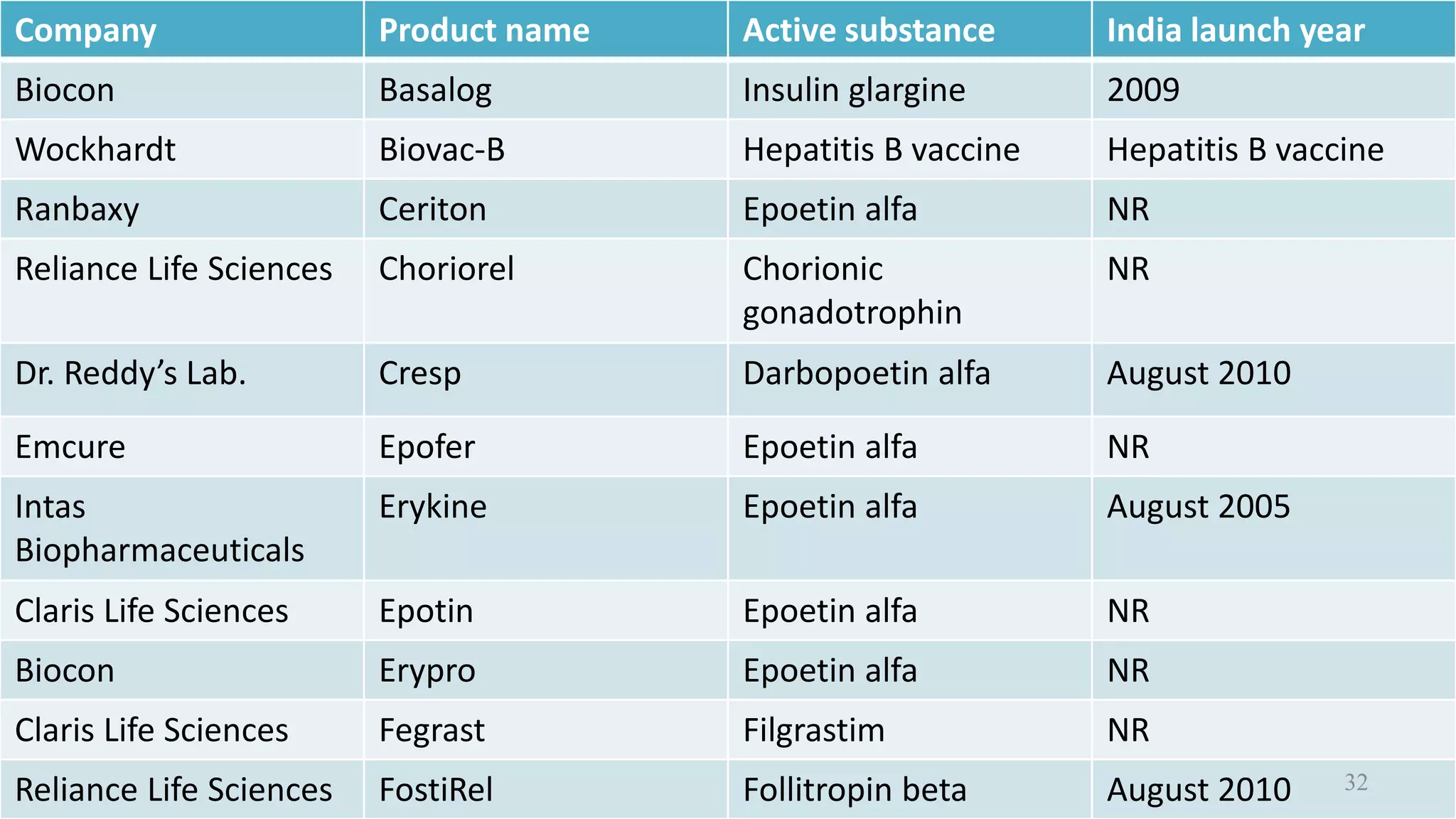
Company Product name Active substance India launch year
Biocon Basalog Insulin glargine 2009
Wockhardt Biovac-B Hepatitis B vaccine Hepatitis B vaccine
Ranbaxy Ceriton Epoetin alfa NR
Reliance Life Sciences Choriorel Chorionic
gonadotrophin
NR
Dr. Reddy’s Lab. Cresp Darbopoetin alfa August 2010
Emcure Epofer Epoetin alfa NR
Intas
Biopharmaceuticals
Erykine Epoetin alfa August 2005
Claris Life Sciences Epotin Epoetin alfa NR
Biocon Erypro Epoetin alfa NR
Claris Life Sciences Fegrast Filgrastim NR
Reliance Life Sciences FostiRel Follitropin beta August 2010 32
Company Product name Active substance India launch year
Dr.Reddy’s lab Grafeel Filgrastim NR
Wockhardt Glaritus Insulin glargine March 2009
Biocon Insugen Human insulin NR
Intas
Biopharmaceuticals
Intalfa Interferon alpha-2b April 2007
Reliance Life Sciences Mirel Reteplase 2009
Biocon Myokinase Streptokinase NR
Intas
Biopharmaceuticals
Neukine Filgrastim July 2004
intas
Biopharmaceuticals
Neupeg Peg-filgrastim August 2007
Biocon Nufil Filgrastim NR
Dr. Reddy’s Lab. Peg-grafeel Peg-filgrastim 10 May 2011
Dr. Reddy’s Lab. Reditux Rituximab 30 April 200733
REFERENCE
• Guideline For The Similar Biologics : Regulatory Requirement For Marketing
Authorization In India
• Sekhon Bs, Saluja V. Biosimilar:an Overview Expert Opinion 2011;1:1-11.
• http:/pwww.Pharmac.Govt.Nz
• Mueller H . Patenting Of Biosimilar ?.Intel Prop Rights 2014:2;4.
• Farhat F, Torreso A, Park W, Lopes G, Mudha R, Ikpazu C, Aad Sa. et al. THE
Concept Of Biosimilars:form Charactrization To Evalution-narrative. New Drug
Development And Clinical Pharmacology.2018;23:46-52.
• Kumar R, Singh J, biosimilar Drug : Current Status. Ijabmr.2018;4(2):63-6.
34
35
36

Biosimilar : A Biologic Drug Revolution.

  • 1.
    BIOSIMILARS PRESENTED BY : YOGESHWARYBHONGADE M.PHARM (SEM I) PHARMACOLOGY ROLL NO. 32 GUIDED BY : Dr . V. S. NADE DEPARTMENT OF PHARMACOLOGY MVP’S COLLEGE OF PHARMACY,NASHIK 1
  • 2.
    CONTENTS • Introduction • Background& objective • Applicable regulations and guidelines • Competent authorities • Scope • Principle for development of similar biologics • Data requirements for preclinical study • Data requirements for clinical trial application • Post market data for similar biologics 2
  • 3.
    LEARNING OBJECTINES • Studyof Biological & small molecule including there molecular and manufacturing difference. • Biological and biosimilars. • Regulatory requirements for marketing authorization in India. • Discuss the quality, safety and efficacy. • Discuss the EMEA status of biosimilars: approval or rejection. • Key component of successful pharmacovigilance program. 3
  • 4.
    BIOPHARMACEUTICALS • Biopharmaceuticals/Biologics referredbroadly to the substance produced by living cells using biotechnology (i.e., Recombinant DNA technology, Controlled gene expression or Antibody technologies). • Biosynthetic human insulin was the first biopharmaceuticals product or biologics made by rDNA technology. 4
  • 5.
    BIOPHARMACEUTICAL FAMILIES • Hormone •Enzyme • Clotting factor • Cell therapies • Monoclonal antibodies • Cytokines and peptides • Vaccines • Antisense drug 5
  • 6.
    PRODUCT RELATED DIFFERENCES Smallmolecule drug • Produced by chemical synthesis • Low molecular weight • Well-defined physiochemical properties • Stable • Single entity, high chemical purity, purity standards well established • Administered through different routes of administration • Rapidly enters systemic circulation through blood capillaries • Distribution to any combination of organ/tissue • Often specific toxicity • Often non-antigenic Biologic drug • Biotechnologically produced by host cell lines • High molecular weight • Complex physiochemical properties • Sensitive to heat and shear (aggregation) • Heterogeneous mixture, broad specification which may change during development, difficult to standardize • Usually administered parenteraly • Larger molecule primarily reach circulation via lymphatic system, subject to proteolysis during interstitial and lymphatic transit • Distribution usually limited to plasma and/or extracellular fluid • Mostly receptor mediated toxicity • Usually antigenic 6
  • 7.
    MANUFACTURING DIFFERENCES Small moleculedrugs • Completely characterized by analytical methods • Easy to purify • Contamination can be generally avoided, is easily detectable and removable • Not affected by slight changes in production process and Environment biologics • High possibility of contamination, detection is harder and removal is often impossible • Highly susceptible to slight changes in production process and environment 7
  • 8.
    FACTS &FIGURES • Theglobal revenue of Biologicals were found $125 billions in 2009. • There are more than 200 Biological which are already in market. • 25% of pipeline drug are Bilogicals. 8
  • 9.
    MANUFACTURING OF BIOLOGICALS 9 Figure1 Typical steps involved in manufacturing of a biologic product. Desired gene isolation Insertion into vector Cell culture Cell bank establishment and characterization Protein production Host cell expression Protein purification Analysis Formulation Storage & handling 9
  • 10.
    MANUFACTURING OF SMALLMOLECULE Pre- formulation study Identify formulation & process Evaluation product & process Manufacturing product Mount stability test stop 10
  • 11.
    PATENT EXPIRATION OFBIOLOGICALS / BIOPHARMACUETICALS 11
  • 12.
    Biopharmaceuti cals Products Indication(s) USpatent status EU patent status Genentech Nutropin™ (somatropin) Growth disorders Expired Expired Abbott Abbokinase™ (eudurase urokunase) Ischemic events Expired Expired Eli lilly Humulin™ (recombinant insulin) Diabetes Expired Expired Genzyme Ceredase™ (algucerase) Gaucher disease Expired Expired 12
  • 13.
    Biopharmaceutic als Products Indication(s) USPatent Status EU Patent Status Astrazeneca Streptase™ (Streptokinase) Ischemic Events Expired Expired Biogen/Roche Intron ATM (Ifn-alfa-2b) Hepatitis B And C Expired Expired Serono Serotim™ (Somatropin) AIDS Wasting Expired Na Eli Lilly Humatrope™ (Somatropin) Growth Disorders Expired Na Amgen Epogen™, Procrit™, Epres™ (Erythropoietin) Anemia Expired Expired 13
  • 14.
    Biopharmaceutica ls Products Indication(s) USPatent Status EU Patent Status Roche Neorecormon™ (Erythropoietin) Anemia Na Expired Genetech Tnkase™ (Tenecteplase Tnk-tpa) Acute Myocardial Infarction Expired Expired Inter Mune Actimmune™ (Ifn-gamma-ib) CGD, Malignant Obsteopetrosis Expired Na Genetech Alteplase™ (Tpa) Acute Myocardial Infarction Expired Expired Chiron Proleukin™ (IL-2) Hiv Expired Expired 14
  • 15.
  • 16.
    INTRODUCTION • Biosimilars areequivalent of generic for biologicals. • These are biological medicine that is develop to be highly similar to an existing biological medicine (the reference medicine). • It does not have any meaningful difference from the reference medicine in term of quality, safety and efficacy. 16
  • 17.
  • 18.
    BIOSIMILAR MEDICINES a major opportunityfor the EU Since 2006, eu approved biosimilar medicines have generated more than 400 million patient days of clinical experience worldwide EU approved biosimilar medicines are available for patients in over 60 countries around the world, and recognized as high quality, safe and effective medicines The first worldwide biosimilar medicine (somatropin) was approved in the EU in 2006 Over 14 european countries have manufacturing sites for biosimilar medicines, or biosimilar candidates under development or under evaluation The use of biosimilars is expected to result in overall savings from €11.8 up to €33.4 billion for 8 EU countries between 2007-20203 6 biological medicines with sales Of €10.1 billion in 2013 in europe alone will lose exclusivity by 2020 The entrance of biosimilar filgastrim increased patient access by 44% in the UK between 2009 and 2012 The first biosimilar monoclonal antibody medicine (infliximab) was approved in the EU in 2013
  • 19.
    BACKGREOUND AND OBJECTIVES •CDSCO is the national regulatory authority in India that evaluates safety, efficacy and quality of drugs in the country. • DBT through Review Committee on Genetic Manipulation (RCGM) is responsible for overseeing the development and preclinical evaluation of recombinant Biologics. 19
  • 20.
    APPLICABLE REGULATIONS &GUIDLINES TheSimilar Biologics are regulated as per the Drugs and Cosmetics Act, 1940, the Drugs and Cosmetics Rules, 1945 (as amended from time to time) and Rules for the manufacture, use, import, export and storage of hazardous microorganisms/ genetically engineered organisms or cells, 1989 (Rules, 1989) notified under the Environment (Protection) Act, 1986. 20
  • 21.
    VARIOUS APPLICABLE GUIDLINES •Recombinant DNA Safety Guidelines, 1990. • Guidelines for generating preclinical and clinical data for rDNA vaccines, diagnostics and other Biologicals, 1999 • CDSCO guidance for industry, 2008:  Submission of Clinical Trial Application for Evaluating Safety and Efficacy.  Requirements for permission of New Drugs Approval 21
  • 22.
    Cont.  Post approvalchanges in Biological products: Quality, Safety and Efficacy Documents.  Preparation of the Quality Information for Drug Submission for New Drug Approval : Biotechnological/Biological Products • Guidelines and Handbook for Institutional Biosafety Committees (IBSCs), 2011 • Guidelines on Similar Biologics: Regulatory Requirements for Marketing authorization in India 2012 22
  • 23.
    COMPETENT AUTHORITIES • Institutionalbiosafety committee(IBSC) • Review committee on generic manipulation(RCGM) • Genetic engineering appraisal committee(GEAC) • Central drug standard control organization (CDSCO) 23
  • 24.
    SCOPE Market value Indian biologicalmarket crossed US $3 billions in 2011-2012 when compared with the global sale of the biologics US $157 billions in 2012. 24
  • 25.
    • Many qualitiesthat attribute to the success of India in global market  Literacy  Change  Advancement of science  Cost of biosimilars  Less entry of competitors  Government initiative to encourage biosimilars 25
  • 26.
    PRINCIPLE FOR DEVELOPMENTOF SIMILAR BIOLOGICS • Selection of reference biologic • Manufacturing process  Molecular biology consideration  Upstream process development • Downstream process development • Quality based consideration for similar biologics  Analytical method  Product characterization 26
  • 27.
     Product characterization -Structuraland physicochemical properties -Biological activity -Immunological properties -Purity and impurities  Specifications  Stability  Quality comparability study Cont. 27
  • 28.
    • Data requirementfor preclinical studies  Prerequisite before conducting preclinical study  Preclinical studies ( pharmacodynamics & technology studies) - Pharmacodynamics studies -Toxicological study  Immune responses in animals • Data requirements for clinical trial application  Pharmacokinetic (pk) studies -Single dose comparative PK studies -Multiple dose comparative PK studies Cont. 28
  • 29.
    • Pharmacodynamics studies •Confirmatory safety and efficacy study  Waiver of safety and efficacy study  Non-comparative safety and efficacy study • Safety and immunogenicity data • Extrapolation of efficacy and safety data on other indications Cont. 29
  • 30.
    POST-MARKET DATA FOR SIMILARBIOLOGICS • Pharmacovigilance plan • Adverse drug reaction reporting • Post marketing studies (phase IV study) 30
  • 31.
  • 32.
    Company Product nameActive substance India launch year Biocon Basalog Insulin glargine 2009 Wockhardt Biovac-B Hepatitis B vaccine Hepatitis B vaccine Ranbaxy Ceriton Epoetin alfa NR Reliance Life Sciences Choriorel Chorionic gonadotrophin NR Dr. Reddy’s Lab. Cresp Darbopoetin alfa August 2010 Emcure Epofer Epoetin alfa NR Intas Biopharmaceuticals Erykine Epoetin alfa August 2005 Claris Life Sciences Epotin Epoetin alfa NR Biocon Erypro Epoetin alfa NR Claris Life Sciences Fegrast Filgrastim NR Reliance Life Sciences FostiRel Follitropin beta August 2010 32
  • 33.
    Company Product nameActive substance India launch year Dr.Reddy’s lab Grafeel Filgrastim NR Wockhardt Glaritus Insulin glargine March 2009 Biocon Insugen Human insulin NR Intas Biopharmaceuticals Intalfa Interferon alpha-2b April 2007 Reliance Life Sciences Mirel Reteplase 2009 Biocon Myokinase Streptokinase NR Intas Biopharmaceuticals Neukine Filgrastim July 2004 intas Biopharmaceuticals Neupeg Peg-filgrastim August 2007 Biocon Nufil Filgrastim NR Dr. Reddy’s Lab. Peg-grafeel Peg-filgrastim 10 May 2011 Dr. Reddy’s Lab. Reditux Rituximab 30 April 200733
  • 34.
    REFERENCE • Guideline ForThe Similar Biologics : Regulatory Requirement For Marketing Authorization In India • Sekhon Bs, Saluja V. Biosimilar:an Overview Expert Opinion 2011;1:1-11. • http:/pwww.Pharmac.Govt.Nz • Mueller H . Patenting Of Biosimilar ?.Intel Prop Rights 2014:2;4. • Farhat F, Torreso A, Park W, Lopes G, Mudha R, Ikpazu C, Aad Sa. et al. THE Concept Of Biosimilars:form Charactrization To Evalution-narrative. New Drug Development And Clinical Pharmacology.2018;23:46-52. • Kumar R, Singh J, biosimilar Drug : Current Status. Ijabmr.2018;4(2):63-6. 34
  • 35.
  • 36.