Respiratory Drugs (for Asthma & COPD) Phase III/Therapeutics
Asthma is a Major Public Health Problem 150 million sufferers Worldwide Prevalence rising in most countries - up to 50%/decade Large burden on health budgets Major economic impact from lost days at work & school Causes 100,000 deaths p.a. Worldwide
Asthma Triggers Allergen exposure e.g. HDM, pet dander, pollens etc. Exercise/cold-air - drying airway mucosa. Drugs - Beta blockers, NSAIDs and anaphylactoids. Food additives - tartrazines , sulphites etc.  Viral URTIs - especially rhinovirus.  Gastroesophageal reflux (GORD). NB a number of  irritants  can increase airway reactivity leading to deterioration of symptom control without necessarily being ‘triggers’ - atmospheric pollutants (gases and particulates) are the best example.
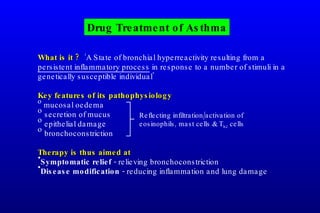
What is it ?   ‘A State of bronchial hyperreactivity resulting from a  persistent inflammatory process  in response to a number of stimuli in a genetically susceptible individual' Key features of its pathophysiology mucosal oedema secretion of mucus epithelial damage bronchoconstriction Therapy is thus aimed at Symptomatic relief  - relieving bronchoconstriction Disease modification  - reducing inflammation and lung damage   Drug Treatment of Asthma Reflecting infiltration/activation of eosinophils, mast cells & T h2  cells
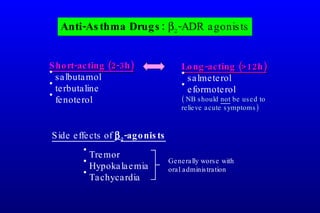
Anti-Asthma Drugs:   2 -ADR agonists Short-acting (2-3h) salbutamol terbutaline fenoterol Long-acting (>12h) salmeterol eformoterol ( NB should  not  be used to relieve acute symptoms) Side effects of   2 -agonists Tremor  Hypokalaemia  Tachycardia  Generally worse with oral administration
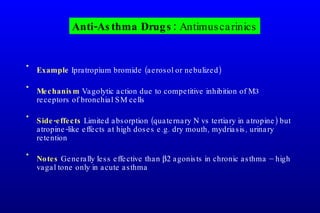
Example  Ipratropium bromide (aerosol or nebulized) Mechanism  Vagolytic action due to competitive inhibition of M3 receptors of bronchial SM cells Side-effects  Limited absorption (quaternary N vs tertiary in atropine) but atropine-like effects at high doses e.g. dry mouth, mydriasis, urinary retention Notes  Generally less effective than   agonists in chronic asthma – high vagal tone only in acute asthma Anti-Asthma Drugs:  Antimuscarinics
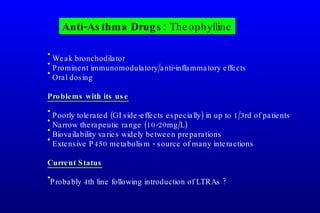
Anti-Asthma Drugs:  Theophylline Weak bronchodilator Prominent immunomodulatory/anti-inflammatory effects Oral dosing Problems with its use Poorly tolerated (GI side-effects especially) in up to 1/3rd of patients Narrow therapeutic range (10-20mg/L) Biovailability varies widely between preparations Extensive P450 metabolism - source of many interactions Current Status Probably 4th line following introduction of LTRAs ?
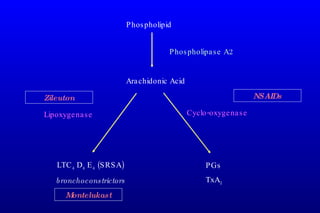
Arachidonic Acid LTC 4  D 4  E 4  (SRSA) bronchoconstrictors PGs TxA 2 Lipoxygenase Cyclo-oxygenase Phospholipid Phospholipase A2 Montelukast NSAIDs Zileuton
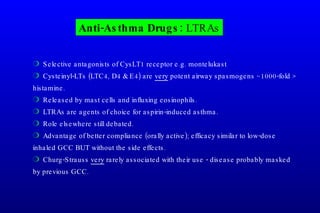
Anti-Asthma Drugs:  LTRAs Selective antagonists of CysLT1 receptor e.g. montelukast Cysteinyl-LTs (LTC4, D4 & E4) are  very  potent airway spasmogens ~1000-fold > histamine. Released by mast cells and influxing eosinophils. LTRAs are agents of choice for aspirin-induced asthma. Role elsewhere still debated. Advantage of better compliance (orally active); efficacy similar to low-dose inhaled GCC BUT without the side effects. Churg-Strauss  very  rarely associated with their use - disease probably masked by previous GCC.
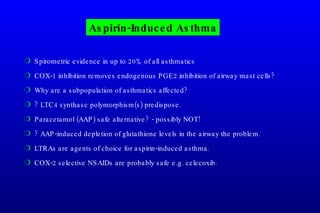
Aspirin-Induced Asthma Spirometric evidence in up to 20% of all asthmatics COX-1 inhibition removes endogenous PGE2 inhibition of airway mast cells? Why are a subpopulation of asthmatics affected? ? LTC4 synthase polymorphism(s) predispose. Paracetamol (AAP) safe alternative? - possibly NOT! ? AAP-induced depletion of glutathione levels in the airway the problem. LTRAs are agents of choice for aspirin-induced asthma. COX-2 selective NSAIDs are probably safe e.g. celecoxib.
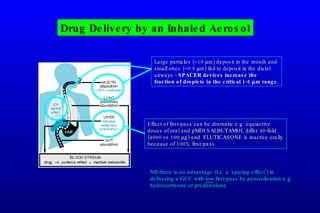
Drug Delivery by an Inhaled Aerosol Large particles (>10   m) deposit in the mouth and small ones (<0.5   m) fail to deposit in the distal airways -  SPACER devices increase the fraction of droplets in the critical 1-5   m range. Effect of first-pass can be dramatic e.g. equiactive doses of oral and pMDI SALBUTAMOL differ 40-fold (4000 vs 100   g) and  FLUTICASONE is inactive orally because of 100% first-pass. NB there is no advantage (I.e. a ‘sparing effect’) in delivering a GCC with  low  first-pass by aerosolisation e.g. hydrocortisone or prednisolone.
Drug Delivery Systems: Metered-dose Inhalers MDIs Pressurised MDI (pMDI) CFC (being replaced by HFA) propellant Require co-ordinated activation/inhalation Dry Powder MDI No propellant Require only priming then sucking Low PEFR a problem (<60L/min) Delivery humidity dependent ? Orange  [fluticasone] Blue  [short acting   2 agonist] Green  [salmeterol] Brown  [BDP or budesonide] Turbuhaler Diskhaler
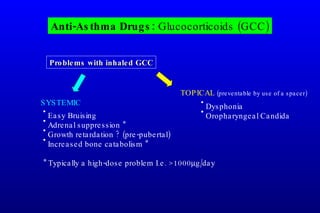
Anti-Asthma Drugs:  Glucocorticoids (GCC) SYSTEMIC TOPICAL   (preventable by use of a spacer) Dysphonia Oropharyngeal Candida Easy Bruising Adrenal suppression * Growth retardation ? (pre-pubertal) Increased bone catabolism * * Typically a high-dose problem I.e. >1000  g/day Problems with inhaled GCC
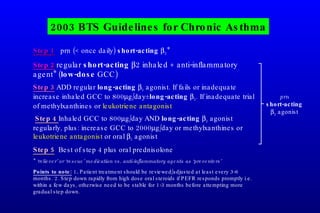
2003 BTS Guidelines for Chronic Asthma prn short-acting  2  agonist Step 1   prn (< once daily)  short-acting    2 * Step 2   regular  short-acting    2   inhaled + anti-inflammatory agent* ( low-dose  GCC)   Step 3  ADD regular  long-acting    2  agonist. If fails or inadequate increase inhaled GCC to 800  g/day± long-acting    2 . If inadequate trial of methylxanthines or  leukotriene antagonist Step 4  Inhaled GCC to 800  g/day AND   long-acting    2  agonist regularly, plus: increase GCC to 2000  g/day or methylxanthines or  leukotriene antagonist  or oral    2  agonist Step 5   Best of step 4 plus oral prednisolone *  ‘reliever’ or ‘rescue’ medication vs. anti-inflammatory agents as ‘preventers’ Points to note:   1 .  Patient treatment should be reviewed/adjusted at least every 3-6 months. 2. Step down rapidly from high dose oral steroids if PEFR responds promptly i.e. within a few days, otherwise need to be stable for 1-3 months before attempting more gradual step down.
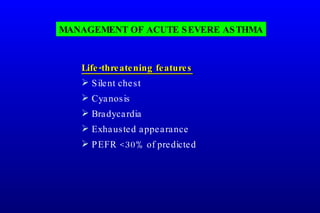
MANAGEMENT OF ACUTE SEVERE ASTHMA Life-threatening features Silent chest Cyanosis Bradycardia Exhausted appearance PEFR <30% of predicted
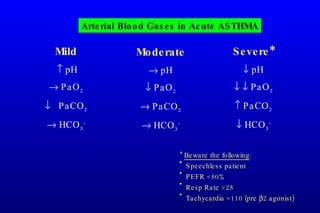
Arterial Blood Gases in Acute ASTHMA Mild    pH    PaO 2    PaCO 2    HCO 3 - Moderate    pH    PaO 2    PaCO 2    HCO 3 - Severe*    pH       PaO 2    PaCO 2    HCO 3 - *  Beware the following : Speechless patient PEFR <50% Resp Rate >25 Tachycardia >110 (pre   2 agonist)
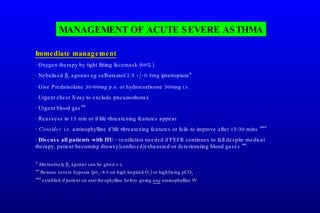
Immediate management · Oxygen therapy by tight fitting facemask (60%). · Nebulised   2  agonist eg salbutamol 2.5 +/- 0.5mg ipratropium* · Give Prednisolone 30-60mg p.o. or hydrocortisone 300mg i.v. · Urgent chest X-ray to exclude pneumothorax · Urgent blood gas** · Reassess in 15 min or if life-threatening features appear ·  Consider   i.v. aminophylline if life-threatening features or fails to improve after 15-30 mins *** ·  Discuss all patients with ITU  - ventilation needed if PEFR continues to fall despite medical therapy, patient becoming drowsy/confused/exhausted or deteriorating blood gases **. * Alternatively   2  agonist can be given s.c. ** Beware severe hypoxia (p0 2 <8.0 on high inspired O 2 ) or high/rising pCO 2 *** establish if patient on oral theophylline before giving  any  aminophylline IV. MANAGEMENT OF ACUTE SEVERE ASTHMA
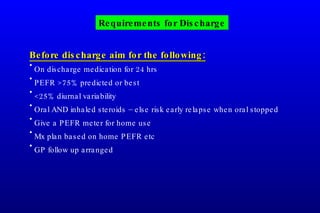
Before discharge aim for the following: On discharge medication for 24 hrs PEFR >75% predicted or best <25% diurnal variability Oral AND inhaled steroids – else risk early relapse when oral stopped Give a PEFR meter for home use Mx plan based on home PEFR etc GP follow up arranged Requirements for Discharge
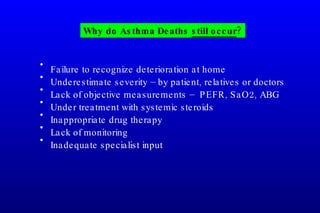
Failure to recognize deterioration at home Underestimate severity – by patient, relatives or doctors Lack of objective measurements –  PEFR, SaO2, ABG Under treatment with systemic steroids Inappropriate drug therapy Lack of monitoring Inadequate specialist input Why do Asthma Deaths  still occur ?
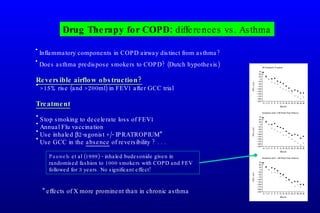
Inflammatory components in COPD airway distinct from asthma? Does asthma predispose smokers to COPD? (Dutch hypothesis) Drug Therapy for COPD:  differences vs. Asthma Reversible airflow obstruction?   >15% rise (and >200ml) in FEV1 after GCC trial Treatment Stop smoking to decelerate loss of FEV1 Annual Flu vaccination  Use inhaled   2-agonist +/- IPRATROPIUM* Use GCC in the  absence  of reversibility ? . . .  * effects of X more prominent than in chronic asthma Pauwels  et al (1999)  - inhaled budesonide given in randomised fashion to 1000 smokers with COPD and FEV followed for 3 years. No significant effect!
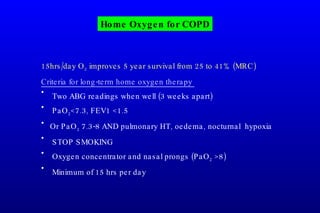
Home Oxygen for COPD 15hrs/day O 2  improves 5 year survival from 25 to 41% (MRC) Criteria for long-term home oxygen therapy   Two ABG readings when well (3 weeks apart) PaO 2 <7.3, FEV1 <1.5 Or PaO 2  7.3-8 AND pulmonary HT, oedema, nocturnal  hypoxia STOP SMOKING Oxygen concentrator and nasal prongs (PaO 2  >8) Minimum of 15 hrs per day
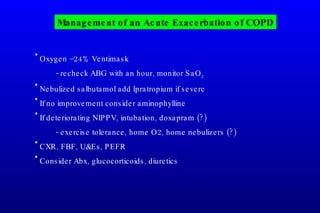
Management of an Acute Exacerbation of COPD Oxygen –24% Ventimask - recheck ABG with an hour, monitor SaO 2   Nebulized salbutamol add Ipratropium if severe If no improvement consider aminophylline If deteriorating NIPPV, intubation, doxapram (?) - exercise tolerance, home O2, home nebulizers (?) CXR, FBF, U&Es, PEFR Consider Abx, glucocorticoids, diuretics
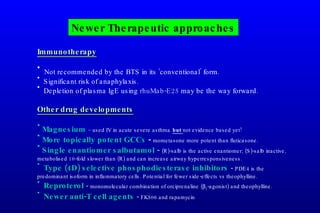
Newer Therapeutic approaches Immunotherapy Not recommended by the BTS in its ‘conventional’ form. Significant risk of anaphylaxis. Depletion of plasma IgE using  rhuMab-E25  may be the way forward. Other drug developments Magnesium  – used IV in acute severe asthma   but  not evidence based yet! More topically potent GCCs  -  mometasone more potent than fluticasone. Single enantiomer salbutamol  -  (R)-salb is the active enantiomer; (S)-salb inactive, metabolised 10-fold slower than (R) and can increase airway hyperresponsiveness. Type (4D) selective phosphodiesterase inhibitors  -  PDE4 is the predominant isoform in inflammatory cells. Potential for fewer side-effects vs theophylline. Reproterol  -  monomolecular combination of orciprenaline (  2 -agonist) and theophylline. Newer anti-T cell agents  -  FK506 and rapamycin
Further Information Full  BTS guidelines  for asthma management (BTS website) Full  BTS guidelines  for COPD management (BTS website) NEJM review  on Leukotrienes and LTRAs (pdf) Click on link

Respiratory Drugs (for Asthma & COPD)

  • 1.
    Respiratory Drugs (forAsthma & COPD) Phase III/Therapeutics
  • 2.
    Asthma is aMajor Public Health Problem 150 million sufferers Worldwide Prevalence rising in most countries - up to 50%/decade Large burden on health budgets Major economic impact from lost days at work & school Causes 100,000 deaths p.a. Worldwide
  • 3.
    Asthma Triggers Allergenexposure e.g. HDM, pet dander, pollens etc. Exercise/cold-air - drying airway mucosa. Drugs - Beta blockers, NSAIDs and anaphylactoids. Food additives - tartrazines , sulphites etc. Viral URTIs - especially rhinovirus. Gastroesophageal reflux (GORD). NB a number of irritants can increase airway reactivity leading to deterioration of symptom control without necessarily being ‘triggers’ - atmospheric pollutants (gases and particulates) are the best example.
  • 4.
    What is it? ‘A State of bronchial hyperreactivity resulting from a persistent inflammatory process in response to a number of stimuli in a genetically susceptible individual' Key features of its pathophysiology mucosal oedema secretion of mucus epithelial damage bronchoconstriction Therapy is thus aimed at Symptomatic relief - relieving bronchoconstriction Disease modification - reducing inflammation and lung damage   Drug Treatment of Asthma Reflecting infiltration/activation of eosinophils, mast cells & T h2 cells
  • 5.
    Anti-Asthma Drugs:  2 -ADR agonists Short-acting (2-3h) salbutamol terbutaline fenoterol Long-acting (>12h) salmeterol eformoterol ( NB should not be used to relieve acute symptoms) Side effects of  2 -agonists Tremor Hypokalaemia Tachycardia Generally worse with oral administration
  • 6.
    Example Ipratropiumbromide (aerosol or nebulized) Mechanism Vagolytic action due to competitive inhibition of M3 receptors of bronchial SM cells Side-effects Limited absorption (quaternary N vs tertiary in atropine) but atropine-like effects at high doses e.g. dry mouth, mydriasis, urinary retention Notes Generally less effective than  agonists in chronic asthma – high vagal tone only in acute asthma Anti-Asthma Drugs: Antimuscarinics
  • 7.
    Anti-Asthma Drugs: Theophylline Weak bronchodilator Prominent immunomodulatory/anti-inflammatory effects Oral dosing Problems with its use Poorly tolerated (GI side-effects especially) in up to 1/3rd of patients Narrow therapeutic range (10-20mg/L) Biovailability varies widely between preparations Extensive P450 metabolism - source of many interactions Current Status Probably 4th line following introduction of LTRAs ?
  • 8.
    Arachidonic Acid LTC4 D 4 E 4 (SRSA) bronchoconstrictors PGs TxA 2 Lipoxygenase Cyclo-oxygenase Phospholipid Phospholipase A2 Montelukast NSAIDs Zileuton
  • 9.
    Anti-Asthma Drugs: LTRAs Selective antagonists of CysLT1 receptor e.g. montelukast Cysteinyl-LTs (LTC4, D4 & E4) are very potent airway spasmogens ~1000-fold > histamine. Released by mast cells and influxing eosinophils. LTRAs are agents of choice for aspirin-induced asthma. Role elsewhere still debated. Advantage of better compliance (orally active); efficacy similar to low-dose inhaled GCC BUT without the side effects. Churg-Strauss very rarely associated with their use - disease probably masked by previous GCC.
  • 10.
    Aspirin-Induced Asthma Spirometricevidence in up to 20% of all asthmatics COX-1 inhibition removes endogenous PGE2 inhibition of airway mast cells? Why are a subpopulation of asthmatics affected? ? LTC4 synthase polymorphism(s) predispose. Paracetamol (AAP) safe alternative? - possibly NOT! ? AAP-induced depletion of glutathione levels in the airway the problem. LTRAs are agents of choice for aspirin-induced asthma. COX-2 selective NSAIDs are probably safe e.g. celecoxib.
  • 11.
    Drug Delivery byan Inhaled Aerosol Large particles (>10  m) deposit in the mouth and small ones (<0.5  m) fail to deposit in the distal airways - SPACER devices increase the fraction of droplets in the critical 1-5  m range. Effect of first-pass can be dramatic e.g. equiactive doses of oral and pMDI SALBUTAMOL differ 40-fold (4000 vs 100  g) and FLUTICASONE is inactive orally because of 100% first-pass. NB there is no advantage (I.e. a ‘sparing effect’) in delivering a GCC with low first-pass by aerosolisation e.g. hydrocortisone or prednisolone.
  • 12.
    Drug Delivery Systems:Metered-dose Inhalers MDIs Pressurised MDI (pMDI) CFC (being replaced by HFA) propellant Require co-ordinated activation/inhalation Dry Powder MDI No propellant Require only priming then sucking Low PEFR a problem (<60L/min) Delivery humidity dependent ? Orange [fluticasone] Blue [short acting  2 agonist] Green [salmeterol] Brown [BDP or budesonide] Turbuhaler Diskhaler
  • 13.
    Anti-Asthma Drugs: Glucocorticoids (GCC) SYSTEMIC TOPICAL (preventable by use of a spacer) Dysphonia Oropharyngeal Candida Easy Bruising Adrenal suppression * Growth retardation ? (pre-pubertal) Increased bone catabolism * * Typically a high-dose problem I.e. >1000  g/day Problems with inhaled GCC
  • 14.
    2003 BTS Guidelinesfor Chronic Asthma prn short-acting  2 agonist Step 1 prn (< once daily) short-acting  2 * Step 2 regular short-acting  2 inhaled + anti-inflammatory agent* ( low-dose GCC) Step 3 ADD regular long-acting  2 agonist. If fails or inadequate increase inhaled GCC to 800  g/day± long-acting  2 . If inadequate trial of methylxanthines or leukotriene antagonist Step 4 Inhaled GCC to 800  g/day AND long-acting  2 agonist regularly, plus: increase GCC to 2000  g/day or methylxanthines or leukotriene antagonist or oral  2 agonist Step 5 Best of step 4 plus oral prednisolone * ‘reliever’ or ‘rescue’ medication vs. anti-inflammatory agents as ‘preventers’ Points to note: 1 . Patient treatment should be reviewed/adjusted at least every 3-6 months. 2. Step down rapidly from high dose oral steroids if PEFR responds promptly i.e. within a few days, otherwise need to be stable for 1-3 months before attempting more gradual step down.
  • 15.
    MANAGEMENT OF ACUTESEVERE ASTHMA Life-threatening features Silent chest Cyanosis Bradycardia Exhausted appearance PEFR <30% of predicted
  • 16.
    Arterial Blood Gasesin Acute ASTHMA Mild  pH  PaO 2  PaCO 2  HCO 3 - Moderate  pH  PaO 2  PaCO 2  HCO 3 - Severe*  pH   PaO 2  PaCO 2  HCO 3 - * Beware the following : Speechless patient PEFR <50% Resp Rate >25 Tachycardia >110 (pre  2 agonist)
  • 17.
    Immediate management ·Oxygen therapy by tight fitting facemask (60%). · Nebulised  2 agonist eg salbutamol 2.5 +/- 0.5mg ipratropium* · Give Prednisolone 30-60mg p.o. or hydrocortisone 300mg i.v. · Urgent chest X-ray to exclude pneumothorax · Urgent blood gas** · Reassess in 15 min or if life-threatening features appear · Consider i.v. aminophylline if life-threatening features or fails to improve after 15-30 mins *** · Discuss all patients with ITU - ventilation needed if PEFR continues to fall despite medical therapy, patient becoming drowsy/confused/exhausted or deteriorating blood gases **. * Alternatively  2 agonist can be given s.c. ** Beware severe hypoxia (p0 2 <8.0 on high inspired O 2 ) or high/rising pCO 2 *** establish if patient on oral theophylline before giving any aminophylline IV. MANAGEMENT OF ACUTE SEVERE ASTHMA
  • 18.
    Before discharge aimfor the following: On discharge medication for 24 hrs PEFR >75% predicted or best <25% diurnal variability Oral AND inhaled steroids – else risk early relapse when oral stopped Give a PEFR meter for home use Mx plan based on home PEFR etc GP follow up arranged Requirements for Discharge
  • 19.
    Failure to recognizedeterioration at home Underestimate severity – by patient, relatives or doctors Lack of objective measurements – PEFR, SaO2, ABG Under treatment with systemic steroids Inappropriate drug therapy Lack of monitoring Inadequate specialist input Why do Asthma Deaths still occur ?
  • 20.
    Inflammatory components inCOPD airway distinct from asthma? Does asthma predispose smokers to COPD? (Dutch hypothesis) Drug Therapy for COPD: differences vs. Asthma Reversible airflow obstruction? >15% rise (and >200ml) in FEV1 after GCC trial Treatment Stop smoking to decelerate loss of FEV1 Annual Flu vaccination Use inhaled  2-agonist +/- IPRATROPIUM* Use GCC in the absence of reversibility ? . . . * effects of X more prominent than in chronic asthma Pauwels et al (1999) - inhaled budesonide given in randomised fashion to 1000 smokers with COPD and FEV followed for 3 years. No significant effect!
  • 21.
    Home Oxygen forCOPD 15hrs/day O 2 improves 5 year survival from 25 to 41% (MRC) Criteria for long-term home oxygen therapy Two ABG readings when well (3 weeks apart) PaO 2 <7.3, FEV1 <1.5 Or PaO 2 7.3-8 AND pulmonary HT, oedema, nocturnal hypoxia STOP SMOKING Oxygen concentrator and nasal prongs (PaO 2 >8) Minimum of 15 hrs per day
  • 22.
    Management of anAcute Exacerbation of COPD Oxygen –24% Ventimask - recheck ABG with an hour, monitor SaO 2 Nebulized salbutamol add Ipratropium if severe If no improvement consider aminophylline If deteriorating NIPPV, intubation, doxapram (?) - exercise tolerance, home O2, home nebulizers (?) CXR, FBF, U&Es, PEFR Consider Abx, glucocorticoids, diuretics
  • 23.
    Newer Therapeutic approachesImmunotherapy Not recommended by the BTS in its ‘conventional’ form. Significant risk of anaphylaxis. Depletion of plasma IgE using rhuMab-E25 may be the way forward. Other drug developments Magnesium – used IV in acute severe asthma but not evidence based yet! More topically potent GCCs - mometasone more potent than fluticasone. Single enantiomer salbutamol - (R)-salb is the active enantiomer; (S)-salb inactive, metabolised 10-fold slower than (R) and can increase airway hyperresponsiveness. Type (4D) selective phosphodiesterase inhibitors - PDE4 is the predominant isoform in inflammatory cells. Potential for fewer side-effects vs theophylline. Reproterol - monomolecular combination of orciprenaline (  2 -agonist) and theophylline. Newer anti-T cell agents - FK506 and rapamycin
  • 24.
    Further Information Full BTS guidelines for asthma management (BTS website) Full BTS guidelines for COPD management (BTS website) NEJM review on Leukotrienes and LTRAs (pdf) Click on link