

Asthma
Review of Pathophysiology and
Treatment
Definition


It is a chronic inflamatory disorder due
to hyperresponsiveness of airways
characterized by dysponea,
cough,wheezing and chest tightness
with variable airway obstruction.
Types
Early onset asthma Late onsetasthma
 Nocturnal asthma
Brittle asthma
 Cardiac asthma
Catamenial asthma
 Cough variant asthma
 Aspirin sensitive asthma
 Occupational asthma

Child-onset asthma
– Associated with atopy
– IgE directed against common
environmental antigens (house-dust
mites, animal proteins, fungi
– Viral wheezing Infants/children,
allergy/allergy history associated with
continuing asthma through childhood
Adult-onset asthma
– Many situations
– Allergens important
– Non-IgE asthma have nasal polyps,
sinusitis, aspirin sensitivity or NSAID
sensitivity
– Idiosyncratic asthma less understood
Adult-onset asthma
– Occupational exposure
 animal

products, biological enzymes, plastic
resin, wood dusts, metal
 removal from workplace may improve
symptoms although symptoms persist in some
Pathophysiology
Airway limitation usually reversible
 Airway hyperreactivity
 Airway inflamation




With increased severity and chronicity
remodelling,fibrosis and fixed narrowing of airways
and decreased response to drugs.
Airway Inflammation
More often triggered by infections and chronic allergies.

IgE mediated triggering mast cell release.
Causes “fixed” obstruction not responsive to albuterol and
more often has an inspiratory component.

Strong genetic contribution.
Needs steroids.
Airway hyperresponsiveness
Primarily smooth muscle mediated.
Can occur at any age.
Reversible with albuterol. Primarily expiratory wheezes.
Results in air trapping / obstruction (can be quantified on
PFT’s).
Variable throughout lungs. May cause atelectasis on xray.
Primary process for wheezing due to cold air, exercise,
pet allergens.
Airflow limitation
– Acute bronchoconstriction
IgE -dependent mediator release from mast
cell (leukotrienes, histamine, tryptase,
prostaglandins)
 aspirin /NSAID
 non-IgE response (cold air, exercise, irritants)



Airflow limitation
– Chronic mucus plug formation
 secretions

& inspissated plugs
 persistent airflow limitation in severe intractable
asthma

– Airway remodeling
 irreversible

component of airflow limitation
secondary to structural airway matrix changes
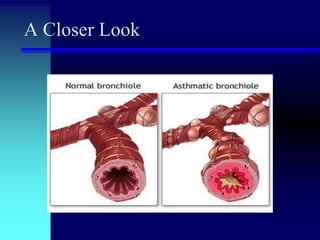
A Closer Look
Etiology



Environmental(hygeine hypothesis)



Genetical
Common Triggers
Infections: viral respiratory illness
(rhinovirus, influenza, RSV, parainfluenz
a, human metapneumovirus), sinus
infections
Allergens: seasonal allergens, indoor
allergens, pets
Irritants: cigarette smoke, wood
smoke, other pollutants, weather
changes
Diagnosis
Compatible history plus either/or
 FEV more than15% following
bronchodilator therapy.
 More than 20% diurnal variation on
PEFR diary for 3 days a week for 2
weeks.
 FEV more than 15% decrease after 6
minutes of exercise.

Differential Diagnosis
Upper RTI
 Lower RTI
 Systemic

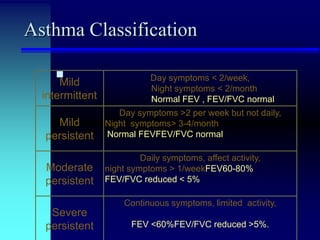
Asthma Classification

Mild
intermittent

Day symptoms < 2/week,
Night symptoms < 2/month
Normal FEV , FEV/FVC normal

Mild
persistent

Day symptoms >2 per week but not daily,
Night symptoms> 3-4/month
Normal FEVFEV/FVC normal

Moderate
persistent

Daily symptoms, affect activity,
night symptoms > 1/weekFEV60-80%
FEV/FVC reduced < 5%
Continuous symptoms, limited activity,

Severe
persistent

FEV <60%FEV/FVC reduced >5%.
Investigation
Lab investigations
 Radiology
 Spirometry
 PEFR recording

Pharmacologic Therapy
Long-term control medications
 (Controllers)
 Short term control medications
 (Relievers)


– corticosteroids
 inhaled

form
 systemic steroids used to gain prompt control
of disease when initiating inhaled tx

– cromolyn sodium or nedocromil
 mild-to-moderate

anti-inflammatory medications
Management
AccordingtoGINA,NAEPP3,WHO,NHI,
 NHLBI guidelines management should
be in 4 steps.
 Assess and monitor asthma severity
and control
 Patient education
 Environmental control
 Medical therapy

Pharmacologic Therapy


Long-term control medications
– corticosteroids
 inhaled

form
 systemic steroids used to gain prompt control
of disease when initiating inhaled tx

– cromolyn sodium or nedocromil
 mild-to-moderate

anti-inflammatory medications
(may be used initially in children)
 preventive tx. prior to exercise or unavoidable
exposure to known allergens
Relievers
Beta adrenergic agonists.
 Anticholinergic agents
 Phosphodiesterase inhibitors
 Corticosteroids
 Antimicrobials

Controllers
Anti inflamatory agents (steroids)
 Long acting bronchodilators





Mediator inhibitors
Beta adrenergic agonists
Phosphodiesterase inhibitors

Leukotrienes modifiers
 Desensitization drugs
 Vaccinations
 Miscellaneous agents

Long-term control medications
– Long-acting beta2-agonists
 used

concomitantly with anti-inflammatory
meds for long-term symptom control especially
nocturnal symptoms
 prevents exercise-induced bronchospasm

– Methylxanthines
 sustained-release

theophylline used as
adjuvant to inhaled steroids for prevention of
nocturnal symptoms
Long-term control medications
– Leukotriene modifiers
 zafirlukast

- leukotriene receptor antagonist
 zileuton - 5-lipoxygenase inhibitor is alternative
therapy to low doses of inhaled
steroids/nedocromil/cromolyn
 alternative tx to low dose inhaled
steroids/cromolyn/nedocromil
 recommended for >12yrs with mild persistent
asthma.
Quick relief medications
– Short acting beta2-agonists - relief of acute
symptoms

– Anticholinergics - may provide additive benefit
to beta2 drugs in severe exacerbation. May be
alternative to beta2-agonists

– Systemic steroids - moderate-to-severe
persistent asthma in acute exacerbations or to
prevent recurrence of exacerbations
Treatment/Long Term Control


Corticosteroids
– Most potent and effective
– Reduction in symptoms, improvement in
PEF and spirometry, diminished airway
hyperresponsiveness, prevention of
exacerbations, possible prevention of
airway wall remodeling
– Suppresses: cytosine production, airway
eosinophilic recruitment, chemical mediators
LABA


Long-acting beta-2 agonists
– Relax airway smooth muscle
– Duration of action >12 hrs
– Not used in acute exacerbations
– Adjunct to anti-inflammatory tx for longterm symptom control especially nocturnal
symptoms
Methylxanthines
– Provides mild-moderate bronchodilation
– Low dose has mild anti-inflammatory action
– Sustained release form used as alternative
but not preferred to long-acting beta2
agonists to control nocturnal symptoms
– Use may be necessary because of cost or
patient compliance
Leukotriene modifiers
– Leukotrienes are potent biochemical
mediators released from mast cells,
eosinophils, and basophils that:
 contract

bronchial smooth muscle
 increase vascular permeability
 increase mucus secretions
 attract & activate inflammatory cells in airways
Leukotriene modifiers
– Zafirlukast & zileuton (oral tabs)
 improves

lung fx and diminishes symptoms &
need for short-acting beta2 agonists

– Studies in mild-moderate asthma showing
modest improvements
– Alternative to low-dose inhaled steroids for
pts. with mild persistent asthma
– Further study in of other groups needed
Asthma Treatment/Quick Relief


Short-acting beta2 agonists
– Relax airway smooth muscle and increase
in airflow in <30 minutes
– Drug of choice for treating symptoms and
exacerbations and EIB
– Use of >1 canister/mo indicates
inadequate control and indicates need to
intensify anti-inflammatory tx
– Regularly scheduled use NOT
recommended
Anticholinergics
– Cholinergic innervation important in
regulation of airway smooth muscle tone
– Ipratropium bromide (quaternary derivative
of atropine without its’ side effects)
– Additive benefit with inhaled beta 2agonists in severe asthma exacerbations
– Effectiveness in long-term management
not demonstrated


Systemic steroids
– speed resolution of airflow obstruction
– reduce rate of relapse



Medications to reduce oral steroid
dependence
– Troleandomycin, cyclosporin, gold,
methotrexate, IV immunoglobulin,
dapsone, hydroxychloroquine
Intermittent Asthma


Step 1
– Short-acting inhaled beta 2 agonists PRN
 IF

NEEDED >2 X/wk PATIENT SHOULD BE
MOVED TO THE NEXT STEP OF CARE
(exception is EIB or viral infections)

– Viral infections
 mild

symptoms - beta 2 agonist Q 4-6 hr
 moderate-to-severe symptoms - short course of
systemic steroids recommended plus above
Persistent Asthma


Mild, moderate or severe
– Daily long-term control recommended



Mild persistent asthma (step 2 care)
– Daily anti-inflammatory meds - inhaled
steroids (low dose) or cromolyn or
nedocromil
– Sustained release theophylline alternative
but not preferred


Moderate persistent asthma (step 3
care)
– Increase inhaled steroids to medium dose
OR
– Add long-acting bronchodilator to a lowmedium dose of inhaled steroids
OR
– Increase to medium dose steroid then
lower dose & add nedocromil (+/-)


Moderate persistent asthma (if not
adequately controlled)
– Increase to high dose inhaled steroids &
add long-acting bronchodilator (serevent or
theophylline)


Severe persistent asthma (step 4)
– If not controlled on high dose of inhaled
steroids and long-acting bronchodilator
ADD oral systemic steroids on a
regularly scheduled, long-term basis
 use

lowest dose
 monitor closely
 attempt to reduce or take off when control
established
Complications
Due to drugs
 Due to disease


Asthma management 2

Asthma management 2

  • 1.
  • 2.
    Definition  It is achronic inflamatory disorder due to hyperresponsiveness of airways characterized by dysponea, cough,wheezing and chest tightness with variable airway obstruction.
  • 3.
    Types Early onset asthmaLate onsetasthma  Nocturnal asthma Brittle asthma  Cardiac asthma Catamenial asthma  Cough variant asthma  Aspirin sensitive asthma  Occupational asthma 
  • 4.
    Child-onset asthma – Associatedwith atopy – IgE directed against common environmental antigens (house-dust mites, animal proteins, fungi – Viral wheezing Infants/children, allergy/allergy history associated with continuing asthma through childhood
  • 5.
    Adult-onset asthma – Manysituations – Allergens important – Non-IgE asthma have nasal polyps, sinusitis, aspirin sensitivity or NSAID sensitivity – Idiosyncratic asthma less understood
  • 6.
    Adult-onset asthma – Occupationalexposure  animal products, biological enzymes, plastic resin, wood dusts, metal  removal from workplace may improve symptoms although symptoms persist in some
  • 7.
    Pathophysiology Airway limitation usuallyreversible  Airway hyperreactivity  Airway inflamation   With increased severity and chronicity remodelling,fibrosis and fixed narrowing of airways and decreased response to drugs.
  • 8.
    Airway Inflammation More oftentriggered by infections and chronic allergies. IgE mediated triggering mast cell release. Causes “fixed” obstruction not responsive to albuterol and more often has an inspiratory component. Strong genetic contribution. Needs steroids.
  • 9.
    Airway hyperresponsiveness Primarily smoothmuscle mediated. Can occur at any age. Reversible with albuterol. Primarily expiratory wheezes. Results in air trapping / obstruction (can be quantified on PFT’s). Variable throughout lungs. May cause atelectasis on xray. Primary process for wheezing due to cold air, exercise, pet allergens.
  • 10.
    Airflow limitation – Acutebronchoconstriction IgE -dependent mediator release from mast cell (leukotrienes, histamine, tryptase, prostaglandins)  aspirin /NSAID  non-IgE response (cold air, exercise, irritants) 
  • 11.
     Airflow limitation – Chronicmucus plug formation  secretions & inspissated plugs  persistent airflow limitation in severe intractable asthma – Airway remodeling  irreversible component of airflow limitation secondary to structural airway matrix changes
  • 12.
  • 13.
  • 14.
    Common Triggers Infections: viralrespiratory illness (rhinovirus, influenza, RSV, parainfluenz a, human metapneumovirus), sinus infections Allergens: seasonal allergens, indoor allergens, pets Irritants: cigarette smoke, wood smoke, other pollutants, weather changes
  • 15.
    Diagnosis Compatible history pluseither/or  FEV more than15% following bronchodilator therapy.  More than 20% diurnal variation on PEFR diary for 3 days a week for 2 weeks.  FEV more than 15% decrease after 6 minutes of exercise. 
  • 16.
    Differential Diagnosis Upper RTI Lower RTI  Systemic 
  • 17.
    Asthma Classification  Mild intermittent Day symptoms< 2/week, Night symptoms < 2/month Normal FEV , FEV/FVC normal Mild persistent Day symptoms >2 per week but not daily, Night symptoms> 3-4/month Normal FEVFEV/FVC normal Moderate persistent Daily symptoms, affect activity, night symptoms > 1/weekFEV60-80% FEV/FVC reduced < 5% Continuous symptoms, limited activity, Severe persistent FEV <60%FEV/FVC reduced >5%.
  • 18.
    Investigation Lab investigations  Radiology Spirometry  PEFR recording 
  • 19.
    Pharmacologic Therapy Long-term controlmedications  (Controllers)  Short term control medications  (Relievers)  – corticosteroids  inhaled form  systemic steroids used to gain prompt control of disease when initiating inhaled tx – cromolyn sodium or nedocromil  mild-to-moderate anti-inflammatory medications
  • 20.
    Management AccordingtoGINA,NAEPP3,WHO,NHI,  NHLBI guidelinesmanagement should be in 4 steps.  Assess and monitor asthma severity and control  Patient education  Environmental control  Medical therapy 
  • 21.
    Pharmacologic Therapy  Long-term controlmedications – corticosteroids  inhaled form  systemic steroids used to gain prompt control of disease when initiating inhaled tx – cromolyn sodium or nedocromil  mild-to-moderate anti-inflammatory medications (may be used initially in children)  preventive tx. prior to exercise or unavoidable exposure to known allergens
  • 22.
    Relievers Beta adrenergic agonists. Anticholinergic agents  Phosphodiesterase inhibitors  Corticosteroids  Antimicrobials 
  • 23.
    Controllers Anti inflamatory agents(steroids)  Long acting bronchodilators     Mediator inhibitors Beta adrenergic agonists Phosphodiesterase inhibitors Leukotrienes modifiers  Desensitization drugs  Vaccinations  Miscellaneous agents 
  • 24.
    Long-term control medications –Long-acting beta2-agonists  used concomitantly with anti-inflammatory meds for long-term symptom control especially nocturnal symptoms  prevents exercise-induced bronchospasm – Methylxanthines  sustained-release theophylline used as adjuvant to inhaled steroids for prevention of nocturnal symptoms
  • 25.
    Long-term control medications –Leukotriene modifiers  zafirlukast - leukotriene receptor antagonist  zileuton - 5-lipoxygenase inhibitor is alternative therapy to low doses of inhaled steroids/nedocromil/cromolyn  alternative tx to low dose inhaled steroids/cromolyn/nedocromil  recommended for >12yrs with mild persistent asthma.
  • 26.
    Quick relief medications –Short acting beta2-agonists - relief of acute symptoms – Anticholinergics - may provide additive benefit to beta2 drugs in severe exacerbation. May be alternative to beta2-agonists – Systemic steroids - moderate-to-severe persistent asthma in acute exacerbations or to prevent recurrence of exacerbations
  • 27.
    Treatment/Long Term Control  Corticosteroids –Most potent and effective – Reduction in symptoms, improvement in PEF and spirometry, diminished airway hyperresponsiveness, prevention of exacerbations, possible prevention of airway wall remodeling – Suppresses: cytosine production, airway eosinophilic recruitment, chemical mediators
  • 28.
    LABA  Long-acting beta-2 agonists –Relax airway smooth muscle – Duration of action >12 hrs – Not used in acute exacerbations – Adjunct to anti-inflammatory tx for longterm symptom control especially nocturnal symptoms
  • 29.
    Methylxanthines – Provides mild-moderatebronchodilation – Low dose has mild anti-inflammatory action – Sustained release form used as alternative but not preferred to long-acting beta2 agonists to control nocturnal symptoms – Use may be necessary because of cost or patient compliance
  • 30.
    Leukotriene modifiers – Leukotrienesare potent biochemical mediators released from mast cells, eosinophils, and basophils that:  contract bronchial smooth muscle  increase vascular permeability  increase mucus secretions  attract & activate inflammatory cells in airways
  • 31.
    Leukotriene modifiers – Zafirlukast& zileuton (oral tabs)  improves lung fx and diminishes symptoms & need for short-acting beta2 agonists – Studies in mild-moderate asthma showing modest improvements – Alternative to low-dose inhaled steroids for pts. with mild persistent asthma – Further study in of other groups needed
  • 32.
    Asthma Treatment/Quick Relief  Short-actingbeta2 agonists – Relax airway smooth muscle and increase in airflow in <30 minutes – Drug of choice for treating symptoms and exacerbations and EIB – Use of >1 canister/mo indicates inadequate control and indicates need to intensify anti-inflammatory tx – Regularly scheduled use NOT recommended
  • 33.
    Anticholinergics – Cholinergic innervationimportant in regulation of airway smooth muscle tone – Ipratropium bromide (quaternary derivative of atropine without its’ side effects) – Additive benefit with inhaled beta 2agonists in severe asthma exacerbations – Effectiveness in long-term management not demonstrated
  • 34.
     Systemic steroids – speedresolution of airflow obstruction – reduce rate of relapse  Medications to reduce oral steroid dependence – Troleandomycin, cyclosporin, gold, methotrexate, IV immunoglobulin, dapsone, hydroxychloroquine
  • 35.
    Intermittent Asthma  Step 1 –Short-acting inhaled beta 2 agonists PRN  IF NEEDED >2 X/wk PATIENT SHOULD BE MOVED TO THE NEXT STEP OF CARE (exception is EIB or viral infections) – Viral infections  mild symptoms - beta 2 agonist Q 4-6 hr  moderate-to-severe symptoms - short course of systemic steroids recommended plus above
  • 36.
    Persistent Asthma  Mild, moderateor severe – Daily long-term control recommended  Mild persistent asthma (step 2 care) – Daily anti-inflammatory meds - inhaled steroids (low dose) or cromolyn or nedocromil – Sustained release theophylline alternative but not preferred
  • 37.
     Moderate persistent asthma(step 3 care) – Increase inhaled steroids to medium dose OR – Add long-acting bronchodilator to a lowmedium dose of inhaled steroids OR – Increase to medium dose steroid then lower dose & add nedocromil (+/-)
  • 38.
     Moderate persistent asthma(if not adequately controlled) – Increase to high dose inhaled steroids & add long-acting bronchodilator (serevent or theophylline)
  • 39.
     Severe persistent asthma(step 4) – If not controlled on high dose of inhaled steroids and long-acting bronchodilator ADD oral systemic steroids on a regularly scheduled, long-term basis  use lowest dose  monitor closely  attempt to reduce or take off when control established
  • 40.
  • 41.