Cough & Asthma
Dr. Rupendra K. Bharti
MBBS MD
Cough
Mucolytics
Bromhexine & Ambroxol
• It is a potent mucolytic and mucokinetic, capable
of inducing thin copious bronchial secretion.
• It depolymerises mucopolysaccharides directly
as well as by liberating lysosomal enzymes—
network of fibres in tenacious sputum is broken.
Dose:adults 8 mg TDS, children 1–5 years 4 mg BD,
5–10 years 4 mg TDS.
Carbocisteine
• Its opens disulfide bonds in mucoproteins
• present in sputum—makes it less viscid.
• orally (250–750 mg TDS).
• Given in chronic bronchitis.
• contraindicated in peptic ulcer patients
combination with amoxicillin or cephalexin for treatment of
bronchitis, bronchiectasis, sinusitis.
ANTITUSSIVES
• These are drugs that act in the CNS to raise the
threshold of cough centre or act peripherally in
the respiratory tract to reduce tussal impulses, or
both these actions.
• There aim is to control cough impulses from
cough centre.
• Mainly used in dry nonproductive cough mostly
in case of hernia, piles, cardiac disease, ocular
• surgery.
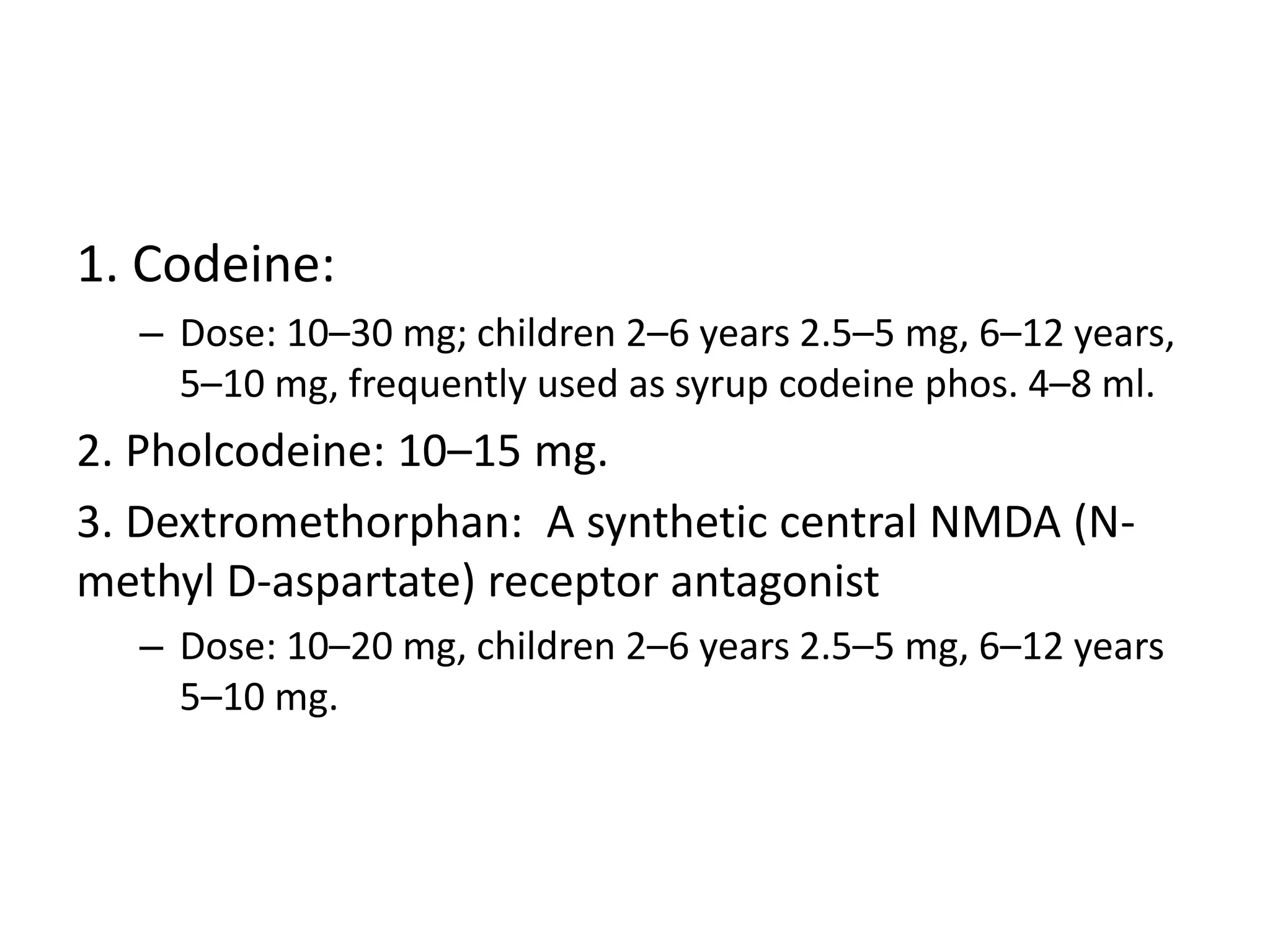
1. Codeine:
– Dose: 10–30 mg; children 2–6 years 2.5–5 mg, 6–12 years,
5–10 mg, frequently used as syrup codeine phos. 4–8 ml.
2. Pholcodeine: 10–15 mg.
3. Dextromethorphan: A synthetic central NMDA (N-
methyl D-aspartate) receptor antagonist
– Dose: 10–20 mg, children 2–6 years 2.5–5 mg, 6–12 years
5–10 mg.
Antihistamines
• Chlorpheniramine (2–5 mg),
• Diphenhydramine(15–25 mg) and
• Promethazine (15–25 mg
Asthma
Types
Extrinsic Intrinsic
Required External stimuli Not necessary
Onset Mainly in childhood Adult/ later in life
History of allergy Present Absent
Level of IgE High Normal
Prognosis Good poor
Aetiology
• Air Pollution
• Exercise induced
• Infections (mainly viral infection)
• Allergens
• Drugs
Sign and Symptoms
• Dry cough (may worst at night and early
morning)
• Cough during exercise
• Breathlessness
• Wheezing
Diagnosis
• Chest X-ray
• Pulmonary function test (PFT).
– Cold air induced (worsening in symptoms)
– Methacholine/histamine challenge test
– Beta-2 agonist test
Management
Nonpharmacological
• Identify and avoid the trigger factor(s), stop
smoking and do regular breathing exercises,
e.g.
• ‘Pranayama’.
• Reduce weight (for obese patients with
asthma).
1. β2 Sympathomimetics:
– Short acting: Salbutamol, Terbutaline
– Long acting: Salmeterol, Formoterol
• Short acting drugs used only for acute
condition.
• Long acting is used for maintenance therapy
and for nocturnal asthma.
• Long acting beta-2 agonist always used with
inhaled corticosteroid.
Methylxanthines
(Theophylline, Aminophylline)
• Increases Release of Ca2+ from sarcoplasmic
reticulum
• Inhibitor of phosphodiesterase (PDE) and also
interfere with adenosine receptor.
• It has narrow therapeutic margin.
• It also follows saturable order of kinetics; that
may lead to toxicity.
Anticholinergics
• Anticholinergic drugs (Ipratropium bromide,
tiotropium bromide) produces bronchodilatation
by blocking M3 receptor mediated cholinergic
constrictor tone.
• Ipratropium bromide is a short acting and
tiotropium bromide is long acting.
• Both are less efficacious than inhaled β2
sympathomimetics in bronchial asthma.
• They are the bronchodilators of choice in COPD.
Leukotriene antagonist
(Montelukast and Zafirlukast)
• They competitively antagonize cysteinyl LT1
receptor.
• They are indicated for prophylactic therapy of
mild-to-moderate asthma as alternatives to
inhaled glucocorticoids.
• They are not to be used for terminating
asthma episodes.
Mast cell stabilizers
(Sodium cromoglycate, ketotifen)
• Sodium cromoglycate inhibits degranulation of
mast by trigger stimuli.
• Interfere the release of mediators of asthma
like histamine, LTs, PAF, interleukins, etc.
• Ketotifen is an antihistaminic (H1), produces
sedation.
• The mechanism of action is similar to sodium
cromoglycate.
Corticosteroids
• Glucocorticoids are not bronchodilators.
• They reduces bronchial hyperreactivity,
mucosal edema and by suppressing
inflammatory response to AG:AB reaction or
other trigger stimuli.
• They also increase airway smooth muscle
responsiveness to β2 agonists.
Anti-IgE antibody
(Omalizumab)
• It is a humanized monoclonal antibody against
IgE.
• it neutralizes free IgE in circulation without
activating mast cells and other inflammatory
cells.
• In severe extrinsic asthma, omalizumab has been
found to reduce exacerbations and steroid
requirement.
• No benefit has been noted in nonallergic asthma.
• It is very expensive.
STATUS ASTHMATICUS/REFRACTORY
ASTHMA
It is also known as acute severe asthma. It is a life threatening
condition and mostly occurs due to precipitation of chronic
asthma by acute respiratory infection.
Patient presents with following signs/symptoms:
• Unable to speak a sentence due to severe dyspnea.
• Severe cyanosis.
• Pulsus paradoxus (inspiratory fall in systolic blood pressure
≥10mmHg).
• Silent chest (No pathological sign during auscultation).
• Encephalopathy, seizure, coma and death if not treated
appropriately within the golden period.
• Treatment of life-threatening episode should be
immediate and no time should be spent on detailed
clinical history.
• Oxygen inhalation 4 L/min to maintain SpO2>90%.
• Inj. Terbutaline 10 mcg/kg subcutaneously or IV
(maximum 40 mcg/day).
• Inhaled Salbutamol/Terbutaline preferably by
nebulizer (as discussed above).
• Ipratropium Bromide 250 mcg by nebulizer with
Salbutamol.
• Inj. Hydrocortisone 10 mg/kg IV. Inj. Aminophylline 5 mg/kg
bolus slowly followed by 0.8-1.2 mg/kg/hour slow infusion
(If patient has received theophylline preparation in last 72
hours; reduce bolus dose to 2.5 mg/kg).
• Inj. Magnesium sulphate 40 mg/kg in 50 ml 5% dextrose as
slow infusion over 30 minutes can be considered.
If no response do arterial blood gas analysis, X-raychest and
serum electrolytes. Intubate the patient if no or poor
respiratory effort, increased carbon dioxide with respiratory
acidosis. Transfer to intensive care unit as early as possible.
CHOICE OF TREATMENT
Conditions Management
Mild episodic asthma Inhaled short-acting β2 agonist at onset of each
episode
Seasonal asthma Regular low-dose inhaled steroid (200–400 μg/day) or
cromoglycate 3–4 weeks before anticipated seasonal
attacks and continue till 3–4 weeks after the season is
over. Treat individual episodes with inhaled short-acting
β2 agonist.
Mild chronic (persistent)
asthma with occasional
exacerbations
Regular low-dose (100–500 μg/day) inhaled steroid.
Episode treatment with inhaled short acting β2 agonist.
Moderate asthma with
frequent exacerbations
inhaled steroid (up to 800 μg/day) + inhaled long-acting
β2 agonist.
Leukotriene antagonists and theophyllin may be tried
in place of long-acting β2 agonists
Severe asthma Regular high dose inhaled steroid
(800–2000 μg/day) + inhaled long-acting β2 agonist
(salmeterol) twice daily.
Leukotriene antagonist/ oral theophylline/oral β2
agonist/inhaled ipratropium bromide.

Cough & Asthma; Pharmacotherapy

  • 1.
    Cough & Asthma Dr.Rupendra K. Bharti MBBS MD
  • 2.
  • 3.
    Mucolytics Bromhexine & Ambroxol •It is a potent mucolytic and mucokinetic, capable of inducing thin copious bronchial secretion. • It depolymerises mucopolysaccharides directly as well as by liberating lysosomal enzymes— network of fibres in tenacious sputum is broken. Dose:adults 8 mg TDS, children 1–5 years 4 mg BD, 5–10 years 4 mg TDS.
  • 4.
    Carbocisteine • Its opensdisulfide bonds in mucoproteins • present in sputum—makes it less viscid. • orally (250–750 mg TDS). • Given in chronic bronchitis. • contraindicated in peptic ulcer patients combination with amoxicillin or cephalexin for treatment of bronchitis, bronchiectasis, sinusitis.
  • 5.
    ANTITUSSIVES • These aredrugs that act in the CNS to raise the threshold of cough centre or act peripherally in the respiratory tract to reduce tussal impulses, or both these actions. • There aim is to control cough impulses from cough centre. • Mainly used in dry nonproductive cough mostly in case of hernia, piles, cardiac disease, ocular • surgery.
  • 6.
    1. Codeine: – Dose:10–30 mg; children 2–6 years 2.5–5 mg, 6–12 years, 5–10 mg, frequently used as syrup codeine phos. 4–8 ml. 2. Pholcodeine: 10–15 mg. 3. Dextromethorphan: A synthetic central NMDA (N- methyl D-aspartate) receptor antagonist – Dose: 10–20 mg, children 2–6 years 2.5–5 mg, 6–12 years 5–10 mg.
  • 7.
    Antihistamines • Chlorpheniramine (2–5mg), • Diphenhydramine(15–25 mg) and • Promethazine (15–25 mg
  • 8.
  • 9.
    Types Extrinsic Intrinsic Required Externalstimuli Not necessary Onset Mainly in childhood Adult/ later in life History of allergy Present Absent Level of IgE High Normal Prognosis Good poor
  • 10.
    Aetiology • Air Pollution •Exercise induced • Infections (mainly viral infection) • Allergens • Drugs
  • 12.
    Sign and Symptoms •Dry cough (may worst at night and early morning) • Cough during exercise • Breathlessness • Wheezing
  • 14.
    Diagnosis • Chest X-ray •Pulmonary function test (PFT). – Cold air induced (worsening in symptoms) – Methacholine/histamine challenge test – Beta-2 agonist test
  • 16.
    Management Nonpharmacological • Identify andavoid the trigger factor(s), stop smoking and do regular breathing exercises, e.g. • ‘Pranayama’. • Reduce weight (for obese patients with asthma).
  • 17.
    1. β2 Sympathomimetics: –Short acting: Salbutamol, Terbutaline – Long acting: Salmeterol, Formoterol • Short acting drugs used only for acute condition. • Long acting is used for maintenance therapy and for nocturnal asthma. • Long acting beta-2 agonist always used with inhaled corticosteroid.
  • 19.
    Methylxanthines (Theophylline, Aminophylline) • IncreasesRelease of Ca2+ from sarcoplasmic reticulum • Inhibitor of phosphodiesterase (PDE) and also interfere with adenosine receptor. • It has narrow therapeutic margin. • It also follows saturable order of kinetics; that may lead to toxicity.
  • 21.
    Anticholinergics • Anticholinergic drugs(Ipratropium bromide, tiotropium bromide) produces bronchodilatation by blocking M3 receptor mediated cholinergic constrictor tone. • Ipratropium bromide is a short acting and tiotropium bromide is long acting. • Both are less efficacious than inhaled β2 sympathomimetics in bronchial asthma. • They are the bronchodilators of choice in COPD.
  • 23.
    Leukotriene antagonist (Montelukast andZafirlukast) • They competitively antagonize cysteinyl LT1 receptor. • They are indicated for prophylactic therapy of mild-to-moderate asthma as alternatives to inhaled glucocorticoids. • They are not to be used for terminating asthma episodes.
  • 25.
    Mast cell stabilizers (Sodiumcromoglycate, ketotifen) • Sodium cromoglycate inhibits degranulation of mast by trigger stimuli. • Interfere the release of mediators of asthma like histamine, LTs, PAF, interleukins, etc. • Ketotifen is an antihistaminic (H1), produces sedation. • The mechanism of action is similar to sodium cromoglycate.
  • 26.
    Corticosteroids • Glucocorticoids arenot bronchodilators. • They reduces bronchial hyperreactivity, mucosal edema and by suppressing inflammatory response to AG:AB reaction or other trigger stimuli. • They also increase airway smooth muscle responsiveness to β2 agonists.
  • 28.
    Anti-IgE antibody (Omalizumab) • Itis a humanized monoclonal antibody against IgE. • it neutralizes free IgE in circulation without activating mast cells and other inflammatory cells. • In severe extrinsic asthma, omalizumab has been found to reduce exacerbations and steroid requirement. • No benefit has been noted in nonallergic asthma. • It is very expensive.
  • 29.
    STATUS ASTHMATICUS/REFRACTORY ASTHMA It isalso known as acute severe asthma. It is a life threatening condition and mostly occurs due to precipitation of chronic asthma by acute respiratory infection. Patient presents with following signs/symptoms: • Unable to speak a sentence due to severe dyspnea. • Severe cyanosis. • Pulsus paradoxus (inspiratory fall in systolic blood pressure ≥10mmHg). • Silent chest (No pathological sign during auscultation). • Encephalopathy, seizure, coma and death if not treated appropriately within the golden period.
  • 30.
    • Treatment oflife-threatening episode should be immediate and no time should be spent on detailed clinical history. • Oxygen inhalation 4 L/min to maintain SpO2>90%. • Inj. Terbutaline 10 mcg/kg subcutaneously or IV (maximum 40 mcg/day). • Inhaled Salbutamol/Terbutaline preferably by nebulizer (as discussed above). • Ipratropium Bromide 250 mcg by nebulizer with Salbutamol.
  • 31.
    • Inj. Hydrocortisone10 mg/kg IV. Inj. Aminophylline 5 mg/kg bolus slowly followed by 0.8-1.2 mg/kg/hour slow infusion (If patient has received theophylline preparation in last 72 hours; reduce bolus dose to 2.5 mg/kg). • Inj. Magnesium sulphate 40 mg/kg in 50 ml 5% dextrose as slow infusion over 30 minutes can be considered. If no response do arterial blood gas analysis, X-raychest and serum electrolytes. Intubate the patient if no or poor respiratory effort, increased carbon dioxide with respiratory acidosis. Transfer to intensive care unit as early as possible.
  • 32.
    CHOICE OF TREATMENT ConditionsManagement Mild episodic asthma Inhaled short-acting β2 agonist at onset of each episode Seasonal asthma Regular low-dose inhaled steroid (200–400 μg/day) or cromoglycate 3–4 weeks before anticipated seasonal attacks and continue till 3–4 weeks after the season is over. Treat individual episodes with inhaled short-acting β2 agonist. Mild chronic (persistent) asthma with occasional exacerbations Regular low-dose (100–500 μg/day) inhaled steroid. Episode treatment with inhaled short acting β2 agonist. Moderate asthma with frequent exacerbations inhaled steroid (up to 800 μg/day) + inhaled long-acting β2 agonist. Leukotriene antagonists and theophyllin may be tried in place of long-acting β2 agonists Severe asthma Regular high dose inhaled steroid (800–2000 μg/day) + inhaled long-acting β2 agonist (salmeterol) twice daily. Leukotriene antagonist/ oral theophylline/oral β2 agonist/inhaled ipratropium bromide.