BIOLOGY FORM 5
CHAPTER 3
COORDINATION & RESPONSE PART 3
LEARNING OBJECTIVES
3.4 Synthesising the concept of homeostasis in humans
LEARNING OUTCOMES
 explain the necessity to maintain an optimal physical and chemical
condition in the internal environment
 state the meaning of homeostasis,
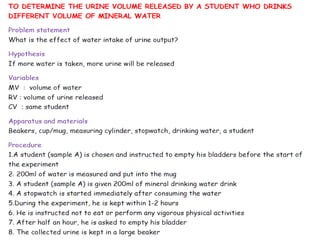
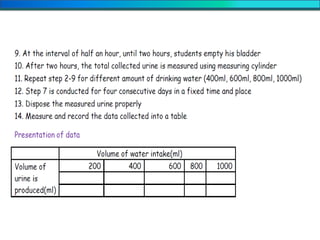
 design an experiment to study the effect of different quantities of
water intake on urine output,
 relate changes in blood osmotic pressure to urine output,
 describe the formation of urine,
 relate the formation of urine to excretion,
 describe briefly the mechanism of osmoregulation,
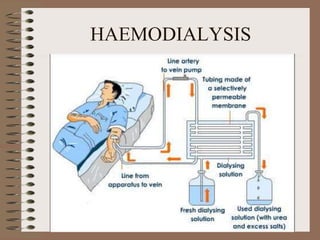
 predict the consequences of impaired kidney function,
 describe the regulation of blood sugar level,
 describe the regulation of body temperature,
 conceptualise homeostasis.
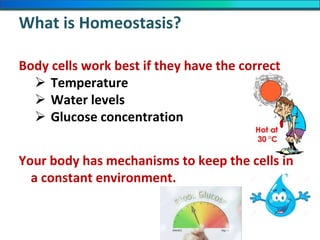
What is Homeostasis?
Body cells work best if they have the correct
 Temperature
 Water levels
 Glucose concentration
Your body has mechanisms to keep the cells in
a constant environment.
Homeostasis:
 Greek: ‘homoios’ = similar
‘stasis’ = standing still
Homeostasis is the
maintenance of a relatively
stable internal environment
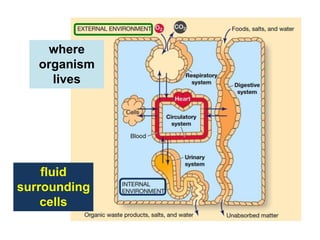
The ‘internal’ environment is
the:
 tissue fluid [interstitial fluid]
 plasma
fluid
surrounding
cells
where
organism
lives
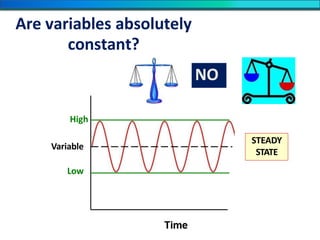
Are variables absolutely
constant?
STEADY
STATE
High
Variable
Low
NO
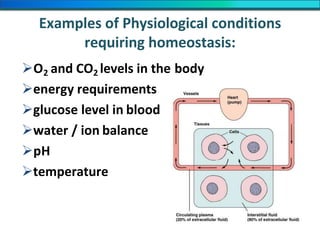
Examples of Physiological conditions
requiring homeostasis:
O2 and CO2 levels in the body
energy requirements
glucose level in blood
water / ion balance
pH
temperature
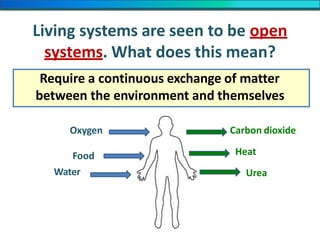
Living systems are seen to be open
systems. What does this mean?
Require a continuous exchange of matter
between the environment and themselves
Oxygen Carbon dioxide
Heat
Urea
Food
Water
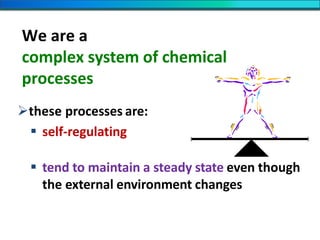
We are a
complex system of chemical
processes
these processes are:
 self-regulating
 tend to maintain a steady state even though
the external environment changes
What is Homeostasis?
The maintenance of a
constant environment
in the body is called
Homeostasis
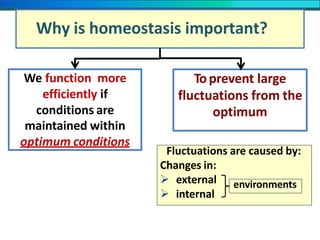
Why is homeostasis important?
We function more
efficiently if
conditions are
maintained within
optimum conditions
Fluctuations are caused by:
Changes in:
 external
 internal
Toprevent large
fluctuations from the
optimum
environments
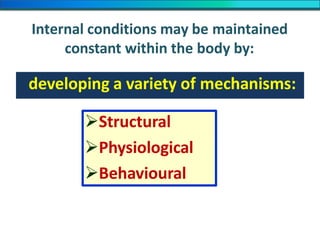
Internal conditions may be maintained
constant within the body by:
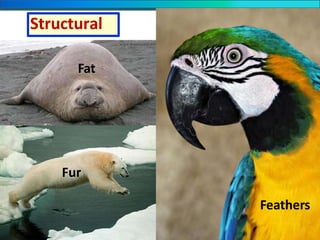
developing a variety of mechanisms:
Structural
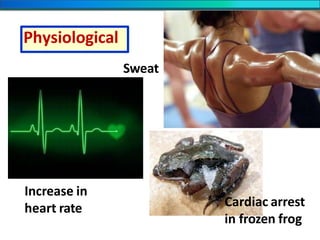
Physiological
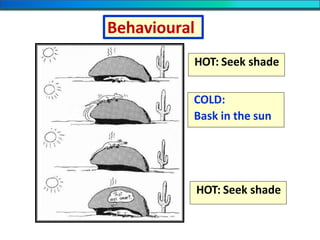
Behavioural
Fat
Fur
Feathers
Structural
Sweat
Increase in
heart rate Cardiac arrest
in frozen frog
Physiological
HOT: Seek shade
HOT: Seek shade
COLD:
Bask in the sun
Behavioural
LEARNING OBJECTIVES
3.4 Synthesising the concept of homeostasis in humans
LEARNING OUTCOMES
 explain the necessity to maintain an optimal physical and chemical
condition in the internal environment
 state the meaning of homeostasis,
 design an experiment to study the effect of different quantities of
water intake on urine output,
 relate changes in blood osmotic pressure to urine output,
 describe the formation of urine,
 relate the formation of urine to excretion,
 describe briefly the mechanism of osmoregulation,
 predict the consequences of impaired kidney function,
 describe the regulation of blood sugar level,
 describe the regulation of body temperature,
 conceptualise homeostasis.
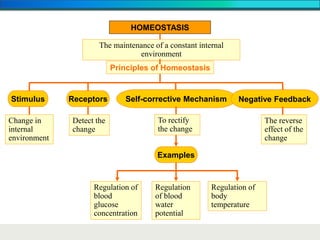
Principles of Homeostasis
Stimulus Receptors Self-corrective Mechanism Negative Feedback
Change in
internal
environment
Detect the
change
Regulation of
blood
glucose
concentration
Examples
To rectify
the change
Regulation
of blood
water
potential
Regulation of
body
temperature
The reverse
effect of the
change
HOMEOSTASIS
The maintenance of a constant internal
environment
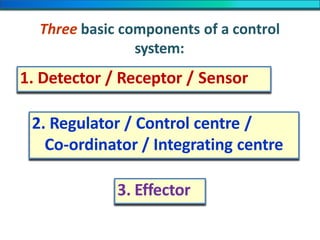
Three basic components of a control
system:
1. Detector / Receptor / Sensor
2. Regulator / Control centre /
Co-ordinator / Integrating centre
3. Effector
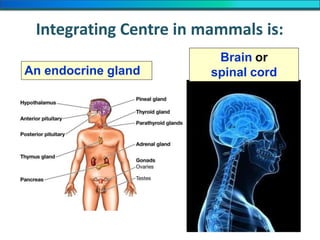
Integrating Centre in mammals is:
An endocrine gland
Brain or
spinal cord
What is Feedback?
Feedback refers to responses made
after a change has been detected
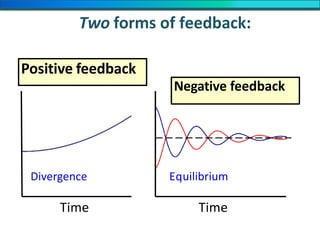
Positive feedback
Two forms of feedback:
Equilibrium
Time
Divergence
Time
Negative feedback
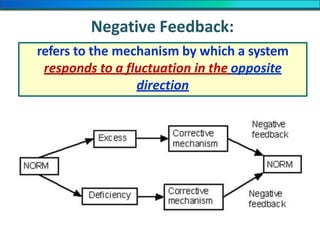
Negative Feedback:
refers to the mechanism by which a system
responds to a fluctuation in the opposite
direction
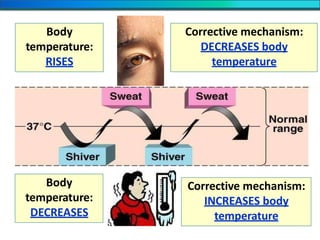
Body
temperature:
RISES
Corrective mechanism:
DECREASES body
temperature
Body
temperature:
DECREASES
Corrective mechanism:
INCREASES body
temperature
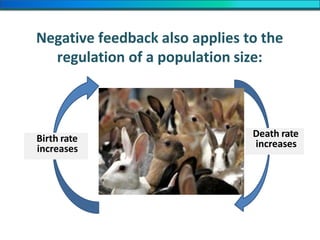
Negative feedback also applies to the
regulation of a population size:
Death rate
increasesBirth rate
increases
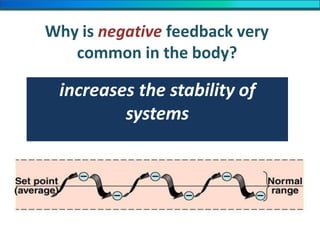
Why is negative feedback very
common in the body?
increases the stability of
systems
Examples of Negative Feedback Control:
O2 and CO2 levels in the body
hormone levels, e.g. thyroxine
sex hormones
metabolic levels e.g. glucose
water balance
the regulation of pH
body temperature
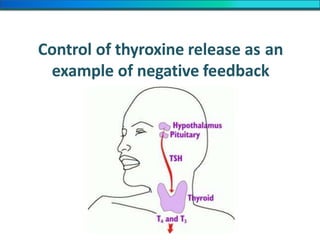
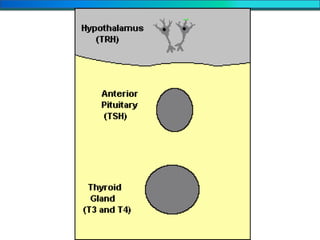
Control of thyroxine release as an
example of negative feedback
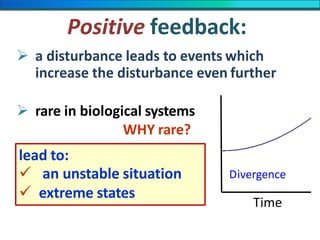
Positive feedback:
 a disturbance leads to events which
increase the disturbance even further
 rare in biological systems
WHY rare?
lead to:
 an unstable situation
 extreme states
Time
Divergence
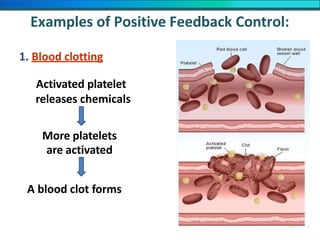
Examples of Positive Feedback Control:
1. Blood clotting
Activated platelet
releases chemicals
More platelets
are activated
A blood clot forms
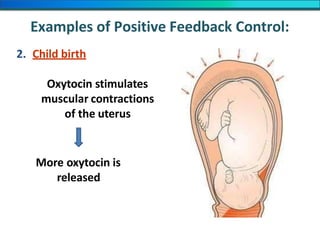
Examples of Positive Feedback Control:
2. Child birth
Oxytocin stimulates
muscular contractions
of the uterus
More oxytocin is
released
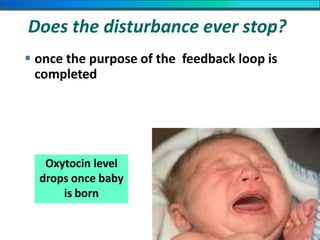
Does the disturbance ever stop?
 once the purpose of the feedback loop is
completed
Oxytocin level
drops once baby
is born
LEARNING OBJECTIVES
3.4 Synthesising the concept of homeostasis in humans
LEARNING OUTCOMES
 explain the necessity to maintain an optimal physical and chemical
condition in the internal environment
 state the meaning of homeostasis,
 design an experiment to study the effect of different quantities of
water intake on urine output,
 relate changes in blood osmotic pressure to urine output,
 describe the formation of urine,
 relate the formation of urine to excretion,
 describe briefly the mechanism of osmoregulation,
 predict the consequences of impaired kidney function,
 describe the regulation of blood sugar level,
 describe the regulation of body temperature,
 conceptualise homeostasis.
LEARNING OBJECTIVES
3.4 Synthesising the concept of homeostasis in humans
LEARNING OUTCOMES
 explain the necessity to maintain an optimal physical and chemical
condition in the internal environment
 state the meaning of homeostasis,
 design an experiment to study the effect of different quantities of
water intake on urine output,
 relate changes in blood osmotic pressure to urine output,
 describe the formation of urine,
 relate the formation of urine to excretion,
 describe briefly the mechanism of osmoregulation,
 predict the consequences of impaired kidney function,
 describe the regulation of blood sugar level,
 describe the regulation of body temperature,
 conceptualise homeostasis.
Formation of Urine
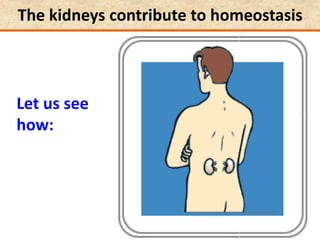
The kidneys contribute to homeostasis
Let us see
how:
Urine Production
• Regulation of water
and salts in the body
- osmoregulation
• Rids body of waste –
excretion
• Maintaining blood pH
• Regulating blood
volume & pressure
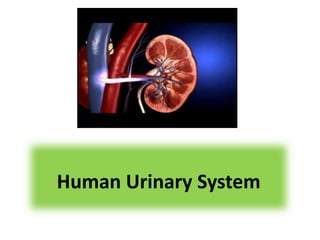
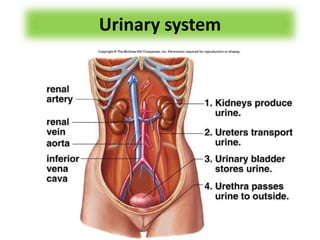
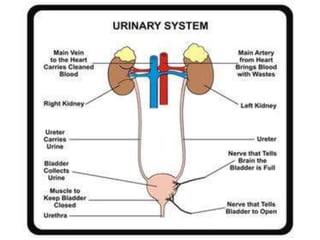
Human Urinary System
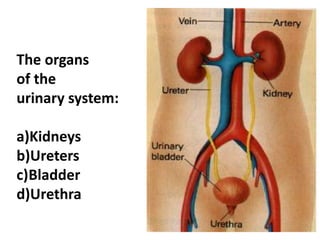
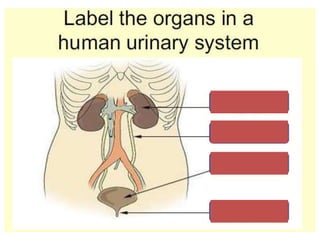
The organs
of the
urinary system:
a)Kidneys
b)Ureters
c)Bladder
d)Urethra
Urinary system
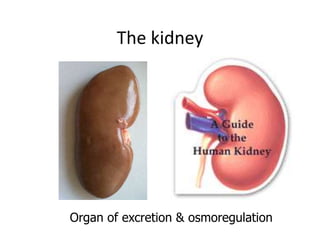
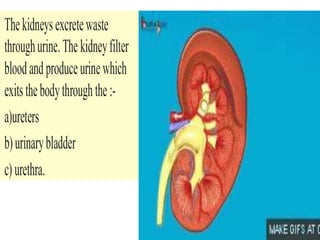
The kidney
Organ of excretion & osmoregulation
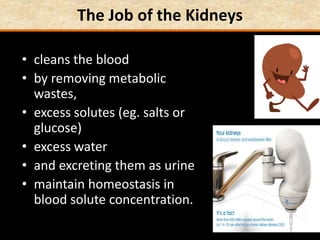
The Job of the Kidneys
• cleans the blood
• by removing metabolic
wastes,
• excess solutes (eg. salts or
glucose)
• excess water
• and excreting them as urine
• maintain homeostasis in
blood solute concentration.
The Hard-working Kidneys
• The two kidneys in the body
receive between 1100 – 2000
liters (1160 – 2100 quarts or
500 gallons) of blood per day –
about the volume of a car!
• Because the body has only
about 5.6 liters of blood, your
blood runs through the kidneys
to be cleaned about once every
four minutes.
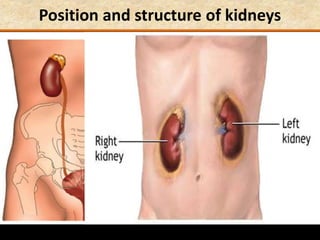
Position and structure of kidneys
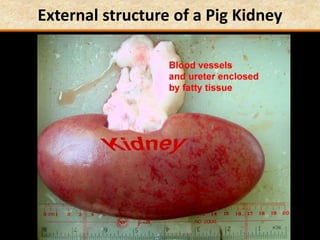
External structure of a Pig Kidney
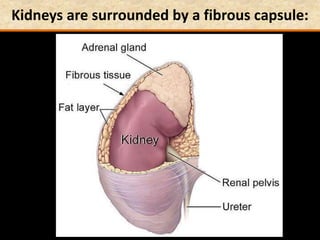
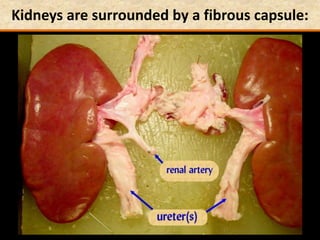
Kidneys are surrounded by a fibrous capsule:
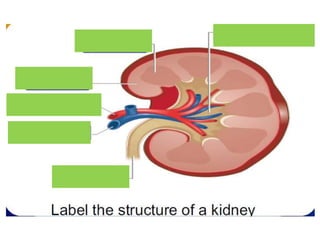
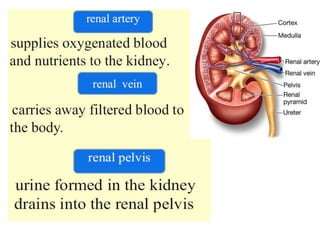
(b) Kidney structure
Ureter
Section of kidney from a rat
Renal
medulla
Renal
cortex
Renal
pelvis
Figure 44.13b
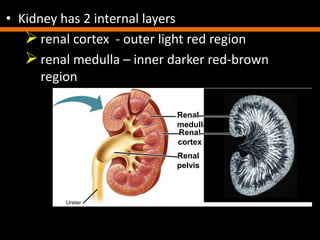
• Kidney has 2 internal layers
renal cortex - outer light red region
renal medulla – inner darker red-brown
region
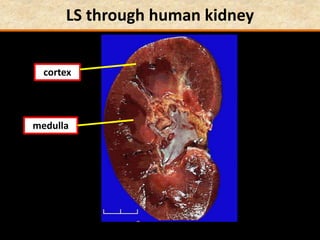
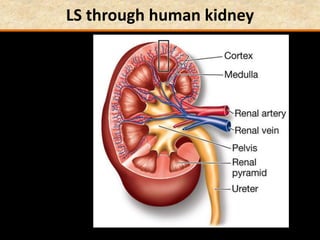
LS through human kidney
medulla
cortex
LS through human kidney
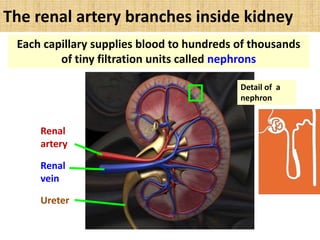
The renal artery branches inside kidney
Renal
artery
Ureter
Renal
vein
Each capillary supplies blood to hundreds of thousands
of tiny filtration units called nephrons
Detail of a
nephron
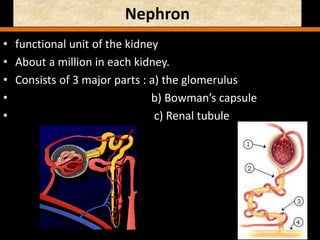
Nephron
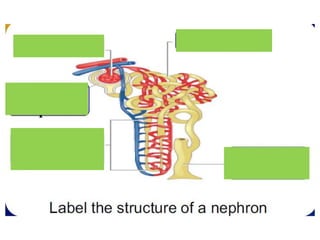
• functional unit of the kidney
• About a million in each kidney.
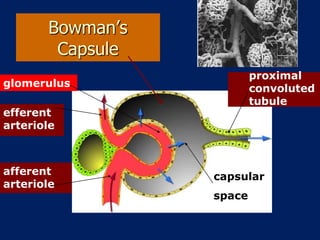
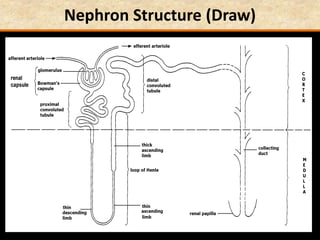
• Consists of 3 major parts : a) the glomerulus
• b) Bowman’s capsule
• c) Renal tubule
Bowman’s
Capsule
glomerulus
afferent
arteriole
efferent
arteriole
proximal
convoluted
tubule
capsular
space
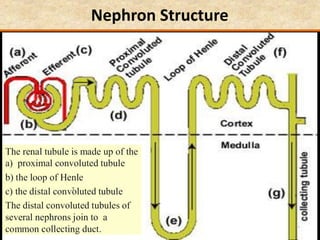
Nephron Structure
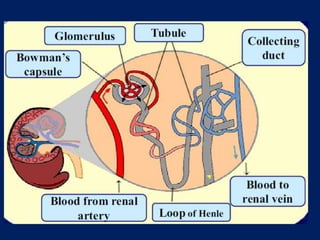
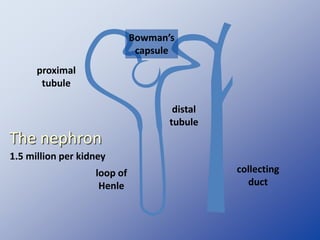
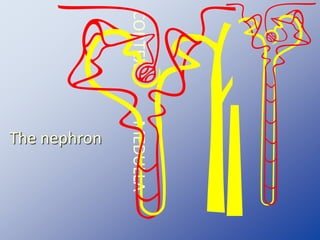
The nephron
1.5 million per kidney
collecting
duct
Bowman’s
capsule
distal
tubule
loop of
Henle
proximal
tubule
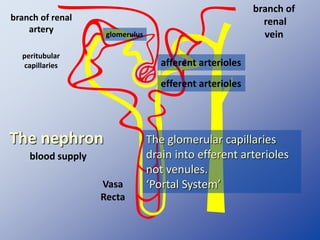
The nephron
blood supply
peritubular
capillaries
Vasa
Recta
glomerulus
branch of renal
artery
afferent arterioles
efferent arterioles
branch of
renal
vein
The glomerular capillaries
drain into efferent arterioles
not venules.
‘Portal System’
CORTEXMEDULLA
The nephron
Nephron Structure (Draw)
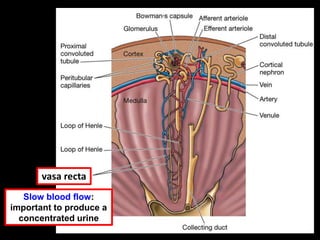
vasa recta
Slow blood flow:
important to produce a
concentrated urine
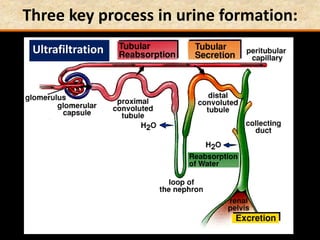
Three key process in urine formation:
Ultrafiltration
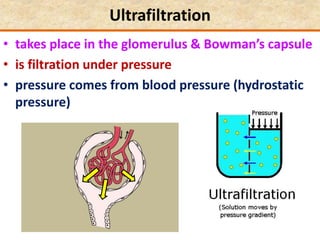
Ultrafiltration
• takes place in the glomerulus & Bowman’s capsule
• is filtration under pressure
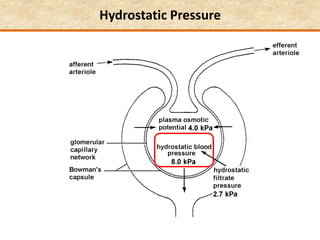
• pressure comes from blood pressure (hydrostatic
pressure)
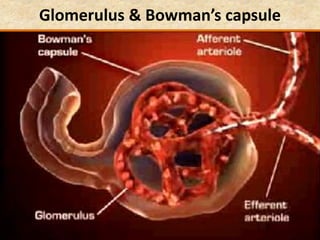
Glomerulus & Bowman’s capsule
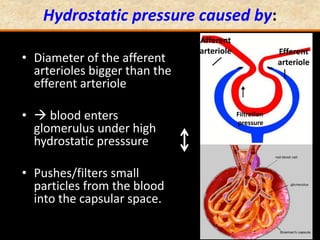
Hydrostatic pressure caused by:
Efferent
arteriole
Afferent
arteriole
Filtration
pressure
GFR maintained
• Diameter of the afferent
arterioles bigger than the
efferent arteriole
•  blood enters
glomerulus under high
hydrostatic presssure
• Pushes/filters small
particles from the blood
into the capsular space.
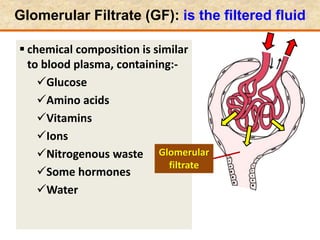
Glomerular Filtrate (GF): is the filtered fluid
 chemical composition is similar
to blood plasma, containing:-
Glucose
Amino acids
Vitamins
Ions
Nitrogenous waste
Some hormones
Water
Glomerular
filtrate
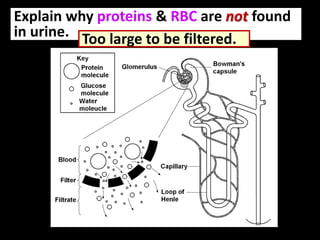
Explain why proteins & RBC are not found
in urine. Too large to be filtered.
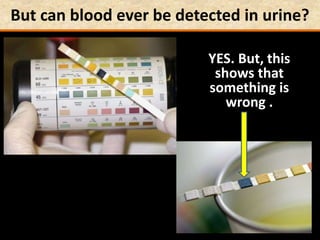
But can blood ever be detected in urine?
YES. But, this
shows that
something is
wrong .
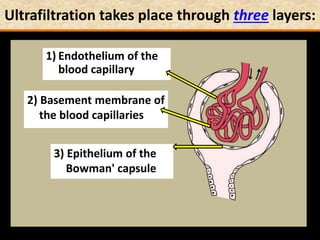
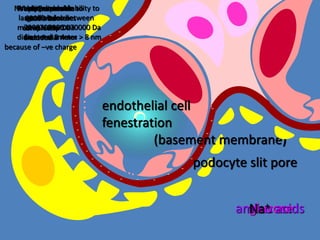
Ultrafiltration takes place through three layers:
1) Endothelium of the
blood capillary
2) Basement membrane of
the blood capillaries
3) Epithelium of the
Bowman' capsule
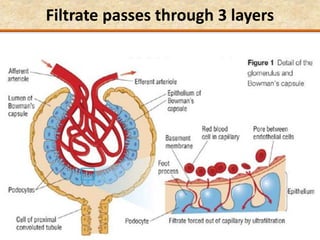
Filtrate passes through 3 layers
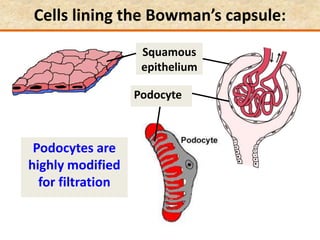
Cells lining the Bowman’s capsule:
Podocyte
Squamous
epithelium
Podocytes are
highly modified
for filtration
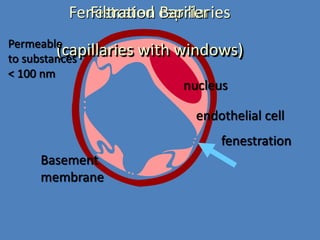
Basement
membrane
Fenestrated capillaries
(capillaries with windows)Permeable
to substances
< 100 nm
endothelial cell
fenestration
nucleus
Filtration Barrier
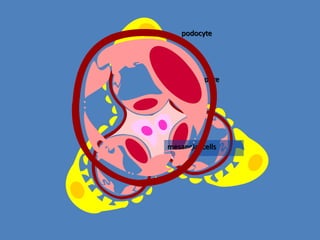
mesangial cells
podocyte
slit pore
glucoseamino acids
(basement membrane)
podocyte slit pore
Na+
--
-
-
-
---
-
-
-
-
-
-
-
-
-
-
-
-
- -
-
-
--
-
-
-
Limited permeability to
molecules between
7000 > mwt > 70000 Da
4 nm > diameter > 8 nm
Freely permeable to
small molecules
mwt < 7000 Da
diameter < 4 nm
Not permeable to
large molecules
mwt > 70000 Da
diameter > 8 nm
Water Permeablealbumin
60000 Da
completely
excluded…
because of –ve charge
endothelial cell
fenestration
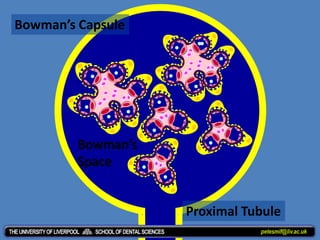
Bowman’s Capsule
Bowman’s
Space
Proximal Tubule
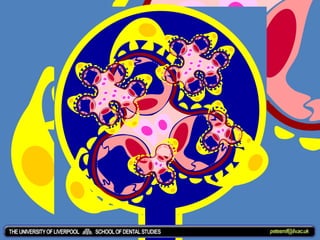
petesmif@liv.ac.uk
Hydrostatic Pressure
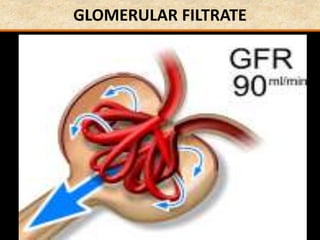
GLOMERULAR FILTRATE
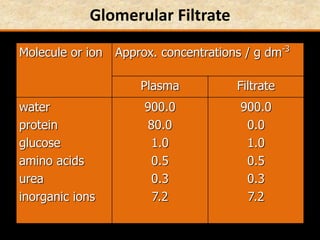
Glomerular Filtrate
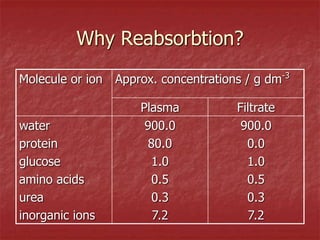
Molecule or ion Approx. concentrations / g dm-3
Plasma Filtrate
water
protein
glucose
amino acids
urea
inorganic ions
900.0
80.0
1.0
0.5
0.3
7.2
900.0
0.0
1.0
0.5
0.3
7.2
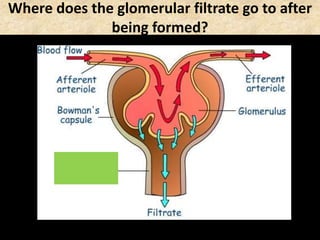
Where does the glomerular filtrate go to after
being formed?
Recap: What is ultrafiltration?
Ultrafiltration begins in the Bowman's Capsule.
a) Blood arrives in the kidney in the Afferent arteriole
(with a wide blood vessel) at high pressure.
b) Blood passes through the Glomerulus and passes out
the Efferent arteriole (with a narrow blood vessel).
c) Blood pressure increases in the Glomerulus.
d) High hydrostatic pressure forces the plasma (liquid in
blood - water, salts, amino acids, glucose and urea) out
of the blood vessel into the inside of the Bowman's
Capsule - This is called "Glomerular Filtrate."
After ultrafiltration
2 more processes
2) Reabsorbtion
3)Secretion
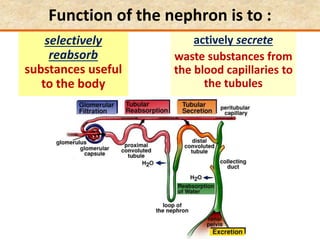
Function of the nephron is to :
actively secrete
waste substances from
the blood capillaries to
the tubules
selectively
reabsorb
substances useful
to the body
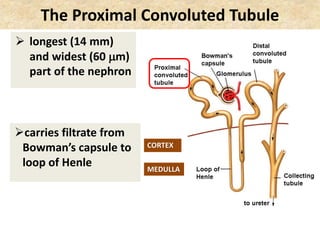
The Proximal Convoluted Tubule
 longest (14 mm)
and widest (60 m)
part of the nephron
carries filtrate from
Bowman’s capsule to
loop of Henle
CORTEX
MEDULLA
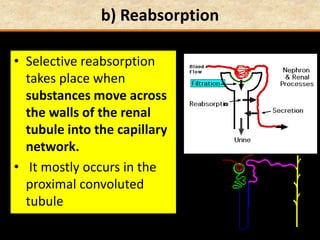
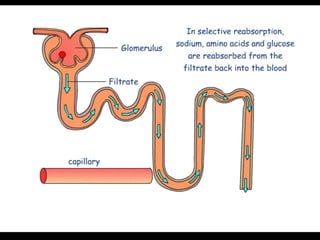
b) Reabsorption
• Selective reabsorption
takes place when
substances move across
the walls of the renal
tubule into the capillary
network.
• It mostly occurs in the
proximal convoluted
tubule
Why Reabsorbtion?
Molecule or ion Approx. concentrations / g dm-3
Plasma Filtrate
water
protein
glucose
amino acids
urea
inorganic ions
900.0
80.0
1.0
0.5
0.3
7.2
900.0
0.0
1.0
0.5
0.3
7.2
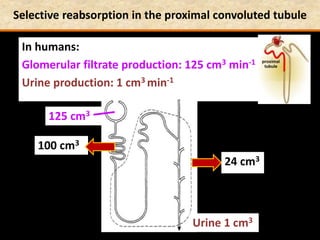
Selective reabsorption in the proximal convoluted tubule
In humans:
Glomerular filtrate production: 125 cm3 min-1
Urine production: 1 cm3 min-1
24 cm3
100 cm3
Urine 1 cm3
125 cm3
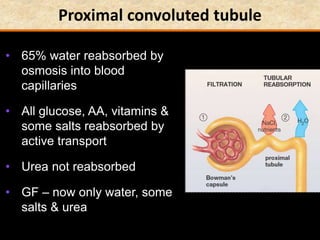
Proximal convoluted tubule
• 65% water reabsorbed by
osmosis into blood
capillaries
• All glucose, AA, vitamins &
some salts reabsorbed by
active transport
• Urea not reabsorbed
• GF – now only water, some
salts & urea
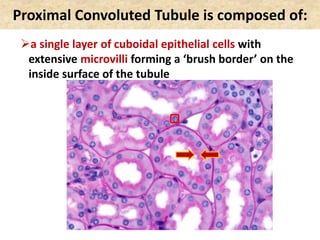
Proximal Convoluted Tubule is composed of:
a single layer of cuboidal epithelial cells with
extensive microvilli forming a ‘brush border’ on the
inside surface of the tubule
Figure 44.9
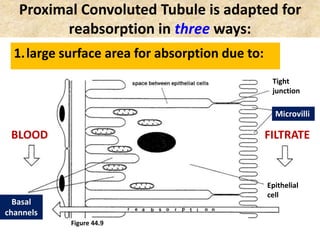
Proximal Convoluted Tubule is adapted for
reabsorption in three ways:
1.large surface area for absorption due to:
Figure 44.9
Microvilli
Basal
channels
BLOOD FILTRATE
Tight
junction
Epithelial
cell
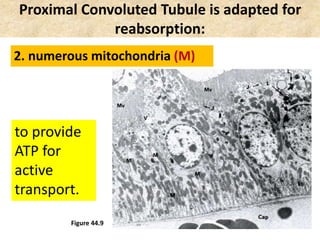
Proximal Convoluted Tubule is adapted for
reabsorption:
Figure 44.9
2. numerous mitochondria (M)
to provide
ATP for
active
transport.
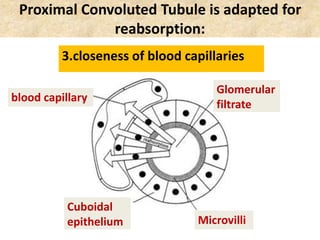
Proximal Convoluted Tubule is adapted for
reabsorption:
Figure 44.9
3.closeness of blood capillaries
blood capillary
Glomerular
filtrate
Microvilli
Cuboidal
epithelium
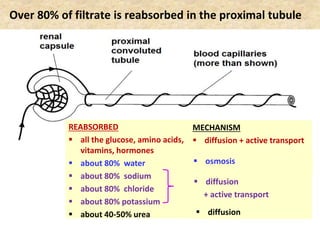
Over 80% of filtrate is reabsorbed in the proximal tubule
REABSORBED
 all the glucose, amino acids,
vitamins, hormones
 about 80% water
 about 80% sodium
 about 80% chloride
 about 80% potassium
 about 40-50% urea
MECHANISM
 diffusion + active transport
 osmosis
 diffusion
+ active transport
 diffusion
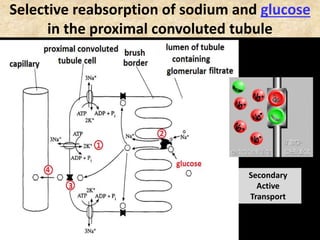
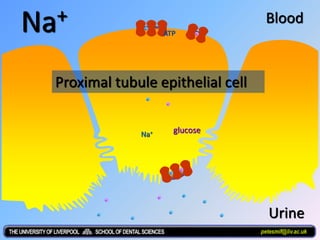
Selective reabsorption of sodium and glucose
in the proximal convoluted tubule
Figure 44.9
Secondary
Active
Transport
Na+
glucoseNa+
ATP
ADP
Blood
Urine
Proximal tubule epithelial cell
petesmif@liv.ac.uk
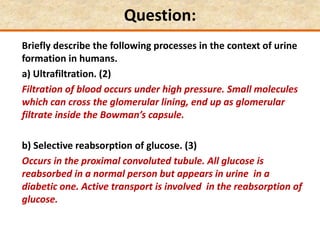
Question:
Briefly describe the following processes in the context of urine
formation in humans.
a) Ultrafiltration. (2)
Filtration of blood occurs under high pressure. Small molecules
which can cross the glomerular lining, end up as glomerular
filtrate inside the Bowman’s capsule.
b) Selective reabsorption of glucose. (3)
Occurs in the proximal convoluted tubule. All glucose is
reabsorbed in a normal person but appears in urine in a
diabetic one. Active transport is involved in the reabsorption of
glucose.
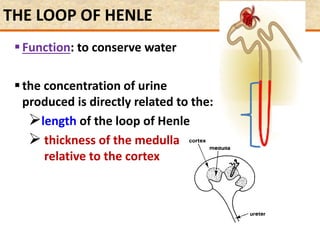
THE LOOP OF HENLE
Function: to conserve water
the concentration of urine
produced is directly related to the:
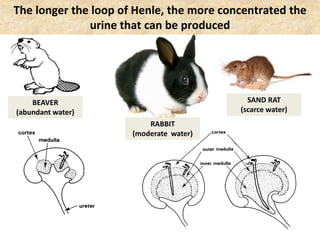
length of the loop of Henle
 thickness of the medulla
relative to the cortex
The longer the loop of Henle, the more concentrated the
urine that can be produced
BEAVER
(abundant water)
RABBIT
(moderate water)
SAND RAT
(scarce water)
Birds & Mammals are the only vertebrates:
which can produce a urine which is more
concentrated than the blood
[hypertonic]
with loops of Henle
Loop of Henle
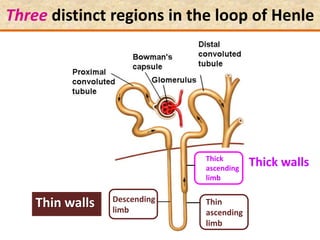
Three distinct regions in the loop of Henle
Thin
ascending
limb
Descending
limb
Thick
ascending
limb
Thin walls
Thick walls
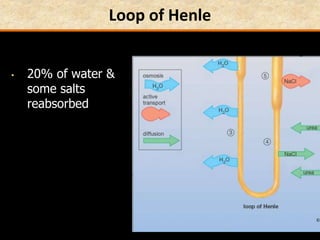
Loop of Henle
• 20% of water &
some salts
reabsorbed
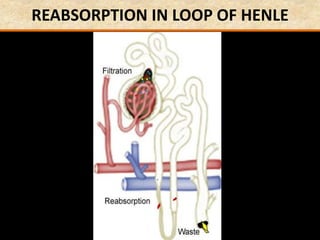
REABSORPTION IN LOOP OF HENLE
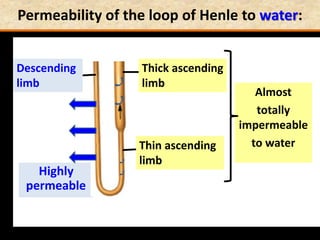
Permeability of the loop of Henle to water:
Highly
permeable
Descending
limb
Almost
totally
impermeable
to waterThin ascending
limb
Thick ascending
limb
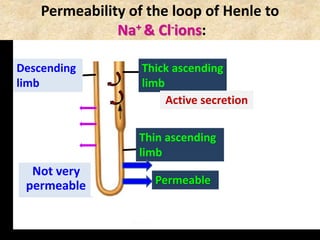
Permeability of the loop of Henle to
Na+ & Cl-ions:
Not very
permeable
Descending
limb
Thin ascending
limb
Thick ascending
limb
Permeable
Active secretion
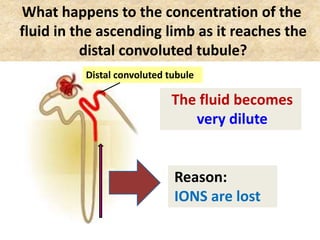
What happens to the concentration of the
fluid in the ascending limb as it reaches the
distal convoluted tubule?
The fluid becomes
very dilute
Distal convoluted tubule
Reason:
IONS are lost
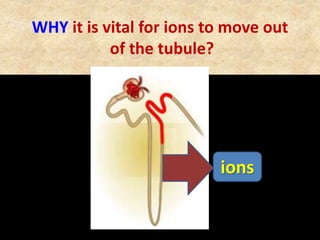
WHY it is vital for ions to move out
of the tubule?
ions
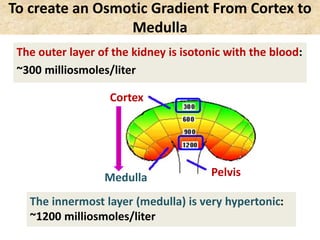
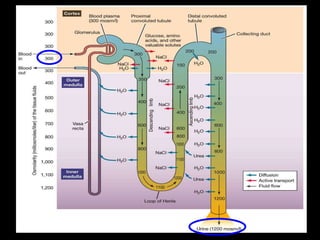
To create an Osmotic Gradient From Cortex to
Medulla
PelvisMedulla
Cortex
The outer layer of the kidney is isotonic with the blood:
~300 milliosmoles/liter
The innermost layer (medulla) is very hypertonic:
~1200 milliosmoles/liter
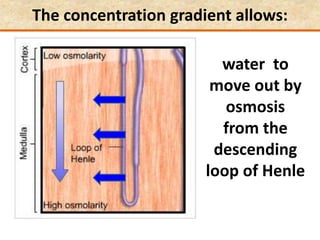
The concentration gradient allows:
water to
move out by
osmosis
from the
descending
loop of Henle
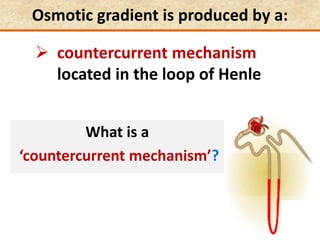
Osmotic gradient is produced by a:
 countercurrent mechanism
located in the loop of Henle
What is a
‘countercurrent mechanism’?
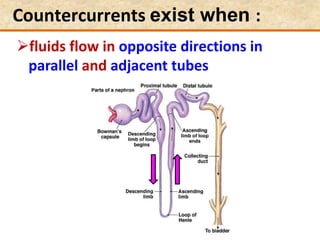
Countercurrents exist when :
fluids flow in opposite directions in
parallel and adjacent tubes
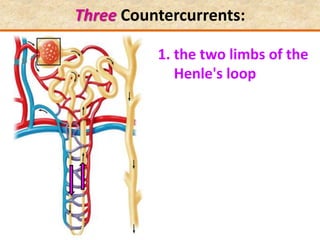
Three Countercurrents:
1. the two limbs of the
Henle's loop
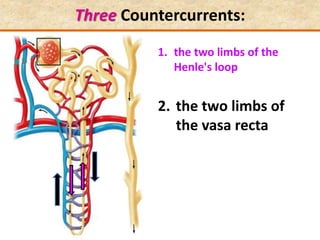
Three Countercurrents:
1. the two limbs of the
Henle's loop
2. the two limbs of
the vasa recta
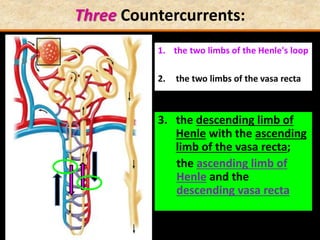
Three Countercurrents:
1. the two limbs of the Henle's loop
2. the two limbs of the vasa recta
3. the descending limb of
Henle with the ascending
limb of the vasa recta;
the ascending limb of
Henle and the
descending vasa recta
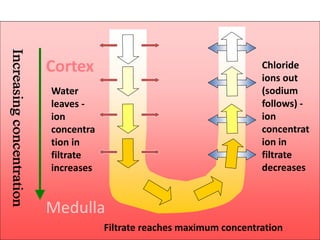
Cortex
Water
leaves -
ion
concentra
tion in
filtrate
increases
Filtrate reaches maximum concentration
Chloride
ions out
(sodium
follows) -
ion
concentrat
ion in
filtrate
decreases
Medulla
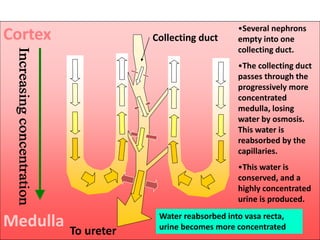
To ureter
Collecting duct
•Several nephrons
empty into one
collecting duct.
•The collecting duct
passes through the
progressively more
concentrated
medulla, losing
water by osmosis.
This water is
reabsorbed by the
capillaries.
•This water is
conserved, and a
highly concentrated
urine is produced.
Water reabsorbed into vasa recta,
urine becomes more concentrated
Cortex
Medulla
Question: [SEP, 2009]
Briefly describe the role of each of the following in
osmoregulation in humans:
i) The descending limb of the Loop of Henle; (2)
Is permeable to water. Functions towards water
conservation.
ii) The ascending limb of the Loop of Henle; (2)
Is relatively impermeable to water but permeable to salts.
The tissue fluid inside the medulla becomes concentrated as
salts move out of the ascending limb. This causes water to be
drawn out of the descending limb.
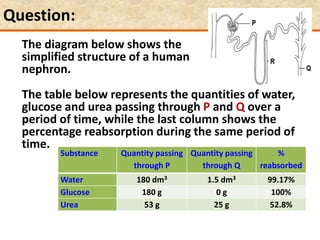
Question:
The diagram below shows the
simplified structure of a human
nephron.the loop of Henle
Substance Quantity passing
through P
Quantity passing
through Q
%
reabsorbed
Water 180 dm3 1.5 dm3 99.17%
Glucose 180 g 0 g 100%
Urea 53 g 25 g 52.8%
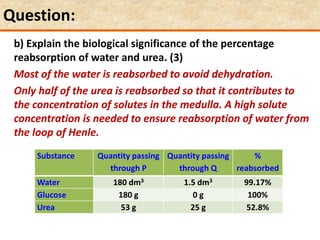
The table below represents the quantities of water,
glucose and urea passing through P and Q over a
period of time, while the last column shows the
percentage reabsorption during the same period of
time.
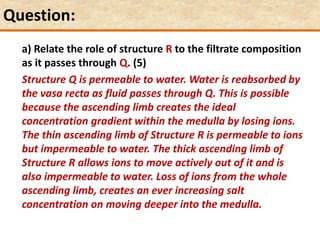
Question:
a) Relate the role of structure R to the filtrate composition
as it passes through Q. (5)
Structure Q is permeable to water. Water is reabsorbed by
the vasa recta as fluid passes through Q. This is possible
because the ascending limb creates the ideal
concentration gradient within the medulla by losing ions.
The thin ascending limb of Structure R is permeable to ions
but impermeable to water. The thick ascending limb of
Structure R allows ions to move actively out of it and is
also impermeable to water. Loss of ions from the whole
ascending limb, creates an ever increasing salt
concentration on moving deeper into the medulla.
Question:
Substance Quantity passing
through P
Quantity passing
through Q
%
reabsorbed
Water 180 dm3 1.5 dm3 99.17%
Glucose 180 g 0 g 100%
Urea 53 g 25 g 52.8%
b) Explain the biological significance of the percentage
reabsorption of water and urea. (3)
Most of the water is reabsorbed to avoid dehydration.
Only half of the urea is reabsorbed so that it contributes to
the concentration of solutes in the medulla. A high solute
concentration is needed to ensure reabsorption of water from
the loop of Henle.
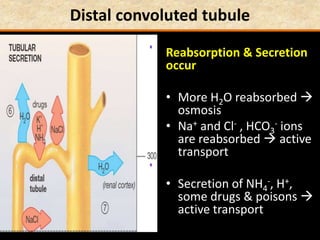
Distal convoluted tubule
Reabsorption & Secretion
occur
• More H2O reabsorbed 
osmosis
• Na+ and Cl- , HCO3
- ions
are reabsorbed  active
transport
• Secretion of NH4
-, H+,
some drugs & poisons 
active transport
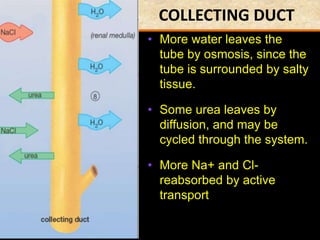
COLLECTING DUCT
• More water leaves the
tube by osmosis, since the
tube is surrounded by salty
tissue.
• Some urea leaves by
diffusion, and may be
cycled through the system.
• More Na+ and Cl-
reabsorbed by active
transport
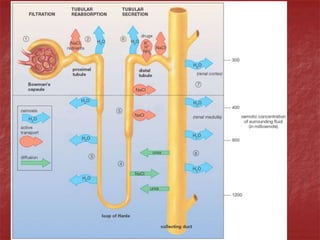
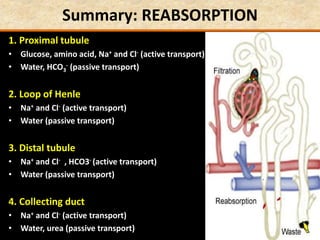
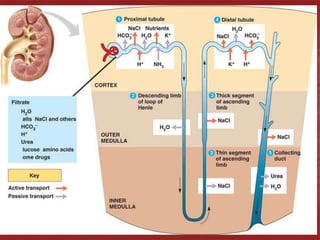
Summary: REABSORPTION
1. Proximal tubule
• Glucose, amino acid, Na+ and Cl- (active transport)
• Water, HCO3
- (passive transport)
2. Loop of Henle
• Na+ and Cl- (active transport)
• Water (passive transport)
3. Distal tubule
• Na+ and Cl- , HCO3- (active transport)
• Water (passive transport)
4. Collecting duct
• Na+ and Cl- (active transport)
• Water, urea (passive transport)
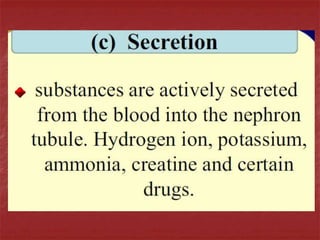
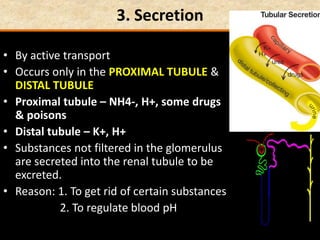
3. Secretion
• By active transport
• Occurs only in the PROXIMAL TUBULE &
DISTAL TUBULE
• Proximal tubule – NH4-, H+, some drugs
& poisons
• Distal tubule – K+, H+
• Substances not filtered in the glomerulus
are secreted into the renal tubule to be
excreted.
• Reason: 1. To get rid of certain substances
2. To regulate blood pH
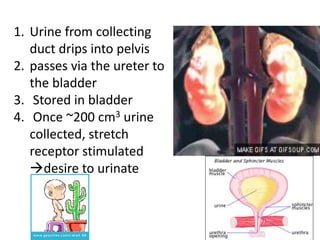
1. Urine from collecting
duct drips into pelvis
2. passes via the ureter to
the bladder
3. Stored in bladder
4. Once ~200 cm3 urine
collected, stretch
receptor stimulated
desire to urinate
OSMOREGULATION, ADH &
URINE FORMATION
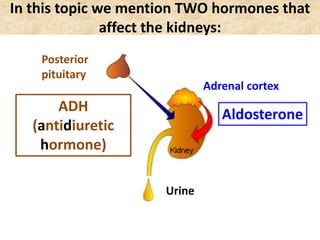
In this topic we mention TWO hormones that
affect the kidneys:
Urine
ADH
(antidiuretic
hormone)
Posterior
pituitary
Adrenal cortex
Aldosterone
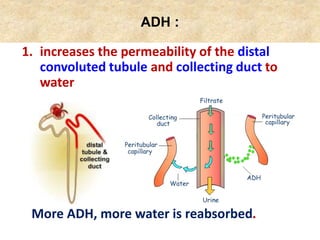
ADH :
1. increases the permeability of the distal
convoluted tubule and collecting duct to
water
More ADH, more water is reabsorbed.
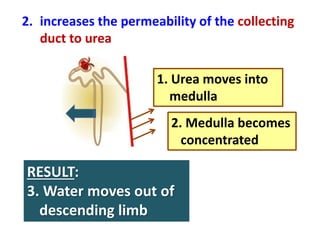
2. increases the permeability of the collecting
duct to urea
1. Urea moves into
medulla
2. Medulla becomes
concentrated
RESULT:
3. Water moves out of
descending limb
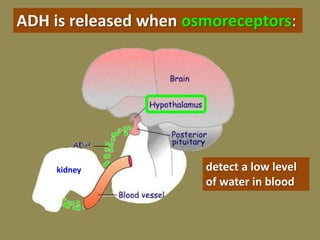
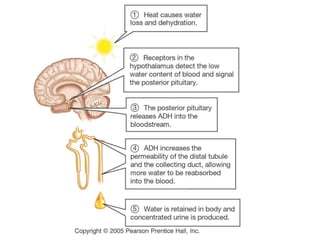
ADH is released when osmoreceptors:
detect a low level
of water in blood
kidney
Water
Salts
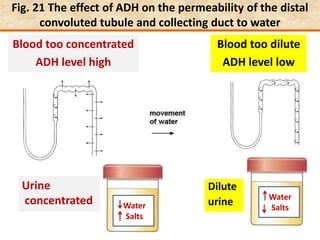
Fig. 21 The effect of ADH on the permeability of the distal
convoluted tubule and collecting duct to water
Blood too concentrated
ADH level high
Blood too dilute
ADH level low
Dilute
urine
Urine
concentrated Water
Salts
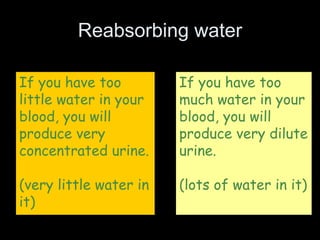
Reabsorbing water
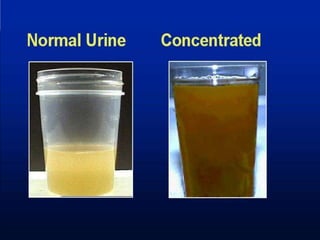
If you have too
little water in your
blood, you will
produce very
concentrated urine.
(very little water in
it)
If you have too
much water in your
blood, you will
produce very dilute
urine.
(lots of water in it)
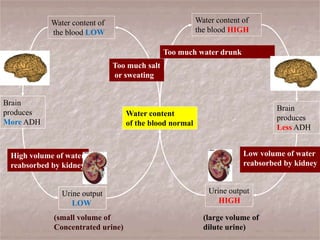
Water level regulation by
negative feedback control
Water content
of the blood normal
Water content of
the blood HIGH
Water content of
the blood LOW
Too much water drunk
Too much salt
or sweating
Brain
produces
More ADH
Urine output
LOW
Brain
produces
Less ADH
Urine output
HIGH
High volume of water
reabsorbed by kidney
Low volume of water
reabsorbed by kidney
(small volume of
Concentrated urine)
(large volume of
dilute urine)
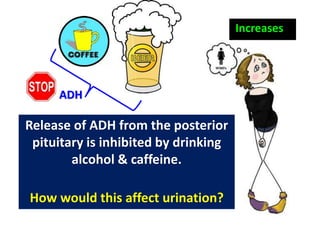
Release of ADH from the posterior
pituitary is inhibited by drinking
alcohol & caffeine.
How would this affect urination?
Increases
ADH
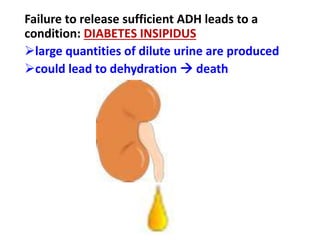
Failure to release sufficient ADH leads to a
condition: DIABETES INSIPIDUS
large quantities of dilute urine are produced
could lead to dehydration  death
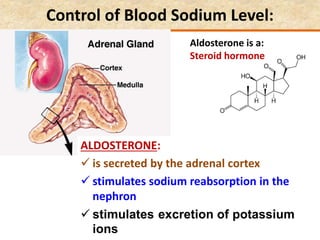
ALDOSTERONE:
 is secreted by the adrenal cortex
 stimulates sodium reabsorption in the
nephron
 stimulates excretion of potassium
ions
Control of Blood Sodium Level:
Aldosterone is a:
Steroid hormone
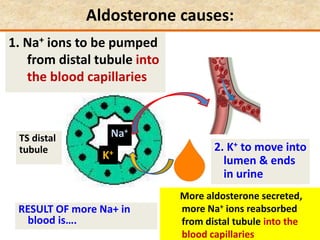
Aldosterone causes:
2. K+ to move into
lumen & ends
in urine
1. Na+ ions to be pumped
from distal tubule into
the blood capillaries
TS distal
tubule
K+
Na+
RESULT OF more Na+ in
blood is….
More aldosterone secreted,
more Na+ ions reabsorbed
from distal tubule into the
blood capillaries
A decrease in blood Na leads to a
decrease in blood volume. WHY?
Because less water enters the
blood by osmosis.
Less water =
reduction in blood pressure
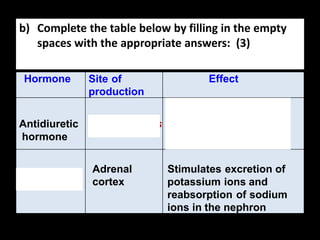
b) Complete the table below by filling in the empty
spaces with the appropriate answers: (3)
Hormone Site of
production
Effect
Antidiuretic
hormone
Hypothalamus
Stimulates distal
convoluted tubule and
collecting duct to
reabsorb water
Aldosterone
Adrenal
cortex
Stimulates excretion of
potassium ions and
reabsorption of sodium
ions in the nephron
Factors that affect kidney
function
• Antidiuretic hormone (ADH) – prevents excess
water loss from kidneys
• Alcohol – inhibits secretion of ADH = more
urine volume
• Aldosterone – prevents excess loss of sodium and
water from kidneys
• Caffeine – increases rate of salt and water loss
from kidneys
• Increased blood pressure – increase rate of water
loss from kidneys.
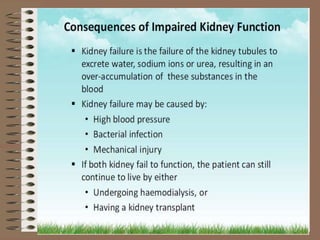
IIMPAIRED KIDNEY
FUNCTION
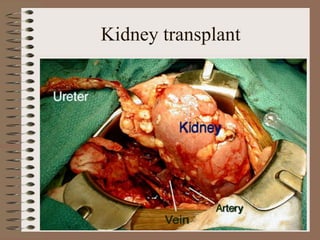
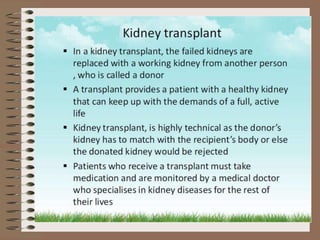
Kidney transplant
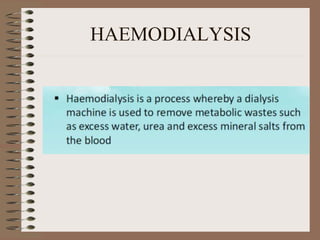
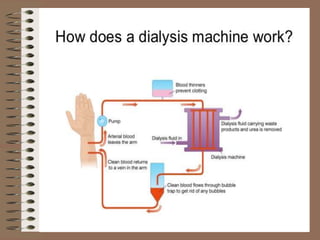
HAEMODIALYSIS
HAEMODIALYSIS
HAEMODIALYSIS VIDEO
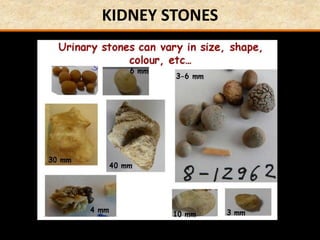
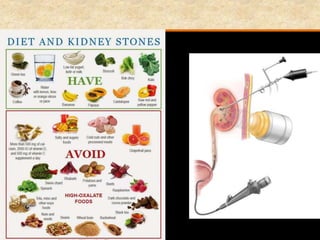
KIDNEY STONES
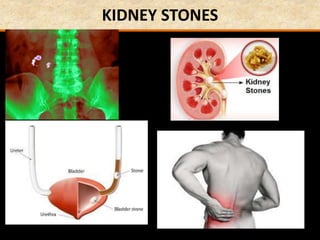
KIDNEY STONES
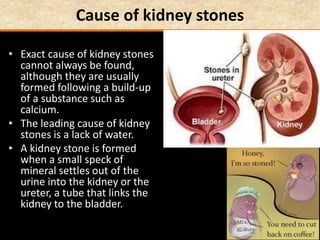
Cause of kidney stones
• Exact cause of kidney stones
cannot always be found,
although they are usually
formed following a build-up
of a substance such as
calcium.
• The leading cause of kidney
stones is a lack of water.
• A kidney stone is formed
when a small speck of
mineral settles out of the
urine into the kidney or the
ureter, a tube that links the
kidney to the bladder.
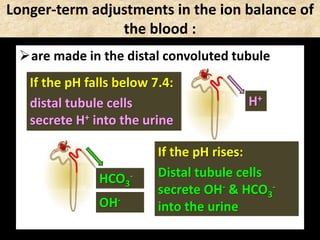
Control of Blood pH
Longer-term adjustments in the ion balance of
the blood :
are made in the distal convoluted tubule
If the pH falls below 7.4:
distal tubule cells
secrete H+ into the urine
If the pH rises:
Distal tubule cells
secrete OH- & HCO3
-
into the urine
H+
HCO3
-
OH-
Manneken Piss [Brussels, Belgium]
THE END OF URINARY SYSTEM

COORDINATION & RESPONSE PART 3 - HOMEOSTATIS - URINE FORMATION

  • 1.
    BIOLOGY FORM 5 CHAPTER3 COORDINATION & RESPONSE PART 3
  • 2.
    LEARNING OBJECTIVES 3.4 Synthesisingthe concept of homeostasis in humans LEARNING OUTCOMES  explain the necessity to maintain an optimal physical and chemical condition in the internal environment  state the meaning of homeostasis,  design an experiment to study the effect of different quantities of water intake on urine output,  relate changes in blood osmotic pressure to urine output,  describe the formation of urine,  relate the formation of urine to excretion,  describe briefly the mechanism of osmoregulation,  predict the consequences of impaired kidney function,  describe the regulation of blood sugar level,  describe the regulation of body temperature,  conceptualise homeostasis.
  • 3.
    What is Homeostasis? Bodycells work best if they have the correct  Temperature  Water levels  Glucose concentration Your body has mechanisms to keep the cells in a constant environment.
  • 4.
    Homeostasis:  Greek: ‘homoios’= similar ‘stasis’ = standing still Homeostasis is the maintenance of a relatively stable internal environment The ‘internal’ environment is the:  tissue fluid [interstitial fluid]  plasma
  • 5.
  • 6.
  • 7.
    Examples of Physiologicalconditions requiring homeostasis: O2 and CO2 levels in the body energy requirements glucose level in blood water / ion balance pH temperature
  • 8.
    Living systems areseen to be open systems. What does this mean? Require a continuous exchange of matter between the environment and themselves Oxygen Carbon dioxide Heat Urea Food Water
  • 9.
    We are a complexsystem of chemical processes these processes are:  self-regulating  tend to maintain a steady state even though the external environment changes
  • 10.
    What is Homeostasis? Themaintenance of a constant environment in the body is called Homeostasis
  • 11.
    Why is homeostasisimportant? We function more efficiently if conditions are maintained within optimum conditions Fluctuations are caused by: Changes in:  external  internal Toprevent large fluctuations from the optimum environments
  • 12.
    Internal conditions maybe maintained constant within the body by: developing a variety of mechanisms: Structural Physiological Behavioural
  • 13.
  • 14.
    Sweat Increase in heart rateCardiac arrest in frozen frog Physiological
  • 15.
    HOT: Seek shade HOT:Seek shade COLD: Bask in the sun Behavioural
  • 16.
    LEARNING OBJECTIVES 3.4 Synthesisingthe concept of homeostasis in humans LEARNING OUTCOMES  explain the necessity to maintain an optimal physical and chemical condition in the internal environment  state the meaning of homeostasis,  design an experiment to study the effect of different quantities of water intake on urine output,  relate changes in blood osmotic pressure to urine output,  describe the formation of urine,  relate the formation of urine to excretion,  describe briefly the mechanism of osmoregulation,  predict the consequences of impaired kidney function,  describe the regulation of blood sugar level,  describe the regulation of body temperature,  conceptualise homeostasis.
  • 17.
    Principles of Homeostasis StimulusReceptors Self-corrective Mechanism Negative Feedback Change in internal environment Detect the change Regulation of blood glucose concentration Examples To rectify the change Regulation of blood water potential Regulation of body temperature The reverse effect of the change HOMEOSTASIS The maintenance of a constant internal environment
  • 18.
    Three basic componentsof a control system: 1. Detector / Receptor / Sensor 2. Regulator / Control centre / Co-ordinator / Integrating centre 3. Effector
  • 19.
    Integrating Centre inmammals is: An endocrine gland Brain or spinal cord
  • 20.
    What is Feedback? Feedbackrefers to responses made after a change has been detected
  • 21.
    Positive feedback Two formsof feedback: Equilibrium Time Divergence Time Negative feedback
  • 22.
    Negative Feedback: refers tothe mechanism by which a system responds to a fluctuation in the opposite direction
  • 23.
  • 24.
    Negative feedback alsoapplies to the regulation of a population size: Death rate increasesBirth rate increases
  • 25.
    Why is negativefeedback very common in the body? increases the stability of systems
  • 26.
    Examples of NegativeFeedback Control: O2 and CO2 levels in the body hormone levels, e.g. thyroxine sex hormones metabolic levels e.g. glucose water balance the regulation of pH body temperature
  • 27.
    Control of thyroxinerelease as an example of negative feedback
  • 29.
    Positive feedback:  adisturbance leads to events which increase the disturbance even further  rare in biological systems WHY rare? lead to:  an unstable situation  extreme states Time Divergence
  • 30.
    Examples of PositiveFeedback Control: 1. Blood clotting Activated platelet releases chemicals More platelets are activated A blood clot forms
  • 31.
    Examples of PositiveFeedback Control: 2. Child birth Oxytocin stimulates muscular contractions of the uterus More oxytocin is released
  • 32.
    Does the disturbanceever stop?  once the purpose of the feedback loop is completed Oxytocin level drops once baby is born
  • 33.
    LEARNING OBJECTIVES 3.4 Synthesisingthe concept of homeostasis in humans LEARNING OUTCOMES  explain the necessity to maintain an optimal physical and chemical condition in the internal environment  state the meaning of homeostasis,  design an experiment to study the effect of different quantities of water intake on urine output,  relate changes in blood osmotic pressure to urine output,  describe the formation of urine,  relate the formation of urine to excretion,  describe briefly the mechanism of osmoregulation,  predict the consequences of impaired kidney function,  describe the regulation of blood sugar level,  describe the regulation of body temperature,  conceptualise homeostasis.
  • 36.
    LEARNING OBJECTIVES 3.4 Synthesisingthe concept of homeostasis in humans LEARNING OUTCOMES  explain the necessity to maintain an optimal physical and chemical condition in the internal environment  state the meaning of homeostasis,  design an experiment to study the effect of different quantities of water intake on urine output,  relate changes in blood osmotic pressure to urine output,  describe the formation of urine,  relate the formation of urine to excretion,  describe briefly the mechanism of osmoregulation,  predict the consequences of impaired kidney function,  describe the regulation of blood sugar level,  describe the regulation of body temperature,  conceptualise homeostasis.
  • 37.
  • 38.
    The kidneys contributeto homeostasis Let us see how:
  • 39.
    Urine Production • Regulationof water and salts in the body - osmoregulation • Rids body of waste – excretion • Maintaining blood pH • Regulating blood volume & pressure
  • 40.
  • 41.
    The organs of the urinarysystem: a)Kidneys b)Ureters c)Bladder d)Urethra
  • 42.
  • 44.
    The kidney Organ ofexcretion & osmoregulation
  • 45.
    The Job ofthe Kidneys • cleans the blood • by removing metabolic wastes, • excess solutes (eg. salts or glucose) • excess water • and excreting them as urine • maintain homeostasis in blood solute concentration.
  • 46.
    The Hard-working Kidneys •The two kidneys in the body receive between 1100 – 2000 liters (1160 – 2100 quarts or 500 gallons) of blood per day – about the volume of a car! • Because the body has only about 5.6 liters of blood, your blood runs through the kidneys to be cleaned about once every four minutes.
  • 47.
  • 48.
  • 49.
    Kidneys are surroundedby a fibrous capsule:
  • 50.
    Kidneys are surroundedby a fibrous capsule:
  • 51.
    (b) Kidney structure Ureter Sectionof kidney from a rat Renal medulla Renal cortex Renal pelvis Figure 44.13b • Kidney has 2 internal layers renal cortex - outer light red region renal medulla – inner darker red-brown region
  • 52.
    LS through humankidney medulla cortex
  • 53.
  • 54.
    The renal arterybranches inside kidney Renal artery Ureter Renal vein Each capillary supplies blood to hundreds of thousands of tiny filtration units called nephrons Detail of a nephron
  • 57.
    Nephron • functional unitof the kidney • About a million in each kidney. • Consists of 3 major parts : a) the glomerulus • b) Bowman’s capsule • c) Renal tubule
  • 59.
  • 60.
  • 61.
    The nephron 1.5 millionper kidney collecting duct Bowman’s capsule distal tubule loop of Henle proximal tubule
  • 62.
    The nephron blood supply peritubular capillaries Vasa Recta glomerulus branchof renal artery afferent arterioles efferent arterioles branch of renal vein The glomerular capillaries drain into efferent arterioles not venules. ‘Portal System’
  • 63.
  • 64.
  • 66.
    vasa recta Slow bloodflow: important to produce a concentrated urine
  • 70.
    Three key processin urine formation: Ultrafiltration
  • 71.
    Ultrafiltration • takes placein the glomerulus & Bowman’s capsule • is filtration under pressure • pressure comes from blood pressure (hydrostatic pressure)
  • 72.
  • 73.
    Hydrostatic pressure causedby: Efferent arteriole Afferent arteriole Filtration pressure GFR maintained • Diameter of the afferent arterioles bigger than the efferent arteriole •  blood enters glomerulus under high hydrostatic presssure • Pushes/filters small particles from the blood into the capsular space.
  • 74.
    Glomerular Filtrate (GF):is the filtered fluid  chemical composition is similar to blood plasma, containing:- Glucose Amino acids Vitamins Ions Nitrogenous waste Some hormones Water Glomerular filtrate
  • 75.
    Explain why proteins& RBC are not found in urine. Too large to be filtered.
  • 76.
    But can bloodever be detected in urine? YES. But, this shows that something is wrong .
  • 77.
    Ultrafiltration takes placethrough three layers: 1) Endothelium of the blood capillary 2) Basement membrane of the blood capillaries 3) Epithelium of the Bowman' capsule
  • 78.
  • 79.
    Cells lining theBowman’s capsule: Podocyte Squamous epithelium Podocytes are highly modified for filtration
  • 80.
    Basement membrane Fenestrated capillaries (capillaries withwindows)Permeable to substances < 100 nm endothelial cell fenestration nucleus Filtration Barrier
  • 81.
  • 83.
    glucoseamino acids (basement membrane) podocyteslit pore Na+ -- - - - --- - - - - - - - - - - - - - - - - -- - - - Limited permeability to molecules between 7000 > mwt > 70000 Da 4 nm > diameter > 8 nm Freely permeable to small molecules mwt < 7000 Da diameter < 4 nm Not permeable to large molecules mwt > 70000 Da diameter > 8 nm Water Permeablealbumin 60000 Da completely excluded… because of –ve charge endothelial cell fenestration
  • 85.
  • 86.
  • 87.
  • 88.
    Glomerular Filtrate Molecule orion Approx. concentrations / g dm-3 Plasma Filtrate water protein glucose amino acids urea inorganic ions 900.0 80.0 1.0 0.5 0.3 7.2 900.0 0.0 1.0 0.5 0.3 7.2
  • 89.
    Where does theglomerular filtrate go to after being formed?
  • 90.
    Recap: What isultrafiltration? Ultrafiltration begins in the Bowman's Capsule. a) Blood arrives in the kidney in the Afferent arteriole (with a wide blood vessel) at high pressure. b) Blood passes through the Glomerulus and passes out the Efferent arteriole (with a narrow blood vessel). c) Blood pressure increases in the Glomerulus. d) High hydrostatic pressure forces the plasma (liquid in blood - water, salts, amino acids, glucose and urea) out of the blood vessel into the inside of the Bowman's Capsule - This is called "Glomerular Filtrate."
  • 91.
    After ultrafiltration 2 moreprocesses 2) Reabsorbtion 3)Secretion
  • 92.
    Function of thenephron is to : actively secrete waste substances from the blood capillaries to the tubules selectively reabsorb substances useful to the body
  • 93.
    The Proximal ConvolutedTubule  longest (14 mm) and widest (60 m) part of the nephron carries filtrate from Bowman’s capsule to loop of Henle CORTEX MEDULLA
  • 94.
    b) Reabsorption • Selectivereabsorption takes place when substances move across the walls of the renal tubule into the capillary network. • It mostly occurs in the proximal convoluted tubule
  • 95.
    Why Reabsorbtion? Molecule orion Approx. concentrations / g dm-3 Plasma Filtrate water protein glucose amino acids urea inorganic ions 900.0 80.0 1.0 0.5 0.3 7.2 900.0 0.0 1.0 0.5 0.3 7.2
  • 96.
    Selective reabsorption inthe proximal convoluted tubule In humans: Glomerular filtrate production: 125 cm3 min-1 Urine production: 1 cm3 min-1 24 cm3 100 cm3 Urine 1 cm3 125 cm3
  • 97.
    Proximal convoluted tubule •65% water reabsorbed by osmosis into blood capillaries • All glucose, AA, vitamins & some salts reabsorbed by active transport • Urea not reabsorbed • GF – now only water, some salts & urea
  • 99.
    Proximal Convoluted Tubuleis composed of: a single layer of cuboidal epithelial cells with extensive microvilli forming a ‘brush border’ on the inside surface of the tubule Figure 44.9
  • 100.
    Proximal Convoluted Tubuleis adapted for reabsorption in three ways: 1.large surface area for absorption due to: Figure 44.9 Microvilli Basal channels BLOOD FILTRATE Tight junction Epithelial cell
  • 101.
    Proximal Convoluted Tubuleis adapted for reabsorption: Figure 44.9 2. numerous mitochondria (M) to provide ATP for active transport.
  • 102.
    Proximal Convoluted Tubuleis adapted for reabsorption: Figure 44.9 3.closeness of blood capillaries blood capillary Glomerular filtrate Microvilli Cuboidal epithelium
  • 103.
    Over 80% offiltrate is reabsorbed in the proximal tubule REABSORBED  all the glucose, amino acids, vitamins, hormones  about 80% water  about 80% sodium  about 80% chloride  about 80% potassium  about 40-50% urea MECHANISM  diffusion + active transport  osmosis  diffusion + active transport  diffusion
  • 104.
    Selective reabsorption ofsodium and glucose in the proximal convoluted tubule Figure 44.9 Secondary Active Transport
  • 105.
  • 106.
    Question: Briefly describe thefollowing processes in the context of urine formation in humans. a) Ultrafiltration. (2) Filtration of blood occurs under high pressure. Small molecules which can cross the glomerular lining, end up as glomerular filtrate inside the Bowman’s capsule. b) Selective reabsorption of glucose. (3) Occurs in the proximal convoluted tubule. All glucose is reabsorbed in a normal person but appears in urine in a diabetic one. Active transport is involved in the reabsorption of glucose.
  • 107.
    THE LOOP OFHENLE Function: to conserve water the concentration of urine produced is directly related to the: length of the loop of Henle  thickness of the medulla relative to the cortex
  • 108.
    The longer theloop of Henle, the more concentrated the urine that can be produced BEAVER (abundant water) RABBIT (moderate water) SAND RAT (scarce water)
  • 109.
    Birds & Mammalsare the only vertebrates: which can produce a urine which is more concentrated than the blood [hypertonic] with loops of Henle Loop of Henle
  • 110.
    Three distinct regionsin the loop of Henle Thin ascending limb Descending limb Thick ascending limb Thin walls Thick walls
  • 111.
    Loop of Henle •20% of water & some salts reabsorbed
  • 112.
  • 113.
    Permeability of theloop of Henle to water: Highly permeable Descending limb Almost totally impermeable to waterThin ascending limb Thick ascending limb
  • 114.
    Permeability of theloop of Henle to Na+ & Cl-ions: Not very permeable Descending limb Thin ascending limb Thick ascending limb Permeable Active secretion
  • 115.
    What happens tothe concentration of the fluid in the ascending limb as it reaches the distal convoluted tubule? The fluid becomes very dilute Distal convoluted tubule Reason: IONS are lost
  • 116.
    WHY it isvital for ions to move out of the tubule? ions
  • 117.
    To create anOsmotic Gradient From Cortex to Medulla PelvisMedulla Cortex The outer layer of the kidney is isotonic with the blood: ~300 milliosmoles/liter The innermost layer (medulla) is very hypertonic: ~1200 milliosmoles/liter
  • 118.
    The concentration gradientallows: water to move out by osmosis from the descending loop of Henle
  • 119.
    Osmotic gradient isproduced by a:  countercurrent mechanism located in the loop of Henle What is a ‘countercurrent mechanism’?
  • 120.
    Countercurrents exist when: fluids flow in opposite directions in parallel and adjacent tubes
  • 121.
    Three Countercurrents: 1. thetwo limbs of the Henle's loop
  • 122.
    Three Countercurrents: 1. thetwo limbs of the Henle's loop 2. the two limbs of the vasa recta
  • 123.
    Three Countercurrents: 1. thetwo limbs of the Henle's loop 2. the two limbs of the vasa recta 3. the descending limb of Henle with the ascending limb of the vasa recta; the ascending limb of Henle and the descending vasa recta
  • 125.
    Cortex Water leaves - ion concentra tion in filtrate increases Filtratereaches maximum concentration Chloride ions out (sodium follows) - ion concentrat ion in filtrate decreases Medulla
  • 126.
    To ureter Collecting duct •Severalnephrons empty into one collecting duct. •The collecting duct passes through the progressively more concentrated medulla, losing water by osmosis. This water is reabsorbed by the capillaries. •This water is conserved, and a highly concentrated urine is produced. Water reabsorbed into vasa recta, urine becomes more concentrated Cortex Medulla
  • 127.
    Question: [SEP, 2009] Brieflydescribe the role of each of the following in osmoregulation in humans: i) The descending limb of the Loop of Henle; (2) Is permeable to water. Functions towards water conservation. ii) The ascending limb of the Loop of Henle; (2) Is relatively impermeable to water but permeable to salts. The tissue fluid inside the medulla becomes concentrated as salts move out of the ascending limb. This causes water to be drawn out of the descending limb.
  • 128.
    Question: The diagram belowshows the simplified structure of a human nephron.the loop of Henle Substance Quantity passing through P Quantity passing through Q % reabsorbed Water 180 dm3 1.5 dm3 99.17% Glucose 180 g 0 g 100% Urea 53 g 25 g 52.8% The table below represents the quantities of water, glucose and urea passing through P and Q over a period of time, while the last column shows the percentage reabsorption during the same period of time.
  • 129.
    Question: a) Relate therole of structure R to the filtrate composition as it passes through Q. (5) Structure Q is permeable to water. Water is reabsorbed by the vasa recta as fluid passes through Q. This is possible because the ascending limb creates the ideal concentration gradient within the medulla by losing ions. The thin ascending limb of Structure R is permeable to ions but impermeable to water. The thick ascending limb of Structure R allows ions to move actively out of it and is also impermeable to water. Loss of ions from the whole ascending limb, creates an ever increasing salt concentration on moving deeper into the medulla.
  • 130.
    Question: Substance Quantity passing throughP Quantity passing through Q % reabsorbed Water 180 dm3 1.5 dm3 99.17% Glucose 180 g 0 g 100% Urea 53 g 25 g 52.8% b) Explain the biological significance of the percentage reabsorption of water and urea. (3) Most of the water is reabsorbed to avoid dehydration. Only half of the urea is reabsorbed so that it contributes to the concentration of solutes in the medulla. A high solute concentration is needed to ensure reabsorption of water from the loop of Henle.
  • 131.
    Distal convoluted tubule Reabsorption& Secretion occur • More H2O reabsorbed  osmosis • Na+ and Cl- , HCO3 - ions are reabsorbed  active transport • Secretion of NH4 -, H+, some drugs & poisons  active transport
  • 132.
    COLLECTING DUCT • Morewater leaves the tube by osmosis, since the tube is surrounded by salty tissue. • Some urea leaves by diffusion, and may be cycled through the system. • More Na+ and Cl- reabsorbed by active transport
  • 134.
    Summary: REABSORPTION 1. Proximaltubule • Glucose, amino acid, Na+ and Cl- (active transport) • Water, HCO3 - (passive transport) 2. Loop of Henle • Na+ and Cl- (active transport) • Water (passive transport) 3. Distal tubule • Na+ and Cl- , HCO3- (active transport) • Water (passive transport) 4. Collecting duct • Na+ and Cl- (active transport) • Water, urea (passive transport)
  • 136.
    3. Secretion • Byactive transport • Occurs only in the PROXIMAL TUBULE & DISTAL TUBULE • Proximal tubule – NH4-, H+, some drugs & poisons • Distal tubule – K+, H+ • Substances not filtered in the glomerulus are secreted into the renal tubule to be excreted. • Reason: 1. To get rid of certain substances 2. To regulate blood pH
  • 138.
    1. Urine fromcollecting duct drips into pelvis 2. passes via the ureter to the bladder 3. Stored in bladder 4. Once ~200 cm3 urine collected, stretch receptor stimulated desire to urinate
  • 143.
  • 144.
    In this topicwe mention TWO hormones that affect the kidneys: Urine ADH (antidiuretic hormone) Posterior pituitary Adrenal cortex Aldosterone
  • 145.
    ADH : 1. increasesthe permeability of the distal convoluted tubule and collecting duct to water More ADH, more water is reabsorbed.
  • 146.
    2. increases thepermeability of the collecting duct to urea 1. Urea moves into medulla 2. Medulla becomes concentrated RESULT: 3. Water moves out of descending limb
  • 147.
    ADH is releasedwhen osmoreceptors: detect a low level of water in blood kidney
  • 148.
    Water Salts Fig. 21 Theeffect of ADH on the permeability of the distal convoluted tubule and collecting duct to water Blood too concentrated ADH level high Blood too dilute ADH level low Dilute urine Urine concentrated Water Salts
  • 150.
    Reabsorbing water If youhave too little water in your blood, you will produce very concentrated urine. (very little water in it) If you have too much water in your blood, you will produce very dilute urine. (lots of water in it)
  • 152.
    Water level regulationby negative feedback control
  • 153.
    Water content of theblood normal Water content of the blood HIGH Water content of the blood LOW Too much water drunk Too much salt or sweating Brain produces More ADH Urine output LOW Brain produces Less ADH Urine output HIGH High volume of water reabsorbed by kidney Low volume of water reabsorbed by kidney (small volume of Concentrated urine) (large volume of dilute urine)
  • 154.
    Release of ADHfrom the posterior pituitary is inhibited by drinking alcohol & caffeine. How would this affect urination? Increases ADH
  • 155.
    Failure to releasesufficient ADH leads to a condition: DIABETES INSIPIDUS large quantities of dilute urine are produced could lead to dehydration  death
  • 156.
    ALDOSTERONE:  is secretedby the adrenal cortex  stimulates sodium reabsorption in the nephron  stimulates excretion of potassium ions Control of Blood Sodium Level: Aldosterone is a: Steroid hormone
  • 157.
    Aldosterone causes: 2. K+to move into lumen & ends in urine 1. Na+ ions to be pumped from distal tubule into the blood capillaries TS distal tubule K+ Na+ RESULT OF more Na+ in blood is…. More aldosterone secreted, more Na+ ions reabsorbed from distal tubule into the blood capillaries
  • 158.
    A decrease inblood Na leads to a decrease in blood volume. WHY? Because less water enters the blood by osmosis. Less water = reduction in blood pressure
  • 159.
    b) Complete thetable below by filling in the empty spaces with the appropriate answers: (3) Hormone Site of production Effect Antidiuretic hormone Hypothalamus Stimulates distal convoluted tubule and collecting duct to reabsorb water Aldosterone Adrenal cortex Stimulates excretion of potassium ions and reabsorption of sodium ions in the nephron
  • 160.
    Factors that affectkidney function • Antidiuretic hormone (ADH) – prevents excess water loss from kidneys • Alcohol – inhibits secretion of ADH = more urine volume • Aldosterone – prevents excess loss of sodium and water from kidneys • Caffeine – increases rate of salt and water loss from kidneys • Increased blood pressure – increase rate of water loss from kidneys.
  • 161.
  • 163.
  • 165.
  • 166.
  • 168.
  • 169.
  • 170.
  • 171.
    Cause of kidneystones • Exact cause of kidney stones cannot always be found, although they are usually formed following a build-up of a substance such as calcium. • The leading cause of kidney stones is a lack of water. • A kidney stone is formed when a small speck of mineral settles out of the urine into the kidney or the ureter, a tube that links the kidney to the bladder.
  • 173.
  • 174.
    Longer-term adjustments inthe ion balance of the blood : are made in the distal convoluted tubule If the pH falls below 7.4: distal tubule cells secrete H+ into the urine If the pH rises: Distal tubule cells secrete OH- & HCO3 - into the urine H+ HCO3 - OH-
  • 175.
  • 176.
    THE END OFURINARY SYSTEM