



A POWER POINT
PRESENTATION
ON
MINERAL RESOURCES
&
FOOD RESOURCES
BY
ERIN DAVIS
BIOTECHNOLOGY ENGINEERING
MINERAL
RESOURCES
INTRODUCTION
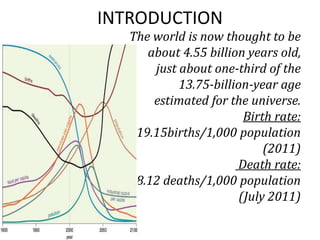
The world is now thought to be
about 4.55 billion years old,
just about one-third of the
13.75-billion-year age
estimated for the universe.
Birth rate:
19.15births/1,000 population
(2011)
Death rate:
8.12 deaths/1,000 population
(July 2011)
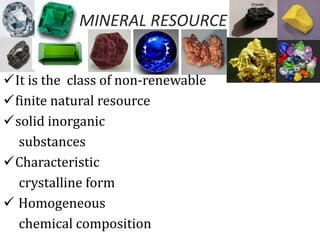
MINERAL RESOURCE
It is the class of non-renewable
finite natural resource
solid inorganic
substances
Characteristic
crystalline form
 Homogeneous
chemical composition
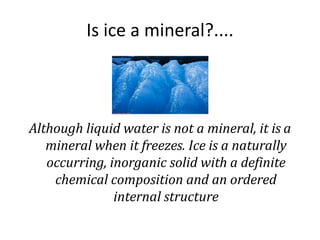
Is ice a mineral?....
Although liquid water is not a mineral, it is a
mineral when it freezes. Ice is a naturally
occurring, inorganic solid with a definite
chemical composition and an ordered
internal structure
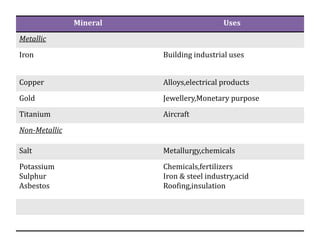
Mineral Uses
Metallic
Iron Building industrial uses
Copper Alloys,electrical products
Gold Jewellery,Monetary purpose
Titanium Aircraft
Non-Metallic
Salt Metallurgy,chemicals
Potassium
Sulphur
Asbestos
Chemicals,fertilizers
Iron & steel industry,acid
Roofing,insulation
ADVERSE EFFECTS
• 40% of mining area is for waste disposal
• Deforestation
• Degradation of land
• Air pollution due to emission of dust &
gases
• Rehabilitation of affected population like
tribals
• Adverse impact on historical monuments
RESPONSES TO LIMITED AVAILABILITY
 Find more sources
 Find substitute
 Recycle
 Use less & make more efficient use of what
is available
FOOD
RESOURCES
INTRODUCTION
 It is consumed to
provide nutritional
support for the body.
 It is usually
of plant or animal
origin, and contains
essential nutrients, such
as carbohydrates, fats, p
roteins, vitamins,
or minerals.
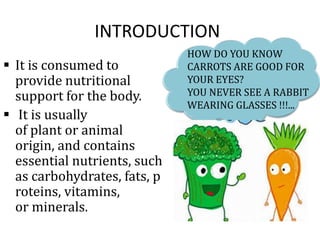
HOW DO YOU KNOW
CARROTS ARE GOOD FOR
YOUR EYES?
YOU NEVER SEE A RABBIT
WEARING GLASSES !!!...
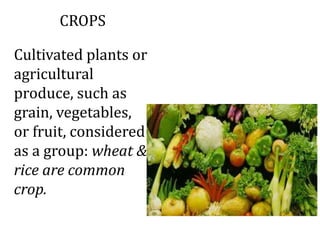
CROPS
Cultivated plants or
agricultural
produce, such as
grain, vegetables,
or fruit, considered
as a group: wheat &
rice are common
crop.
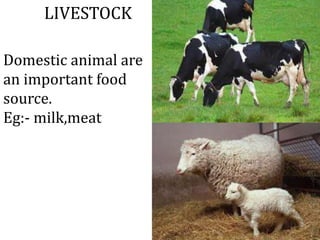
Domestic animal are
an important food
source.
Eg:- milk,meat
LIVESTOCK
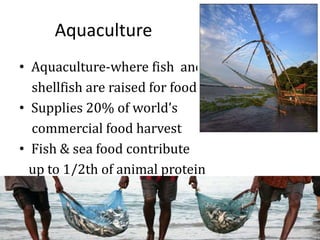
Aquaculture
• Aquaculture-where fish and
shellfish are raised for food
• Supplies 20% of world’s
commercial food harvest
• Fish & sea food contribute
up to 1/2th of animal protein
UNDERNUTRITION
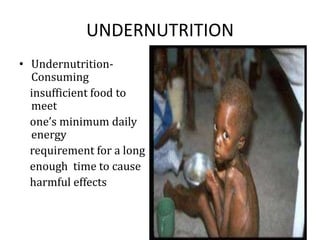
• Undernutrition-
Consuming
insufficient food to
meet
one’s minimum daily
energy
requirement for a long
enough time to cause
harmful effects
MALNUTRITION
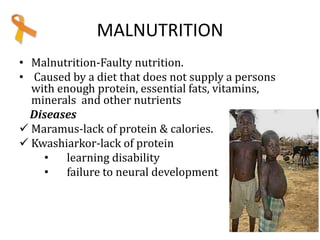
• Malnutrition-Faulty nutrition.
• Caused by a diet that does not supply a persons
with enough protein, essential fats, vitamins,
minerals and other nutrients
Diseases
 Maramus-lack of protein & calories.
 Kwashiarkor-lack of protein
• learning disability
• failure to neural development
OVERNUTRITION
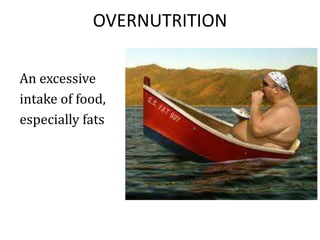
An excessive
intake of food,
especially fats
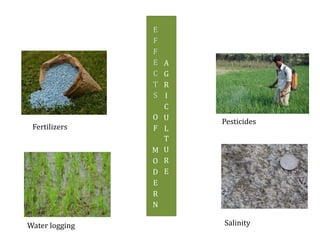
E
F
F
E
C
T
S
O
F
M
O
D
E
R
N
A
G
R
I
C
U
L
T
U
R
E
Salinity
Fertilizers
Pesticides
Water logging
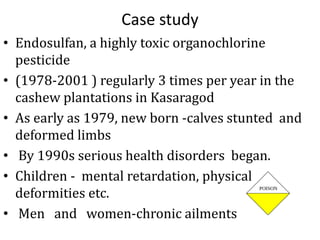
Case study
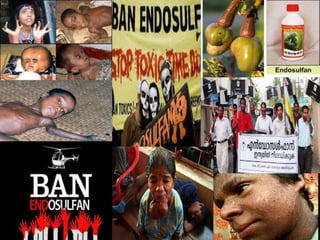
• Endosulfan, a highly toxic organochlorine
pesticide
• (1978-2001 ) regularly 3 times per year in the
cashew plantations in Kasaragod
• As early as 1979, new born -calves stunted and
deformed limbs
• By 1990s serious health disorders began.
• Children - mental retardation, physical
deformities etc.
• Men and women-chronic ailments
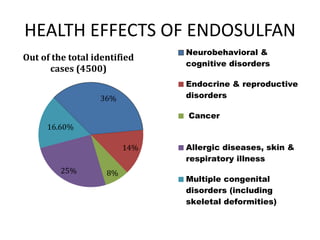
HEALTH EFFECTS OF ENDOSULFAN
36%
14%
8%25%
16.60%
Out of the total identified
cases (4500)
Neurobehavioral &
cognitive disorders
Endocrine & reproductive
disorders
Cancer
Allergic diseases, skin &
respiratory illness
Multiple congenital
disorders (including
skeletal deformities)
THE
END

A brief description about the Mineral Resources and Food Resources

  • 1.
    A POWER POINT PRESENTATION ON MINERALRESOURCES & FOOD RESOURCES BY ERIN DAVIS BIOTECHNOLOGY ENGINEERING
  • 2.
  • 3.
    INTRODUCTION The world isnow thought to be about 4.55 billion years old, just about one-third of the 13.75-billion-year age estimated for the universe. Birth rate: 19.15births/1,000 population (2011) Death rate: 8.12 deaths/1,000 population (July 2011)
  • 4.
    MINERAL RESOURCE It isthe class of non-renewable finite natural resource solid inorganic substances Characteristic crystalline form  Homogeneous chemical composition
  • 5.
    Is ice amineral?.... Although liquid water is not a mineral, it is a mineral when it freezes. Ice is a naturally occurring, inorganic solid with a definite chemical composition and an ordered internal structure
  • 6.
    Mineral Uses Metallic Iron Buildingindustrial uses Copper Alloys,electrical products Gold Jewellery,Monetary purpose Titanium Aircraft Non-Metallic Salt Metallurgy,chemicals Potassium Sulphur Asbestos Chemicals,fertilizers Iron & steel industry,acid Roofing,insulation
  • 7.
    ADVERSE EFFECTS • 40%of mining area is for waste disposal • Deforestation • Degradation of land • Air pollution due to emission of dust & gases • Rehabilitation of affected population like tribals • Adverse impact on historical monuments
  • 8.
    RESPONSES TO LIMITEDAVAILABILITY  Find more sources  Find substitute  Recycle  Use less & make more efficient use of what is available
  • 9.
  • 10.
    INTRODUCTION  It isconsumed to provide nutritional support for the body.  It is usually of plant or animal origin, and contains essential nutrients, such as carbohydrates, fats, p roteins, vitamins, or minerals. HOW DO YOU KNOW CARROTS ARE GOOD FOR YOUR EYES? YOU NEVER SEE A RABBIT WEARING GLASSES !!!...
  • 11.
    CROPS Cultivated plants or agricultural produce,such as grain, vegetables, or fruit, considered as a group: wheat & rice are common crop.
  • 12.
    Domestic animal are animportant food source. Eg:- milk,meat LIVESTOCK
  • 13.
    Aquaculture • Aquaculture-where fishand shellfish are raised for food • Supplies 20% of world’s commercial food harvest • Fish & sea food contribute up to 1/2th of animal protein
  • 15.
    UNDERNUTRITION • Undernutrition- Consuming insufficient foodto meet one’s minimum daily energy requirement for a long enough time to cause harmful effects
  • 16.
    MALNUTRITION • Malnutrition-Faulty nutrition. •Caused by a diet that does not supply a persons with enough protein, essential fats, vitamins, minerals and other nutrients Diseases  Maramus-lack of protein & calories.  Kwashiarkor-lack of protein • learning disability • failure to neural development
  • 17.
  • 18.
  • 19.
    Case study • Endosulfan,a highly toxic organochlorine pesticide • (1978-2001 ) regularly 3 times per year in the cashew plantations in Kasaragod • As early as 1979, new born -calves stunted and deformed limbs • By 1990s serious health disorders began. • Children - mental retardation, physical deformities etc. • Men and women-chronic ailments
  • 20.
    HEALTH EFFECTS OFENDOSULFAN 36% 14% 8%25% 16.60% Out of the total identified cases (4500) Neurobehavioral & cognitive disorders Endocrine & reproductive disorders Cancer Allergic diseases, skin & respiratory illness Multiple congenital disorders (including skeletal deformities)
  • 24.