


PRODUCT POLISHING
Gel Permeation Chromatography
&
Dialysis
ERIN DAVIS
B.TECH BIOTECHNOLOGY
What is PRODUCT POLISHING ?
• Final processing steps
• Ends with packaging of the product
• In a form that is :-
1. Stable
2. easily transportable
3. convenient
• Include operations
• to sterilize the product
• remove or deactivate trace contaminants
 to ensure product safety
 Example:- The removal of viruses
Gel permeation chromatography
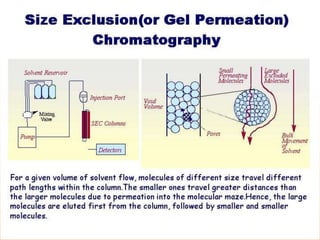
• Separates analyte on the basis of size
• Often used for the analysis of polymers
• Also called size exclusion chromatography and
molecular sieve chromatography
Gel permeation chromatography
THEORY
Total volume of column packed with a gel that has been swelled by water or
other solvent is given by
V t = Vg + V l + Vo
where,
V t = total bed volume
Vg = vol. occupied by solid matrix of gel
V l = vol. of solvent held in pores
Vo = free vol. outside the gel particles
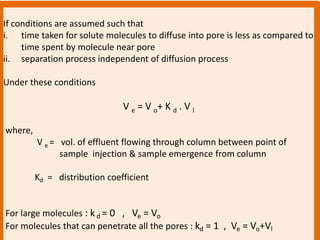
If conditions are assumed such that
i. time taken for solute molecules to diffuse into pore is less as compared to
time spent by molecule near pore
ii. separation process independent of diffusion process
Under these conditions
V e = V o+ K d . V l
where,
V e = vol. of effluent flowing through column between point of
sample injection & sample emergence from column
Kd = distribution coefficient
For large molecules : k d = 0 , Ve = Vo
For molecules that can penetrate all the pores : kd = 1 , Ve = Vo+Vl
GPC Separation Mechanism
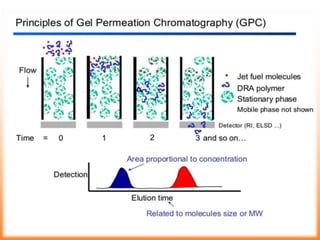
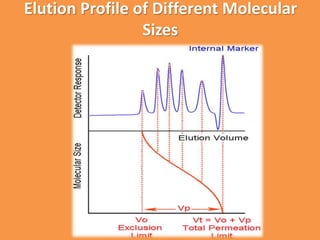
• GPC separates molecules in solution by their effective size in solution.
• To prepare a sample for GPC analysis the resin is first dissolved in an
appropriate solvent.
• Inside the gel permeation chromatograph, the dissolved resin is
injected into a continually flowing stream of solvent (mobile phase).
• The mobile phase flows through millions of highly porous, rigid
particles (stationary phase) tightly packed together in a column.
• The pore sizes of these particles
are controlled and available in a
range of sizes.
• Polymer molecules are
separated according to
molecular size, eluting largest
first, smallest last
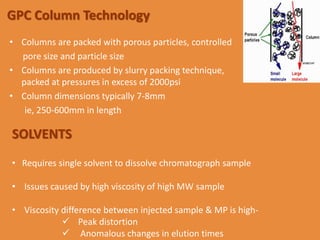
GPC Column Technology
• Columns are packed with porous particles, controlled
pore size and particle size
• Columns are produced by slurry packing technique,
packed at pressures in excess of 2000psi
• Column dimensions typically 7-8mm
ie, 250-600mm in length
SOLVENTS
• Requires single solvent to dissolve chromatograph sample
• Issues caused by high viscosity of high MW sample
• Viscosity difference between injected sample & MP is high-
 Peak distortion
 Anomalous changes in elution times
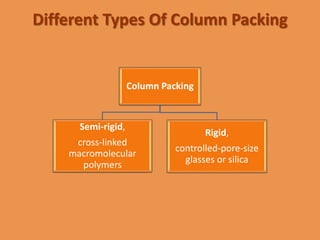
Different Types Of Column Packing
Column Packing
Semi-rigid,
cross-linked
macromolecular
polymers
Rigid,
controlled-pore-size
glasses or silica
• Semi-rigid polymers:-
 these materials swell slightly
 care must be taken during use
 limited to a maximum pressure of 300 psi due to bed
compressibility
 Examples:
• styrene divinylbenzene polymers for compounds of MW range of
100-500 million
• suspension polymerization of 2- hydroxyethyl methacrylate with
ethylene dimethacrylate (can withstand pressure upto 3000 psi)
• Rigid Porous glasses or silica:-
 Cover wide range of pore diameter
 Chemically resistant
 Used with aqueous & polar organic solvents
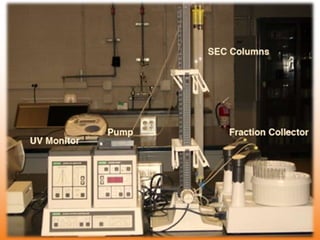
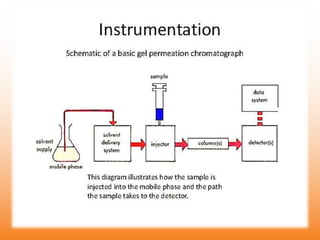
1. PUMP
• Pumps the polymer in solution through the system.
• For different solutions pump should deliver the same flow rate
independent of its viscosity differences.
• Constant flow rate is a critical feature of the instrument.
2. INJECTOR
• Introduces the solution into the mobile phase.
• It must be capable
for small vol injection
 mol.wt determination
for large vol injection
 fraction collection
• It should not disturb the continuous mobile phase flow.
• When sample vol is large ,automatic multiple sample injection
must be done.
3. DETECTORS
• Must be non-destructive to eluting components.
• Must be sensitive even to trace amounts.
• Must be compatible with exclusion columns
Widely used detectors :-
a) Differential refractometer
• Universal detector
• Detector response is directly proportional to concentration.
b) Spectrophotometric detectors
• UV absorbance
c) Low-angle laser light scattering( LALLS) detector
• Determination of absolute molecular weights
• Provides information on variation of long chain branching
with molecular weight
Elution Profile of Different Molecular
Sizes
• Separation of sugars , polypeptides, proteins, liquids, butyl
rubbers, polystyrenes, silicon polymers.
• Sephadex G-25
for separation of salts &amino acids from proteins .
• Sephadex G-75
fractionation & purification of proteins polysaccharides & nucleic acids.
• Polymers can be characterized for
 number average mol.wt. (Mn)
 weight average mol. wt. (Mw)
 size average mol. wt. (Mz)
 polydispersity index
Advantages
• Chromatography columns can be
cleaned and reused.
• Scaling up is easy by varying the
membrane area or process time.
• Has well defined separation time
• Can provide narrow bands .
• Low chance for analyte loss.
• Determination of MW of
polymers
• Low possibility of sample
contamination & biodegradation.
• Often become fouled and require
repacking.
• Chromatography columns are
limited by the amount of sample
load.
• Highly expensive.
• Requires at least 10% difference in
MW for reasonable resolution of
peaks .
• Pre-filtration of sample.
DisadvantagesAdvantages Disadvantages
DIALYSIS
HISTORY
• The term dialysis was used for scientific or
medical purposes in the late 1800s
• Early 1900s, pioneered by the
work of Thomas Graham
DIALYSIS
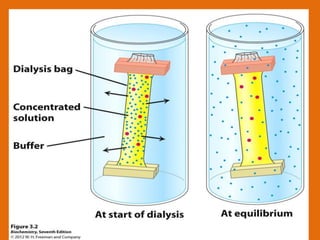
• Old established procedure for the removal or exchange of low mol.wt
solutes from a solution.
• Ie, small molecules such as salts, reducing agents, or dyes from larger
macromolecules such as proteins, DNA, or polysaccharides.
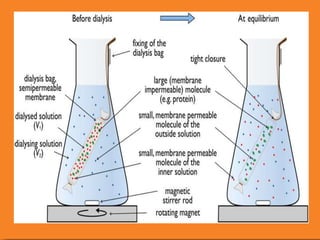
• It requires a dialysis bag (membrane casing of defined porosity), which
has to be placed in a bath of water or buffer.
• REQUIREMENTS
 Dialysis membrane in an appropriate format (tubing, cassette,
etc.) and molecular weight cut-off (MWCO)
 A container to hold the dialysate buffer
 The ability to stir the solutions and control the temperature
(optional)
Principles of Dialysis
• Diffusion is the random, thermal movement of
molecules in solution (Brownian motion).
• It leads to the net movement of molecules from an
area of higher concentration to a lower concentration
until equilibrium is reached.
• In dialysis, a sample and a buffer solution called the
dialysate are separated by a semi-permeable
membrane that causes differential diffusion patterns .
• Thereby permitting the separation of molecules in
both the sample and dialysate.
DISADVANTAGES
• Time consuming ,takes several days for complete salt
removal.
• Requires manual manipulation of the dialysis bags for
filling and tying off.
• Chance of bag breakage and slipping out of hand while
tying is more.
• It is not practical for larger sample volumes.
• Universal dialysis procedure for all applications cannot
be provided .
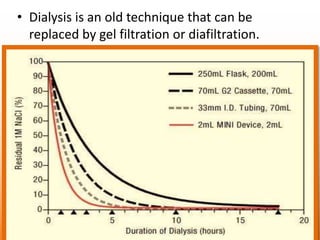
• Dialysis is an old technique that can be
replaced by gel filtration or diafiltration.
Dialysis Membranes and Molecular-
Weight Cut Off (MWCO)
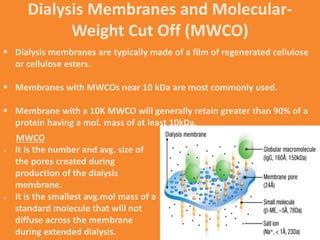
 Dialysis membranes are typically made of a film of regenerated cellulose
or cellulose esters.
 Membranes with MWCOs near 10 kDa are most commonly used.
 Membrane with a 10K MWCO will generally retain greater than 90% of a
protein having a mol. mass of at least 10kDa.
MWCO
 It is the number and avg. size of
the pores created during
production of the dialysis
membrane.
 It is the smallest avg.mol mass of a
standard molecule that will not
diffuse across the membrane
during extended dialysis.
Dialyzers
• Designed for specific sample volume ranges
• provide greater sample security and improved ease of
use
• performance for dialysis experiments over tubing.
• The most common preformatted dialyzers
 Slide-A-Lyzer
 Float-A-Lyzer
 the Pur-A-lyzer/D-Tube/GeBAflex Dialyzers product
lines.
GENERAL PROTOCOL
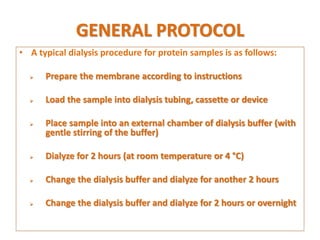
• A typical dialysis procedure for protein samples is as follows:
 Prepare the membrane according to instructions
 Load the sample into dialysis tubing, cassette or device
 Place sample into an external chamber of dialysis buffer (with
gentle stirring of the buffer)
 Dialyze for 2 hours (at room temperature or 4 °C)
 Change the dialysis buffer and dialyze for another 2 hours
 Change the dialysis buffer and dialyze for 2 hours or overnight
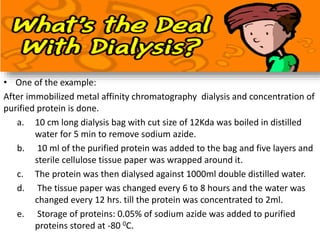
• One of the example:
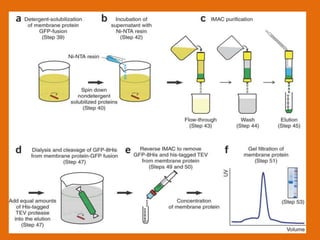
After immobilized metal affinity chromatography dialysis and concentration of
purified protein is done.
a. 10 cm long dialysis bag with cut size of 12Kda was boiled in distilled
water for 5 min to remove sodium azide.
b. 10 ml of the purified protein was added to the bag and five layers and
sterile cellulose tissue paper was wrapped around it.
c. The protein was then dialysed against 1000ml double distilled water.
d. The tissue paper was changed every 6 to 8 hours and the water was
changed every 12 hrs. till the protein was concentrated to 2ml.
e. Storage of proteins: 0.05% of sodium azide was added to purified
proteins stored at -80 0C.
Product polishing techniques in Downstream Processing

Product polishing techniques in Downstream Processing

  • 1.
    PRODUCT POLISHING Gel PermeationChromatography & Dialysis ERIN DAVIS B.TECH BIOTECHNOLOGY
  • 2.
    What is PRODUCTPOLISHING ? • Final processing steps • Ends with packaging of the product • In a form that is :- 1. Stable 2. easily transportable 3. convenient • Include operations • to sterilize the product • remove or deactivate trace contaminants  to ensure product safety  Example:- The removal of viruses
  • 3.
  • 4.
    • Separates analyteon the basis of size • Often used for the analysis of polymers • Also called size exclusion chromatography and molecular sieve chromatography Gel permeation chromatography
  • 7.
    THEORY Total volume ofcolumn packed with a gel that has been swelled by water or other solvent is given by V t = Vg + V l + Vo where, V t = total bed volume Vg = vol. occupied by solid matrix of gel V l = vol. of solvent held in pores Vo = free vol. outside the gel particles
  • 8.
    If conditions areassumed such that i. time taken for solute molecules to diffuse into pore is less as compared to time spent by molecule near pore ii. separation process independent of diffusion process Under these conditions V e = V o+ K d . V l where, V e = vol. of effluent flowing through column between point of sample injection & sample emergence from column Kd = distribution coefficient For large molecules : k d = 0 , Ve = Vo For molecules that can penetrate all the pores : kd = 1 , Ve = Vo+Vl
  • 9.
    GPC Separation Mechanism •GPC separates molecules in solution by their effective size in solution. • To prepare a sample for GPC analysis the resin is first dissolved in an appropriate solvent. • Inside the gel permeation chromatograph, the dissolved resin is injected into a continually flowing stream of solvent (mobile phase). • The mobile phase flows through millions of highly porous, rigid particles (stationary phase) tightly packed together in a column.
  • 10.
    • The poresizes of these particles are controlled and available in a range of sizes. • Polymer molecules are separated according to molecular size, eluting largest first, smallest last
  • 12.
    GPC Column Technology •Columns are packed with porous particles, controlled pore size and particle size • Columns are produced by slurry packing technique, packed at pressures in excess of 2000psi • Column dimensions typically 7-8mm ie, 250-600mm in length SOLVENTS • Requires single solvent to dissolve chromatograph sample • Issues caused by high viscosity of high MW sample • Viscosity difference between injected sample & MP is high-  Peak distortion  Anomalous changes in elution times
  • 13.
    Different Types OfColumn Packing Column Packing Semi-rigid, cross-linked macromolecular polymers Rigid, controlled-pore-size glasses or silica
  • 14.
    • Semi-rigid polymers:- these materials swell slightly  care must be taken during use  limited to a maximum pressure of 300 psi due to bed compressibility  Examples: • styrene divinylbenzene polymers for compounds of MW range of 100-500 million • suspension polymerization of 2- hydroxyethyl methacrylate with ethylene dimethacrylate (can withstand pressure upto 3000 psi) • Rigid Porous glasses or silica:-  Cover wide range of pore diameter  Chemically resistant  Used with aqueous & polar organic solvents
  • 16.
    1. PUMP • Pumpsthe polymer in solution through the system. • For different solutions pump should deliver the same flow rate independent of its viscosity differences. • Constant flow rate is a critical feature of the instrument. 2. INJECTOR • Introduces the solution into the mobile phase. • It must be capable for small vol injection  mol.wt determination for large vol injection  fraction collection • It should not disturb the continuous mobile phase flow. • When sample vol is large ,automatic multiple sample injection must be done.
  • 17.
    3. DETECTORS • Mustbe non-destructive to eluting components. • Must be sensitive even to trace amounts. • Must be compatible with exclusion columns Widely used detectors :- a) Differential refractometer • Universal detector • Detector response is directly proportional to concentration. b) Spectrophotometric detectors • UV absorbance c) Low-angle laser light scattering( LALLS) detector • Determination of absolute molecular weights • Provides information on variation of long chain branching with molecular weight
  • 18.
    Elution Profile ofDifferent Molecular Sizes
  • 19.
    • Separation ofsugars , polypeptides, proteins, liquids, butyl rubbers, polystyrenes, silicon polymers. • Sephadex G-25 for separation of salts &amino acids from proteins . • Sephadex G-75 fractionation & purification of proteins polysaccharides & nucleic acids. • Polymers can be characterized for  number average mol.wt. (Mn)  weight average mol. wt. (Mw)  size average mol. wt. (Mz)  polydispersity index
  • 20.
    Advantages • Chromatography columnscan be cleaned and reused. • Scaling up is easy by varying the membrane area or process time. • Has well defined separation time • Can provide narrow bands . • Low chance for analyte loss. • Determination of MW of polymers • Low possibility of sample contamination & biodegradation. • Often become fouled and require repacking. • Chromatography columns are limited by the amount of sample load. • Highly expensive. • Requires at least 10% difference in MW for reasonable resolution of peaks . • Pre-filtration of sample. DisadvantagesAdvantages Disadvantages
  • 21.
  • 22.
    HISTORY • The termdialysis was used for scientific or medical purposes in the late 1800s • Early 1900s, pioneered by the work of Thomas Graham
  • 23.
    DIALYSIS • Old establishedprocedure for the removal or exchange of low mol.wt solutes from a solution. • Ie, small molecules such as salts, reducing agents, or dyes from larger macromolecules such as proteins, DNA, or polysaccharides. • It requires a dialysis bag (membrane casing of defined porosity), which has to be placed in a bath of water or buffer. • REQUIREMENTS  Dialysis membrane in an appropriate format (tubing, cassette, etc.) and molecular weight cut-off (MWCO)  A container to hold the dialysate buffer  The ability to stir the solutions and control the temperature (optional)
  • 25.
    Principles of Dialysis •Diffusion is the random, thermal movement of molecules in solution (Brownian motion). • It leads to the net movement of molecules from an area of higher concentration to a lower concentration until equilibrium is reached. • In dialysis, a sample and a buffer solution called the dialysate are separated by a semi-permeable membrane that causes differential diffusion patterns . • Thereby permitting the separation of molecules in both the sample and dialysate.
  • 26.
    DISADVANTAGES • Time consuming,takes several days for complete salt removal. • Requires manual manipulation of the dialysis bags for filling and tying off. • Chance of bag breakage and slipping out of hand while tying is more. • It is not practical for larger sample volumes. • Universal dialysis procedure for all applications cannot be provided .
  • 27.
    • Dialysis isan old technique that can be replaced by gel filtration or diafiltration.
  • 28.
    Dialysis Membranes andMolecular- Weight Cut Off (MWCO)  Dialysis membranes are typically made of a film of regenerated cellulose or cellulose esters.  Membranes with MWCOs near 10 kDa are most commonly used.  Membrane with a 10K MWCO will generally retain greater than 90% of a protein having a mol. mass of at least 10kDa. MWCO  It is the number and avg. size of the pores created during production of the dialysis membrane.  It is the smallest avg.mol mass of a standard molecule that will not diffuse across the membrane during extended dialysis.
  • 29.
    Dialyzers • Designed forspecific sample volume ranges • provide greater sample security and improved ease of use • performance for dialysis experiments over tubing. • The most common preformatted dialyzers  Slide-A-Lyzer  Float-A-Lyzer  the Pur-A-lyzer/D-Tube/GeBAflex Dialyzers product lines.
  • 31.
    GENERAL PROTOCOL • Atypical dialysis procedure for protein samples is as follows:  Prepare the membrane according to instructions  Load the sample into dialysis tubing, cassette or device  Place sample into an external chamber of dialysis buffer (with gentle stirring of the buffer)  Dialyze for 2 hours (at room temperature or 4 °C)  Change the dialysis buffer and dialyze for another 2 hours  Change the dialysis buffer and dialyze for 2 hours or overnight
  • 32.
    • One ofthe example: After immobilized metal affinity chromatography dialysis and concentration of purified protein is done. a. 10 cm long dialysis bag with cut size of 12Kda was boiled in distilled water for 5 min to remove sodium azide. b. 10 ml of the purified protein was added to the bag and five layers and sterile cellulose tissue paper was wrapped around it. c. The protein was then dialysed against 1000ml double distilled water. d. The tissue paper was changed every 6 to 8 hours and the water was changed every 12 hrs. till the protein was concentrated to 2ml. e. Storage of proteins: 0.05% of sodium azide was added to purified proteins stored at -80 0C.