PRESENTED BY
AGLAIA
Resolution and scanning system
Sensors
 They are devices used for making observations
 It consist of usually sophisticated lenses with filter
coatings to focus the area observed on a plane in
which the detectors are placed
 The major characteristics of imaging remote
sensing instrument operating in the visible and
infrared spectral bands are described in terms of
spatial ,spectral ,temporal and radiometric
resolution.
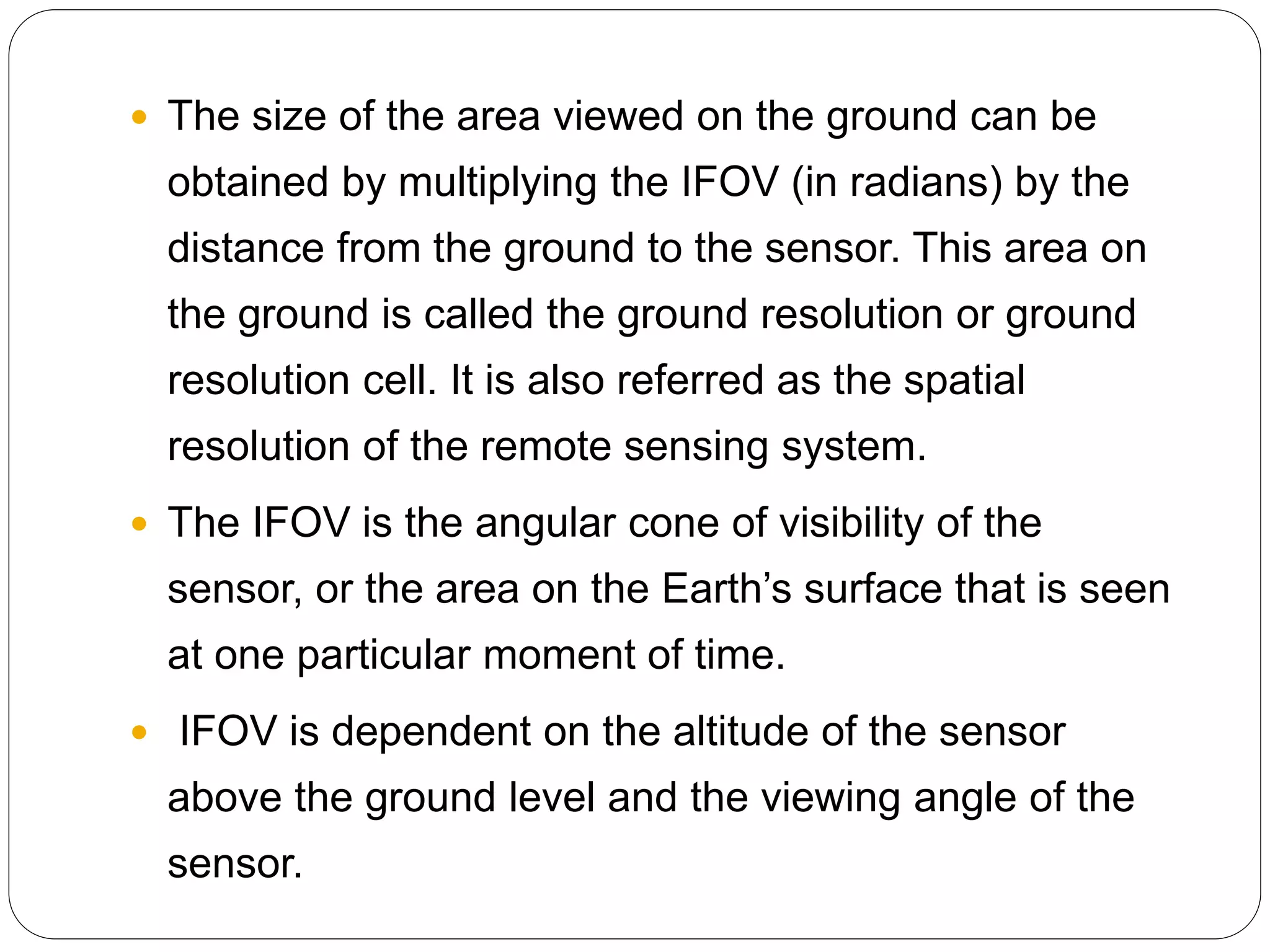
Spatial resolution
 A digital image consists of an array of pixels. Each
pixel contains information about a small area on the
land surface, which is considered as a single object.
 Spatial resolution is a measure of the area or size of
the smallest dimension on the Earth’s surface over
which an independent measurement can be made by
the sensor.
 It is expressed by the size of the pixel on the ground
 The size of the area viewed on the ground can be
obtained by multiplying the IFOV (in radians) by the
distance from the ground to the sensor. This area on
the ground is called the ground resolution or ground
resolution cell. It is also referred as the spatial
resolution of the remote sensing system.
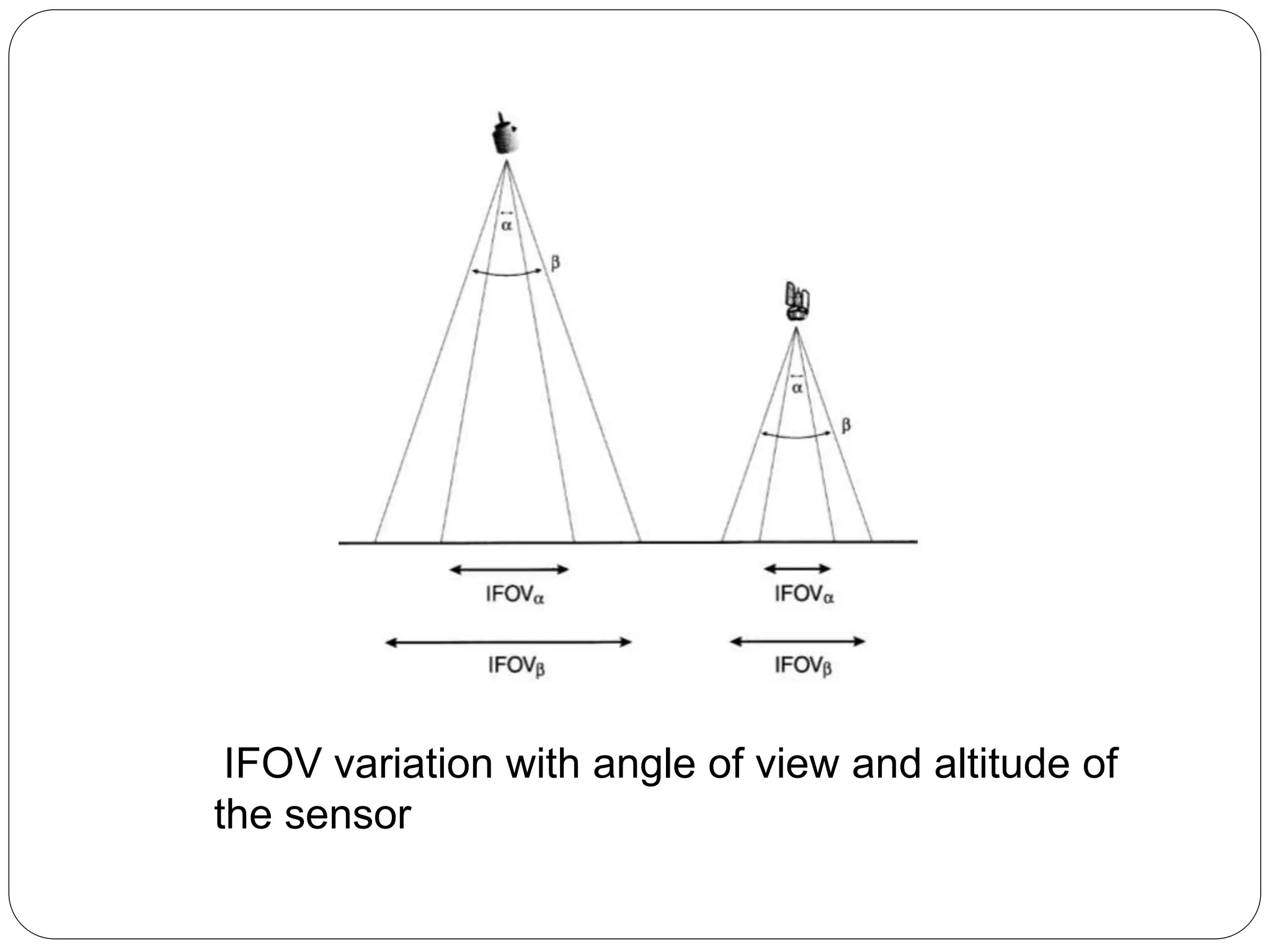
 The IFOV is the angular cone of visibility of the
sensor, or the area on the Earth’s surface that is seen
at one particular moment of time.
 IFOV is dependent on the altitude of the sensor
above the ground level and the viewing angle of the
sensor.
IFOV variation with angle of view and altitude of
the sensor
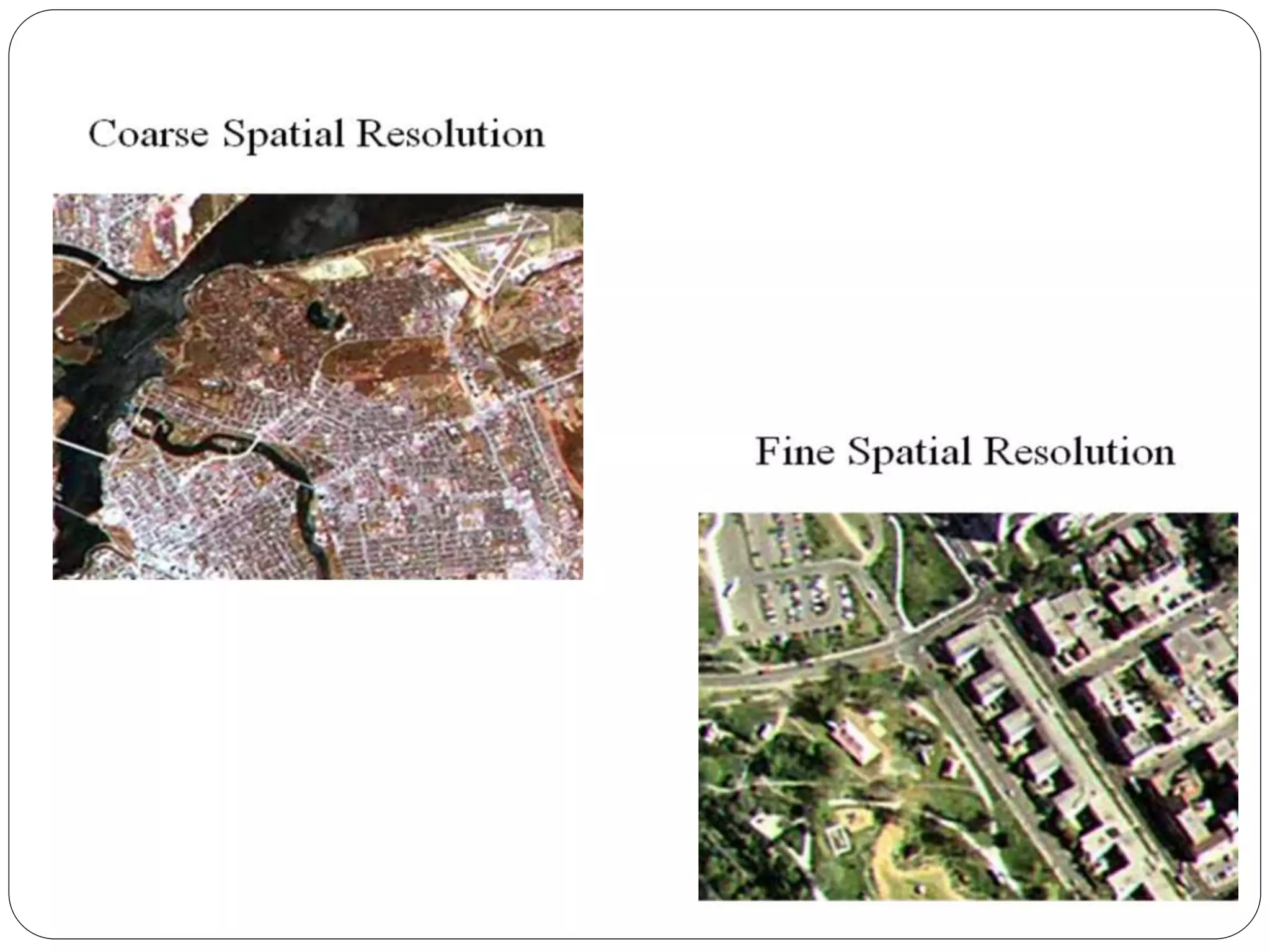
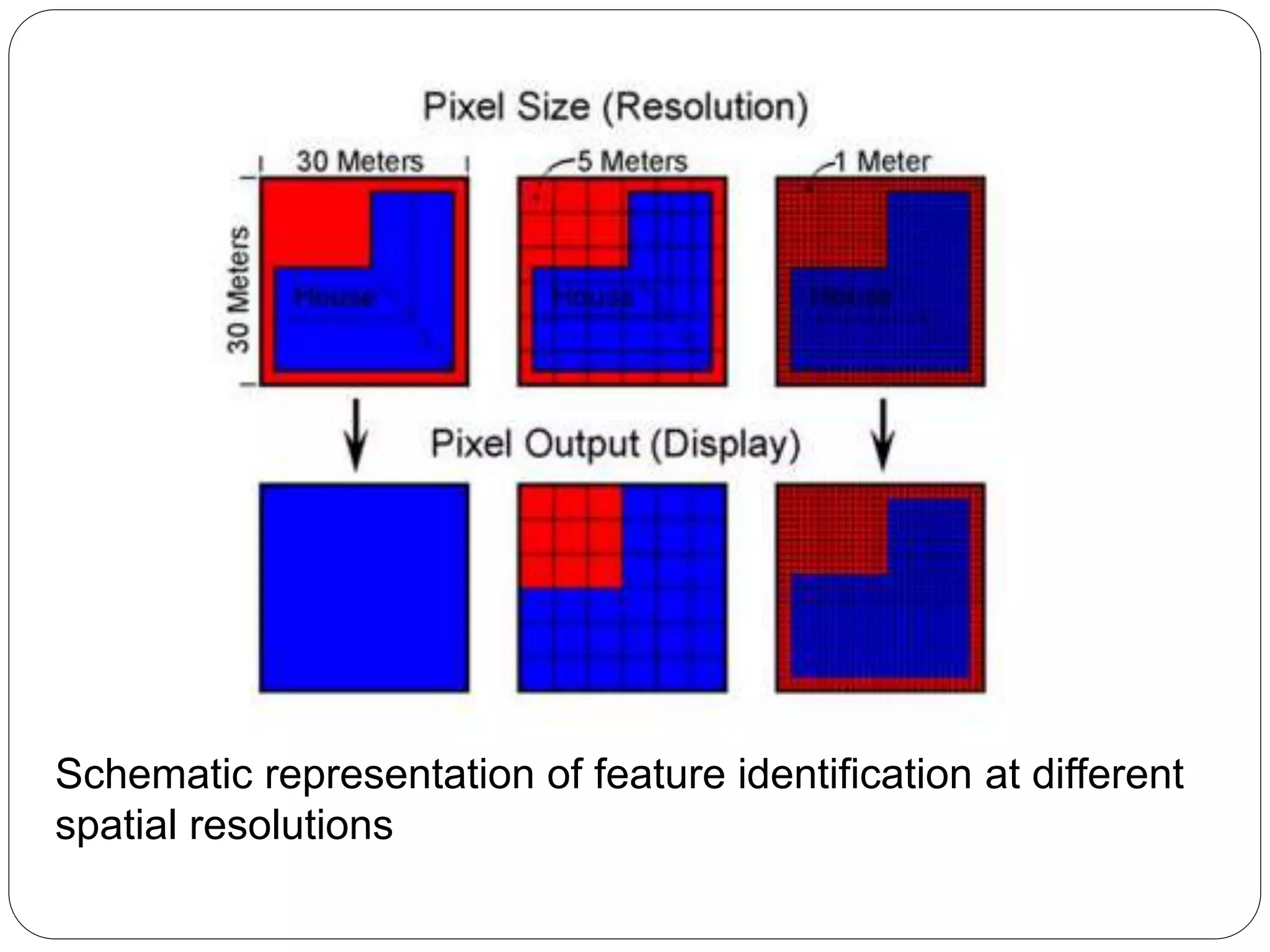
Schematic representation of feature identification at different
spatial resolutions
 Based on the spatial resolution, satellite systems can be
classified as follows.
 Low resolution system
 Medium resolution systems
 High resolution systems
 Very high resolution systems
 Remote sensing systems with spatial resolution more
than 1km are generally considered as low resolution
systems.
Examples ;MODIS and AVHRR
 When the spatial resolution is 100m – 1km, such systems
are considered as moderate resolution systems.
Examples ; IRS WiFS (188m), LANDSAT TM (120m).
 Remote sensing systems with spatial resolution
approximately in the range 5-100m are classified as high
resolution systems. Examples LANDSAT ETM+ (30m), IRS
LISSIII (23m MSS and 6m Panchromatic) and AWiFS (56-
70m), SPOT 5(2.5-5m)
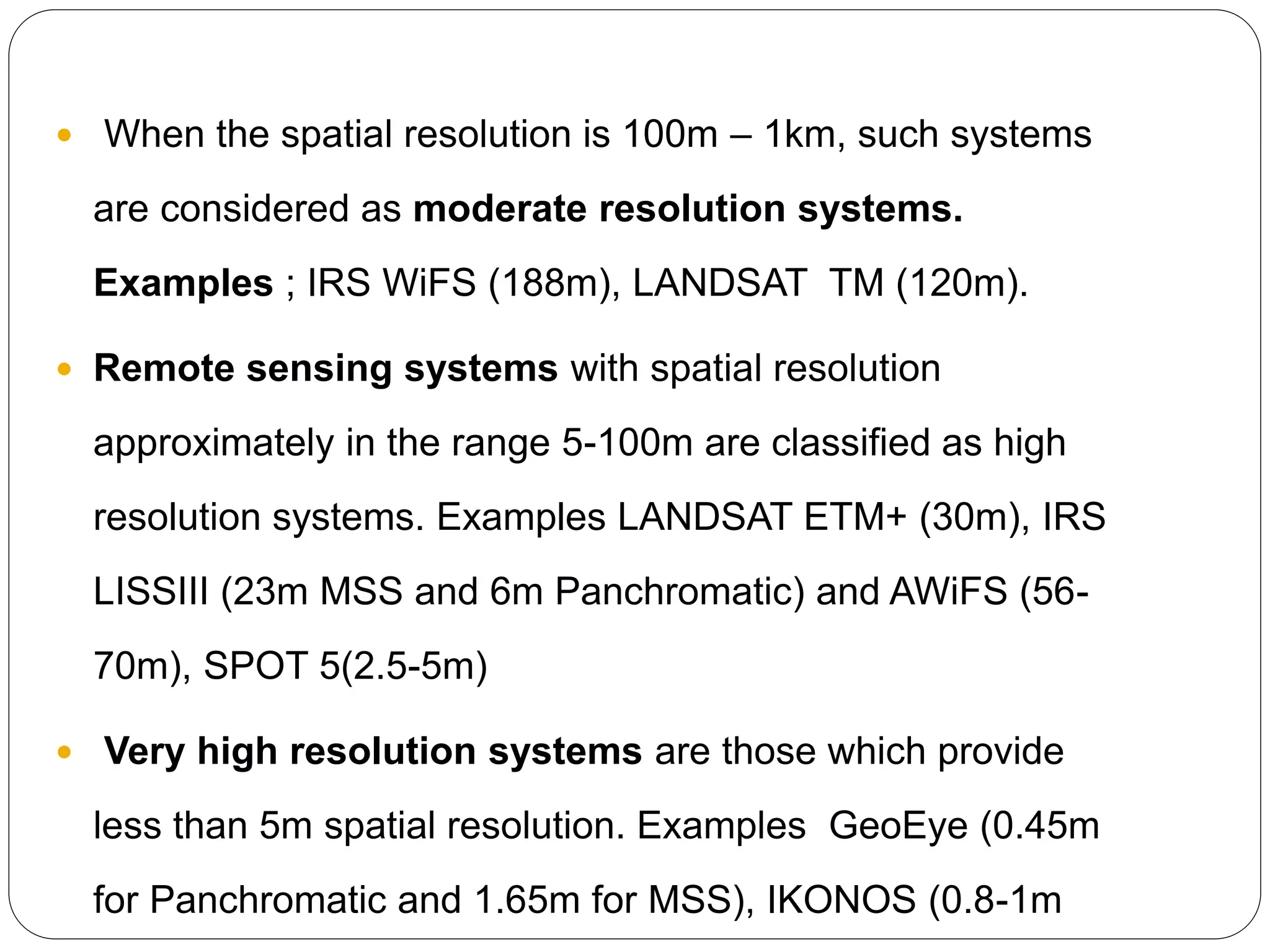
 Very high resolution systems are those which provide
less than 5m spatial resolution. Examples GeoEye (0.45m
for Panchromatic and 1.65m for MSS), IKONOS (0.8-1m
Spectral resolution
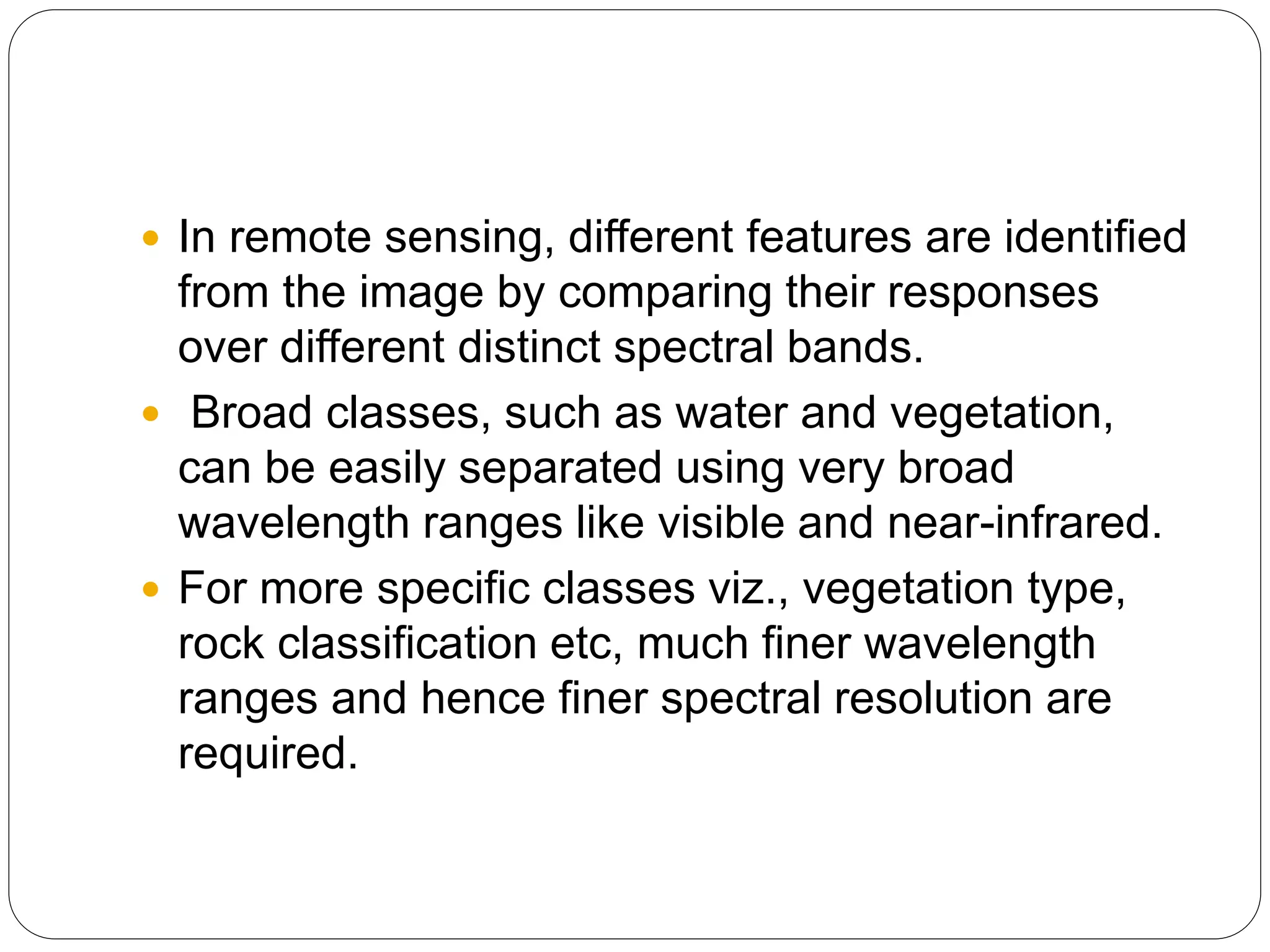
 Spectral resolution represents the spectral band width of
the filter and the sensitiveness of the detector.
 The spectral resolution may be defined as the ability of a
sensor to define fine wavelength intervals or the ability of
a sensor to resolve the energy received in a spectral
bandwidth to characterize different constituents of earth
surface.
 The finer the spectral resolution, the narrower the
wavelength range for a particular channel or band
 Generally surface features can be better distinguished
from multiple narrow bands, than from a single wide
band.
Hypothetical representation of remote sensing systems with
different spectral resolution
 In remote sensing, different features are identified
from the image by comparing their responses
over different distinct spectral bands.
 Broad classes, such as water and vegetation,
can be easily separated using very broad
wavelength ranges like visible and near-infrared.
 For more specific classes viz., vegetation type,
rock classification etc, much finer wavelength
ranges and hence finer spectral resolution are
required.
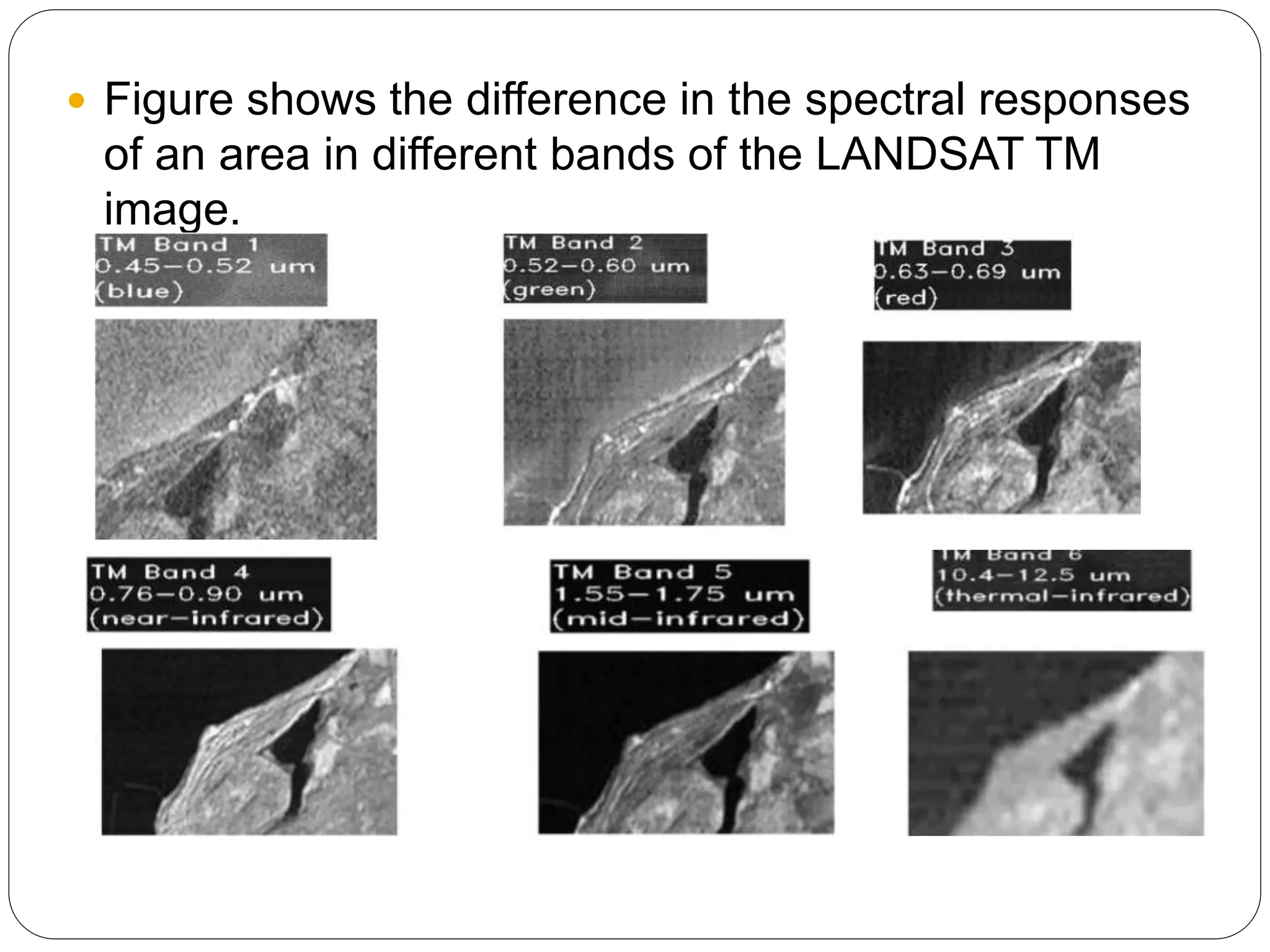
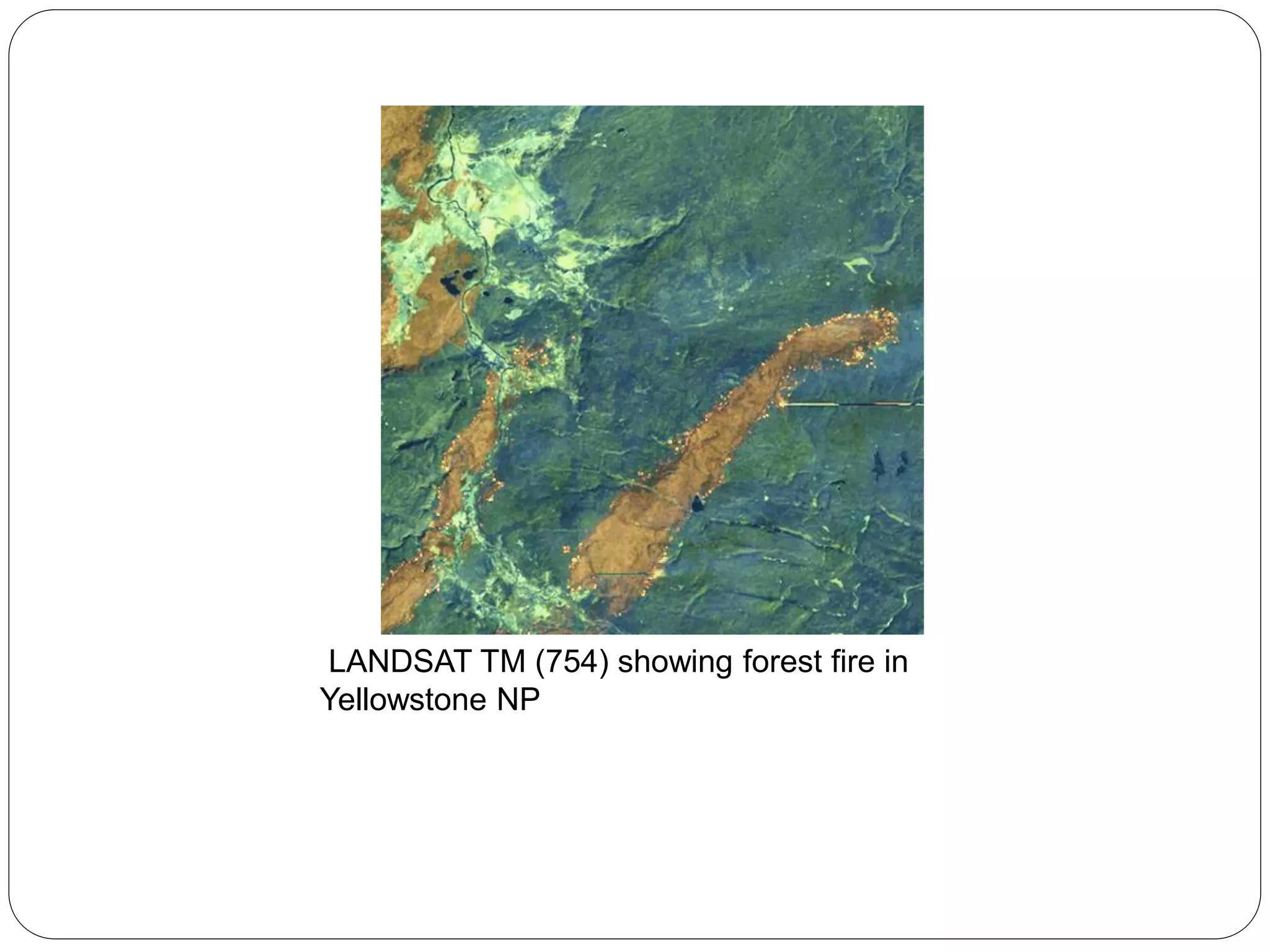
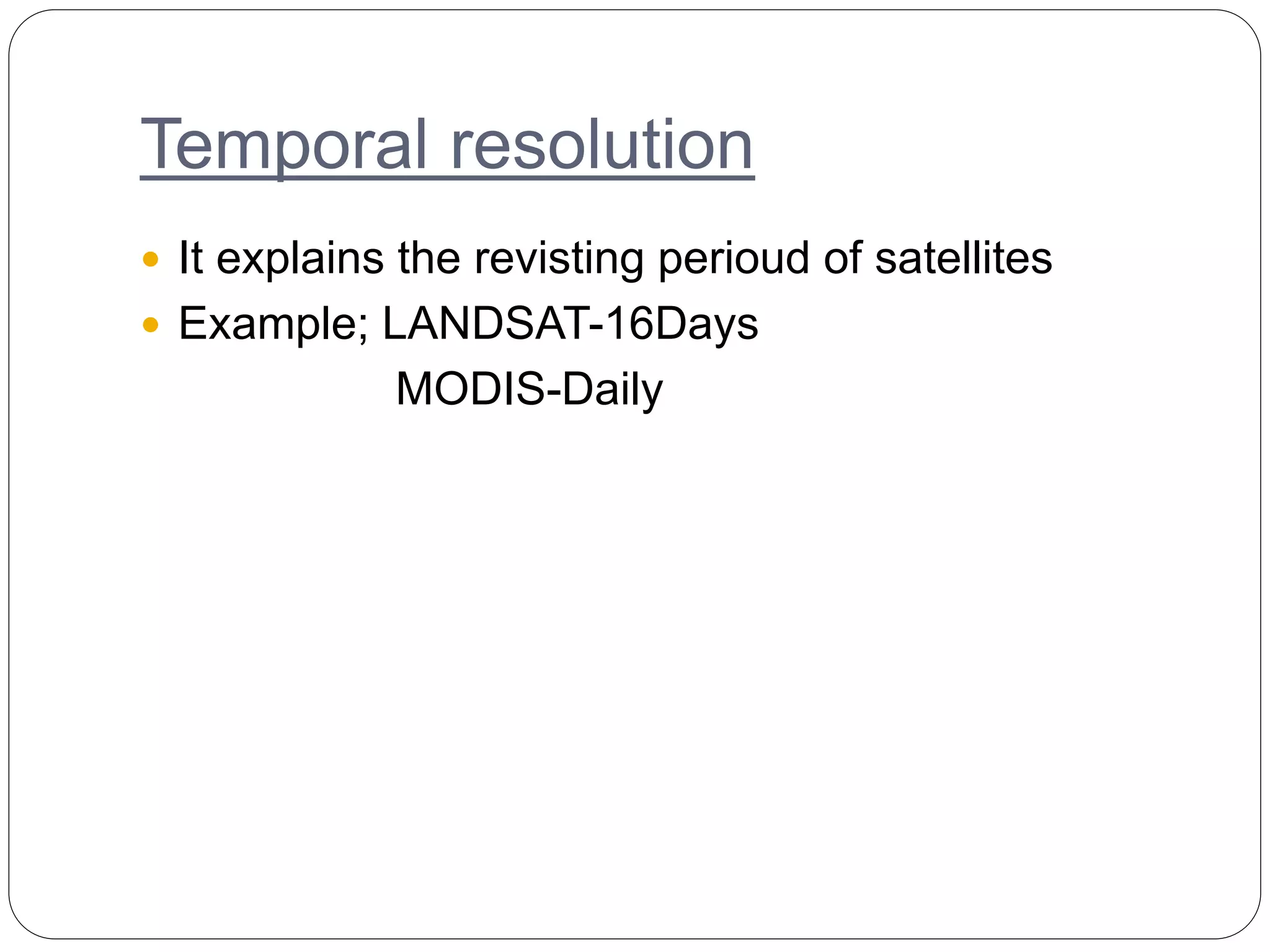
 Figure shows the difference in the spectral responses
of an area in different bands of the LANDSAT TM
image.
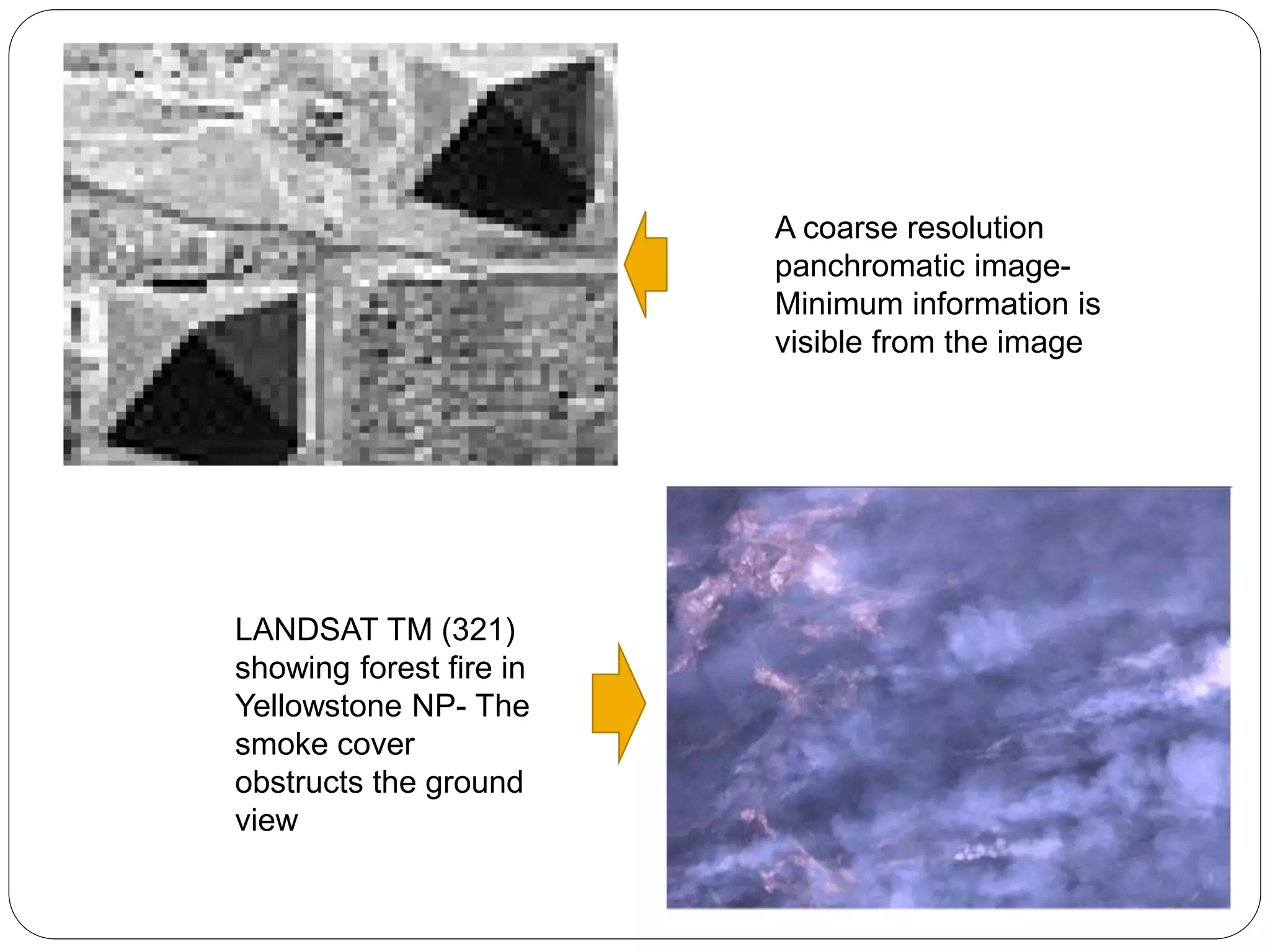
A coarse resolution
panchromatic image-
Minimum information is
visible from the image
LANDSAT TM (321)
showing forest fire in
Yellowstone NP- The
smoke cover
obstructs the ground
view
LANDSAT TM (754) showing forest fire in
Yellowstone NP
Temporal resolution
 It explains the revisting perioud of satellites
 Example; LANDSAT-16Days
MODIS-Daily
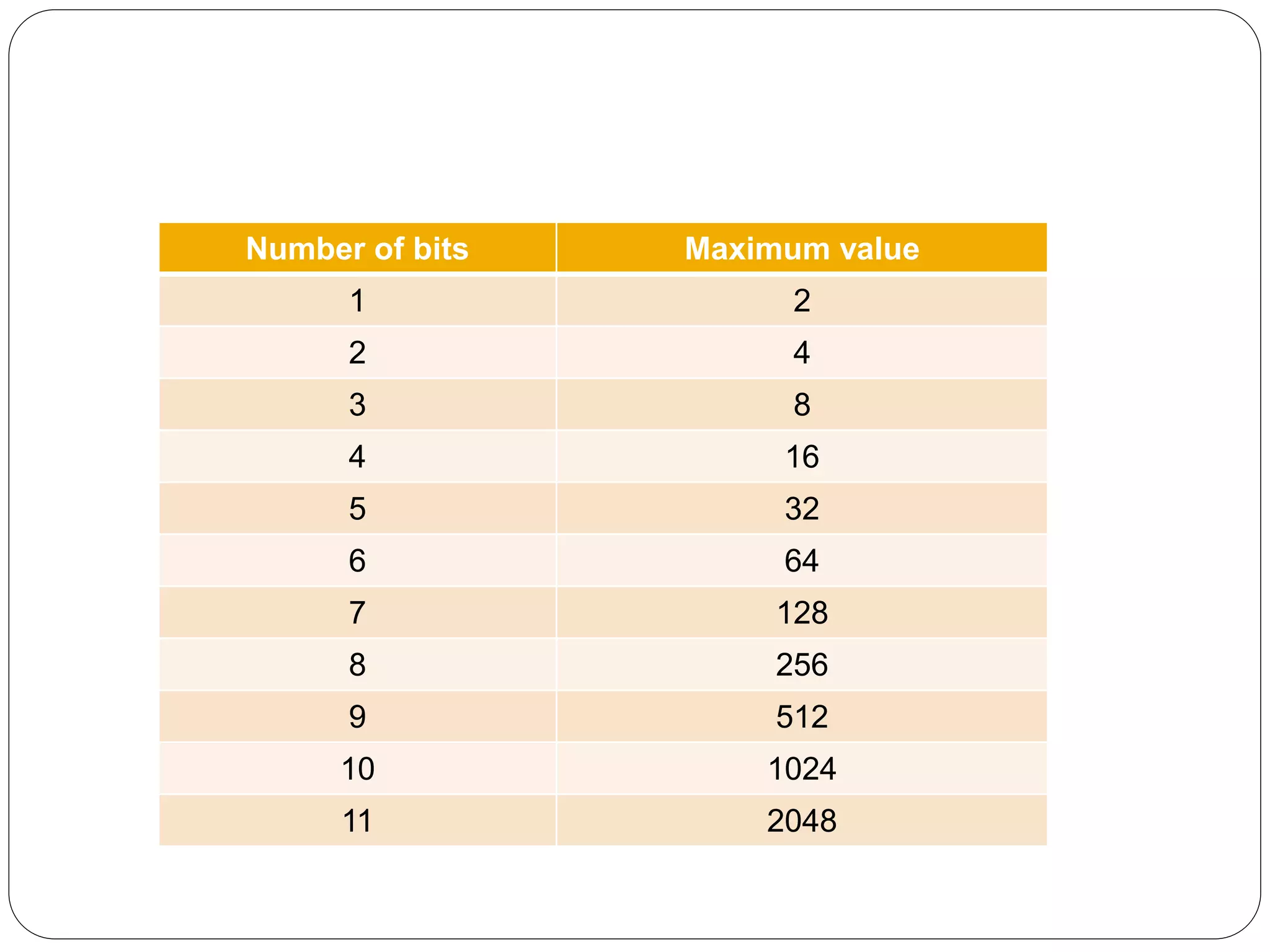
Radiometric resolution
 It depends upon the sensitivity of the sensor to
the magnitude of EMR.
 The finer the radiometric resolution of a sensor,
the more sensitive to detecting a small difference
in the reflected/ emitted energy.
 Data ,volume ,length increases as the radiometric
resolution increases.
Number of bits Maximum value
1 2
2 4
3 8
4 16
5 32
6 64
7 128
8 256
9 512
10 1024
11 2048
Multispectral imaging sensor
systems
 Many electronic (as opposed to photographic) remote
sensors acquire data using scanning systems, which
employ a sensor with a narrow field of view (i.e. IFOV) that
sweeps over the terrain to build up and produce a two-
dimensional image of the surface.
 A scanning system used to collect data over a variety of
different wavelength ranges is called a multispectral
scanner (MSS), and is the most commonly used scanning
system.
 There are two main modes or methods of scanning
employed to acquire multispectral image data -
across-track scanning, and along-track
scanning.
 Scanning systems can be used on both aircraft
and satellite platforms and have essentially the
same operating principles.
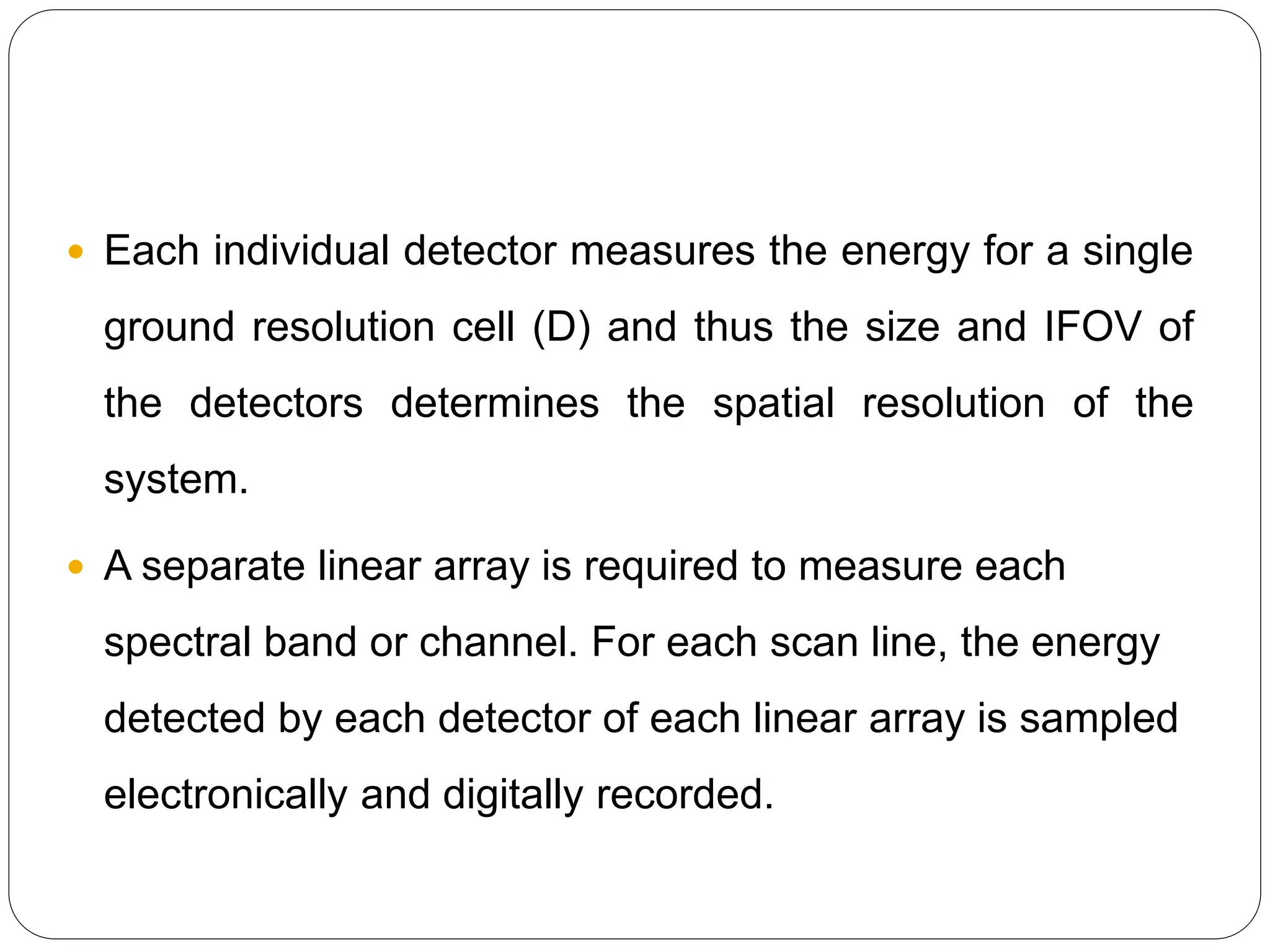
Along-track scanners
 It use the forward motion of the platform to record
successive scan lines and build up a two-dimensional
image, perpendicular to the flight direction.
 they use a linear array of detectors located at the focal
plane of the image formed by lens systems , which are
"pushed" along in the flight track direction (i.e. along
track).
 These systems are also referred to as pushbroom
scanners, as the motion of the detector array is
 Each individual detector measures the energy for a single
ground resolution cell (D) and thus the size and IFOV of
the detectors determines the spatial resolution of the
system.
 A separate linear array is required to measure each
spectral band or channel. For each scan line, the energy
detected by each detector of each linear array is sampled
electronically and digitally recorded.
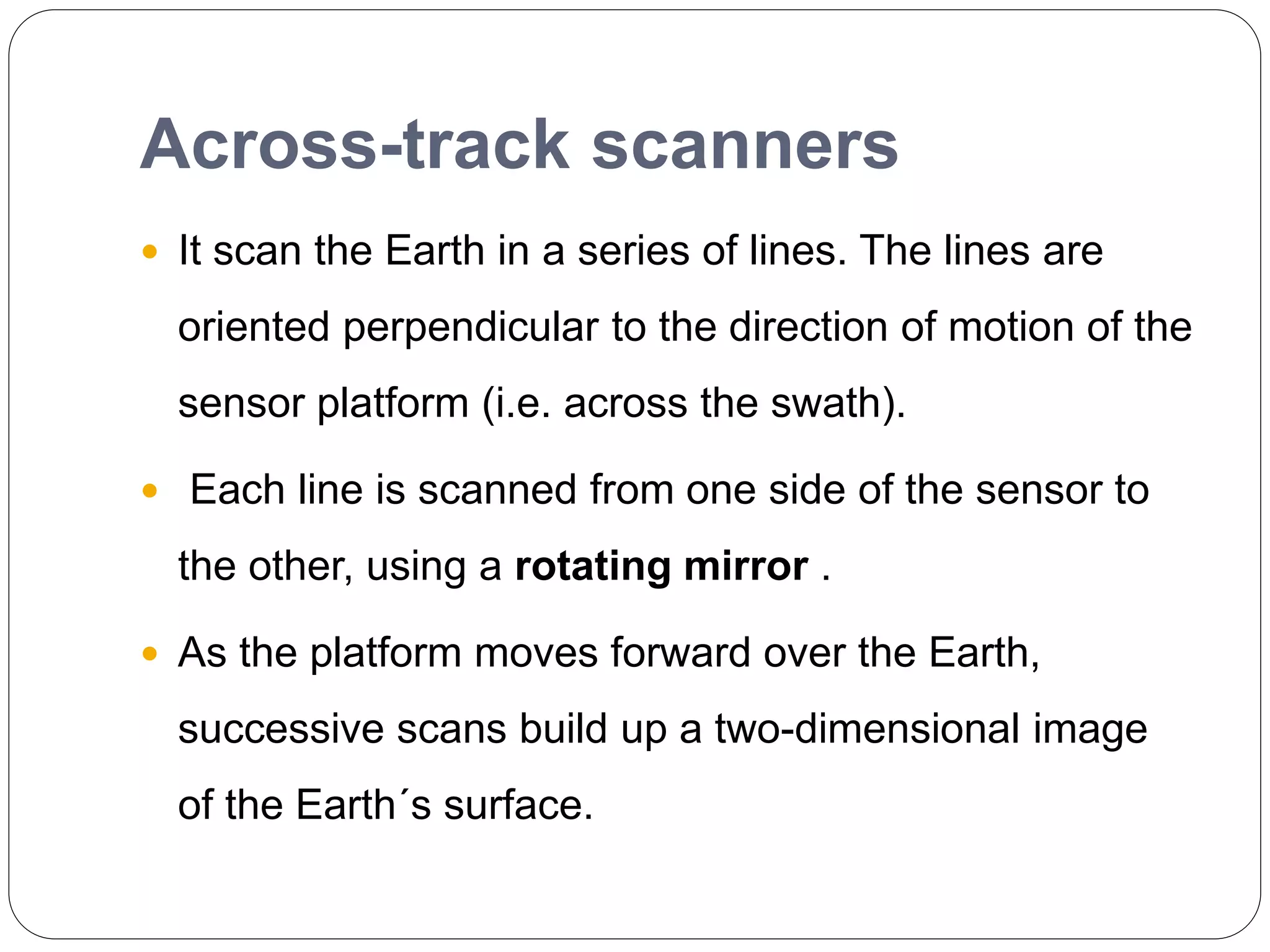
Across-track scanners
 It scan the Earth in a series of lines. The lines are
oriented perpendicular to the direction of motion of the
sensor platform (i.e. across the swath).
 Each line is scanned from one side of the sensor to
the other, using a rotating mirror .
 As the platform moves forward over the Earth,
successive scans build up a two-dimensional image
of the Earth´s surface.
 The incoming reflected or emitted radiation is
separated into several spectral components that are
detected independently. The UV, visible, near-
infrared, and thermal radiation are dispersed into their
constituent wavelengths.
 A bank of internal detectors ,each sensitive to a
specific range of wavelengths, detects and measures
the energy for each spectral band and then, as an
electrical signal, they are converted to digital data and
recorded for subsequent computer processing.
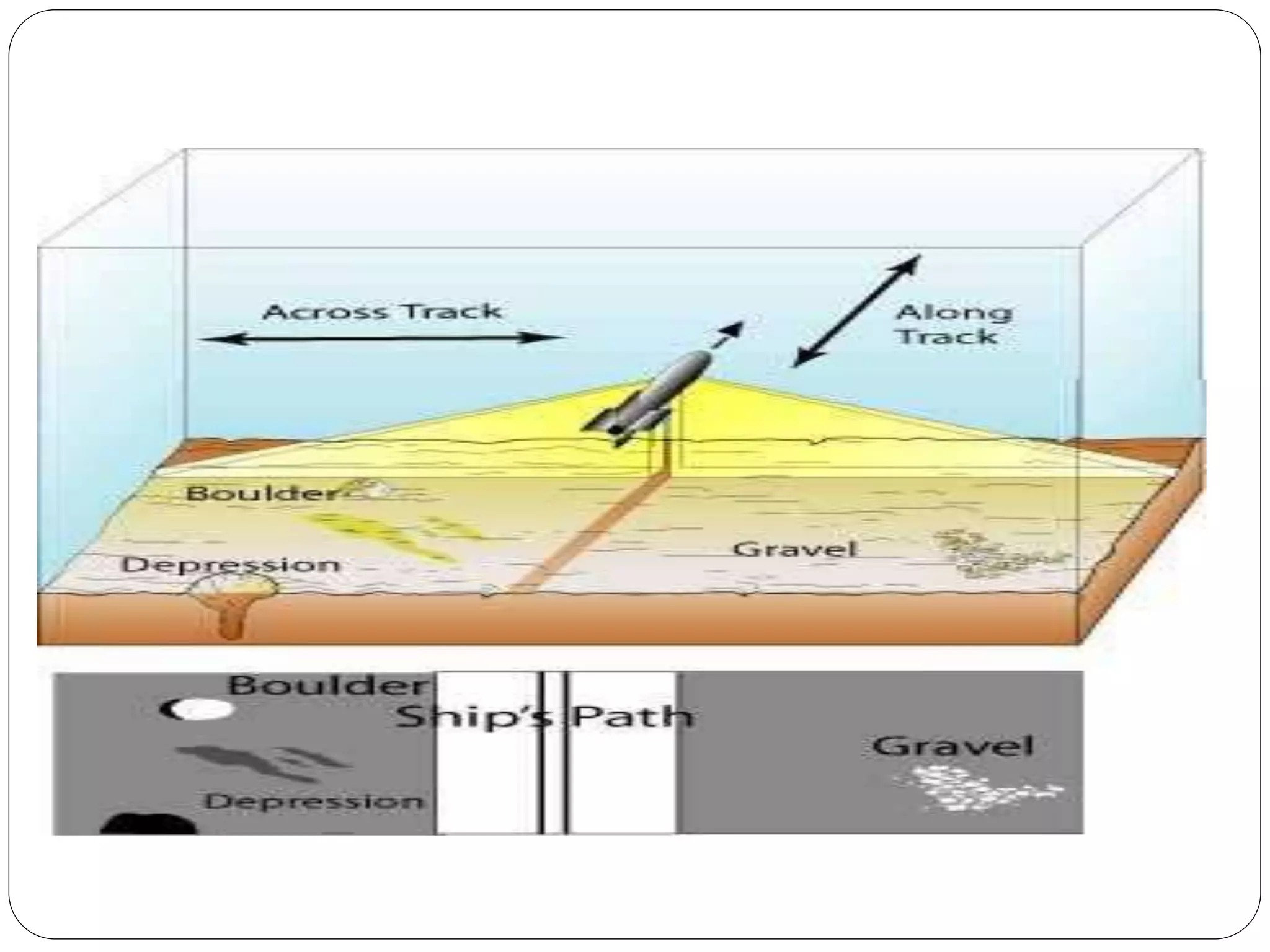
Along track scanning system Across track scanning system
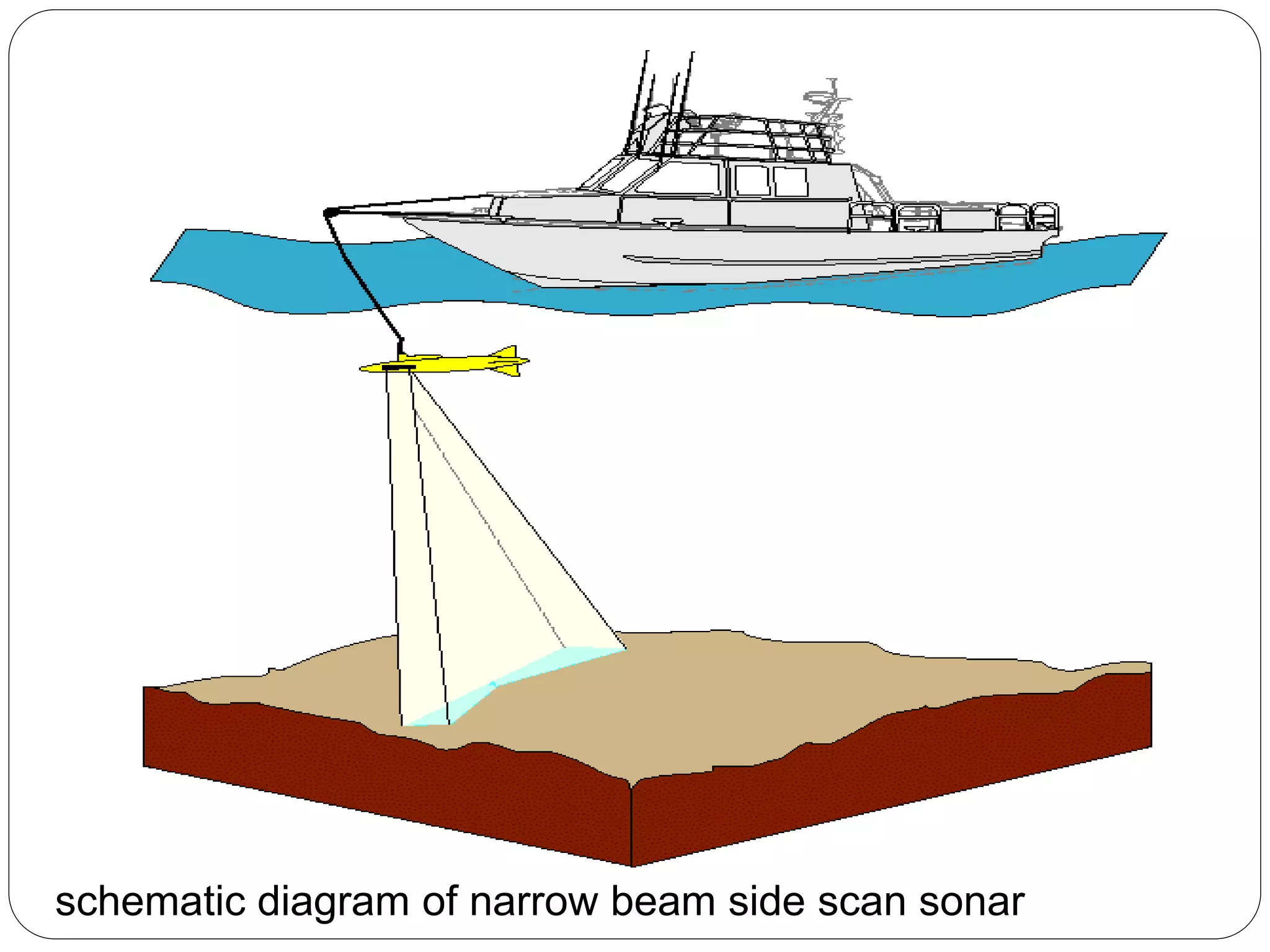
schematic diagram of narrow beam side scan sonar
THANK YOU
For more…. Mail to aglaiaconnect2018@gmail.co

Resolution and scanning system

  • 1.
  • 2.
    Sensors  They aredevices used for making observations  It consist of usually sophisticated lenses with filter coatings to focus the area observed on a plane in which the detectors are placed  The major characteristics of imaging remote sensing instrument operating in the visible and infrared spectral bands are described in terms of spatial ,spectral ,temporal and radiometric resolution.
  • 3.
    Spatial resolution  Adigital image consists of an array of pixels. Each pixel contains information about a small area on the land surface, which is considered as a single object.  Spatial resolution is a measure of the area or size of the smallest dimension on the Earth’s surface over which an independent measurement can be made by the sensor.  It is expressed by the size of the pixel on the ground
  • 5.
     The sizeof the area viewed on the ground can be obtained by multiplying the IFOV (in radians) by the distance from the ground to the sensor. This area on the ground is called the ground resolution or ground resolution cell. It is also referred as the spatial resolution of the remote sensing system.  The IFOV is the angular cone of visibility of the sensor, or the area on the Earth’s surface that is seen at one particular moment of time.  IFOV is dependent on the altitude of the sensor above the ground level and the viewing angle of the sensor.
  • 6.
    IFOV variation withangle of view and altitude of the sensor
  • 7.
    Schematic representation offeature identification at different spatial resolutions
  • 8.
     Based onthe spatial resolution, satellite systems can be classified as follows.  Low resolution system  Medium resolution systems  High resolution systems  Very high resolution systems  Remote sensing systems with spatial resolution more than 1km are generally considered as low resolution systems. Examples ;MODIS and AVHRR
  • 9.
     When thespatial resolution is 100m – 1km, such systems are considered as moderate resolution systems. Examples ; IRS WiFS (188m), LANDSAT TM (120m).  Remote sensing systems with spatial resolution approximately in the range 5-100m are classified as high resolution systems. Examples LANDSAT ETM+ (30m), IRS LISSIII (23m MSS and 6m Panchromatic) and AWiFS (56- 70m), SPOT 5(2.5-5m)  Very high resolution systems are those which provide less than 5m spatial resolution. Examples GeoEye (0.45m for Panchromatic and 1.65m for MSS), IKONOS (0.8-1m
  • 10.
    Spectral resolution  Spectralresolution represents the spectral band width of the filter and the sensitiveness of the detector.  The spectral resolution may be defined as the ability of a sensor to define fine wavelength intervals or the ability of a sensor to resolve the energy received in a spectral bandwidth to characterize different constituents of earth surface.  The finer the spectral resolution, the narrower the wavelength range for a particular channel or band  Generally surface features can be better distinguished from multiple narrow bands, than from a single wide band.
  • 11.
    Hypothetical representation ofremote sensing systems with different spectral resolution
  • 12.
     In remotesensing, different features are identified from the image by comparing their responses over different distinct spectral bands.  Broad classes, such as water and vegetation, can be easily separated using very broad wavelength ranges like visible and near-infrared.  For more specific classes viz., vegetation type, rock classification etc, much finer wavelength ranges and hence finer spectral resolution are required.
  • 13.
     Figure showsthe difference in the spectral responses of an area in different bands of the LANDSAT TM image.
  • 14.
    A coarse resolution panchromaticimage- Minimum information is visible from the image LANDSAT TM (321) showing forest fire in Yellowstone NP- The smoke cover obstructs the ground view
  • 15.
    LANDSAT TM (754)showing forest fire in Yellowstone NP
  • 16.
    Temporal resolution  Itexplains the revisting perioud of satellites  Example; LANDSAT-16Days MODIS-Daily
  • 17.
    Radiometric resolution  Itdepends upon the sensitivity of the sensor to the magnitude of EMR.  The finer the radiometric resolution of a sensor, the more sensitive to detecting a small difference in the reflected/ emitted energy.  Data ,volume ,length increases as the radiometric resolution increases.
  • 18.
    Number of bitsMaximum value 1 2 2 4 3 8 4 16 5 32 6 64 7 128 8 256 9 512 10 1024 11 2048
  • 19.
    Multispectral imaging sensor systems Many electronic (as opposed to photographic) remote sensors acquire data using scanning systems, which employ a sensor with a narrow field of view (i.e. IFOV) that sweeps over the terrain to build up and produce a two- dimensional image of the surface.  A scanning system used to collect data over a variety of different wavelength ranges is called a multispectral scanner (MSS), and is the most commonly used scanning system.
  • 20.
     There aretwo main modes or methods of scanning employed to acquire multispectral image data - across-track scanning, and along-track scanning.  Scanning systems can be used on both aircraft and satellite platforms and have essentially the same operating principles.
  • 21.
    Along-track scanners  Ituse the forward motion of the platform to record successive scan lines and build up a two-dimensional image, perpendicular to the flight direction.  they use a linear array of detectors located at the focal plane of the image formed by lens systems , which are "pushed" along in the flight track direction (i.e. along track).  These systems are also referred to as pushbroom scanners, as the motion of the detector array is
  • 22.
     Each individualdetector measures the energy for a single ground resolution cell (D) and thus the size and IFOV of the detectors determines the spatial resolution of the system.  A separate linear array is required to measure each spectral band or channel. For each scan line, the energy detected by each detector of each linear array is sampled electronically and digitally recorded.
  • 23.
    Across-track scanners  Itscan the Earth in a series of lines. The lines are oriented perpendicular to the direction of motion of the sensor platform (i.e. across the swath).  Each line is scanned from one side of the sensor to the other, using a rotating mirror .  As the platform moves forward over the Earth, successive scans build up a two-dimensional image of the Earth´s surface.
  • 24.
     The incomingreflected or emitted radiation is separated into several spectral components that are detected independently. The UV, visible, near- infrared, and thermal radiation are dispersed into their constituent wavelengths.  A bank of internal detectors ,each sensitive to a specific range of wavelengths, detects and measures the energy for each spectral band and then, as an electrical signal, they are converted to digital data and recorded for subsequent computer processing.
  • 26.
    Along track scanningsystem Across track scanning system
  • 28.
    schematic diagram ofnarrow beam side scan sonar
  • 29.
    THANK YOU For more….Mail to aglaiaconnect2018@gmail.co