RESEARCH SYNOPSIS
PRESENTATION
GUIDE NAME:
MR PRAVIN DANI
(Professor)
SUBMITTED TO:
MISS.SNEHAL VITTHAL
WAIDANDE
(F.Y.M.SC NURSING)
STATEMENT OF PROBLEM:
“A study to assess the knowledge regarding
renal diet among primary caregivers of renal failure
patients in selected hospitals of Sangli Miraj Kupwad
corporation area in a view to develop self
instructional module.”
OBJECTISVE OF STUDY:
1. To assess the existing knowledge of primary
caregivers regarding renal diet.
2. To develop self instructional module on renal
diet among primary caregivers of renal failure
patients.
OPERATIONAL DEFINATIONS:
1. ASSESS: According to oxford dictionary
“Assess means to evaluate or estimate the
nature or quality of.”
In this study It means, process of gathering
information regarding renal diet using
structured questionnaire.
3. KNOWLEDGE: According to oxford dictionary,
Knowledge means a state of being aware of or
information.
In this study ,It means the correct response
given to structured questionaries' .
4. SELF INSTRUCTIONAL MODULE: According to
oxford dictionary ,SIM refers to a information
booklet.
In this study ,It means a booklet prepared on renal
diet.
5. Diet : A special course of food to which a person
restricts themselves either to lose weight or for
medical reasons.
In this study it means special course of food for renal
failure patients.
Assumption:
• 1) Primary caregiver of renal failure patients
will have some knowledge regarding renal
diet.
DELIMITATIONS:
The study is limited to primary caregivers of
renal failure patients admitted in nephrology unit in
selected hospitals of Sangli Miraj Kupwad Corporation
area.
RESEARCH METHODOLOGY:
RESEARCH APPROACH: Quantitative
research.
RESEARCH DESIGN: non-experimental
descriptive research design.
SETTINGS: Nephrology unit of selected
hospitals of Sangli Miraj Kupwad
corporation area.
.
POPULATION: Primary caregivers of renal failure
patients.
Sample: Primary caregivers of renal failure patients
in selected hospitals.
SAMPLE SIZE: 60
SAMPLING TEACHNIQUE: Non probability
purposive sampling technique.
INCLUSION CRITERIA
1. Primary caregivers of renal failure patient.
2. Primary caregivers who are able to understand
English or Marathi.
3. Primary caregivers available at the time of study.
EXCLUSION CRITERIA:
• Primary caregivers who are not willing to
participate in the study.
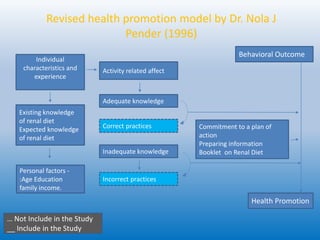
Individual
characteristics and
experience
Existing knowledge
of renal diet
Expected knowledge
of renal diet
Personal factors -
:Age Education
family income.
Activity related affect
Adequate knowledge
Correct practices
Incorrect practices
Inadequate knowledge
Commitment to a plan of
action
Preparing information
Booklet on Renal Diet
Behavioral Outcome
Health Promotion
… Not Include in the Study
__ Include in the Study
Revised health promotion model by Dr. Nola J
Pender (1996)
TOOL AND TECHNIQUE:
Description of the tool:
Section A: Demographic variables.
Section B: Self structured Questionnaire to
assess the knowledge.
PILOT STUDY
• Samples of 10% from the main study will be
selected to conduct pilot study.
Methods of Data Collection :
• Permission from concerned authority.
• Consent from samples.
• Administration of pre test.
• develop self instructional module.
PLAN FOR DATA ANALYSIS:
1. Frequency percentage, Mean, SD will be
calculated.
2. Chi square test will be applied to check the
association between different demographic
variables and knowledge.
• PLAN FOR DESIMINATION AND
UTILIZATION:
1. Study findings will be published in nursing
journals and workshops.
References
• American Dietetic Association. Nutrition and Renal Disease.
Handbook of clinical dietetics. 1992; 2(13) : p 364-348.
• Black JM, Hawks JH. Medical-Surgical Nursing. 7th ed. New Delhi:
Elsevier Limited ; 2007. p 941.
• Modi GK , Jha V. The incidence of ESRD in India: A population-based
study. Kidney International. 2006 Oct 25; 17(70): p 2131-33.
• Boon NA, College NR, Walker BR. Davidson’s Principles And Practice
of Medicine. 20th ed. Philadelphia: Elsevier Limited; 2007. p 491.
• Tayyem R, Mrayyan M, Heath D, Bawadi H. Assessment of
nutritional status among ESRD patients. Journal of Renal Nutrition
2002 May; 3(18): 281-282.
• Green D. Malnutrition And Chronic Kidney Disease. Complete
Nutrition. 2009; 9(5): p 21-22.
• Luckmann J, Sorensen KC. Medical-Surgical Nursing. 2nd ed.
Philadelphia: WB Saunders Company; 1980. p 909.
• Bajwa SS, Kwatra IS. Nutritional needs and dietary modifications in
patients on dialysis and chronic kidney disease. J Med Nutr
Nutraceut [serial online] 2013 [cited 2014 Jan 2]. Available
from: http://www.jmnn.org/text.asp?2013/2/1/46/105330
• Cupisti A, Ferreti V, Alessandra C, Petrone I, Giorgio A, Meela M, et
al. Journal of Renal Nutrition. 2012 Nov; 22 (6): p 541-546.
• Neumann ME. Are the incentives in the ESRD payment bundle
getting more dialysis patients home. Nephrology news and issues.
2013 June 24. Available from:
http://www.nephrologynews.com/blogs/1-first-word/post/109585-
are-the-incentives-in-the-esrd-payment-bundle-getting-more-
dialysis-patients-home

research synopsis

  • 1.
    RESEARCH SYNOPSIS PRESENTATION GUIDE NAME: MRPRAVIN DANI (Professor) SUBMITTED TO: MISS.SNEHAL VITTHAL WAIDANDE (F.Y.M.SC NURSING)
  • 2.
    STATEMENT OF PROBLEM: “Astudy to assess the knowledge regarding renal diet among primary caregivers of renal failure patients in selected hospitals of Sangli Miraj Kupwad corporation area in a view to develop self instructional module.”
  • 3.
    OBJECTISVE OF STUDY: 1.To assess the existing knowledge of primary caregivers regarding renal diet. 2. To develop self instructional module on renal diet among primary caregivers of renal failure patients.
  • 4.
    OPERATIONAL DEFINATIONS: 1. ASSESS:According to oxford dictionary “Assess means to evaluate or estimate the nature or quality of.” In this study It means, process of gathering information regarding renal diet using structured questionnaire.
  • 5.
    3. KNOWLEDGE: Accordingto oxford dictionary, Knowledge means a state of being aware of or information. In this study ,It means the correct response given to structured questionaries' .
  • 6.
    4. SELF INSTRUCTIONALMODULE: According to oxford dictionary ,SIM refers to a information booklet. In this study ,It means a booklet prepared on renal diet. 5. Diet : A special course of food to which a person restricts themselves either to lose weight or for medical reasons. In this study it means special course of food for renal failure patients.
  • 7.
    Assumption: • 1) Primarycaregiver of renal failure patients will have some knowledge regarding renal diet.
  • 8.
    DELIMITATIONS: The study islimited to primary caregivers of renal failure patients admitted in nephrology unit in selected hospitals of Sangli Miraj Kupwad Corporation area.
  • 9.
    RESEARCH METHODOLOGY: RESEARCH APPROACH:Quantitative research. RESEARCH DESIGN: non-experimental descriptive research design. SETTINGS: Nephrology unit of selected hospitals of Sangli Miraj Kupwad corporation area. .
  • 10.
    POPULATION: Primary caregiversof renal failure patients. Sample: Primary caregivers of renal failure patients in selected hospitals. SAMPLE SIZE: 60 SAMPLING TEACHNIQUE: Non probability purposive sampling technique.
  • 11.
    INCLUSION CRITERIA 1. Primarycaregivers of renal failure patient. 2. Primary caregivers who are able to understand English or Marathi. 3. Primary caregivers available at the time of study.
  • 12.
    EXCLUSION CRITERIA: • Primarycaregivers who are not willing to participate in the study.
  • 13.
    Individual characteristics and experience Existing knowledge ofrenal diet Expected knowledge of renal diet Personal factors - :Age Education family income. Activity related affect Adequate knowledge Correct practices Incorrect practices Inadequate knowledge Commitment to a plan of action Preparing information Booklet on Renal Diet Behavioral Outcome Health Promotion … Not Include in the Study __ Include in the Study Revised health promotion model by Dr. Nola J Pender (1996)
  • 14.
    TOOL AND TECHNIQUE: Descriptionof the tool: Section A: Demographic variables. Section B: Self structured Questionnaire to assess the knowledge.
  • 15.
    PILOT STUDY • Samplesof 10% from the main study will be selected to conduct pilot study.
  • 16.
    Methods of DataCollection : • Permission from concerned authority. • Consent from samples. • Administration of pre test. • develop self instructional module.
  • 17.
    PLAN FOR DATAANALYSIS: 1. Frequency percentage, Mean, SD will be calculated. 2. Chi square test will be applied to check the association between different demographic variables and knowledge.
  • 18.
    • PLAN FORDESIMINATION AND UTILIZATION: 1. Study findings will be published in nursing journals and workshops.
  • 19.
    References • American DieteticAssociation. Nutrition and Renal Disease. Handbook of clinical dietetics. 1992; 2(13) : p 364-348. • Black JM, Hawks JH. Medical-Surgical Nursing. 7th ed. New Delhi: Elsevier Limited ; 2007. p 941. • Modi GK , Jha V. The incidence of ESRD in India: A population-based study. Kidney International. 2006 Oct 25; 17(70): p 2131-33. • Boon NA, College NR, Walker BR. Davidson’s Principles And Practice of Medicine. 20th ed. Philadelphia: Elsevier Limited; 2007. p 491. • Tayyem R, Mrayyan M, Heath D, Bawadi H. Assessment of nutritional status among ESRD patients. Journal of Renal Nutrition 2002 May; 3(18): 281-282. • Green D. Malnutrition And Chronic Kidney Disease. Complete Nutrition. 2009; 9(5): p 21-22.
  • 20.
    • Luckmann J,Sorensen KC. Medical-Surgical Nursing. 2nd ed. Philadelphia: WB Saunders Company; 1980. p 909. • Bajwa SS, Kwatra IS. Nutritional needs and dietary modifications in patients on dialysis and chronic kidney disease. J Med Nutr Nutraceut [serial online] 2013 [cited 2014 Jan 2]. Available from: http://www.jmnn.org/text.asp?2013/2/1/46/105330 • Cupisti A, Ferreti V, Alessandra C, Petrone I, Giorgio A, Meela M, et al. Journal of Renal Nutrition. 2012 Nov; 22 (6): p 541-546. • Neumann ME. Are the incentives in the ESRD payment bundle getting more dialysis patients home. Nephrology news and issues. 2013 June 24. Available from: http://www.nephrologynews.com/blogs/1-first-word/post/109585- are-the-incentives-in-the-esrd-payment-bundle-getting-more- dialysis-patients-home