Accenture Life Trends 2025 Report - Consulting Presentation Example
Accenture’s Life Trends 2025 highlights five shifts: Cost of hesitations, The parent trap, Impatience economy, The dignity of work, and Social rewilding.
Accenture Life Trends2025
Accenture Life Trends 2025
About this report
We create these trends every year as a window into
the interplay between people and their behaviors
and attitudes to the world around them—be it
business, technology or other societal shifts.
It’s now commonly accepted that customer obsession
is the best growth strategy. Superb customer
experiences are expected. It takes meticulous
orchestration to play a meaningful and relevant role
in your customers’ lives. However, people are messy.
They’re emotional and they’re changing faster than
you can change your business, so keeping pace is a
constant challenge. These trends examine these shifts
and seek to help businesses define how to catalyze
growth by staying relevant to customers—which is
Accenture Song’s mission.
2
3.
Accenture Life Trends2025
Research snapshot
Each year, Accenture Song’s global network of
designers, creatives, technologists, sociologists,
and anthropologists across 50+ design studios and
creative agencies watch out for signals in their
countries. We synthesize their thoughts, discuss
them with futurists and academics and shape them
into trends. External, in-depth interviews with
people in eight countries tell us whether and how
the trends are manifesting, in their own words.
We combine these insights with an extensive
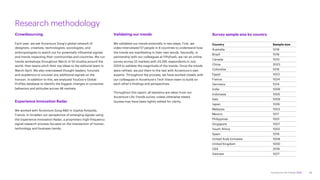
online survey of 24,295 people across 22 markets
to shape these final trends.
For more information, please see page 89.
3
Accenture Life Trends 2025
4.
Accenture Life Trends2025
Accenture Life Trends 2025
Executive summary
As disruptive breakthroughs dramatically evolve people’s digital experiences, they naturally
react and adjust their relationship with technology to ensure it still serves them. Right now,
trust online is in the spotlight and people are increasingly scrutinizing what they see and what
they believe, which is affecting how customers behave towards the businesses trying to reach
them. Thematically, then, the opening trend anchors the set.
Cost of hesitations details how it’s now
incredibly easy to create all kinds of digital
content, and a flood of scams is blurring the lines
between the authentic and the deceptive. Even
on once-trustworthy platforms, it’s harder for
people to tell what’s real, seeding hesitation into
their digital interactions.
Within this context, The parent trap investigates
how people are evaluating their options for helping
the next generation shape a safe, healthy
relationship with digital technology as it evolves.
Impatience economy observes that consumers are
going their own way, finding quick solutions via
relatable online content to satisfy their growing
impatience to achieve life goals.
Foundational to a thriving workplace, The dignity
of work is being challenged and resulting in rising
tensions as business, technological and human
trends collide. As new technologies arrive in the
workplace, will people hesitate—or trust and
embrace them?
Perhaps a response to a digital experience that is
breeding hesitation, people are seeking simplicity
and deeper connections, which we see as a
movement towards Social rewilding. They want to
engage with the world in meaningful ways, finding
textural experiences that connect them with their
environment and each other.
Don’t hesitate. Read on.
4
5.
Accenture Life Trends2025
Contents
Cost of
hesitations
6–22
The parent
trap
23–37
Impatience
economy
38–53
The dignity
of work
54–69
Social
rewilding
70–84
Trend 1 Trend 2 Trend 3 Trend 4 Trend 5
5
Accenture Life Trends2025
Accenture Life Trends 2025
The innate trustworthiness of digital technology is
under threat, and its additive value for people’s daily
lives has become diluted by authenticity and trust
issues. It’s now incredibly easy to create all kinds of
digital content, so a flood of scams is blurring the
lines between what’s real and what’s deceptive,
making it harder for people to tell them apart.
This introduces hesitation into all interactions,
which is disrupting people’s online experiences.
Generative AI is a revelatory tool both for honest
enterprises and bad actors. It’s ushering in a new
era of confusion and concern, challenging
people’s trust in digital in deeply personal ways.
As people weigh up the possibility of dialing down
their dependence on the internet, trust should
become a top priority. While the scams may occur
on channels, brands suffer from the consequences
of hesitation.
7
8.
Accenture Life Trends2025
At the center of this trend is people’s new
hesitation reflex when doing anything online, and
the resulting cost for anyone doing business there.
For customers, the degradation of experience and
the rising likelihood of being misled means they
must constantly ask themselves, “Is this real?”
in multiple contexts, and on platforms they
once trusted. If people become too weary, online
shopping could take a hit and brands would suffer.
Some of the signals that shape this trend aren’t
new, but their escalation makes their inclusion here
important, especially as increasing use of artificial
intelligence has the potential to ramp things up
very fast.
What’s
going on
In the past year,
52%
of people have seen fake news
or articles
38.8%
have seen fraudulent product
reviews online
52%
have experienced deep-fake
attacks or scams for personal
information and/or money
Accenture Life Trends survey, 2024
8
Cost
of
hesitations
The
parent
trap
Impatience
economy
The
dignity
of
work
Social
rewilding
/
/
/
/
9.
Accenture Life Trends2025
Suggested,
recommended,
sponsored, for you?
The online discovery experience has become
chaotic and frustrating. The digital places that were
once reliably on-point for finding products, services
and information have become less effective. There
are three main factors causing this degradation.
First, the search experience has become cluttered
with suggested posts and related queries when
people just want the results they’ve asked for.
Second, people increasingly can’t trust that what
they find is real, (more on that in a moment). Third,
the apparent commercialization of every point in
the online experience—driven by the need for a
sustainable business model—means that almost half
of people (48%) feel like shopping is being pushed
on them whenever they go online.1
In a world where technological
progress seems so highly prized,
these things should be getting better,
not worse.
Search engine algorithms spawned an SEO industry
that has subtly but indisputably changed the web by
shaping word choices, page layouts and site maps
to maximize visibility. Experts know how to make
sure their content rises above genuine results that
would be more helpful or relevant—and this tactic
can now be supercharged by generative AI that can
create against the algorithm’s guidelines.2
Consequently, search results are clogged up by low-
quality content, seemingly unrelated suggested
posts and product recommendation lists motivated
by affiliate marketing kickbacks, pushing genuinely
relevant results down the page. Fundamentally,
search engines now often respond to a user’s
request for help by creating more work—and let’s
not forget that their original purpose was to make
navigating the internet easier.
This degradation is pushing people to create new
routes to discovery. Many have lost patience with
search engines and are going direct to a trusted
source or retailer instead. Others are turning to
places like Reddit and similar platforms, where
short-form content focused on shopping
recommendations has become popular.3,4
9
Cost
of
hesitations
The
parent
trap
Impatience
economy
The
dignity
of
work
Social
rewilding
/
/
/
/
10.
Accenture Life Trends2025
Wait, is this real?
The acceleration of generative AI content into all
places where people have traditionally discovered,
socialized and shopped online is causing trust
issues and fueling hesitation. Our Accenture Life
Trends survey indicates 62% of respondents say
trust is an important factor to them when choosing
to engage with a brand, (up from 56% last year).5
If people are going to be able to distinguish
between legitimate and false content, the brands
and creators sharing it might consider ways to
signal authenticity to rebuild trust.
“Personally, I find fake pictures
or videos on the internet very
unacceptable. Even though the
internet is a virtual environment,
virtual does not mean fake.”
YK Zhang, 33, China
Is this information real?
Even content created with harmless intent is
affecting people’s ability to trust what they read
online. Our survey found that 48.6% of people
often or always question the authenticity of the
news.6 It’s becoming harder to distinguish fact
from fiction—to identify what has been written by
a person with relevant credentials and what has
been generated by a well-trained machine.
Organizations producing content for digital
channels are excited about the advancing abilities
of technology for helping them create more of it at
speed. But the critical question many are failing to
ask is: Do people want it?
Further, generative AI models sometimes surface
incorrect or misleading results known as
hallucinations, because the models believe their
own assertions. Causes include inadequate or
biased training data, or incorrect assumptions
made by the model. What should be the next
generation of customer engagement tools are
sometimes making unhelpful suggestions like
putting glue on pizza.7, 8 Of course, this example
is easy to dismiss as absurd, but others are harder
to accurately assess.
Is this product real?
Generative AI is vulnerable to exploitation for
the purpose of misleading people, which is
increasingly muddying the discovery experience.
Computer-generated images often misrepresent
the quality of a product and/or the detail of its
features, sparking social media trends showing,
“What I ordered vs what I got.”9
Is this brand real?
In advertising, bad actors are staging fake podcast
endorsements or using deep-fake videos of
celebrities including Viola Davis to promote
dubious brands.10, 11 One consumer commented on
X, “I keep getting [social media] ads for clothes
that I would absolutely buy and then I google [sic]
the company and they have no online presence
beside a website. […] no way to tell if it’s a
legitimate company or an AI scam tailored to
my exact taste in T-shirts.”12
10
Cost
of
hesitations
The
parent
trap
Impatience
economy
The
dignity
of
work
Social
rewilding
/
/
/
/
11.
Accenture Life Trends2025
Is this website real?
People are also being stung by visiting sites that
bear all the hallmarks of the result they want to
see, when they are just fronts for something else.
For example, customers trying to reduce their
carbon footprint by buying local are increasingly
receiving their order from the other side of the
planet, shrouded in plastic packaging. Worse,
some pay and share their personal details and
receive nothing.13 When the deception becomes
clear, people are left feeling naïve, victimized
and angry.
Worse still, a tactic called “malvertising” uses
online advertising as a route to attack people’s
computers, but it doesn’t even require direct
action from the user. Simply visiting a website
hosting malvertising is enough to cause
problems.14
Is this review real?
Once a helpful shortcut to verifying credibility
and quality, online reviews have also lost their
dependability, with fake reviews becoming a
pervasive issue—even more so now they are
quickly scalable through AI. In 2022, TripAdvisor
identified 1.3 million fake reviews, and in 2021,
TrustPilot removed 2.7 million.15
Our survey found that 38% of
those surveyed have seen
fraudulent product reviews
online in the past year, and
52.8% often or always question
the authenticity of product
reviews when they see them.16
11
Accenture Life Trends 2025
Cost
of
hesitations
The
parent
trap
Impatience
economy
The
dignity
of
work
Social
rewilding
/
/
/
/
12.
Accenture Life Trends2025
Is this picture real?
A Getty Images report revealed that people feel
less favorably about brands that use AI-generated
visuals.17 The survey of over 7,500 people from 25
countries found that 90% of consumers want to
know if an image is AI-generated, and 87% value
image authenticity. Crucially, 76% say they find it
increasingly difficult to tell the difference between
real and AI-generated images, fueling skepticism.
Language is evolving to lend expression to the
uncomfortable feeling of spotting generative AI
content that feels inhuman. “Slop” is the new
“spam”—a broad term that has gained traction
to describe shoddy or unwanted AI-generated
content in art, books, social media and search
results.18
The issue of trust throughout the online experience
is multi-faceted and stems from a spectrum of
motivations from well-intended and genuine to
malicious and harmful.
12
Accenture Life Trends 2025
Cost
of
hesitations
The
parent
trap
Impatience
economy
The
dignity
of
work
Social
rewilding
/
/
/
/
13.
Accenture Life Trends2025
Hyper-personalized
harm
Fraudulent behavior and scams online aren’t new
but put them together with generative AI, and
people whose aim is to commit crimes online
now have a tool that makes it much easier.
Releasing generative AI so that anyone can
use it has created numerous unintended
consequences, some of which are as serious as
it gets—and it’s happening before people feel
the promised value of the technology.
The most tangible consequence is fraud
perpetuated when people are tricked into sharing
payment information in exchange for a non-
existent product or service. Less easily quantifiable
is the psychological impact of new, non-financial
types of fraud that are destroying people’s trust in
the online experience and making hesitation a
reflex. Our survey has found that in the past year,
32.6% of respondents have experienced deep-fake
attacks or scams designed to steal their personal
information and/or money.19
In June 2024, Google DeepMind published
research into tactics being exploited by bad actors
to misuse generative AI’s capabilities.20, 21 Among
those tactics affecting people directly are
impersonation, altering people’s appearance to
change the story told by a photograph, and
creating non-consensual intimate imagery, using
a person’s likeness. They’re also falsifying
documents, using people’s IP without permission
and imitating or reproducing original work,
brands or styles with the intention of presenting
it as real. Listed out like this, it becomes
abundantly clear that along with the good
generative AI can do, it can also do significant
damage in the wrong hands.
Deep-fake scams are proliferating worldwide,
leading organizations to consider them a bigger
threat than identity theft.22 In these scams, callers
use deep-fake audio to mimic the voice of a loved
one in a dire situation and request financial help.
The Asia-Pacific region saw a 1530% rise in deep-
fake cases from 2022 to 2023—the second largest
rise in the world, behind North America.23
Further, celebrities and citizens alike are
increasingly discovering their images and voices
are being used without their consent for nefarious
purposes, risking harm to their mental well-being
and their reputation. According to Britt Paris at
Rutgers School of Communication and
Information, with deep-fake technology, “anybody
can just put a face into this app and get an image
of somebody… completely without clothes.”24
Shockingly, this is happening both to adult and
child victims.
13
Cost
of
hesitations
The
parent
trap
Impatience
economy
The
dignity
of
work
Social
rewilding
/
/
/
/
14.
Accenture Life Trends2025
In the absence of adequate action from those
responsible for moderating this technology,
people are increasingly skeptical of what they see
online, leading to a risk that they hesitate to sign
up, opt in or buy now. Search, social, commerce
and consumption channels must tread carefully.
Trust is easier broken than built, and the early signs
are that consumers may already be seeking
alternatives. Brands will need to be ready.
Is people’s well-being simply considered the cost
of progress? Digital interactions are now riddled
with pitfalls and confusion, and inaction implies
that the impact on people’s lives doesn’t matter.
Brands’ best route to enabling people to engage
online without hesitation is to focus on reassurance
and trust to serve their needs—not at the expense
of strategic targets, but in addition to them. People
need clear reasons to trust and engage with a
brand online.
For years,
organizations have
been asking people
to prove who they
are. Now, brands are
on the hook to do
the same.
14
Accenture Life Trends 2025
Cost
of
hesitations
The
parent
trap
Impatience
economy
The
dignity
of
work
Social
rewilding
/
/
/
/
15.
Accenture Life Trends2025
For a long time, the sheer convenience of the
internet outweighed people’s need for trust, but
that equation is beginning to shift. Our survey
found that 59.9% of people are questioning the
authenticity of online content more than before.25
If this trend continues, unchecked by legal or
systematic intervention, people will likely start to
abandon any platforms and brands they can’t trust.
Whether they reduce, change or stop certain
behaviors entirely will be down to the individual,
but it will affect discovery, sharing, shopping
and socializing.
What’s
next
The most important
move now is for every
brand, platform,
business and
government to
prioritize trust in
channels and digital
experiences. Leaders’
goal should be to
make it easy for
people to trust in their
brand, such that
engaging with it is a
hesitation-free choice.
15
Cost
of
hesitations
The
parent
trap
Impatience
economy
The
dignity
of
work
Social
rewilding
/
/
/
/
16.
Accenture Life Trends2025
Decontaminating
the ecosystem
Design and marketing now face a huge challenge:
How do they maintain a strong digital relationship
with customers when the channels they use are
becoming contaminated by slop? Communicating
authenticity will mean revisiting or even
redesigning channel strategies from scratch.
Brands must be honest about whether their
channels have been polluted and whether
customers have fallen out of love with, avoid
or distrust them. This presents an opportunity
for a more direct relationship with customers
as they seek alternatives. Those that invest in
becoming the trusted brand within a category
could become its default choice.
We expect to see platforms investing in
technologies to mitigate scams and harm, and to
fumigate the slop that is destroying the customer
experience. This move might be motivated by
stronger policy enforcement and investment in
trust and safety functions—which has recently
fallen victim to efficiency drives within big tech.26
It will be challenging for platforms due to the
ease and low cost of AI-generated content, but
prioritizing quality over quantity is necessary to
maintain the internet as a valuable and authentic
resource for everyone. Balancing profitability with
authenticity is difficult but crucial.
“In the end, the customer is going to
find out whether the product is real
or fake. And if it’s fake, then you’ve
lost the customer forever. The
whole point of business is to build
that trust with their consumers.”
Azure’de, 38, US
16
Accenture Life Trends 2025
Cost
of
hesitations
The
parent
trap
Impatience
economy
The
dignity
of
work
Social
rewilding
/
/
/
/
17.
Accenture Life Trends2025
The search for
authenticity
When platforms fall short, brands in some
industries may need to prioritize consumer safety
to help people avoid falling victim to scams and
abuse, and to help minimize the consequences if
it happens. People need protection and systems to
help them right wrongs, restore dignity and repair
damage. One route to enhancing trust is to create
digital signifiers of authenticity. For example, it’s
possible to use two-way QR codes and blockchain
technologies to prove the authenticity of products,
to create transparency of the product’s journey.
We may also see the introduction of symbols of
trust, stamped onto content to indicate that it has
not been created or manipulated using AI.
Industries might organize new associations (or
use existing ones) to manage and uphold trust
standards. Technology itself may also help, with AI
programmed to calculate probable reliability and
an option to appeal against mistaken ratings.
For organizations dabbling with AI-generated
content, it will be critical to monitor how that
content is received by customers. The prevailing
assumption is that people will adapt to altered
images of people, objects and landscapes, but we
see evidence indicating the opposite.27 There are
emerging risks to brand trust and perception
based on the use of AI content, which must be
carefully managed.
People feel it matters significantly if
AI-generated images are shared by:
51%
their healthcare provider
50%
their regular bank
44%
their favorite technology brand
Accenture Life Trends survey, 2024
17
Cost
of
hesitations
The
parent
trap
Impatience
economy
The
dignity
of
work
Social
rewilding
/
/
/
/
18.
Accenture Life Trends2025
These organizations should also align with their
brand purpose when considering the use of
generative AI. For instance, it’s long been known
that imagery has a powerful effect on the way
people feel about themselves. Fashion and beauty
brands may want to carefully consider the use
generative AI imagery and how it will perpetuate
unrealistic beauty standards.
Whether formalized or unwritten, we expect to
see new rules of engagement around when it’s
acceptable to use AI. People are likely to be
annoyed by AI-generated content, images or
videos that mislead in relation to travel,
emotionally manipulative subjects, for illustrating
or embellishing real stories, and for physical
products where the design has an emotional
component.
“What makes the most sense
to me when interacting with
a brand on the internet is the
question of the trust I have in
that brand.”
Daniel, 31, Brazil
18
Accenture Life Trends 2025
Cost
of
hesitations
The
parent
trap
Impatience
economy
The
dignity
of
work
Social
rewilding
/
/
/
/
19.
Accenture Life Trends2025
Responsibly seeking
consent
When it comes to training AI models using people’s
content, platforms will need to be explicit about
their intent—and doing this via terms and
conditions will not be enough. People must be
afforded a fair opportunity to evaluate whether
to allow the use of their personal data.
Creators, artists, media and individual people
are already grappling with issues like consent,
copyright and privacy. We expect to see
legislation, regulation and protection increasing
rapidly and unevenly in relation to AI use cases. At
the time of writing, over 400 pieces of AI-related
legislation exist—most notably the COPIED act,
which seeks to grant consent and transparency.28
Creators rely on platforms to distribute and
monetize their content, but generative AI
disrupts this process by summarizing that
content, using it to train data and reducing
visitor numbers. Their relationship is thereby
undermined, as their work is exploited without
proper compensation and their livelihood is
impacted. Public opinion on slop is already being
swayed by creatives with large audiences who
feel AI threatens their work or their livelihood.29
Software solutions are already emerging. The
Cara app was created to give artists who oppose
unethical AI a safe space to share images and
network with peers.30 Developed by the University
of Chicago, Glaze adds a so-called “cloak” to an
image to thwart scraping attempts, and
Nightshade distorts the image for the generative AI
scraper.31 Kudurru puts control in artists’ hands by
enabling them to block the scaping IP address
and/or to return an image of their own choosing.32
Brands would be well advised to take a careful look
at their communication channels and drive trust in
and through them. This presents an opportunity for
a more direct relationship with customers as they
seek alternatives. Those that invest in becoming
the trusted brand within a category could become
its new, hesitation-free choice.
19
Cost
of
hesitations
The
parent
trap
Impatience
economy
The
dignity
of
work
Social
rewilding
/
/
/
/
20.
Accenture Life Trends2025
“Authentic” was Merriam-Webster’s word of the
year in 2023.33 With the rise of artificial intelligence
and its impact on deep-fake videos, actors’
contracts, academic honesty and a vast number
of other topics, the line between real and fake has
become blurred. Authenticity and its growing
importance to internet users is more than just
something brands should aspire to be. It’s
something they must actively do as part of
every interaction with their customers.
Being authentic and trustworthy is a win-win,
because when customers can trust an
organization, they will engage with it—
without hesitation.
The onus is now on
brands to make sure
that their online
activity builds trust
rather than adding
to hesitation.
20
Accenture Life Trends 2025
Cost
of
hesitations
The
parent
trap
Impatience
economy
The
dignity
of
work
Social
rewilding
/
/
/
/
21.
Accenture Life Trends2025
From sophisticated scams to
engagement-farming slop,
online content and
experiences are becoming
less trustworthy for consumers.
If brands, organizations and
platforms fail to prioritize
authenticity and earn trust,
people will stop engaging.
In a matter of months, what people thought they
knew and trusted about how they consumed
information, socialized and shopped online
changed. Generative AI’s ability to facilitate hyper-
personalized harm and harassment, deep-fakes
and scams has quickly become a serious issue.
Every day, people are experiencing a pause—
questioning the authenticity of the information
they’re reading, the products they’re seeing, the
websites they visit, and the calls, texts and emails
they’re receiving.
Why this
matters now
21
Accenture Life Trends 2025
Cost
of
hesitations
The
parent
trap
Impatience
economy
The
dignity
of
work
Social
rewilding
/
/
/
/
22.
Accenture Life Trends2025
Accenture Life Trends 2025
We recommend
Platforms should evolve and invest to modernize
their content moderation value chains to address
the known exponential influx of content that is
harmful and deceitful. This is already being worked
on at a rapid pace, and that will continue.
Brands need to establish and communicate clear
methods for customers to verify their authenticity.
Reassure customers by creating beacons of trust in
communications, commerce and baked into the
product. This is a marketing, digital and security
collaboration to ensure channels are trusted and
customers are retained. Explore when and how to
use AI-generated content, with moral and
responsible AI front of mind.34
Customers will need and demand support as
more and more people fall victim to these
sophisticated scams. Organizations will look at
this in terms of costs, but they should think
creatively about ways they can help their
customers. Understand where customers need
additional support in discovery, and provide
trusted solutions, advice and communications
to allay the concerns that make them hesitate.
If the volume of deep-fake scams continues,
insurance companies may want think through
new types of products, similar to the identity theft
products launched years ago. A new insurance
product against deep-fake scams and abuse
could offer coverage for financial losses, legal
fees and emotional distress, and could provide
comprehensive protection and support for
victims of digital fraud and harassment.
Governments may need to ramp up consumer
protections and new compliance measures
placed on organizations. These new consumer
protections may require organizations to safeguard
against scams, deep-fake harassment and abuse,
ensuring product safety and transparency.
22
Accenture Life Trends2025
Accenture Life Trends 2025
Most parents’ instinct is to protect their children—
to keep them healthy and safe from harm. They
perceive their job includes raising children to be
well-adjusted adults and perhaps passing on
important cultural values. One of today’s biggest
parental challenges is how to help the next
generation shape a safe, healthy relationship
with digital technology.
Growing up today looks very different from parents’
own experiences. Unfettered access to the internet
and social media is causing harm, influencing
extreme behaviors and forcing young people to live
with unintended consequences. We’re seeing an
acceleration of top-down policies from governments
and bottom-up action from parents and schools to
establish guardrails and protect children. This will
undoubtedly have major repercussions for
organizations—and soon.
24
25.
Accenture Life Trends2025
Finding the balance between letting children learn
by experience and safeguarding them against harm
has always been an underlying challenge for
parents. In some situations, potential threats are
obvious from a distance, giving parents time to
intervene. But unlike physical hazards, many
dangers of smartphones and social media for
young people approach undetected, until the
consequences become clear.
What’s
going on
There are strong ties
between this and other
trends in this 2025 set:
adults are coming to
terms with the less
favorable ways that
digital technology has
affected their lives, and
they’re seeking both a
cure for themselves
and prevention for
their children.
25
Cost
of
hesitations
The
parent
trap
Impatience
economy
The
dignity
of
work
Social
rewilding
/
/
/
/
26.
Accenture Life Trends2025
It’s important to stress that smartphones
and social media aren’t all bad—there are
demonstrable benefits for all users, including
young people. Smartphones offer obvious
convenience, a ubiquitous companion to
education and the safety of location tracking,
while social media offers a window into a diverse
world that people simply wouldn’t have seen 50
years ago. This breeds empathy, curiosity and
connectedness in the next generation.
For young people who don’t feel they fit in with
their peers, social media is a place to explore and
find a precious sense of belonging—especially for
those from the LGBTIQ+ communities.35 It’s also a
remarkable mouthpiece for parenting experts,
enabling them to offer clarity and education on
child development that helps today’s parents. It’s
also a place for camaraderie—a daily reminder that
others are very much in the same boat.
However, evidence of the negative impact of social
media and smartphones is piling up, and while
governments are pushing for protective measures,
many parents and schools don’t feel the results are
coming fast enough, so they’re mobilizing. And in
the absence of granular controls, their approach is
more extensive.
Social psychologist Jonathan Haidt’s best-selling
2024 book, The Anxious Generation, has whipped
up a visceral sense of urgency around young
people’s well-being. In it, he shares statistics that
show significant rises in teen depression, mental
illness among college students, anxiety among
18- to 25-year-olds and hospital admissions for self-
harm and suicide among younger adolescents.36
These concerns have surged since 2010–2012,
which coincides with mass smartphone adoption,
a sudden engagement spike on social media and
business models that have increased screen time.
Haidt’s book is behaving as a catalyst. While these
links between technology and mental health
outcomes have been suggested for a while, they’re
now backed up by data and presented in a way
that makes the harm feel more tangible and
understandable.
56.5% of those aged 18-24 are more
than twice as likely as those over 55
(23.3%) to agree that social media
significantly impacts how they think
about their own identity.37
26
Cost
of
hesitations
The
parent
trap
Impatience
economy
The
dignity
of
work
Social
rewilding
/
/
/
/
27.
Accenture Life Trends2025
Vulnerabilities
Parents are justifiably concerned about mental and
emotional harm from online bullying (from both
friends and strangers), abuse, unrealistic beauty
standards and age-inappropriate content that once
seen, cannot be unseen.
“When there are screens, there’s
no communication.”
Marie, 44, France
Broadly speaking, impacts have manifested
differently for girls and for boys.38 For instance,
a survey for the Children’s Commissioner for
England found that over half (51%) of 16- to 21-year-
old girls had been sent or shown explicit content
involving someone they know, compared to a third
(33%) of boys.39
A troubling new trend is also taking hold in high
schools around the world, where girls are being
cyberbullied with deep-fake nudes and
pornography featuring their own image without
their consent. Boys at one high school in New
Jersey reportedly targeted more than 30 girls in
this way before being discovered.40 This behavior
is making young victims feel shamed, silenced and
frightened for their safety, and has tipped bullying
into sexual abuse.
Meanwhile, teenage boys are targeted by
“sextortion” scammers on social media, driving
some to take their own lives. In the United States,
the FBI reported that over 12,600 victims—
primarily young boys—were coerced into sharing
explicit images and then extorted for money under
the threat that those pictures would be released to
their friends.41
On social media, unrealistic standards of beauty
driven by filters, cosmetic enhancements and
deep-fakes are, increasing symptoms of anxiety
and depression in young women. This has reached
new levels with the introduction of a Miss AI Beauty
Pageant. As a representative from the Chilean
Network for Women stated, “It is incalculable how
harmful the creation of “model women” by
machines can be. If beauty pageants with real
women were already creating impossible
expectations for us, where do invented women
leave us?”42
27
Cost
of
hesitations
The
parent
trap
Impatience
economy
The
dignity
of
work
Social
rewilding
/
/
/
/
28.
Accenture Life Trends2025
Extreme behaviors
and beliefs
Parents are also concerned about the influences
their children are exposed to online. Those who are
persuaded into extreme beliefs or behaviors can
be coerced into problematic or dangerous actions
that could harm themselves or others.
Social media can be a confusing place, serving
a constant flow of content to people who aren’t
always asking for it. Adults can find it
overwhelming, and those with young, developing
brains even more so. In a whirlwind of confusion,
decisive voices provide something to hold on to.
Unfortunately, some of the loudest voices promote
toxic traits for shock purposes, which, once
entertained, are perpetuated by algorithms.43
For instance, misogyny isn’t new, but social media
is changing it. According to research by University
College, London and the University of Kent, after
only five days using a popular social media
platform, there was a fourfold increase in
misogynistic content being served as suggested
content. The algorithm delivered extreme videos,
often focused on anger and blame directed at
women.”44 Research shows that Gen Z boys and
young men are more likely than Baby Boomers
to believe that feminism has done more harm
than good.45
“I think children spending a lot of
time on digital screens is a bad
thing. It makes them more isolated
from the outside world. They
become a bit detached from reality.”
Peter, 49, United Kingdom
There has also been a notable increase in
avoidance of in-person interaction. In Japan,
a form of extreme social withdrawal called
Hikikomori has been a focus since the late-1990s,
just as access to the internet became widespread
and adolescent boys started retreating into
solitude.46, 47
28
Cost
of
hesitations
The
parent
trap
Impatience
economy
The
dignity
of
work
Social
rewilding
/
/
/
/
29.
Accenture Life Trends2025
Unintended
consequences
Another angle sees teenaged boys buffeted
by anti-male messages implying that they are
accountable for society’s problems, with articles
from respected sources pushing this narrative.
Economist Richard Reeves observes that this
toxicity is prompting extreme reactions in some
boys, as they perceive a false dilemma that forces
them to choose between masculinity and
equality.48 Parents are watching the effects take
hold, as their children’s self-worth plummets.
A BBC Radio documentary, “About the boys,”
featured young boys discussing their exposure
to online pornography, their struggles at school
and their thoughts on becoming men. The piece
revealed vulnerabilities, conflicts and the silencing
impact of being told at such a young age that men
are evil.49
While twenty years ago, there was little to separate
younger men’s and women’s political views,
evidence suggests they’re polarizing in many parts
of the world, as noted both by the New York Times
and the Economist.50, 51 “What is striking… is that
a gulf in political opinions has opened up, as
younger women are becoming sharply more liberal
while their male peers are not.” This could be
explained by the fact that they often occupy
different digital spaces, where they are exposed
to starkly contrasting narratives.
In Belgium, Flemish nationalist party, Vlaams
Belang, is easily garnering support from young
men, but evoking aversion among young women.52
In a recent international study, young men were
more likely than young women to agree with
statements like, “men should put career first,
whereas women should put family first” and “when
the economy is bad, female employees should be
fired first.” 53
Connected to these divisive narratives are
symptoms like notably lower educational
achievement in boys versus girls, which is not
something to be ignored. In his book, Haidt states
that 59% of US bachelor’s degrees were awarded
to young women in 2019, plus boys were less likely
to be able to read and less likely to graduate from
high school.
Across the board, social media is changing the way
people exist in the world. Author of the newsletter
“How to feel alive,” Catherine Price reflected: “Has
hours upon hours of exposure to social media
algorithms led people to perform their lives instead
of live them?”54
29
Cost
of
hesitations
The
parent
trap
Impatience
economy
The
dignity
of
work
Social
rewilding
/
/
/
/
30.
Accenture Life Trends2025
Parents’ demand
for change
At the center of this trend is a generation of
parents trapped between the imperative to protect
their children from harmful parts of the internet,
while cutting them off completely would remove
opportunities and the ability to fully live in today’s
society. According to YouGov, 64.7% globally think
parents should limit the time their child(ren)
spend(s) on social media.55
As Peggy Noonan wrote for the Wall Street Journal,
“The truth becomes a cliché before it becomes
actionable. Then a person of high respect, a good-
faith scholar who respects data, say, comes
forward with evidence proving what everyone
knows, and it is galvanizing. […] Jonathan Haidt’s
book has broken through and is clearing the way
for parents’ groups to move forward on an
established idea.”56
Technology firms show a lack of empathy for
parents’ predicament. Flippantly suggesting that
parents simply take smartphones away is unhelpful
at best and insulting at worst. These devices and
platforms were knowingly designed to exploit
people’s innate need for social validation, and their
creators’ attempts are widely perceived not to do
enough to help mitigate the consequences for
young people’s health and well-being. Although,
in September 2024 as a response to feedback from
parents, a global social media platform
implemented teen-focused accounts with more
controls and restrictions around the content young
people can see, who can contact them and limits
the amount of time spent on the app.
“At the end of the day, it’s the
responsibility of the parents.
We are the first line of defense. So,
it would be nice if companies and
governments would do something.”
Azure’de, 38, US
Parents aren’t accepting this anymore. They’re
organizing from the bottom up, while governments
attempt to legislate from the top down. This
matters for brands because public debate around
what it means to grow from child to adult in a
digitally dependent world is already bubbling
and could soon erupt.
Some people may not engage at all, but many will
be watching how companies portray culture, and
how they target children and young people.
Navigating this sensitively is essential for
maintaining trust and relevance in the market.
Nobody cares about something until they suddenly
do—because it affects them. Marketeers and
employers need to be the first to care.
30
Cost
of
hesitations
The
parent
trap
Impatience
economy
The
dignity
of
work
Social
rewilding
/
/
/
/
31.
Accenture Life Trends2025
Parents want their children to be happy and healthy.
While debate continues around the extent to which
smartphones and social media have caused health
impacts in young people, conflicting media narratives
and technology companies behaving defensively only
add noise. Parents are seeing the impact with their
own eyes—they’re feeling the urgency and all they
want is solutions.
As the United States Surgeon General, Vivek Murthy,
commented when recommending health warning labels
for social media, “One of the most important lessons
I learned in medical school was that in an emergency,
you don’t have the luxury to wait for perfect
information. You assess the available facts, you
use your best judgment, and you act quickly.”
What’s
next
“The mental health
crisis among young
people is an
emergency—and
social media has
emerged as an
important
contributor.”57
Vivek Murthy,
United States Surgeon General
31
Cost
of
hesitations
The
parent
trap
Impatience
economy
The
dignity
of
work
Social
rewilding
/
/
/
/
32.
Accenture Life Trends2025
Sentiment will continue
to spread
Scott Galloway, NYU media professor and influential
media and technology podcaster, takes a broader
view of young people’s plight: “A decent proxy for
the success of a society is how it treats children.
Not how individuals parent, but the success of the
structures, incentives, and leadership charged with
preventing a tragedy of the commons.”58 Parents
around the world are rallying for change, and the
movement is gaining traction.
In the UK, St Albans is set to become the first city
to be smartphone-free for all children under 14,
and a number of London schools are seeking to
follow suit.59, 60 In February 2024, the French
government passed a law to protect children on
the internet, specifically on social networks.61
China has been ahead of this trend, having
imposed limits on children’s exposure to short
videos and online games back in 2021, which
was a move welcomed by most parents.62
In the US, the Kids Online Safety Act (KOSA)
passed, mandating that online platforms adopt
a duty of care for minors by mitigating risks such
as online bullying, sexual exploitation, drug
promotion and eating disorders. Platforms must
default to the highest privacy settings for minors,
and parental controls are mandated to oversee
privacy settings, limit purchases and manage time
spent online.63
Not all parents agree. The National Parents Union
in the US states that children should have phone
access during their free time.64
“I get really nervous with them
being on social media, but realize,
the more that I try to limit it the less
they’re going to have skills and
know how to cope with it.”
Charlotte, 40, US
32
Accenture Life Trends 2025
Cost
of
hesitations
The
parent
trap
Impatience
economy
The
dignity
of
work
Social
rewilding
/
/
/
/
33.
Accenture Life Trends2025
Parent-teenager relationships have probably
always been peppered with heated discussions as
they struggle to balance what the child wants with
what the parent believes is appropriate. The push
and pull is emotional and challenging for both
sides, and, whenever an agreement is made, it
often doesn’t last long as a new temptation always
pops up to upset the equilibrium.
By design, smartphones contain all the good and
bad of the internet in a single device that goes
everywhere with its user. Parents cannot possibly
monitor everything their children do or see on
their devices, and for every existing safeguarding
mechanism, there appears to be a workaround that
children find long before their parents.
Modern parenting often points to modeling
desired behavior—whether it’s manners, creating
a balanced diet, developing eco-conscious
habits or use of digital devices. But parents’ lives
are bundled into their own devices, making it
almost impossible to model healthy behaviors.
Even those who have stepped away from social
media may have their finances, groceries, school
apps, news sources, music, utilities and personal
and professional communications wrapped up in
their phones.
Difficult conversations
at home will continue
33
Cost
of
hesitations
The
parent
trap
Impatience
economy
The
dignity
of
work
Social
rewilding
/
/
/
/
34.
Accenture Life Trends2025
Unbundling may
be coming
Bundling every possible facility into a single device
was a revolutionary move that gave people access
to everything, everywhere, all the time. For adults,
the convenience is valuable, but this is neither
required nor desirable for children. Most parents
want their children to be locatable, contactable
and sociable, and able to pay for things while they
develop their independence.
Unbundling everything else will be a challenge,
because of the dominance of smartphones in the
market and their integration into all parts of people’s
lives. But the customer need for a dramatic
rebalancing is very much there. It will be a
challenging road and will likely feature a lot of
failures that could limit attempts to fringe areas,
but there’s no doubt the appetite for options is there.
34
Accenture Life Trends 2025
Cost
of
hesitations
The
parent
trap
Impatience
economy
The
dignity
of
work
Social
rewilding
/
/
/
/
35.
Accenture Life Trends2025
Parents and children are huge demographics, so
this trend is crucial for numerous organizations.
We could be witnessing the start of a significant
shift in dynamics. Marketing channels that have
been reliable for over a decade could become
significantly less effective, and people could start
living more—and expecting brands to engage with
them—in the real world. (More on this in our fifth
trend, Social rewilding.)
We believe it’s reasonable to expect a societal shift
toward banning smartphones for the under-14s
(possibly the under-16s) on a local and maybe even
global scale. Any business that targets children and
teens will feel the impact, including social media,
technology platforms, technology hardware, telcos,
banks, fast-moving consumer goods (especially food
and drink), hospitality and media.
Brands need to be ready for a world in which the
next generation has been well shielded from smart
devices and social media. They should develop
engaging, offline experiences and products that
encourage creativity, humanity and real-world
social interaction. We could see a wholesale
rethink of how and where to market to anyone
under 16, which would decimate some services
and create opportunities for others.
There will be new opportunities to shape
technology services that treat young people’s
developing brains with empathy and scientific
awareness. Semi-dumb phones and telco plans
for young people are likely under development
as we write. The Yondr pouch has launched to
limit the use of phones without removing them
completely.65 Alternative connected devices like
watches will probably have a role, and AI may be
deployed to moderate access to content.
It remains to be seen how dramatic the change will
be. Even without outright bans, we expect to see a
greater commitment to digital literacy and critical
thinking, endorsed by governments and
implemented by schools. But there will be a
generation of young people who will strongly resist
this change and seek workarounds. We expect the
tension to continue for a long while yet.
Brand strategies need
a radical rethink
35
Cost
of
hesitations
The
parent
trap
Impatience
economy
The
dignity
of
work
Social
rewilding
/
/
/
/
36.
Accenture Life Trends2025
What parents and their children
want could diverge further,
making the use of technology
a much greater, daily point of
tension than it has been to date.
Brands may face significant
gaps in their ability to engage
children and teenagers.
We believe this trend could unbalance the whole
ecosystem of technology, marketing and
entertainment—plus products and services targeted
at younger demographics. At the least, if some,
or even most, younger customers have reduced
access to digital technology and social media,
it will affect how brands become visible to them.
Why this
matters now
36
Accenture Life Trends 2025
Cost
of
hesitations
The
parent
trap
Impatience
economy
The
dignity
of
work
Social
rewilding
/
/
/
/
37.
Accenture Life Trends2025
Accenture Life Trends 2025
If reaching younger people matters to a brand,
it will be crucial to workshop a less
digital/social media-dependent strategy.
Alternatives include putting retail (and retail
media) in the mix, going old school with on-the-
ground promotion in shopping malls, a greater
weighting towards events on television and
streaming services, and sponsorship.
If limits on child- or teen-focused apps and
devices are imposed, it will be necessary to
redesign or create services that don’t depend
on smartphones. Alternatively, experiences can
bypass controversial content domains or be ring-
fenced in more content-limited interfaces.
Unbundling the smartphone creates opportunity.
Organizations should ensure they stay on top of
what is culturally relevant. Social media continues
to be the forge and main distribution channel for
ideas, language shifts and fashion. Likely this won’t
change for those over 16, but movements that
originate or are perpetuated in non-digital ways
may become more important.
It’s important to think through an organization’s
permission space. Will using social media
advertising/commerce to engage with young
people be acceptable for the company, or will it
come under attack from concerned parties? And of
course, if the brand serves as any kind of gateway
to harmful content, whether generally or
specifically to either boys or girls, it must be
dealt with—immediately and robustly.
If parents’ gatekeeping role for children and
young people expands, brands should consider
how to create parent-friendly propositions that
help build an affinity with wary parents and create
relevance for their children.
We recommend
37
Accenture Life Trends2025
Accenture Life Trends 2025
Many cultures around the world share a core belief
in the idea that people can shape their desired
future through education, hard work and
determination. However, right now, the reality of
a set of circumstances we laid out in last year’s
Decade of deconstruction trend is biting.66
But an innate determination is evident in people’s
behaviors as they seek the shortest paths to
their goals.
People are going their own way, weighing up the
risks and rewards and betting on themselves
bolstered by information and experience from the
crowd online. At the heart of this trend is the fact
that people are finding quick solutions via relatable
content online to satisfy their growing impatience
to achieve their life goals. When companies don’t
meet people’s needs, they look to the crowd for
education, so brands will need to plug those gaps
to keep their customers.
39
40.
Accenture Life Trends2025
Two interconnected catalysts are driving people
toward taking initiatives to speed up their pursuit of
their life goals. First, technology has made it easier
to find new routes to pursue a goal. Second, people
seeking advice on navigating life’s complexities are
finding it in social channels, often delivered by
someone to whom they relate. Bolstered by the
knowledge of the digital crowd, they find the
confidence to create a new path instead of
following traditional ones.
What’s
going on
55%
of people prefer quick
solutions over traditional
methods and many are willing
to explore riskier routes to
achieve their health and
financial goals
Accenture Life Trends survey, 2024
40
Cost
of
hesitations
The
parent
trap
Impatience
economy
The
dignity
of
work
Social
rewilding
/
/
/
/
41.
Accenture Life Trends2025
“I look for shortcuts in every
area that I can. Anything that
I can do to speed my life, help
make things go faster, better,
more accurate.”
Stan, 46, US
It’s unsurprising that the immediacy of modern life
is fostering impatience—and new behaviors to
match. According to our survey, 55% of people
prefer quick solutions over traditional methods
and many are willing to explore riskier routes to
achieve their health and financial goals (68% in
physical health; 67% mental health; 67% financial
goals).67
Interestingly, one word in Hindi, Urdu and Punjabi
sums up this sentiment: jugaad. It doesn’t directly
translate to English, but it articulates the idea of
improvising or creating a new solution to get a
quick result when you lack the time, skills or
opportunity to do it the established way.68
Where classic approaches like hard work and
education aren’t cutting it, people are thinking
laterally and using opportunities presented by
social media and other digital platforms. Two-
thirds of our survey respondents (63.2%) said they
get inspiration from social media on how to do
things smarter—for those aged 18–34, it’s closer
to three-quarters (74.1%).69
The power of the crowd is almost like a riptide.
Someone finds a new solution to a problem,
tests it, and if they find success, they share it and
take others along with them on a new route to a
desired result.
Brands need to work out whether their value
proposition is part of that tide, or whether it’s
sweeping around them as people crowd-source
their routes to health, wealth and happiness—
fundamental to survival, security and well-being.
41
Accenture Life Trends 2025
Cost
of
hesitations
The
parent
trap
Impatience
economy
The
dignity
of
work
Social
rewilding
/
/
/
/
42.
Accenture Life Trends2025
Proactive health
and well-being
Proactive health-related behaviors stem from
people’s desire to live as long and strong a life
as possible, and they’re finding new ways to
understand themselves both physically and
mentally. This can prevent or resolve issues, but
risks include unnecessary anxiety or incorrect
treatment. Self-diagnosis is on the rise, driven in
some cases by the cost of seeking medical advice
and in others, by long delays in investigations. In
the United Kingdom, the waitlist to see an autism
specialist has increased fivefold since 2019, as
found by the Nuffield Trust.70
People also seek help from social media, which is
faster than waiting for an appointment, and houses
volumes of advice from people experiencing
similar symptoms. Recognizing one’s own
experience in social content can feel validating
and give people a sense of belonging. However,
it can also lead to self-treatment, which, without
proper supervision, can make problems worse.71
Further, medical professionals sharing generalized
explanations can easily be misunderstood in
situations where case-by-case detail matters.
For fitness advice, middle-aged men are tapping
into approachable content found online. While
some—dubbed “Huberman husbands”—are finding
value in neuroscientist Andrew Huberman’s
layperson-friendly descriptions of well-being
issues, the “quantified self” movement sees others
employing the latest technologies for monitoring
and optimizing their fitness.72, 73
For enhancing performance, the media has
reported that professional women in the US are
increasingly exploring an as yet unsubstantiated
health hack.74 They’re microdosing with
psilocybin—more commonly known as “magic
mushrooms”—to help them focus and manage
their busy lives.
There are risks associated with many of these
approaches. With personal trainers, gym
memberships and alternative health consultants
out of budget for many people, the “cheats” and
“hacks” they try can turn out to be too good to be
true. If the promise is too tempting to resist, some
don’t stop to check the credibility of their source,
leading to disappointment.
“This economy is rough so if I have
a mild symptom of something that
I want to understand, obviously the
internet is my friend. And obviously
there’s [social media] doctors that
give you certain advice.”
Mel, 40, South Africa
42
Cost
of
hesitations
The
parent
trap
Impatience
economy
The
dignity
of
work
Social
rewilding
/
/
/
/
43.
Accenture Life Trends2025
Financial alternatives
People’s security is deeply tied up in their access
to the money needed to fund the essentials of life.
Easy access to technology is empowering a new,
never-ending financial hustle, breeding more
options to earn, spend and invest than ever before.
More than half of Gen Z and Millennial Americans
have a side hustle, earning an average of $1,253
per month in extra income. When asked what
inspired their side hustle, 40% cited inflation and
38% said it was the economic fallout from the
pandemic.75 Our survey found that in the past 12
months, 28.1% of people had started a side hustle
to boost their income.76
For many, seeking additional income has been
necessary just to stay in the black, but recently,
more highly paid professionals are taking on
second jobs, too. Some want financial freedom,
others consider their main job’s salary trajectory
too slow, and in some cases, it’s down to
uncertainty in the availability of future jobs. People
seeking financial security through side hustles
rather than relying on a single employer are
predominantly Gen Z and Millennials. Social media
is awash with people sharing their own tips on
making it work. Even news sites are offering this
kind of content.77
“I use social media for things like
upskilling around things like
financial independence, which
I’m quite into and also financial
advice.”
Amrita, 34, UK
43
Accenture Life Trends 2025
Cost
of
hesitations
The
parent
trap
Impatience
economy
The
dignity
of
work
Social
rewilding
/
/
/
/
44.
Accenture Life Trends2025
On social media and other platforms, people are
discovering peer-to-peer financial education
through billions of videos under hashtags like
#passiveincome and #financialfreedom.78
Subreddits, podcasts and local forums share
similar advice, and the fact that young people
make up much of the audience for these
forums has an impact on the financial world.
In Indonesia, for instance, 57% of individual stock
market investors in August 2023 were Gen Z.79
The key here is the ease of availability and the
style of delivery.
People relate to others who
can make financial advice
understandable and relatable to
their own context—far more than
they can to dry, factual resources
on a bank’s website.
Enabled by market deregulation and driven in part
by the allure of easy money, digital gambling
appears to be on the rise, offering another
potential shortcut to wealth—albeit a risky, volatile
one. Young men, in particular, have flocked to
online betting, with more than 30% of 18- to 34-
year-olds across the US now having online
sportsbook accounts.80 Our survey found that in
the past 12 months, 16.2% of people gambled
online, betting more than a day’s pay each time.81
Then there’s the classic: gold. Perhaps seeking
the reassurance of owning something that
historically has maintained its value, people often
buy gold in times of economic turmoil.82 In South
Korea, small bars of gold can be bought from
vending machines in convenience stores.83 US
retail giant, Costco, has been selling gold bars
since October 2023 to the tune of approximately
$100–200 million each month. While it may not be
making much profit, it’s driving increased footfall
and leading to a boost in sales.84
The desire for money and the promises of what it
can do for people’s lives are deeply motivating.
The crowd is sharing advice on ways to find more
financial security in some aspects, and financial
exploration in others. It’s clear that economic
uncertainty is prompting diverse strategies for
financial security. Before social media, advice of
this type was typically accessible only to the
wealthy. This shift highlights that people are more
aware of the lack of relatable financial advice and
accessible channels.
44
Cost
of
hesitations
The
parent
trap
Impatience
economy
The
dignity
of
work
Social
rewilding
/
/
/
/
45.
Accenture Life Trends2025
Affordable joy
Once the bills are paid, people derive joy from the
extras in life, whether that means aspirational
fashion items, memorable experiences or escapism
entertainment. Faced with economic pressures,
many are seeing their “fun money” depleting, and
some are turning to questionable or even illegal
ways to find joy.
For instance, a trend dubbed “pirate and chill” is
surging, costing the US economy billions.85 People
are streaming content they haven’t paid for, and/or
accessing streaming services that aren’t officially
available in their country. According to Forbes
Advisor 2024, illegal streaming is surging around
the world, and 46% of people with VPN access use
it for streaming services.86 A VPN has the added
benefit of reducing the cost of accessing the
service, and in many cases, the illicit services are
almost as easy to use as the paid-for ones. In 2024,
around 20 million viewers illegally streamed a key
boxing match between Tyson Fury and Oleksandr
Ysuk, costing pay-per-view broadcasters an
estimated GBP95 million in profits.87
In fashion and beauty, counterfeits and dupes have
become popular among Gen Z and Millennials,
enabling them to enjoy the style without the price
tag. The shift here is that while wearing a fake
luxury watch or branded clothing was once
something to hide and pass off as real, wearing a
dupe is now accepted as a smart way to embrace
a style affordably.88 With rising demand comes
accelerating production, and the cycle drives
itself—with some help from social media. Certain
online retailers have become known for their habit
of copying items on the luxury market. The
difference is that now, they’re also targeting the
work of independent designers, to poorer quality
standards, which is seriously impacting small
businesses’ profits.89
45
Cost
of
hesitations
The
parent
trap
Impatience
economy
The
dignity
of
work
Social
rewilding
/
/
/
/
46.
Accenture Life Trends2025
CCC
The signals add up to reveal a trend toward self-
agency, quicker fixes and alternative routes to
success—all of which are tied up in risks and
rewards. Traditional systems that serve people are
critical, and the regulation around them exists for
valid, experience-led reasons, but people’s
patience is exhausted by a life system that
feels rigged.
People are taking
control of their
own destiny—and
companies should
stay acutely aware
of their motivations
and methods.
46
Accenture Life Trends 2025
Cost
of
hesitations
The
parent
trap
Impatience
economy
The
dignity
of
work
Social
rewilding
/
/
/
/
47.
Accenture Life Trends2025
At the center of this trend is the fact that people are
being more impatient, proactive and assertive in how
they navigate life. Their new approaches to pursuing
health, wealth and happiness are challenging the
status quo for businesses. The role of influencers
started with product recommendations and has
moved on to helping people solve their life problems
and offering them alternatives. For the past twenty
years, tech startups have spotted gaps in the market
and filled them, but now it’s the power of the crowd.
What’s
next
68.2%
of people would engage
more with a brand that
educates them through
blogs and videos90
Accenture Life Trends survey, 2024
47
Cost
of
hesitations
The
parent
trap
Impatience
economy
The
dignity
of
work
Social
rewilding
/
/
/
/
48.
Accenture Life Trends2025
The power of the crowd is
uncovering needs that aren’t being
met by organizations—whether
that means brands, service
providers or government agencies.
Connection, built
through content
As social media continues to offer a way to share
and discover helpful information, we expect to see
people continuing to help each other navigate
roadblocks and improve their lives. Brands should
take note of this behavior, though, as it reveals
significant gaps in the service and information
they offer.
Avoiding major disruption will require a rethink of
customer engagement strategy, and a drive to
remove obstacles to direct connection. Content
and connection are not the same thing.
Influencers’ content is popular because it’s
relatable. They share lived experiences in which
people recognize their own circumstances, making
it feel like they’re singing the same song and their
recommendations must be worth consideration.
A small number of brands are already leaning into
this trend. For instance, Ally Bank and Credit Karma
are partnering with Fintok influencer Michela
Allocca, who shares personal finance video
content with her 800,000 followers.91
We expect to see an increasing tide of people
looking to each other for awareness of options that
will get them to their goals faster. This is becoming
a more powerful space than those where most
companies currently choose to engage.
Trusted institutions have the right message but not
the right medium. Social platforms have the right
medium but not always the right messages. There
is an opportunity here to serve an unmet need by
delivering trusted information via the right
channel, with a relatable, person-to-person quality.
48
Accenture Life Trends 2025
Cost
of
hesitations
The
parent
trap
Impatience
economy
The
dignity
of
work
Social
rewilding
/
/
/
/
49.
Accenture Life Trends2025
Personal touches
Companies should appreciate that person-to-
person engagement creates intimacy, which is
infinitely more relatable and captivating than
anything found on a branded website. This affinity
is set to disrupt and displace branded content that
fails to connect on a personal level.
While writing this trend, we started referring to
some of these new solutions as “smartcuts,” as
they often involve making quick, intuitive, savvy
choices to achieve a goal. Brands can satisfy this
instinct by offering simple, convenient solutions
alongside more thoughtful options for those who
want to be more considered. They will, however,
need to respect the balance articulated by
Christine Kieffer at the Financial Industry
Regulatory Authority: “Social media is public,
but finances are private.”92
Organizations need to understand how and where
to use technology when helping people to achieve
their goals. The evidence above points to people
wanting peer-to-peer or at least person-to-person
contact. Technology can be used to empower or
facilitate engagement, but machines used in place
of people will likely have a detrimental effect on
trust. Companies that have been viewing direct
customer relationships as a cost—and treating
them as such—will need to take a hard look at
whether this strategy will soon diminish growth
and profits in this new context.
“I value brands that not only provide
tools for immediate use but also
invest in innovation and customer
feedback to improve their offerings
over time.”
Thato, 30, South Africa
49
Accenture Life Trends 2025
Cost
of
hesitations
The
parent
trap
Impatience
economy
The
dignity
of
work
Social
rewilding
/
/
/
/
50.
Accenture Life Trends2025
“Anything that a brand can do
for me that’s making my life
easier or that is saving me time is
something that I think is important
to spend money on, and that is in
the short term now, but then also
in the long term.”
Amrita, 34, UK
Companies can’t leave critical financial advice
languishing on FAQ pages. They need to create a
connection that is compelling enough to be widely
shared for its ability to get to the core of people’s
lived experience. Self-service interactions over the
past few years have fallen victim to efficiencies,
compromising quality and personalization. What
hope does this advice have when the alternative is
highly entertaining content that may inspire
customers to go a different way?
Areas of life where people want
long-term support:
61.1%
Financial investment
59.9%
Physical health
58.9%
Mental health
57.2%
Insurance
56.6%
Education and skill development
Accenture Life Trends survey, 2024
50
Cost
of
hesitations
The
parent
trap
Impatience
economy
The
dignity
of
work
Social
rewilding
/
/
/
/
51.
Accenture Life Trends2025
Motivations
behind the actions
In each industry, businesses will need to evaluate
the motivations behind the new solutions people
have found. In some cases, it could be down to
customers’ impatience, in which case companies
will need to manage their expectations and make
the experience simple and accessible through
every touchpoint. Other times, it will be a symptom
of a gap or disruption in the business model. In
these situations, a quick and coherent fix will be
essential to minimizing the impact.
As people continue finding and exploiting quicker
and/or easier solutions, businesses will likely need
to rethink their relationships with customers both
in real life and online. Their determination to
succeed remains strong, but their methods have
evolved and will continue to do so. Brands should
deeply understand what they’re trying to achieve,
instead of focusing just on selling to them.
Companies that offer solutions that
satisfy people’s need for immediacy
and relatability will be rewarded for
providing meaningful support as
people navigate life.
51
Cost
of
hesitations
The
parent
trap
Impatience
economy
The
dignity
of
work
Social
rewilding
/
/
/
/
52.
Accenture Life Trends2025
These so-called “life hacks” are
being consumed widely and
it’s impacting industries where
the customer’s goals are
deprioritized. When customers
go looking for a shortcut, find a
way for your brand to be the
answer to their question.
We believe that the personal recommendations
people are absorbing from social media—those
that feel more authentic, more relatable, and more
actionable—are influencing decision-making in
people’s lives more than ever. They are becoming
hyper-aware of information and actions to be more
proactive in their finances, their health, and the
value for their hard-earned money. Becoming the
brand they want means minimizing the mundane
(interactions that get in the way) and maximizing
the humane (experiences that are relatable).
Why this
matters now
52
Accenture Life Trends 2025
Cost
of
hesitations
The
parent
trap
Impatience
economy
The
dignity
of
work
Social
rewilding
/
/
/
/
53.
Accenture Life Trends2025
Accenture Life Trends 2025
We recommend
Brands should check the experience delivery.
This means looking for aspects of the experience
that could be minimized—in other words,
automated or seamlessly handled through invisible
interfaces. Enhancing experiences with a human
touch will likely set brands apart. The aim should
be to deliver a fluid experience in which the
offering is deeply tailored to each person, making
it more relevant and engaging.
It will be important to reinvent the organization
with customer-centricity at the heart. It involves
identifying channels and influential voices through
which the brand can help people pursue their
goals when they’re disengaged from institutions.
For things that matter, they want advice and help
from real people, so companies should expand
their use of channels that feel more immediate and
use voices to whom customers can relate.
The crowd’s power to navigate alternatives shows
that there are unmet needs. If a business only
thinks in terms of products instead of customers,
it’s missing a valuable opportunity. Data will enable
organizations to anticipate needs and proactively
provide useful, relevant experiences.
People are more impatient than ever and seizing
opportunities to drive their lives in their desired
direction. This motivates proactivity, which is
disruptive for the services and goals that require
patience, including healthcare and finance.
Companies should seek opportunities to position
products and services in other contexts and
ecosystems, broadening propositions through
partnerships that develop the brand’s role in
people’s lives.
Customer service needs fresh focus. People
simply aren’t getting what they want from brands/
businesses, presenting an opportunity to
differentiate. Customer service is about learning
from the customer and applying the findings to
new products services and solutions. If that loop
is broken, products and the ability to innovate
also suffer.
53
Accenture Life Trends2025
Accenture Life Trends 2025
The dignity of work is a critical pillar of a healthy
workplace, but it’s increasingly being shaken by
business pressures, technological advances and
evolving human dynamics. In this challenging setup,
the importance and value of people’s contribution is
at risk of being taken for granted, but the way
leaders treat people will be the difference between
employees embracing or hesitating over shifts
caused by technologies like generative AI.
If employees aren’t motivated—with agency—how
can they be expected to deliver first-rate products,
services and experiences to customers?
55
56.
Accenture Life Trends2025
The evidence in this trend shows that work is feeling
increasingly transactional and draining for leaders
and employees alike, and in many places, the
once-lively workplace has become compromised.
A successful value exchange between employer and
employee depends on the energy each expends for
the benefit of the other. The willingness or ability to
invest in this exchange has weakened—and the
impact has recently become apparent in the day-to-
day working environment.
What’s
going on
60%
of large employers are using
tools to track their staff’s
activity, despite autonomy
being proven to boost job
satisfaction, motivation
and creativity93, 94
56
Cost
of
hesitations
The
parent
trap
Impatience
economy
The
dignity
of
work
Social
rewilding
/
/
/
/
57.
Accenture Life Trends2025
Few would deny that the pandemic sucked energy
out of working culture and, like it or not, it’s still
important to include here around five years since it
began. According to Gartner research, the number
of large employers using tools to track their staff’s
activity, which kicked off as a response to the
pandemic’s need for remote work, doubled to 60%
between early 2020 and 2022, despite Forbes
finding that autonomy is proven to boost job
satisfaction, motivation and creativity.93, 94
Even as things settled, the adjustments that had
been forced remained in place—including the
costs that had been cut for survival and never got
picked up again as economies started recovering.
Reluctant compromise on where work happens
still haunts the workplace, the cuts driven by
economic efficiencies have kept coming and
the mood feels subdued.
This assertion is supported by data. Forrester
research indicated that between 2022 and 2023,
global employee engagement fell from 41% to 37%,
and culture energy from 63% to 59%. They predict
further declines in 2024, with engagement at 34%
and culture energy at 55%, due to return-to-office
mandates and compensation disputes.95
Leaders have had to rapidly adapt their priorities,
reshape their teams and drive outcomes while the
world lurches from one crisis to the next. The result
is an unsettled workplace that has been dominated
by external forces, with the unintended
consequence of pushing people’s needs aside
and diminishing their energy at work.
It’s a small but significant signal
that 53% of employees chose not
to attend an end-of-year party
in 2023.96
57
Accenture Life Trends 2025
Cost
of
hesitations
The
parent
trap
Impatience
economy
The
dignity
of
work
Social
rewilding
/
/
/
/
58.
Accenture Life Trends2025
Employee emotional
distancing
An emotional distancing between workers and
work is becoming clear. Evolving attitudes to work
have employees demanding more flexibility,
better balance and higher salaries. According to
our survey, people prize work/life balance most
highly (52%), with salary (48.4%) and job security
(39.1%) following close behind.97 Work/life
balance is being elevated above all other factors
(albeit by small margins), which feels significant
as it potentially indicates that the promise of
money could hold less power in motivating
people to work harder.
Our analysis of YouGov global profiles data
found that over the past two years, people have
increasingly valued their free time.98 Having
realized the benefits of flexibility, many are
reluctant to make the concessions that were
previously accepted as a standard part of working
life, affecting office culture, productivity and
performance. But with only 29% of employees
trusting that their company’s leaders have their
best interests at heart, it’s not difficult to
rationalize their unwillingness to make sacrifices.
The Accenture Future of Work study
found that only 29% of employees
trust their company’s leaders to
have their best interests at heart.99
Further, a study from Credit Karma notes that 42%
of Gen Z and Millennials describe the feeling of
“money dysmorphia” as the feeling of being
“insecure about their financial standing, no matter
the reality of their situation.” As a result, some are
“acting their wage”—a trend describing how, in the
wake of layoffs or hiring freezes, employees are
increasingly reluctant to take on additional roles
beyond their designated scope.100
This is exacerbated by career influencers and regular
users on social media introducing some helpful and
some unrealistic expectations for younger workers.
Experts say early-career employees often look to
peers on social media for advice, valuing relatable
mentors over those with more experience or formal
ties. This can be healthy, fostering genuine
connections and helping people learn how to
conduct tough conversations at work, but it could
also lead to a dependence on less experienced
voices or a decline into antagonistic relationships
with employers.101
58
Cost
of
hesitations
The
parent
trap
Impatience
economy
The
dignity
of
work
Social
rewilding
/
/
/
/
59.
Accenture Life Trends2025
Perceived organizational
dehumanization
A growing genre of academic research,
“organizational dehumanization” articulates the
phenomenon that employees increasingly feel
they’re treated like tools, machines or resources
rather than people.102 (Even the word “resource”
feels inherently inhuman.)
According to Gartner, 82% of employees say it’s
important for their organization to see them as a
person rather than just a “human resource,” but
only 45% believe their organization does view
them as such.103 This is wrapped up in the basic
courtesies of human interaction, like respect and
dignity. But drives for efficiency have evolved such
that people feel they’re valued more by the metrics
that quantify their output than their experience,
skills or personal contribution to culture. This is
making employees feel like cogs in a machine—
functional and easily replaceable—which is
demotivating and ultimately hurts both employee
and employer.
Employees are also having their energy depleted
by “technostress,” which has crept in over the past
several years. Technostress is defined as the
pressure experienced through engaging with
information systems.104 In many cases, well-
intended IT initiatives to improve efficiency place
additional burden on employees to learn new
systems and regularly set aside time to input the
necessary information. And often, legacy systems
aren’t retired, meaning the technology load just
keeps growing.
Companies striving for growth in a difficult
economic landscape often place their hopes in
reorganizations, aiming to restructure various
functions and streamline operations. In some
cases, these moves become sources of stress, and
directly correlate with burnout and compromised
work-life balance.105 While often necessary, cost-
cutting can seriously impact energy and morale
in the workplace. Four years into this period of
constant reorganization and cost-cutting,
employees have grown weary of standing on
unstable ground, which affects how they feel
at work and shouldn’t be ignored.
“I’d say the boss’s attitude toward
employees has changed too;
it’s no longer about employee
well-being, but more about
performance, money. I don’t get
the recognition I used to.”
Marie, 44, France
59
Accenture Life Trends 2025
Cost
of
hesitations
The
parent
trap
Impatience
economy
The
dignity
of
work
Social
rewilding
/
/
/
/
60.
Accenture Life Trends2025
The employee
experience recession
The value exchange is at the heart of the
“EX recession”—a phrase coined by Forrester
that has picked up steam. The result is a collection
of worrying tensions that are depleting energy
within the workplace. Without intervention, we
could see a breakdown of the employer/employee
value exchange such that people continue to mute
themselves in the workplace.
The activities that have long been known to bring
energy to an organization have been gradually
deprioritized over recent years. In companies
around the world, investment has dropped for
initiatives that mattered to organizations—
such as diversity, equality and inclusion (DEI)
and Sustainability.106 Forrester predicts that
organizational DEI investments will fall from 33%
in 2022 to 20% in 2024.107
Cutbacks to employee welfare schemes, financial
incentives and training make people feel like their
leaders aren’t willing to invest in their development
anymore. In the United Kingdom, companies have
reduced investment in training by 28% since 2005
despite 75% of employees referencing improved
training and development as key to boosting their
engagement at work.108, 109
“Improving productivity” is the
message most frequently heard
(49.5%) by employees from their
employers—more often than any
messages about improving
customer value or workforce
development.
Accenture Life Trends survey, 2024
Like consumers, employees were primed on
more than a decade of talk about the employee
experience. Many have come to expect more than
a transactional relationship with their employer.
The deeper context here is an ongoing
re-evaluation of the value, benefits, and social
function of work. This re-evaluation has multiple
fronts, but they all push towards growing feeling
that human agency and dignity needs to be
reasserted in the face of a challenged work culture.
60
Cost
of
hesitations
The
parent
trap
Impatience
economy
The
dignity
of
work
Social
rewilding
/
/
/
/
61.
Accenture Life Trends2025
The demands made and endurance required of
leaders—including CEOs, management and team
leads—need a new mindset and a special kind of
energy. Leaders have to lead for the world as it
exists today, navigating complex challenges like
cost pressures, dwindling team morale and the
relentless need for organizational growth in a
volatile environment.
It’s by no means a given that energy will be restored
in the workplace, and the value exchange will find
balance again. We believe that leaders who see the
value of effecting positive change and creating the
conditions that naturally raise enthusiasm in their
teams will emerge as winners. Those who ignore
what’s happening will increasingly notice a lack of
dignity at work, resulting in poor culture, work and
motivation—and worse outcomes for customers
and business growth.
What’s
next
Centered on
person-to-person
connection,
humanized leadership
is key to restoring
energy.
61
Cost
of
hesitations
The
parent
trap
Impatience
economy
The
dignity
of
work
Social
rewilding
/
/
/
/
62.
Accenture Life Trends2025
The chain of
humanization
How can leaders steer their teams when so much
is beyond their control? It starts by fostering
cohesion and a sense of purpose among leaders.
Companies must recharge leaders so that they,
in turn, can recharge those that they lead. When
leaders are united and driven by a clear mission,
they can inspire and support their people through
instability, creating a resilient and motivated
workforce ready to tackle any challenge.
Centered on person-to-person connection,
humanized leadership is key to restoring energy.
By focusing on empathy and interaction, leaders
can build trust and engagement—which is
something digital productivity technologies can’t
replicate. This approach revitalizes teams, making
them stronger and more driven. When tough
decisions must be made, explaining the reasons
clearly and with empathy around the impact on
people will define morale going forward.
Employees should be walking ambassadors for
an organization, inspired to do their best work for
their employer, clients and customers, but if they
feel unappreciated and short-changed, why would
they bother? People need to know that their
achievements for the business are noticed and
appreciated. Even when budgets do not stretch to
financial reward, a sincere show of gratitude costs
nothing and means a great deal, but the
importance of such gestures is being forgotten.
Thriving work environments have leaders and team
members who voice their appreciation, and good
employers will ensure they know this is happening.
Support (or lack of it) directly correlates with
well-being, including job satisfaction, emotional
exhaustion and stress-related health issues.110
Bringing energy back into the workplace means
actively making people feel supported by the
organization—and this should become a metric for
every level of leadership. Surface-level efforts will
be recognized as such, and may be perceived as
“well-being washing,” which would backfire.111
“I want it to be fundamentally
enjoyable and to be honest,
I do not really have any
connection with my employer.”
Shogo, K., 25, Japan
62
Accenture Life Trends 2025
Cost
of
hesitations
The
parent
trap
Impatience
economy
The
dignity
of
work
Social
rewilding
/
/
/
/
63.
Accenture Life Trends2025
Accenture research found that 75% of organizations
don’t yet have comprehensive strategies to ensure
positive employee experiences and outcomes with
generative AI.112 As leaders start thinking about this,
keeping employees front of mind becomes critical
to beginning the change journey.
Leaders should be mindful not to treat people
the same as they treat the tools within the
organization—especially when generative AI
begins to mature. If organizations fall into the trap
of personifying AI agents, it could lead to a
backlash and make people feel like their bosses
see them and the bots as equals.113 Success will
require top-down action to enable the growth of a
culture that works comfortably alongside AI from
the bottom up.
It’s important to make conscious effort to treat
people with dignity and recognize their value as
experienced, skilled workers. Using generative AI
tools as part of managerial work needs to be
approached with care. Dignity and respect for
individuals’ contributions must be kept in mind,
even when generative AI tools are used for written
performance feedback or reviewing work.
People invest their time, effort and energy into their
work so assessing their performance must make
them feel valued and that what they do matters.
The tech sphere is awash with numerous opinions
and predictions about generative AI’s potential
impact on the workplace, running the gamut from
underwhelming to transformative. At the
transformative end of the scale are voices
including Zoom CEO Eric Yuan, who speculates
that people will have digital twins to attend
meetings and make decisions on their behalf.114
It could be that autonomous AI agents will
increasingly automate tasks, which has potential
to reduce jobs and to pivot people’s contribution
from doing the work to managing the work.
Conversely, investors are reportedly getting
nervous about whether they will ever see
satisfactory returns.115 How do people find their
rightful place in this ambiguous, ever-changing
AI picture?
Use AI,
but value humanity
Use AI, but value
humanity
63
Cost
of
hesitations
The
parent
trap
Impatience
economy
The
dignity
of
work
Social
rewilding
/
/
/
/
64.
Accenture Life Trends2025
At this point, employees listening to a swirl of
conflicting information are left feeling uncertain
about their near future. However significant AI’s
role turns out to be, if it becomes common in the
workplace, employers will need to keep a close
watch on the dehumanization impact on the
people expected to take instruction from or
collaborate with machines. And until AI is
trustworthy enough to make critical choices (if it
ever is), humans must maintain accountability.
Leaders and employees are all reading the same
headlines, but those in control take them
differently from those who must roll with any
changes, and we see little evidence of employers
seeking to allay employee’s concerns. A recent
study found just 17% of employees’ companies had
clear AI policies, half encouraging and half
prohibiting AI use.116 Employees are left feeling that
this potentially radical reinvention of the workplace
is happening to them and not with them. This is a
dignity issue. Accenture found that 60% of
employees are concerned about generative AI
increasing their stress and burnout, but only 37%
of leaders see this as a problem.117
The Economist articulates an excellent point: “The
thing for managers to remember is that machines
can make employees feel differently about their
work. So, it matters whether new technologies are
introduced in collaboration with employees or
imposed from above, and whether they enhance or
sap their sense of competence. Bosses who ignore
these issues are missing something meaningful.”118
60%
of employees are concerned about
generative AI increasing their stress
and burnout
Accenture Life Trends survey, 2024
64
Accenture Life Trends 2025
Cost
of
hesitations
The
parent
trap
Impatience
economy
The
dignity
of
work
Social
rewilding
/
/
/
/
65.
Accenture Life Trends2025
The productivity x
efficiency equation
The ways in which leaders assess this technology
should be transparent and grounded in the reality
of how work is done within the organization. We
expect that as it plays out, AI will affect some tasks
more than others and will eventually eliminate or
at least slim down some tasks—but not necessarily
entire jobs. Leaders need to understand that jobs
and tasks are different things, and clearly
communicate this with employees. Employees, for
the most part, care about the quality of what they
produce—which is why they sometimes find it hard
to reconcile generative AI’s promises versus what
they see it deliver.
Today, workers are already using AI in their jobs
where they find it valuable to them. Our survey
found that three out of four people find generative
AI tools helpful at work, saying that they make
work more efficient (43.6%) and improve the
quality of work (38.4%), while some are concerned
that they limit creativity (13.9%), make work more
transactional (15.5%) and create anxiety about job
security (11%).119
In some cases, purchasing a tool and forcing
employees to integrate it into their daily processes
may create more work, not less—particularly for
high-impact work. And a word of warning: in this
situation, employees may find workarounds that
haven’t been approved for corporate use.
A workplace enhanced by generative AI is likely to
see an exponential increase in output, due to its
capacity to produce more work at speed. History
suggests that higher output often leads to a
growth in capacity, which then creates new roles.
Beware, though, that the risk of faster output is
unreasonable expectation of time needed to do
intellectually rigorous or creative work, which
could compromise quality. Time to think is part of
the process and is one of the most motivating and
fulfilling elements of any role.
Purchasing a tool and forcing
employees to integrate it into their
daily processes may create more
work, not less.
65
Accenture Life Trends 2025
Cost
of
hesitations
The
parent
trap
Impatience
economy
The
dignity
of
work
Social
rewilding
/
/
/
/
66.
Accenture Life Trends2025
We expect to see existing roles evolving, though
leaders will need to be cautious about how far roles
evolve from what the employees want to do. If
people in creative roles pivot to critical thinking and
analysis to manage generative AI output, they could
switch from executor to supervisor, creator to
curator, or doer to manager. Many would be
unhappy with this outcome, as the skills and talents
they’ve spent their careers honing would be wasted.
How it’s implemented will matter the most. Jobs
are not just tasks that can be isolated but rather,
a complex relationship between tasks and what
happens in between. As celebrated jazz trumpeter,
Miles Davis put it: “It’s not the notes you play, it’s
the notes you don’t play.”
“By using generative AI and
becoming more efficient, I am
concerned about using it as
people at work comment how
quick I am. As a result, it’s
actually increased the work
I have to do.”
Shogo, K., 25, Japan
66
Accenture Life Trends 2025
Cost
of
hesitations
The
parent
trap
Impatience
economy
The
dignity
of
work
Social
rewilding
/
/
/
/
67.
Accenture Life Trends2025
Employee experience
drives customer
experience
Organizations should be looking to make better
use of people’s creative skills, as we expect to see
them becoming an even stronger differentiator
against competitors who lean too heavily on
machine-generated output. Those that use
generative AI as an enabler of human creativity
and ingenuity are likely to find most success.
For example, marketers are increasingly using
high-quality, AI-generated synthetic data to save
on costs, but it’s widely recognized that this data
should be paired with the insights of human
strategists and creatives.120
It’s critical to keep front of mind the fact that
investing time and effort into a fulfilled, valued
workforce will enable companies to shape a
differentiated, appealing customer experience
(CX)—ultimately leading to business growth.121
Last year, we called out the decline of CX and
perceived service levels in the trend, Where is the
love? Could it be that a workforce without energy
is a key driver? We believe it is, and that the
reverse holds true—providing the key to growth
and renewal.
Humanized leadership is critical to restoring
energy in the workplace and emboldening people
to do their best work both for their own sense of
worth and for the good of the company. Without
attention on—and investment in—energizing the
workforce, the returns for cost-cutting measures
will steeply decline.
Treating people like people and not as tools means
understanding the superpower strengths that only
they can contribute to a thriving workplace. When
implementing AI, leaders need to be aware that
alongside the lure of a rapid boost to productivity
and profit, the technology also has potential to
affect the value exchange with employees.
A wildlife-related quote from Alexander Den Heijer
feels relevant here, too: “When a flower doesn’t
bloom, you fix the environment in which it grows,
not the flower.”122 When employees work in an
environment where they feel valued and understood,
they feel relevant and energized, and then they
create experiences that make customers feel the
same. This is the key to organizational success.
67
Cost
of
hesitations
The
parent
trap
Impatience
economy
The
dignity
of
work
Social
rewilding
/
/
/
/
68.
Accenture Life Trends2025
People want to feel like their contribution to work
matters. Work is a way to realize one’s potential
and labor movements throughout history have
been in pursuit of dignity.
Today’s leaders need to adapt to today’s context,
including leading teams across all metrics the
organization is demanding of them, while cutting
costs. Critically, they should balance this with
employees’ engagement and well-being. These
factors directly impact the company’s
performance, reputation and ability to attract and
retain talent—ultimately influencing long-term
success and profitability.
Why this
matters now
Rapid advances in AI and
automation are reshaping
workforce dynamics across all
industries and we believe this
takes a new leadership mindset.
68
Accenture Life Trends 2025
Cost
of
hesitations
The
parent
trap
Impatience
economy
The
dignity
of
work
Social
rewilding
/
/
/
/
69.
Accenture Life Trends2025
Accenture Life Trends 2025
We recommend
The workforce needs to be re-energized—starting
with leaders. Facilitate authentic human
connections—whether face-to-face or remotely—
to revitalize teams, foster trust and boost
engagement. The anemic feeling from year-over-
year cost cuts in the things that energize people
will need to be watched carefully.
People need to be treated like people and
machines like machines—and AI shouldn’t be
personified. There is no dignity in a
manager/employee relationship if one of them is
not a person. Personifying AI undervalues human
contributions and leads to unrealistic expectations.
Leaders should design fulfilling work structured
with dignity and respect to retain the best talent.
Treating people with respect and making it clear
that their contribution is important to the team’s
goals are crucial to their engagement with the
company and the work. Recognizing the difference
they make will build pride and purpose.
Employees should have their voices heard and
respected when it comes to AI adoption. People
know how to do their jobs and have begun to use
the technology where it best fits. Organizations
might not capture value from this because in a lot
of cases, the tasks weren’t measured for value to
begin with. At the time of writing, generative AI use
cases are still emerging, but leaders should think
about whether people will want to be held
accountable for work that is produced by
generative AI but that is their responsibility.
Change management is a constant requirement.
Leadership involves creating the right conditions
for strategic changes to be made. It’s about
determining what tomorrow should look like and
working towards that as a shared goal. Leading
change means consistently demonstrating and
reinforcing the mindsets and behaviors that will
create a desired future, including understanding
how colleagues perceive and engage with their
work and each other.123
69
Accenture Life Trends2025
Accenture Life Trends 2025
People are seeking depth, authenticity and sensory
richness in their experiences. They want to engage
with the world in meaningful ways, finding textural
experiences that connect them with their
environment and each other. This is social
rewilding—a quest to reconnect socially in the real
world, often but not always around nature, and to
balance technology’s role in the moments that bring
people joy and well-being.
When shaping Accenture Life Trends each year,
profoundly local signals often spotlight fringe
activities. This year, social rewilding signals from
around the world combined to reveal a much bigger
movement. Globally, people are increasingly
embracing experiences that reconnect them with
nature, enable them to create using their hands and
foster genuine connections to their surroundings
and other people. This offers opportunities for
change in the role organizations play in their lives.
71
72.
Accenture Life Trends2025
We’re seeing signals of social rewilding, revealing
a growing appreciation for the physical world and
human connection—often both at once. Inspired
by a similar concept around regenerating the
natural world, social rewilding offers hope by
restoring people’s natural rhythms and
reestablishing connections to life, including the
great outdoors, healthy routines and reviving lost
hobbies and habits.124
The past couple of decades have acted like an
experiment to see how much human connection can
be achieved in the digital world. Digital interactions
make a lot of sense for busy modern life, delivering
ease and convenience, so this is not a rejection of
digital but a search for texture. There’s a notable
shift in people being more intentional with their use
of digital, rebalancing its use to amplify the joys of
real-world experiences. They’re allocating digital a
supportive role rather than continuing to allow it to
pull them away from experiences through which
they connect with people, places and culture.
What’s
going on
“Living in the present
and focusing on
what’s in front of me
is the most real and
reliable for me.
Online, I might just
have a moment of
happiness from
reading a novel or
watching a funny
video but it’s
fleeting.”
XJ, Li., 27, China
72
Cost
of
hesitations
The
parent
trap
Impatience
economy
The
dignity
of
work
Social
rewilding
/
/
/
/
73.
Accenture Life Trends2025
Pre-digital nostalgia
Nostalgia is part of this story. While people have
always shared an affinity for simpler times, digitally
native generations are seeking textures from the
past that hold valuable novelty for them. For them,
the pre-digital era reveals artifacts of textured
experiences, which they are culturally retrofitting
into their modern existence. For instance, Gen Z
and Gen Alpha are looking back to the 1990s—
before they were born—and perceiving an
existence unencumbered by 24/7 connectivity.
One YouTube video entitled “Class of ’98 Last Day
at Solon High School – Part 1” has been watched
over a million times and has garnered comments
that celebrate the pre-digital richness of the
event.125 One user wrote, “Simpler times…
everyone looked to be ‘living in the moment.’
A photograph was to be cherished. Friendship
was not a mere Add Friend button.
Everyone looked ‘alive’.” Another commented,
“There’s so much more social confidence here.
I think social media has made everyone care way
too much about what others think. This is how we
were meant to interact with one another.”
“Definitely, for me, the most
important remains in the real world,
because the virtual world is good,
but in the end, it is something that
we appreciate less.”
Emine, 33, France
Meanwhile, a niche group of under-30s is finding
the joy of driving modern classic cars from the ‘80s
and ‘90s. Scott Linford, one of those enthusiasts
from the United Kingdom, remarked, “I paid £1,500
for it in 2020, it’s worth at least £2,000 now—but
the pleasure it gives is priceless. Modern cars are
bland. The Minx makes me feel connected to the
road, it’s fun to drive, does 30-35mpg, costs £100
to insure and easily keeps up with modern
traffic.”126
73
Cost
of
hesitations
The
parent
trap
Impatience
economy
The
dignity
of
work
Social
rewilding
/
/
/
/
74.
Accenture Life Trends2025
People are finding a purity of joy in making
memories through experiences that are tactile
and finite—enjoying it while it lasts and then
moving on. This is illustrated by a rise in demand
for so-called “simple technology,” which includes
devices designed to perform limited functions and
to perform them well.127, 128 In some cases, the
experience surrounding simple technology is as
valuable as the use of it. For example, vinyl records
are not just appealing for the music they host but
also for the ritual of going to a record store (which
are flourishing all over the world), spending time
flipping through covers, absorbing the artwork,
maybe talking to fellow enthusiasts, then buying a
tangible product to treasure, collect or pass on to
loved ones.129
Disposable cameras are enjoying a resurgence,
too. Again, it’s not just the device, but also the
experience—the physical memento of a moment
that can be printed, kept, thumbed through and
displayed. People are also seeking out
dumbphones that offer necessary avenues of
communication without the temptation of other
apps.130, 131, 132 The ad campaign for the Light Phone
III explains all the things the device cannot do as its
major selling point, to “give you the space you
need to take your passions seriously.”133
Touch is an important factor in social rewilding—
along with sound, smell and taste—as sensory
enrichment is something people have lacked for
a while. For instance, some shoppers are adjusting
the balance of their online/high street habits and
reviving the ritual of visiting a store to enjoy the
atmosphere, engage with people and physically
examine, smell and touch products before
deciding what to buy.134
Top physical activities people say they’ve
done more of over the past 12 months:
48%
Spending time outdoor/in nature
47%
Hanging out with friends in real life
46.9%
Shopping in physical grocery stores
36%
Shopping in other retail stores (non-grocery)
30.1%
Reading physical books or magazines
Accenture Life Trends survey, 2024
74
Cost
of
hesitations
The
parent
trap
Impatience
economy
The
dignity
of
work
Social
rewilding
/
/
/
/
75.
Accenture Life Trends2025
Real-world relationships
with the self and others
People are searching for and appreciating deeper
emotional connections with others in the real
world. Those looking for love are starting to step
back from dating apps and find ways to meet
people in more traditional—arguably poetic—ways.
A study by Axios and Generation Lab found that
79% of Gen Z are choosing in-person interactions
over dating apps, with one interviewee saying,
“I don’t want a pen pal.”135
Among survey respondents who are dating in real
life, 62.1% say they’re doing so more over the past
12 months, having switched from online
equivalents.136 This turning of the tide is already
showing up in culture, with the Hollywood
Reporter identifying a trend where new romantic
comedies offer “a return to an imagined time…
where authenticity and spontaneity reign in real-
life interactions.”137
“A moment of sharing, a moment of
laughter, a moment of relaxation.
[...] We laughed, we ate, we danced.
We shared a lot of things. We talked
and it’s moments like that that are
becoming rarer and rarer, but they
make us happy and give us joy.”
Marie, 44, France
Elsewhere, while some still appreciate the
convenience of online fitness classes, others are
fueling a boom in running clubs, which offer an
opportunity to make friends while taking care of
their health.138 In the UK, doctors are increasingly
prescribing social interaction as part of a treatment
plan for those suffering long-term conditions,
complex social needs, low-level mental health
challenges or isolation.139, 140
For self-care, the great outdoors is getting more
attention as people rediscover the value of
spending time in nature for improving mental
well-being, creativity, physical health and
longevity.141, 142 Some take things further, and get
a great deal of personal enrichment out of growing
and nurturing new life. As Dana G Smith wrote for
the New York Times, “gardening is a workout,
meditation and opportunity to socialize with my
neighbors all rolled into one.”143
There’s also been a worldwide surge of interest in
hand-crafting activities like pottery.144 For hobbies
like this, it’s not possible to divide attention
between a lump of clay and a screen, so people
enjoy a luxurious opportunity to focus just on one
thing for a while.
75
Cost
of
hesitations
The
parent
trap
Impatience
economy
The
dignity
of
work
Social
rewilding
/
/
/
/
76.
Accenture Life Trends2025
All textures of life are linked together with people,
place and culture—a broad topic and one where
more fascinating signals are arising. Emotional
connections to place are profoundly important—
it’s what grounds memories and provides anchors
that bring stability as people move through life.
In places like Poland, Mexico, Costa Rica and
China, local culture and national pride are heavily
shaping domestic renaissances in fashion and
travel. These elements emerge as ways for people
to understand themselves, with “Where do I come
from?” helping to determine “Where am I going?”
Ask anyone under 30 in urban China about the
coolest activity after the Covid emergency and
they’ll likely reply, “city walks.” Reminiscent of
French flânerie, this trend involves leisurely
exploring urban areas. Once a niche activity during
lockdowns, city walks quickly became mainstream
when China lifted its COVID-19 lockdown in early
2023. Social media platform, Xiaohongshu, ranked
city walks fifth in its Top 10 Lifestyle Trends for
2022 and at the time of writing, they’re featured in
over 2.15 million user-generated posts and 440
million views on that platform alone.145
In the design industry, creatives are increasingly
experimenting with maximalism through graphic
styles enriched with texture and hand-crafted
elements that are unmistakably human—perhaps
seeking a way to stand out among AI-generated
images.146 Flamboyant styles are on the rise in
many parts of life, including interior design and
experiential design, where luxury train travel offers
nostalgic, maximalist escape.147, 148
We’re also seeing a reversal of a phenomenon
called “brand-blanding,” where numerous well-
known companies appeared caught up in a
“gradual but inexorable march into the land of sans
serifs.” 149 For example, in recent years, some
brands have resurrected older logos with intricate
design details and serif fonts that point toward
their heritage, particularly in the fashion industry.
Social rewilding is a substantial and positive
movement. It’s happening right now and touching
numerous parts of life.
As people, we expect most readers will recognize
themselves in this trend and perhaps experience
a sense of relief or space when contemplating the
options for a simpler, real-world life.
In the 1990s, pioneering digital agency Razorfish
used to say, “Everything that can be digital, will
be.” Now, people are questioning whether it should
be. Some brands that have so far been digital-first
would naturally be more powerfully experienced
in the real world. Brands should consider: is the
sweet spot really digital-first, or is it anchored
in the physical world?
Grounded in
culture and place
76
Cost
of
hesitations
The
parent
trap
Impatience
economy
The
dignity
of
work
Social
rewilding
/
/
/
/
77.
Accenture Life Trends2025
We’re on the cusp of a cultural movement that sees
people rebalancing their relationship with the
physical world. Social rewilding is prompted by the
fatigue of a digital-first lifestyle and characterized as
an intentional shift toward a more balanced and
simplified existence. In our survey, 41.9% of
respondents said their most enjoyable experience
in the previous week was a physical one, while only
15.3% said it was digital. In fact, 37.9% increasingly
appreciate the “joy of missing out” on technology—
or JOMO.150
What’s
next
41.9%
of respondents said their most
enjoyable experience in the
previous week was a
physical one
Accenture Life Trends survey, 2024
77
Cost
of
hesitations
The
parent
trap
Impatience
economy
The
dignity
of
work
Social
rewilding
/
/
/
/
78.
Accenture Life Trends2025
Our survey reveals momentum in people taking
control of their technology habits. We learned that
59.9% of people are questioning the authenticity of
online content more than before, as indicated in
our first trend, Cost of hesitations. Of that 59.9%,
three quarters (76.9%) indicate they’re more
intentional about their use of social media instead
of doomscrolling, more than half (51.8%) are
spending time with friends in person, and almost
half (42.4%) are shopping in physical retail more
than they did a year before. We see this social
rewilding trend as a reaction to a drop in quality
of content and experience.151
It’s challenging to recognize movements as they
emerge and it’s even harder when the symptoms
aren’t easily captured by data, as is the case here,
but the signals are growing in reach and number.
Brands will need to assess how customers want to
engage with them now, and carefully consider the
real-world textures in their offerings. We expect to
see companies in the startup space leading the
charge toward an unbundling of complexity and a
focus on simplicity and texture. This shift focuses
on depth of feeling over compressed experiences.
Top categories in which people want
face-to-face interactions:
60.8%
Healthcare, wellness and mental health
services
56.4%
Grocery retailers
48.1%
Fitness centers, diet and nutrition experts
41.7%
Other retailers
Accenture Life Trends survey, 2024
78
Accenture Life Trends 2025
Cost
of
hesitations
The
parent
trap
Impatience
economy
The
dignity
of
work
Social
rewilding
/
/
/
/
79.
Accenture Life Trends2025
Balancing digital
with physical
This is less about choosing between physical and
digital, and more about finding the right balance of
both. Customer service, for example, is crying out
for change. Companies in many industries have
invested heavily in technology that enables them
to deliver solutions without needing to speak to
customers. Bank branches have been closed, and
chatbots have been deployed to reduce voice
calls. Some companies bury contact numbers on
their websites, and when people manage to call,
they’re often greeted by automated messages
inviting them to resolve their issues online.
Customers should feel they’re seen more as an
investment for growth rather than a cost to serve.
These companies should apply the same
rebalancing approach to customer service as
people are applying to life. In our survey, 65.3% of
people say they are intentional about their use of
social media.152 Companies will need to scrutinize
which parts of the business are best delivered via
digital channels, and which would be enriched by
a more sensory, textural treatment or human-to-
human connection.
Brands should be mindful of their dependence
on digital to drive real-world interactions. We
expect to see more people reducing their time
on social channels, which would dent brands’
engagement figures. E-commerce isn’t going
away, but brands will need to find other places
where they can get people’s attention without
overstepping their new boundaries.
79
Cost
of
hesitations
The
parent
trap
Impatience
economy
The
dignity
of
work
Social
rewilding
/
/
/
/
80.
Accenture Life Trends2025
Connecting to
something real
People will appreciate and tell their friends about
companies that reach beyond the transactional
and deliver something personal. For example,
barbecue company, Big Green Egg encourages
people to “disconnect to reconnect with friends,
your family, and neighbors.” The company avoids
distribution through large retailers or direct-to-
consumer, focusing instead on local distributors
who can build lasting personal, local relationships
with customers.153
It may be a solid strategy to look to very different
industries for inspiration. In the creative sphere,
digital is returning to its role as a complement to
the experience rather than a replacement for it.
Artists are now dominating both the streaming
market and the vinyl market, so this is not just a
grassroots movement of enthusiasts—it’s also a
lucrative strategy for the wider music industry.
In 2024, Taylor Swift’s music accounted for 7%
of vinyl sales in the US in 2023.154
Brands should be asking themselves how they can
deliver joy offline as part of their brand promise.
They will need to define what “the good life” looks
like for their customers and work out whether they
have permission to find a place in it.
“In the past year, I have participated
more in physical, face-to-face
activities such as reading books,
attending live performances,
exercising and taking walks. I think
brands can interact with me more
by organizing more offline events
such as activity days, consultation
days or exhibition days.”
M. Xie, 44, China
80
Accenture Life Trends 2025
Cost
of
hesitations
The
parent
trap
Impatience
economy
The
dignity
of
work
Social
rewilding
/
/
/
/
81.
Accenture Life Trends2025
The bonds of loyalty are strengthened through
real-world textural experiences, offering a depth
and authenticity that digital interactions often lack.
While digital tools provide powerful means to
measure, reward and visualize engagement, they
cannot fully replicate the emotional richness of
textural experiences. Textural experiences offer a
layer of emotional depth beyond what is visually
immediate. This means exploring sound and audio,
real-life experiences, scent and ways to inspire
emotional responses.
The Paris Olympics in 2024 provided a powerful
reminder of what draws people into an experience.
What made it memorable viewing were the
displays of real emotion—more than the statistics
around the records the athletes broke or the
performance statistics they recorded. Notably,
music was a much greater part of the Olympic
experience than ever before, adding further
texture and broadening engagement.
Sport is a fantastic source of inspiration for textural
experience. It’s deeply event-based, limited to a
defined period, which is a compelling part of
texture. On a related point, brands that have most
impact at sporting events are those that add
something relevant, fun and additive without
getting in the way of fans’ enjoyment of the event.
Physical experiences create lasting
memories and a sense of presence
that deepens trust and loyalty,
and this presents an opportunity
to engage.
People like having a reason to do something, and
brands can benefit by embracing that need. For
example, sportswear and other health-related
brands are jumping at the chance to sponsor
running clubs, where members can sample their
products and participate in events.155
81
Using texture
to drive loyalty
Cost
of
hesitations
The
parent
trap
Impatience
economy
The
dignity
of
work
Social
rewilding
/
/
/
/
82.
Accenture Life Trends2025 82
It has long been known that spending on long-term
brand building is important for sustained growth,
as quantified in Binet and Field’s seminal book, The
Long and the Short of it: Balancing Short and Long-
Term Marketing Strategies.156 They recommend
allocating 60% of marketing budgets to long-term
brand building, which grows equity through
emotional engagement, and 40% to short-term
tactics, which drive immediate sales. One well-
known apparel brand has seen a significant decline
in customer engagement in recent years, and there
is speculation that this is at least in part down to
performative marketing.
Initiatives that offer people real-life experiences
that feel authentic to the brand will do well. The
brand will then find a natural place in a newly
balanced lifestyle where digital reclaims its crown
as a phenomenally practical resource, and the real
world regains a dominant role in people’s lived
experience. Brands should balance the share of
budget spent on digital, which delivers a shallow
experience, with the share spent on providing
tangible touchpoints that carry with them depth
and sensory engagement.
Balance is the theme that trickles through all Life
Trends this year. People are rebalancing the role
of technology in their lives as facilitator rather than
lead actor. They’re assessing their own digital
habits, helping the next generation to learn from
their experiences and redirecting their attention
toward more enriching activities.
People are stopping to smell the
proverbial roses—and even grow
them, too.
Accenture Life Trends 2025
Cost
of
hesitations
The
parent
trap
Impatience
economy
The
dignity
of
work
Social
rewilding
/
/
/
/
83.
Accenture Life Trends2025
This movement is happening
now, and we expect to see it
grow both in scope and
popularity, so brands that get
on board with it now will likely
set themselves apart.
People are seeking out enriching experiences in
the physical world, creating opportunities for
brands to create more vibrant, textural
experiences that connect with customers’ lives
offline. We don’t expect people to abandon digital
technology, but we do believe more people will
seek to adjust the balance, scaling their use of
screens back in favor of real-world experiences.
Why this
matters now
83
Accenture Life Trends 2025
Cost
of
hesitations
The
parent
trap
Impatience
economy
The
dignity
of
work
Social
rewilding
/
/
/
/
84.
Accenture Life Trends2025
Accenture Life Trends 2025
We recommend
Brands should seek out non-digital ways to
authentically connect with customers in the
moments when they’re looking for textural,
face-to-face experiences. This could be a key
differentiator at a time when many brands have
shifted the focus to digital. It may mean bringing
additional joy to moments of fun, or being there
physically when customers need a helping hand.
Organizations need to understand what people
value in simpler technology. As people reach for
simpler technologies in the moments that matter
to them, the mindset they’re in when they do so
is important, as is the possible effect on their
expectations of a brand. The aesthetics that simple
tech advocates have adopted (including film grain
and digital noise) are key as they signal a brand’s
relevance and understanding of the emotional
desire to disconnect.
There’s an opportunity to go local—without the
clichés. Brands can build affinity by sensitively
connecting with local cultures—without stooping
to stereotypes—and highlighting the texture and
nuance of specific cities and regions in events,
content, advertising and experiences.
It’s time to go green. Certain brands may benefit
from embracing the nature-led aesthetic that is
becoming increasingly important to people, and/or
exploring events or even business models
centered on people’s desire to get outdoors.
84
85.
Accenture Life Trends2025
Accenture Life Trends 2025
It’s all about touchpoints—where
relevance and emotion happen.
Each one of these touchpoints must be a
harmonious blend of strategy, creativity, design,
technology and intelligence to create customer
value that drives enterprise value. If any of these
elements fall short, the touchpoint becomes less
effective—and the opportunity to build a
relationship is compromised. Relevance is
thoughtfully written in at the granular level and
manifests in the numerous touchpoints where
brand and customer come together.
Accenture Song orchestrates a diversity of talents,
skills and experience to drive relevance, by
harmonizing every touchpoint across the customer
experience. Because relevance is not an accident—
it is built. Hence Accenture Life Trends, which aim
to help organizations deeply understand the
context of what is happening when people and
brands interact.
The breadth of skills and the depth of experience
at Accenture Song enables us to ensure our
clients remain powerfully relevant in their
customers’ lives, turning every touchpoint into
a connection, and building every connection
into a lasting relationship.
About Accenture Song
85
86.
Accenture Life Trends2025
Accenture Life Trends 2025
The value created at each stage of the customer
journey has its own unique hallmarks. In some
cases, there’s overlap, but each cluster of
touchpoints has a specialty.
Marketing:
Where awareness is generated
Sharing the right message with the right customer
at the right time. Creativity and strategy lead the
charge, developing compelling messages and
targeted campaigns powered by technology and
intelligence. This optimizes reach and
engagement, turning awareness into action and
driving enterprise growth.
Design and Digital Products:
Where the customer engages
Empowering customers to achieve their goals
effortlessly. Thoughtful design centered on
people’s needs ensures that each touchpoint is
smooth and engaging, driving customer
satisfaction, increased adoption and loyalty,
ultimately generating significant enterprise value
through improved efficiency and sustained
customer relationships.
Commerce:
Where purchase happens
Using technology to power smooth transactions,
while strategic planning ensures the shopping
experience aligns with customers’ needs and
design makes purchasing effortless. This harmony
drives higher conversion rates, customer
satisfaction and repeat business, ultimately
increasing revenue and long-term value by
optimizing each critical touchpoint.
Service:
Where issues are handled
Meeting customer needs efficiently at every
touchpoint. Strategy ensures that support is
aligned with customer expectations, while
technology enables quick, efficient responses.
An integrated approach with a constant data,
feedback and improvement loop resolves issues
effectively and enhances customer satisfaction
and loyalty.
86
87.
Accenture Life Trends2025
Accenture Life Trends 2025
Nick Law Katie Burke Agneta Björnsjö Alexandre Naressi
Creative Chairperson,
Accenture Song
Global Thought Leadership Lead,
Accenture Song
Global Research Lead,
Accenture Song
Global R&D Lead,
Accenture Song
Nick Law is Accenture Song’s Creative
Chairperson and lead of our Creative
Strategic Priority. He is one of the world’s
most innovative and versatile creative
leaders, who believes all technology
needs creativity to make it human, and all
creativity needs technology to make it
real. He has twice been named in the
Creativity 50, a list of the world’s most
influential creative people.
Among other client facing roles, Katie is
the global thought leadership lead for
Accenture Song, focused on how future
technologies are changing the future of
interactions, human behavior, and
marketing. With over 17 years of strategy
experience, Katie serves as a futurist and
the lead content writer for the annual
Accenture Song Life Trends report.
Agneta is the global thought leadership
research lead for Accenture Song. She
has been with Accenture for nearly 24
years, focused on leading global
research projects for a rich variety of
industries and specialisms, including
high tech, communications and media,
and consumer technology. Agneta
leads the research for Accenture Life
Trends this year.
Alexandre leads R&D for Accenture Song
and incubates new areas such as
Generative AI with a 3–5-year horizon at
the intersection of human, business and
technology trends. Alexandre also leads
the Accenture Song Innovation Center in
Sophia Antipolis, a unique ideation space
dedicated to the future of customer
experience. With a background in
Computer Science and Physics Research,
and 20+ years of international R&D
experience, Alexandre is a prolific
inventor with a passion for AI, Marketing
and UX.
Authors
87
88.
Accenture Life Trends2025
Acknowledgements
The Accenture Life Trends report is labor of love from our amazing creatives and design
studios across the globe. A special thank you to these individuals for their contribution:
Afolashade Shodeinde
Agostina Tjunczyk
Alfred Wong
Alissa El Assaad
Alissar Diamenti
Amanda Brooke Sayers
Anna Slesareva
Ariane Lira
Ashley Spencer
Bernhard Resch
Carmen Bouza Fernández
Carmen Stamato
Carolina Villalobos
Carolina Barbosa
Carolina Solano
Carter Cooper
Danilo Ramirez-Chaves
David Johannes Krogh
Emilia Synowiecki
Emily Launer
Emmanuel Tauch
Farah Ramadan
Fatima Monge Matute
Fero Romagnoli Torres
Greg Judelman
Hans Kerkhoff
Ida Jensen
Israel Barros
Janet Yesk
Janne Salo
Joao Pereira
Juan Pedraza
Julie Kim
Kathleen Godfrey
Katy Amos
Keamogetswe Sediane
Konstantina Lekaki
Krzysztof Jezierski
Laura Poluzzi
Louise Kennedy
Luca Bottoni
Lucia Ramirez Montt
Lydia Ward
Mansi Tanna
Marcos Paviolo
Maria Rodriguez
Marije Gast
Marion Duncan
Mayra Alvarez
Mia Nellums
Michael Klammer
Moritz Casonati
Nat Luenthaisong
Natalia Shugaeva
Natalia Paz Carrasco
Nataly Perez
Nathan Reutiman
Nicolas Guio
Peter Crawley
Petya Pavlova
Priscila Gonzalez-Pereira
Qianqian Meng
Rachel Griffin
Rafael Martínez
Rebekka Bush
Rodrigo Rico
Roselle Lam
Samara Mattos
Sandra Fieber
Sandro Barreto
Sara Gabbioni
Sarah Lu
Sarah Coughlan
Signe Elise Livgard
Silvia Ferrante
Steph Dunn
Stephanie Lafontaine
Thomas Waegemans
Valerie Greene
Victor Duarte
Viraj Joshi
Weiru Guo
Woody Kaewchusri
Yap San San
Yohanes Sitanggang
Accenture Creative
Andrew Davenport
Brandon Nwokeji
Christina Chung
Dara Neubauer
Eric Kneler
Jayati Sinha
Jenelle Benoit
Kurt Jones
Molly O’Shea
Rachael Beaver
Robert Donovan
TJ Hatfield
Vic Huang
Zakkiyya Leonard
Accenture M+C
Alex Claremont
Andrea Barabino
Andrea Donatucci
Andreea-Lucia Macsiniuc
Artur Scherer
Ashley Williams
Atique Ullah
Dilan Rupps
Florencia Shekerdemian
Georgina Bortoli
Gwennie Cheung
Julian McBride
Keith Upton
Krista Monica Garcia
Maigan Triplett
Robert Zapalski
Rosie Milton-Schönemann
Sheryl-Sue Sober
Trisha Meathe
Veronica Filgueira
Accenture Research
Abhishek Kumar Mishra
Andrew McGaffney
Bridget Connolly
Konrad Suchecki
Omaro Maseli
Ravi Advani
Roger Neyland
Rohan Girish Amrute
Contributors
Alex Jones
Andrew Brines
Baiju Shah
Beck Bailey
Chloé Cappelier
Cristina Carbajo
Elisabeth Edvardsen
Helen Tweedy
Jayant Kaushal
Josh Woods
Juliana Azuero
Jussi Edlund
Katrina Alcorn
Lewis Harvey
Liz Barnesdale
Mark Curtis
Mark Emerson
Mark Sherwin
Marvin Miranda
Nadia Malik
Nevine El-Warraky
Olof Schybergson
Pauline Norkiewicz
Prakhar Mehrotra
Quezia Soares
Rahel Rasu
Sean Lyons
Shubhanshu Sharma
Thomas Mueller
Tristan Morel L’Horset
88
89.
Accenture Life Trends2025
Crowdsourcing
Each year, we ask Accenture Song’s global network of
designers, creatives, technologists, sociologists, and
anthropologists to watch out for potentially influential signals
and trends impacting their communities and countries. We run
trends workshops throughout March in 50 studios around the
world, then teams pitch their top ideas to the editorial team in
March-April. We also interviewed thought leaders, futurists
and academics to uncover any additional signals on the
horizon. In addition to this, we analyzed YouGov’s Global
Profiles database to identify the biggest changes in consumer
behaviors and attitudes across 48 markets.
Experience Innovation Radar
We worked with Accenture Song R&D in Sophia Antipolis,
France, to broaden our perspective of emerging signals using
the Experience Innovation Radar, a proprietary high-frequency
signal research process focused on the intersection of human,
technology and business trends.
Validating our trends
We validated our trends externally in two steps. First, we
video-interviewed 57 people in 8 countries to understand how
the trends are manifesting in their own words. Secondly, in
partnership with our colleagues at Fiftyfive5, we ran an online
survey across 22 markets with 24,295 respondents in July
2024 to validate the magnitude of the trends. Once the trends
were refined, we put them to the test with Accenture’s own
experts. Throughout the process, we have worked closely with
our colleagues in Accenture’s Tech Vision team to build on
each other’s findings and perspectives.
Throughout this report, all statistics are taken from our
Accenture Life Trends survey unless otherwise stated.
Quotes may have been lightly edited for clarity.
Survey sample size by country
Country Sample size
Australia 1018
Brazil 1018
Canada 1010
China 2023
Colombia 1016
Egypt 1023
France 1024
Germany 1014
India 1009
Indonesia 1005
Italy 1009
Japan 1026
Malaysia 1003
Mexico 1017
Philippines 1001
Singapore 1007
South Africa 1002
Spain 1019
United Arab Emirates 1008
United Kingdom 1000
USA 2016
Vietnam 1027
Research methodology
89
90.
Accenture Life Trends2025
References
Trend 1
Cost of hesitations
1. Accenture Life Trends survey, 2024
2. Koebler, J. (2024, March 19). Facebook’s shrimp Jesus, explained. 404 Media:
https://www.404media.co/email/1cdf7620-2e2f-4450-9cd9-e041f4f0c27f/
3. Jacobino, N. (2024, June 6). Here’s why some users are turning to Reddit for web searches.
Yahoo! Finance: https://finance.yahoo.com/video/heres-why-users-turning-reddit-
163910261.html
4. Koetsier, J. (2024, March 11). GenZ dumping Google for TikTok, Instagram as social search wins.
Forbes: https://www.forbes.com/sites/johnkoetsier/2024/03/11/genz-dumping-google-for-
tiktok-instagram-as-social-search-wins/
5. Accenture Life Trends survey, 2024
6. Accenture Life Trends survey, 2024
7. Pierce, D. (2023, May 10). The AI takeover of Google Search starts now. The Verge.
https://www.theverge.com/2023/5/10/23717120/google-search-ai-results-generated-
experience-io
8. Kelly, J. (2024, May 31). Google’s AI recommended adding glue to pizza and other
misinformation – what cause the viral blunders? Forbes:
https://www.forbes.com/sites/jackkelly/2024/05/31/google-ai-glue-to-pizza-viral-blunders/
9. Kinderyté, S., et al. (2024, January 21). 50 hilarious experiences of people receiving not what
they thought they ordered (new pics). Boredpanda:
https://www.boredpanda.com/disappointing-online-shopping-fails/
10. Carman, A. (2024, April 11). Actors are making thousands of dollars through fake video podcast
ads. Bloomberg: https://www.bloomberg.com/news/newsletters/2024-04-11/actors-are-making-
thousands-of-dollars-through-fake-video-podcast-ads
11. Young, D. (2024, May 29). Hair company uses AI version of Viola Davis to sell products, Viola
responds with her own GIFs. BET: https://www.bet.com/article/3vyh2g/hair-company-uses-ai-
version-of-viola-davis-to-sell-products-viola-responds-with-her-own-gifs
12. Herzog, K. (2024, May 12). X: https://x.com/kittypurrzog/status/1789470523807936894
13. García, C., et al. (2024, May 8). Chinese network behind one of world’s ‘largest online scams’.
The Guardian: https://www.theguardian.com/money/article/2024/may/08/chinese-network-
behind-one-of-worlds-largest-online-scams
14. L, J. (2017, January 3). I’ll make you an offer you can’t refuse… National Cyber Security
Centre: https://webarchive.nationalarchives.gov.uk/ukgwa/20240701101117/https://www.ncsc.
gov.uk/blog-post/ill-make-you-offer-you-cant-refuse
15. Collinson, P. (2023, July 15). Fake reviews: can we trust what we read online as use of AI
explodes? The Guardian: https://www.theguardian.com/money/2023/jul/15/fake-reviews-ai-
artificial-intelligence-hotels-restaurants-products
16. Accenture Life Trends survey, 2024
17. Barrett, E. (2024, April 30). Consumers dislike brands using AI images of people, report finds. PR
Week: https://www.prweek.com/article/1870853/consumers-dislike-brands-using-ai-images-
people-report-finds
18. Hoffman, N. (2024, June 11) First came ‘spam.’ Now with A.I., we’ve got ‘slop’. The New York
Times: https://www.nytimes.com/2024/06/11/style/ai-search-slop.html
19. Accenture Life Trends survey, 2024
20. Marchal, N. and Xu, R. (2024, August 2) Mapping the misuse of generative AI. Google DeepMind:
https://deepmind.google/discover/blog/mapping-the-misuse-of-generative-ai/
21. Marchal, N., et al (2024, June 5). Generative Ai misuse: A taxonomy of tactics and insights from
real-world data. Arxiv.org: https://arxiv.org/pdf/2406.13843
22. The Europol Innovation Lab (2024, January). Facing reality? Law enforcement and the
challenge of deepfakes. Europol:
https://www.europol.europa.eu/cms/sites/default/files/documents/Europol_Innovation_Lab_
Facing_Reality_Law_Enforcement_And_The_Challenge_Of_Deepfakes.pdf
23. Surasit, N. (2024, February 29). Rogue replicants. Global Initiative Against Organized Crime:
https://globalinitiative.net/analysis/deepfakes-ai-cyber-scam-south-east-asia-organized-crime
24. North, A. (2024, May 2). AI has created a new form of sexual abuse. Vox:
https://www.vox.com/24145522/ai-deepfake-apps-teens-ban-laws
25. Accenture Life Trends survey, 2024
26. Goggin, B. (2024, March 29). Big tech companies reveal trust and safety cuts in disclosures to
Senate Judiciary Committee. NBC News: https://www.nbcnews.com/tech/tech-news/big-tech-
companies-reveal-trust-safety-cuts-disclosures-senate-judicia-rcna145435
27. Barrett, E. (2024, April 30). Consumers dislike brands using AI images of people, report finds.
PR Week: https://www.prweek.com/article/1870853/consumers-dislike-brands-using-ai-
images-people-report-finds
28. Feiner, L. (2024, July 11). The AI-focused COPIED Act would make removing digital watermarks
illegal. The Verge: https://www.theverge.com/2024/7/11/24196769/copied-act-cantwell-
blackburn-heinrich-ai-journalists-artists
29. Brewer, P., et al (2024, January 30). Artists or art thieves? Media use, media messages, and
public opinion about artificial intelligence image generators. Springer Link:
https://link.springer.com/article/10.1007/s00146-023-01854-3
30. Knibbs, K. (2024, June 12) Meet the photographer behind the social media app for everyone
sick of Meta’s AI. WIRED: https://www.wired.com/story/cara-portfolio-app-artificial-
intelligence-jingna-zhang/
31. Knibbs, K. (2023, October 12). A new tool helps artists thwart AI – with a middle finger. WIRED:
https://www.wired.com/story/kudurru-ai-scraping-block-poisoning-spawning/
32. Knibbs, K. (2023, October 12). A new tool helps artists thwart AI – with a middle finger. WIRED:
https://www.wired.com/story/kudurru-ai-scraping-block-poisoning-spawning/
33. Merriam-Webster (2024). Word of the year 2023: https://www.merriam-
webster.com/wordplay/word-of-the-year
34. Accenture (2024). Make responsible AI pervasive and systematic in the enterprise.
https://www.accenture.com/us-en/services/data-ai/responsible-ai
Trend 2
The parent trap
35. Ybarra, M. et al. (2015, January). Online social support as a buffer against online and offline
peer and sexual victimization among U.S. LGBT and non-LGBT youth. Science Direct:
https://www.sciencedirect.com/science/article/abs/pii/S014521341400283X
36. Haidt, J. (2024). The anxious generation
37. Accenture Life Trends survey, 2024
38. These signals were gathered as we shaped these trends. Signals relating to the experiences of
those who identify as non-binary or as transgender did not arise.
39. Children’s Commissioner (2023, January). ‘A lot of it is actually just abuse’: young people and
pornography: https://assets.childrenscommissioner.gov.uk/wpuploads/2023/02/cc-a-lot-of-it-
is-actually-just-abuse-young-people-and-pornography-updated.pdf
40. Pfefferkorn, R. (2024, June 10). Teens are spreading deepfake nudes of one another. It’s no
joke. Scientific American: www.scientificamerican.com/article/teens-are-spreading-deepfake-
nudes-of-one-another-its-no-joke/
41. Clement-Webb, E. (2024, January 23). Sextortion: growing threat targeting minors. FBI:
https://www.fbi.gov/contact-us/field-offices/memphis/news/sextortion-a-growing-threat-
targeting-minors
42. Elmostrador (2024, April 18). Concurso “Miss IA”: ¿Innovación o violencia estética en el
metaverso?: https://www.elmostrador.cl/braga/2024/04/18/concurso-miss-ia-innovacion-o-
violencia-estetica-en-el-metaverso/
43. Rose, S. (2024, June 12). The sad, stupid rise of the sigma male: how toxic masculinity took
over social media. The Guardian:
https://www.theguardian.com/society/article/2024/jun/12/the-sad-stupid-rise-of-the-sigma-
male-how-toxic-masculinity-took-over-soc
44. University College London and University of Kent (2024, January). Safer Scrolling: how
algorithms popularize and gamify online hate and misogyny for young
people: https://www.ascl.org.uk/ASCL/media/ASCL/Help%20and%20advice/Inclusion/Safer-
scrolling.pdf
45. King’s College London (2024, February 1). Masculinity and women’s equality: study finds
emerging gender divide in young people’s attitudes: https://www.kcl.ac.uk/news/masculinity-
and-womens-equality-study-finds-emerging-gender-divide-in-young-peoples-atti
46. Psychology Today (2024). Hikikomori. https://www.psychologytoday.com/ie/basics/hikikomori
47. Bergland, C. (2020, January 12). The global epidemic of extreme social withdrawal. Psychology
Today: https://www.psychologytoday.com/gb/blog/the-athletes-way/202001/the-global-
epidemic-of-extreme-social-withdrawal
48. Kahloon, I. (2023, January 23). What’s the matter with men? The New Yorker:
https://www.newyorker.com/magazine/2023/01/30/whats-the-matter-with-men
49. BBC Radio 4 (2024). About the boys: https://www.bbc.co.uk/programmes/m001yshm
50. Edsall, T. (2024, May 1). A huge gender gap is emerging among young voters. The New York
Times: https://www.nytimes.com/2024/05/01/opinion/biden-younger-voters-gender.html
51. The Economist (2024, March 13). Why young men and women are drifting apart:
https://www.economist.com/international/2024/03/13/why-the-growing-gulf-between-young-
men-and-women
52. Cokelaere, H. (2024, May 29) It’s not just boomers, young people are voting far right too.
Politico: https://www.politico.eu/article/europe-young-people-right-wing-voters-far-right-
politics-eu-elections-parliament/
53. The Economist. (2024, March 13). Why young men and women are drifting apart. The
Economist: https://www.economist.com/international/2024/03/13/why-the-growing-gulf-
between-young-men-and-women
54. Price, C. (2024, August 4). Let’s live life, not perform it. How to Feel Alive with Catherine Price:
https://open.substack.com/pub/catherineprice/p/lets-live-life-not-perform-it
55. YouGov Global Profiles, Time period: 12 months ended 15 May 2024 (n= 332,530), Base: Global
Adults, Question: I think parents should limit the time their child(ren) spend(s) on social media
(Agree, 3-point scale)
56. Noonan, P. (2024, April 4). Can we save our children from smartphones? The Wall Street
Journal: https://www.wsj.com/articles/can-we-save-our-children-from-smartphones-03eaf449
57. Murthy, V. (2024, June 17). Surgeon general: why I’m calling for a warning label on social media
platforms. The New York Times: https://www.nytimes.com/2024/06/17/opinion/social-media-
health-warning.html
58. Galloway, S. (2024, April 19). War on the young. No Mercy / No Malice:
https://www.profgalloway.com/war-on-the-young/
59. Weale, S. (2024, May 22). Campaigners ‘thrilled’ as S Albans aims to be smartphone-free for
under-14s. The Guardian: https://www.theguardian.com/technology/article/2024/may/22/st-
albans-headteachers-call-for-under-14s-smartphone-ban
60. Warren, J. (2024, June 7). Secondary school heads urge delay in smartphone use. BBC:
https://www.bbc.co.uk/news/articles/c4nnp7qlxggo
61. Le Monde with AFP. (2023, June 29). France requires parental consent for under-15s on social
media: https://www.lemonde.fr/en/france/article/2023/06/29/france-requires-parental-
consent-for-under-15s-on-social-media_6039514_7.html
90
91.
Accenture Life Trends2025
References
62. Cellan-Jones, R. (2021, September 3). Tech tent – China’s crackdown on young gamers. BBC:
https://www.bbc.co.uk/news/technology-58433644
63. Ohlheiser A.W. (2024, May 30). Congress’s online child safety bill, explained. Vox:
https://www.vox.com/technology/352251/kosa-congress-online-child-safety-bill-explained
64. The Economist (2024, June 6). American parents want their children to have phones in schools:
https://www.economist.com/united-states/2024/06/06/american-parents-want-their-children-
to-have-phones-in-schools
65. Kingson, J. (2024, March 22). The new school essential: a Yondr cellphone pouch. Axios:
https://www.axios.com/2024/03/22/yondr-phone-pouch-schools-students
Trend 3
Impatience economy
66. Curtis, M., Burke, K., Björnsjö, A. et al (2024, October 18) Accenture Life Trends 2024.
Accenture: https://www.accenture.com/content/dam/accenture/final/accenture-
com/document-2/Accenture-Life-Trends-2024-Report.pdf
67. Accenture Life Trends survey, 2024
68. Cachero, P., et al. (2017, December 14). Jugaad: an untranslatable word for winging it. BBC:
https://www.bbc.com/culture/article/20171213-jugaad-an-untranslatable-word-for-winging-it
69. Accenture Life Trends survey, 2024
70. Foster, A. and Crew, J. (2024, April 4). NHS cannot meet autism or ADHD demand, report says.
BBC: https://www.bbc.co.uk/news/health-68725973
71. Dwoskin, E., et al. (2024, June 9). Doctors couldn’t help. They turned to a shadow system of DIY
medical tests. The Washington Post:
https://www.washingtonpost.com/technology/2024/06/09/home-health-tests-doctors-fda/
72. Grose, J. (2023, August 2). ‘Huberman husbands,’ ‘bro diets’ and the ‘masculine’ branding of
fitness culture. The New York Times:
https://www.nytimes.com/2023/08/02/opinion/huberman-husband.html
73. Bonyhady, M. (2023, November 27). How the tech crowd track their health to live longer. The
Australian Financial Review: https://www.afr.com/technology/how-the-tech-crowd-track-their-
health-to-live-longer-20231108-p5eiik
74. Lieber, C. (2024, February 6). The working woman’s newest life hack: magic mushrooms. The
Wall Street Journal: https://www.wsj.com/style/microdosing-mushrooms-psilocybin-trend-
women-f8d28b72
75. Davis, M., et al. (2024, February 5). More than half of Gen Zers and Millennials have a side
hustle, 80% of whom say they’re more reliant on the extra money due to the current economy.
Lendingtree: https://www.lendingtree.com/debt-consolidation/young-side
76. Accenture Life Trends survey, 2024
77. Lahiri, I. (2024, March 18). The art of the deal: how side hustles keep Gen Zers afloat. Euronews:
https://www.euronews.com/business/2024/03/18/from-tutoring-to-web-design-which-side-
hustles-pay-the-most
78. Harwood-Baynes, M. (2022, November 6). FinTok: How the cost of living crisis helped turn
TikTok into a hub of financial advice. Sky News: https://news.sky.com/story/fintok-how-the-
cost-of-living-crisis-helped-turn-tiktok-into-a-hub-of-financial-advice-12737328
79. Redaksi, (2023, October 7). Gen Z in the Indonesian capital market. Kompas:
https://www.kompas.id/baca/english/2023/10/06/en-gen-z-di-pasar-modal-indonesia
80. Canvas8 (2024, March 28). NBA League pass in-app betting draws concern. Canvas8:
https://www.canvas8.com/library/signals/2024/03/28/nba-league-pass-inapp-betting-draws-
concern
81. Accenture Life Trends survey, 2024
82. Bromberg, M. (2024, June 10). 7 good reasons to own gold. Investopedia:
https://www.investopedia.com/articles/basics/08/reasons-to-own-gold.asp
83. General, R. (2024, May 14). Gold bars sold at convenience stores in South Korea. Nextshark:
https://nextshark.com/10227327-2
84. Carballo, R. (2024, April 11). Customers flock to Costco to buy gold bars. The New York Times:
https://www.nytimes.com/2024/04/11/business/costco-gold-bars.html
85. Frick, S., et al. (2023, May). Pirate and chill: the effect of Netflix on illegal streaming.
ScienceDirect: https://www.sciencedirect.com/science/article/abs/pii/S0167268123000793
86. Crail, C. (2024, February 29). VPN statistics and trends in 2024. Forbes:
https://www.forbes.com/advisor/business/vpn-statistics
87. Long, D. (2024, May 21). Tyson Fury vs Oleksandr Usyk illegal streaming numbers revealed.
Give Me Sport: https://www.givemesport.com/tyson-fury-vs-oleksandr-usyk-illegal-streaming-
numbers-revealed
88. Lowry, E. (2023, December 21). Generation dupe: why Gen Z admits to buying knockoff goods.
Bloomberg: https://www.bloomberg.com/opinion/articles/2023-12-21/why-gen-z-admits-to-
buying-knockoff-goods
89. Elgar, G. (2023, November 19). Trend or fad: the rise of dupes. Foundation:
https://foundationagency.co.uk/blog/trend-or-fad-the-rise-of-the-dupes/
90. Accenture Life Trends survey, 2024
91. De Visé, D. (2023, November 12). Stock tips from TikTok? The platforms brims with financial
advice, good and bad. USA Today Money:
https://eu.usatoday.com/story/money/2023/11/12/young-people-investment-advice-
tiktok/71529053007/
92. De Visé, D. (2023, November 12). Stock tips from TikTok? The platforms brims with financial
advice, good and bad. USA Today Money:
https://eu.usatoday.com/story/money/2023/11/12/young-people-investment-advice-
tiktok/71529053007/
Trend 4
The dignityof work
93. Turner, J. (2022, June 9). The right way to monitor your employee productivity. Gartner:
https://www.gartner.com/en/articles/the-right-way-to-monitor-your-employee-productivity
94. Price, A. (2024, March 28). Employee autonomy: a blessing or a curse for employers? Forbes:
https://www.forbes.com/sites/forbeshumanresourcescouncil/2024/03/28/employee-
autonomy-a-blessing-or-a-curse-for-employers/
95. Gownder, J.P. (2023, October 26). Predictions 2024: An EX recession and an AI revolution
reshape the future of work. Forrester: https://www.forrester.com/blogs/predictions-2024-
future-of-work-employee-experience
96. Mayne, M. and Rowsell, J. (2023, December 4). More than half of employees not attending work
Christmas party, People Management poll finds. People Management:
https://www.peoplemanagement.co.uk/article/1849831/half-employees-not-attending-work-
christmas-p
97. Accenture Life Trends survey, 2024
98. YouGov Global Profiles, Time period: 12 months ended 15 May 2024 (n= 332,530), Base: Global
Adults, Question: I think parents should limit the time their child(ren) spend(s) on social media
(Agree, 3-point scale)
99. Pape, J., et al. (2022, November 29). Future of work research. Accenture:
https://www.accenture.com/gr-en/insights/consulting/future-work
100. Madell, R. (2024, February 23). What is the ‘act your wage’ trend in the workplace? U.S. News:
https://money.usnews.com/money/blogs/outside-voices-careers/articles/what-is-the-act-your-
wage-trend
101. Atherton, A. (2022, November 2) The young workers flocking to ’career influencers’. BBC:
https://www.bbc.com/worklife/article/20221028-the-young-workers-flocking-to-career-
influencers
102. Stinghamber, F., et al. (2017, April). Perceived organizational support and employees’ well-
being: the mediating role of organizational dehumanization. Research Gate:
https://www.researchgate.net/profile/Florence-Stinglhamber-
2/publication/316470426_Perceived_organizational_support_and_employees’_well-
being_the_mediating_role_of_organizational_dehumanization/links/5a0737100f7e9b68229b34a
5/Perceived-organizational-support-and-employees-well-being-the-mediating-role-of-
organizational-dehumanization.pdf
103. Turner, J. (2023, March 29). Employees seek personal value and purpose at work. Be prepared
to deliver. Gartner: https://www.gartner.com/en/articles/employees-seek-personal-value-and-
purpose-at-work-be-prepared-to-deliver
104. Ariño-Mateo, E., et al. (2024, February 23). The level of conscientiousness trait and
technostress: a moderated mediation model. Nature: https://www.nature.com/articles/s41599-
024-02766-3
105. Stankeviciute, Z., et al. (2024, June 12). Editorial: New work demans and managing employee
well-being in the post-pandemic world. Frontiers:
https://www.frontiersin.org/journals/psychology/articles/10.3389/fpsyg.2024.1392687/full
106. Golden, R. (2023, November 14). Analysts predict employee experience ‘recession’ in 2024. HR
Dive: https://www.hrdive.com/news/analysts-predict-employee-experience-
recession/699798/
107. Gownder, J.P. (2023, October 26). Predictions 2024: An EX recession and an AI revolution
reshape the future of work. Forrester: https://www.forrester.com/blogs/predictions-2024-
future-of-work-employee-experience
108. Evans, S. (2023, May 12). Time to learn. Learning and Work Institute:
https://learningandwork.org.uk/resources/research-and-reports/time-to-learn/
109. HR News (2022). Employees want better personal development opportunities:
https://hrnews.co.uk/employees-want-better-personal-development-opportunities/
110. Caesens, G. (2017, April 25) Perceived organizational support and employees’ well-being: the
mediating role of organizational dehumanization. Taylor & Francis Online:
https://www.tandfonline.com/doi/abs/10.1080/1359432X.2017.1319817
111. Mayne, M. (2024, June 6). Is your firm guilty of ‘wellbeing washing’? People Management:
https://www.peoplemanagement.co.uk/article/1875808/firm-guilty-wellbeing-washing
112. Jaco, J. (2024, April 26). Elevating employee experience to keep up with disruption. Accenture:
https://www.accenture.com/us-en/blogs/business-functions-blog/elevating-employee-
experience
113. Peters, J. (2024, July 15). This HR company tried to treat AI bots like people – it didn’t go well.
The Verge: https://www.theverge.com/2024/7/15/24199054/lattice-digital-workers-ai
114. Royle, O. (2024, June 5). Zoom founder Eric Yuan wants ‘digital twins’ to attend meetings for
you so you can ‘go to the beach’ instead. Fortune: https://fortune.com/2024/06/05/zoom-
founder-eric-yuan-digital-ai-twins-attend-meetings-for-you/
115. Tech News Briefing (2024, April 30). The Wall Street Journal:
https://www.wsj.com/podcasts/tech-news-briefing/investors-are-pouring-money-into-ai-
startups-is-it-the-next-bubble/92b994ee-73a8-4865-a52c-d6502d58d78a
116. Brooks, C (2024, November 8). With little employer oversight, ChatGPT usage rates rise among
American workers. Business.com: https://www.business.com/technology/chatgpt-usage-
workplace-study
117. Shook, E. and Daugherty, P. (2024, January 16). Work, workforce, workers. Accenture:
https://www.accenture.com/gr-en/insights/consulting/gen-ai-talent
91
92.
Accenture Life Trends2025
References
118. The Economist (2024, July 25). Machines might not take your job. But they could make it
worse:https://www.economist.com/business/2024/07/25/machines-might-not-take-your-job-
but-they-could-make-it-worse
119. Accenture Life Trends survey, 2024
120. Ritson, M. (2024, June 13). Synthetic data is as good as real – next comes synthetic strategy.
Marketing Week: https://www.marketingweek.com/ritson-synthetic-data-strategy/
121. Lee Yohn, D. (2023, April 5) Engaged employees create better customer experiences. HBR:
https://hbr.org/2023/04/engaged-employees-create-better-customer-experiences
122. Shannon, B. (2023, April 8) Rewilding social care. Rewilding Social Care:
https://rewritingsocialcare.blog/2023/04/08/rewilding-social-care/
123. Azagury, J. and Close, K. (2024, July 23). Change reinvented. Accenture:
https://www.accenture.com/us-en/insights/consulting/change-reinvented
Trend 5
Social rewilding
124. Rewilding Britain (2024). What is rewilding?: https://www.rewildingbritain.org.uk/why-
rewild/what-is-rewilding
125. iBrianRose YouTube (2009, November 25): https://www.youtube.com/watch?v=Q_CNOAFsVgA
126. Macauley, I. (2024, July 2). Why the under-30s have fallen in love with classic cars. The
Telegraph: https://www.telegraph.co.uk/cars/classic/why-the-under-30s-have-fallen-in-love-
with-classic-cars/
127. Carter, K. (2023, November 13). Despite rising process, demand for film cameras is surging –
50% increase in users over past year. Digital Camera World:
https://www.digitalcameraworld.com/news/despite-rising-prices-demand-for-film-cameras-is-
surging-50-in
128. Cook, J. (2024, March 5). A look inside vinyl’s resurgence. From 2014 to 2023, sales increased
from just under 1.3 million to more than 6.1 million. Business Leader:
https://www.businessleader.co.uk/will-vinyl-resurgence-last/
129. Evitts, J. and Trenholm, M. (2024, March 6). Number of independent record shops in UK hits 10-
year high. BBC: https://www.bbc.com/news/newsbeat-68483084
130. Pierce, D. (2024, June 11). The Light Phone 3 is a little less light – but a lot more useful. The
Verge: https://www.theverge.com/2024/6/11/24176026/light-phone-3-launch-price-release-
date
131. Tapper, J. and Ahmed, A. (2024, April 27). The ‘boring phone’: stressed-out gen Z ditch
smartphones for dumbphones. The Guardian:
https://www.theguardian.com/society/2024/apr/27/the-boring-phone-stressed-out-gen-z-
ditch-smartphones-for-dumbphones
132. Doherty, B. (2024, May 20). People want ‘dumbphones’. Will companies make them? BBC:
https://www.bbc.com/future/article/20240515-the-dumbphones-people-want-are-hard-to-find
133. The Light Phone YouTube (2024, June 12). Introducing the Light Phone III:
https://www.youtube.com/watch?v=KhMb0-t2MyU
134. Onita, L. (2024, January 10). How online shoppers fell back in love with the high street.
Financial Times: https://www.ft.com/content/15a0711c-2d68-45be-8b73-84257b925329
135. Lake, S. (2024, May 16). The dating app exodus: 4 reasons Gen Z and Millennials are rebelling
against Hinge, Tinder and Bumble. Fortune: https://fortune.com/2024/05/16/gen-z-
millennialls-shun-dating-apps-tinder-bumble-hinge/
136. Accenture Life Trends survey, 2024
137. Carlson, E. (2024, April 18). New rom-com wave is big on imagining real-life offline. The
Hollywood Reporter: https://www.hollywoodreporter.com/movies/movie-features/anyone-but-
you-idea-of-you-irish-wish-rom-com-wave-1235876083
138. Jackson, L. (2023, September 24). The Rise of Run clubs. The New York Times:
https://www.nytimes.com/2023/09/24/briefing/berlin-marathon.html
139. NHS England (2024). Social Prescribing: https://www.england.nhs.uk/personalisedcare/social-
prescribing
140. Coleman, Dr. F. (2024, June 4). How doctors are prescribing behavioral changes to reverse
illness. StudyFinds: https://studyfinds.org/lifestyle-medicine
141. Pyrah, S. (2023, November 27). The nature cure: how time outdoors transforms our memory,
imagination and logic. The Guardian:
https://www.theguardian.com/lifeandstyle/2023/nov/27/the-nature-cure-how-time-outdoors-
transforms-our-memory-imagination-and-logi
142. Bentley, P.,et al. (2023, January). Nature, smells and human wellbeing. PubMed Central:
https://www.ncbi.nlm.nih.gov/pmc/articles/PMC9289359/
143. Smith, D. (Update: 2024, June 8). Why Gardening Is So Good for You. The New York Times:
https://www.nytimes.com/2024/05/23/well/live/gardening-health-benefits.html
144. Lutyens, D. (2021, April 29). Why the slow, mindful craft of pottery is booming worldwide. BBC:
https://www.bbc.com/culture/article/20210428-why-the-slow-mindful-craft-of-pottery-is-
booming-worldwide
145. Luo, J. (2023, December 11). Jing Daily: https://jingdaily.com/posts/gen-z-city-walk-trend
146. Calm Digital (2023, October 23). The rise of hand-drawn design in the digital era. Calm Digital:
https://www.calmdigital.com/rise-hand-drawn-design-digital-era
147. Berrington, K. (2024, April 19). How to embrace maximalism in your home. NET-A-PORTER:
https://www.net-a-porter.com/en-gb/porter/article-
4001daafd67ae2e2/lifestyle/interiors/maximalist-decor
148. Mycek, S. (Updated: 2024, August 23). These are the best luxury train journeys in Europe.
Travel Curator: https://travelcurator.com/travel-guides/the-5-best-luxury-train-journeys-in-
europe
149. D&AD. (2023) Beyond the sans serif: how type can move on from ‘blanding’. D&AD:
https://www.dandad.org/en/d-ad-beyond-sans-serif-how-type-can-move-blanding-awards-
insights/
150. Accenture Life Trends survey, 2024
151. Accenture Life Trends survey, 2024
152. Accenture Life Trends survey, 2024
153. Patel, N (2024, July 1). Big Green Egg CEO Dan Gertsacov is inviting zoomers to the cult of
kamado cooking. The Verge: https://www.theverge.com/24188080/big-green-egg-smoker-
grill-cooking-kamado-backyard-dan-gertsacov-fire-fourth-of-july
154. Caulfield, K. (2024, January 16). One in every 15 vinyl albums sold in the US in 2023 was by
Taylor Swift. Billboard Pro: https://www.billboard.com/pro/taylor-swift-vinyl-albums-sold-2023-
total/
155. Barkho, G. (2024, January 11). As running clubs explode in popularity, brands are tapping these
groups for sampling opportunities and sponsorships. ModernRetail:
https://www.modernretail.co/marketing/as-running-clubs-explode-in-popularity-brands-are-
tappi
156. Marketing Week Reporters (2023, March 20). This much I learned: Les Binet and Peter Field on
10 years of The Long and the Short of It. Marketing Week:
https://www.marketingweek.com/this-much-i-learned-les-binet-peter-field/
92



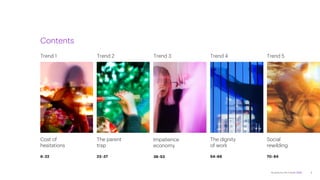



![Accenture Life Trends 2025
Wait, is this real?
The acceleration of generative AI content into all
places where people have traditionally discovered,
socialized and shopped online is causing trust
issues and fueling hesitation. Our Accenture Life
Trends survey indicates 62% of respondents say
trust is an important factor to them when choosing
to engage with a brand, (up from 56% last year).5
If people are going to be able to distinguish
between legitimate and false content, the brands
and creators sharing it might consider ways to
signal authenticity to rebuild trust.
“Personally, I find fake pictures
or videos on the internet very
unacceptable. Even though the
internet is a virtual environment,
virtual does not mean fake.”
YK Zhang, 33, China
Is this information real?
Even content created with harmless intent is
affecting people’s ability to trust what they read
online. Our survey found that 48.6% of people
often or always question the authenticity of the
news.6 It’s becoming harder to distinguish fact
from fiction—to identify what has been written by
a person with relevant credentials and what has
been generated by a well-trained machine.
Organizations producing content for digital
channels are excited about the advancing abilities
of technology for helping them create more of it at
speed. But the critical question many are failing to
ask is: Do people want it?
Further, generative AI models sometimes surface
incorrect or misleading results known as
hallucinations, because the models believe their
own assertions. Causes include inadequate or
biased training data, or incorrect assumptions
made by the model. What should be the next
generation of customer engagement tools are
sometimes making unhelpful suggestions like
putting glue on pizza.7, 8 Of course, this example
is easy to dismiss as absurd, but others are harder
to accurately assess.
Is this product real?
Generative AI is vulnerable to exploitation for
the purpose of misleading people, which is
increasingly muddying the discovery experience.
Computer-generated images often misrepresent
the quality of a product and/or the detail of its
features, sparking social media trends showing,
“What I ordered vs what I got.”9
Is this brand real?
In advertising, bad actors are staging fake podcast
endorsements or using deep-fake videos of
celebrities including Viola Davis to promote
dubious brands.10, 11 One consumer commented on
X, “I keep getting [social media] ads for clothes
that I would absolutely buy and then I google [sic]
the company and they have no online presence
beside a website. […] no way to tell if it’s a
legitimate company or an AI scam tailored to
my exact taste in T-shirts.”12
10
Cost
of
hesitations
The
parent
trap
Impatience
economy
The
dignity
of
work
Social
rewilding
/
/
/
/](https://image.slidesharecdn.com/accenture-lifetrends2025-report-260116041003-63293b92/85/Accenture-Life-Trends-2025-Report-Consulting-Presentation-Example-10-320.jpg)





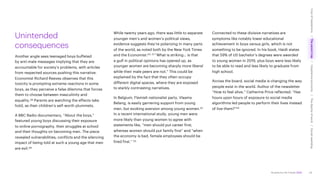
![Accenture Life Trends 2025
Parents’ demand
for change
At the center of this trend is a generation of
parents trapped between the imperative to protect
their children from harmful parts of the internet,
while cutting them off completely would remove
opportunities and the ability to fully live in today’s
society. According to YouGov, 64.7% globally think
parents should limit the time their child(ren)
spend(s) on social media.55
As Peggy Noonan wrote for the Wall Street Journal,
“The truth becomes a cliché before it becomes
actionable. Then a person of high respect, a good-
faith scholar who respects data, say, comes
forward with evidence proving what everyone
knows, and it is galvanizing. […] Jonathan Haidt’s
book has broken through and is clearing the way
for parents’ groups to move forward on an
established idea.”56
Technology firms show a lack of empathy for
parents’ predicament. Flippantly suggesting that
parents simply take smartphones away is unhelpful
at best and insulting at worst. These devices and
platforms were knowingly designed to exploit
people’s innate need for social validation, and their
creators’ attempts are widely perceived not to do
enough to help mitigate the consequences for
young people’s health and well-being. Although,
in September 2024 as a response to feedback from
parents, a global social media platform
implemented teen-focused accounts with more
controls and restrictions around the content young
people can see, who can contact them and limits
the amount of time spent on the app.
“At the end of the day, it’s the
responsibility of the parents.
We are the first line of defense. So,
it would be nice if companies and
governments would do something.”
Azure’de, 38, US
Parents aren’t accepting this anymore. They’re
organizing from the bottom up, while governments
attempt to legislate from the top down. This
matters for brands because public debate around
what it means to grow from child to adult in a
digitally dependent world is already bubbling
and could soon erupt.
Some people may not engage at all, but many will
be watching how companies portray culture, and
how they target children and young people.
Navigating this sensitively is essential for
maintaining trust and relevance in the market.
Nobody cares about something until they suddenly
do—because it affects them. Marketeers and
employers need to be the first to care.
30
Cost
of
hesitations
The
parent
trap
Impatience
economy
The
dignity
of
work
Social
rewilding
/
/
/
/](https://image.slidesharecdn.com/accenture-lifetrends2025-report-260116041003-63293b92/85/Accenture-Life-Trends-2025-Report-Consulting-Presentation-Example-30-320.jpg)

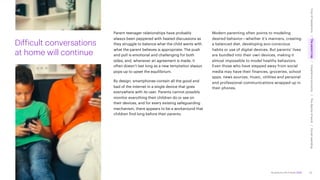

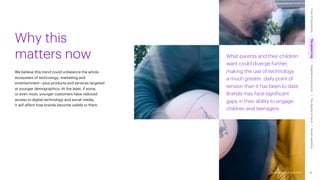



![Accenture Life Trends 2025
Proactive health
and well-being
Proactive health-related behaviors stem from
people’s desire to live as long and strong a life
as possible, and they’re finding new ways to
understand themselves both physically and
mentally. This can prevent or resolve issues, but
risks include unnecessary anxiety or incorrect
treatment. Self-diagnosis is on the rise, driven in
some cases by the cost of seeking medical advice
and in others, by long delays in investigations. In
the United Kingdom, the waitlist to see an autism
specialist has increased fivefold since 2019, as
found by the Nuffield Trust.70
People also seek help from social media, which is
faster than waiting for an appointment, and houses
volumes of advice from people experiencing
similar symptoms. Recognizing one’s own
experience in social content can feel validating
and give people a sense of belonging. However,
it can also lead to self-treatment, which, without
proper supervision, can make problems worse.71
Further, medical professionals sharing generalized
explanations can easily be misunderstood in
situations where case-by-case detail matters.
For fitness advice, middle-aged men are tapping
into approachable content found online. While
some—dubbed “Huberman husbands”—are finding
value in neuroscientist Andrew Huberman’s
layperson-friendly descriptions of well-being
issues, the “quantified self” movement sees others
employing the latest technologies for monitoring
and optimizing their fitness.72, 73
For enhancing performance, the media has
reported that professional women in the US are
increasingly exploring an as yet unsubstantiated
health hack.74 They’re microdosing with
psilocybin—more commonly known as “magic
mushrooms”—to help them focus and manage
their busy lives.
There are risks associated with many of these
approaches. With personal trainers, gym
memberships and alternative health consultants
out of budget for many people, the “cheats” and
“hacks” they try can turn out to be too good to be
true. If the promise is too tempting to resist, some
don’t stop to check the credibility of their source,
leading to disappointment.
“This economy is rough so if I have
a mild symptom of something that
I want to understand, obviously the
internet is my friend. And obviously
there’s [social media] doctors that
give you certain advice.”
Mel, 40, South Africa
42
Cost
of
hesitations
The
parent
trap
Impatience
economy
The
dignity
of
work
Social
rewilding
/
/
/
/](https://image.slidesharecdn.com/accenture-lifetrends2025-report-260116041003-63293b92/85/Accenture-Life-Trends-2025-Report-Consulting-Presentation-Example-42-320.jpg)
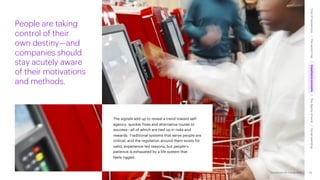
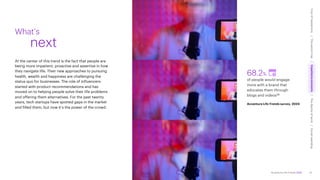
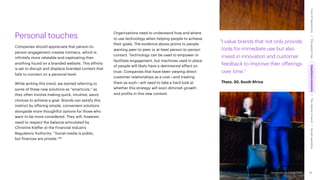
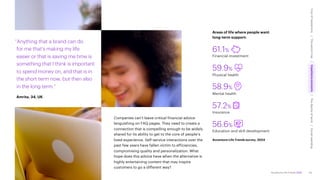





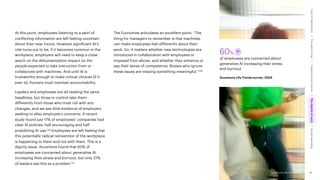

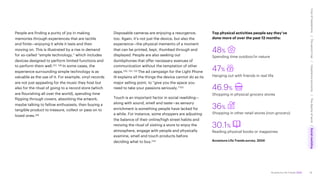
![Accenture Life Trends 2025
Real-world relationships
with the self and others
People are searching for and appreciating deeper
emotional connections with others in the real
world. Those looking for love are starting to step
back from dating apps and find ways to meet
people in more traditional—arguably poetic—ways.
A study by Axios and Generation Lab found that
79% of Gen Z are choosing in-person interactions
over dating apps, with one interviewee saying,
“I don’t want a pen pal.”135
Among survey respondents who are dating in real
life, 62.1% say they’re doing so more over the past
12 months, having switched from online
equivalents.136 This turning of the tide is already
showing up in culture, with the Hollywood
Reporter identifying a trend where new romantic
comedies offer “a return to an imagined time…
where authenticity and spontaneity reign in real-
life interactions.”137
“A moment of sharing, a moment of
laughter, a moment of relaxation.
[...] We laughed, we ate, we danced.
We shared a lot of things. We talked
and it’s moments like that that are
becoming rarer and rarer, but they
make us happy and give us joy.”
Marie, 44, France
Elsewhere, while some still appreciate the
convenience of online fitness classes, others are
fueling a boom in running clubs, which offer an
opportunity to make friends while taking care of
their health.138 In the UK, doctors are increasingly
prescribing social interaction as part of a treatment
plan for those suffering long-term conditions,
complex social needs, low-level mental health
challenges or isolation.139, 140
For self-care, the great outdoors is getting more
attention as people rediscover the value of
spending time in nature for improving mental
well-being, creativity, physical health and
longevity.141, 142 Some take things further, and get
a great deal of personal enrichment out of growing
and nurturing new life. As Dana G Smith wrote for
the New York Times, “gardening is a workout,
meditation and opportunity to socialize with my
neighbors all rolled into one.”143
There’s also been a worldwide surge of interest in
hand-crafting activities like pottery.144 For hobbies
like this, it’s not possible to divide attention
between a lump of clay and a screen, so people
enjoy a luxurious opportunity to focus just on one
thing for a while.
75
Cost
of
hesitations
The
parent
trap
Impatience
economy
The
dignity
of
work
Social
rewilding
/
/
/
/](https://image.slidesharecdn.com/accenture-lifetrends2025-report-260116041003-63293b92/85/Accenture-Life-Trends-2025-Report-Consulting-Presentation-Example-75-320.jpg)