How to write your synopsis
DR MARYAM ALAM KHAN
SURGICAL E WARD
KHYBER TEACHING HOSPITAL
Key components
 Timing
 Choosing a topic according to CPSP rules
 Literature review
 Sample size
 Synopsis writing
 References
TIMING
 1st year of training/ take workshop and start off
 Submit it in 2nd year before IMM
 Collect data in 3rd year
 Write dissertation in 4th year
 Submit a few months before your training ends
What is a synopsis and its components
 The synopsis is a brief out line (about four A-4 size pages or 1000 words is the
maximum limit) of your future work.
 TITILE
 INTRODUCTION
 OBJECTIVES
 HYPOTHESIS
 METHODS AND MATERIALS
 OPERATIONAL DEFINITION
 DATA COLLECTION PROCEDURE
 DATA ANALYSIS
 REFERENCES
TOPIC
 Should reflect the objectives of the study. It must be written after the whole synopsis has been written so that it is a
true representative of the plan (i.e. the synopsis).
 CPSP RULE:
 Not be studied in last 5 years in Peshawar
 Should not be original ….!
 Should not be cross sectional/ community based; they prefer RCT’s
 Should be very relevant to your speciality
 E.G:
“COMPARISON OF FREQUENCY OF SEROMA FORMATION IN FLAP FIXATION VS CONVENTIONAL CLOSURE AFTER
MODIFIED RADICAL MASTECTOMY AND AXILLARY CLEARANCE”
LITERATURE REVEIW
 Find an exactly similar research done elsewhere within 5 years
 If there are many, find the one with most significant results
 Use this to calculate sample size
 GOOGLE SCHOLAR: MESH KEY WORDS
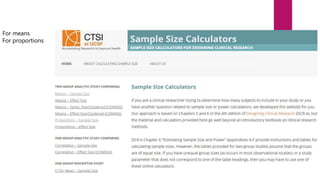
 SAMPLE SIZE CALCULATOR
For means
For proportions
 CONFIDENCE INTERVAL 95%
 MARGIN OF ERROR 7%
 POWER OF STUDY 80%
In RCT You need means +-SD or you need proportions
INTRODUCTION!
Generalized statements to more specific statements
Global statistics
Local /regional statistics
Risk factors? Causes? Types of treatments/ surgeries
Discuss the method u will be using
Mention 2/3 articles
rationale
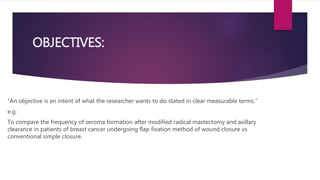
OBJECTIVES:
“An objective is an intent of what the researcher wants to do stated in clear measurable terms.”
e.g:
To compare the frequency of seroma formation after modified radical mastectomy and axillary
clearance in patients of breast cancer undergoing flap fixation method of wound closure vs
conventional simple closure.
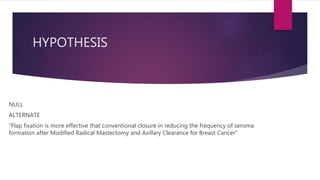
HYPOTHESIS
NULL
ALTERNATE
“Flap fixation is more effective that conventional closure in reducing the frequency of seroma
formation after Modified Radical Mastectomy and Axillary Clearance for Breast Cancer”
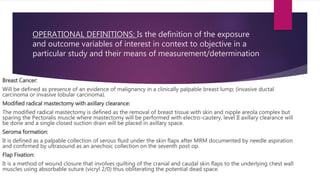
OPERATIONAL DEFINITIONS: Is the definition of the exposure
and outcome variables of interest in context to objective in a
particular study and their means of measurement/determination
Breast Cancer:
Will be defined as presence of an evidence of malignancy in a clinically palpable breast lump; (invasive ductal
carcinoma or invasive lobular carcinoma).
Modified radical mastectomy with axillary clearance:
The modified radical mastectomy is defined as the removal of breast tissue with skin and nipple areola complex but
sparing the Pectoralis muscle where mastectomy will be performed with electro-cautery, level II axillary clearance will
be done and a single closed suction drain will be placed in axillary space.
Seroma formation:
It is defined as a palpable collection of serous fluid under the skin flaps after MRM documented by needle aspiration
and confirmed by ultrasound as an anechoic collection on the seventh post op.
Flap Fixation:
It is a method of wound closure that involves quilting of the cranial and caudal skin flaps to the underlying chest wall
muscles using absorbable suture (vicryl 2/0) thus obliterating the potential dead space.
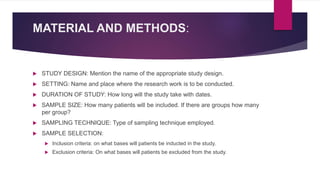
MATERIAL AND METHODS:
 STUDY DESIGN: Mention the name of the appropriate study design.
 SETTING: Name and place where the research work is to be conducted.
 DURATION OF STUDY: How long will the study take with dates.
 SAMPLE SIZE: How many patients will be included. If there are groups how many
per group?
 SAMPLING TECHNIQUE: Type of sampling technique employed.
 SAMPLE SELECTION:
 Inclusion criteria: on what bases will patients be inducted in the study.
 Exclusion criteria: On what bases will patients be excluded from the study.
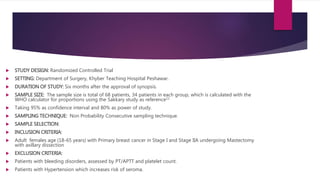
 STUDY DESIGN: Randomized Controlled Trial
 SETTING: Department of Surgery, Khyber Teaching Hospital Peshawar.
 DURATION OF STUDY: Six months after the approval of synopsis.
 SAMPLE SIZE: The sample size is total of 68 patients, 34 patients in each group, which is calculated with the
WHO calculator for proportions using the Sakkary study as reference11
 Taking 95% as confidence interval and 80% as power of study.
 SAMPLING TECHNIQUE: Non Probability Consecutive sampling technique.
 SAMPLE SELECTION:
 INCLUSION CRITERIA:
 Adult females age (18-65 years) with Primary breast cancer in Stage I and Stage IIA undergoing Mastectomy
with axillary dissection
 EXCLUSION CRITERIA:
 Patients with bleeding disorders, assessed by PT/APTT and platelet count.
 Patients with Hypertension which increases risk of seroma.
DATA COLLECTION
 Data about demographic , clinical, Operative variables and postoperative variables.
 will be collected from the patients fulfilling inclusion and exclusion criteria and entered
on pre-tested questionnaire (attached).
 Informed consent will be taken and the patient will be assured that their data will be
kept confidential.
 The study will include randomly selected patients assigned groups by lottery method.
 What will you do in each group
 What will you measure
 When will you do follow up and what will you look for
DATA ANALYSIS
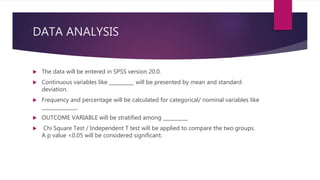
 The data will be entered in SPSS version 20.0.
 Continuous variables like __________ will be presented by mean and standard
deviation.
 Frequency and percentage will be calculated for categorical/ nominal variables like
______________.
 OUTCOME VARIABLE will be stratified among __________
 Chi Square Test / Independent T test will be applied to compare the two groups.
A p value <0.05 will be considered significant.
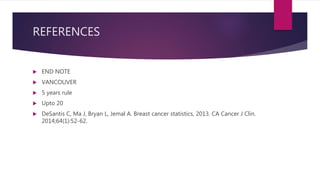
REFERENCES
 END NOTE
 VANCOUVER
 5 years rule
 Upto 20
 DeSantis C, Ma J, Bryan L, Jemal A. Breast cancer statistics, 2013. CA Cancer J Clin.
2014;64(1):52-62.
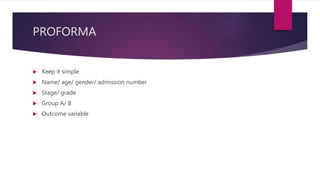
PROFORMA
 Keep it simple
 Name/ age/ gender/ admission number
 Stage/ grade
 Group A/ B
 Outcome variable
DATA COLLECTION
 NAME / AGE/ GENDER / GROUP A/B
 PRE OPERATIVE VARIABLES
 INTRAOPERATIVE
 POST OPERATIVE
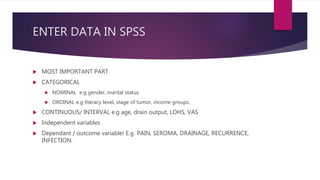
ENTER DATA IN SPSS
 MOST IMPORTANT PART
 CATEGORICAL
 NOMINAL e.g gender, marital status
 ORDINAL e.g literacy level, stage of tumor, income groups,
 CONTINUOUS/ INTERVAL e.g age, drain output, LOHS, VAS
 Independent variables
 Dependant / outcome variable! E.g PAIN, SEROMA, DRAINAGE, RECURRENCE,
INFECTION.
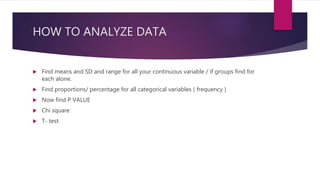
HOW TO ANALYZE DATA
 Find means and SD and range for all your continuous variable / if groups find for
each alone.
 Find proportions/ percentage for all categorical variables ( frequency )
 Now find P VALUE
 Chi square
 T- test
QUESTIONS?!

How to write your synopsis

  • 1.
    How to writeyour synopsis DR MARYAM ALAM KHAN SURGICAL E WARD KHYBER TEACHING HOSPITAL
  • 2.
    Key components  Timing Choosing a topic according to CPSP rules  Literature review  Sample size  Synopsis writing  References
  • 3.
    TIMING  1st yearof training/ take workshop and start off  Submit it in 2nd year before IMM  Collect data in 3rd year  Write dissertation in 4th year  Submit a few months before your training ends
  • 4.
    What is asynopsis and its components  The synopsis is a brief out line (about four A-4 size pages or 1000 words is the maximum limit) of your future work.  TITILE  INTRODUCTION  OBJECTIVES  HYPOTHESIS  METHODS AND MATERIALS  OPERATIONAL DEFINITION  DATA COLLECTION PROCEDURE  DATA ANALYSIS  REFERENCES
  • 5.
    TOPIC  Should reflectthe objectives of the study. It must be written after the whole synopsis has been written so that it is a true representative of the plan (i.e. the synopsis).  CPSP RULE:  Not be studied in last 5 years in Peshawar  Should not be original ….!  Should not be cross sectional/ community based; they prefer RCT’s  Should be very relevant to your speciality  E.G: “COMPARISON OF FREQUENCY OF SEROMA FORMATION IN FLAP FIXATION VS CONVENTIONAL CLOSURE AFTER MODIFIED RADICAL MASTECTOMY AND AXILLARY CLEARANCE”
  • 6.
    LITERATURE REVEIW  Findan exactly similar research done elsewhere within 5 years  If there are many, find the one with most significant results  Use this to calculate sample size  GOOGLE SCHOLAR: MESH KEY WORDS  SAMPLE SIZE CALCULATOR
  • 8.
  • 9.
     CONFIDENCE INTERVAL95%  MARGIN OF ERROR 7%  POWER OF STUDY 80% In RCT You need means +-SD or you need proportions
  • 10.
    INTRODUCTION! Generalized statements tomore specific statements Global statistics Local /regional statistics Risk factors? Causes? Types of treatments/ surgeries Discuss the method u will be using Mention 2/3 articles rationale
  • 11.
    OBJECTIVES: “An objective isan intent of what the researcher wants to do stated in clear measurable terms.” e.g: To compare the frequency of seroma formation after modified radical mastectomy and axillary clearance in patients of breast cancer undergoing flap fixation method of wound closure vs conventional simple closure.
  • 12.
    HYPOTHESIS NULL ALTERNATE “Flap fixation ismore effective that conventional closure in reducing the frequency of seroma formation after Modified Radical Mastectomy and Axillary Clearance for Breast Cancer”
  • 13.
    OPERATIONAL DEFINITIONS: Isthe definition of the exposure and outcome variables of interest in context to objective in a particular study and their means of measurement/determination Breast Cancer: Will be defined as presence of an evidence of malignancy in a clinically palpable breast lump; (invasive ductal carcinoma or invasive lobular carcinoma). Modified radical mastectomy with axillary clearance: The modified radical mastectomy is defined as the removal of breast tissue with skin and nipple areola complex but sparing the Pectoralis muscle where mastectomy will be performed with electro-cautery, level II axillary clearance will be done and a single closed suction drain will be placed in axillary space. Seroma formation: It is defined as a palpable collection of serous fluid under the skin flaps after MRM documented by needle aspiration and confirmed by ultrasound as an anechoic collection on the seventh post op. Flap Fixation: It is a method of wound closure that involves quilting of the cranial and caudal skin flaps to the underlying chest wall muscles using absorbable suture (vicryl 2/0) thus obliterating the potential dead space.
  • 14.
    MATERIAL AND METHODS: STUDY DESIGN: Mention the name of the appropriate study design.  SETTING: Name and place where the research work is to be conducted.  DURATION OF STUDY: How long will the study take with dates.  SAMPLE SIZE: How many patients will be included. If there are groups how many per group?  SAMPLING TECHNIQUE: Type of sampling technique employed.  SAMPLE SELECTION:  Inclusion criteria: on what bases will patients be inducted in the study.  Exclusion criteria: On what bases will patients be excluded from the study.
  • 15.
     STUDY DESIGN:Randomized Controlled Trial  SETTING: Department of Surgery, Khyber Teaching Hospital Peshawar.  DURATION OF STUDY: Six months after the approval of synopsis.  SAMPLE SIZE: The sample size is total of 68 patients, 34 patients in each group, which is calculated with the WHO calculator for proportions using the Sakkary study as reference11  Taking 95% as confidence interval and 80% as power of study.  SAMPLING TECHNIQUE: Non Probability Consecutive sampling technique.  SAMPLE SELECTION:  INCLUSION CRITERIA:  Adult females age (18-65 years) with Primary breast cancer in Stage I and Stage IIA undergoing Mastectomy with axillary dissection  EXCLUSION CRITERIA:  Patients with bleeding disorders, assessed by PT/APTT and platelet count.  Patients with Hypertension which increases risk of seroma.
  • 16.
    DATA COLLECTION  Dataabout demographic , clinical, Operative variables and postoperative variables.  will be collected from the patients fulfilling inclusion and exclusion criteria and entered on pre-tested questionnaire (attached).  Informed consent will be taken and the patient will be assured that their data will be kept confidential.  The study will include randomly selected patients assigned groups by lottery method.  What will you do in each group  What will you measure  When will you do follow up and what will you look for
  • 17.
    DATA ANALYSIS  Thedata will be entered in SPSS version 20.0.  Continuous variables like __________ will be presented by mean and standard deviation.  Frequency and percentage will be calculated for categorical/ nominal variables like ______________.  OUTCOME VARIABLE will be stratified among __________  Chi Square Test / Independent T test will be applied to compare the two groups. A p value <0.05 will be considered significant.
  • 18.
    REFERENCES  END NOTE VANCOUVER  5 years rule  Upto 20  DeSantis C, Ma J, Bryan L, Jemal A. Breast cancer statistics, 2013. CA Cancer J Clin. 2014;64(1):52-62.
  • 19.
    PROFORMA  Keep itsimple  Name/ age/ gender/ admission number  Stage/ grade  Group A/ B  Outcome variable
  • 20.
    DATA COLLECTION  NAME/ AGE/ GENDER / GROUP A/B  PRE OPERATIVE VARIABLES  INTRAOPERATIVE  POST OPERATIVE
  • 21.
    ENTER DATA INSPSS  MOST IMPORTANT PART  CATEGORICAL  NOMINAL e.g gender, marital status  ORDINAL e.g literacy level, stage of tumor, income groups,  CONTINUOUS/ INTERVAL e.g age, drain output, LOHS, VAS  Independent variables  Dependant / outcome variable! E.g PAIN, SEROMA, DRAINAGE, RECURRENCE, INFECTION.
  • 22.
    HOW TO ANALYZEDATA  Find means and SD and range for all your continuous variable / if groups find for each alone.  Find proportions/ percentage for all categorical variables ( frequency )  Now find P VALUE  Chi square  T- test
  • 23.