

This document discusses communicating research findings. It states that research is not complete until findings are shared with others. There are various written and verbal methods for communicating research, including theses, journal articles, presentations, and posters. When communicating research, authors should select their audience, method of communication, avoid jargon, and prepare systematically. The document then provides details on writing theses and journal articles, as well as giving oral and poster presentations. It emphasizes the importance of clearly presenting research in an easy to understand way.
“Research not publishedis research not
done”
Research is not complete unless it is
written up and the findings have been
communicated to others.
Communication of research findings is the
final and one of the most important steps of
research process.
3.
Research communication isdefined as the
process of interpreting or translating
complex research findings into a language,
format and context that non expert can
understand.
4.
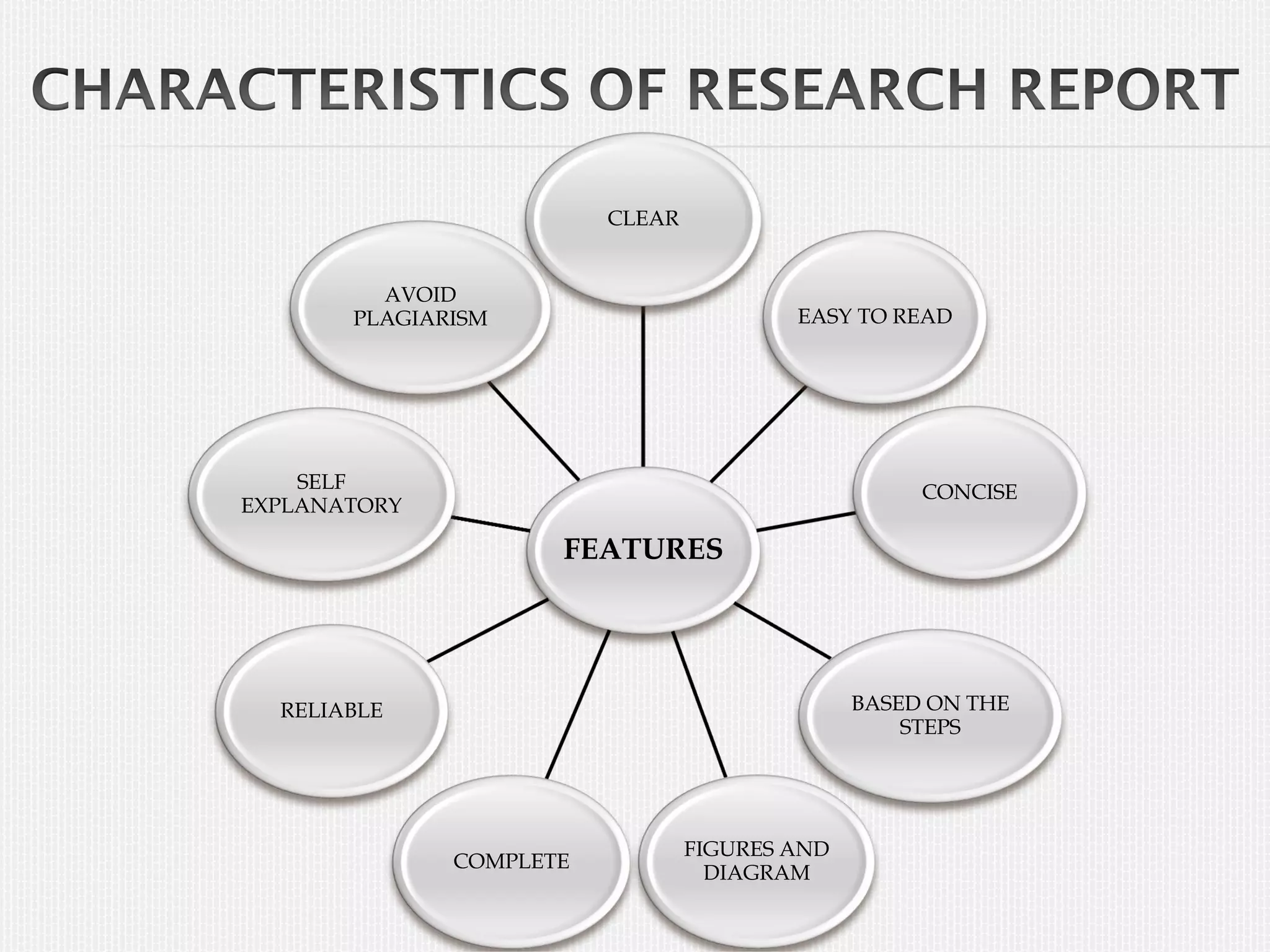
Select theaudience.
Select method of communication.
Avoid technical jargons.
Do not overload presentation.
Prepare systematically.
Effective writing.
5.
COMMUNICATION OF RESEARCHFINDINGS
WRITTEN
THESIS
JOURNAL
ARTICLE
VERBAL / ORAL
PLATFORM
PRESENTATION
POSTER
PRESENTATION
• It isa formal written account of a study from
its inception to its conclusions and
recommendations.
• These findings can be utilized for replication,
for review of literature or for planning a new
study.
• The thesis is read by limited number of
people who are interested in a particular
topic.
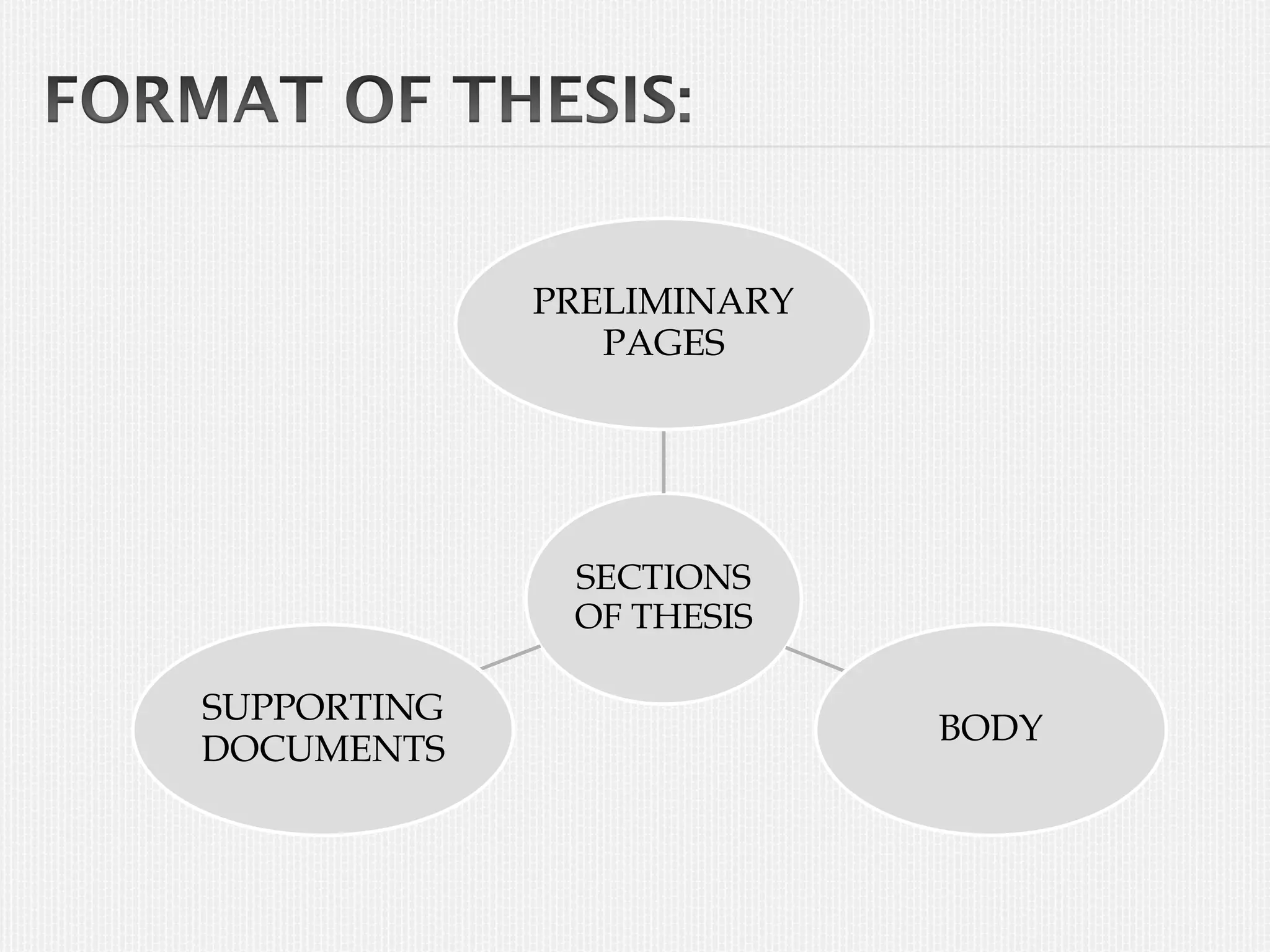
It includes:
Thetitle / cover page
Certificate from the guides and principal
Dedication page (optional)
Acknowledgement page (optional)
Table of contents
List of tables and figures
Abbreviation page
Abstract including keywords
10.
It includes chapterson (IMRaD)
Introduction
Review of literature
Methodology
Results
Discussion
Summary, conclusion, implications and
recommendations.
11.
It includes:
Thereferences
The appendices
The length of the thesis varies as per the
program and university policy.
o Master’s degree – 25,000 words
o Doctoral thesis – 100,000 words
12.
FONT: TimesNew Roman
FONT SIZE:
Title of chapter : 18 – 24, bold
Main section headings : 14, bold
Second headings : 12, bold
Subheadings : 12, regular
Second subheadings : 12, italics
Text : 12
13.
SPACING: oneand a half spacing for the
text. Table and figure captions may be single
spaced.
MARGINS: Left 4cm; top, bottom and right
2.5cm (binding and trimming)
PAGE NUMBERING:
Preliminary pages to be numbered in Roman
numerals.
Chapters to be numbered in arabic numbers.
Page numbers should be placed in the lower
right corner or centre of the page. Only numbers
should be mentioned.
14.
TABLES ANDFIGURES: Tables and figures
should be inserted at the appropriate places
in the text. Figures must have numbers and
captions under the figures. Tables have their
titles and numbers above the table.
CDs and DVDs (if any): These should be
identified with title, name of student and
date.
15.
One ofthe main vehicles by which research
findings are communicated is through
articles published in professional journals.
A scientific paper is a written report
describing original research results.
Through publication, the findings can guide
policy makers and program planners to see
where modifications are required.
It increases the researcher’s own confidence
of writing.
17.
It shall containtitle, abstract,
introduction, methods, results, discussion,
conclusion and references (usually IMRaD).
TITLE
It must have five components such as
title, author’s name, institutional affiliation,
running head and author’s note.
Title: It is a clear, concise statement of the main
topic. It should be self explanatory with 10
– 15 words and without abbreviations.
18.
Author and institutionalaffiliation:
Author’s name and the highlights of when
and where the author conducted the
research.
Running head:
Abbreviated form of title printed at top of all
pages and shall have 50 characters or less
including letters, punctuation and spaces.
Author notes:
Additional information about affiliation,
acknowledgements, disclaimers, etc.
19.
ABSTRACT:
- It isa brief and comprehensive summary of
the contents of the research work with 150 –
250 words.
- The components are introduction,
background of study, research objectives,
methods, results and conclusion.
- Keywords (3 – 5) must be mentioned in
italics.
20.
INTRODUCTION:
- It shouldbe logical, coherent and
descriptive with 300 – 500 words.
- It should include statement of problem
with the objectives and hypothesis.
- Some journals may require the depiction of
conceptual framework.
- The introduction should begin broadly and
progressing to specific problems.
21.
METHODS:
- This sectiondescribes in detail about
material and methods used to complete the
research study.
- This includes design, population, setting,
duration, sampling technique, sample size,
variables in the study and analytical and
statistical procedures.
- This helps the reader to evaluate credibility
and worth of the study.
22.
RESULT:
- This sectionis considered as heart of the
research report.
- This summarizes the results of the
statistical or qualitative analysis performed
on the data.
- This can include tables and figures that
depict the research findings.
23.
DISCUSSION:
- It isa core aspect of report writing where
the researcher should summarize the main
findings with the objectives, hypothesis,
review of literature and conceptual
framework.
- The hypothesis and its acceptance or
rejection should be discussed based on the
statistical value.
- The summary of findings should be brief as
the main focus of discussion is on inferring
the findings.
24.
CONCLUSION:
- It mustbe clear, comprehensive, concise,
written in informative and interesting way
to sum up the total work of research.
REFERENCES:
- A list of sources must appear in the
reference list.
- Most of the journals require the references
to be written in Vancouver style and
numbered in superscript at the end of the
completion of sentence.
25.
ACKNOWLEDGEMENT:
- The peoplewho helped in research process
but does not fulfil the criteria of authorship
should be recognized in acknowledgement
list.
- These may be people like authority who
gave permission for study, statistician and
data collectors.
26.
CHECKLIST:
- A fewjournals require the completion of an
author checklist.
- The checklist may contain information
regarding copyright form, keywords, ethical
permission, instruments permission letter,
etc.
27.
The researchresults are communicated to
peers and others through oral (platform or
poster) presentation by the researcher.
The presentation is commonly done in Faculty
Development Program, Seminar, Workshop,
Symposium, etc.
Most conferences require presenter to submit
abstract (250 – 300 words) of research report
containing purposes, research questions,
hypothesis, design, methodology, major
findings and conclusion.
28.
o During oralpresentation, presenter is asked
to present the report within stipulated time
period (10 – 15 minutes including
discussion).
o The discussion can be a good opportunity for
presenter and audiences to improve the
depth understanding regarding certain
aspects of research report.
29.
A posteris a static, visual medium
containing text, graphics, tables and photos
that synoptically present each phase of the
research in storyboard layout.
The poster are prepared aesthetically to
attract the audience to view it.
Usually it is allowed to be presented
informally to the interested observers.
30.
The instructionsregarding the size of the
poster (usual size is 4x8), type of display area
provided and other specific criteria regarding
the contents of the display, etc are given by
the organizers of the conferences.
It is better to have the background of light
colour and coloured boxes to emphasize the
text and graphics.
There should be self explanatory graphics
and tables.
31.
The textshould be minimum.
Use short sentences and avoid jargons,
acronyms and unusual abbreviations.
There should be 30% text, 50% graphics and
20% empty space.
Empty space should be between different
parts of the poster to differentiate and to put
emphasize on these parts.
The graphic materials and written portion
should be visible from at least 6 feet distance.
32.
It isa poster in power point format and the
presenters share their respective topic of
presentation in 3-4 slides.
These posters are displayed digitally in the
conferences.
We can use multiple audio, video, enlarged
graphics, hyperlinks while presenting
e-poster.
33.
1. 9 P’s(Prior Proper Preparation Prevents Poor
Performance of the Person Putting on
presentation).
2. Know the room and audience.
3. Relax and give attention to the presentation and
audience.
4. Vary the tone of voice and avoid speaking
hurriedly.
5. Avoid doing distracting things like mannerism.
6. Be mobile with smile and eye contact with
audience.
INTRODUCTION
Critical appraisal isa systematic process used
to identify the strengths and weaknesses of a
research in order to assess the usefulness and
validity of research findings.
A good critique identifies areas of adequacy
and inadequacy in an unbiased manner.
Research critique should not confuse with
criticism which only looks for limitations. It is an
intellectual critique to evaluate limitations and
strengths of a research work.
36.
DEFINITION
Critiquing is asystematic method of
appraising the strengths and limitations of
a piece of research in order to determine
its credibility and its applicability to
practice.
- Valente, 2003
37.
PURPOSES
To identifythe flaws and limitations and therefore expand
the own body of knowledge about the topic, area and
process of research.
Gives an idea about the level of research understanding of
the person who completed the work.
Helps the investigator to improve upon the deficit areas of
a research.
Recommend appropriate suggestions to improve the
research.
Enhance the novice nurse researcher’s critical thinking
skills.
Explore the alternative approaches to solve the problems.
RESEARCH CRITIQUE
TITLE:
It mustbe self explanatory, concise and short (10
– 15 words) and must answer what, when, where
(key variables and study population) and key
words.
AUTHORS:
Authors must mention their qualification,
affiliation and details about the principal
investigator and co investigator.
41.
CONTD.,
ABSTRACT:
- Should clearlyand concisely summarize the main
features of the report such as introduction,
objectives, material and methods, results,
conclusion, and key words.
- Abstract must be precise and must have 150 – 250
words.
INTRODUCTION:
- Must include statement of problem, background of
study, objectives, hypothesis, significance of study
with recent references as well as conceptual and
theoretical framework.
42.
CONTD.,
OBJECTIVES AND HYPOTHESES:
-Objectives should be written clearly following
the SMART criteria.
- Hypotheses should be appropriately worded
with clear specification of key variables and study
population.
LITERATURE REVIEW:
- Review should be organized systematically and
up-to-date.
43.
CONTD.,
CONCEPTUAL/THEORETICALFRAMEWORK:
- The keyconcepts should be adequately defined
and the framework should be appropriate.
PROTECTION OF HUMAN RIGHTS:
- The procedures should safeguard the rights of
study participants and should be externally reviewed
by ethics review board.
44.
CONTD.,
RESEARCH DESIGN:
- Thedesign should minimize the biases and threats
to the internal and external validity of the study.
POPULATION AND SAMPLE:
- The sampling design and sample size should be
adequate to enhance the sample’s representativeness.
45.
CONTD.,
DATA COLLECTION ANDMEASUREMENT:
- The instrument should be specific and measure the
variables using appropriate method.
DATAANALYSIS:
- Appropriate statistical methods should be used.
- Errors should be minimized.
- Information about statistical significance should be
presented.
46.
CONTD.,
DISCUSSION:
- The majorfindings should be interpreted and
discussed within the context of prior research.
- The report should address the issue of the
generalizability of the findings.
IMPLICATIONS AND RECOMMENDATIONS:
- Reasonable and complete implications should be
discussed.
47.
CONTD.,
CONCLUSION:
- Clear andconcise conclusion should be written in
informative, interesting manner and a new
perspective should be demonstrated.
REFERENCES:
- References should be written in vancouver style
and numbered superscript at the end of completion
of sentence.
49.
One of theimportant goals of research is
to generate new knowledge and establish an
evidence base within the profession. The
need for quality patient outcomes and cost
effective care has made it essential that
nurses base their practice on research
evidence. However, despite an increase in
research output, utilizing research evidence
by nurses in clinical setting remains a
challenge.
50.
Research utilization refersto the review
and critique of scientific research and then
the application of the findings to the clinical
practice. - ESTABROOKS, 1998
The process of synthesizing,
disseminating and using research generated
knowledge to make an impact on or a change
in the existing practices in the society.
- BURNS and GROVE, 2005
51.
Development ofspecialized research
department / wing.
Design educational program before
implementing research utilization concept.
Develop reward system for nurses.
Organize continuing education events.
Administrative support.
Open communication channels.
Change the attitude to welcome research in
practice.
Lack ofknowledge about the scientific
research process.
Lack of interest of higher authority to
change or adopt new practices.
Lack of supportive colleagues.
Lack of knowledge of technical language.
Overwhelming patient load.
Lack of time to do quality research.
54.
Lack ofrecognition in terms of salary,
incentive and promotion.
Lack of resources.
Apathy of nurse administrator towards
novel ideas.
Lack of decentralization and formalization in
an organization.
55.
Lack ofknowledge about scientific research
process.
Lack of knowledge on statistical analysis
and tests.
Lack of knowledge in writing research
report.
Inability to organize voluminous amount of
information.
Lack of resources related to publication and
literature.
56.
Lack ofcommunication skills to higher
authorities like administrator, research
committee, funding agencies, etc.
Long standing time for acceptance of
manuscript.
Inadequate knowledge about method of
research communication.