Research Report
@ Dr. K. Thiyagu 1Dr. K. Thiyagu, AssistantProfessor,Departmentof Education, CentralUniversity of Kerala, Kasaragod, Kerala
“Research report is a research document that
contains basic aspects of the research project”.
@ Dr. K. Thiyagu 2
Research Report Format
A. Preliminary Section
B. Main Section
C. Reference Section
[adapted from: John W. Best, Research in Education, 2nd ed.,
(Englewood Cliffs, NJ: Prentice-Hall, 1970)].
@ Dr. K. Thiyagu 3
A. Preliminary Section
@ Dr. K. Thiyagu 4
A. Preliminary Section
• Cover Page
• Title Page
• Certificate
• Declaration
• Acknowledgments (if any)
• Table of Contents / Index
• List of Tables (if any)
• List of Figures (if any)
• Abbreviations
• Abstract / Summary Report
@ Dr. K. Thiyagu 5
B. Main Section
@ Dr. K. Thiyagu 6
Chapter 1: Introduction /
Conceptual Framework
• Conceptual framework of the study
• Need and Significance of the Problem
• Purpose or score of the study
• Statement of the Problem
• Definition of Terms
• Objectives of the study
• Hypotheses of the study
• Assumptions
• Limitations / delimitations
• Chapterization
@ Dr. K. Thiyagu 7
Chapter 2:
Review of Related
Literature / Studies
• Studies related to foreign
• Studies related in India
• Critical Review
• Gap Identified
@ Dr. K. Thiyagu 8
Chapter 3:
Design of the Study /
Methodology
• Description of Research Design
• Population and sample
• Sampling Procedures
• Sources of Data
• Tools / instruments used
Pilot study
Item analysis
Reliability
validity
• Date gathering
• Statistical Treatment
@ Dr. K. Thiyagu 9
Chapter 4:
Analysis of Data /
Data Analysis
• Descriptive statistics
• Differential statistics
• Text with appropriate
• Tables and
• Figures
@ Dr. K. Thiyagu 10
Chapter 5:
Summary and Conclusions
• Restatement of the Problem
• Description of Procedures
• Major Findings (reject or fail to reject Ho)
• Interpretation
• Discussion
• Conclusions
• Recommendations for Further Investigation
@ Dr. K. Thiyagu 11
C. Reference Section
@ Dr. K. Thiyagu 12
C. Reference Section
• End Notes (if in that format of citation)
• Bibliography or Literature Cited or References
• Appendix / Appendices
A copy of questionnaire
Detail of sampling and rate of response
Photos of data collection
Master table / master matrix
Statement of expenses
@ Dr. K. Thiyagu 13
Pagination
Format
@ Dr. K. Thiyagu 14
Paper
A4 Sheet: 8.27’’ x 11.69’’
Letter: 8.5 x 11"
@ Dr. K. Thiyagu 15
Page Margins
Research Paper:
 1" on all sides (top, bottom, left, right)
Research Report:
 Top – 1”
 Bottom – 1”
 Left – 1.25 to 1.4”
 Right – 1.2 to 1.25”
@ Dr. K. Thiyagu 16
Font
Text:
 Times Roman
 Courier.
Tables and Figures:
 sans serif
 Arial.
@ Dr. K. Thiyagu 17
Font Size
12 Point Times New Roman
@ Dr. K. Thiyagu 18
@ Dr. K. Thiyagu 19
Alignment
Justified
@ Dr. K. Thiyagu 20
Paragraph Indentation
5–7 spaces
Ms word: Click page layout, indent
@ Dr. K. Thiyagu 21
Binding
Hard Board
Binding
@ Dr. K. Thiyagu 22
@ Dr. K. Thiyagu 23
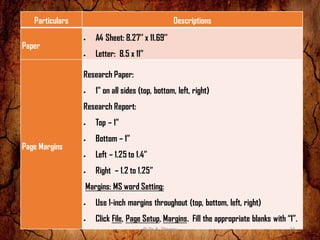
Particulars Descriptions
Paper
 A4 Sheet: 8.27’’ x 11.69’’
 Letter: 8.5 x 11"
Page Margins
Research Paper:
 1" on all sides (top, bottom, left, right)
Research Report:
 Top – 1”
 Bottom – 1”
 Left – 1.25 to 1.4”
 Right – 1.2 to 1.25”
Margins: MS word Setting:
 Use 1-inch margins throughout (top, bottom, left, right)
 Click File, Page Setup, Margins. Fill the appropriate blanks with “1”.
@ Dr. K. Thiyagu 24
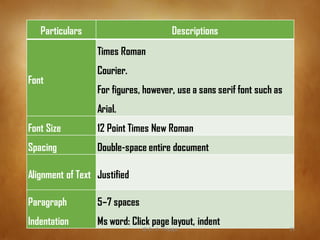
Particulars Descriptions
Font
Times Roman
Courier.
For figures, however, use a sans serif font such as
Arial.
Font Size 12 Point Times New Roman
Spacing Double-space entire document
Alignment of Text Justified
Paragraph
Indentation
5–7 spaces
Ms word: Click page layout, indent
@ Dr. K. Thiyagu 25
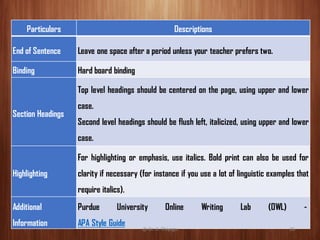
Particulars Descriptions
End of Sentence Leave one space after a period unless your teacher prefers two.
Binding Hard board binding
Section Headings
Top level headings should be centered on the page, using upper and lower
case.
Second level headings should be flush left, italicized, using upper and lower
case.
Highlighting
For highlighting or emphasis, use italics. Bold print can also be used for
clarity if necessary (for instance if you use a lot of linguistic examples that
require italics).
Additional
Information
Purdue University Online Writing Lab (OWL) -
APA Style Guide
@ Dr. K. Thiyagu 26
FIGURES
TABLES GRAPHS
@ Dr. K. Thiyagu 27
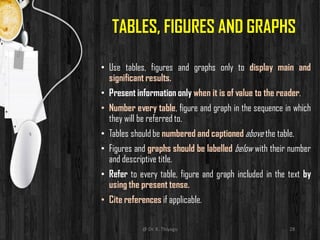
TABLES, FIGURES AND GRAPHS
• Use tables, figures and graphs only to display main and
significant results.
• Present information only when it is of value to the reader.
• Number every table, figure and graph in the sequence in which
they will be referred to.
• Tables should be numbered and captioned above the table.
• Figures and graphs should be labelled below with their number
and descriptive title.
• Refer to every table, figure and graph included in the text by
using the present tense.
• Cite references if applicable.
@ Dr. K. Thiyagu 28
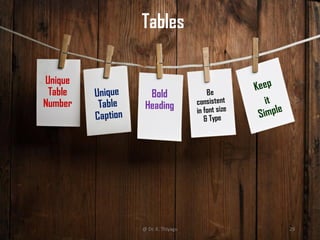
Tables
Unique
Table
Number
Bold
Heading
@ Dr. K. Thiyagu 29
Graphs
• Unique Graph Number
• Unique Caption
• Label Axes
• Label Units
• Label Scale
• Label Parameters
@ Dr. K. Thiyagu 30
Writing Style in Research Reporting /
Academic Writing
@ Dr. K. Thiyagu 31
WRITING STYLE
• A scientific paper is a formal
text written in an
impersonal, objective,
neutral and professional
way.
• The writing is concise with
specific wordings and
formulations. The
writing should be clear as
well and lead to a deeper
understanding of the subject.
@ Dr. K. Thiyagu 32
Avoid colloquial or informal language
• Eliminate all 'filler' and needless words.
• Biased language is not acceptable in academic writing.
@ Dr. K. Thiyagu 33
Avoid personal or familiar language
• Do not directly address the reader and do not ask rhetorical
questions.
• Remember that the use of personal pronouns (I, You, me,
him, her, us etc) does not fit into an objective, scientific
paper. @ Dr. K. Thiyagu 34
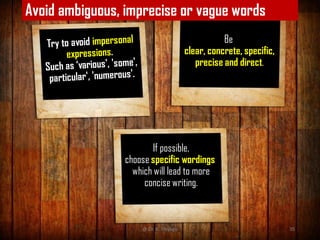
Avoid ambiguous, imprecise or vague words
Be
clear, concrete, specific,
precise and direct.
If possible,
choose specific wordings
which will lead to more
concise writing.
@ Dr. K. Thiyagu 35
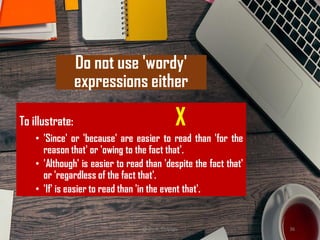
Do not use 'wordy'
expressions either
To illustrate: X
• 'Since' or 'because' are easier to read than 'for the
reason that' or 'owing to the fact that'.
• 'Although' is easier to read than 'despite the fact that'
or 'regardless of the fact that'.
• 'If' is easier to read than 'in the event that'.
@ Dr. K. Thiyagu 36
Abbreviations and
Contractions
• Limit the use of abbreviations in
academic writing. Explain the
abbreviations you are using.
• Avoid contractions such as 'doesn't',
'haven't'. Always write full forms.
@ Dr. K. Thiyagu 37
Written Language
• Scientific Papers should be
written with correct
grammar, spelling and
punctuation.
@ Dr. K. Thiyagu 38
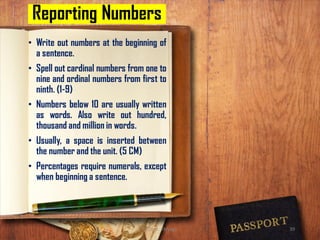
Reporting Numbers
• Write out numbers at the beginning of
a sentence.
• Spell out cardinal numbers from one to
nine and ordinal numbers from first to
ninth. (1-9)
• Numbers below 10 are usually written
as words. Also write out hundred,
thousand and million in words.
• Usually, a space is inserted between
the number and the unit. (5 CM)
• Percentages require numerals, except
when beginning a sentence.
@ Dr. K. Thiyagu 39
Punctuation
Do not forget
punctuation.
Do not use commas
instead of full
stops.
To separate items in
a list, use a colon.
Commas are used
between each item
Do not use
excessive
punctuation.
@ Dr. K. Thiyagu 40
Structure
• A scientific paper or text should have a logical structure and
organization.
• Typically, an academic text comprises of different chapters and
sections of about equal length flowing smoothly into each other.
• Sections consist of associated paragraphs that are carefully
formatted in a consistent page lay-out.
@ Dr. K. Thiyagu 41
• Paragraphs are more or less evenly distributed.
• Develop a paragraph in a systematic way, for
instance working from general to specific or from
theory to practice.
• Be consistent in tense use throughout paragraphs.
• Pay attention to transitions between and within
paragraphs
• Link sentences within paragraphs using signal
phrases, connecting phrases as well as reference
words. Paragraphs should be coherent and presented
as a whole.
Writing Paragraphs
@ Dr. K. Thiyagu 42
Transition Words
@ Dr. K. Thiyagu 43
• Avoid complex sentence structures making
your text difficult to follow.
• Use correct, simple and compound
sentences.
• Break up long sentences
• Creating multiple sentences in order to
improve readability.
• Focus on one idea per sentence and
emphasize the most important element.
• Avoid using first person pronouns
('I', 'we') as well as personal experience in
academic writing.
• Never begin a sentence with conjunctions
such as 'for', 'and', 'or', 'but'.@ Dr. K. Thiyagu 44
Tenses and Structures
@ Dr. K. Thiyagu 45
Bibliography
• The term bibliography is the term used for a list of sources
(e.g. books, articles, websites) used to write an assignment
(e.g. an essay). It usually includes all the sources consulted
even if they not directly cited (referred to) in the
assignment.
@ Dr. K. Thiyagu 46
References usually come at the end of a text
(essay or research report) and should
contain only those works cited within the text. So,
use the term 'References' to cover works cited.
A Bibliography is any list of references at the end of a text, whether cited
or not. It includes texts you made use of, not only texts you referred to in
your paper, but your own additional background reading, and any other
articles you think the reader might need as background reading.
Reference Vs Bibliography
@ Dr. K. Thiyagu 47
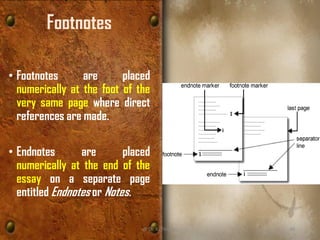
Footnotes
• Footnotes are placed
numerically at the foot of the
very same page where direct
references are made.
• Endnotes are placed
numerically at the end of the
essay on a separate page
entitled Endnotes or Notes.
@ Dr. K. Thiyagu 48
Thank You
@ Dr. K. Thiyagu 49

Research Report Format Thiyagu

  • 1.
    Research Report @ Dr.K. Thiyagu 1Dr. K. Thiyagu, AssistantProfessor,Departmentof Education, CentralUniversity of Kerala, Kasaragod, Kerala
  • 2.
    “Research report isa research document that contains basic aspects of the research project”. @ Dr. K. Thiyagu 2
  • 3.
    Research Report Format A.Preliminary Section B. Main Section C. Reference Section [adapted from: John W. Best, Research in Education, 2nd ed., (Englewood Cliffs, NJ: Prentice-Hall, 1970)]. @ Dr. K. Thiyagu 3
  • 4.
    A. Preliminary Section @Dr. K. Thiyagu 4
  • 5.
    A. Preliminary Section •Cover Page • Title Page • Certificate • Declaration • Acknowledgments (if any) • Table of Contents / Index • List of Tables (if any) • List of Figures (if any) • Abbreviations • Abstract / Summary Report @ Dr. K. Thiyagu 5
  • 6.
    B. Main Section @Dr. K. Thiyagu 6
  • 7.
    Chapter 1: Introduction/ Conceptual Framework • Conceptual framework of the study • Need and Significance of the Problem • Purpose or score of the study • Statement of the Problem • Definition of Terms • Objectives of the study • Hypotheses of the study • Assumptions • Limitations / delimitations • Chapterization @ Dr. K. Thiyagu 7
  • 8.
    Chapter 2: Review ofRelated Literature / Studies • Studies related to foreign • Studies related in India • Critical Review • Gap Identified @ Dr. K. Thiyagu 8
  • 9.
    Chapter 3: Design ofthe Study / Methodology • Description of Research Design • Population and sample • Sampling Procedures • Sources of Data • Tools / instruments used Pilot study Item analysis Reliability validity • Date gathering • Statistical Treatment @ Dr. K. Thiyagu 9
  • 10.
    Chapter 4: Analysis ofData / Data Analysis • Descriptive statistics • Differential statistics • Text with appropriate • Tables and • Figures @ Dr. K. Thiyagu 10
  • 11.
    Chapter 5: Summary andConclusions • Restatement of the Problem • Description of Procedures • Major Findings (reject or fail to reject Ho) • Interpretation • Discussion • Conclusions • Recommendations for Further Investigation @ Dr. K. Thiyagu 11
  • 12.
    C. Reference Section @Dr. K. Thiyagu 12
  • 13.
    C. Reference Section •End Notes (if in that format of citation) • Bibliography or Literature Cited or References • Appendix / Appendices A copy of questionnaire Detail of sampling and rate of response Photos of data collection Master table / master matrix Statement of expenses @ Dr. K. Thiyagu 13
  • 14.
  • 15.
    Paper A4 Sheet: 8.27’’x 11.69’’ Letter: 8.5 x 11" @ Dr. K. Thiyagu 15
  • 16.
    Page Margins Research Paper: 1" on all sides (top, bottom, left, right) Research Report:  Top – 1”  Bottom – 1”  Left – 1.25 to 1.4”  Right – 1.2 to 1.25” @ Dr. K. Thiyagu 16
  • 17.
    Font Text:  Times Roman Courier. Tables and Figures:  sans serif  Arial. @ Dr. K. Thiyagu 17
  • 18.
    Font Size 12 PointTimes New Roman @ Dr. K. Thiyagu 18
  • 19.
    @ Dr. K.Thiyagu 19
  • 20.
  • 21.
    Paragraph Indentation 5–7 spaces Msword: Click page layout, indent @ Dr. K. Thiyagu 21
  • 22.
  • 23.
    @ Dr. K.Thiyagu 23
  • 24.
    Particulars Descriptions Paper  A4Sheet: 8.27’’ x 11.69’’  Letter: 8.5 x 11" Page Margins Research Paper:  1" on all sides (top, bottom, left, right) Research Report:  Top – 1”  Bottom – 1”  Left – 1.25 to 1.4”  Right – 1.2 to 1.25” Margins: MS word Setting:  Use 1-inch margins throughout (top, bottom, left, right)  Click File, Page Setup, Margins. Fill the appropriate blanks with “1”. @ Dr. K. Thiyagu 24
  • 25.
    Particulars Descriptions Font Times Roman Courier. Forfigures, however, use a sans serif font such as Arial. Font Size 12 Point Times New Roman Spacing Double-space entire document Alignment of Text Justified Paragraph Indentation 5–7 spaces Ms word: Click page layout, indent @ Dr. K. Thiyagu 25
  • 26.
    Particulars Descriptions End ofSentence Leave one space after a period unless your teacher prefers two. Binding Hard board binding Section Headings Top level headings should be centered on the page, using upper and lower case. Second level headings should be flush left, italicized, using upper and lower case. Highlighting For highlighting or emphasis, use italics. Bold print can also be used for clarity if necessary (for instance if you use a lot of linguistic examples that require italics). Additional Information Purdue University Online Writing Lab (OWL) - APA Style Guide @ Dr. K. Thiyagu 26
  • 27.
  • 28.
    TABLES, FIGURES ANDGRAPHS • Use tables, figures and graphs only to display main and significant results. • Present information only when it is of value to the reader. • Number every table, figure and graph in the sequence in which they will be referred to. • Tables should be numbered and captioned above the table. • Figures and graphs should be labelled below with their number and descriptive title. • Refer to every table, figure and graph included in the text by using the present tense. • Cite references if applicable. @ Dr. K. Thiyagu 28
  • 29.
  • 30.
    Graphs • Unique GraphNumber • Unique Caption • Label Axes • Label Units • Label Scale • Label Parameters @ Dr. K. Thiyagu 30
  • 31.
    Writing Style inResearch Reporting / Academic Writing @ Dr. K. Thiyagu 31
  • 32.
    WRITING STYLE • Ascientific paper is a formal text written in an impersonal, objective, neutral and professional way. • The writing is concise with specific wordings and formulations. The writing should be clear as well and lead to a deeper understanding of the subject. @ Dr. K. Thiyagu 32
  • 33.
    Avoid colloquial orinformal language • Eliminate all 'filler' and needless words. • Biased language is not acceptable in academic writing. @ Dr. K. Thiyagu 33
  • 34.
    Avoid personal orfamiliar language • Do not directly address the reader and do not ask rhetorical questions. • Remember that the use of personal pronouns (I, You, me, him, her, us etc) does not fit into an objective, scientific paper. @ Dr. K. Thiyagu 34
  • 35.
    Avoid ambiguous, impreciseor vague words Be clear, concrete, specific, precise and direct. If possible, choose specific wordings which will lead to more concise writing. @ Dr. K. Thiyagu 35
  • 36.
    Do not use'wordy' expressions either To illustrate: X • 'Since' or 'because' are easier to read than 'for the reason that' or 'owing to the fact that'. • 'Although' is easier to read than 'despite the fact that' or 'regardless of the fact that'. • 'If' is easier to read than 'in the event that'. @ Dr. K. Thiyagu 36
  • 37.
    Abbreviations and Contractions • Limitthe use of abbreviations in academic writing. Explain the abbreviations you are using. • Avoid contractions such as 'doesn't', 'haven't'. Always write full forms. @ Dr. K. Thiyagu 37
  • 38.
    Written Language • ScientificPapers should be written with correct grammar, spelling and punctuation. @ Dr. K. Thiyagu 38
  • 39.
    Reporting Numbers • Writeout numbers at the beginning of a sentence. • Spell out cardinal numbers from one to nine and ordinal numbers from first to ninth. (1-9) • Numbers below 10 are usually written as words. Also write out hundred, thousand and million in words. • Usually, a space is inserted between the number and the unit. (5 CM) • Percentages require numerals, except when beginning a sentence. @ Dr. K. Thiyagu 39
  • 40.
    Punctuation Do not forget punctuation. Donot use commas instead of full stops. To separate items in a list, use a colon. Commas are used between each item Do not use excessive punctuation. @ Dr. K. Thiyagu 40
  • 41.
    Structure • A scientificpaper or text should have a logical structure and organization. • Typically, an academic text comprises of different chapters and sections of about equal length flowing smoothly into each other. • Sections consist of associated paragraphs that are carefully formatted in a consistent page lay-out. @ Dr. K. Thiyagu 41
  • 42.
    • Paragraphs aremore or less evenly distributed. • Develop a paragraph in a systematic way, for instance working from general to specific or from theory to practice. • Be consistent in tense use throughout paragraphs. • Pay attention to transitions between and within paragraphs • Link sentences within paragraphs using signal phrases, connecting phrases as well as reference words. Paragraphs should be coherent and presented as a whole. Writing Paragraphs @ Dr. K. Thiyagu 42
  • 43.
  • 44.
    • Avoid complexsentence structures making your text difficult to follow. • Use correct, simple and compound sentences. • Break up long sentences • Creating multiple sentences in order to improve readability. • Focus on one idea per sentence and emphasize the most important element. • Avoid using first person pronouns ('I', 'we') as well as personal experience in academic writing. • Never begin a sentence with conjunctions such as 'for', 'and', 'or', 'but'.@ Dr. K. Thiyagu 44
  • 45.
    Tenses and Structures @Dr. K. Thiyagu 45
  • 46.
    Bibliography • The termbibliography is the term used for a list of sources (e.g. books, articles, websites) used to write an assignment (e.g. an essay). It usually includes all the sources consulted even if they not directly cited (referred to) in the assignment. @ Dr. K. Thiyagu 46
  • 47.
    References usually comeat the end of a text (essay or research report) and should contain only those works cited within the text. So, use the term 'References' to cover works cited. A Bibliography is any list of references at the end of a text, whether cited or not. It includes texts you made use of, not only texts you referred to in your paper, but your own additional background reading, and any other articles you think the reader might need as background reading. Reference Vs Bibliography @ Dr. K. Thiyagu 47
  • 48.
    Footnotes • Footnotes areplaced numerically at the foot of the very same page where direct references are made. • Endnotes are placed numerically at the end of the essay on a separate page entitled Endnotes or Notes. @ Dr. K. Thiyagu 48
  • 49.
    Thank You @ Dr.K. Thiyagu 49