Structuring and formatting
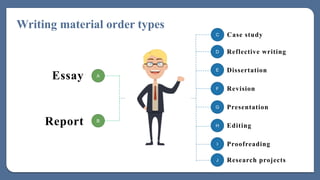
Writing material order types
D Reflective writing
E Dissertation
F Revision
G Presentation
H Editing
I Proofreading
C Case study
J Research projects
A
B
Essay
Report
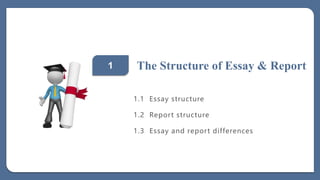
The Structure of Essay & Report
1
1.1 Essay structure
1.2 Report structure
1.3 Essay and report differences
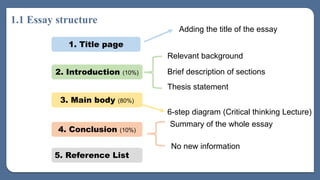
1.1 Essay structure
1. Title page
3. Main body (80%)
4. Conclusion (10%)
Adding the title of the essay
2. Introduction (10%)
Relevant background
Brief description of sections
Thesis statement
6-step diagram (Critical thinking Lecture)
Summary of the whole essay
5. Reference List
No new information
Title page
1.1 Essay structure
Introduction Main body Conclusion Reference List
References
A high score essay sample
1.1 Essay structure
Please note: This is just a sample file.
The actual situation shall be subject to
the order requirements.
1.1 Essay structure
Conclusion (10%)
Summary of the whole essay
No new information
1. Title page
3. Main body (80%)
4. Conclusion (10%)
2. Introduction (10%)
5. Reference List
Reference List
1.2 Report structure
1. Title page
2. Executive
Summary
3. Table of
contents
Adding the title of the report
150-200 words
Last thing to write
Summarize all the information
1.2 Report structure
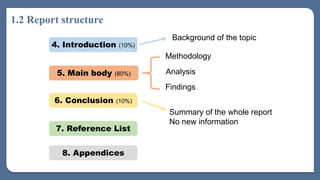
4. Introduction (10%)
5. Main body (80%)
6. Conclusion (10%)
7. Reference List
Background of the topic
Methodology
Analysis
Findings
Summary of the whole report
No new information
8. Appendices
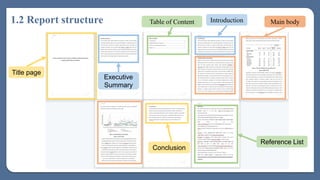
1.2 Report structure
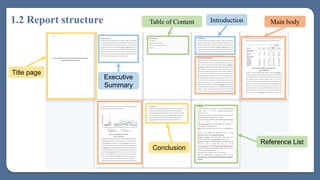
Title page
Table of Content Introduction Main body
Conclusion
Reference List
Executive
Summary
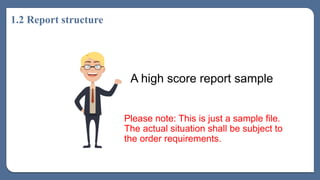
A high score report sample
1.2 Report structure
Please note: This is just a sample file.
The actual situation shall be subject to
the order requirements.
1.3 Essay and report differences
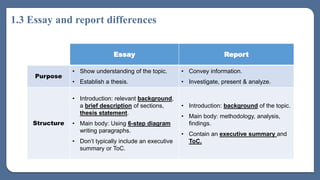
Essay Report
Purpose
• Show understanding of the topic.
• Establish a thesis.
• Convey information.
• Investigate, present & analyze.
Structure
• Introduction: relevant background,
a brief description of sections,
thesis statement.
• Main body: Using 6-step diagram
writing paragraphs.
• Don’t typically include an executive
summary or ToC.
• Introduction: background of the topic.
• Main body: methodology, analysis,
findings.
• Contain an executive summary and
ToC.
1.2 Report structure
Title page
Table of Content Introduction Main body
Conclusion
Reference List
Executive
Summary
1.2 Report structure
Formatting
2
2.1 Basic rules
2.2 MS Word operation
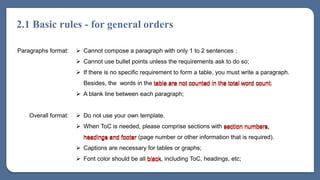
2.1 Basic rules - for general orders
 Cannot compose a paragraph with only 1 to 2 sentences;
 Cannot use bullet points unless the requirements ask to do so;
 If there is no specific requirement to form a table, you must write a paragraph.
Besides, the words in the table are not counted in the total word count;
 A blank line between each paragraph;
 Do not use your own template.
 When ToC is needed, please comprise sections with section numbers,
headings and footer (page number or other information that is required).
 Captions are necessary for tables or graphs;
 Font color should be all black, including ToC, headings, etc;
Paragraphs format:
Overall format:
black
table are not counted in the total word count
section numbers,
headings and footer
2.2 MS Word operation - Add cover page
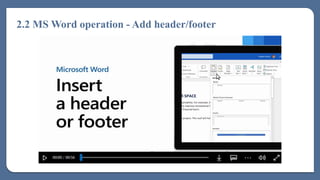
2.2 MS Word operation - Add header/footer
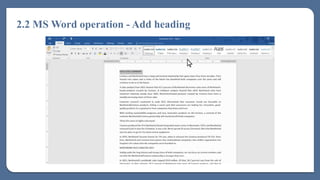
2.2 MS Word operation - Add heading
2.2 MS Word operation - Add ToC
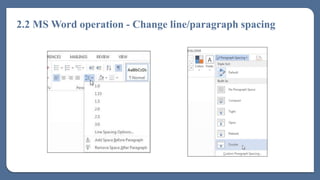
2.2 MS Word operation - Change line/paragraph spacing
2.2 MS Word operation - Change margins
2.2 MS Word operation - Add citation & reference list
Modify them according to the given reference guide after auto-produced by MS Word!!!
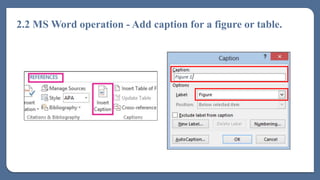
2.2 MS Word operation - Add caption for a figure or table.
Thanks for watching

Structuring and Formatting for academic writing

  • 1.
  • 2.
    Writing material ordertypes D Reflective writing E Dissertation F Revision G Presentation H Editing I Proofreading C Case study J Research projects A B Essay Report
  • 3.
    The Structure ofEssay & Report 1 1.1 Essay structure 1.2 Report structure 1.3 Essay and report differences
  • 4.
    1.1 Essay structure 1.Title page 3. Main body (80%) 4. Conclusion (10%) Adding the title of the essay 2. Introduction (10%) Relevant background Brief description of sections Thesis statement 6-step diagram (Critical thinking Lecture) Summary of the whole essay 5. Reference List No new information
  • 5.
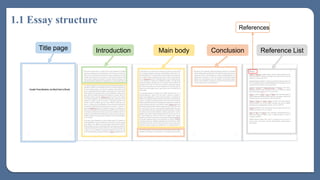
    Title page 1.1 Essaystructure Introduction Main body Conclusion Reference List References
  • 6.
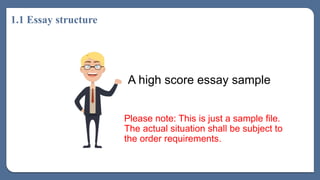
    A high scoreessay sample 1.1 Essay structure Please note: This is just a sample file. The actual situation shall be subject to the order requirements.
  • 8.
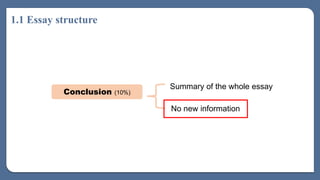
    1.1 Essay structure Conclusion(10%) Summary of the whole essay No new information
  • 9.
    1. Title page 3.Main body (80%) 4. Conclusion (10%) 2. Introduction (10%) 5. Reference List
  • 10.
  • 11.
    1.2 Report structure 1.Title page 2. Executive Summary 3. Table of contents Adding the title of the report 150-200 words Last thing to write Summarize all the information
  • 12.
    1.2 Report structure 4.Introduction (10%) 5. Main body (80%) 6. Conclusion (10%) 7. Reference List Background of the topic Methodology Analysis Findings Summary of the whole report No new information 8. Appendices
  • 13.
    1.2 Report structure Titlepage Table of Content Introduction Main body Conclusion Reference List Executive Summary
  • 14.
    A high scorereport sample 1.2 Report structure Please note: This is just a sample file. The actual situation shall be subject to the order requirements.
  • 15.
    1.3 Essay andreport differences Essay Report Purpose • Show understanding of the topic. • Establish a thesis. • Convey information. • Investigate, present & analyze. Structure • Introduction: relevant background, a brief description of sections, thesis statement. • Main body: Using 6-step diagram writing paragraphs. • Don’t typically include an executive summary or ToC. • Introduction: background of the topic. • Main body: methodology, analysis, findings. • Contain an executive summary and ToC.
  • 17.
    1.2 Report structure Titlepage Table of Content Introduction Main body Conclusion Reference List Executive Summary
  • 19.
  • 20.
  • 21.
    2.1 Basic rules- for general orders  Cannot compose a paragraph with only 1 to 2 sentences;  Cannot use bullet points unless the requirements ask to do so;  If there is no specific requirement to form a table, you must write a paragraph. Besides, the words in the table are not counted in the total word count;  A blank line between each paragraph;  Do not use your own template.  When ToC is needed, please comprise sections with section numbers, headings and footer (page number or other information that is required).  Captions are necessary for tables or graphs;  Font color should be all black, including ToC, headings, etc; Paragraphs format: Overall format: black table are not counted in the total word count section numbers, headings and footer
  • 22.
    2.2 MS Wordoperation - Add cover page
  • 23.
    2.2 MS Wordoperation - Add header/footer
  • 24.
    2.2 MS Wordoperation - Add heading
  • 25.
    2.2 MS Wordoperation - Add ToC
  • 26.
    2.2 MS Wordoperation - Change line/paragraph spacing
  • 27.
    2.2 MS Wordoperation - Change margins
  • 28.
    2.2 MS Wordoperation - Add citation & reference list Modify them according to the given reference guide after auto-produced by MS Word!!!
  • 29.
    2.2 MS Wordoperation - Add caption for a figure or table.
  • 32.

Editor's Notes

  • #3 In this slide, you can see that there are 10 order types of writing material. As for essay and report orders, they are the largest number of writing materials you will assign in the future, so in this lecture, we will mainly talk about the structure and general format of essay and report. Why do we have this lecture? When you write the blog or post on the social media platform, you can generate anything together and post them in any structures or formats you want, right? The contents are in random order, the structure may vague or tight. However, can you write academic writing in this way? Obviously not. In academic writing, we need a general standard of structuring and formatting to organize your writings, which makes them look more standardized and professional. Thus, the purpose of this lecture is to teach you how to structure your essay and report, and how to use proper ways to make the formatting look more coherent and standard. Here, I will give you a brief introduction about other 8 order types. Please remember that follow requirements from university is a top priority. C. Case study. Sometimes, you need to write the case study orders based on the cases given to you, you may follow the general structure and format. D. Reflective writing. Do you remember in academic writing, we have learnt person perspectives? In this kind of orders, you may use the first and second person and follow the general structure and format in this lecture as well if there is no other requirements from uni. E. Dissertation. As writing a dissertation is a huge program, so we will normally divide it into several parts, including abstract, introduction, literature review, methodology, findings, discussion, conclusion and overall formatting. F. Revision. You need to revise the order based on the instructions given to you. There may be some related feedback files or extra files for you to refer. G. Presentation. This kind of order requires you to make slides for the client and write a corresponding speech. The format and picture in the slides should be well-organized. H. Editing. When you take an editing order, it is easy to understand that you need to do edit in this order. I. Proofreading. This is a paper polish service. You need to check the vocabulary, grammar, reference, format and reduce the repetition rate for the customers. Please check the original work given. J. Research projects. They are like research proposals and have similar structure or structure according to the guideline.
  • #5 An essay is used to show readers your understanding of a specific topic and establish a thesis. There are normally 5 parts in essay writing. The first one is the title page. Please do not use any colorful template, just a blank page with a black title of this essay would be enough. Then, there should be an introduction paragraph, which normally takes 10% of the total word count. Generally, an introduction will give readers information like a case or essay background, a brief description of sections, and your thesis statement. Next, main body paragraphs would take around 80% of the total word count. All paragraphs in the main body should be critical, and the easiest way of doing it would be following 6- step diagram taught in the critical thinking lecture. The last 10% words would be the conclusion paragraph. It is the summary of the whole essay. Please keep in mind that this part should not include any new ideas that have not been addressed in the main body, therefore, it should not use any reference. The final part would be the reference list. It should start from a new page.
  • #6 One title page, 1 paragraph for introduction, several paragraphs for the main body, 1 paragraph for the conclusion, and a reference list start from a new page. Please note here, only the reference list needs the heading ‘References’, other sections don’t need any heading, just the content would be enough.
  • #9 The correct answer is no. Because the conclusion paragraph cannot include any new information, it is only used to summarize the above information.
  • #10 As we mentioned above. They are a title page, an introduction, main body paragraphs, a conclusion, and a reference list.
  • #11 The correct answer is the reference list. Only this section needs to include the heading ‘References’.
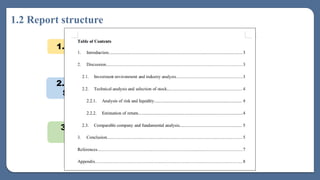
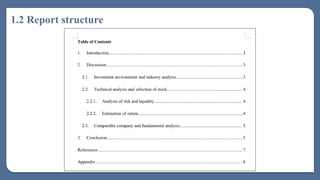
  • #12 Firstly, you need to add the title of the report on the title page. Secondly, Executive Summary should be put after the title page if the requirement asks to do so. Normally, 150 to 200 words are required to Executive Summary, and it is the last thing to write since the purpose of Executive Summary is to summarize all the information in the report. Thirdly, Table of Contents is needed for the report typically, please make sure some headings need to include section numbers. Here is the sample Table of Contents, you may notice that Executive Summary is not included in it, and there is no section number for references and appendices.
  • #13 The fourth part in the report structure is introduction, which mainly talks about the background of the topic. Next part is the most important part in report, the main body part. In this part, you may include some methodologies and analysis, then have some findings. The following part is conclusion, same as essay conclusion paragraph, it needs to summarize the whole report and should not include any new information in this paragraph. Then, you need to add the reference list for your report. If the requirement asks you to add the appendices, you need to put this part after reference list and also start it on a new page.
  • #14 Here is the overview of the report structure, title page, Executive Summary, Table of Contents, introduction, main body, conclusion, and reference list. In this sample, we did not show the appendices, but please remember that if you do have any appendixes, you need to put them after reference list. Besides, you may notice that title page, Executive Summary, Table of Contents, introduction,reference list are all start at the new page, please also do this when you are writing the live orders.
  • #16 Firstly, the essay is more focused on showing the authors’ understanding of a topic and establishing a thesis. While the report is mainly used to convey information by investigating, presenting, and analyzing. Essay and reports’ structure is also different. The essay introduction needs to include background, brief section description, and thesis statement, while the report introduction only needs the background information on the topic. Essays’ main body paragraphs may follow 6-steps, while reports’ main body needs to include methodology, analysis, and findings, which is not limited to any writing model. An executive summary and ToC would be mainly included in report writing unless there is any specific requirement for an essay.
  • #18 The answer is in front of. As we mentioned in the report structure, here, the Executive Summary is between the title page and the table of content.
  • #20 Correct answer is no. As we mentioned here. In the table of content, it should not count in the Executive Summary. And for references and appendix, they should not have section numbers.
  • #22 The first is some rules related to paragraphs. Do not compose a paragraph with only one or two sentences. Next, normally, we cannot use bullet points in the essay or report unless the requirement ask you to do so. Moreover, if there is no specific requirement that asks you to form a table in the task, you must write a paragraph to convey your ideas. Please noted here that the words in the table are not counted in the total word count normally. The last rule for paragraph, a blank line between each paragraph, you may notice that in some academic journals, authors always leave a blank line between each paragraph in order to make more clear and clean to separate each paragraph. Secondly, please do not use your own template, or I mean, please do not format the essay or report like what you want. If there is the specific requirement about formatting from uni or professor, please just follow the requirement; if not, please follow the structure and format we have mentioned and learnt in this lecture. Besides, when ToC is needed, you need to comprise sections with section numbers, headings and footer. If there are other requirement for header, you also need to add this based on the requirement. Moreover, it is necessary to add the captions for tables and graphs that you show in the essay or report. Please keep in mind that font color in any orders should always be black, no matter it is the ToC, headings, title or any other things. We need to keep the format of your essay or report neat and coherent.
  • #23  You don’t need to enter that many empty spaces to create a title page. You can click insert and find the cover page button, then find a suitable blank one.
  • #24 Normally, we need to include the page number as a footer for orders that are needed, while the header is optional.
  • #25 Only after you added the footer of page number and headings following the video, you can add a table of content.
  • #27 You can select all and then choose these buttons to set them according to requirements
  • #29 Microsoft can help us to auto-produce a reference list draft, which may save our time. But please note, that it is just a draft, you cannot directly use it, because the uni may require a different reference style as we mentioned in the reference lecture. So you need to always check and modify it! It is very important! You cannot just put the auto-produced reference list there.
  • #30 29. Then also under the references category, you can add a caption for a figure or table. You can choose the label here, then enter the figure or table title there.
  • #31 The answer is no. As we mentioned many times, you need to modify it according to the live order requirement.
  • #32 The answer is always to follow the requirement file first. Please note, that all the content in today’s lecture is used to help you when there is no specific requirement, but live order requirement is always the priority.