WELLCOME TO PRESENTATION
The Presentation Concerns On How to Write a Thesis
Proposals
Submitted to:
Guche G.(Ph.D.)
LAYOUT
1. INTRODUCTION
2. FORMAT OF PRELIMINARY & MAIN BODY OF PROPOSAL
3. LITERATURE REVIEW
4. MATERIALS AND METHODOLOGY
5.RESULTS AND DISCUSSIONS
6. CONCLUSIONS
1. Introduction
Before we start writing the proposal , the student must keep the following statements
in mind.
1) Whether he/she is familiar with other researches that have been conducted in the
areas related to his proposed research problem
2) Whether he/she has clear understanding of the steps that will be used in
conducting his/her research
3) Whether he/she has ability to get through each of the steps necessary to complete
his/her research project
4) Whether he is motivated and have the drive to get through all the steps in the
proposed research project
Cont’d
What is a research proposal?
 A document with two major objectives:
1.To analyze and synthesize the existing research about particular topic.
2. Describe the researcher’s idea for a new study.
 A document which the researcher wants to sell in the market.
1. Buyer needs to take it from the gallery.
2. Suits to buyer’s pocket.
Cont’d
What is the purpose of research proposal?
Thesis proposals are designed to:
Justify and plan (or contract for) a research project.
Show how your project contributes to existing research.
Demonstrate to your advisor and committee that you understand how to
conduct discipline-specific research within an acceptable time-frame.
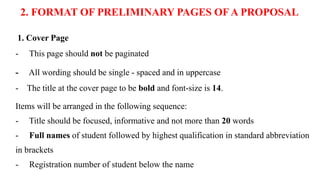
2. FORMAT OF PRELIMINARY PAGES OF A PROPOSAL
1. Cover Page
- This page should not be paginated
- All wording should be single - spaced and in uppercase
- The title at the cover page to be bold and font-size is 14.
Items will be arranged in the following sequence:
- Title should be focused, informative and not more than 20 words
- Full names of student followed by highest qualification in standard abbreviation
in brackets
- Registration number of student below the name
Cont’d
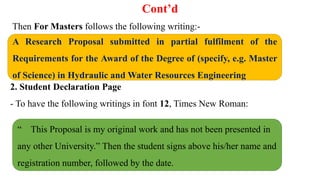
Then For Masters follows the following writing:-
2. Student Declaration Page
- To have the following writings in font 12, Times New Roman:
A Research Proposal submitted in partial fulfilment of the
Requirements for the Award of the Degree of (specify, e.g. Master
of Science) in Hydraulic and Water Resources Engineering
“ This Proposal is my original work and has not been presented in
any other University.” Then the student signs above his/her name and
registration number, followed by the date.
Cont’d
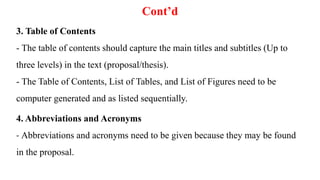
3. Table of Contents
- The table of contents should capture the main titles and subtitles (Up to
three levels) in the text (proposal/thesis).
- The Table of Contents, List of Tables, and List of Figures need to be
computer generated and as listed sequentially.
4. Abbreviations and Acronyms
- Abbreviations and acronyms need to be given because they may be found
in the proposal.
Cont’d
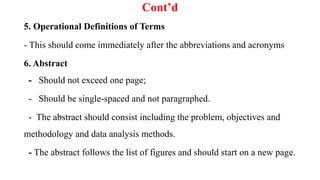
5. Operational Definitions of Terms
- This should come immediately after the abbreviations and acronyms
6. Abstract
- Should not exceed one page;
- Should be single-spaced and not paragraphed.
- The abstract should consist including the problem, objectives and
methodology and data analysis methods.
- The abstract follows the list of figures and should start on a new page.
3. FORMAT OF MAIN BODY OFA PROPOSAL
1. Introduction
 Should highlight the scope and significance of the proposed research work along
with the knowledge gaps and objectives of the study under separate sub-headings.
2. Background to the Study : This Section
 Integrates review of related literature to place the study within the larger context of
the scholarly literature.
 Creates reader’s interest in the topic and
 Gives you an opportunity to show that you have a good knowledge of the body of
literature
Cont’d
3. Problem Statement and Justification
 The problem statement should include an explanation of what the problem is
about, why it is a problem and for whom.
 To be precise and focused
4. Objectives of the study
 The main purpose of the research objective is to interlink the topic and
statement of the problem
 Objectives should be simple (not complex), specific (not vague), stated in
advance (not after the research is done)
Cont’d
5. Research Questions
 The research questions emerge from the objectives of the study and always
written in question forms.
6. Significance of the Study
 It indicates how the proposed research will contribute to existing knowledge and
practices in the field of study.
 What are the expected outputs of the study?
 Who are the potential beneficiaries?
 How will results influence programs, methods, and/or interventions?
Cont’d
7. Delimitation/Scope
 Delimitation addresses how a study is narrowed in scope in terms of time and
space.
 This section specifies the context, population, methodological procedures, and
issues to be addressed.
8. Operational Definitions
When the researcher thinks that some of the key words are used in a special
manner in the context of the current study, he/she needs to provide a section
with operational definitions of terms.
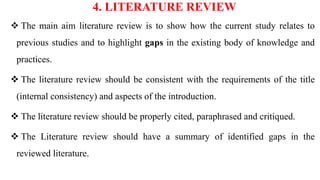
4. LITERATURE REVIEW
 The main aim literature review is to show how the current study relates to
previous studies and to highlight gaps in the existing body of knowledge and
practices.
 The literature review should be consistent with the requirements of the title
(internal consistency) and aspects of the introduction.
 The literature review should be properly cited, paraphrased and critiqued.
 The Literature review should have a summary of identified gaps in the
reviewed literature.
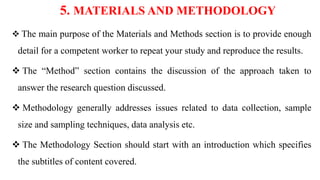
5. MATERIALS AND METHODOLOGY
 The main purpose of the Materials and Methods section is to provide enough
detail for a competent worker to repeat your study and reproduce the results.
 The “Method” section contains the discussion of the approach taken to
answer the research question discussed.
 Methodology generally addresses issues related to data collection, sample
size and sampling techniques, data analysis etc.
 The Methodology Section should start with an introduction which specifies
the subtitles of content covered.
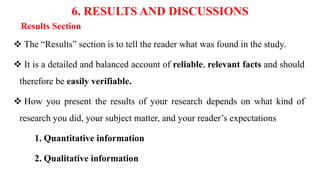
6. RESULTS AND DISCUSSIONS
Results Section
 The “Results” section is to tell the reader what was found in the study.
 It is a detailed and balanced account of reliable, relevant facts and should
therefore be easily verifiable.
 How you present the results of your research depends on what kind of
research you did, your subject matter, and your reader’s expectations
1. Quantitative information
2. Qualitative information
Cont’d
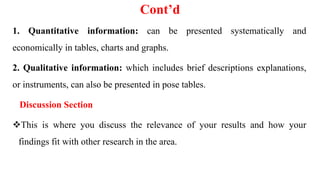
1. Quantitative information: can be presented systematically and
economically in tables, charts and graphs.
2. Qualitative information: which includes brief descriptions explanations,
or instruments, can also be presented in pose tables.
Discussion Section
This is where you discuss the relevance of your results and how your
findings fit with other research in the area.
Cont’d
 This is the last major section of the report.
 In the Discussion section you should discuss the results.
 What generalizations can be drawn?
 How do your findings compare to the findings of others or to
expectations based on previous work?
 Are there any theoretical/practical implications of your work?
Cont’d
In the discussion section you step back and take a broad look at your findings
and your study as a whole. And it must be:
From the specific to a broader horizons.
Reference to purpose.
Most important findings with comments.
Implication
Cont’d
This section usually includes the following information elements:
Main purpose:
Explanation for the findings:
Implications:
generalization from the results
Need for further research
Recommendation
BUDGETS AND WORK PLAN
The work plan showing the activities and the corresponding time it is planned
to be completed could be prepared in the form of chart.
CONCLUSION
 This is a summary of the most significant results/findings.
 The “conclusion” section briefly restates the findings and relates them to the
previous work.
 You must provide clear, unexaggerated, objective statements summarizing the
information given in the body of the report.
Con’d
The Limitations of the study can be added in this section.
 The conclusion considers the evidence presented in the main body,
draws out the implications and brings it to one overall conclusion or an
ordered series of final conclusions
Words that indicate a conclusion are: (Therefore, This proves that,
Then, Consequently, thus, etc.)
Recommendation
 This includes suggestions for what needs to be done as a result of your
findings.
 Recommendations are usually listed in order of priority.
 Recommendations are personal statements provided by the writer on:
a) What is to be done?
b) Who is to do it; and
c) How it is to be achieved.
REFERENCES
 References should be single- spaced and listed alphabetically in the
reference list.
 For citations within the text, the format of author and year of publication
is recommended.
 Use the latest American Psychology Association (APA) style of
referencing.
APPENDICES
 They will include such items as Work Plan, Budget, Maps, and
Questionnaires. These must be numbered sequentially
7. CONCLUSIONS
 The production of quality and relevant research outputs (thesis) demands
the existence of supportive guideline that directs the various activities of
the research work. Therefore, Article 132 (3) of AMU senate legislation
requires the Research and Development Committee (RDC) of the
university to issue detailed thesis formats and guidelines that standardize
and direct the conduction, supervision and evaluation of thesis across all
institute programs hosted by School of Post Graduate Studies (SPGS).
 A post graduate student who has got an approved proposal and
registered for thesis work is eligible for perusing his/her main
research.
Proposal writing

Proposal writing

  • 1.
    WELLCOME TO PRESENTATION ThePresentation Concerns On How to Write a Thesis Proposals Submitted to: Guche G.(Ph.D.)
  • 2.
    LAYOUT 1. INTRODUCTION 2. FORMATOF PRELIMINARY & MAIN BODY OF PROPOSAL 3. LITERATURE REVIEW 4. MATERIALS AND METHODOLOGY 5.RESULTS AND DISCUSSIONS 6. CONCLUSIONS
  • 3.
    1. Introduction Before westart writing the proposal , the student must keep the following statements in mind. 1) Whether he/she is familiar with other researches that have been conducted in the areas related to his proposed research problem 2) Whether he/she has clear understanding of the steps that will be used in conducting his/her research 3) Whether he/she has ability to get through each of the steps necessary to complete his/her research project 4) Whether he is motivated and have the drive to get through all the steps in the proposed research project
  • 4.
    Cont’d What is aresearch proposal?  A document with two major objectives: 1.To analyze and synthesize the existing research about particular topic. 2. Describe the researcher’s idea for a new study.  A document which the researcher wants to sell in the market. 1. Buyer needs to take it from the gallery. 2. Suits to buyer’s pocket.
  • 5.
    Cont’d What is thepurpose of research proposal? Thesis proposals are designed to: Justify and plan (or contract for) a research project. Show how your project contributes to existing research. Demonstrate to your advisor and committee that you understand how to conduct discipline-specific research within an acceptable time-frame.
  • 6.
    2. FORMAT OFPRELIMINARY PAGES OF A PROPOSAL 1. Cover Page - This page should not be paginated - All wording should be single - spaced and in uppercase - The title at the cover page to be bold and font-size is 14. Items will be arranged in the following sequence: - Title should be focused, informative and not more than 20 words - Full names of student followed by highest qualification in standard abbreviation in brackets - Registration number of student below the name
  • 7.
    Cont’d Then For Mastersfollows the following writing:- 2. Student Declaration Page - To have the following writings in font 12, Times New Roman: A Research Proposal submitted in partial fulfilment of the Requirements for the Award of the Degree of (specify, e.g. Master of Science) in Hydraulic and Water Resources Engineering “ This Proposal is my original work and has not been presented in any other University.” Then the student signs above his/her name and registration number, followed by the date.
  • 8.
    Cont’d 3. Table ofContents - The table of contents should capture the main titles and subtitles (Up to three levels) in the text (proposal/thesis). - The Table of Contents, List of Tables, and List of Figures need to be computer generated and as listed sequentially. 4. Abbreviations and Acronyms - Abbreviations and acronyms need to be given because they may be found in the proposal.
  • 9.
    Cont’d 5. Operational Definitionsof Terms - This should come immediately after the abbreviations and acronyms 6. Abstract - Should not exceed one page; - Should be single-spaced and not paragraphed. - The abstract should consist including the problem, objectives and methodology and data analysis methods. - The abstract follows the list of figures and should start on a new page.
  • 10.
    3. FORMAT OFMAIN BODY OFA PROPOSAL 1. Introduction  Should highlight the scope and significance of the proposed research work along with the knowledge gaps and objectives of the study under separate sub-headings. 2. Background to the Study : This Section  Integrates review of related literature to place the study within the larger context of the scholarly literature.  Creates reader’s interest in the topic and  Gives you an opportunity to show that you have a good knowledge of the body of literature
  • 11.
    Cont’d 3. Problem Statementand Justification  The problem statement should include an explanation of what the problem is about, why it is a problem and for whom.  To be precise and focused 4. Objectives of the study  The main purpose of the research objective is to interlink the topic and statement of the problem  Objectives should be simple (not complex), specific (not vague), stated in advance (not after the research is done)
  • 12.
    Cont’d 5. Research Questions The research questions emerge from the objectives of the study and always written in question forms. 6. Significance of the Study  It indicates how the proposed research will contribute to existing knowledge and practices in the field of study.  What are the expected outputs of the study?  Who are the potential beneficiaries?  How will results influence programs, methods, and/or interventions?
  • 13.
    Cont’d 7. Delimitation/Scope  Delimitationaddresses how a study is narrowed in scope in terms of time and space.  This section specifies the context, population, methodological procedures, and issues to be addressed. 8. Operational Definitions When the researcher thinks that some of the key words are used in a special manner in the context of the current study, he/she needs to provide a section with operational definitions of terms.
  • 14.
    4. LITERATURE REVIEW The main aim literature review is to show how the current study relates to previous studies and to highlight gaps in the existing body of knowledge and practices.  The literature review should be consistent with the requirements of the title (internal consistency) and aspects of the introduction.  The literature review should be properly cited, paraphrased and critiqued.  The Literature review should have a summary of identified gaps in the reviewed literature.
  • 15.
    5. MATERIALS ANDMETHODOLOGY  The main purpose of the Materials and Methods section is to provide enough detail for a competent worker to repeat your study and reproduce the results.  The “Method” section contains the discussion of the approach taken to answer the research question discussed.  Methodology generally addresses issues related to data collection, sample size and sampling techniques, data analysis etc.  The Methodology Section should start with an introduction which specifies the subtitles of content covered.
  • 16.
    6. RESULTS ANDDISCUSSIONS Results Section  The “Results” section is to tell the reader what was found in the study.  It is a detailed and balanced account of reliable, relevant facts and should therefore be easily verifiable.  How you present the results of your research depends on what kind of research you did, your subject matter, and your reader’s expectations 1. Quantitative information 2. Qualitative information
  • 17.
    Cont’d 1. Quantitative information:can be presented systematically and economically in tables, charts and graphs. 2. Qualitative information: which includes brief descriptions explanations, or instruments, can also be presented in pose tables. Discussion Section This is where you discuss the relevance of your results and how your findings fit with other research in the area.
  • 18.
    Cont’d  This isthe last major section of the report.  In the Discussion section you should discuss the results.  What generalizations can be drawn?  How do your findings compare to the findings of others or to expectations based on previous work?  Are there any theoretical/practical implications of your work?
  • 19.
    Cont’d In the discussionsection you step back and take a broad look at your findings and your study as a whole. And it must be: From the specific to a broader horizons. Reference to purpose. Most important findings with comments. Implication
  • 20.
    Cont’d This section usuallyincludes the following information elements: Main purpose: Explanation for the findings: Implications: generalization from the results Need for further research Recommendation
  • 21.
    BUDGETS AND WORKPLAN The work plan showing the activities and the corresponding time it is planned to be completed could be prepared in the form of chart. CONCLUSION  This is a summary of the most significant results/findings.  The “conclusion” section briefly restates the findings and relates them to the previous work.  You must provide clear, unexaggerated, objective statements summarizing the information given in the body of the report.
  • 22.
    Con’d The Limitations ofthe study can be added in this section.  The conclusion considers the evidence presented in the main body, draws out the implications and brings it to one overall conclusion or an ordered series of final conclusions Words that indicate a conclusion are: (Therefore, This proves that, Then, Consequently, thus, etc.)
  • 23.
    Recommendation  This includessuggestions for what needs to be done as a result of your findings.  Recommendations are usually listed in order of priority.  Recommendations are personal statements provided by the writer on: a) What is to be done? b) Who is to do it; and c) How it is to be achieved.
  • 24.
    REFERENCES  References shouldbe single- spaced and listed alphabetically in the reference list.  For citations within the text, the format of author and year of publication is recommended.  Use the latest American Psychology Association (APA) style of referencing. APPENDICES  They will include such items as Work Plan, Budget, Maps, and Questionnaires. These must be numbered sequentially
  • 25.
    7. CONCLUSIONS  Theproduction of quality and relevant research outputs (thesis) demands the existence of supportive guideline that directs the various activities of the research work. Therefore, Article 132 (3) of AMU senate legislation requires the Research and Development Committee (RDC) of the university to issue detailed thesis formats and guidelines that standardize and direct the conduction, supervision and evaluation of thesis across all institute programs hosted by School of Post Graduate Studies (SPGS).
  • 26.
     A postgraduate student who has got an approved proposal and registered for thesis work is eligible for perusing his/her main research.