Types of Hypothesis
Submitted by
ABILASH.S
II M.Sc MICROBIOLOGY
Agenda
• what is hypothesis
• Characters of hypothesis
• Types of Hypothesis
•Type I and II errors
•Importance of Hypothesis
•Conclusion
What is a Hypothesis?
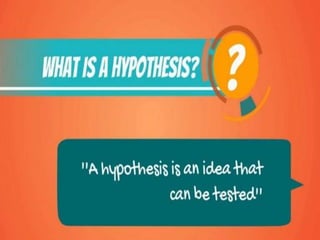
 A hypothesis may be defined as a proposition or a set
of proposition set forth as an explanation for the
occurrence of some specified group of phenomena
either asserted merely as a provisional conjecture to
guide some investigation or accepted as highly
probable in the light of established facts
 Etymologically hypothesis is made up of two words,
“hypo” and “thesis” which means less than or less
certain than a thesis
 According to Lundberg, “A hypothesis is a tentative
generalisation, the validity of which remains to be
tested. In its most elementary stage, the hypothesis
may be any hunch, guess, imaginative idea, which
becomes the basis for action or investigation”
Characters of Hypothesis
Hypothesis should be :
 clear and precise
 capable of being tested.
 state relationship between variables
 limited in scope and must be specific.
 consistent with most known facts
 amenable to testing within a reasonable time.
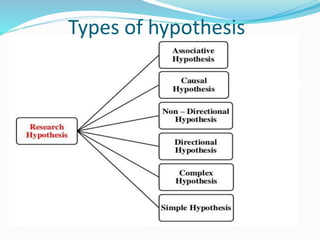
Types of hypothesis
Types of hypothesis
 Simple hypothesis:
 A simple hypothesis is a prediction of the relationship
between two variables: the independent variable and
the dependent variable.
 E.g Drinking sugary drinks daily leads to obesity.
 Complex Hypothesis:
 A complex hypothesis examines the relationship
between two or more independent variables and two
or more dependent variables.
 E.g Overweight adults who 1) value longevity and 2)
seek happiness are more likely than other adults
to 1) lose their excess weight and 2) feel a more
regular sense of joy.
Cont..
 A logical hypothesis is a proposed explanation
possessing limited evidence. Generally, you want to
turn a logical hypothesis into an empirical hypothesis,
putting your theories or postulations to the test.
 E.g Cacti experience more successful growth rates than
tulips on Mars. (Until we're able to test plant growth in
Mars' ground for an extended period of time, the
evidence for this claim will be limited and the
hypothesis will only remain logical.)
Cont..
 An empirical hypothesis, or working hypothesis,
comes to life when a theory is being put to the test,
using observation and experiment. It's no longer just
an idea or notion. It's actually going through some trial
and error, and perhaps changing around those
independent variables.
 E.g Roses watered with liquid Vitamin B grow faster
than roses watered with liquid Vitamin E. (Here, trial
and error is leading to a series of findings.)
Cont..
 A statistical hypothesis is an examination of a
portion of a population.
 If you wanted to conduct a study on the life expectancy
of Savannians, you would want to examine every single
resident of Savannah. This is not practical. Therefore,
you would conduct your research using a statistical
hypothesis, or a sample of the Savannian population.
Difference between directional
and non directional
 Directional Hypotheses - These are usually derived
from theory .They may imply that the researcher is
intellectually committed to a particular outcome. They
specify the expected direction of the relationship
between variables i.e. the researcher predicts not only
the existence of a relationship but also its nature.
 Non-directional Hypotheses - Used when there is
little or no theory, or when findings of previous studies
are contradictory. They may imply impartiality. Do not
stipulate the direction of the relationship.
Associative and causal Hypotheses:
 Associative Hypotheses -Propose relationships
between variables - when one variable changes, the
other changes. Do not indicate cause and effect.
 Causal Hypotheses- Propose a cause and effect
interaction between two or more variables. The
independent variable is manipulated to cause effect on
the dependent variable. The dependent variable is
measured to examine the effect created by the
independent variable
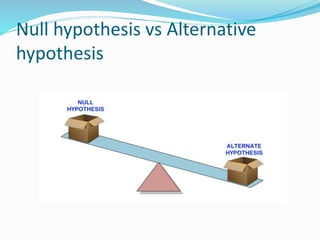
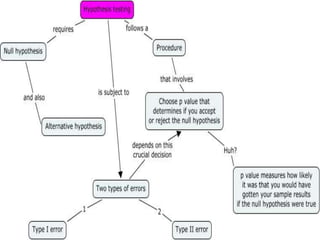
Null hypothesis vs Alternative
hypothesis
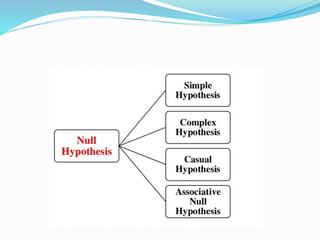
Null Hypothesis:
 These are used when the researcher believes there is
no relationship between two variables or when there is
inadequate theoretical or empirical information to
state a research hypothesis.
 The null hypothesis represents a theory that has been
put forward, either because it is believed to be true or
because it is to be used as a basis for argument, but has
not been proved. Has serious outcome if incorrect
decision is made.
 Designated by: Ho or Hn.
The Alternative Hypothesis
 The alternative hypothesis is a statement of what a
hypothesis test is set up to establish. Designated by: H1
or Ha. It is opposite of Null Hypothesis. It is only
reached if Ha is rejected. Frequently “alternative” is
actual desired conclusion of the researcher
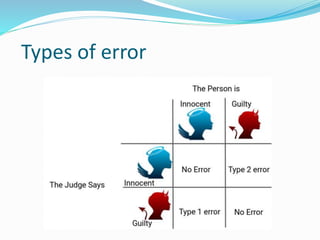
ERROR..
 A person is on trial for a criminal offense and the judge
needs to provide a verdict on his case. Now, there are
four possible combinations in such a case:
 First Case: The person is innocent and the judge
identifies the person as innocent
 Second Case: The person is innocent and the judge
identifies the person as guilty
 Third Case: The person is guilty and the judge
identifies the person as innocent
 Fourth Case: The person is guilty and the judge
identifies the person as guilty
Types of error
CONCLUSION:
 A hypothesis is put to test for its tenability and for
determining its validity. If it is proved, it becomes the
solution of the problem, for which it was formulated.
 If it is not proved, alternate hypothesis or situations
would need to be formulated and tested.
 A hypothesis thus stands somewhere at the midpoint
of research; from here one can look back to the
problem and also forward to data.
BOOKS REFERRED:
 Research Methodology By C.R. Kothari.
 Research Methodology in Education By Dr. K.
Nagarajan, Dr. R. Srinivasan, Dr. (Mrs.) Mary
Vijayakumar. Ram publishers, Chennai, 2003.
 Research Methods in Education By Dr. Radha Mohan.
 Research in Education (Ninth Edition) By John W.
Best & James V. Kahn.
OPEN SESSION