

Major Research Methods
Abdul Rehman and Mohammad Ramzan
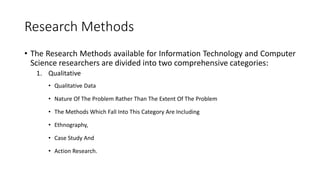
Research Methods
• The Research Methods available for Information Technology and Computer
Science researchers are divided into two comprehensive categories:
1. Qualitative
• Qualitative Data
• Nature Of The Problem Rather Than The Extent Of The Problem
• The Methods Which Fall Into This Category Are Including
• Ethnography,
• Case Study And
• Action Research.
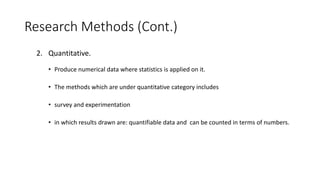
Research Methods (Cont.)
2. Quantitative.
• Produce numerical data where statistics is applied on it.
• The methods which are under quantitative category includes
• survey and experimentation
• in which results drawn are: quantifiable data and can be counted in terms of numbers.
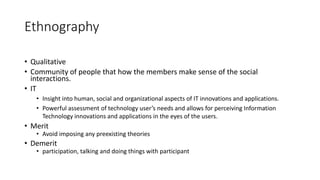
Ethnography
• Qualitative
• Community of people that how the members make sense of the social
interactions.
• IT
• Insight into human, social and organizational aspects of IT innovations and applications.
• Powerful assessment of technology user’s needs and allows for perceiving Information
Technology innovations and applications in the eyes of the users.
• Merit
• Avoid imposing any preexisting theories
• Demerit
• participation, talking and doing things with participant
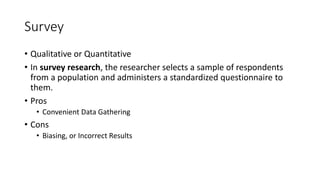
Survey
• Qualitative or Quantitative
• In survey research, the researcher selects a sample of respondents
from a population and administers a standardized questionnaire to
them.
• Pros
• Convenient Data Gathering
• Cons
• Biasing, or Incorrect Results
Secondary Method
• Data is obtained from other sources (previous studies )
• Pros
• Ease of Access
• Time & Cost Effective
• Cons
• Not Specific to Researcher’s Needs
• Inaccuracy of Data
• Not Timely
Case Study
• in-depth investigation of an individual, group, institution or
phenomenon within its real life
• For example, a firm, a specific project, a community.
• Aim
• in-depth understanding.
• Demerit
• data collection and analysis is more open to interpretation.
• Important in Information Technology to evaluate the tools.
Others Research Methods
• Experimentation
Summary
• Qualitative
• Quantitative
• Ethnography
• Survey
• Secondary method
• Case study
• Experimentation

Research Methods Qualitative and Quantitative

  • 1.
    Major Research Methods AbdulRehman and Mohammad Ramzan
  • 2.
    Research Methods • TheResearch Methods available for Information Technology and Computer Science researchers are divided into two comprehensive categories: 1. Qualitative • Qualitative Data • Nature Of The Problem Rather Than The Extent Of The Problem • The Methods Which Fall Into This Category Are Including • Ethnography, • Case Study And • Action Research.
  • 3.
    Research Methods (Cont.) 2.Quantitative. • Produce numerical data where statistics is applied on it. • The methods which are under quantitative category includes • survey and experimentation • in which results drawn are: quantifiable data and can be counted in terms of numbers.
  • 4.
    Ethnography • Qualitative • Communityof people that how the members make sense of the social interactions. • IT • Insight into human, social and organizational aspects of IT innovations and applications. • Powerful assessment of technology user’s needs and allows for perceiving Information Technology innovations and applications in the eyes of the users. • Merit • Avoid imposing any preexisting theories • Demerit • participation, talking and doing things with participant
  • 5.
    Survey • Qualitative orQuantitative • In survey research, the researcher selects a sample of respondents from a population and administers a standardized questionnaire to them. • Pros • Convenient Data Gathering • Cons • Biasing, or Incorrect Results
  • 6.
    Secondary Method • Datais obtained from other sources (previous studies ) • Pros • Ease of Access • Time & Cost Effective • Cons • Not Specific to Researcher’s Needs • Inaccuracy of Data • Not Timely
  • 7.
    Case Study • in-depthinvestigation of an individual, group, institution or phenomenon within its real life • For example, a firm, a specific project, a community. • Aim • in-depth understanding. • Demerit • data collection and analysis is more open to interpretation. • Important in Information Technology to evaluate the tools.
  • 8.
  • 9.
    Summary • Qualitative • Quantitative •Ethnography • Survey • Secondary method • Case study • Experimentation

Editor's Notes

  • #7 1)  Time and Cost effective : Usually time and cost required to collect secondary data is less than efforts required to collect primary data. Data is available freely or at far lesser cost through secondary sources.