


DATA COMMUNICATION
Abdul Rehman
OUTLINES
• Data communication
• Fundamental principles of communication system
• Basic elements of Communication System
• Data Transmission media
• Protocols
• Data transmission forms
DATA COMMUNICATION
• Data communication is the flow of electronic data among two nodes(computers or
other devices) through communication media
• in order to manage communication, the nodes must be part of communication
system linked with each other via some media like cables or Wireless.
• In data communication/networking computers or devices which are connected to
network are termed as nodes.
FUNDAMENTAL PRINCIPLES OF
COMMUNICATION SYSTEM
• Delivery
• The System must carry data with correct end or destination
• The data must be received by correct recipient (device/user)
• Accuracy
• The system must deliver the data with same as it was sent
• The altered or incomplete data is useless
• Timeliness
• The system must deliver data in time
• Late delivery may not be useful
• Therefor time delivery is mandatory
BASIC ELEMENTS OF COMMUNICATION SYSTEM
• Message
• Message is the information that is communicated over the communication system. It includes
text, audio video images.
• Sender
• The node that is used for transferring data is called source or sender.
• In recent digital system the source is mostly computer or a mobile device
• Medium
• Medium is the pathway through which data is sent fro one point to another.
• If the receiver and sender are within the building, a wire (medium) can connect them.
• If they are at different locations they maybe connected through telephone lines, fiber optics
e.t.c.
BASIC ELEMENTS OF COMMUNICATION SYSTEM
CONT…
• Receiver
• The node that receives data is called receiver. The receiver can be computer, mobile device
printer
• Protocols
• A protocol Is set of rules which govern the data transmission between sender or receiver
• Without protocol the data is useless for receiver, as a person understanding only Urdu cannot
understand English messages
• Therefor messages transferred through medium to received are sent through protocol so that
receiver can understand the message.
• Most used communication protocol is TCP/IP (Transmission control Protocol/Internet Protocol)
DATA TRANSMISSION MEDIA
• To connect the devices in a network, either wired media (physical cables) or wireless
media (typically radio signals) can be used.
• The most common wired and wireless networking media are discussed next.
WIRED NETWORKING MEDIA
• The most common types of wired networking media:
• Twisted Pair Cable
• Co-Axial Cable
• Fiber optic cable
TWISTED PAIR CABLE
• Twisted pair is couple of copper wires, twisted together and enfolded a
plastic coating.
• Each pair consists of two wires used for positive data signal and negative
data signal
• Further divided into two categories UTP and STP
• Shielded twisted pair cable
• Its enclosed with foil cover and copper shielding
• STP Cable uses shields to reduce outside interference
• Unshielded twisted pair cable
• Is not enclosed in any cover
• Very flexable and easy to use
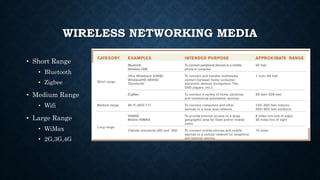
WIRELESS NETWORKING MEDIA
• Short Range
• Bluetooth
• Zigbee
• Medium Range
• Wifi
• Large Range
• WiMax
• 2G,3G,4G
PROTOCOLS USED IN DATA
COMMUNICATION
• A protocol is a set of rules to be followed in a specific situation
• there are communications protocols that determine how devices on a network
communicate.
• The most widely used communications protocol today is TCP/IP. TCP/IP is the
protocol used for transferring data over the Internet and actually consists of two
protocols:
• Transmission Control Protocol (TCP), which is responsible for the delivery of data
• and Internet Protocol (IP), which provides addresses and routing information.
DATA REPRESENTATION FORMS
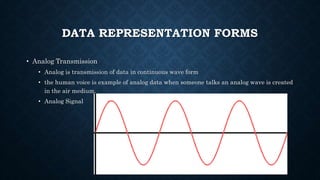
• Analog Transmission
• Analog is transmission of data in continuous wave form
• the human voice is example of analog data when someone talks an analog wave is created
in the air medium.
• Analog Signal
DATA REPRESENTATION FORMS CONT..
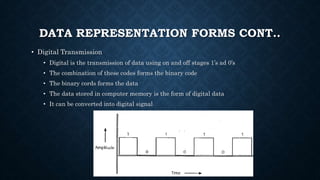
• Digital Transmission
• Digital is the transmission of data using on and off stages 1’s ad 0’s
• The combination of these codes forms the binary code
• The binary cords forms the data
• The data stored in computer memory is the form of digital data
• It can be converted into digital signal
THE END

Data communication

  • 1.
  • 2.
    OUTLINES • Data communication •Fundamental principles of communication system • Basic elements of Communication System • Data Transmission media • Protocols • Data transmission forms
  • 3.
    DATA COMMUNICATION • Datacommunication is the flow of electronic data among two nodes(computers or other devices) through communication media • in order to manage communication, the nodes must be part of communication system linked with each other via some media like cables or Wireless. • In data communication/networking computers or devices which are connected to network are termed as nodes.
  • 5.
    FUNDAMENTAL PRINCIPLES OF COMMUNICATIONSYSTEM • Delivery • The System must carry data with correct end or destination • The data must be received by correct recipient (device/user) • Accuracy • The system must deliver the data with same as it was sent • The altered or incomplete data is useless • Timeliness • The system must deliver data in time • Late delivery may not be useful • Therefor time delivery is mandatory
  • 6.
    BASIC ELEMENTS OFCOMMUNICATION SYSTEM • Message • Message is the information that is communicated over the communication system. It includes text, audio video images. • Sender • The node that is used for transferring data is called source or sender. • In recent digital system the source is mostly computer or a mobile device • Medium • Medium is the pathway through which data is sent fro one point to another. • If the receiver and sender are within the building, a wire (medium) can connect them. • If they are at different locations they maybe connected through telephone lines, fiber optics e.t.c.
  • 7.
    BASIC ELEMENTS OFCOMMUNICATION SYSTEM CONT… • Receiver • The node that receives data is called receiver. The receiver can be computer, mobile device printer • Protocols • A protocol Is set of rules which govern the data transmission between sender or receiver • Without protocol the data is useless for receiver, as a person understanding only Urdu cannot understand English messages • Therefor messages transferred through medium to received are sent through protocol so that receiver can understand the message. • Most used communication protocol is TCP/IP (Transmission control Protocol/Internet Protocol)
  • 8.
    DATA TRANSMISSION MEDIA •To connect the devices in a network, either wired media (physical cables) or wireless media (typically radio signals) can be used. • The most common wired and wireless networking media are discussed next.
  • 9.
    WIRED NETWORKING MEDIA •The most common types of wired networking media: • Twisted Pair Cable • Co-Axial Cable • Fiber optic cable
  • 10.
    TWISTED PAIR CABLE •Twisted pair is couple of copper wires, twisted together and enfolded a plastic coating. • Each pair consists of two wires used for positive data signal and negative data signal • Further divided into two categories UTP and STP • Shielded twisted pair cable • Its enclosed with foil cover and copper shielding • STP Cable uses shields to reduce outside interference • Unshielded twisted pair cable • Is not enclosed in any cover • Very flexable and easy to use
  • 12.
    WIRELESS NETWORKING MEDIA •Short Range • Bluetooth • Zigbee • Medium Range • Wifi • Large Range • WiMax • 2G,3G,4G
  • 13.
    PROTOCOLS USED INDATA COMMUNICATION • A protocol is a set of rules to be followed in a specific situation • there are communications protocols that determine how devices on a network communicate. • The most widely used communications protocol today is TCP/IP. TCP/IP is the protocol used for transferring data over the Internet and actually consists of two protocols: • Transmission Control Protocol (TCP), which is responsible for the delivery of data • and Internet Protocol (IP), which provides addresses and routing information.
  • 14.
    DATA REPRESENTATION FORMS •Analog Transmission • Analog is transmission of data in continuous wave form • the human voice is example of analog data when someone talks an analog wave is created in the air medium. • Analog Signal
  • 15.
    DATA REPRESENTATION FORMSCONT.. • Digital Transmission • Digital is the transmission of data using on and off stages 1’s ad 0’s • The combination of these codes forms the binary code • The binary cords forms the data • The data stored in computer memory is the form of digital data • It can be converted into digital signal
  • 16.