Research Methodology
in
Computer Science
and
Information Technology
Research Methodology
in
Computer Science
and
Information Technology
Lecture 1: Introduction to Research
This course will
• Encourage you to develop your research skills
• Enable you to explore the areas of interest related to your
degree specialization
• Facilitate your application of knowledge in your respective
degree specialization
• Prepare the groundwork to enable independent learning and
study during the research process
• Allow you the opportunity to critically analyze the chosen area
of study
• Assist you in identifying reliable sources of information
Research Methodology in CS & IT: Lecture 1
3
This course will NOT
• Provide you with a research title
• Solve the problems of the industry you plan to join
• Give you all the answers
Research Methodology in CS & IT: Lecture 1
4
Topics we will cover
• Types of research
• Sources of research information
• Primary and secondary research
• Methods of data collection
• Data analysis
• Research Ethics
• Critical thinking
AND… idea generation
Research Methodology in CS & IT: Lecture 1
5
Assessments
• Assignments/ midExam??/ 40%
/ Preparing a Research Proposal
/ Preparing a Scientific Paper
/ Thesis Presentation
SO, YOU NEED TIME MANAGEMENT!!!
• Final Examination 60%
Research Methodology in CS & IT: Lecture 1
6
What is Research?
• Research is:
“…the systematic process of collecting and
analyzing information (data) in order to increase
our understanding of the phenomenon about
which we are concerned or interested”
Research Methodology in CS & IT: Lecture 1
7
What is Research?
• Science develops through some systematic
observation, measurementation,
experimentation, and interpretation
procedure called “research”.
• Thus, research is the most important, if not
the only tool for development of science.
Research Methodology in CS & IT: Lecture 1
8
• “Research can be described as a systematic and
organized effort to investigate a specific problem that
needs a solution” (Sekaran 1992, p.4).
• Keywords:
1. Systematic (Methodical) and organized (planned)
2. It encompasses the processes of inquiring /
investigating – end result would help to solve
problems or suggest ways to solve problems.
What is Research?
Research Methodology in CS & IT: Lecture 1
9
More Understanding on What is
Research ?
• Research is a careful and systematic process of inquiry
to find answers to problem of interest.
• Research include:
– use of facts,
– use of theories,
– data (fact) analysis,
– sampling,
– doing an experiment,
– going to library to read up on a topic.
• To do ‘research’ is to investigate the problem
systematically and thoroughly.
• Goal of research is to solve ‘problem’ of interest
Research Methodology in CS & IT: Lecture 1
10
Research Characteristics
1. Originates with a question or problem.
2. Requires clear articulation of a goal.
3. Follows a specific plan or procedure.
4. Often divides main problem into subproblems.
5. Guided by specific problem, question, or
hypothesis.
6. Requires collection and interpretation of data.
7. Cyclical (helical) in nature.
Research Methodology in CS & IT: Lecture 1
11
The Aims of Research
• To describe about a phenomena
• To predict about “something” in the future
• To explain about solution of problem
• To interpret what is being investigate
Research Methodology in CS & IT: Lecture 1
12
Research environment
• Research is conducted mainly in the following
institutions all-over the world:
- Government or private research
institutions.
- Research and development (R&D) units
of big companies.
- Research in the universities.
Research Methodology in CS & IT: Lecture 1
13
Characteristics of research Process
Research is:
• controlled.
• rigorous (strictly accurate).
• systematic.
• empirical.
• innovative.
• usually expensive.
• Research outcomes are valid and verifiable.
Research Methodology in CS & IT: Lecture 1
14
What is IT/Computer Science Research?
• A human activity based on the intellectual
investigation of aspects of the world related to
the discipline of IT/Computer Science for the
purpose of:
– discovering new knowledge,
– interpreting existing knowledge or
– revising inaccurate or incomplete knowledge.
Research Methodology in CS & IT: Lecture 1
15
What is Computer Science?
• The body of knowledge resulting from this
discipline contains theories for understanding:
– computing systems and methods;
– design methodology, algorithms, and tools;
– methods for the testing of concepts;
– methods of analysis and verification; and
– knowledge representation and implementation.
Src: National Coordination Office for Networking and Information technology Research and Development1 (NITRD).
Research Methodology in CS & IT: Lecture 1
16
Scientific Methods
• “Methods” means way
• Methodology is the discipline of scientific
procedures.
Research Methodology in CS & IT: Lecture 1
17
What is Methodology ?
• A formalized approach to conduct research
– A series of phases and deliverables.
• Research Methodology In Computer
Science/Information System/Information
Technology (CS/IS/IT)
“A collection of methods, procedures,
techniques, tools and documentation aids which
will help the researcher in their efforts to
conduct a research in the field of CS/IS/IT”.
Research Methodology in CS & IT: Lecture 1
18
Research Methodology Vs. Research
Method
• Research Methodology:
– Conceptual frameworks and assumptions
used to inform research
– Elaboration of research method
• Research Method:
– Research technique or procedure used to
gather and analyze data
Research Methodology in CS & IT: Lecture 1
19
Research Methodology
• A research methodology will consist of phases,
sub-phases, which will guide the researchers
in their choice of the methods, techniques,
procedures, tools, etc., that might be
appropriate at each stage of the research and
also help them plan, manage, control and
evaluate the progress of research.
Research Methodology in CS & IT: Lecture 1
20
• A research methodology represents a way to
develop research systematically.
• A research methodology represents a way to
do scientific inquiry.
• A research methodology should have a sound
theoretical basis.
Research Methodology in CS & IT: Lecture 1
21
Why Methodology ?
• It will make you better able to understand and
utilize scientific information in both your
personal life and your work.
• It will make you a more literate and cultured
person.
• It provides you some insight not only into
particular scientific findings but also into
the general nature of science as a human
activity.
Research Methodology in CS & IT: Lecture 1
22
Nature of Research in CS/IS/IT
• Research in CS often requires experimental design as well as
theoretical (basic) research
– Hence, we have to have a methodology in order to
conduct research
– Science approach :new knowledge, theory
• Research in IS/IT often requires system development
– Hence, we have to have a methodology in order to
develop a system (IS/IT system)
– Engineering approach: construction of useful
products
• This IS/IT Development Methodology can be used as a
Research Methodology in IS/IT field.
Research Methodology in CS & IT: Lecture 1
23
How to Start A Research?
• Determine a well define problem
– Understanding about something
• Science approach: phenomena, theory, hypothesis,
experiment..
– Constructing product
• Engineering approach: build a system that perform a
(unique) task, experiment, convergence results
(stable)..
• Follow the steps in the research methodology
• Research results: knowledge, algorithm, method, technique,
approach, framework, product (system), model, etc…
Research Methodology in CS & IT: Lecture 1
24
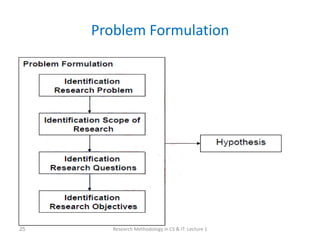
Problem Formulation
Research Methodology in CS & IT: Lecture 1
25
What does Research in degree studies
involve?
• Doing secondary research i.e. familiarising yourself
with the work of “experts” – this process is known as
a Literature Review.
• Doing a primary research – to build upon what you
have already found out about a subject.
• Comparing the findings and drawing your own
conclusions.
• So, Diploma/ Master/ PhD ?
Research Methodology in CS & IT: Lecture 1
26
The research – How !!!!
• Start with a question
• State a goal
• Form a plan
• Formulate experiments and hypotheses
• Make and state important assumptions
• Collect and interpret data
• Research doesn’t happen in straight lines
Research Methodology in CS & IT: Lecture 1
27
Purpose of Research
Two purposes:
1. To generate more knowledge and understanding of
the phenomena of interest and to build theories
based on the research results.
- Basic Research
Example: The public’s opinion of the effectiveness
of its Police Department in tracking people
released on bail (financial guarantee)..
Research Methodology in CS & IT: Lecture 1
28
2. To solve a current problem faced by the manager in
the work setting, demanding a timely solution.
- Applied Research
Example: The Police Department has asked a
research company to come up with a new system
of tracking people released on bail.
Research Methodology in CS & IT: Lecture 1
29
Types/Classifications of Research
• The research can be classified from three
perspectives:
1- Application
• Basic and applied research
2- Objectives
• Exploratory, Descriptive, or Fundamental
3- Type of data
• Qualitative and quantitative
Research Methodology in CS & IT: Lecture 1
30
Research Outcomes
• A new or improved product.
• A new theory or a reinterpretation of an existing theory.
• A new or improved research tool or technique.
• A new or improved algorithm/method.
• A new or improved model.
• A new or improved framework.
• An in-depth study.
• An exploration of a topic area or field.
• A critical analysis.
• A portfolio of work based on research.
• A fact or conclusion, or a collection of facts or conclusions.
Research Methodology in CS & IT: Lecture 1
31
Research Process Steps
1. Selection of research area (Defining a problem)
2. Preliminary information gathering (Informal
Secondary Research)
3. Literature Review (formal secondary research)
4. Hypothesising
5. Further data collection (Primary Research)
6. Data analysis
7. Deduction (conclusion)
8. Writing the report/ article/ thesis …
Research Methodology in CS & IT: Lecture 1
32
Originality in research
• Originality is a "must" in research.
• It is a high-profile requirement.
• You should develop the necessary skills to
recognize "what is original?" and implement it
into your work.
• It may need a considerable incubation period for
the creative skills to function effectively in
development of originality in your research.
• You need to appreciate the scope and potential
of originality.
Research Methodology in CS & IT: Lecture 1
33
The research process: an eight-step model
• Phase I: deciding what to research
– Step I: formulating a research problem
• Phase II: planning a research study
– Step II: conceptualizing a research design
– Step III: constructing an instrument for data collection
– Step IV: selecting a sample
– Step V: writing a research proposal
• Phase III: conducting a research study
– Step VI: collecting data
– Step VII: processing and displaying data
– Step VIII: writing a research report
Research Methodology in CS & IT: Lecture 1
34

01 Introduction to Research.pptx

  • 1.
  • 2.
    Research Methodology in Computer Science and InformationTechnology Lecture 1: Introduction to Research
  • 3.
    This course will •Encourage you to develop your research skills • Enable you to explore the areas of interest related to your degree specialization • Facilitate your application of knowledge in your respective degree specialization • Prepare the groundwork to enable independent learning and study during the research process • Allow you the opportunity to critically analyze the chosen area of study • Assist you in identifying reliable sources of information Research Methodology in CS & IT: Lecture 1 3
  • 4.
    This course willNOT • Provide you with a research title • Solve the problems of the industry you plan to join • Give you all the answers Research Methodology in CS & IT: Lecture 1 4
  • 5.
    Topics we willcover • Types of research • Sources of research information • Primary and secondary research • Methods of data collection • Data analysis • Research Ethics • Critical thinking AND… idea generation Research Methodology in CS & IT: Lecture 1 5
  • 6.
    Assessments • Assignments/ midExam??/40% / Preparing a Research Proposal / Preparing a Scientific Paper / Thesis Presentation SO, YOU NEED TIME MANAGEMENT!!! • Final Examination 60% Research Methodology in CS & IT: Lecture 1 6
  • 7.
    What is Research? •Research is: “…the systematic process of collecting and analyzing information (data) in order to increase our understanding of the phenomenon about which we are concerned or interested” Research Methodology in CS & IT: Lecture 1 7
  • 8.
    What is Research? •Science develops through some systematic observation, measurementation, experimentation, and interpretation procedure called “research”. • Thus, research is the most important, if not the only tool for development of science. Research Methodology in CS & IT: Lecture 1 8
  • 9.
    • “Research canbe described as a systematic and organized effort to investigate a specific problem that needs a solution” (Sekaran 1992, p.4). • Keywords: 1. Systematic (Methodical) and organized (planned) 2. It encompasses the processes of inquiring / investigating – end result would help to solve problems or suggest ways to solve problems. What is Research? Research Methodology in CS & IT: Lecture 1 9
  • 10.
    More Understanding onWhat is Research ? • Research is a careful and systematic process of inquiry to find answers to problem of interest. • Research include: – use of facts, – use of theories, – data (fact) analysis, – sampling, – doing an experiment, – going to library to read up on a topic. • To do ‘research’ is to investigate the problem systematically and thoroughly. • Goal of research is to solve ‘problem’ of interest Research Methodology in CS & IT: Lecture 1 10
  • 11.
    Research Characteristics 1. Originateswith a question or problem. 2. Requires clear articulation of a goal. 3. Follows a specific plan or procedure. 4. Often divides main problem into subproblems. 5. Guided by specific problem, question, or hypothesis. 6. Requires collection and interpretation of data. 7. Cyclical (helical) in nature. Research Methodology in CS & IT: Lecture 1 11
  • 12.
    The Aims ofResearch • To describe about a phenomena • To predict about “something” in the future • To explain about solution of problem • To interpret what is being investigate Research Methodology in CS & IT: Lecture 1 12
  • 13.
    Research environment • Researchis conducted mainly in the following institutions all-over the world: - Government or private research institutions. - Research and development (R&D) units of big companies. - Research in the universities. Research Methodology in CS & IT: Lecture 1 13
  • 14.
    Characteristics of researchProcess Research is: • controlled. • rigorous (strictly accurate). • systematic. • empirical. • innovative. • usually expensive. • Research outcomes are valid and verifiable. Research Methodology in CS & IT: Lecture 1 14
  • 15.
    What is IT/ComputerScience Research? • A human activity based on the intellectual investigation of aspects of the world related to the discipline of IT/Computer Science for the purpose of: – discovering new knowledge, – interpreting existing knowledge or – revising inaccurate or incomplete knowledge. Research Methodology in CS & IT: Lecture 1 15
  • 16.
    What is ComputerScience? • The body of knowledge resulting from this discipline contains theories for understanding: – computing systems and methods; – design methodology, algorithms, and tools; – methods for the testing of concepts; – methods of analysis and verification; and – knowledge representation and implementation. Src: National Coordination Office for Networking and Information technology Research and Development1 (NITRD). Research Methodology in CS & IT: Lecture 1 16
  • 17.
    Scientific Methods • “Methods”means way • Methodology is the discipline of scientific procedures. Research Methodology in CS & IT: Lecture 1 17
  • 18.
    What is Methodology? • A formalized approach to conduct research – A series of phases and deliverables. • Research Methodology In Computer Science/Information System/Information Technology (CS/IS/IT) “A collection of methods, procedures, techniques, tools and documentation aids which will help the researcher in their efforts to conduct a research in the field of CS/IS/IT”. Research Methodology in CS & IT: Lecture 1 18
  • 19.
    Research Methodology Vs.Research Method • Research Methodology: – Conceptual frameworks and assumptions used to inform research – Elaboration of research method • Research Method: – Research technique or procedure used to gather and analyze data Research Methodology in CS & IT: Lecture 1 19
  • 20.
    Research Methodology • Aresearch methodology will consist of phases, sub-phases, which will guide the researchers in their choice of the methods, techniques, procedures, tools, etc., that might be appropriate at each stage of the research and also help them plan, manage, control and evaluate the progress of research. Research Methodology in CS & IT: Lecture 1 20
  • 21.
    • A researchmethodology represents a way to develop research systematically. • A research methodology represents a way to do scientific inquiry. • A research methodology should have a sound theoretical basis. Research Methodology in CS & IT: Lecture 1 21
  • 22.
    Why Methodology ? •It will make you better able to understand and utilize scientific information in both your personal life and your work. • It will make you a more literate and cultured person. • It provides you some insight not only into particular scientific findings but also into the general nature of science as a human activity. Research Methodology in CS & IT: Lecture 1 22
  • 23.
    Nature of Researchin CS/IS/IT • Research in CS often requires experimental design as well as theoretical (basic) research – Hence, we have to have a methodology in order to conduct research – Science approach :new knowledge, theory • Research in IS/IT often requires system development – Hence, we have to have a methodology in order to develop a system (IS/IT system) – Engineering approach: construction of useful products • This IS/IT Development Methodology can be used as a Research Methodology in IS/IT field. Research Methodology in CS & IT: Lecture 1 23
  • 24.
    How to StartA Research? • Determine a well define problem – Understanding about something • Science approach: phenomena, theory, hypothesis, experiment.. – Constructing product • Engineering approach: build a system that perform a (unique) task, experiment, convergence results (stable).. • Follow the steps in the research methodology • Research results: knowledge, algorithm, method, technique, approach, framework, product (system), model, etc… Research Methodology in CS & IT: Lecture 1 24
  • 25.
  • 26.
    What does Researchin degree studies involve? • Doing secondary research i.e. familiarising yourself with the work of “experts” – this process is known as a Literature Review. • Doing a primary research – to build upon what you have already found out about a subject. • Comparing the findings and drawing your own conclusions. • So, Diploma/ Master/ PhD ? Research Methodology in CS & IT: Lecture 1 26
  • 27.
    The research –How !!!! • Start with a question • State a goal • Form a plan • Formulate experiments and hypotheses • Make and state important assumptions • Collect and interpret data • Research doesn’t happen in straight lines Research Methodology in CS & IT: Lecture 1 27
  • 28.
    Purpose of Research Twopurposes: 1. To generate more knowledge and understanding of the phenomena of interest and to build theories based on the research results. - Basic Research Example: The public’s opinion of the effectiveness of its Police Department in tracking people released on bail (financial guarantee).. Research Methodology in CS & IT: Lecture 1 28
  • 29.
    2. To solvea current problem faced by the manager in the work setting, demanding a timely solution. - Applied Research Example: The Police Department has asked a research company to come up with a new system of tracking people released on bail. Research Methodology in CS & IT: Lecture 1 29
  • 30.
    Types/Classifications of Research •The research can be classified from three perspectives: 1- Application • Basic and applied research 2- Objectives • Exploratory, Descriptive, or Fundamental 3- Type of data • Qualitative and quantitative Research Methodology in CS & IT: Lecture 1 30
  • 31.
    Research Outcomes • Anew or improved product. • A new theory or a reinterpretation of an existing theory. • A new or improved research tool or technique. • A new or improved algorithm/method. • A new or improved model. • A new or improved framework. • An in-depth study. • An exploration of a topic area or field. • A critical analysis. • A portfolio of work based on research. • A fact or conclusion, or a collection of facts or conclusions. Research Methodology in CS & IT: Lecture 1 31
  • 32.
    Research Process Steps 1.Selection of research area (Defining a problem) 2. Preliminary information gathering (Informal Secondary Research) 3. Literature Review (formal secondary research) 4. Hypothesising 5. Further data collection (Primary Research) 6. Data analysis 7. Deduction (conclusion) 8. Writing the report/ article/ thesis … Research Methodology in CS & IT: Lecture 1 32
  • 33.
    Originality in research •Originality is a "must" in research. • It is a high-profile requirement. • You should develop the necessary skills to recognize "what is original?" and implement it into your work. • It may need a considerable incubation period for the creative skills to function effectively in development of originality in your research. • You need to appreciate the scope and potential of originality. Research Methodology in CS & IT: Lecture 1 33
  • 34.
    The research process:an eight-step model • Phase I: deciding what to research – Step I: formulating a research problem • Phase II: planning a research study – Step II: conceptualizing a research design – Step III: constructing an instrument for data collection – Step IV: selecting a sample – Step V: writing a research proposal • Phase III: conducting a research study – Step VI: collecting data – Step VII: processing and displaying data – Step VIII: writing a research report Research Methodology in CS & IT: Lecture 1 34