How to write a research
proposal
By
Hebatalla Mohamed Aly
Lecturer of occupational medicine
Outlines
• Definition of research
• What is research proposal?
• Why we need a research proposal?
• What are the elements of a research
proposal?
Definition of research
• Research is the systematic collection, analysis
and interpretation of data to answer a certain
question or solve a problem.
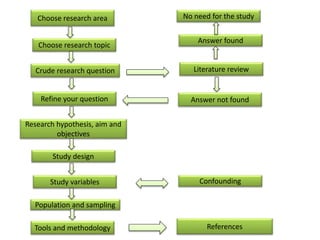
• It is crucial to follow cascading scientific steps
when conducting one’s research
Choose research area
Choose research topic
Crude research question Literature review
Answer found
Answer not foundRefine your question
Research hypothesis, aim and
objectives
Study design
Population and sampling
Tools and methodology
Study variables
No need for the study
References
Confounding
Research proposal
• The research protocol is the detailed plan of the
study.
• Research proposal should include:
 The broad topic you would like to research,
 What the research would set out to achieve (aims
and objectives),
 What is your plan for researching it (methodology),
 How you would undertake it within the time
available (time table) and
 What the results might be in
relation to knowledge and
understanding in the subject
(potential outcomes).
Why we need a research proposal
• Forces the investigators to clarify their thoughts and to
think about all aspects of the study;
• Research proposal is intended to convince others that
you have a worthwhile research project and that you
have the competence and the work-plan to complete it.
• A necessary guide if a team (not a single investigator) is
working on the research;
• Is essential if the study involves research on human
subjects or is on experimental animals, in order to get
the institution’s ethical approval;
• Is an essential component of a research proposal
submitted for funding.
Selection of research area
• Select your broad research area based on:
–Researcher’s:
• Specialty
• Interest
• Scientific background
• Experience
–Actual need for research in this area
–Available resources (interest of funding
body)
Selection of research topic
Selecting a research topic depends on:
– The characteristics of the problem (topic):
• Impact on health:
– Magnitude
– Seriousness
– Preventability
– Curability
• Available interventions
• Proposed solutions
– The characteristics of the proposed study:
• Feasibility
• Cost-effectiveness
• Applicability of the results
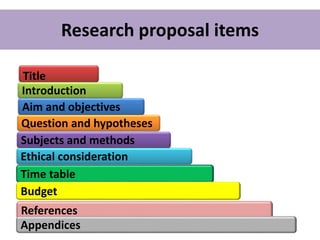
Research proposal items
Title
Introduction
Aim and objectives
Question and hypotheses
Subjects and methods
Ethical consideration
Time table
Budget
References
Appendices
Title
• The title should be descriptive and concise.
• It may need to be revised after completion of
the writing of the protocol to reflect more
closely the sense of the study.
Introduction and rationale
• Introduction should provide the
background of the research study.
• In an introduction, the writer
should:
 Create reader interest in the
topic.
 Explain the fundamental
reasons for your research.
 Justify your work
 Answer the question of why
and what: why the research
needs to be done and what will
be its relevance.
Aim and objectives
• Aim ≠ objectives
• Aim: It describes the goal of the work in broad
terms
• Objectives: more specific and relate directly to
the problem (question). They are classified
into 2 types
Primary objectives (must be achieved)
Secondary objectives (by the way)
Aim and objectives
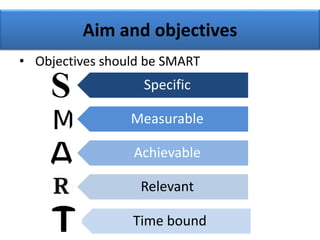
• Objectives should be SMART
Specific
Measurable
Achievable
Relevant
Time bound
Aim and objectives
• Objectives should be:
Closely related to the research question
Covering all aspects of the problem
Very specific
Ordered in a logical sequence
Stated in action verbs that could be evaluated e.g.
to describe, to identify, to measure, to compare,
etc.
Achievable, taking into consideration the available
resources and time
Mutually exclusive, with no repetitions or overlaps
Question and hypotheses
• Make sure that
The question is clear and specific
It has no answer by common sense
It has no answer in the LITERATURE
Finding an answer to the question will solve or
at least help in solving the problem to be
studied.
• Research hypothesis is a statement of (answer
to) the research question in a measurable form.
Question and hypotheses
• Two types of hypotheses are used in research
Alternative hypothesis (H1): The hypothesis
stated by the researcher  the objective of
the study.
Null hypothesis (H0): The opposite of the
alternative hypothesis  is the assumption
that the alternative hypothesis is not true.
Formulation of hypotheses
• Does a research question has only one
hypothesis??
e.g. a prospective cohort study
Designed to answer the
following question “Is aspirin
use reduce the risk of stroke?”
What is the suggested hypothesis??
Formulation of hypotheses
• H1 (prevalence of stroke is lower among patients
who take aspirin regularly compared to patients
who don’t).
• H1 (incidence of stroke is lower among patients
who take aspirin regularly compared to patients
who don’t).
• H1 (patients who use aspirin regularly have reduced
risk of stroke compared to those who don’t).
• H1(there is a negative correlation between dose of
aspirin used and incidence of stroke).
• H1 (there is a significant association between
aspirin use and stroke)
Criteria of sound hypotheses
• Based on plausible scientific background
• Translating the research question
• Using study variables
• Stated in measurable terms
• Testing only one relationship or
phenomenon
• Directional
• Reflecting study design
Subjects and Methods
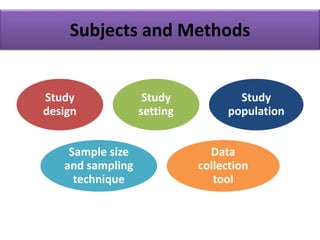
Study
design
Study
setting
Study
population
Sample size
and sampling
technique
Data
collection
tool
Subjects and Methods
• The researcher’s overall plan to obtain an answer
to the research question.
• A fundamental decision is whether :
To take a passive role in observing the events
taking place in the study subjects 
observational study or
 To apply an intervention and examine its effects
on these events  clinical trial.
Study
design
Subjects and Methods
• A typical sequence for studying a topic begins with
observational studies of a type that is often called
descriptive,
• Descriptive studies are usually followed or
accompanied by analytic studies that evaluate
associations to permit inferences about cause and
effect relationship.
(cohort, case control, cross sectional).
• The final step is often a clinical trial to establish the
effects of an intervention.
Study
design
Subjects and Methods
• Where the study will be carried out?
• The group in which the study will be carried out
and to whom will the results refer.
Study
setting
Study
population
Subjects and Methods
• The definition of the sampling unit is done by
setting:
– Inclusion criteria
– Exclusion criteria
(exclusion criteria are not the opposite of inclusion
criteria)
Study
population
Subjects and Methods
• Is the process of selection of a number of units
from a defined study population.
• It involves:
1. Estimation of the sample size
2. Choice of sampling method
Sampling
Subjects and Methods
• Sample size calculation: to determine the
appropriate number of samples that should be
studied with justification
• Calculation of sample size has been made easy
by computer software programs. But the
principles underlying the estimation should be
well understood
Sample
size
Subjects and Methods
• A larger sample size than needed to test the research
hypothesis
 Increases the cost and duration of the study
 Will be unethical (it exposes human subjects to any
potential unnecessary risk without additional
benefit).
• A smaller sample size than needed can also be
unethical (it exposes human subjects to risk with no
benefit to scientific knowledge).
Sample
size
Subjects and Methods
Sampling
technique
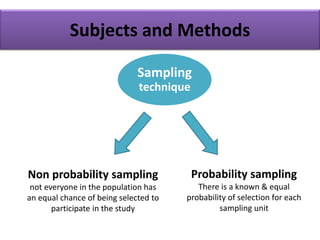
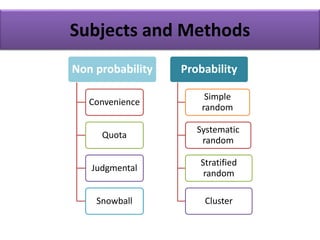
Non probability sampling
not everyone in the population has
an equal chance of being selected to
participate in the study
Probability sampling
There is a known & equal
probability of selection for each
sampling unit
Non probability
Convenience
Quota
Judgmental
Snowball
Probability
Simple
random
Systematic
random
Stratified
random
Cluster
Subjects and Methods
Subjects and methods
• Data are variable:
 Quantitative (continuous, discrete)
 Qualitative (nominal, ordinal)
• Data collection tool/s:
 Using available information (records)
 Observation (checklist)
 Self-administered questionnaire
 Interviewing (individual/group)
 Measuring (all lab. tests and other investigations
Data
collection
Subjects and methods
• Data management: dealing with data
throughout the study
Preparation of data entry
Data entry
Data analysis
Data presentation
Data
collection
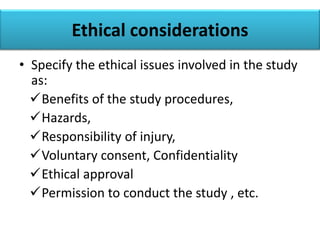
Ethical considerations
• Specify the ethical issues involved in the study
as:
Benefits of the study procedures,
Hazards,
Responsibility of injury,
Voluntary consent, Confidentiality
Ethical approval
Permission to conduct the study , etc.
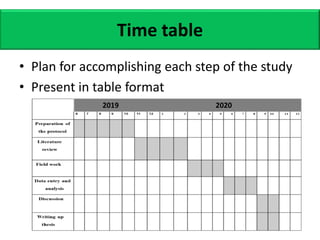
Time table
• Plan for accomplishing each step of the study
• Present in table format
2019 2020
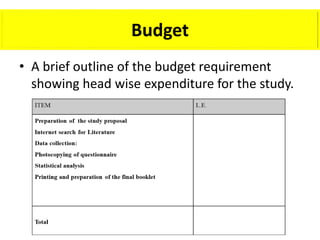
Budget
• A brief outline of the budget requirement
showing head wise expenditure for the study.
References
• The protocol should end with relevant
references on the subject.
• In this section list of the various references
quoted while formulating protocol may be
listed in a sequential manner.
Appendices
• All the formats/questionnaires that may be
used in the study should be placed in a
systematic manner.
• Forms for informed consent
How to write a research proposal

How to write a research proposal

  • 1.
    How to writea research proposal By Hebatalla Mohamed Aly Lecturer of occupational medicine
  • 2.
    Outlines • Definition ofresearch • What is research proposal? • Why we need a research proposal? • What are the elements of a research proposal?
  • 3.
    Definition of research •Research is the systematic collection, analysis and interpretation of data to answer a certain question or solve a problem. • It is crucial to follow cascading scientific steps when conducting one’s research
  • 4.
    Choose research area Chooseresearch topic Crude research question Literature review Answer found Answer not foundRefine your question Research hypothesis, aim and objectives Study design Population and sampling Tools and methodology Study variables No need for the study References Confounding
  • 5.
    Research proposal • Theresearch protocol is the detailed plan of the study. • Research proposal should include:  The broad topic you would like to research,  What the research would set out to achieve (aims and objectives),  What is your plan for researching it (methodology),  How you would undertake it within the time available (time table) and  What the results might be in relation to knowledge and understanding in the subject (potential outcomes).
  • 6.
    Why we needa research proposal • Forces the investigators to clarify their thoughts and to think about all aspects of the study; • Research proposal is intended to convince others that you have a worthwhile research project and that you have the competence and the work-plan to complete it. • A necessary guide if a team (not a single investigator) is working on the research; • Is essential if the study involves research on human subjects or is on experimental animals, in order to get the institution’s ethical approval; • Is an essential component of a research proposal submitted for funding.
  • 7.
    Selection of researcharea • Select your broad research area based on: –Researcher’s: • Specialty • Interest • Scientific background • Experience –Actual need for research in this area –Available resources (interest of funding body)
  • 8.
    Selection of researchtopic Selecting a research topic depends on: – The characteristics of the problem (topic): • Impact on health: – Magnitude – Seriousness – Preventability – Curability • Available interventions • Proposed solutions – The characteristics of the proposed study: • Feasibility • Cost-effectiveness • Applicability of the results
  • 9.
    Research proposal items Title Introduction Aimand objectives Question and hypotheses Subjects and methods Ethical consideration Time table Budget References Appendices
  • 10.
    Title • The titleshould be descriptive and concise. • It may need to be revised after completion of the writing of the protocol to reflect more closely the sense of the study.
  • 11.
    Introduction and rationale •Introduction should provide the background of the research study. • In an introduction, the writer should:  Create reader interest in the topic.  Explain the fundamental reasons for your research.  Justify your work  Answer the question of why and what: why the research needs to be done and what will be its relevance.
  • 12.
    Aim and objectives •Aim ≠ objectives • Aim: It describes the goal of the work in broad terms • Objectives: more specific and relate directly to the problem (question). They are classified into 2 types Primary objectives (must be achieved) Secondary objectives (by the way)
  • 13.
    Aim and objectives •Objectives should be SMART Specific Measurable Achievable Relevant Time bound
  • 14.
    Aim and objectives •Objectives should be: Closely related to the research question Covering all aspects of the problem Very specific Ordered in a logical sequence Stated in action verbs that could be evaluated e.g. to describe, to identify, to measure, to compare, etc. Achievable, taking into consideration the available resources and time Mutually exclusive, with no repetitions or overlaps
  • 15.
    Question and hypotheses •Make sure that The question is clear and specific It has no answer by common sense It has no answer in the LITERATURE Finding an answer to the question will solve or at least help in solving the problem to be studied. • Research hypothesis is a statement of (answer to) the research question in a measurable form.
  • 16.
    Question and hypotheses •Two types of hypotheses are used in research Alternative hypothesis (H1): The hypothesis stated by the researcher  the objective of the study. Null hypothesis (H0): The opposite of the alternative hypothesis  is the assumption that the alternative hypothesis is not true.
  • 17.
    Formulation of hypotheses •Does a research question has only one hypothesis?? e.g. a prospective cohort study Designed to answer the following question “Is aspirin use reduce the risk of stroke?” What is the suggested hypothesis??
  • 18.
    Formulation of hypotheses •H1 (prevalence of stroke is lower among patients who take aspirin regularly compared to patients who don’t). • H1 (incidence of stroke is lower among patients who take aspirin regularly compared to patients who don’t). • H1 (patients who use aspirin regularly have reduced risk of stroke compared to those who don’t). • H1(there is a negative correlation between dose of aspirin used and incidence of stroke). • H1 (there is a significant association between aspirin use and stroke)
  • 19.
    Criteria of soundhypotheses • Based on plausible scientific background • Translating the research question • Using study variables • Stated in measurable terms • Testing only one relationship or phenomenon • Directional • Reflecting study design
  • 20.
    Subjects and Methods Study design Study setting Study population Samplesize and sampling technique Data collection tool
  • 21.
    Subjects and Methods •The researcher’s overall plan to obtain an answer to the research question. • A fundamental decision is whether : To take a passive role in observing the events taking place in the study subjects  observational study or  To apply an intervention and examine its effects on these events  clinical trial. Study design
  • 22.
    Subjects and Methods •A typical sequence for studying a topic begins with observational studies of a type that is often called descriptive, • Descriptive studies are usually followed or accompanied by analytic studies that evaluate associations to permit inferences about cause and effect relationship. (cohort, case control, cross sectional). • The final step is often a clinical trial to establish the effects of an intervention. Study design
  • 23.
    Subjects and Methods •Where the study will be carried out? • The group in which the study will be carried out and to whom will the results refer. Study setting Study population
  • 24.
    Subjects and Methods •The definition of the sampling unit is done by setting: – Inclusion criteria – Exclusion criteria (exclusion criteria are not the opposite of inclusion criteria) Study population
  • 25.
    Subjects and Methods •Is the process of selection of a number of units from a defined study population. • It involves: 1. Estimation of the sample size 2. Choice of sampling method Sampling
  • 26.
    Subjects and Methods •Sample size calculation: to determine the appropriate number of samples that should be studied with justification • Calculation of sample size has been made easy by computer software programs. But the principles underlying the estimation should be well understood Sample size
  • 27.
    Subjects and Methods •A larger sample size than needed to test the research hypothesis  Increases the cost and duration of the study  Will be unethical (it exposes human subjects to any potential unnecessary risk without additional benefit). • A smaller sample size than needed can also be unethical (it exposes human subjects to risk with no benefit to scientific knowledge). Sample size
  • 28.
    Subjects and Methods Sampling technique Nonprobability sampling not everyone in the population has an equal chance of being selected to participate in the study Probability sampling There is a known & equal probability of selection for each sampling unit
  • 29.
  • 30.
    Subjects and methods •Data are variable:  Quantitative (continuous, discrete)  Qualitative (nominal, ordinal) • Data collection tool/s:  Using available information (records)  Observation (checklist)  Self-administered questionnaire  Interviewing (individual/group)  Measuring (all lab. tests and other investigations Data collection
  • 31.
    Subjects and methods •Data management: dealing with data throughout the study Preparation of data entry Data entry Data analysis Data presentation Data collection
  • 32.
    Ethical considerations • Specifythe ethical issues involved in the study as: Benefits of the study procedures, Hazards, Responsibility of injury, Voluntary consent, Confidentiality Ethical approval Permission to conduct the study , etc.
  • 33.
    Time table • Planfor accomplishing each step of the study • Present in table format 2019 2020
  • 34.
    Budget • A briefoutline of the budget requirement showing head wise expenditure for the study.
  • 35.
    References • The protocolshould end with relevant references on the subject. • In this section list of the various references quoted while formulating protocol may be listed in a sequential manner.
  • 36.
    Appendices • All theformats/questionnaires that may be used in the study should be placed in a systematic manner. • Forms for informed consent