Research methodology PPT for Medical Laboratory Sciences x
1.
05/26/2025 1
Research methodology
CourseCode: ComH3151
ECTS: 3
Hadush Negash (MSc in Medical Microbiology)
hadunegash@gmail.com or
hadush.negash@adu.edu.et or
hadunegash@yahoo.com
2.
05/26/2025 2
Chapter 1Introduction to research
Chapter objectives:-
– Define research
– Define health research
– Identify types of research
– Identify Characteristics of Research
– Define health systems research
– Identify main components of any research work
3.
05/26/2025 3
Define research
Research:-A systematic collection, analysis and interpretation of data to
solve a problem
• Is a systematic search for information and new knowledge
• It is a primary tool used in all areas of science to expand the frontiers of
knowledge
Types of research
– Basic vs. Applied Research
– Experimental vs. Non-Experimental
– Analytical vs. Descriptive
– Quantitative vs. Qualitative Research
4.
05/26/2025 4
Basic VsApplied research
Basic research - To generate new knowledge and technologies
Applied research - Solution to problems
-To identify priority problems
– Experimental vs. Non-Experimental
Experimental: RCT, CCT
Observational: Cross-sectional, case control, cohort
- Analytical vs. Descriptive
Analytical: Why? How? For determinants
Descriptive: when? Where? What? ppt
5.
Basic Vs AppliedResearch
Basic research (fundamental or pure research)
Has as its primary objective the advancement of knowledge and
Theoretical understanding of the relations among variables
Provides the foundation for further, sometimes applied research
Applied research
Is original work undertaken in order to acquire new knowledge with a
specific application in view
Is a research that seeks to solve practical problems
6.
Research Design
Refers tothe overall structure or plan of the research
Research Methods
Refers to:
The practices and techniques used to collect, process and analyze
data
The sample size and methods of sampling
In the case of experiments and analytical studies, of assignment to
experimental and control groups
Need to present and justify the appropriateness of the chosen research
methods
7.
05/26/2025 ADU. MEDICALLAB 7
7
Qualitative Research
To gain a qualitative
understanding of the
underlying reasons and
motivations
Small number of non-
representative cases
Unstructured
Non-statistical
Develop an initial
understanding
answers to questions
why? How?
Objective
Sample
Data Collection
Data Analysis
Outcome
Quantitative Research
To quantify the data and
generalize the results from
the sample to the population
of interest
Large number of
representative cases
Structured
Statistical
Recommend a final course of
action
questions about how much?
How many? How often?
Qualitative vs. Quantitative Research
8.
05/26/2025 ADU. MEDICALLAB 8
Health research
• Generation of new knowledge using scientific method to identify and deal
with health problems
• Essential to effectively promote the health of the population
• Process of obtaining systematic knowledge and technology which can be
used for the improvement of the health of individual/groups
• Provides basic information on the state of health and diseases
• Aims to develop tools to prevent and cure illness and mitigate its effects
• Attempts to devise better approaches to health care for the individual and
community
9.
05/26/2025 ADU. MEDICALLAB 9
Characteristics of Health Research
It demands a clear statement of the problem
Refining statement of the problem
It requires a plan
It is not aimlessly looking for something
It builds on existing data, using both positive and negative findings
New data should be collected as required and be organized in such a way
that they answer the original research question/s
Research project follow a logical sequence
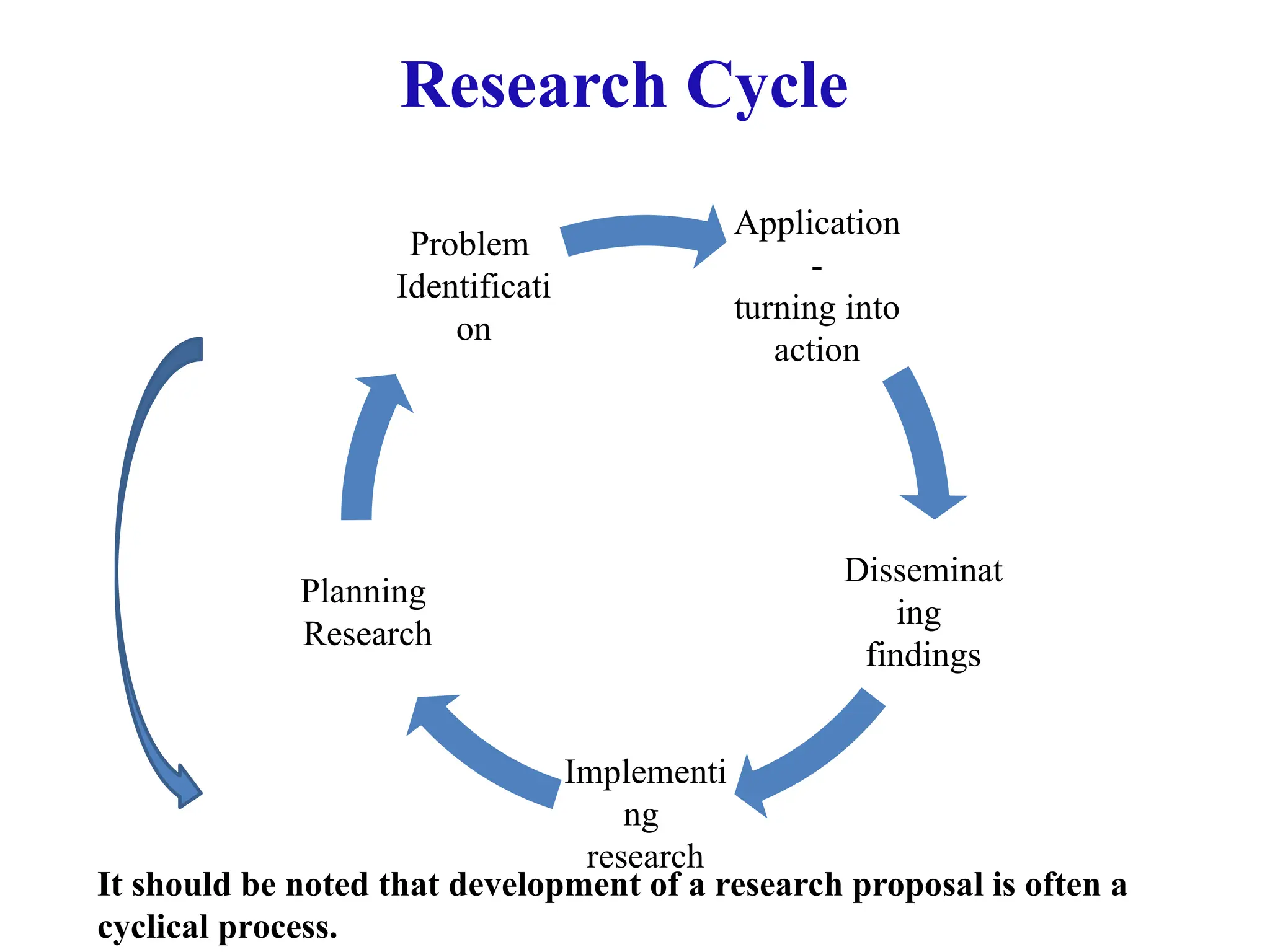
It is a circular process
11
Purposeful: Whatdo you want to be able to contribute?
Targeted: Who are the audiences?
Credible: Consider sources of information, method of data collection,
personnel involved
Timely: Is the information needed?
Research is done to find solutions to health problems.
Research must be
12.
12
Is simple
Has clear question (s)
Good rationale
Appropriate methodology
Clear expectation of the outputs
Main components of research question
1. Preparing a research proposal
2. Field work (i.e. data collections)
3. Analyzing data and preparing a research report
Good research
13.
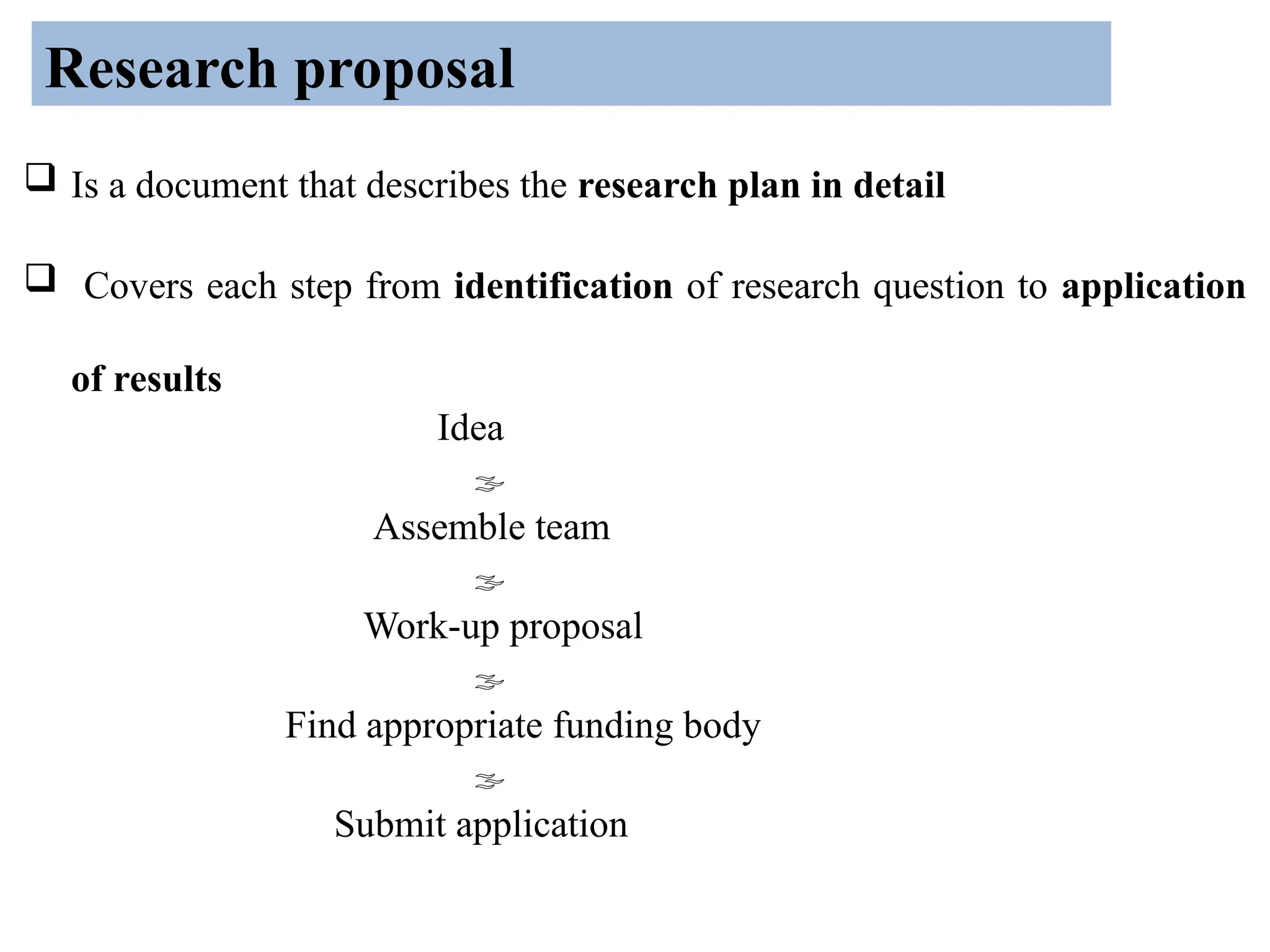
Is adocument that describes the research plan in detail
Covers each step from identification of research question to application
of results
Idea
Assemble team
Work-up proposal
Find appropriate funding body
Submit application
Research proposal
14.
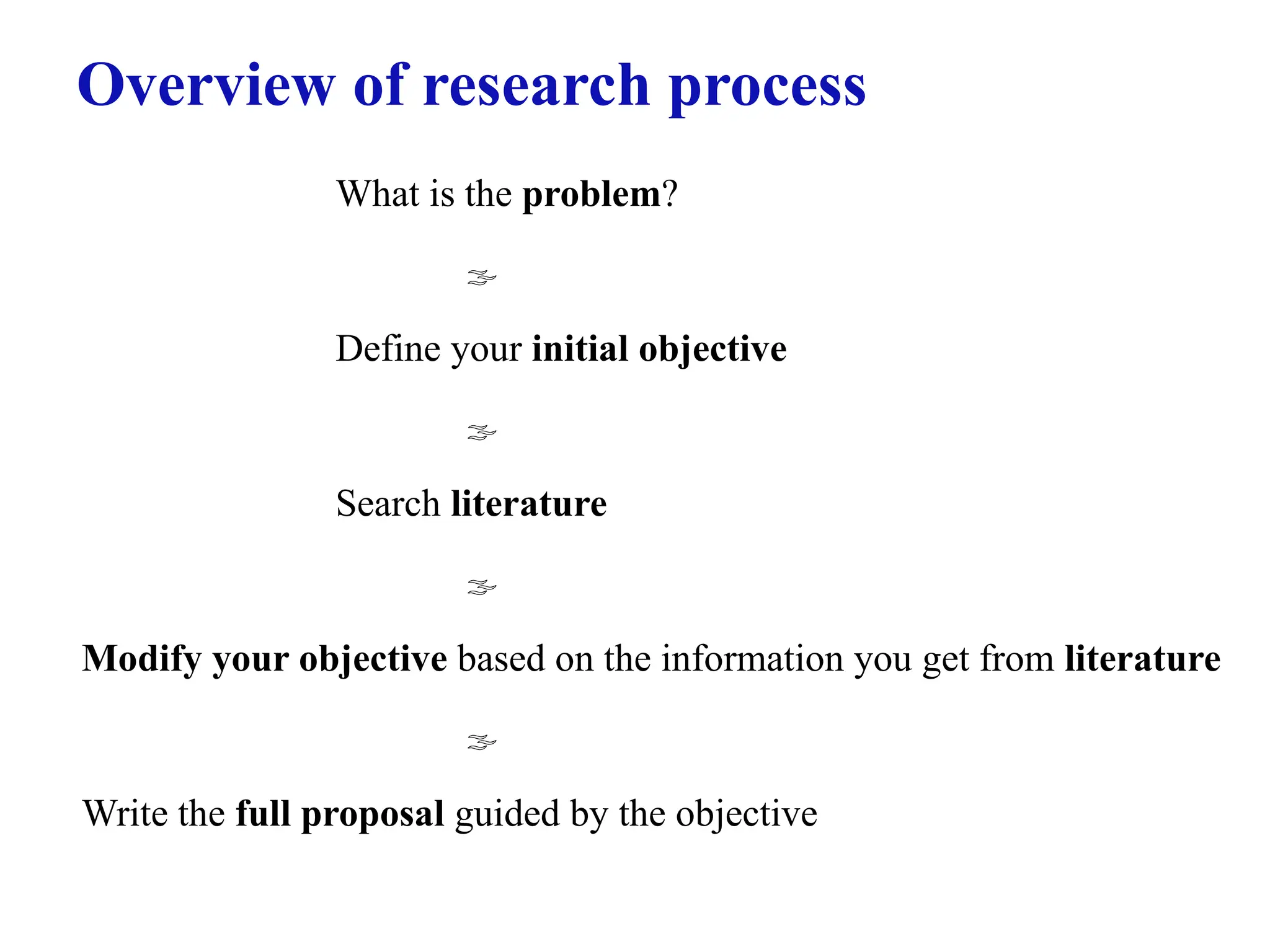
Overview of researchprocess
What is the problem?
Define your initial objective
Search literature
Modify your objective based on the information you get from literature
Write the full proposal guided by the objective
15.
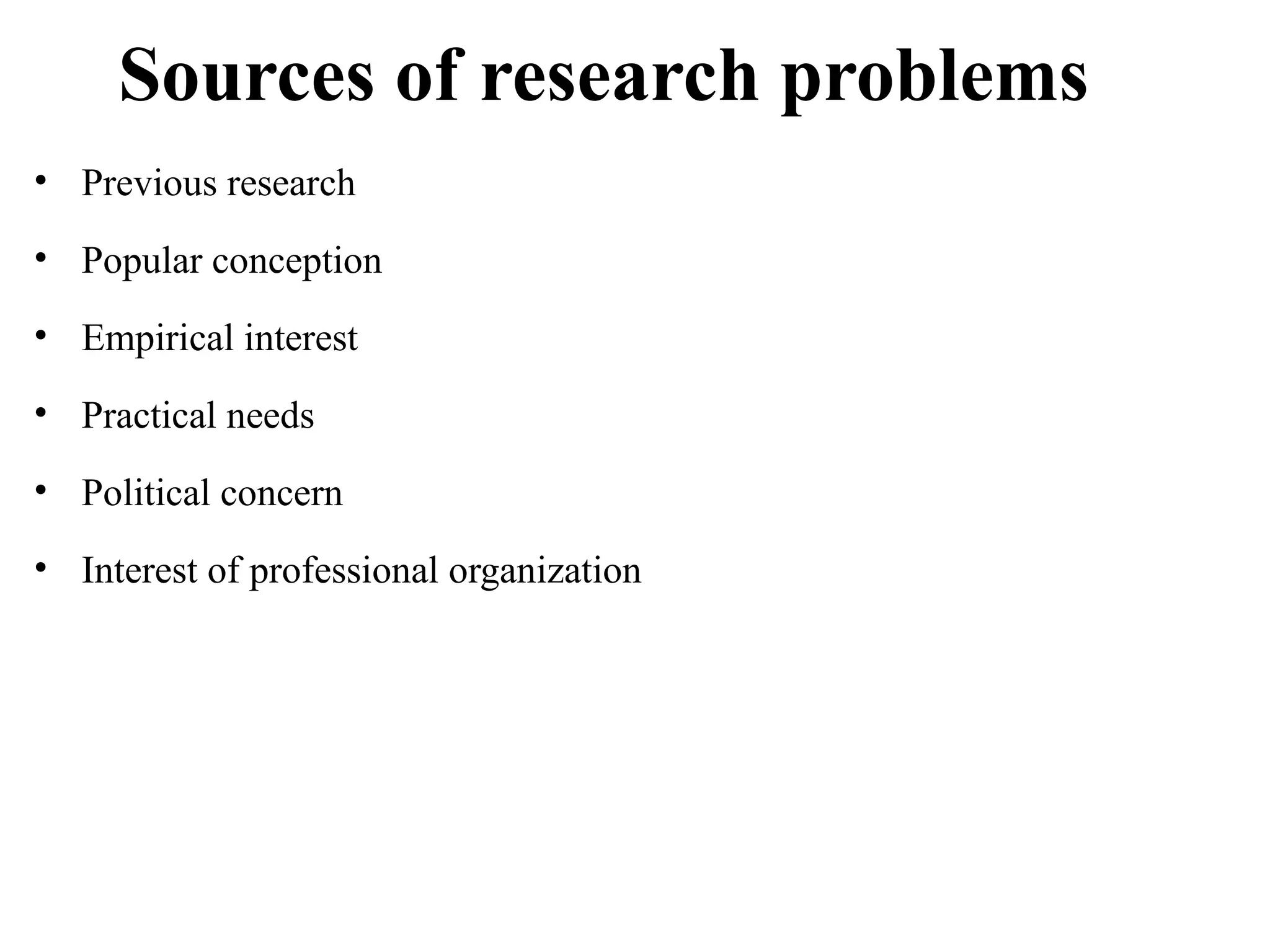
Sources of researchproblems
• Previous research
• Popular conception
• Empirical interest
• Practical needs
• Political concern
• Interest of professional organization
Objectives
• Usually classifiedinto general and specific objectives
General objective:
– Summarizes what is to be achieved by the study
– Should be clearly related to the statement of the problem
Specific objectives:
– Are logically connected parts of the general objective
- Use action verbs such as:
- Determine - Verify - Identify
- Describe - Compare
– Calculate - Establish - Explore
18.
Importance of developingobjectives
• Focus the study
• Avoid the collection of data which are not strictly necessary
• Facilitate the development of research methodology and help to orient
the collection, analysis, interpretation and utilization of data
• Helps for evaluating the project
Research objectives can be stated as:
A) Questions: “The objectives of this study are to answer the following
questions …”
B) Positive sentence: “The objectives of this study are to determine …”
C) Hypothesis: “The objective of this study is to verify the following
hypothesis...”
19.
Choosing study paradigms
Paradigmoptions
Quantitative
Qualitative
Mixed
Criteria for selecting a research paradigm
1) The research problem
2) Personal experience
3) Audience
4) Resources available for the study
20.
1) The researchproblem
Research problems call for specific approaches
If the problems calls for:
a) The identification of factors that influence an outcome
b) The utility of an intervention
c) Knowing the prevalence of diseases
Then a quantitative approach is best
If a concept or phenomenon needs to be understood because little
research has been done on it
qualitative approach is preferred
21.
2) personal experience
•Researcher’s personal training and experience influence the choice of the
approach
An individual trained in technical, scientific writing, statistics and
familiar with quantitative journals most likely choose quantitative design
Individuals who enjoy writing in a literary way or conducting personal
interviews, or making up-close observations prefer qualitative approach
The mixed methods researcher is an individual familiar with both
quantitative and qualitative research
22.
3) Audience
• Researcherswrite for audiences that will accept their research
• These audiences may be journal editors, journal readers, conference
attendees or colleagues in the field
• Students should consider the approaches typically supported by advisors
• The experiences of these audiences with quantitative, qualitative or mixed
method studies can shape the decision
Different types of study designs are not considered equal in the strength of
evidence they provide
• Hierarchy:
– Randomized controlled trial (High strength)
– Cohort, case control study
– Observational descriptive studies
23.
Quantitative study
If theproblems calls for:
a) Identification of factors that influence an outcome
b) Utility of an intervention, or
c) Knowing the prevalence of diseases
Since quantitative studies are traditional mode of research, carefully
worked out procedures and rules exist for them
Researchers may be more comfortable with the systematic procedures of
quantitative research
24.
Qualitative study
• Conceptor phenomenon needs to be understood because little research
has been done on it
• Qualitative research is exploratory and is useful when the researcher does
not know the important variables to examine
This type of approach may be needed When:
The topic is new
The topic has never been addressed with a certain group of people
Existing theories do not apply with the particular sample or group
under study
• Allow room to be innovative and to work more within researcher-
designed frameworks
25.
Mixed methods
• Mixedmethods are becoming popular
• The problems addressed by social & health science researchers are
complex
• The interdisciplinary nature of research calls for mixed methods
• Formation of research teams with individuals having diverse
methodological interests and approaches is required
If researcher wants to both generalize the findings to a population and
develop a detailed view of a phenomenon or concept for individuals
– The researcher first explores generally to learn what variables to study
and then
– Studies those variables with a large sample of individuals
26.
Mixed methods cont’d…
Researchers first survey a large number of individuals and
Follow up with a few participants to obtain their specific language
and voices about the topic
Collects both closed-ended quantitative data and open-ended
qualitative data are advantageous
It takes an extra time
27.
05/26/2025 ADU. MEDICALLAB 27
Planning Research (Developing Proposal)
• The development of a health project goes through a number of stages
• Formulation of the research proposal is the major task in the process of
developing a research project
A written proposal is important:
• To clearly define the problem under study
• To avoid reinventing the wheel
• To clearly depict the methodology to be used
• To be cost and time conscious
• To be clear about what to expect in the end
28.
05/26/2025 ADU. MEDICALLAB 28
Components of Research Proposal
1. Research topic
2. Summary (1 page)
3. Statement of the Problem(1 page)
4. Literature review (2-4 page)
5. Justification of the study (1/2
pages)
6. Objectives(1 page)
7. Methodology (3 pages)
8. Ethical Considerations(1 page)
9. Work plan (1 page)
10. Dissemination and Utilization of
Results (1/2 pages)
11. Cost of the Project (1/2 pages)
12. References (Use Vancouver Style)
13. Annex
14. Assurance of Investigator
29.
05/26/2025 ADU. MEDICALLAB 29
Problem identification
• Research is done with a certain purpose
• The purpose of research may be; to solve a problem, to improve a
program or to get new knowledge
• The first task of a researcher is identifying a research problems
Planning research
• Generate idea
• Assemble team
• Work-up proposal
• Find appropriate funding body
• Submit application
30.
05/26/2025 ADU. MEDICALLAB 30
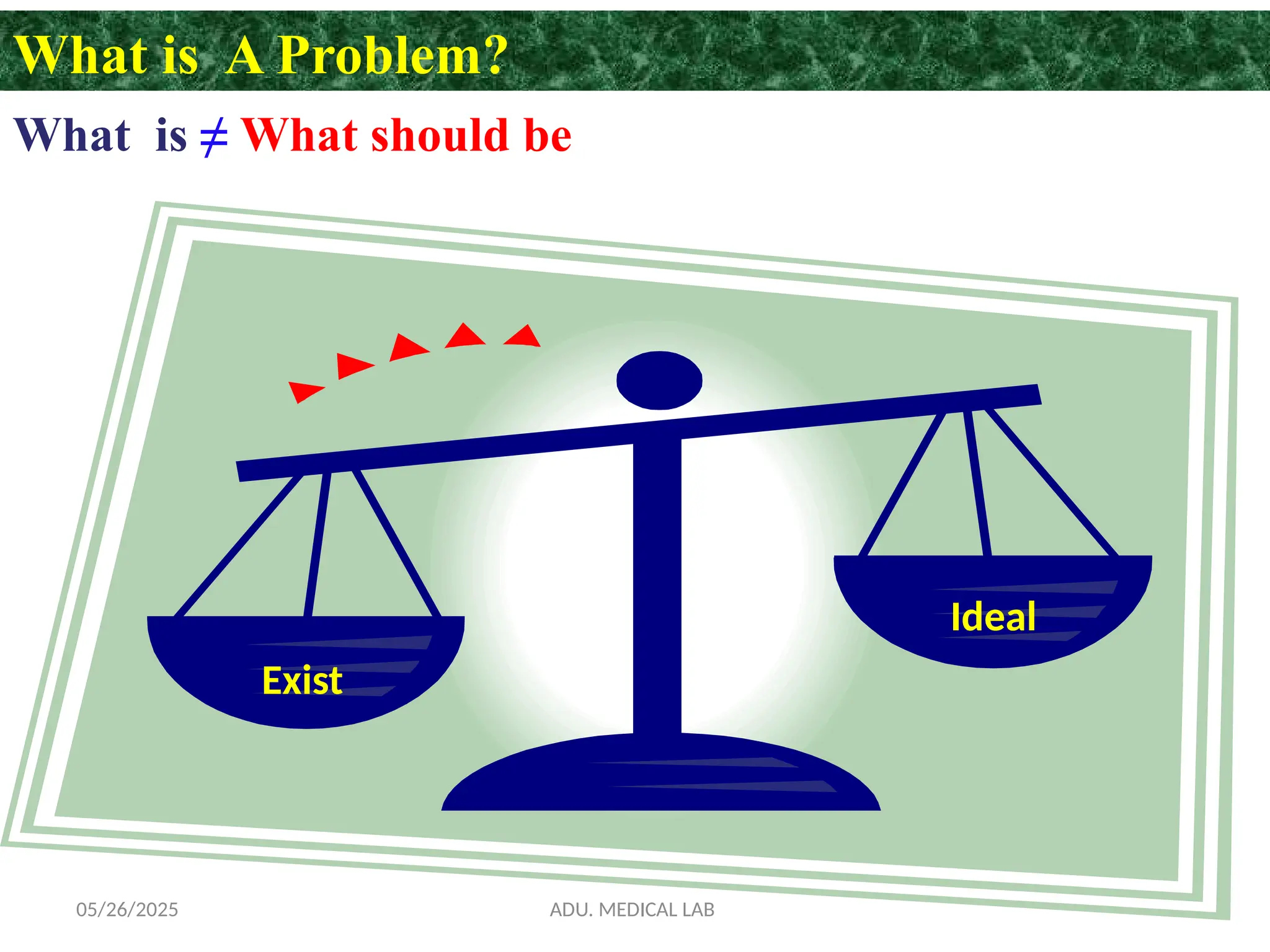
What is a problem?
. . . any situation where a gap exists between the actual and the
desired state
A problem does not necessarily mean that something is seriously
wrong
It could simply indicate an interest in improving an existing situation
Thus, problem definitions can include both existing problems in the
current situation as well as the quest for idealistic states in the future
Research Problem
31.
05/26/2025 ADU. MEDICALLAB 31
Where can we get a research problems?
• Sometimes students faced difficulties to get research problems not due to
the absence of research problems; rather due to difficulty of identifying
research problems
• We can get research problems in different ways from deferent source:-
1. From carful environmental observation and from our day to day
activities
2. From reading
3. From discussion
4. From the social, political and economical changes
5. From personal interest
6. From scarcity of information
32.
05/26/2025 ADU. MEDICALLAB 32
Identify four research problems
????????????
10 minutes!!!!!!!
33.
05/26/2025 ADU. MEDICALLAB 33
Whether a problem requires research depends on three
conditions:
I) There should be a perceived difference or discrepancy between
what it is and what it should be
II) The reason(s) for this difference should be unclear (so that it
makes sense to develop a research question)
III) There should be more than one possible and plausible answer to
the question (or solution to the problem)
05/26/2025 ADU. MEDICALLAB 35
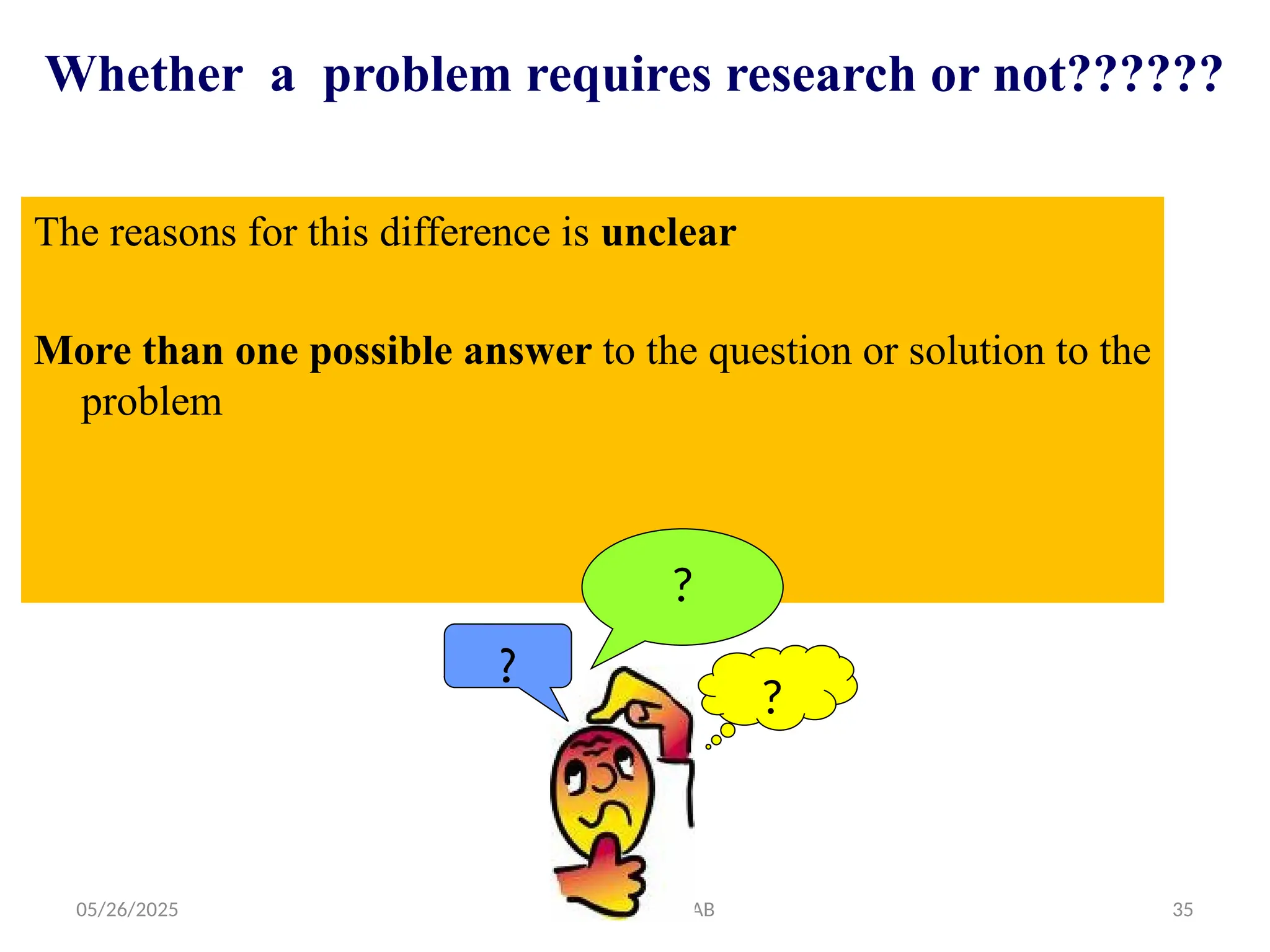
The reasons for this difference is unclear
More than one possible answer to the question or solution to the
problem
Whether a problem requires research or not??????
?
?
?
36.
05/26/2025 ADU. MEDICALLAB 36
Example 1
♣ Problem situation: In district “ Y “ a report showed that in the first
month there were 500 children under one year old who started
immunization, but at the end of the year it was found out that there
were only 25 children who completed their vaccination
♣ Discrepancy: All the 500 children at district “ Y “ should have
completed their vaccination but only 5% out of those who started
vaccination have completed.
♣ Problem (research) question: Why only 5% of the children
completed their vaccination?
Definite answer: Out of the 1 hospital, 2 health centers and 10 health
stations found in district “Y” only 2 health stations were
functioning, the rest were closed due to insecurity in the area
Does it needs research?
In the above example, assuming that all the given information is
true, there is no need of undertaking a research, since definite
answer is obtained to the problem situation
37.
05/26/2025 ADU. MEDICALLAB
Example 2
► Problem situation: In district “Z” (population 100,000) there are 2 health
centers, 1 hospital and 15 health stations and all of them function smoothly.
However, it was found that the MCH utilization was only 25%
► Discrepancy: Although district “Z ” had 100% availability of health
services only 25% of the mothers utilized ANC services
►Problem question: What factors influence ANC utilization in “Z”?
Possible answers:
• Mothers might have problems for not attending
• The MCH, EPI, OPD, etc… programs might not have been integrated
• ANC services are poor in quality
Thus, the above problem situation is researchable
38.
05/26/2025 ADU. MEDICALLAB 38
Whether a problem you identified requires
research or not?
Select the two most researchable problems
5 minutes !!!!!!!!!!!
39.
05/26/2025 ADU. MEDICALLAB 39
Criteria for prioritizing problems for research
• Each problem that is proposed for research has to be judged
according to certain guidelines or criteria
• There may be several ideas to choose from
♣ Before deciding on a research topic, each proposed topic must
be compared with all other options
• 7 Criteria for selection of a research problem
40.
05/26/2025 ADU. MEDICALLAB 40
1. Relevance: The topic you choose should be a priority problem
► How large or widespread is the problem?
►Who is affected?
►How severe is the problem?
2. Avoidance of duplication: Find out whether the suggested topic has been
investigated before
– either within the proposed study area or
– another area with similar conditions
3. Political acceptability: It is advisable to research a topic that has the
interest and support of the authorities. This will facilitate the smooth
conduct of the research and increases the chance that the results of the
study will be implemented
41.
05/26/2025 41
4. Feasibility:Consider the complexity of the problem and the resources
you will require to carry out the study.
• Think about the resources required to conduct the study
• Manpower, time, equipment and money that are locally available
• Possibility of obtaining technical and financial assistance from
external sources
5. Applicability of possible results and recommendations:
– Is it likely that the recommendations from the study will be
applied?
– This will depend not only on the blessing of the authorities but also
on the availability of resources for implementing the
recommendations
42.
05/26/2025 ADU. MEDICALLAB 42
6. Urgency of data needed
► How urgently are the results needed for making a decision?
► Consider which research should be done first and which can
be done late?
7. Ethical acceptability
We should always consider the possibility that we may inflict
harm on others while carrying out research
It will be useful to review the proposed study.
43.
05/26/2025 ADU. MEDICALLAB 43
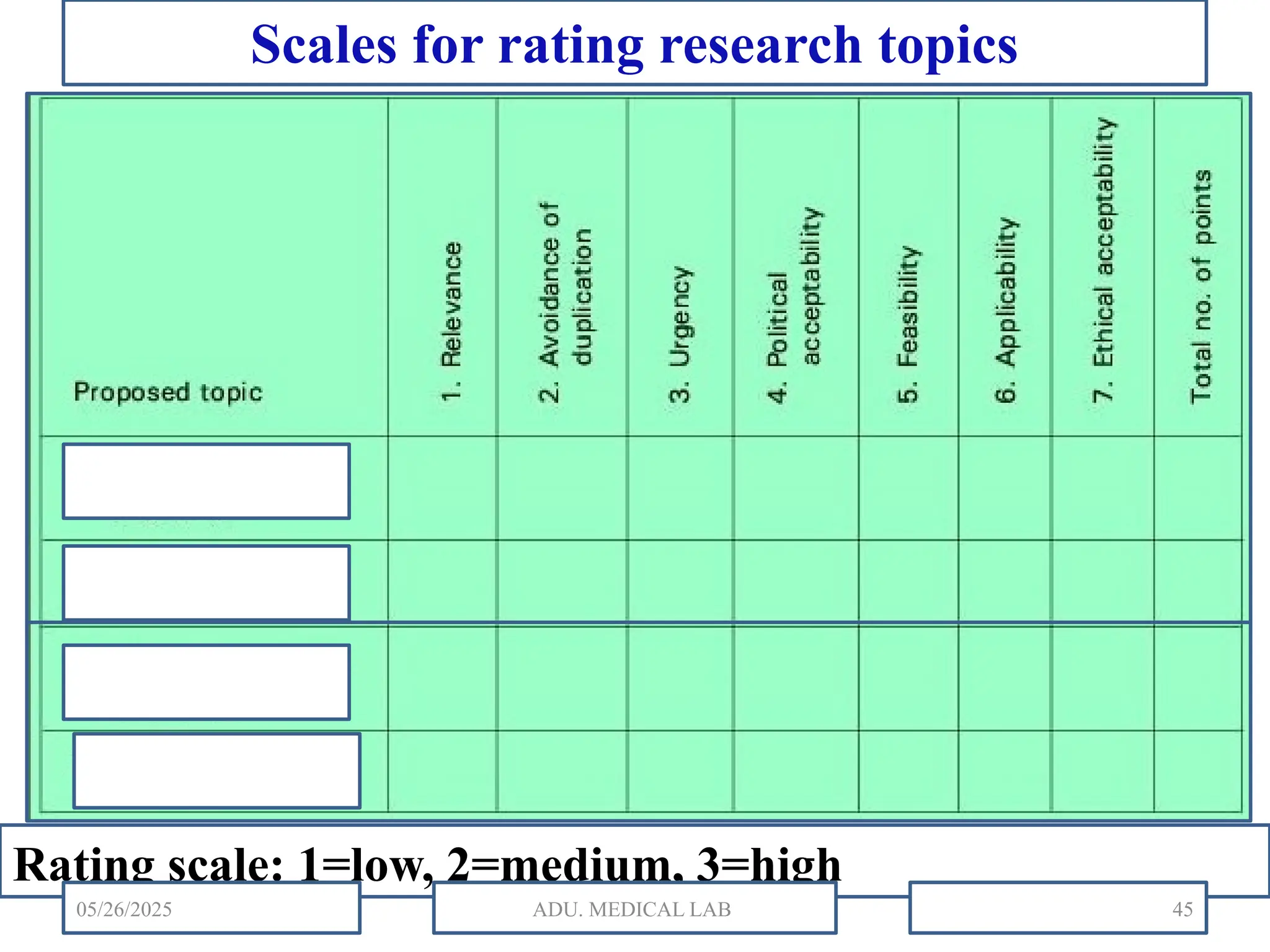
b) Scales for rating research topics
Relevance
1 = Not relevant
2 = Relevant
3 = very relevant
Avoidance of duplication
1 = Sufficient information already available
2 = Some information available but major issues not covered
3 = No sound information available on which to base problem-solving
Feasibility
1 = Study not feasible considering available resources
2 = Study feasible considering available resources
3 = Study very feasible considering available resources
Political acceptability
1 = Topic not acceptable
2 = Topic somewhat acceptable
3 = Topic fully acceptable
44.
05/26/2025 ADU. MEDICALLAB 44
Applicability
1 = No chance of recommendations being implemented
2 = Some chance of recommendations being implemented
3 = Good chance of recommendations being implemented
Urgency
1 = Information not urgently needed
2 = Information could be used but a delay of some months would be
acceptable
3 = Data very urgently needed for decision-making
Ethical acceptability
1 = Major ethical problems
2 = Minor ethical problems
3 = No ethical problems
The above rating should be based on the existing data and not on
mere assumptions.
45.
Rating scale: 1=low,2=medium, 3=high
Scales for rating research topics
05/26/2025 ADU. MEDICAL LAB 45
46.
05/26/2025 ADU. MEDICALLAB 46
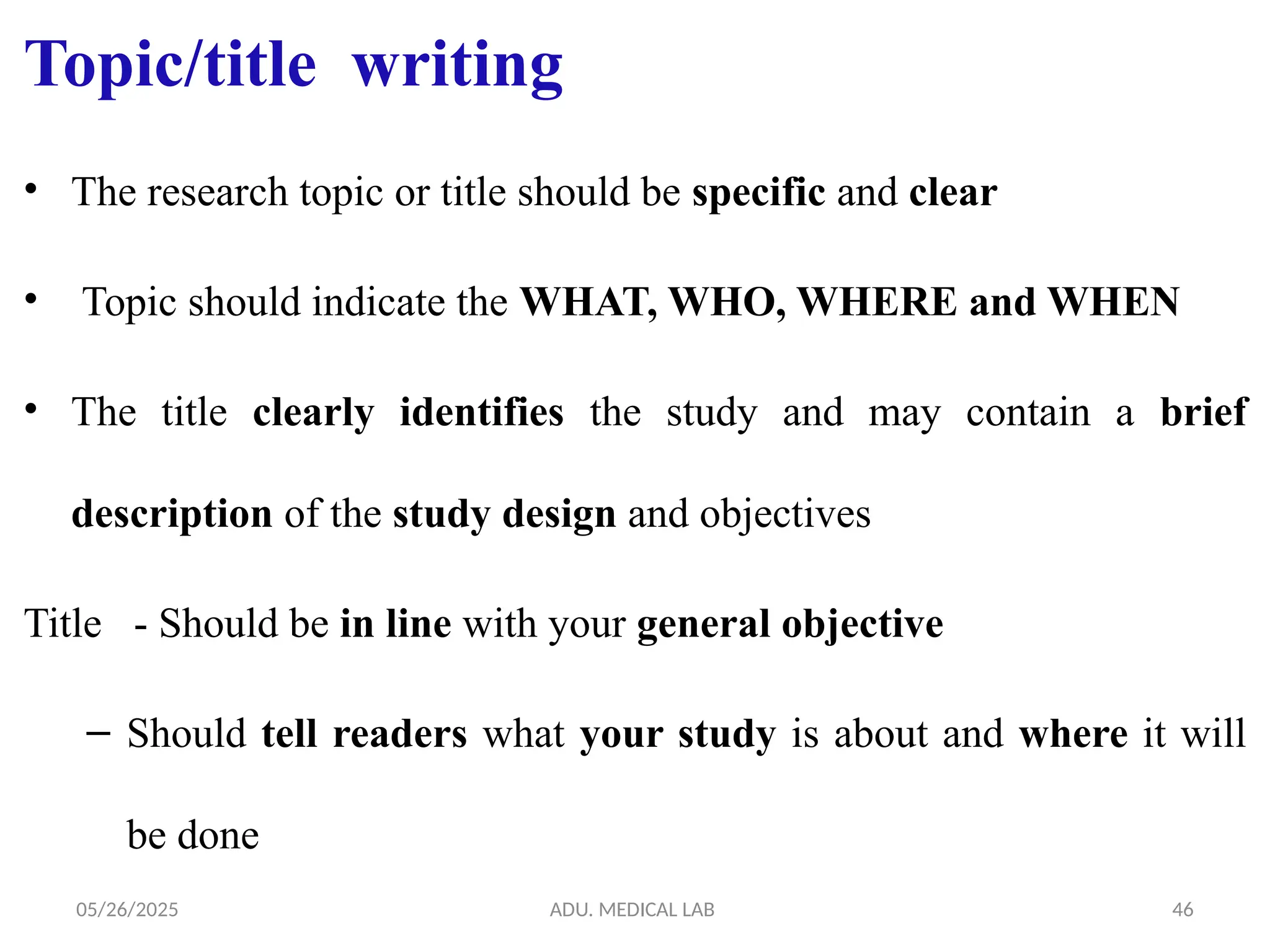
Topic/title writing
• The research topic or title should be specific and clear
• Topic should indicate the WHAT, WHO, WHERE and WHEN
• The title clearly identifies the study and may contain a brief
description of the study design and objectives
Title - Should be in line with your general objective
– Should tell readers what your study is about and where it will
be done
47.
05/26/2025 ADU. MEDICALLAB 47
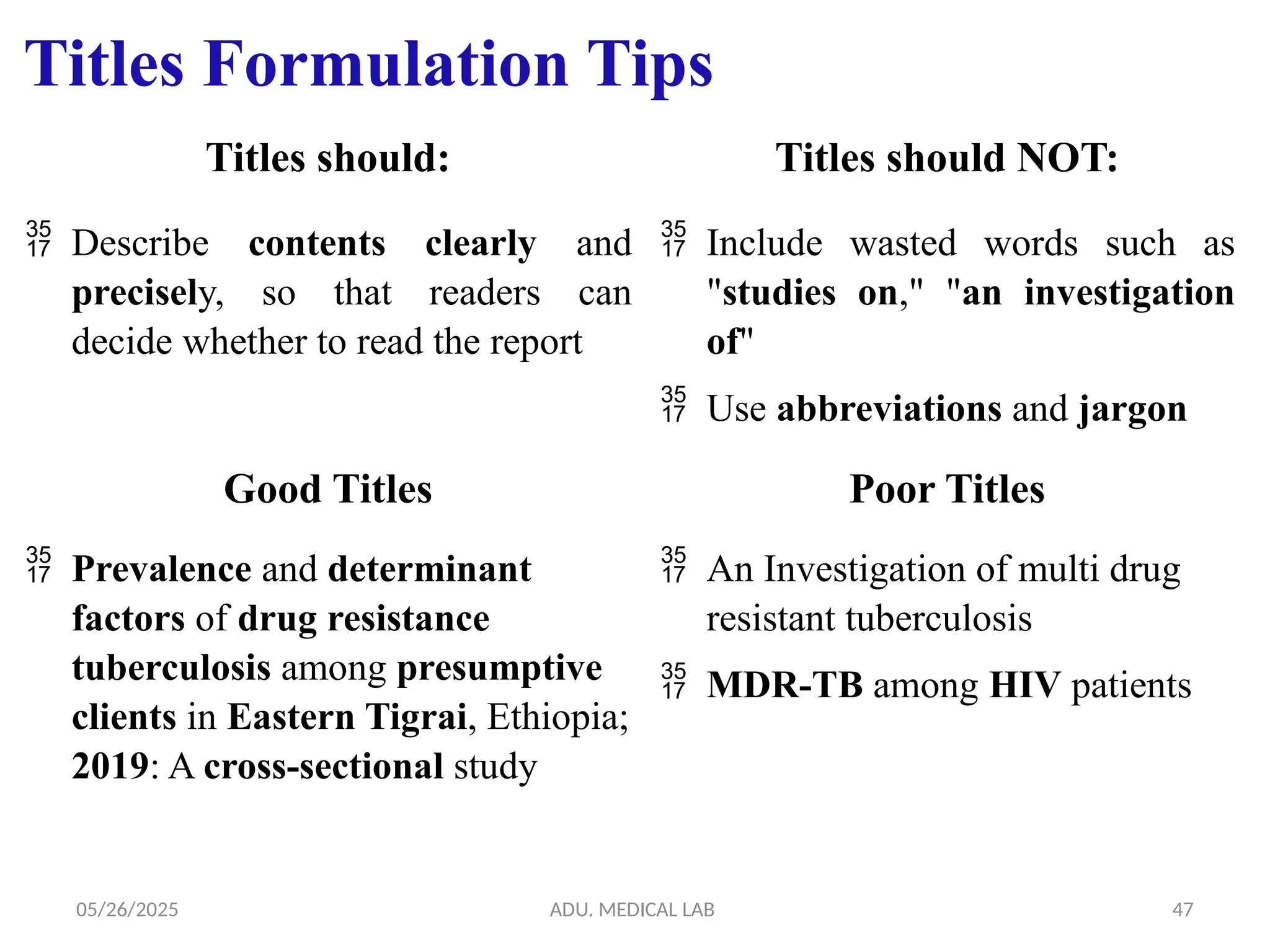
Titles Formulation Tips
Titles should: Titles should NOT:
Describe contents clearly and
precisely, so that readers can
decide whether to read the report
Include wasted words such as
"studies on," "an investigation
of"
Use abbreviations and jargon
Good Titles Poor Titles
Prevalence and determinant
factors of drug resistance
tuberculosis among presumptive
clients in Eastern Tigrai, Ethiopia;
2019: A cross-sectional study
An Investigation of multi drug
resistant tuberculosis
MDR-TB among HIV patients
48.
05/26/2025 ADU. MEDICALLAB 48
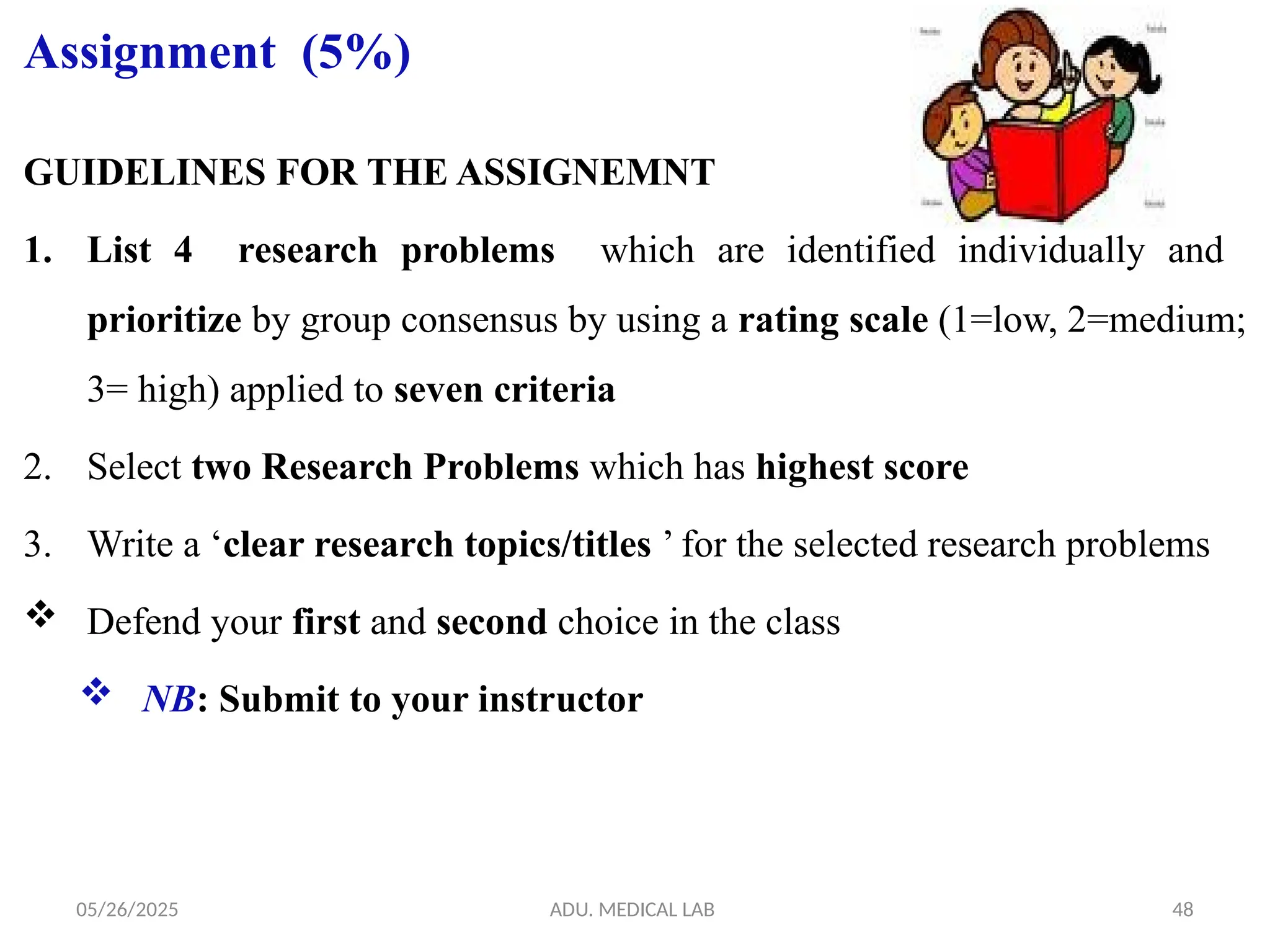
Assignment (5%)
GUIDELINES FOR THE ASSIGNEMNT
1. List 4 research problems which are identified individually and
prioritize by group consensus by using a rating scale (1=low, 2=medium;
3= high) applied to seven criteria
2. Select two Research Problems which has highest score
3. Write a ‘clear research topics/titles ’ for the selected research problems
Defend your first and second choice in the class
NB: Submit to your instructor
05/26/2025 ADU. MEDICALLAB 50
Statement of the problem and Justification
Objective: at the end of this chapter you are able to:
– Analyze the problem
– Formulate the problem statement
– Write Justification
51.
05/26/2025 ADU. MEDICALLAB 51
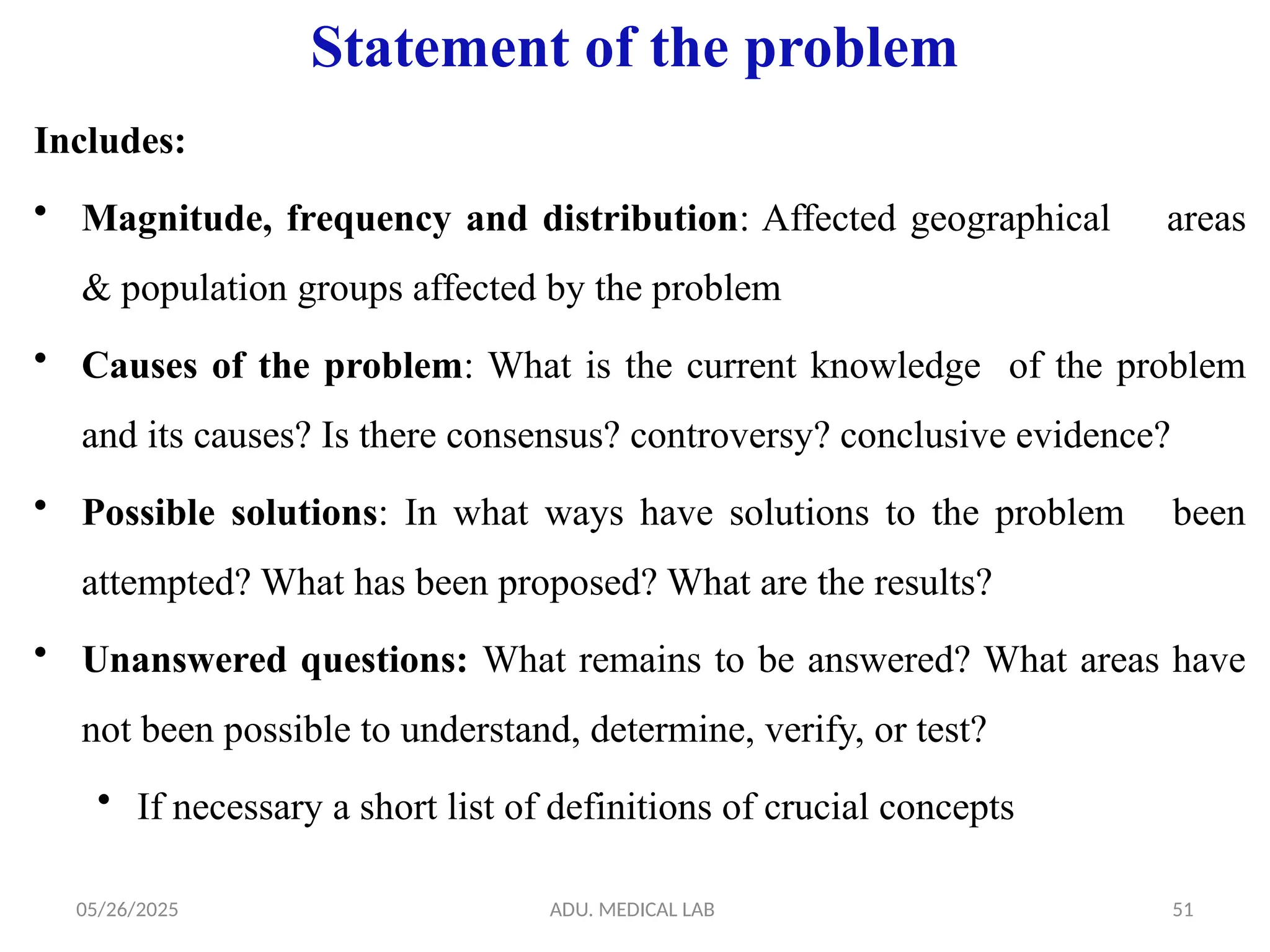
Statement of the problem
Includes:
• Magnitude, frequency and distribution: Affected geographical areas
& population groups affected by the problem
• Causes of the problem: What is the current knowledge of the problem
and its causes? Is there consensus? controversy? conclusive evidence?
• Possible solutions: In what ways have solutions to the problem been
attempted? What has been proposed? What are the results?
• Unanswered questions: What remains to be answered? What areas have
not been possible to understand, determine, verify, or test?
• If necessary a short list of definitions of crucial concepts
52.
05/26/2025 ADU. MEDICALLAB 52
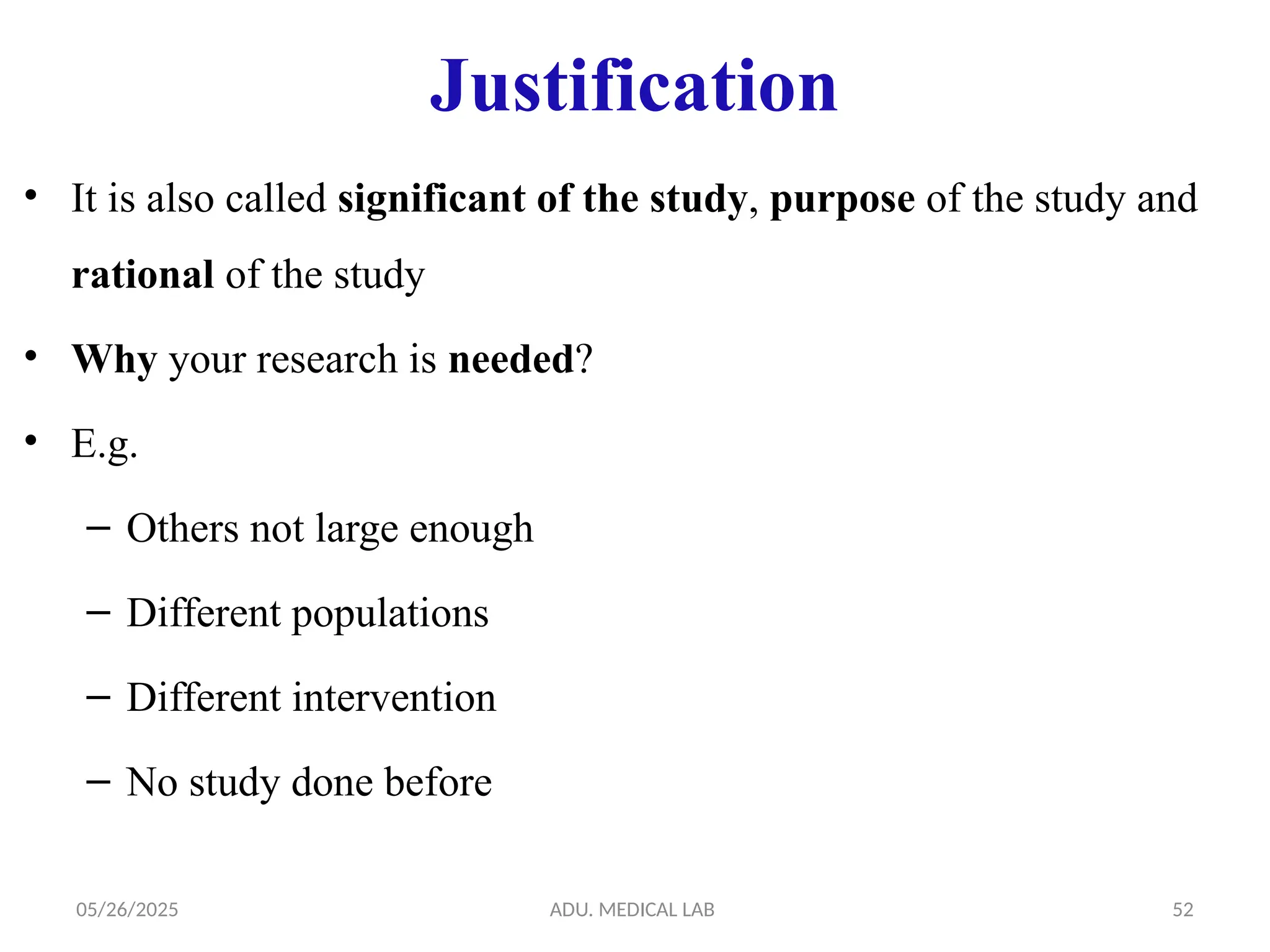
Justification
• It is also called significant of the study, purpose of the study and
rational of the study
• Why your research is needed?
• E.g.
– Others not large enough
– Different populations
– Different intervention
– No study done before
53.
05/26/2025 ADU. MEDICALLAB 53
• A statement indicating the size of the problem (and effect on the health
service) and why the study is appropriate
• Explain what the potential benefits are – to patients and the health service
• Explain what your study will add to the body of evidence already available.
54.
05/26/2025 ADU. MEDICALLAB 54
Assignment
For the selected topic:-
– write statement of the problem and
– justification
55.
05/26/2025 ADU. MEDICALLAB 55
Literature review and Referencing
Objective:
– What is Literature review
– Why it is necessary
– Resources(Source of information)
– How to write a literature review
– Conceptual framework
– Referencing
56.
05/26/2025 ADU. MEDICALLAB 56
What is literature review ???
• Literature: Printed information about something that you want to study
• Review: Consider carefully
- Starting point to refine statement of the problem
- Part of the introduction of a research
• Review of the literature
- Classification and evaluation of what have written, organized according
to guiding concept
57.
05/26/2025 ADU. MEDICALLAB 57
1) This section must be based on peer reviewed journal or other published
materials that are accessible in public domain (use non-published
materials in the Statement of the problem/introduction if necessary but
not in the literature review section).
2) Group findings from several studies (literature) according to common
theme rather than discussing individual paper: themes could be qualitative
versus quantitative approaches, magnitude of the problem, risk factors,
effectiveness of interventions etc.
3) Provide strong "umbrella" sentences at the beginnings of paragraphs,
"signposts" throughout, and brief "so what" summary sentences at
intermediate points in the review.
58.
05/26/2025 ADU. MEDICALLAB 58
Why we use of Literature Review
• Prevent duplicating
• It increase your knowledge and helps to refining statement of the problem
• Become more familiar with the various types of methods
• It provides a framework for establishing the importance of the study
• It serves as a benchmark for comparing the results with other findings
• Describe the characteristics of previous study (where, when, who conduct,
findings, conclusion)
• Comment on strengths and limitation of studies and findings
• Identify the GAP in knowledge
59.
05/26/2025 ADU. MEDICALLAB 59
Libraries
– Published information (books, journals..)
Internet/ web sites
– PUBMED / MEDLINE: - http://www.ncbi.nlm.nih.gov/PubMed/
– WHO website: - http://www. who.int
– Free Medical Journals :http://www.freemedicaljournals.com
– HINARI:- http://www. Healthinternetwork.net
– Medscape:- http://www. medscape.com
Resources
60.
05/26/2025 ADU. MEDICALLAB 60
How to write a review of literature?
• Take research problem
• Find a focus
• Organize
• Decide the order of issue to discuss
• Write coherent discussion in your own words
• Be critical to avoid possible bias
• Well quoted
• Write study design & area and sample size(sometime)
61.
05/26/2025 ADU. MEDICALLAB 61
Conceptual framework
• It is a set of broad ideas and principles used to structure a
subsequent presentation
• Every research activity is conceptualized and will be carried out
within some contextual framework.
• Conceptual frame- works represent ways of thinking about a
problem or a study, or ways of representing how complex things
work.
62.
05/26/2025 ADU. MEDICALLAB 62
Conceptual framework….
• Broadly speaking, conceptual frameworks come from
– Theories with well-organized principles and propositions
that have been confirmed by observations or experiments;
– Models derived from theories, observations or sets of
concepts, or
– Evidence-based best practices derived from outcome and
effectiveness studies.
63.
05/26/2025 ADU. MEDICALLAB 63
Referencing
• Referencing is a standardised method of acknowledging sources of
information and ideas that you have used in your assignment in a
way that uniquely identifies their source.
• Avoid Plagiarism:- The use of another person’s work without
acknowledgement
• A reference list is a list of sources that you have quoted from or
cited in your text
64.
05/26/2025 ADU. MEDICALLAB 64
Referencing systems
• A number of referencing systems are in common use today
including:
– Vancouver (number) .
– Harvard - (author, date).
– APA (American Psychological Association)
– MLA (Modern Linguistics Association)
65.
05/26/2025 ADU. MEDICALLAB 65
A. Vancouver system
For an article the following information should be noted:
• Author(s)’ Surname followed by initials. Title of article. Name of
Journal. Year, Volume(number): page numbers of article.
Example: Louria D. Emerging- and re-emerging infections: The
societal variables. International Journal of Infectious Disease. 1996,
1(2):59-62
• For a book the following information should be noted:
• Author(s)’ Surname followed by initials. Title of book. Place:
Publisher, Year, Edition
Example: Abramson J. Survey methods in community medicine.
66.
05/26/2025 ADU. MEDICALLAB 66
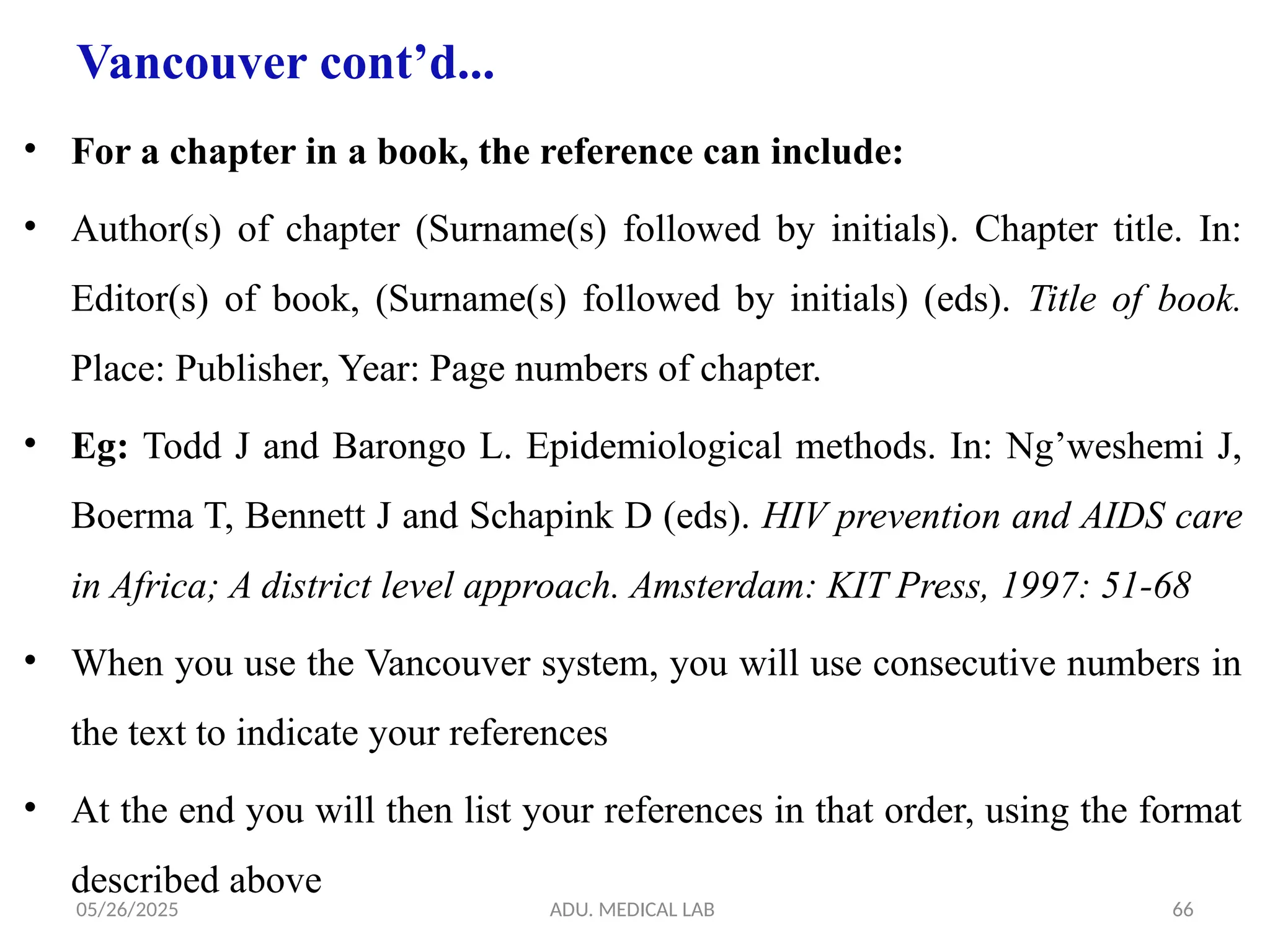
Vancouver cont’d...
• For a chapter in a book, the reference can include:
• Author(s) of chapter (Surname(s) followed by initials). Chapter title. In:
Editor(s) of book, (Surname(s) followed by initials) (eds). Title of book.
Place: Publisher, Year: Page numbers of chapter.
• Eg: Todd J and Barongo L. Epidemiological methods. In: Ng’weshemi J,
Boerma T, Bennett J and Schapink D (eds). HIV prevention and AIDS care
in Africa; A district level approach. Amsterdam: KIT Press, 1997: 51-68
• When you use the Vancouver system, you will use consecutive numbers in
the text to indicate your references
• At the end you will then list your references in that order, using the format
described above
67.
05/26/2025 ADU. MEDICALLAB 67
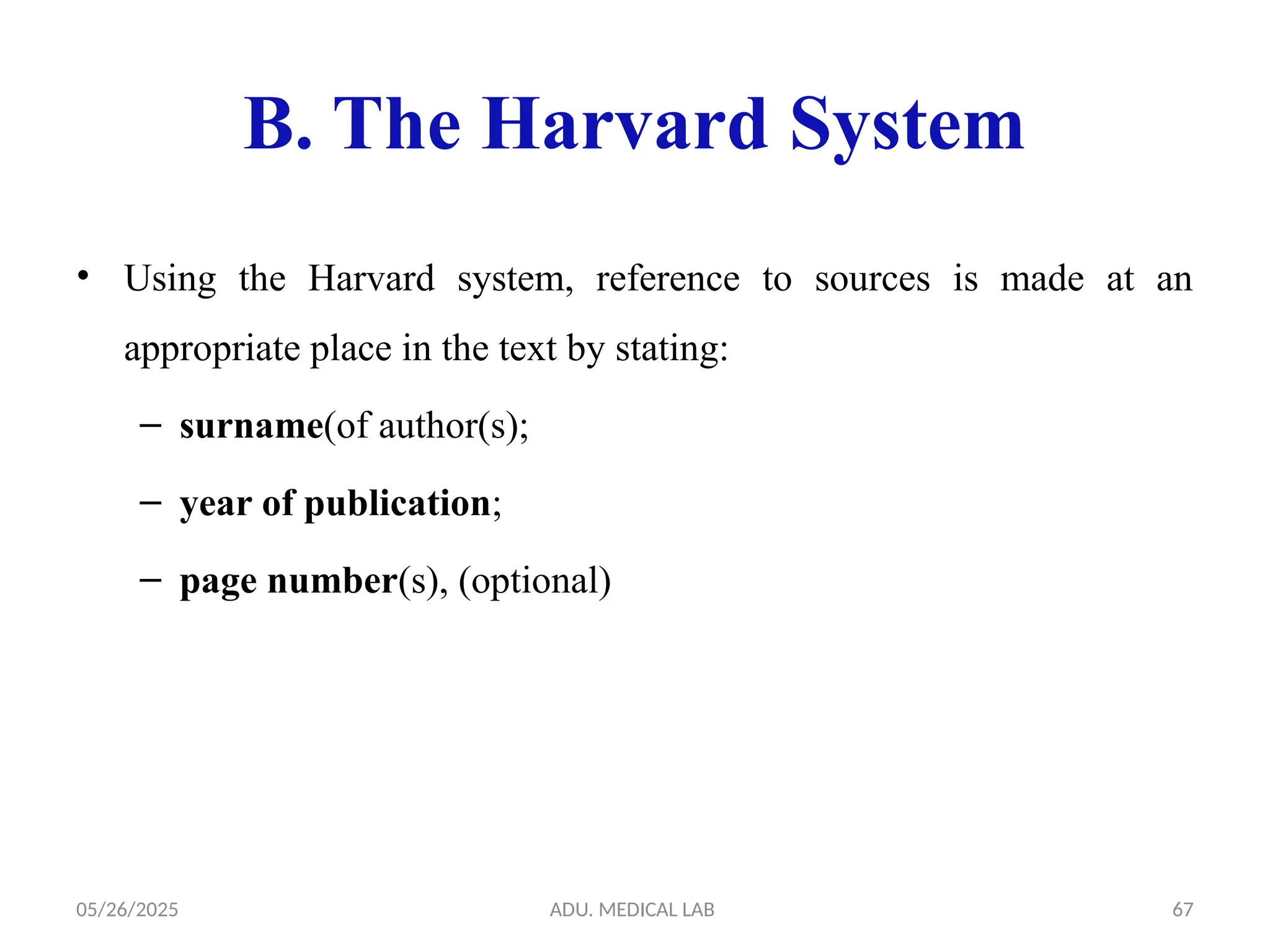
B. The Harvard System
• Using the Harvard system, reference to sources is made at an
appropriate place in the text by stating:
– surname(of author(s);
– year of publication;
– page number(s), (optional)
68.
05/26/2025 ADU. MEDICALLAB 68
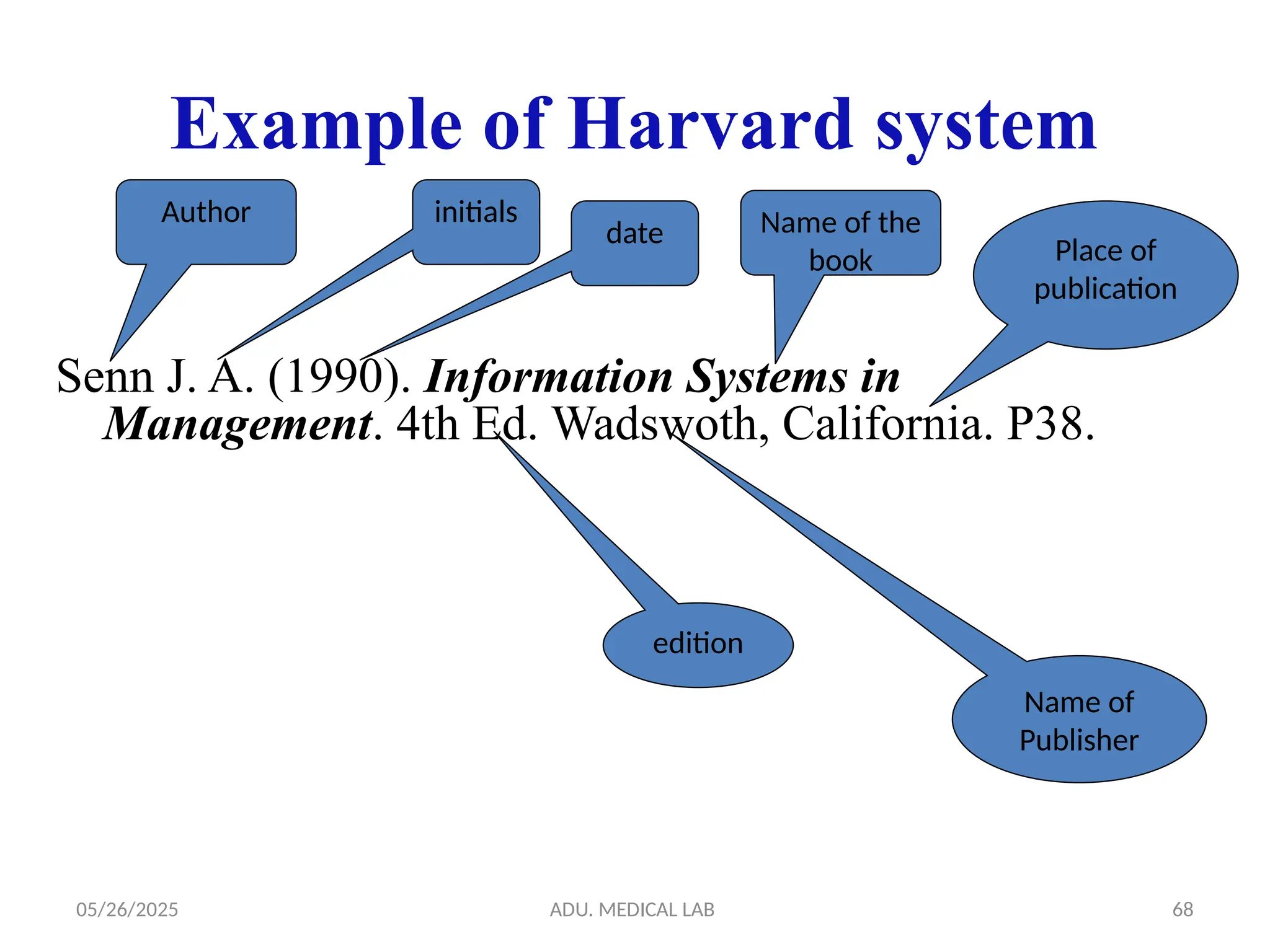
Example of Harvard system
Senn J. A. (1990). Information Systems in
Management. 4th Ed. Wadswoth, California. P38.
Author initials
date Name of the
book
edition
Place of
publication
Name of
Publisher
69.
ADU. MEDICAL LAB69
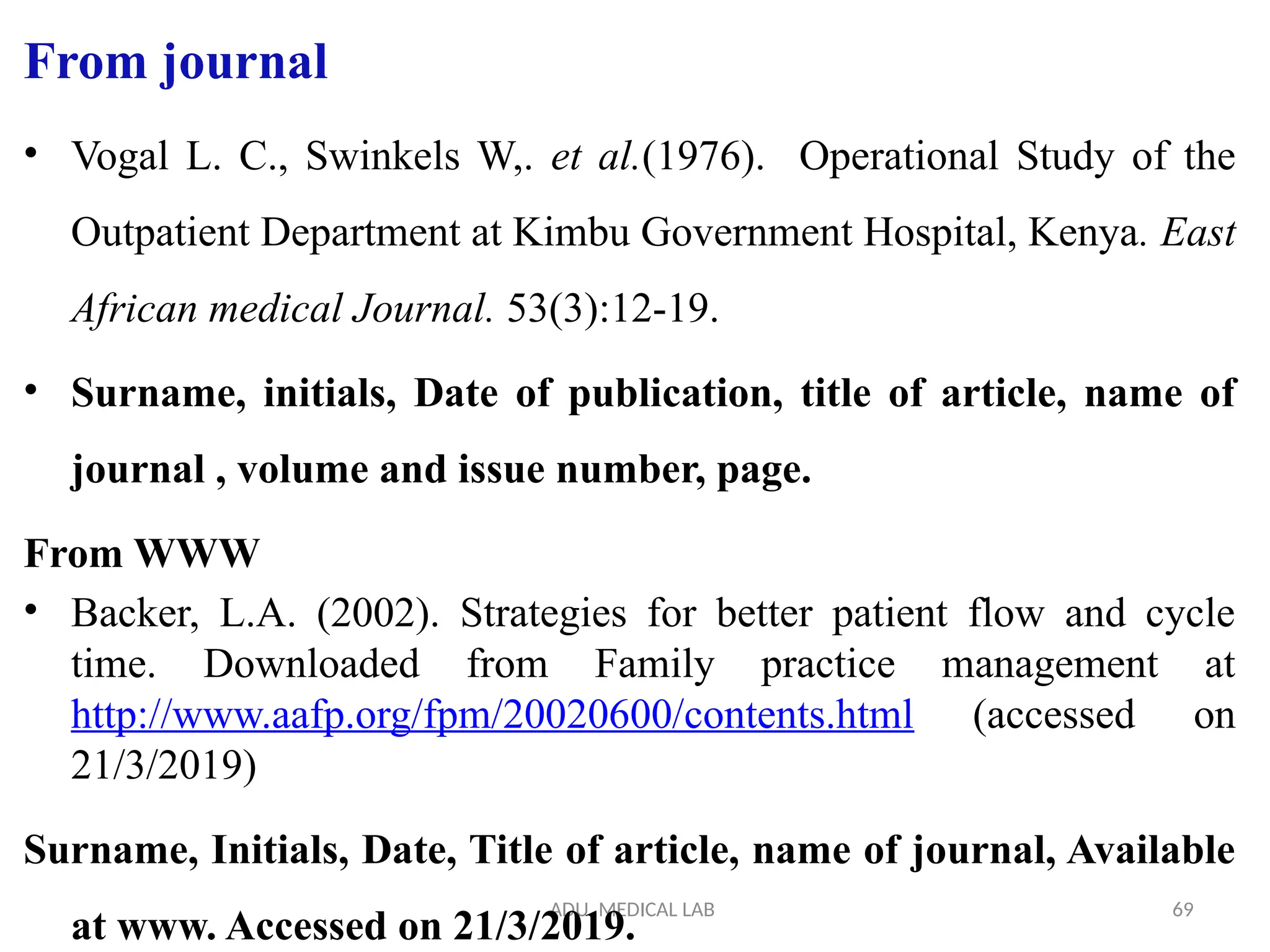
From journal
• Vogal L. C., Swinkels W,. et al.(1976). Operational Study of the
Outpatient Department at Kimbu Government Hospital, Kenya. East
African medical Journal. 53(3):12-19.
• Surname, initials, Date of publication, title of article, name of
journal , volume and issue number, page.
From WWW
• Backer, L.A. (2002). Strategies for better patient flow and cycle
time. Downloaded from Family practice management at
http://www.aafp.org/fpm/20020600/contents.html (accessed on
21/3/2019)
Surname, Initials, Date, Title of article, name of journal, Available
at www. Accessed on 21/3/2019.
70.
05/26/2025 ADU. MEDICALLAB 70
References cont’d.…
• In Harvard System of citation is used, the references at the end of the
proposal, should be listed in Alphabetical order.
71.
05/26/2025 ADU. MEDICALLAB 71
Assignment three
• Write literatures for your research proposal using van cover
style of referencing
72.
05/26/2025 ADU. MEDICALLAB 72
Chapter 5 :Research Objectives
• What is research objectives?
It summarizes what is to be achieved by the research / study
73.
05/26/2025 ADU. MEDICALLAB 73
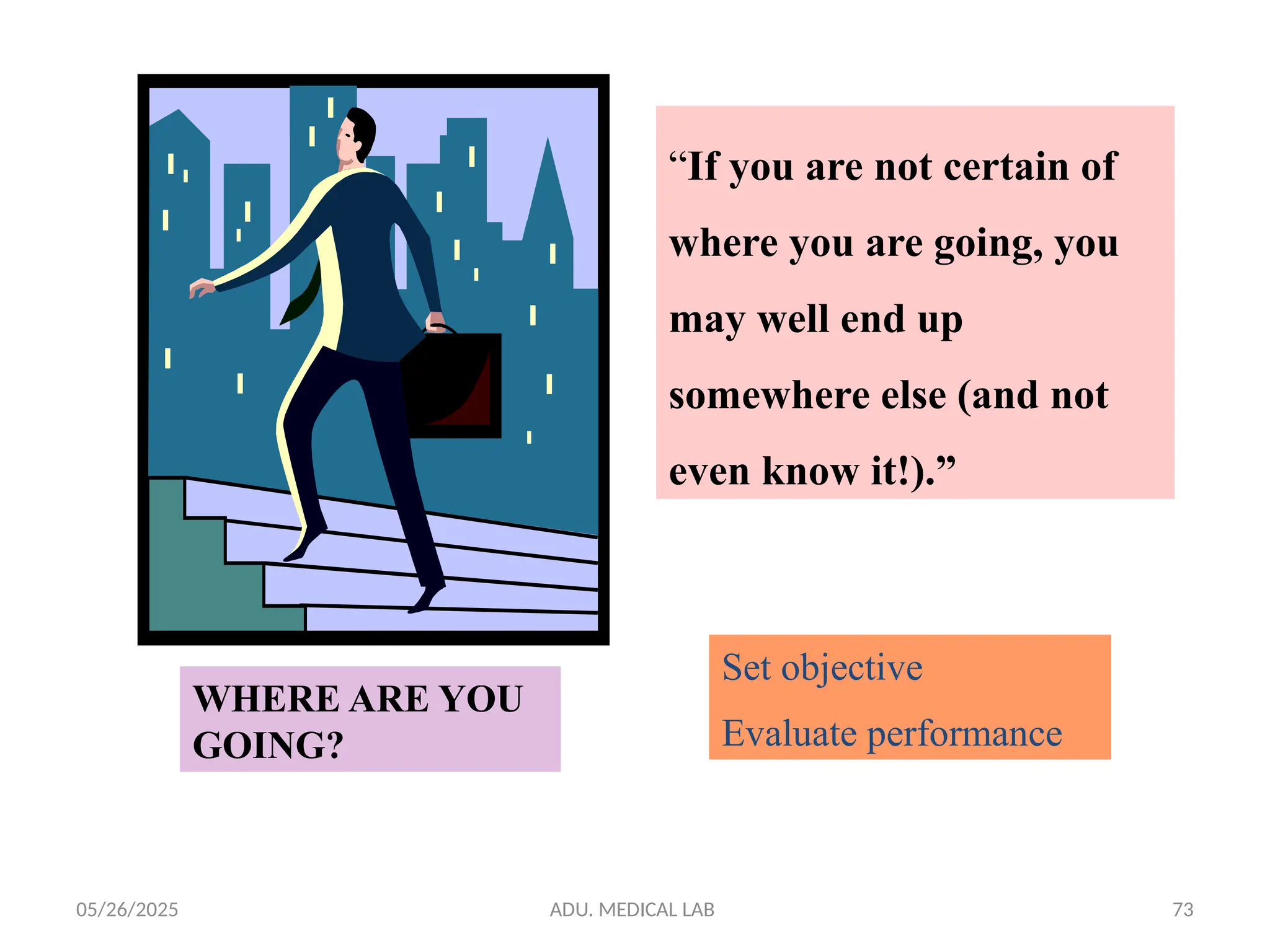
WHERE ARE YOU
GOING?
“If you are not certain of
where you are going, you
may well end up
somewhere else (and not
even know it!).”
Set objective
Evaluate performance
74.
05/26/2025 ADU. MEDICALLAB 74
Importance of developing objectives
• Focus the study
• Avoid the collection of unnecessary data
• facilitate the development of research methodology and help to orient the
– collection,
– analysis,
– interpretation and
– utilization of data
• Helps for evaluating the research project
75.
05/26/2025 ADU. MEDICALLAB 75
Type of Objective
• General Objective
– What is expected to be achieved by the study in general terms
– should be clearly related to the statement of the problem.
• Specific Objectives
– Breaking down the general objective into smaller, logically
connected parts
76.
05/26/2025 ADU. MEDICALLAB 76
Objective should be closely related to problem statement
• Example problem:
– Low utilization of FP clinic
• General Objective:
– To identify the reasons for low utilization of FP clinic in Adigrat
How to write the General objectives?
77.
05/26/2025 ADU. MEDICALLAB 77
How to write the specific objectives?
• Focused, each S. objective cover a single point/idea
• Ordered in a logical sequence, e.g. We don’t put associated factors before
prevalence
• Realistic and feasible to answer
• Operational, using action verbs such as:
– determine - verify -identify
– describe - assess - compare
– calculate - establish -explore
• Avoid use of non-action verbs ( to appreciate, study, understand, Believe ,
Know)
• Measurable outcomes at the end of the research
78.
05/26/2025 ADU. MEDICALLAB 78
• Specific
• Measurable
• Achievable
• Realistic
• Time bound
Objectives should be:-
79.
05/26/2025 ADU. MEDICALLAB 79
Example-1
• Title: Incidence and Predictors of Tuberculosis among people living with HIV
attending adult HIV care clinic at Adigrat Hospital, North Ethiopia, 2019
• General Objective:
– To assess incidence and Predictors of Tuberculosis among adults living
with HIV attending HIV care clinic at Adigrat Hospital, North Ethiopia,
2019.
• Specific Objective:
– To determine incidence rate of Tuberculosis among adults living with HIV
attending HIV care clinic
– To identify the predictors of Tuberculosis among adults living with HIV
attending HIV care clinic
80.
05/26/2025 80
Example-2
• Title:Prevalence of Malnutrition and Associated Factors in Children
attending HIV/AIDS care in the Pediatric ART Clinics of Adigrat Hospital,
North Ethiopia, 2018.
• General Objective:
– To determine the prevalence of malnutrition and factors associated
with it in children living with HIV/AIDS who are on HIV care at
pediatric ART clinics of Adigrat Hospital, North Ethiopia, 2018
• Specific Objectives:
– To determine the prevalence of malnutrition in children with HIV/AIDS
following HIV/AIDS care at pediatric ART clinics
– To identify factors associated with malnutrition in children with
HIV/AIDS following HIV/AIDS care at pediatric ART clinics
81.
05/26/2025 ADU. MEDICALLAB 81
Assignment four
• Write general and specific objectives for your research
proposal.
82.
05/26/2025 ADU. MEDICALLAB 82
Chapter 6: Research Methods and materials
Indicates the methodological steps you will take to answer every question or to test every hypothesis or
problem stated in your study
– Study area and period
– Types of study designs
– Source and Study population
– Inclusion and Exclusion Criteria
– Sample size and sampling
procedures
– Variables
– Operational definitions
– data collection and data
quality control
– data processing and analysis
– Ethical considerations
– Dissemination of Results
83.
05/26/2025 ADU. MEDICALLAB 83
Study area/setting
• Where will the research take place?
• The setting where the study will be conducted
• Mentioned:
– The location of the area/setting
– Size of the population
– Availability of Health service
– Other issue related with your research
84.
05/26/2025 ADU. MEDICALLAB 84
Study area
Topic :-The effect of tuberculosis on immune reconstitution among HIV
patients on highly active antiretroviral therapy in Adigrat General Hospital,
Eastern Tigrai, Ethiopia; 2019: A retrospective follow up study
• A retrospective follow up study will be employed to assess the effect of TB and
other determinant factors of immune reconstitution among HIV patients on
HAART in Adigrat General Hospital, Eastern Tigrai, Ethiopia from October
to July 2019. Adigrat is a zonal administrative town of Eastern Tigrai, with an
estimated population of 76,400 [25]. The town is located at a longitude and
latitude 14°16′N 39°27′E, with an elevation of 2,457 meters (8,061 ft) above sea
level and below a high ridge to the west
• Adigrat General Hospital is one of the governmental Hospitals located in Adigrat
established for peoples from 6 weredas (districts). The Hospital is currently
involved as teaching and referral services for more than 1,000,000 population
with an average annual client flow of 131,125 people. The Hospital has about
120 beds with a total of 209 health care providers and 132 administrative staffs.
There are about 10 health care providers in the HAART clinic of the Hospital
and a total of 1582 HIV patients currently on HAART follow up
85.
05/26/2025 ADU. MEDICALLAB 85
Study design
• A study design is a specific plan or protocol for conducting the
study, which allows the investigator to translate the conceptual
hypothesis into an operational one
• It is a logical model that guides the investigator in the various
stages of the research
Types of study designs
• Several classifications of study types are possible, depending on
what research strategies are used
86.
Epidemiological design
does thestudy test hypothesis?
• does the study has comparison group?
Epidemiological design
Descriptive
Analytic
Correlation
/ ecological
•Case report
• Case series
• Cross
sectional/
prevalence
study
Observationa
l
Intervention
yes
No
No Yes No Yes
intervention
Cohort
Vs
Case control
Experimental
Vs
Quasi
experimental
Study unit individual
87.
Experimental Vs quasi-Experimental
•Similarities:
– Study participants are subjected certain treatment or condition
– Some outcome of interest is measured
– The researchers test whether differences in this outcome are related to
the treatment
• Differences:
– In a true experiment, participants are randomly assigned to either the
treatment or the control group, whereas they are not assigned
randomly in a quasi-experiment
– In a quasi-experiment, the control and treatment groups differ not
only in terms of the experimental treatment they receive, but also in
other, often unknown. Thus, the researcher must try to statistically
control for as many of these differences as possible
– Because control is lacking in quasi-experiments, there may be several
"rival hypotheses" competing with the experimental manipulation
as explanations for observed results
88.
05/26/2025 ADU. MEDICALLAB 88
Did investigator assign exposure?
Experimental study Observational study
Yes No
Individuals or communities?
Individuals Communities
Clinical trial Community trial
Comparison group?
Yes No
Analytical study Descriptive study
Cohort study Case-control study Cross-sectional study
Exposure Outcome Outcome
Exposure
Exposure & Outcome at
the same time
89.
05/26/2025 ADU. MEDICALLAB 89
Study design: Overview
Descriptive
Analytical
•Case reports and case series
•Correlational (ecological) studies
•Cross-sectional surveys
Observational studies
•Cross-sectional comparative
•Cohort studies
•Case-control studies
Intervention studies
•Experimental:
clinical trial; community trial
•Quasi-experimental studies
90.
05/26/2025 ADU. MEDICALLAB 90
To describe the general characteristics of the distribution of a disease, particularly in
relation to person, place and time
Case report & case series
• A case report: Is a descriptive study of a single individual
– Detailed report of one patient
• case series: Is a descriptive study of small group
– Describe clinical characteristics of a well-defined group of patients without
comparison group
• e.g., Initial report of five cases of Pneumocystis pneumonia in previously
healthy, homosexual men
Descriptive studies
91.
05/26/2025 ADU. MEDICALLAB 91
• The unit of analysis is the group, not the individual
• Use data from whole population
• Data often readily available (secondary data)
Example:
– Mean systolic blood pressure levels and stroke mortality rates
in the Seven Countries Study
Correlational / Ecologic studies
92.
05/26/2025 ADU. MEDICALLAB 92
Cross-sectional study
D+
D-
Population Sample
• Observe prevalence of a disease and other characteristics in a well-
defined population
• Exposure and disease measures obtained at the individual level.
• Measure at a single point in time/Single period of observation
• Exposure and disease histories collected simultaneously.
• Association can be investigated
• Example: Prevalence of congenital malformations across maternal
93.
05/26/2025 ADU. MEDICALLAB 93
To examine the relationships between exposure and disease
status (or health outcome) in order to judge whether a
particular exposure causes or prevents disease (determining
determinants and their effect)
Analytic studies
Exposure
Alcohol consumption
Raw meat
Smoking
Health Outcome
Breast Cancer
IP
Lung Cancer
94.
05/26/2025 ADU. MEDICALLAB 94
Classify on basis of presence or absence of exposure follow up to
determine the development of disease in each exposure group
Suitable for rare exposures
Not suitable for rare outcomes
Cohort studies
95.
05/26/2025 ADU. MEDICALLAB 95
Case-control studies
• Case-Control Studies identify existing disease/s and look back in previous
years to identify previous exposures to causal factors.
– Cases are those who have a disease
– Controls are those without a disease
• Analyses examine if exposure levels are different between the groups.
05/26/2025 ADU. MEDICALLAB 97
• Similar to cohort study, except that exposure is allocated by the
investigator
• Subjects followed up to determine if (when) they develop the outcome
• Allocation is best done using a randomization procedure
Types of experiments
• Clinical trials:- Trials on individual patients
• Community trial:- Trials on communities rather than patients
Examples:
- Iron-fortified salt and anemia in the community
- Impregnated bed net and malaria morbidity
Intervention studies
98.
05/26/2025 ADU. MEDICALLAB 98
Randomized controlled trial (RCT)
Disease No disease
No disease
Disease
THE FUTURE
THE PRESENT
Population
Sample
Treatment
Placebo/Standard
R
05/26/2025 ADU. MEDICALLAB 100
Choice of Study Design
The choice of study design is mainly determined by:
Objective of the study
Available resources/ Funds
Time
Researcher Skills
101.
05/26/2025 ADU. MEDICALLAB 101
Objective Study Design
To quantify the magnitude and distribution of
a health state/event
Descriptive
To compare groups to elicit the causes/risk
factors
Analytical
To assess the efficacy of drugs, treatments,
interventions
Experimental
Objective and study design
102.
05/26/2025 ADU. MEDICALLAB 102
Study period
• The period where the data will be collected.
– Example: the study will be conducted from Oct to Dec, 2019
Source and Study population
• Target/source/theoretical population
– Source population refers to the entire group of individuals or objects
to which researchers are interested in generalizing the conclusions.
– A collection of items that have something in common for which we
wish to draw conclusions at a particular time.
– The target population usually has varying characteristics and it is also
known as the theoretical population
103.
05/26/2025 ADU. MEDICALLAB 103
Study population
– But, because of practicalities, entire target population often
cannot be studied.
– The specific population from which data are collected
05/26/2025 ADU. MEDICALLAB 105
Example
The effect of tuberculosis on virological response among adults HIV individuals on
Highly Active Antiretroviral Therapy in AGH, Northern Ethiopia; 2019: A cross-
sectional study
• The source population for this study will be all Adults living with HIV in AGH
• The study population for this study will be those Adults living with HIV who are
screened for tuberculosis
Inclusion and Exclusion Criteria
• Inclusion Criteria: the set of criteria which is important to include the study participant
in to the research
• Exclusion criteria: which help us to exclude those individuals which will not be part of
our study.
– They should be part of the inclusion criteria
106.
05/26/2025 ADU. MEDICALLAB 106
Example
Eligibility criteria
Inclusion criteria
HIV infected individuals with known TB status who are willing and can
have informed consent
Exclusion criteria
HIV infected individuals who are severely ill and being unconscious
107.
05/26/2025 ADU. MEDICALLAB 107
Sample
• In research terms a sample is a group of people, objects, or items
that are taken from a larger population for measurement.
• A subset of a study population, about which information is actually
obtained.
• The sample should be representative of the population to ensure
that we can generalize the findings from the research sample to
the population as a whole.
108.
05/26/2025 ADU. MEDICALLAB 108
Basic Terms
– A population: is a group of individuals persons, objects, or items from which
samples are taken for measurement
– Census: Obtained by collecting information about each member of a
population
– Sample: Obtained by collecting information only about some members of a
"population“
– Sampling Frame; is the list of people from which the sample is taken.
– Probability samples: each population element has a known (non-zero)
chance of being chosen for the sample
– Non-probability samples: we do not know the probability that each
population element will be chosen, and/or we cannot be sure that each
population element has a non-zero chance of being chosen
109.
05/26/2025 ADU. MEDICALLAB 109
Advantage of sampling
Samples offer many benefits:
• Save costs: Less expensive to study the sample than the population.
• Save time: Less time needed to study the sample than the population .
• Accuracy: Since sampling is done with care and studies are conducted by
skilled and qualified interviewers, the results are expected to be accurate
Limitation of sampling
There is always error
Sampling error: is any type of bias that is attributable to mistakes in either
drawing a sample or determining the sample size
Non-sampling error is any error which will be committed during data
collection, coding, entry, and so on
110.
05/26/2025 ADU. MEDICALLAB 110
• How many completed questionnaires do we need to have a representative
sample?
• Generally the larger the better, but that takes more time and money.
• Answer depends on:
– How different or dispersed the population is.
– Desired level of confidence
– Desired degree of accuracy
– Desired margin of error
Sample Size Determination
111.
05/26/2025 ADU. MEDICALLAB 111
Sample Size …
• Sample size may be determined by using:
– Subjective methods (less sophisticated methods)
• The rule of thumb approach: e.g. 5% of population (or at least 10
observations per variable)
• Conventional approach: e.g.. Average of sample sizes of similar
other studies
• Cost basis approach: The number that can be studied with the
available funds;
• Depending on the number of independent variables
112.
05/26/2025 ADU. MEDICALLAB 112
Statistical Formula
• Sample size formula, in general, depends on the number of study
population:
Single population
Two population
113.
05/26/2025 ADU. MEDICALLAB 113
1. Sample size for single population proportion
• If the study aims to be conducted on single population, then we need the
following
What is the probability of the event occurring?
How much error is tolerable (confidence interval)? How
much precision do we need?
How confident do we need to be that the true population value falls
within the confidence interval?
114.
05/26/2025 ADU. MEDICALLAB 114
Sample size determination
The sample size was determined by using a single population
proportion formula considering
the following assumptions: Zα/2 = 1.96 for the standard scale of 95% CL
of confidence, level of precision = 5%, P = 0.069
n = (Zα/2)2
P (1-P)
d2
n = minimum sample size < 10,000
Z = Confidence interval usually used as 95% =1.96
P = Prevalence from previous study (26.9%)
d = is the margin of error, e.g. 0.05
α = is the level of error one is willing to tolerate
n= (1.96)2
*0.269 (0.731) = 302, with 10 % non response rate =333
(0.05)2
05/26/2025 ADU. MEDICALLAB 116
Design effects
• The loss of effectiveness by the use of cluster sampling instead of
simple random sampling is design effect
• Working definition of design effect is that factor by how much sample
variance for the sample plan exceeds simple random sample of same size
• How much worse your sample is from a simple random sample
• For cluster sampling, design effect is 2
• For multistage sampling design effect is equal to the number of stages
117.
05/26/2025 ADU. MEDICALLAB 117
Sampling Technique
Sampling is the process of selecting a small number of elements from a
larger defined target group of elements such that the information gathered
from the small group will allow judgment to be made about the larger
groups.
118.
05/26/2025 ADU. MEDICALLAB 118
Convenience
Types of Sampling Methods
Samples
Non-Probability
Samples
Quata Judgemental
Probability Samples
Simple
Random
Systematic
Stratified
Cluster
119.
05/26/2025 ADU. MEDICALLAB 119
Probability Sampling Method
• Probability sampling strategies using a random or chance process
• The "equal chance" and "independent" components of random
sampling are what makes us confident that the sample has a
reasonable chance of representing the population
• What does it mean to be independent? The researchers select each
person for the study separately
120.
05/26/2025 ADU. MEDICALLAB 120
1. Simple Random Sampling
• Simple random sampling is the most straightforward
• All possible samples of n subjects are equally likely to occur
• How do we actually take a random sample?
• Depending on the complexity of the population, we can use different
tools to select n samples from the frame.
These are lottery method
Table of random number
Computer generated random number
• Lottery method is appropriate if the total population is not too large,
otherwise if the population is too large then it will be very difficult to
use lottery method
• Thus, table of random number or computer generated random
number is the feasible method to be used.
122
2. Systematic RandomSampling
Sample is selected according to position using a skip interval
Steps
1: Obtain a list of units that contains an acceptable frame of population
2: Determine the number of units in the list and the desired sample size
3: Compute the skip interval: The population is listed in a particular order,
then every kth
unit is selected
– Start at a random point between 1 and k
– Here k is chosen so that N ≈ kn
4: Determine a random start point
5: Beginning at the start point, select the units by choosing each unit that
corresponds to the skip interval
123.
05/26/2025 ADU. MEDICALLAB 123
Systematic random sampling
• Example: the researcher wants to know the prevalence of
malnutrition among under 5 children in woreda x
124.
05/26/2025 ADU. MEDICALLAB 124
3. Stratified Random Sampling
Stratified random sampling is a method of probability
sampling in which the population is divided into different
subgroups and samples are selected from each subgroup
125.
05/26/2025 ADU. MEDICALLAB 125
Stratified sampling
A three-stage process:
• Step 1- Divide the target
population into homogeneous
subgroups or strata
• Step 2- Decided which type of
stratified sampling to use
• Step 3- Draw random samples
from each stratum
• Step 4- Combine the samples
from each stratum into a single
sample of the target population
Stratified samples can be:
• Proportionate: involving the
selection of sample elements from
each stratum, such that the ratio of
sample elements from each
stratum to the sample size equals
that of the population elements
within each stratum to the total
number of population elements.
• Disproportionate: the sample is
disproportionate when the above
mentioned ratio is unequal.
126.
05/26/2025 ADU. MEDICALLAB 126
4. Cluster sampling
• If the study covers wide geographical area, using the other methods
will be too costly.
• The idea is, divided the total population in to different clusters and
then the unit of selection will be cluster.
• Therefore, total population in the selected cluster will be taken as
the sample.
127.
05/26/2025 ADU. MEDICALLAB 127
• Steps in cluster sampling are:
– Define the population
– Determine the desired sample size
– Identify and define a logical cluster (can be kebele, residence)
– Make a list of all clusters in the population
– Estimate the average number of population number per cluster
– Determine the number of clusters needed by dividing the sample size
by the estimated size of the cluster
– Randomly select the required number of clusters (using table of
random number as the total number of clusters is manageable)
– Include in the sample all population in the selected cluster.
05/26/2025 ADU. MEDICALLAB 129
Cluster sampling
• Advantages
– Simple as complete list of sampling units within population not
required
– Less travel/resources required
• Disadvantages
– Potential problem is that cluster members are more likely to be alike,
than those in another cluster (homogenous)….
– This “dependence” needs to be taken into account in the sample
size….and the analysis (“design effect”)
130.
05/26/2025 ADU. MEDICALLAB 130
5. Multi-stage Sample Designs
• Many surveys use complex sample designs that combine several of the
above elements in a multi-stage sampling framework
• Sometimes the population is too large and scattered for it to be practical to
make a list of the entire population from which to draw a SRS.
• Suppose that each unit in the population can be divided into a number of
smaller units, or subunits
• The prime stimulus for multi-stage sampling is administrative convenience
• As with cluster sampling, we select c of C clusters, but now instead of
sampling all units in each cluster, we take a random sample. Most large
surveys carried out this way
131.
05/26/2025 ADU. MEDICALLAB 131
Selecting a sampling method
• Population to be studied
– Size/geographical distribution
– Heterogeneity with respect to variable
• Availability of list of sampling units
• Level of precision required
• Resources available
132.
05/26/2025 ADU. MEDICALLAB 132
Non-probability sampling
– Every element in the universe [sampling frame] does not have
equal probability of being chosen in the sample.
– Operationally convenient and simple in theory.
– Results may not be generalized.
– When using non-probability sampling, sample size is unrelated
to accuracy, so cost benefit consideration must be used.
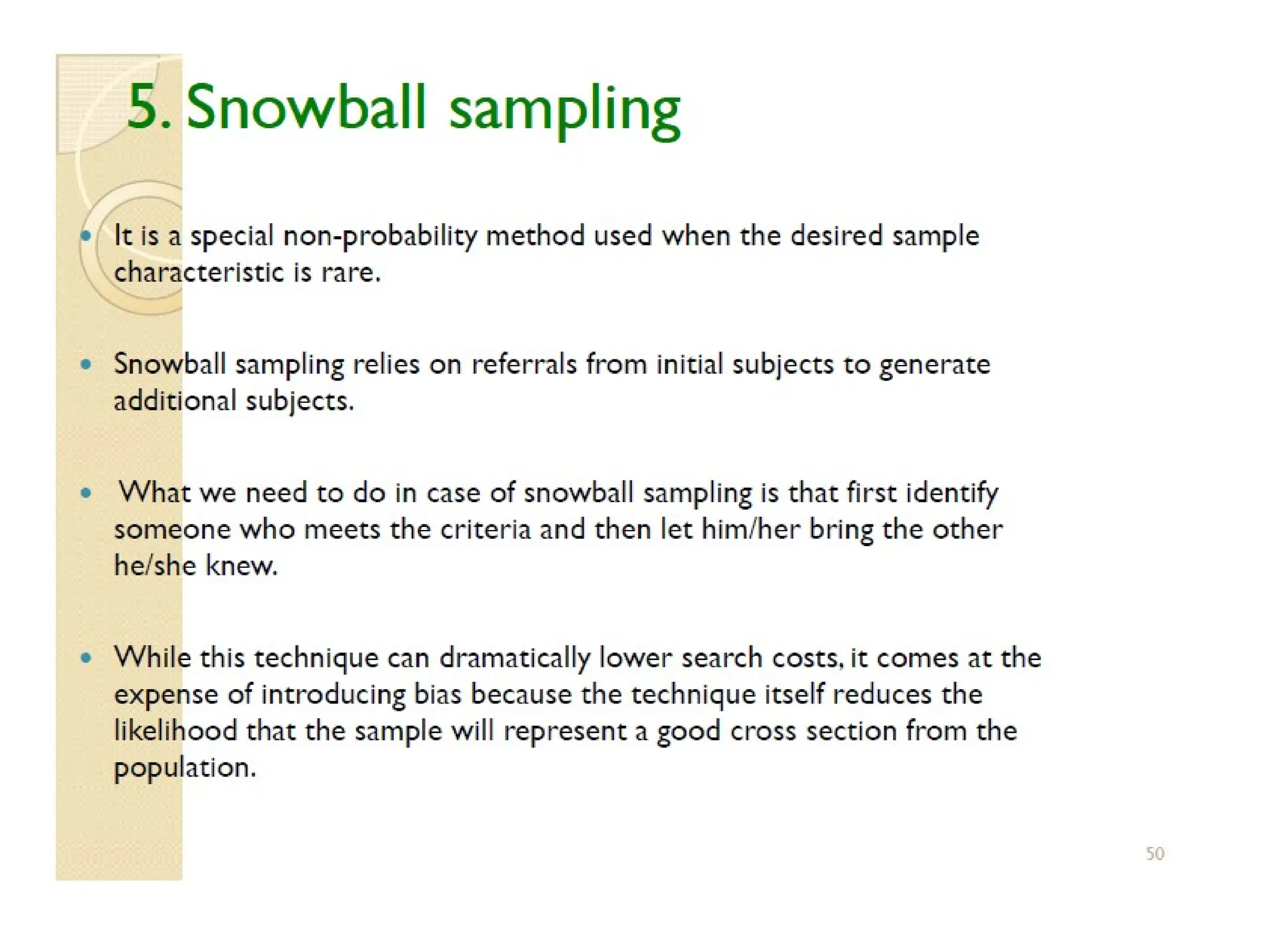
1. Purposive sampling:
– Critical cases
133.
05/26/2025 ADU. MEDICALLAB 133
Non-probability samples…
2. Convenience sampling
Drawn at the convenience of the researcher. Common in exploratory
research. Does not lead to any conclusion.
3. Judgmental sampling
Based on some judgment, feelings or experience of the researcher. If
inference drawing is not necessary, these samples are quite useful.
4. Quota sampling
It is the non-probability equivalent of stratified sampling.
Differs from stratified sampling, stratums are filled by random
sampling.
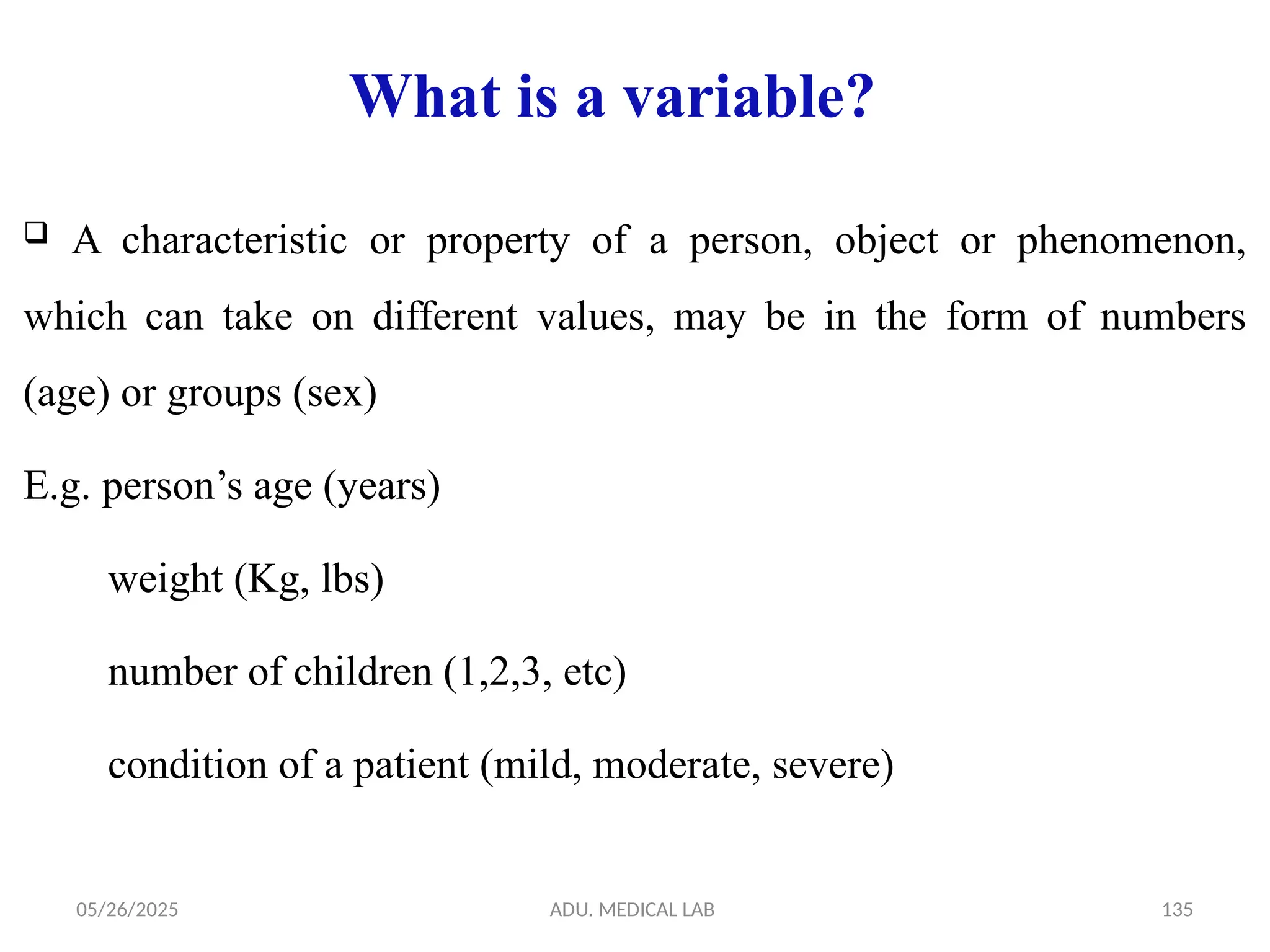
05/26/2025 ADU. MEDICALLAB 135
What is a variable?
A characteristic or property of a person, object or phenomenon,
which can take on different values, may be in the form of numbers
(age) or groups (sex)
E.g. person’s age (years)
weight (Kg, lbs)
number of children (1,2,3, etc)
condition of a patient (mild, moderate, severe)
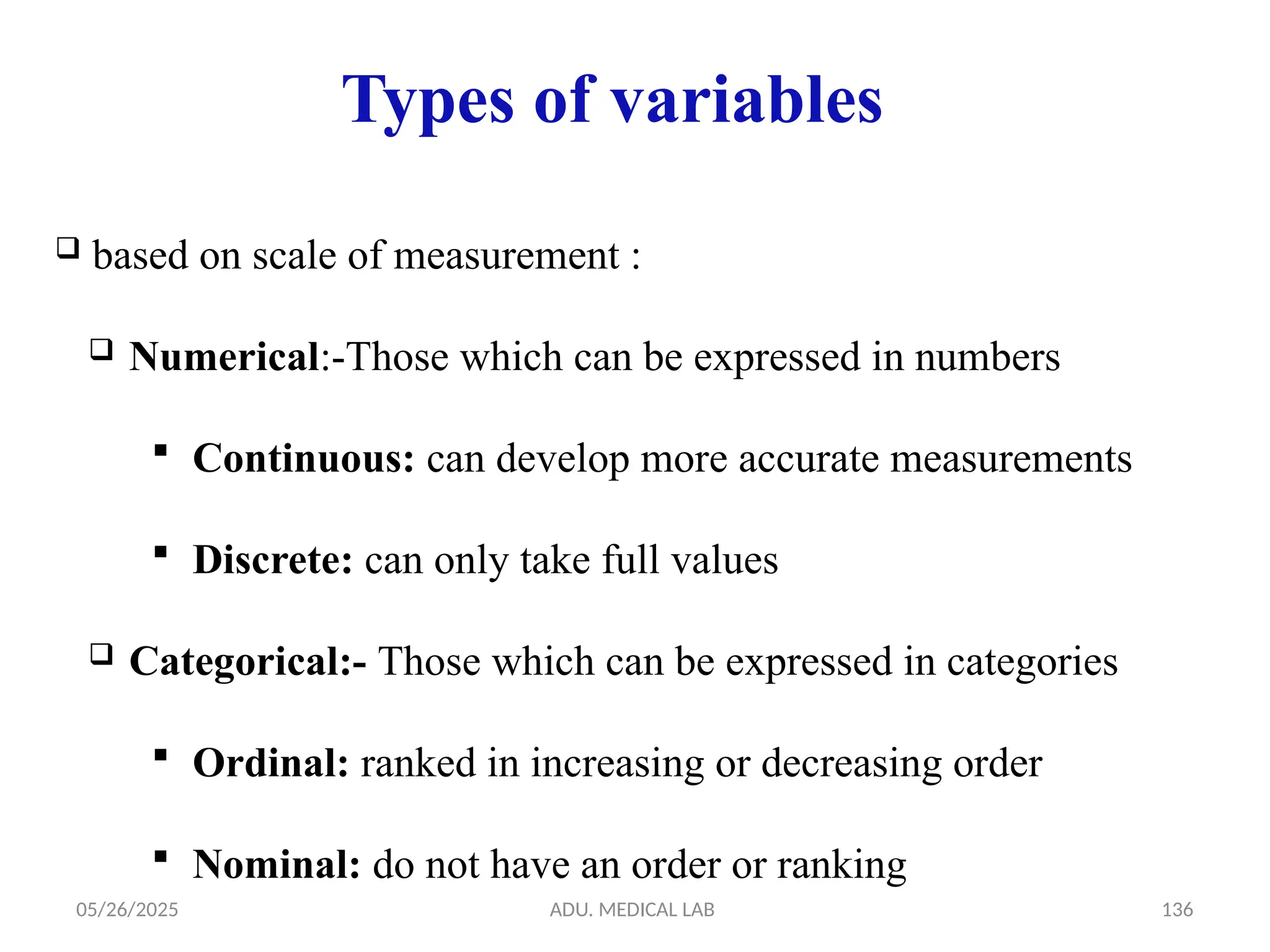
136.
05/26/2025 ADU. MEDICALLAB 136
Types of variables
based on scale of measurement :
Numerical:-Those which can be expressed in numbers
Continuous: can develop more accurate measurements
Discrete: can only take full values
Categorical:- Those which can be expressed in categories
Ordinal: ranked in increasing or decreasing order
Nominal: do not have an order or ranking
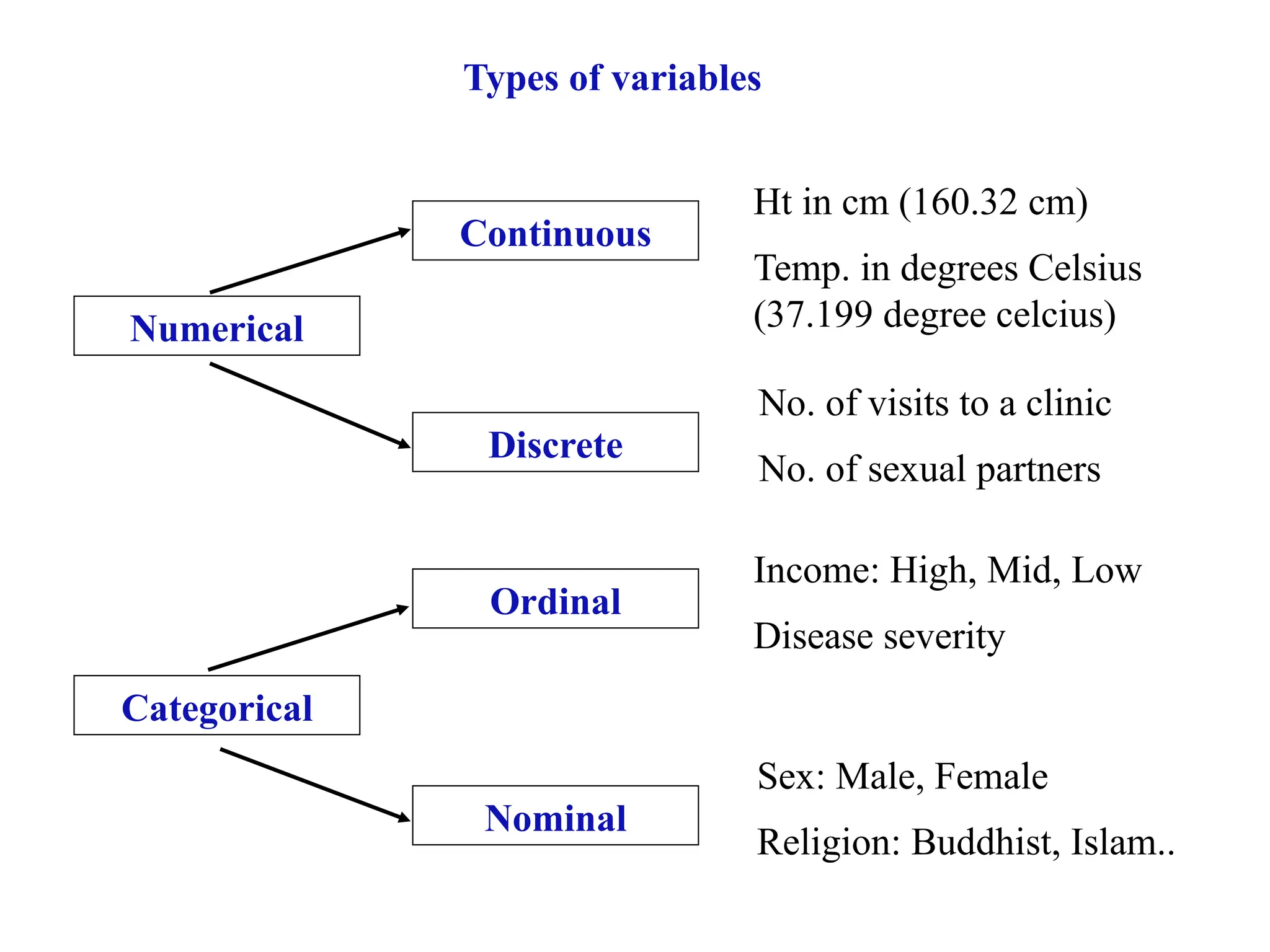
137.
Types of variables
Numerical
Categorical
Continuous
Discrete
Htin cm (160.32 cm)
Temp. in degrees Celsius
(37.199 degree celcius)
No. of visits to a clinic
No. of sexual partners
Ordinal
Nominal
Income: High, Mid, Low
Disease severity
Sex: Male, Female
Religion: Buddhist, Islam..
138.
05/26/2025 ADU. MEDICALLAB 138
Dependent Vs Independent
• A variable can be also either dependant (response, outcome) variables or
independent (explanatory, predictor) variables.
Dependent variables :-
– Variables which can be affected by explanatory variable and it is the
outcome of a study
– A variable you would be interested in predicting or forecasting
– To describe or measure the problem under study
Independent variable:-
– Are any variables that explain the response variable
– To describe or measure the factors that are assumed to cause or at least
to influence the problem
139.
05/26/2025 ADU. MEDICALLAB 139
Determined by the statement of the problem and objectives of the study
Relationship between smoking and lung cancer
Independent variable: smoking
Dependent variable: Lung cancer
Study on reasons for smoking
Independent variable: peer pressure, to release stress, etc
Dependent variable: smoking
In a study to determine whether surgery or chemotherapy results in higher
survival rates for a certain type of cancer, whether or not the patient
survived is one variable, and whether they received surgery or
chemotherapy is the other.
Which is the explanatory variable and which is the response variable?
140.
05/26/2025 ADU. MEDICALLAB 140
Operationalizing variables
Some variables are measurable, but some need indicators
Conceptual definition
Characteristic we would like to measure
E.g.: knowledge level
Operational definition
Characteristic we would actually measure
In a set of 10 questions:
0-3 correct answers poor
4-6 correct answers reasonable
7-10 correct answers good
141.
05/26/2025 ADU. MEDICALLAB 141
At the end of this you will explain??????
Sources of data
Types of data collection methods
Factors considered in choice of method
Data collection tool
Data Collection Methods
142.
05/26/2025 ADU. MEDICALLAB 142
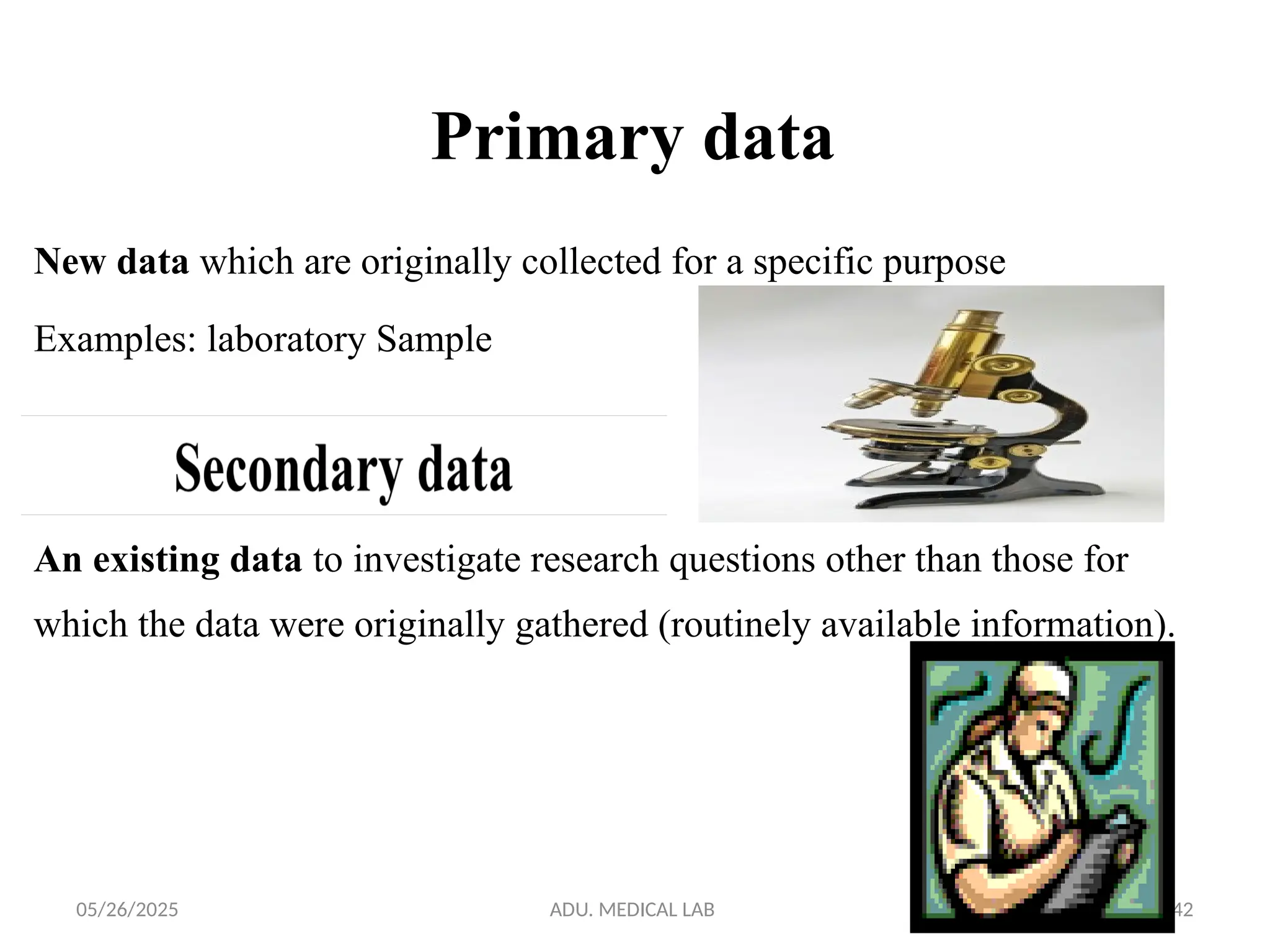
New data which are originally collected for a specific purpose
Examples: laboratory Sample
Primary data
An existing data to investigate research questions other than those for
which the data were originally gathered (routinely available information).
143.
05/26/2025 ADU. MEDICALLAB 143
Types of data collection methods
Quantitative data collection methods (in numbers)
Using available information (secondary data)
Interviewing
Administering questionnaire
Qualitative data collection methods (in words)
Focus group discussion (FGD)
In-depth interview (IDI)
Observation
144.
05/26/2025 ADU. MEDICALLAB 144
Using available information
Census data
Unpublished reports
Hospital records
Information routinely collected by others
Advantage of available data
Collection is inexpensive
Disadvantage of existing data
It is some times difficult to gain access to records or reports
Data may not always be complete and precise enough, or too
disorganized
145.
05/26/2025 ADU. MEDICALLAB 145
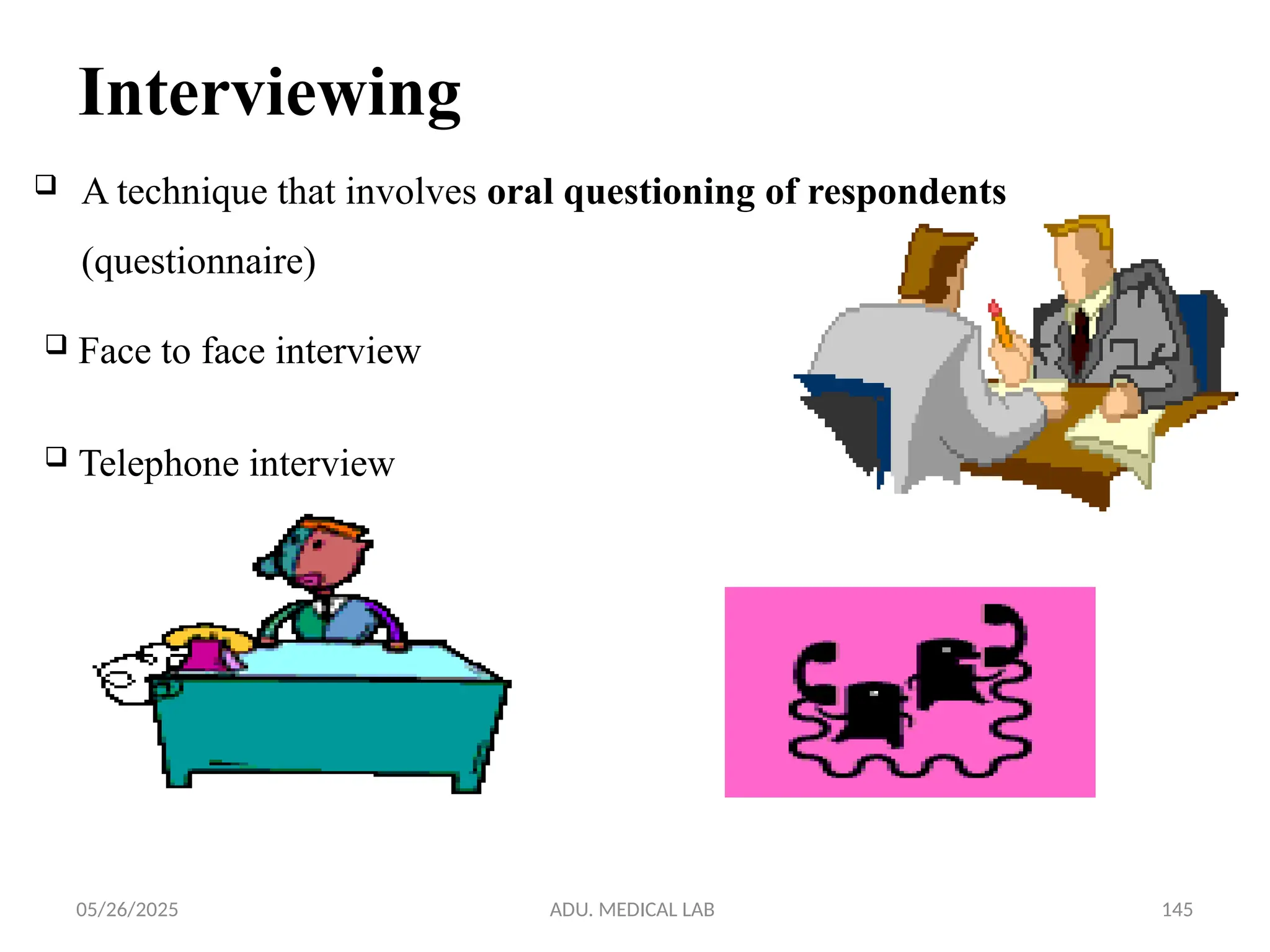
Interviewing
A technique that involves oral questioning of respondents
(questionnaire)
Face to face interview
Telephone interview
146.
05/26/2025 ADU. MEDICALLAB 146
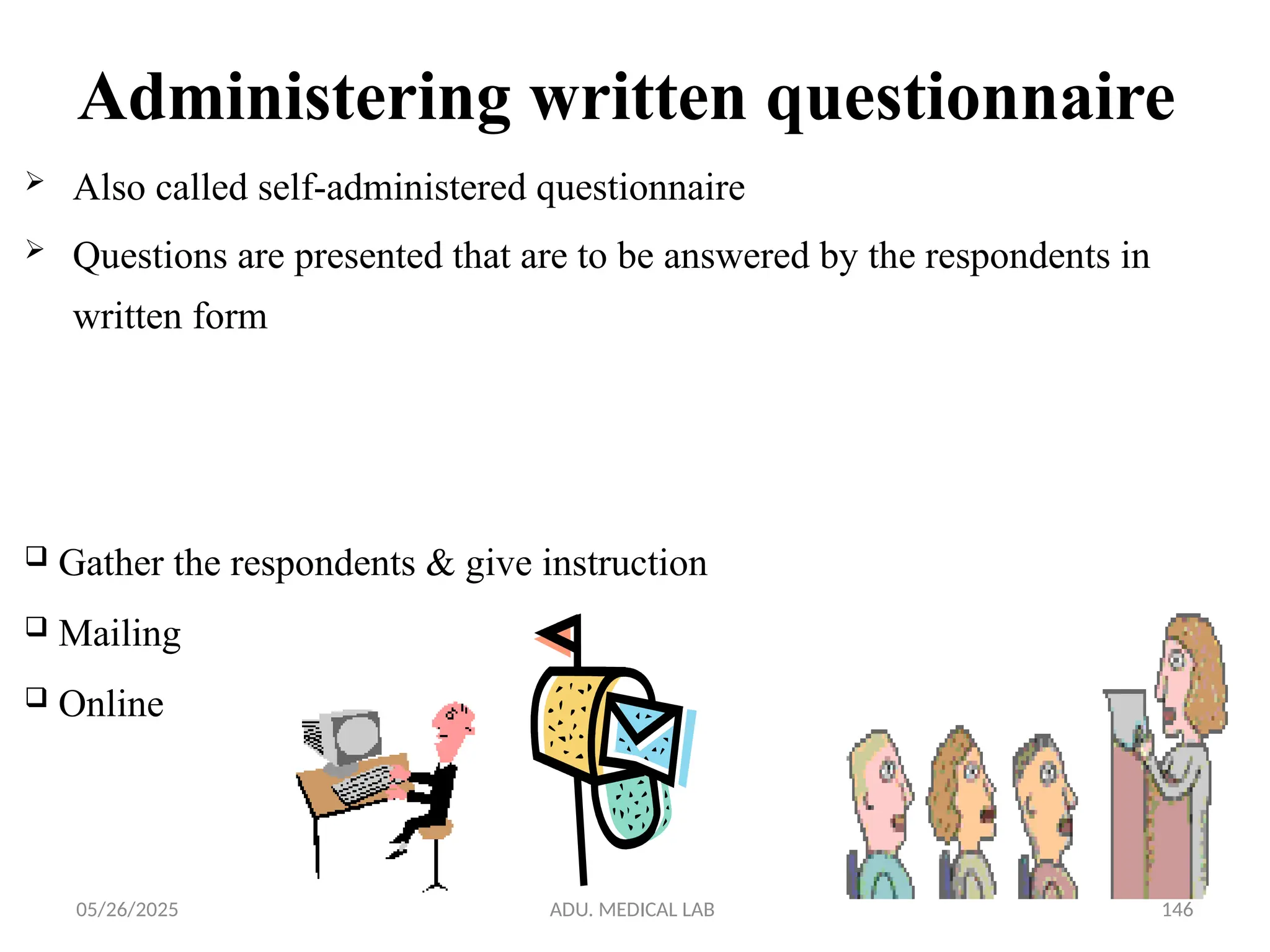
Administering written questionnaire
Also called self-administered questionnaire
Questions are presented that are to be answered by the respondents in
written form
Gather the respondents & give instruction
Mailing
Online
147.
05/26/2025 ADU. MEDICALLAB 147
Questionnaires cont’d
Advantages:
• Less expensive
• Permits anonymity & may result in more honest responses
• Does not require research assistants
• Eliminates bias due to phrasing questions differently with different
respondents
Disadvantages:
• Can't be used with illiterates
• There is often a low rate of response
• Questions may be misunderstood
05/26/2025 ADU. MEDICALLAB 149
Closed questions
A list of possible answers or options
Commonly used for background variables
Should be exhaustive & mutually exclusive
What is your marital status?
1. Single
2. Married
3. Divorced
4. Widowed
150.
05/26/2025 ADU. MEDICALLAB 150
Open-ended questions
Free to answer with fewer limits imposed by the researcher
Useful for exploring new areas
What is your opinion on the services provided in the laboratory?
____________________________________________
____________________________________________
151.
05/26/2025 ADU. MEDICALLAB 151
Semi-opened questions
What is your occupation?
(1) Dependent
(2) Manual labourer
(3) Government employee
(4) Private employee
(5) Owned business
(6) Others (please specify) _____________
152.
05/26/2025 ADU. MEDICALLAB 152
Step 1: Think for the objectives and variables
Step 2: Decide on the main section
Step 3: Write out the questions
Step 4: Sequencing the questions
Step 5: Compose a draft
Step 6: Take out any questions that are not essential
Step 7: Validate
Step 8: Pretest
Steps in designing a questionnaire
153.
05/26/2025 ADU. MEDICALLAB 153
• Use simple language
• Avoid conjunctive items
• Avoid questions that have ambiguous words or phrases
• Avoid questions about behavior that are not bounded by time
• Start with the easy questions
• Ask all respondents each question in exactly the same way
• Do not overload your interview schedule
Points to consider
154.
05/26/2025 ADU. MEDICALLAB 154
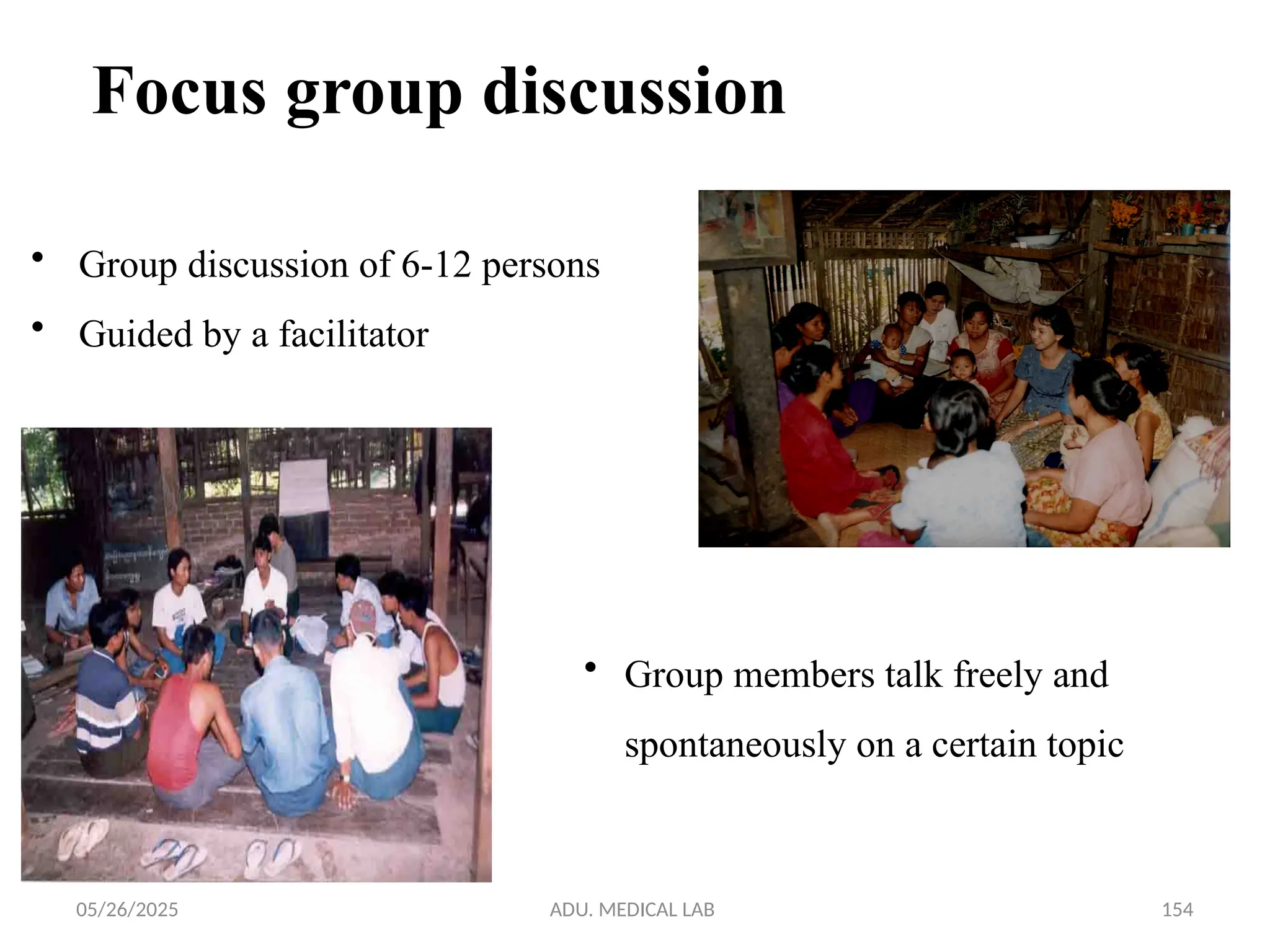
Focus group discussion
• Group discussion of 6-12 persons
• Guided by a facilitator
• Group members talk freely and
spontaneously on a certain topic
155.
05/26/2025 ADU. MEDICALLAB 155
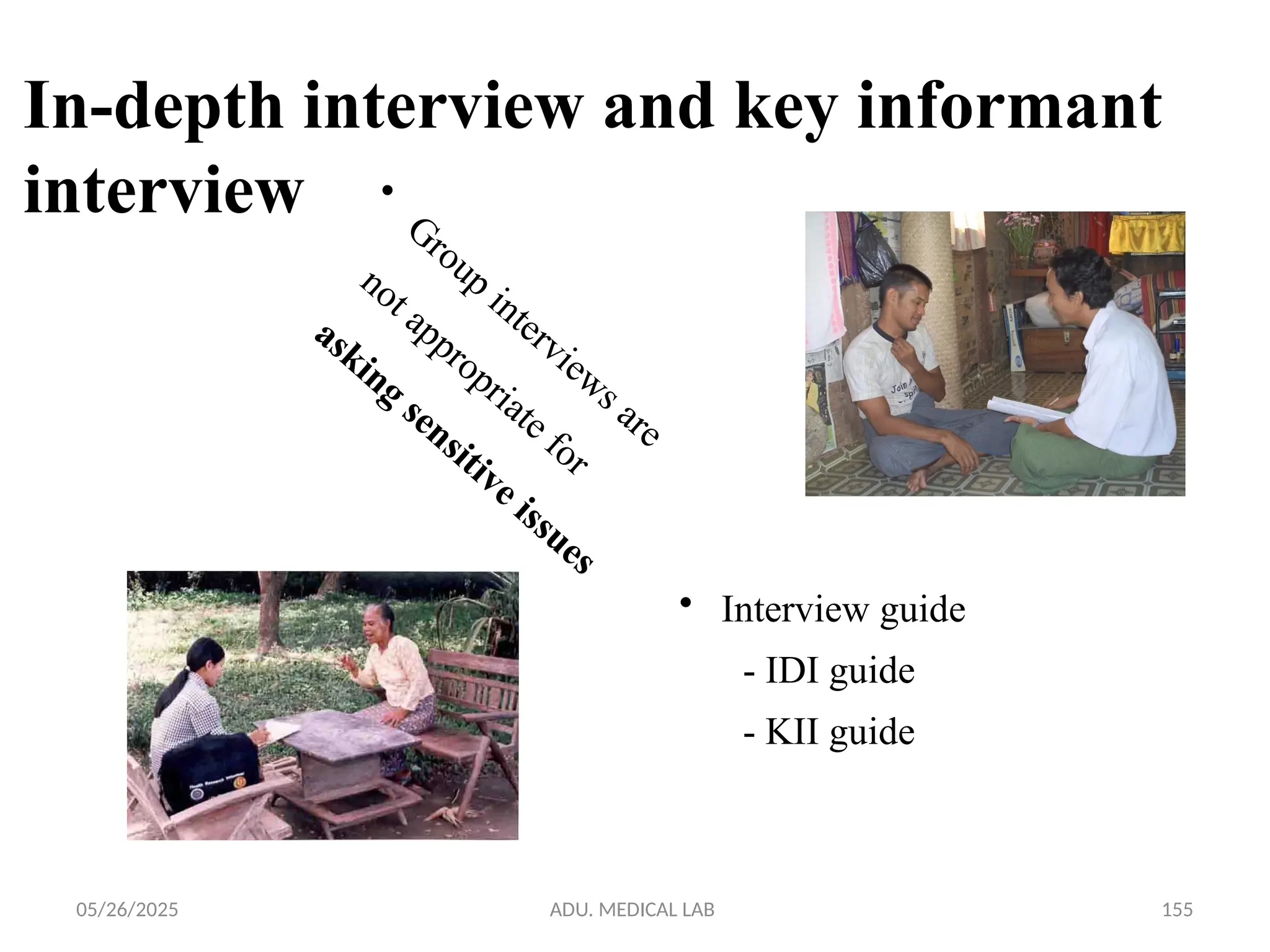
In-depth interview and key informant
interview •
Group
interviews are
not appropriate for
asking
sensitive issues
• Interview guide
- IDI guide
- KII guide
156.
05/26/2025 ADU. MEDICALLAB 156
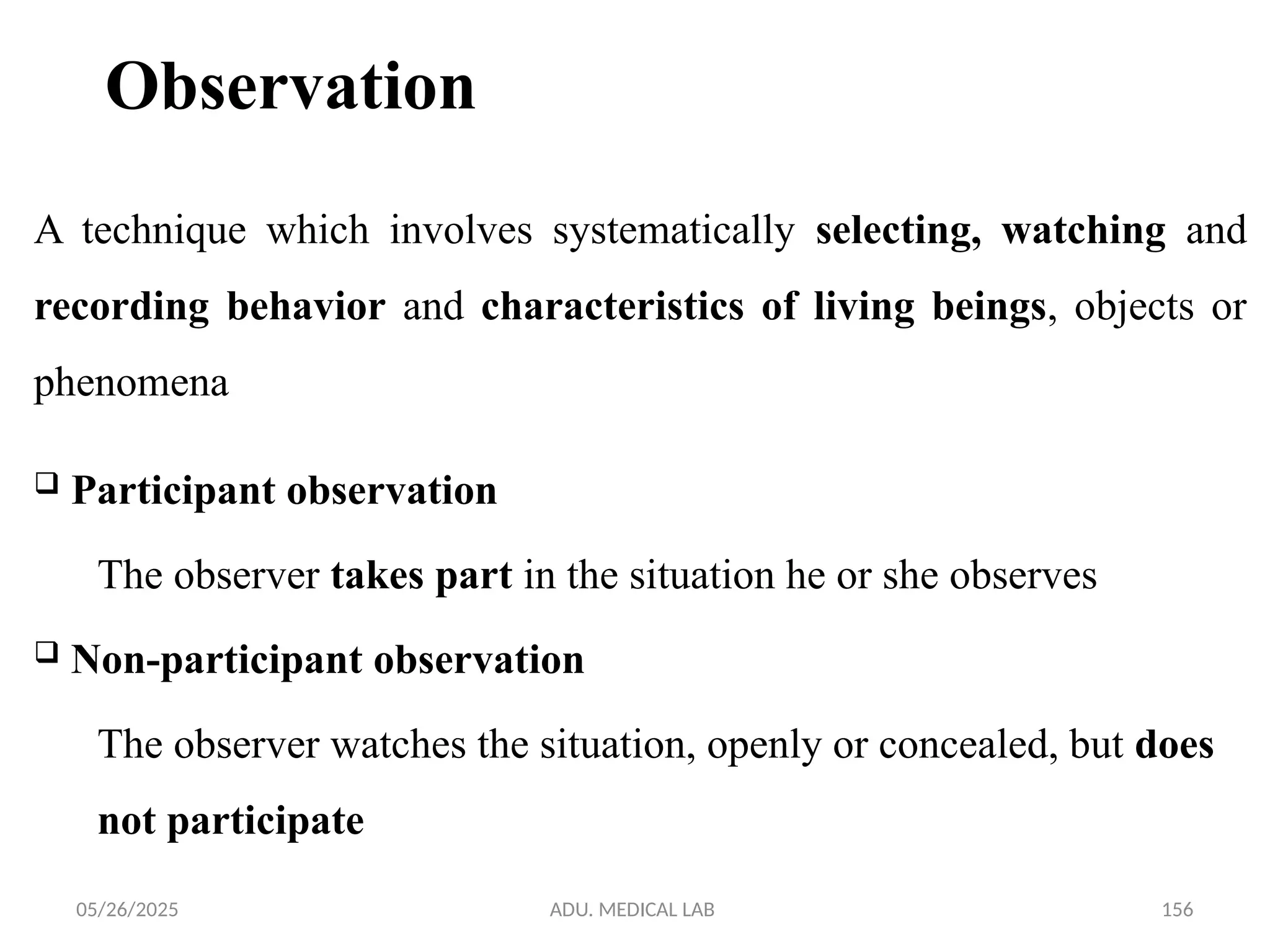
Observation
Participant observation
The observer takes part in the situation he or she observes
Non-participant observation
The observer watches the situation, openly or concealed, but does
not participate
A technique which involves systematically selecting, watching and
recording behavior and characteristics of living beings, objects or
phenomena
157.
05/26/2025 ADU. MEDICALLAB 157
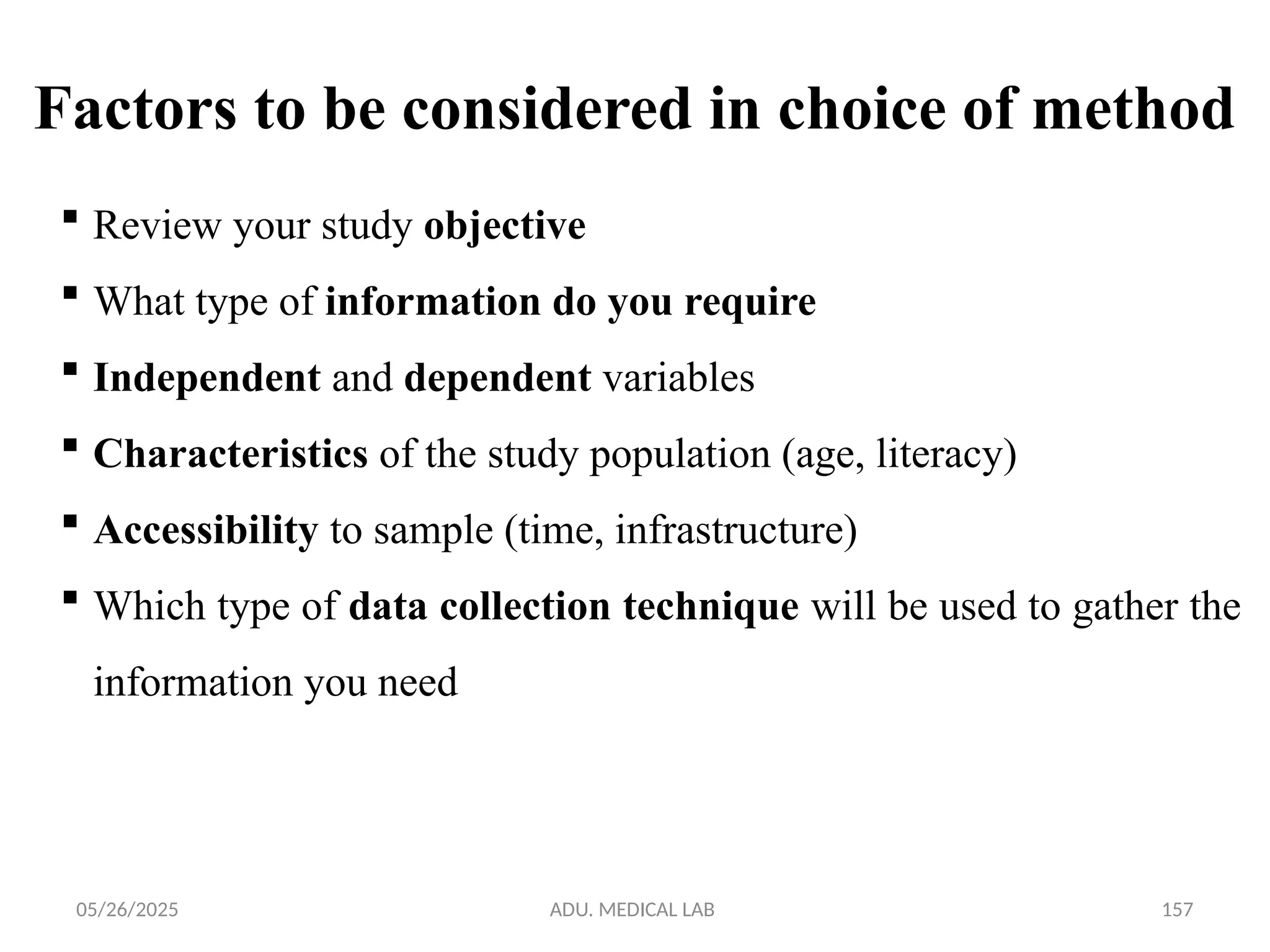
Review your study objective
What type of information do you require
Independent and dependent variables
Characteristics of the study population (age, literacy)
Accessibility to sample (time, infrastructure)
Which type of data collection technique will be used to gather the
information you need
Factors to be considered in choice of method
158.
05/26/2025 ADU. MEDICALLAB 158
View different methods of data collection
Prevalence of hypertension may be obtained by
Measuring blood pressure
(clinical measurement)
Asking a person if he/she has hypertension
(interview)
Record study
(document review)
159.
05/26/2025 ADU. MEDICALLAB 159
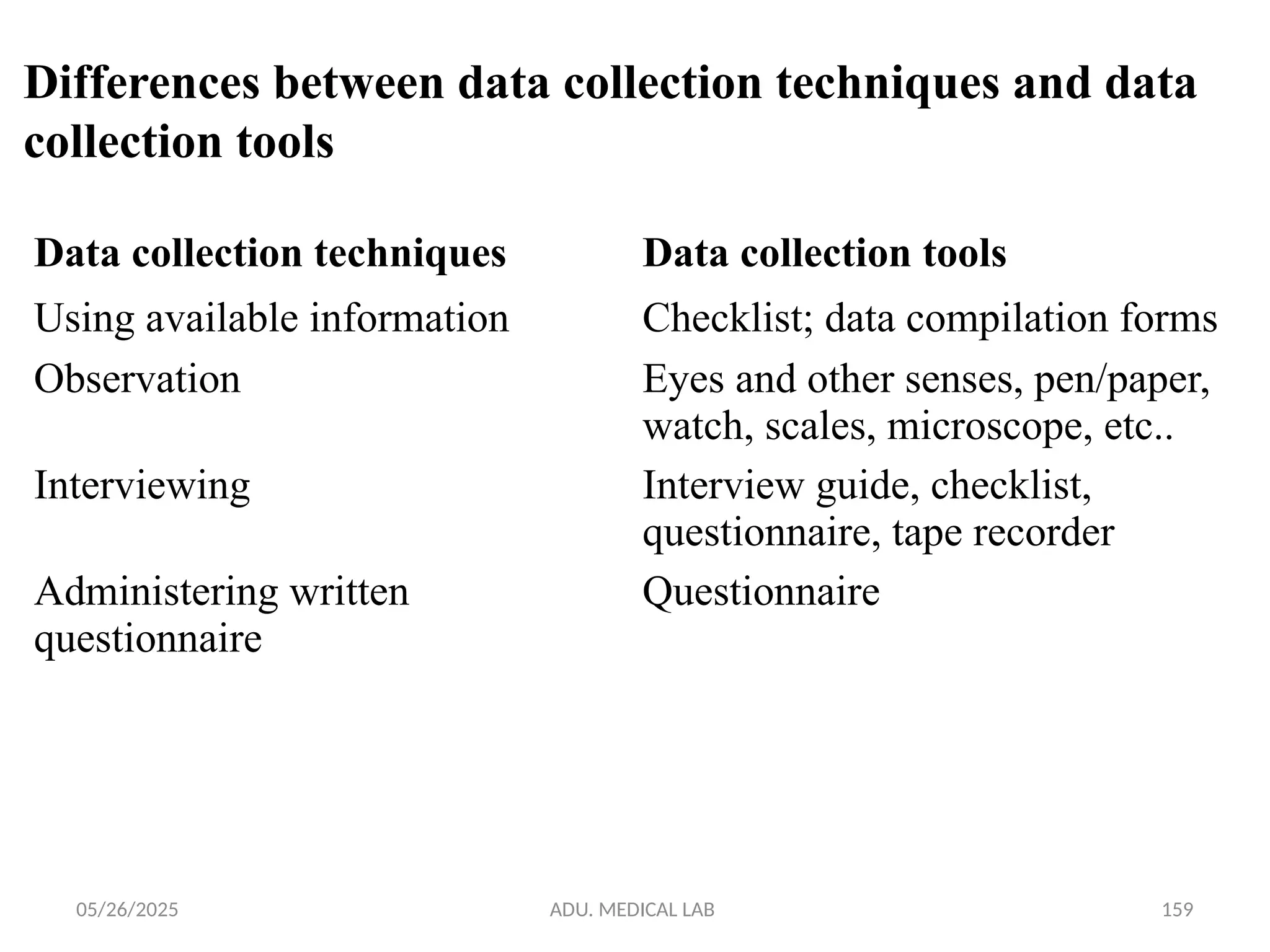
Differences between data collection techniques and data
collection tools
Data collection techniques Data collection tools
Using available information Checklist; data compilation forms
Observation Eyes and other senses, pen/paper,
watch, scales, microscope, etc..
Interviewing Interview guide, checklist,
questionnaire, tape recorder
Administering written
questionnaire
Questionnaire
160.
160
Pretesting and Pilotstudy
– Pretest: Usually refers to a small-scale trial of particular research
components
– Pilot study: Is the process of carrying out a preliminary study, going through
the entire research procedure with a small sample
Data processing
Refers to:
– Data checks and correction, and
– Data entry into a computer
• No matter how carefully the data have been entered some errors are
inevitable
• Produce a relatively ‘clean’ data set ready for analysis
161.
05/26/2025 ADU. MEDICALLAB 161
Data analysis
• Data analysis: Coding, entering, storing, recoding, choice of
statistical methods
• A plan for data analysis should include the following information:
– Identification of the analysis tasks to be completed
– Identification of the statistical software to be used for the
analysis
– A schedule or work plan for the analysis of the data
– A plan for quality control of the data analysis, including regular
checks which involve review and assessment of the quality of a
sample of the analysis already performed
162.
162
Ethical Considerations
• Professionalobligation to safeguard the safety of study participants
• Refer to national and international guidelines
• Describe potential ethical concerns and mechanisms to minimize harm and
maximize benefits
– Every research can potentially cause ethical concerns!!
• Description of ethical issues related to the study. For example consider:
– Approvals from relevant groups (e.g. ERB)
– Informed consent (subject information and informed consent form
appended)
– Benefit of the research
– Confidentiality
163.
05/26/2025 ADU. MEDICALLAB 163
Dissemination and Utilization of Results
• Briefly describe the dissemination plan
– Feedback to the community
– Feedback to local authorities
– Identify relevant agencies that need to be informed
– Scientific publication
– Presentation in meetings/conferences
• Briefly describe how the study results can be best translated into
application
164.
05/26/2025 ADU. MEDICALLAB 164
Chapter 7: Work Plan and budget
At the end of this chapter you will be able to write
– A Work Plan and
– A Budget break down for your research work
• Work plan summarizes (in a table, chart, graph) the various
components of a research project and how they fit together.
• Includes:
– Tasks to be performed
– When the task will be performed
– Who will perform the task (identify human resource)
– Number of staff needed to perform the task
165.
05/26/2025 ADU. MEDICALLAB 165
A work plan can serve as:
• A tool in planning the details of the project activities and later the
project funds
• A visual outline or illustration of the sequence of the project
operations.
• A management tool for the principal investigator and/or members
of his/her team, showing what tasks and activities are planned, their
timing, and when various members will be involved in the tasks;
• A tool for monitoring and evaluation, when the current status of the
project is compared to what was foreseen in the work plan.
166.
05/26/2025 ADU. MEDICALLAB 166
Work plan cont’d ….
• Ways of presenting a work plan
– Work schedule
– GANNT chart
– PERT chart
167.
05/26/2025 ADU. MEDICALLAB 167
Work plan cont’d ...
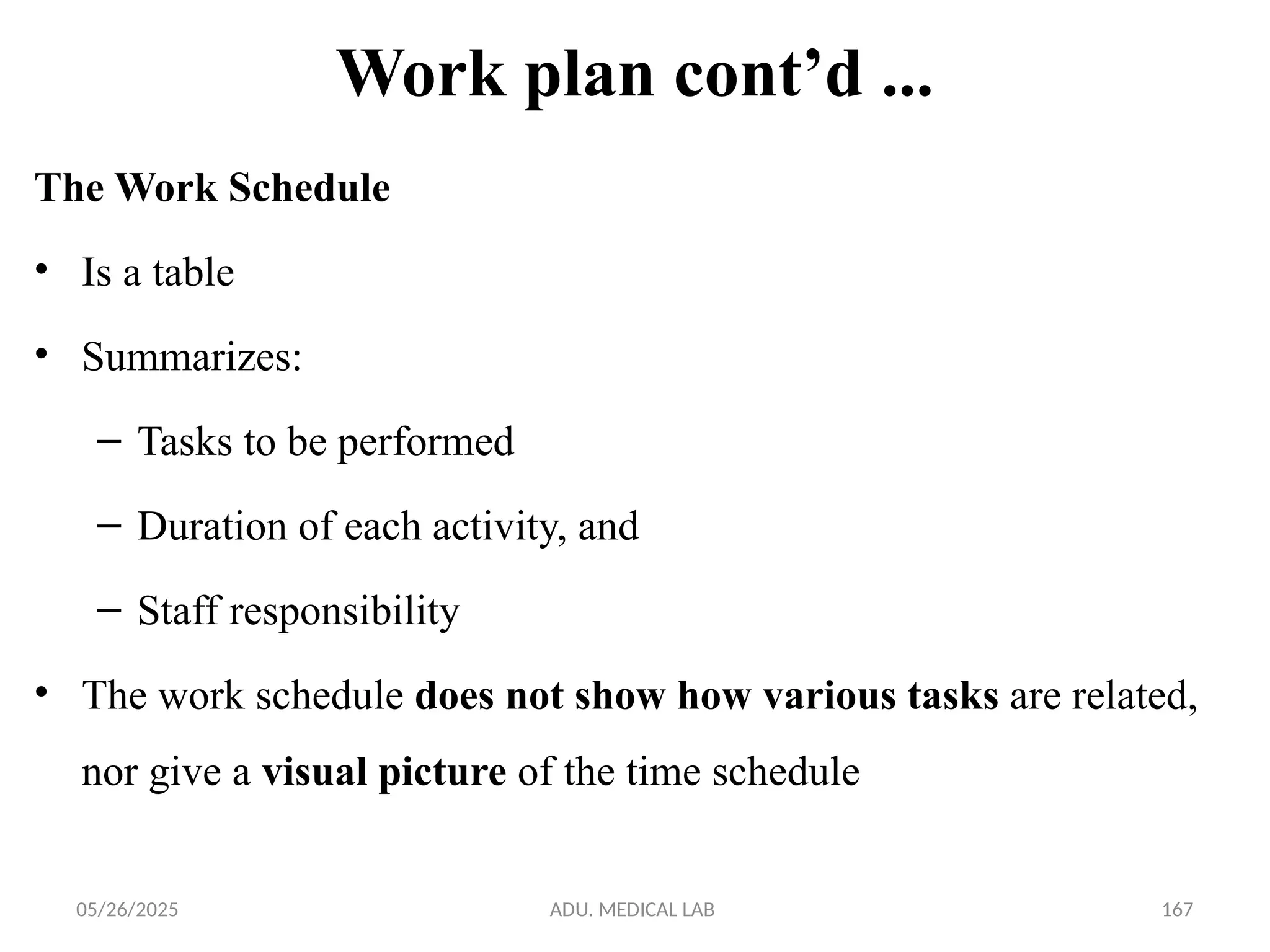
The Work Schedule
• Is a table
• Summarizes:
– Tasks to be performed
– Duration of each activity, and
– Staff responsibility
• The work schedule does not show how various tasks are related,
nor give a visual picture of the time schedule
168.
05/26/2025 ADU. MEDICALLAB 168
Work plan cont’d ...
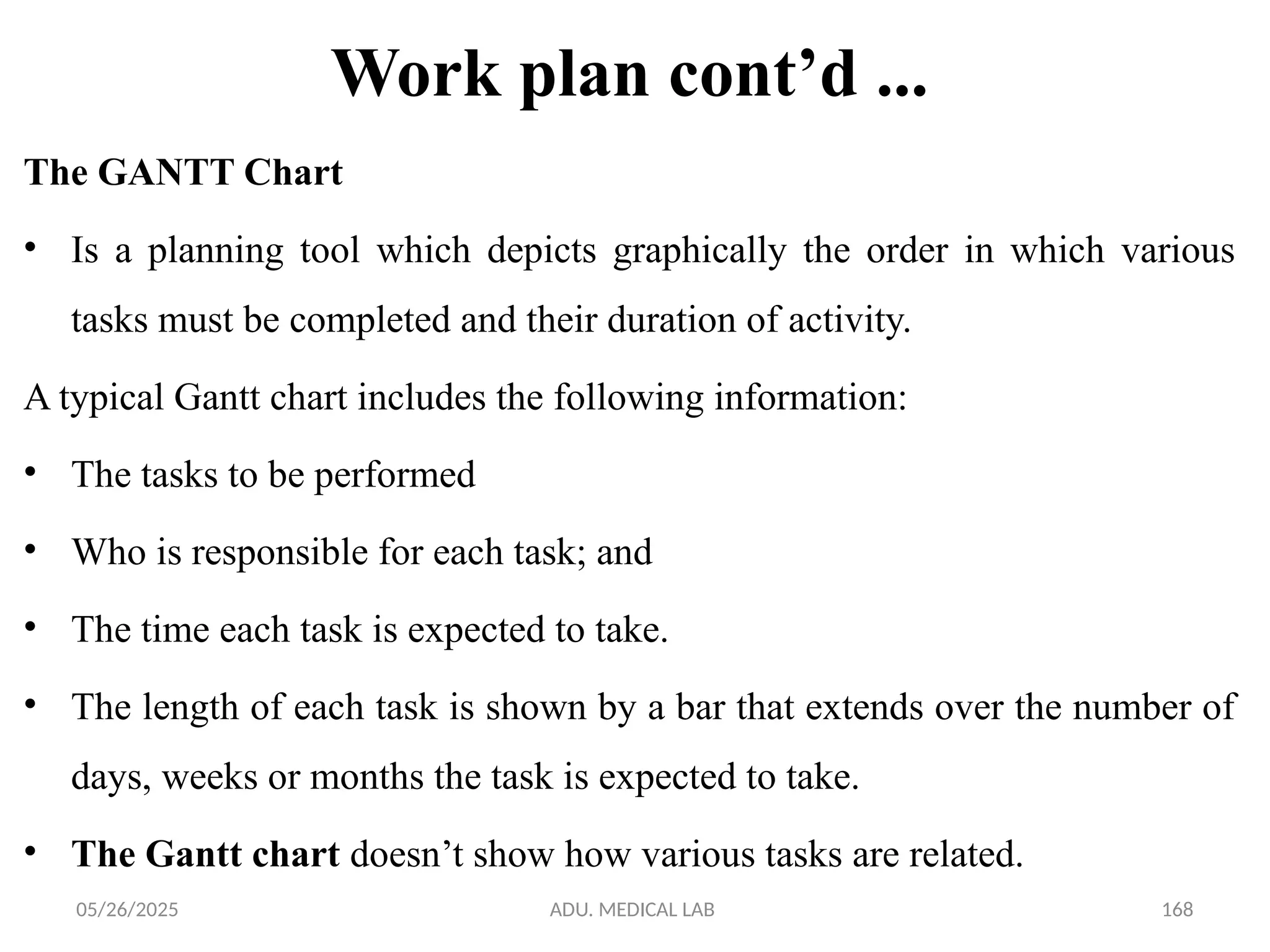
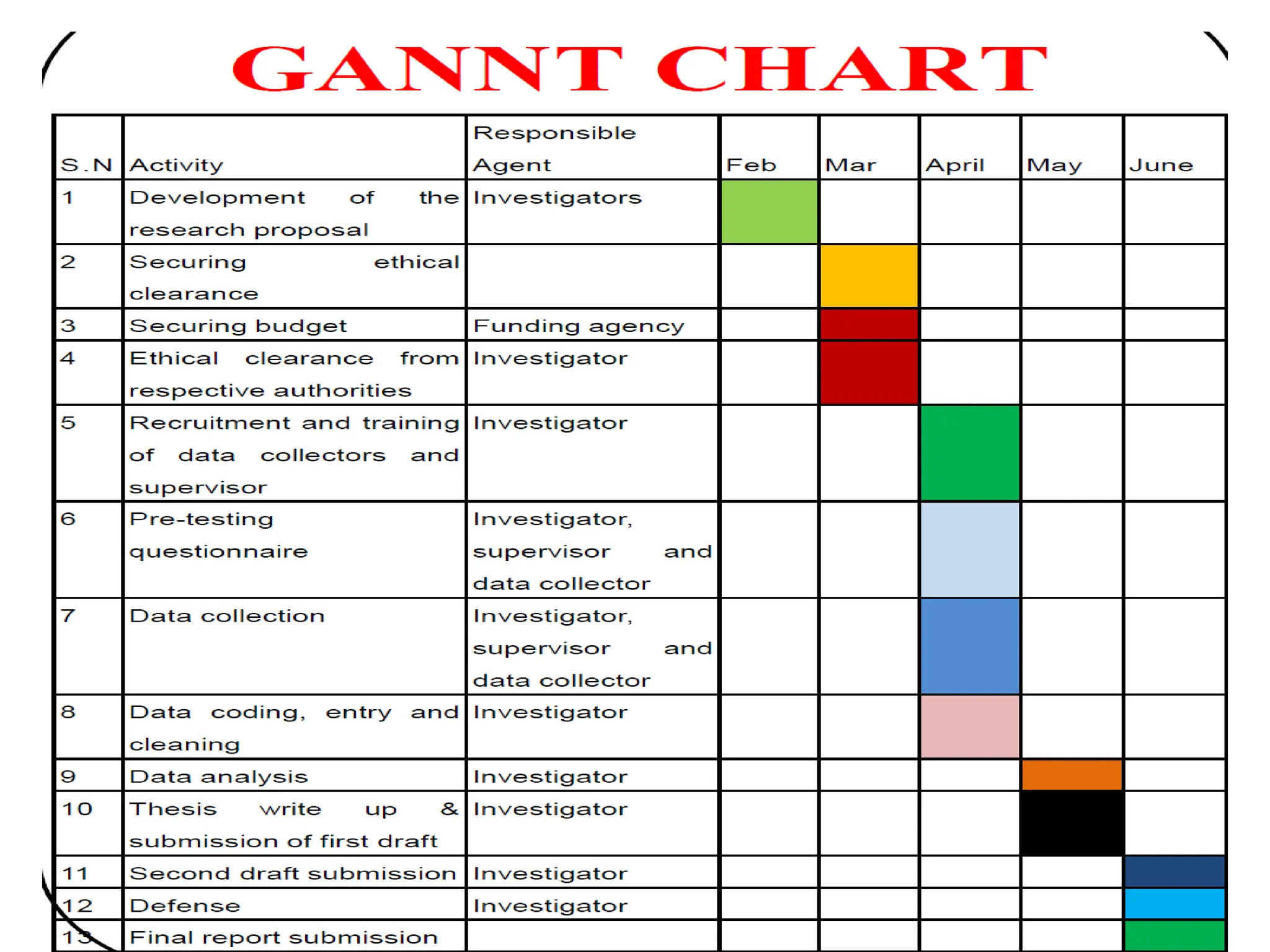
The GANTT Chart
• Is a planning tool which depicts graphically the order in which various
tasks must be completed and their duration of activity.
A typical Gantt chart includes the following information:
• The tasks to be performed
• Who is responsible for each task; and
• The time each task is expected to take.
• The length of each task is shown by a bar that extends over the number of
days, weeks or months the task is expected to take.
• The Gantt chart doesn’t show how various tasks are related.
170
Work plan cont’d...
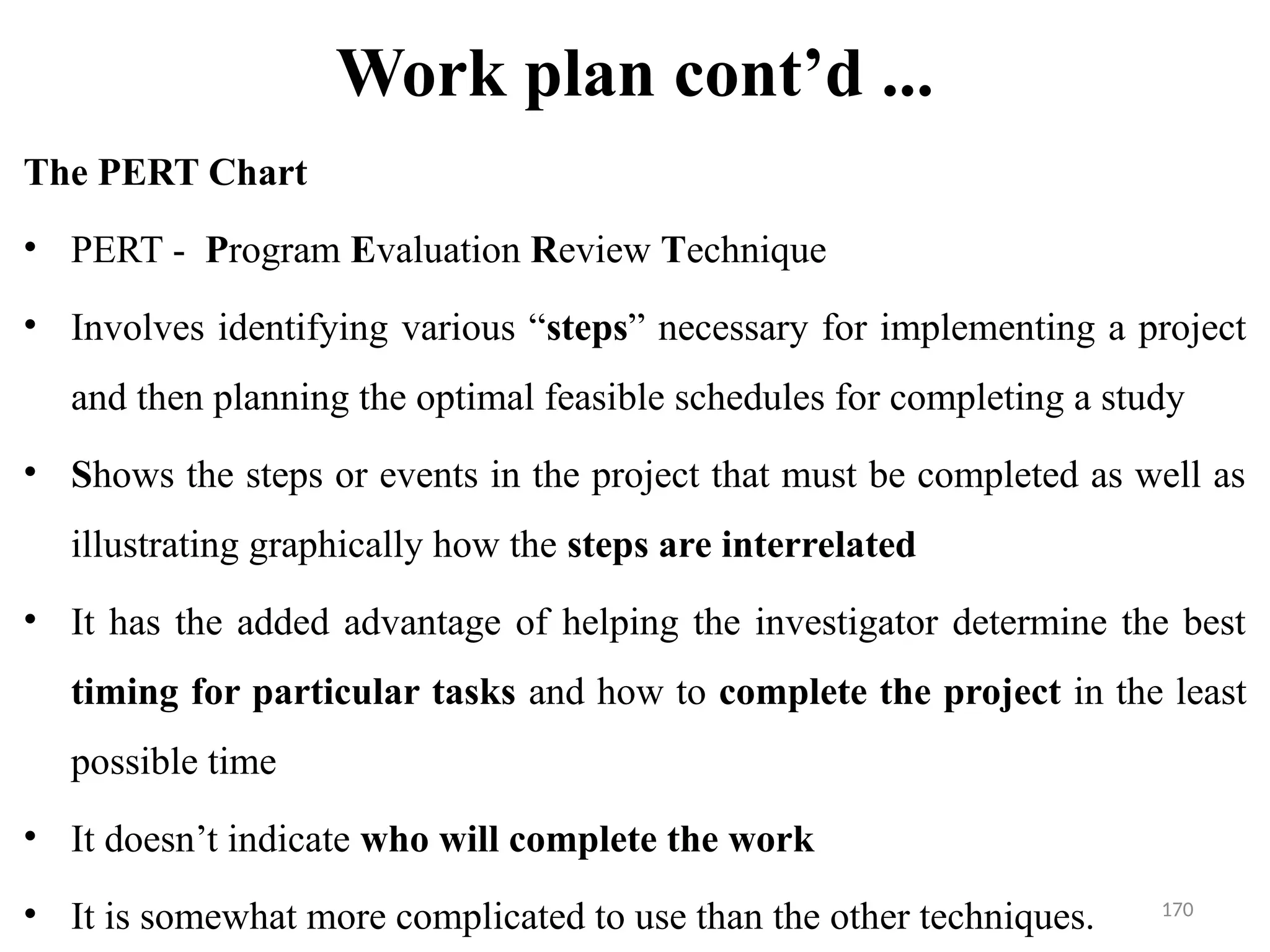
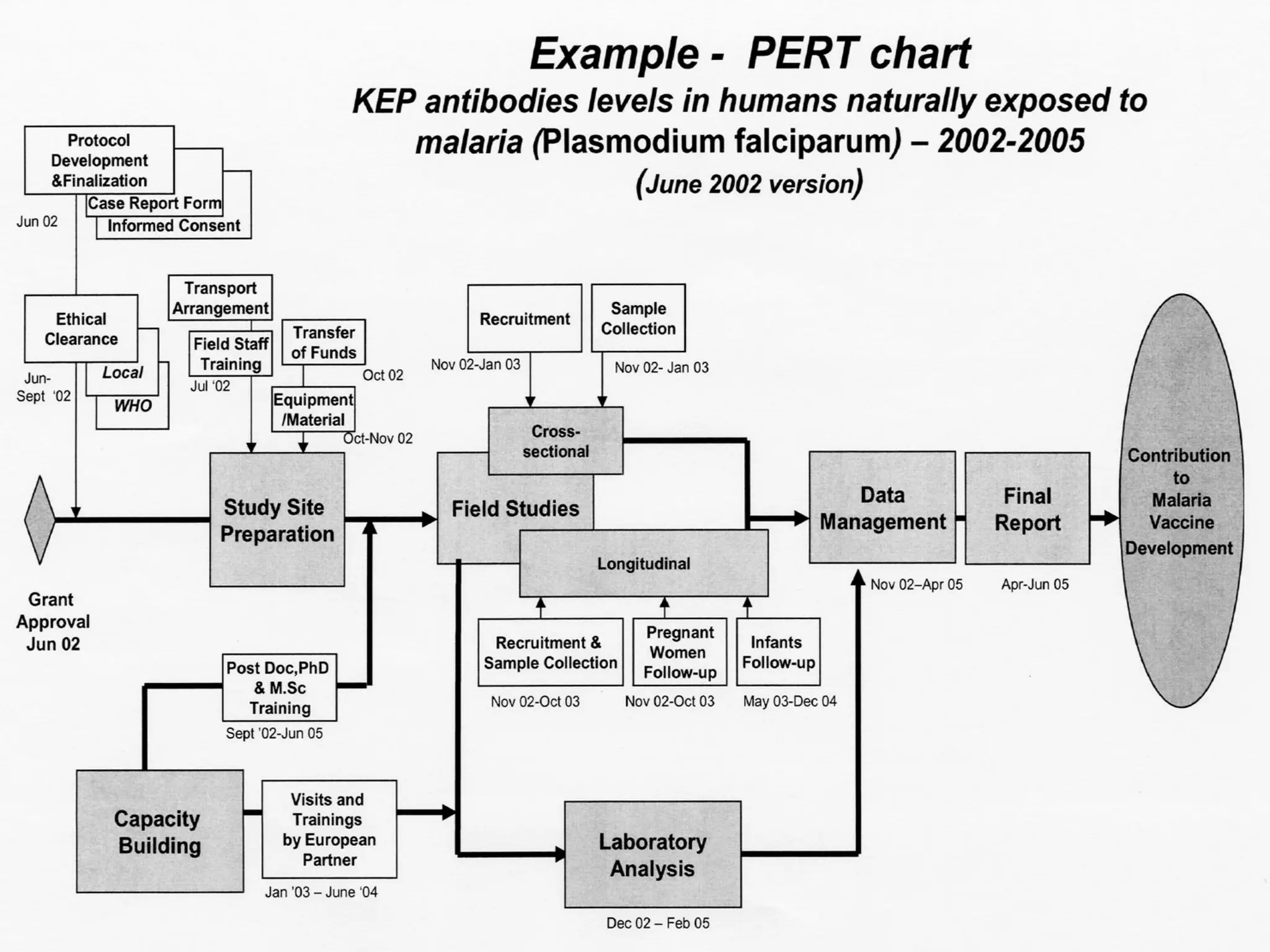
The PERT Chart
• PERT - Program Evaluation Review Technique
• Involves identifying various “steps” necessary for implementing a project
and then planning the optimal feasible schedules for completing a study
• Shows the steps or events in the project that must be completed as well as
illustrating graphically how the steps are interrelated
• It has the added advantage of helping the investigator determine the best
timing for particular tasks and how to complete the project in the least
possible time
• It doesn’t indicate who will complete the work
• It is somewhat more complicated to use than the other techniques.
05/26/2025 ADU. MEDICALLAB 172
Budget
• How should a budget be prepared?
– It is necessary to use the work plan as a starting point
– Specify, for each activity in the work plan, what resources are
required.
– Determine for each resource needed the unit cost and the total
cost
– The budget for the fieldwork component of the work plan will
include funds for personnel, transport and supplies.
– Include a 5%-10% contingency fund
173.
05/26/2025 ADU. MEDICALLAB 173
Annex
• Include in the appendices of your proposal any additional
information you think might be helpful to a proposal reviewer.
• For example, include:
– Biographical data on the principal investigator
– The study questionnaire
– The consent form
– A copy of the approval from the Institutional Review Board
174.
05/26/2025 ADU. MEDICALLAB 174
Chapter 8: Results and Discussion
Results
• Purpose → to describe the results of data analysis that are relevant to the
study
• This component is the core section of the scientific report and which is
presented by tables, figures, charts, etc.
• The results should be presented in an orderly sequence using an outline
• The sequence of the results should follow the sequence of the objectives
and Methods section
175.
05/26/2025 ADU. MEDICALLAB 175
Results cont’d ...
• Use past tense
• Do not interpret results
• Avoid extra words
• Determine whether the data are best presented in the form of
– Text
– Figures, or
– Tables
176.
05/26/2025 176
Text
Describewhat you found, not what you did
Present results in a logical sequence
Consider sub-sections
Do not repeat all of the data from the tables and figures in the text;
Make sure all numbers in text are consistent with tables/figures
Use of tables & figures
Tables are referred to as “tables”, and all other items (graphs,
photographs, drawings, diagrams, maps, etc.) are referred to as
“figures”
177.
177
Discussion
Purpose → tointerpret your results & justify your interpretation
• Is considered the heart of the paper and usually requires several writing attempts
• As short as possible while clearly and fully stating, supporting, explaining, and
defending your answers and discussing other important and directly relevant
issues
• Do not present any new data that were not shown in the result section
• Organize the Discussion from the specific to the general: your findings to the
literature, to theory, to practice.
• Address all the results relating to the questions, regardless of whether or not
the findings were statistically significant
• Discuss any unexpected findings
• Write the limitation and strength of your study
178.
05/26/2025 ADU. MEDICALLAB 178
Chapter 9: Conclusion and Recommendation
• A conclusion is where you summarize the paper’s findings and
generalize their importance,
• ????????????
• Conclusions should be short, as they have been elaborately
discussed in the discussion section
• Strive for accuracy and originality in your conclusion.
• By the time you reach the end of your conclusion, there should be
no question in the reader's mind as to the validity of your claims.
179.
05/26/2025 ADU. MEDICALLAB 179
Recommendations
• Placed in roughly the same sequence as the conclusion
• Recommendations may at the same time be summarized according
to the groups towards which they are directed
Example
– Policy makers
– Managers at district or lower level
– Staff who could implement the activities
– The community at large
– Researchers



![05/26/2025 ADU. MEDICAL LAB 84
Study area
Topic :-The effect of tuberculosis on immune reconstitution among HIV
patients on highly active antiretroviral therapy in Adigrat General Hospital,
Eastern Tigrai, Ethiopia; 2019: A retrospective follow up study
• A retrospective follow up study will be employed to assess the effect of TB and
other determinant factors of immune reconstitution among HIV patients on
HAART in Adigrat General Hospital, Eastern Tigrai, Ethiopia from October
to July 2019. Adigrat is a zonal administrative town of Eastern Tigrai, with an
estimated population of 76,400 [25]. The town is located at a longitude and
latitude 14°16′N 39°27′E, with an elevation of 2,457 meters (8,061 ft) above sea
level and below a high ridge to the west
• Adigrat General Hospital is one of the governmental Hospitals located in Adigrat
established for peoples from 6 weredas (districts). The Hospital is currently
involved as teaching and referral services for more than 1,000,000 population
with an average annual client flow of 131,125 people. The Hospital has about
120 beds with a total of 209 health care providers and 132 administrative staffs.
There are about 10 health care providers in the HAART clinic of the Hospital
and a total of 1582 HIV patients currently on HAART follow up](https://image.slidesharecdn.com/researchmethodologypptformls-250526190946-c9d32bc7/75/Research-methodology-PPT-for-Medical-Laboratory-Sciences-x-84-2048.jpg)
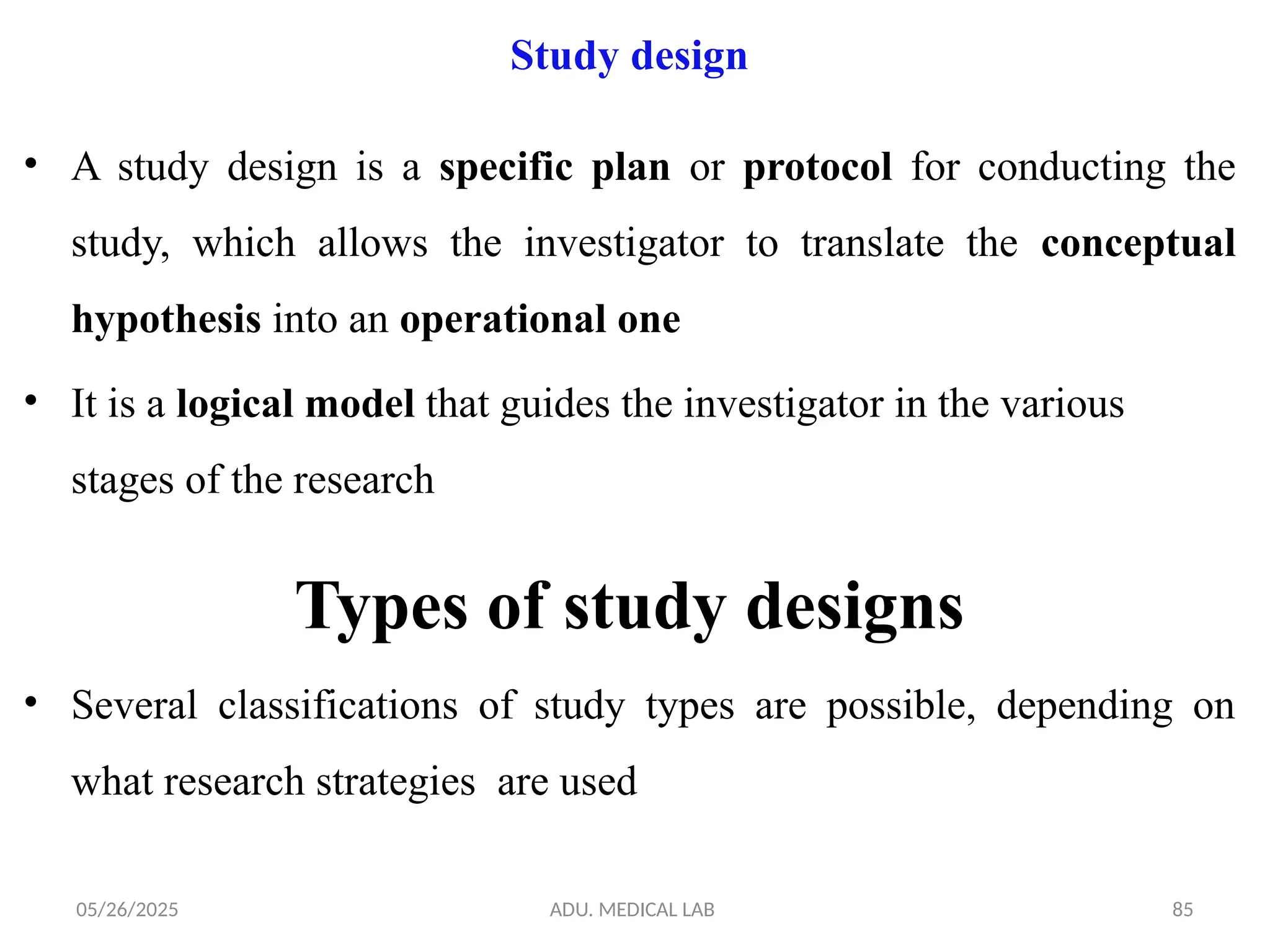
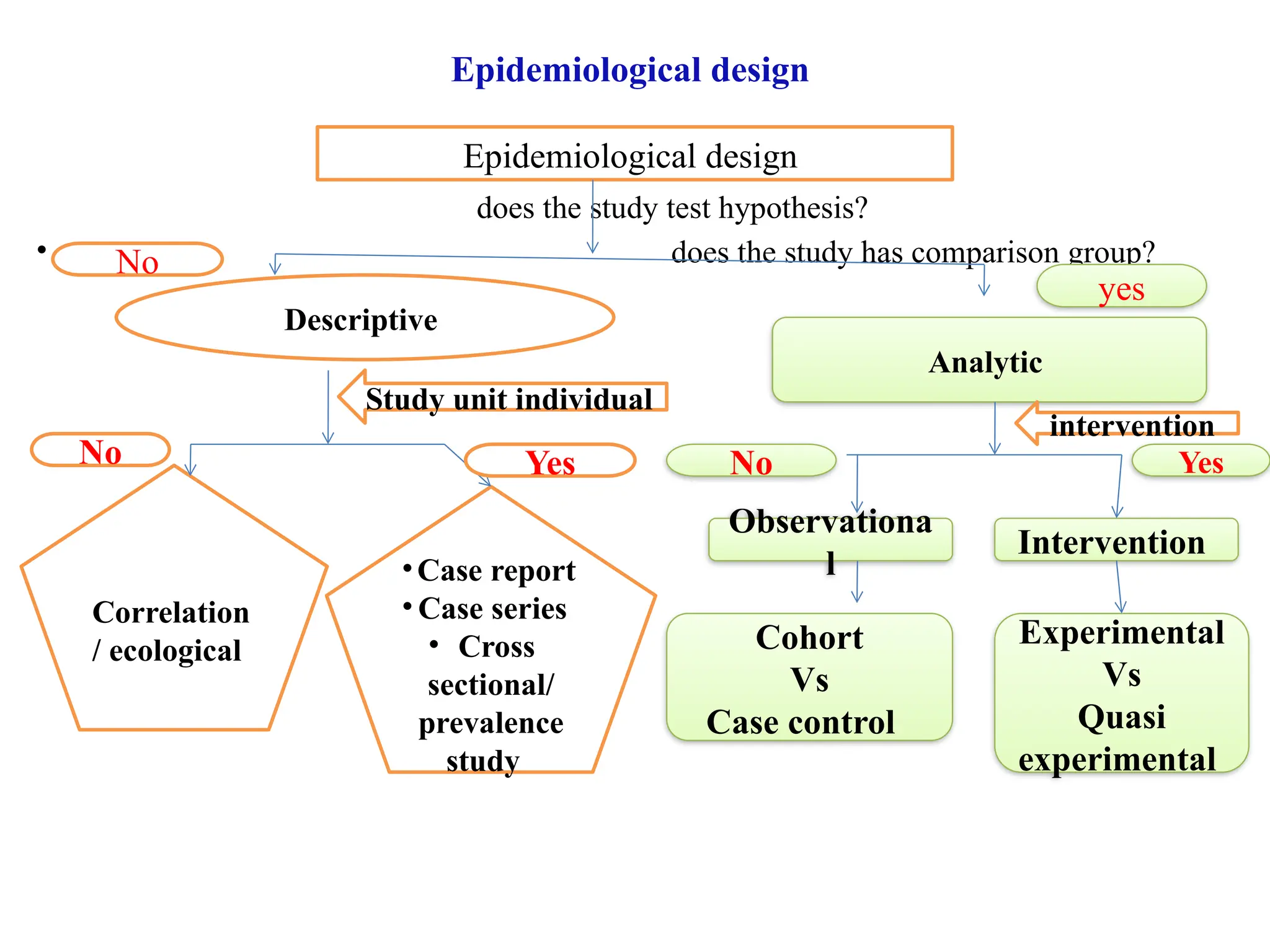
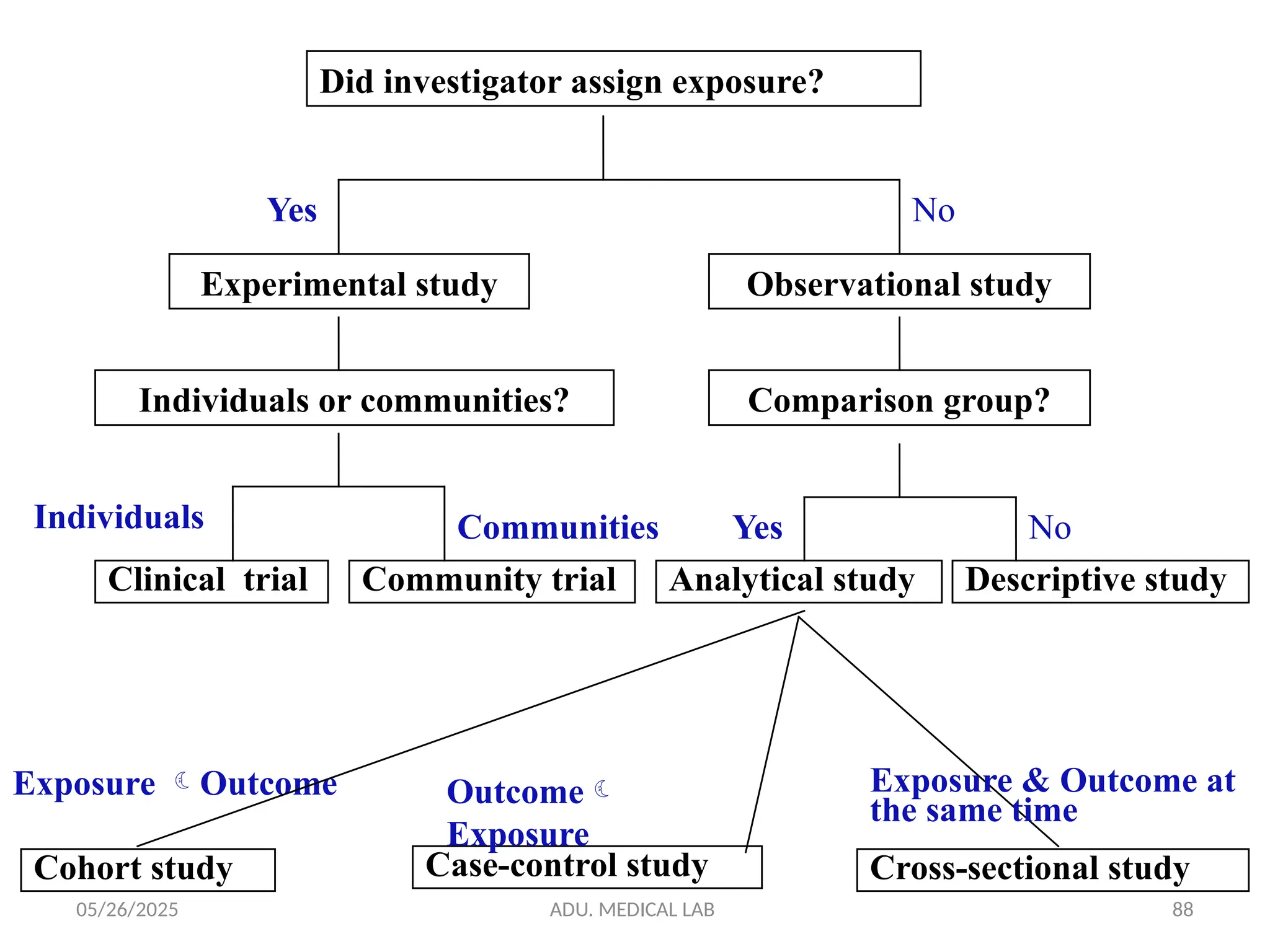
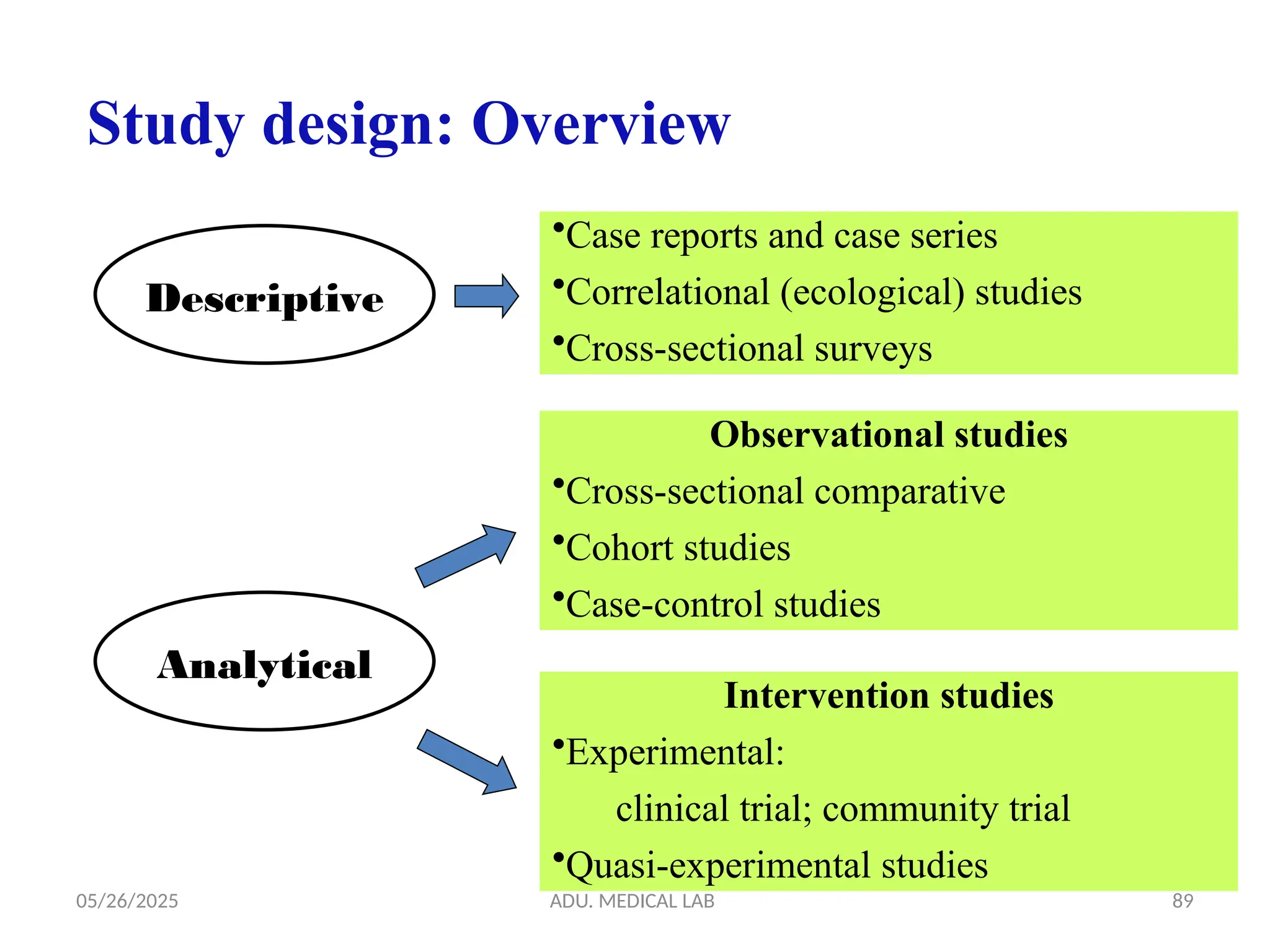
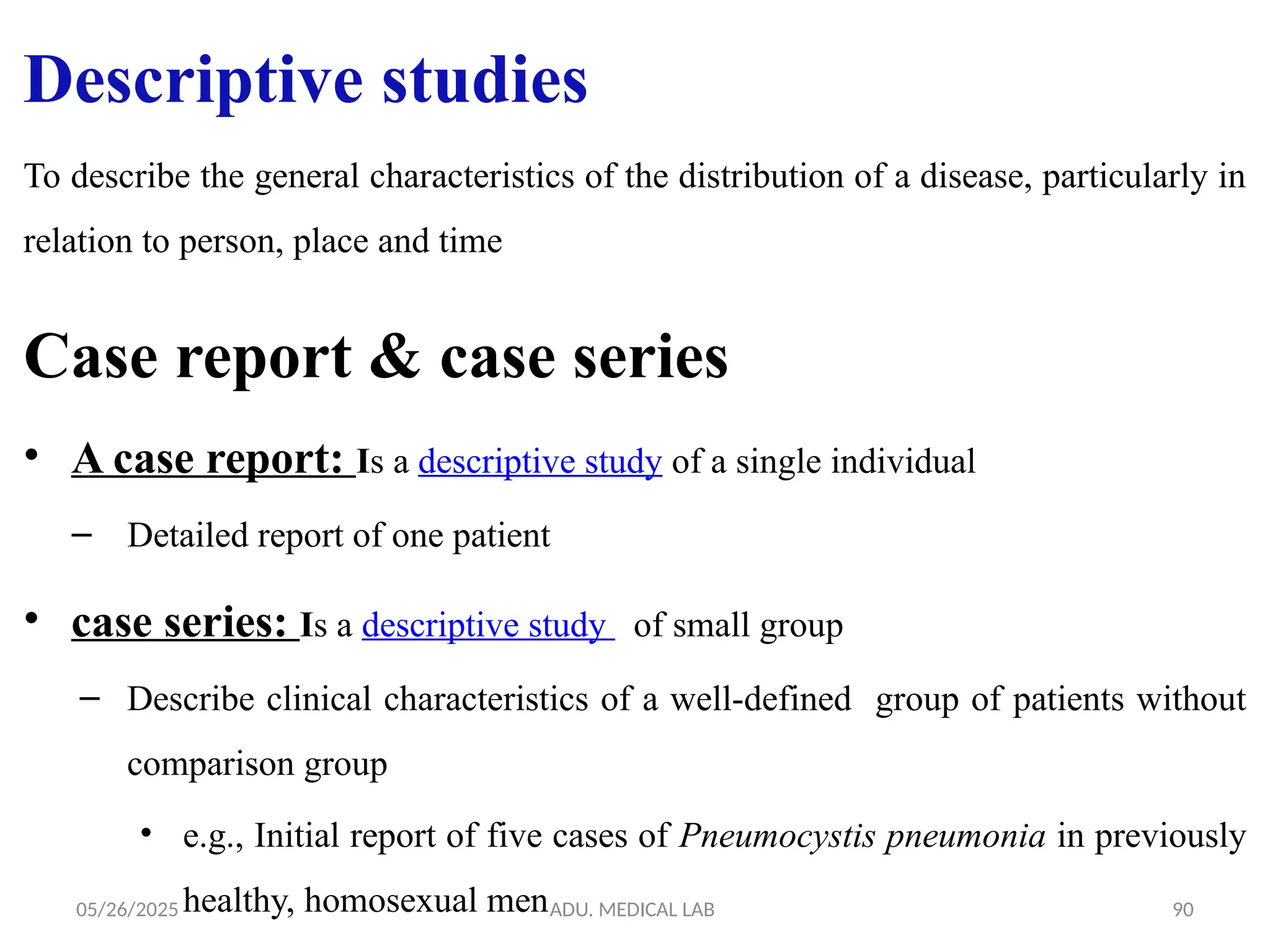
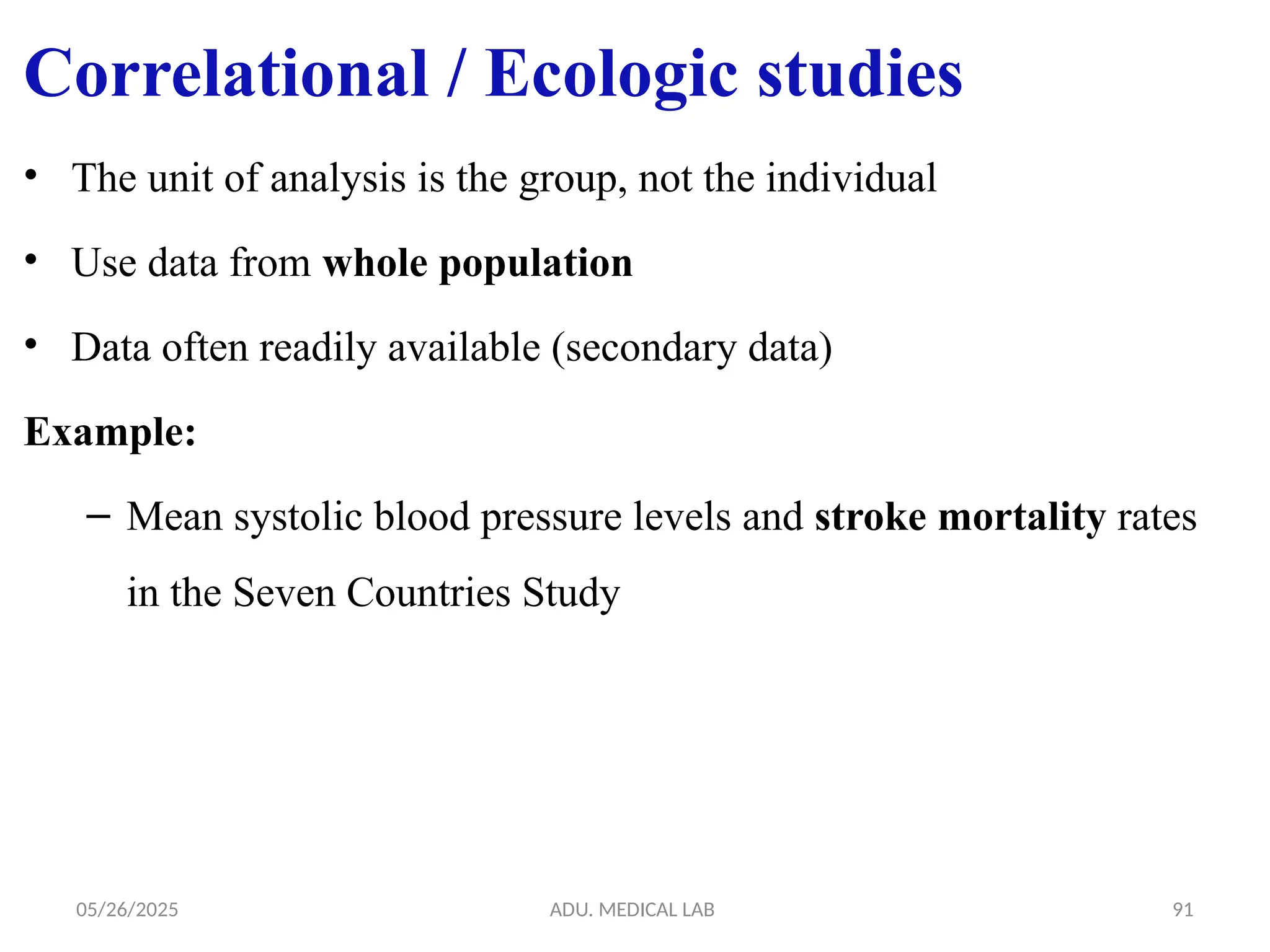
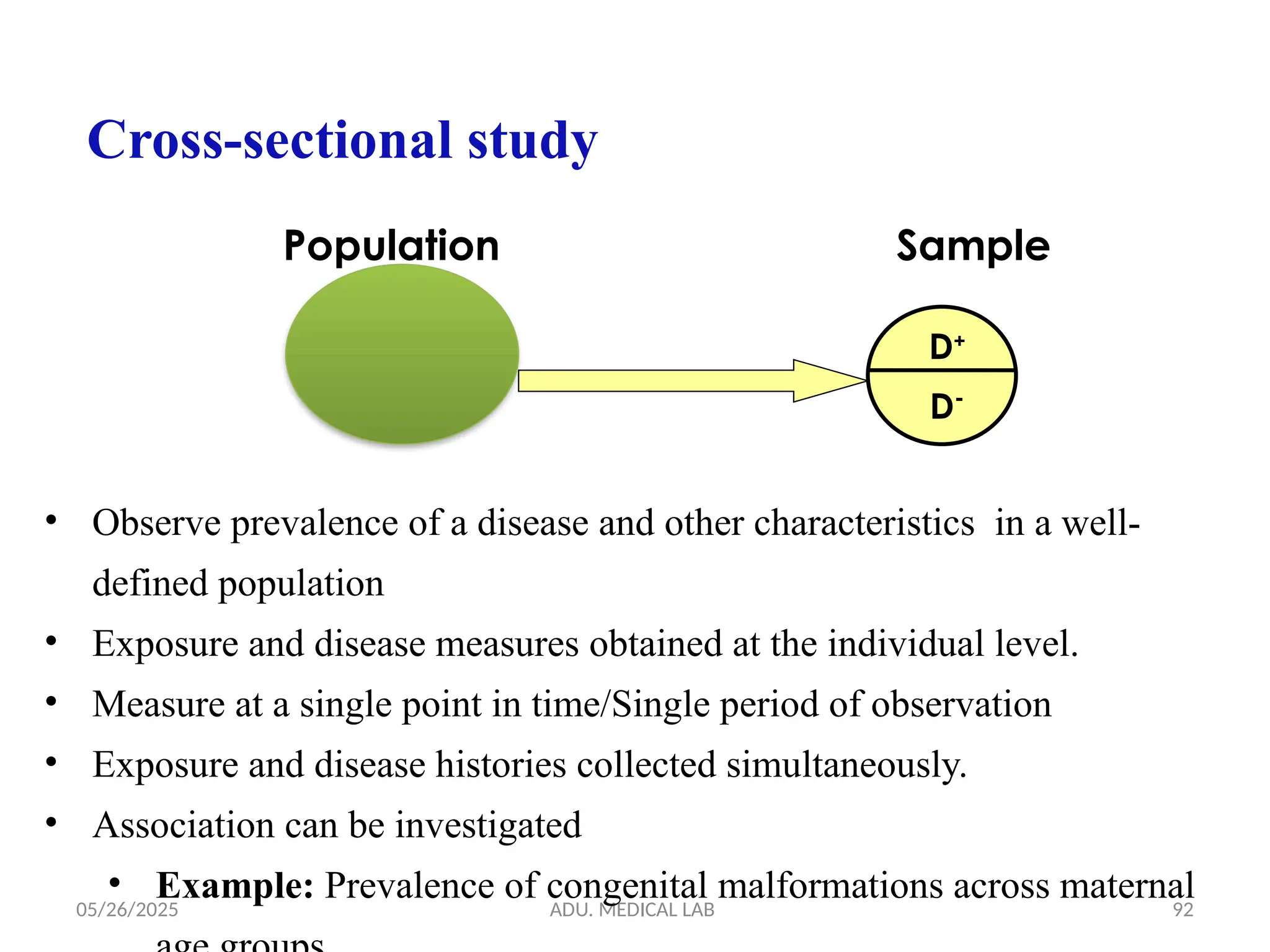
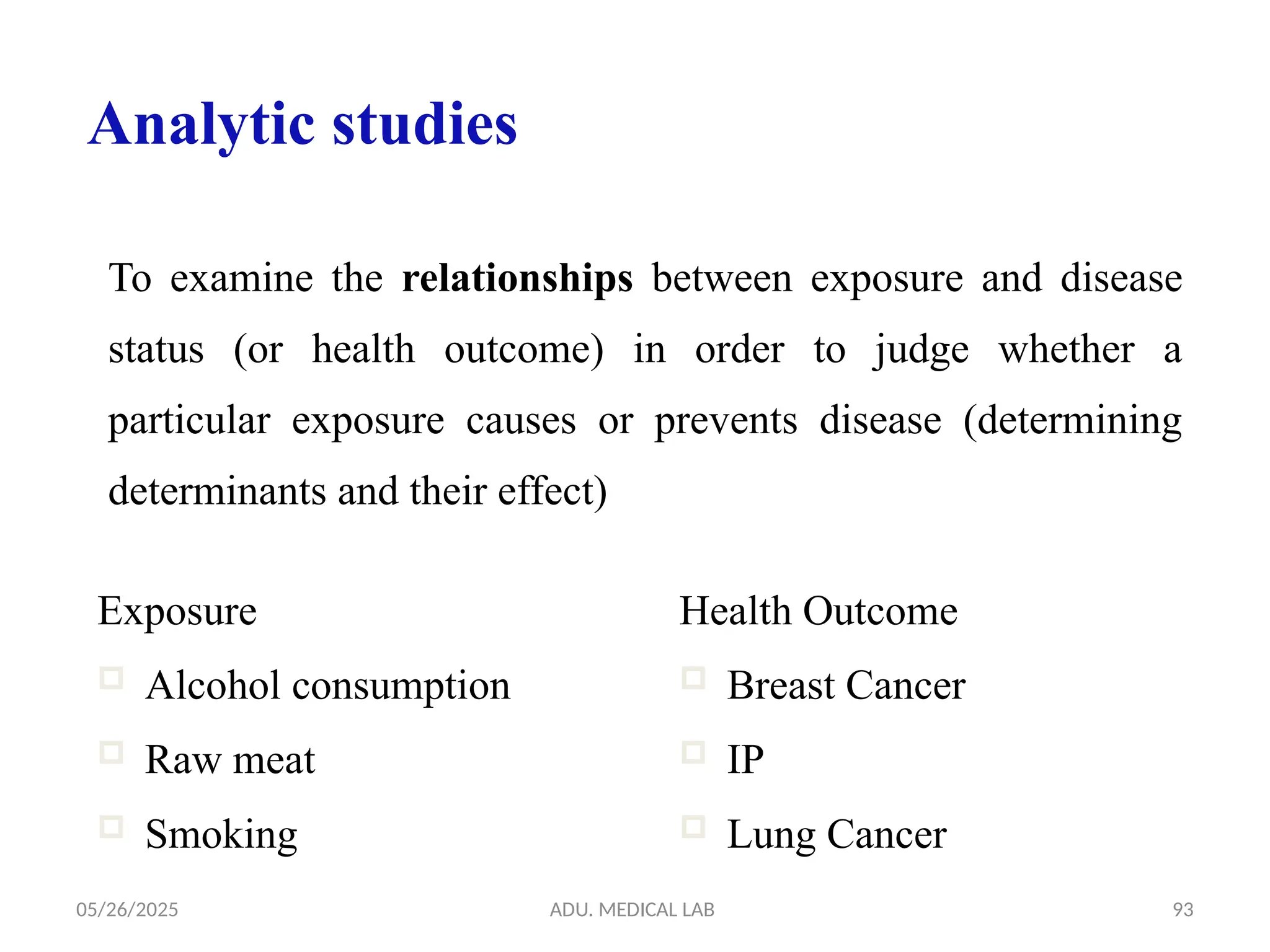
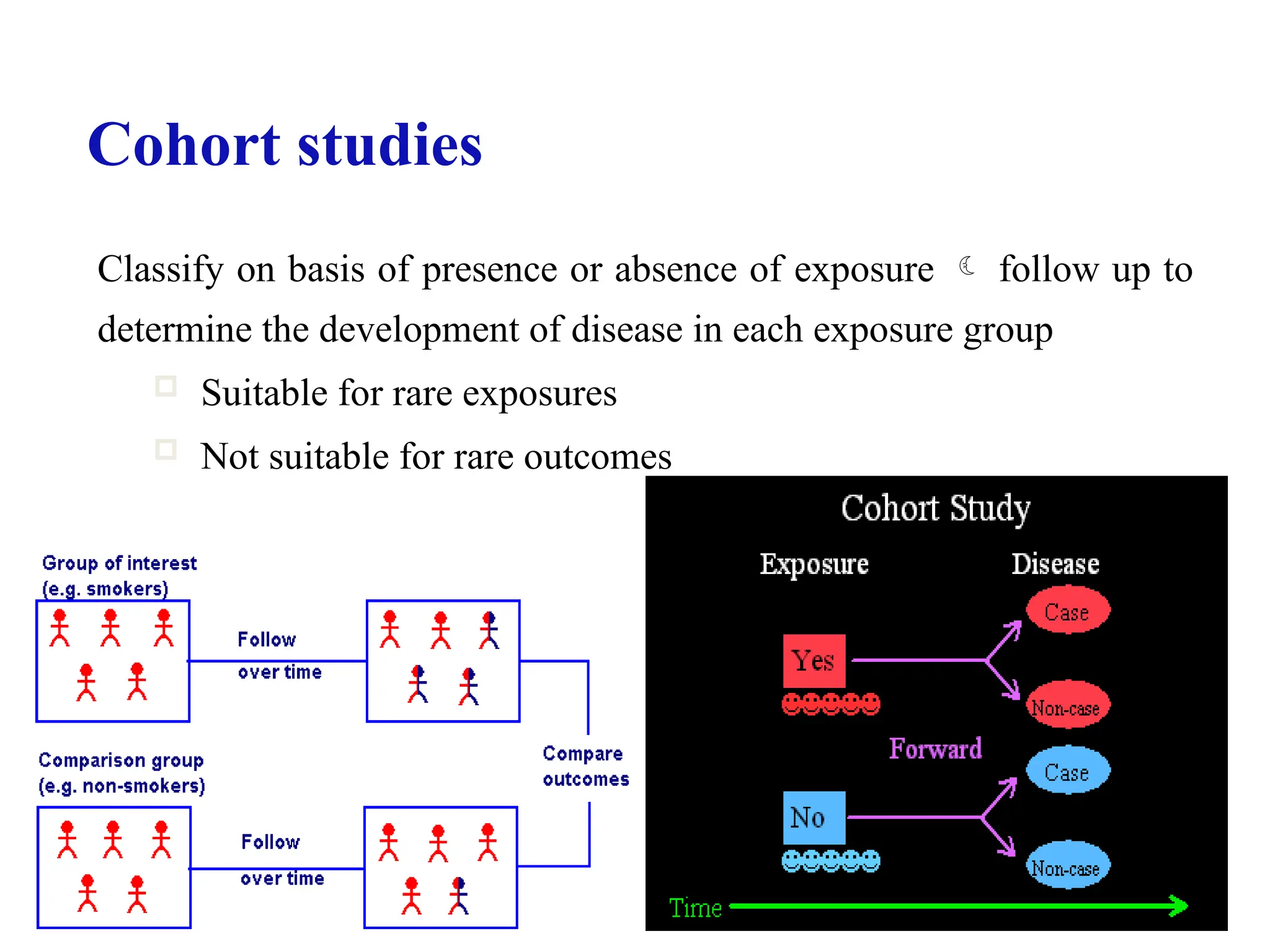
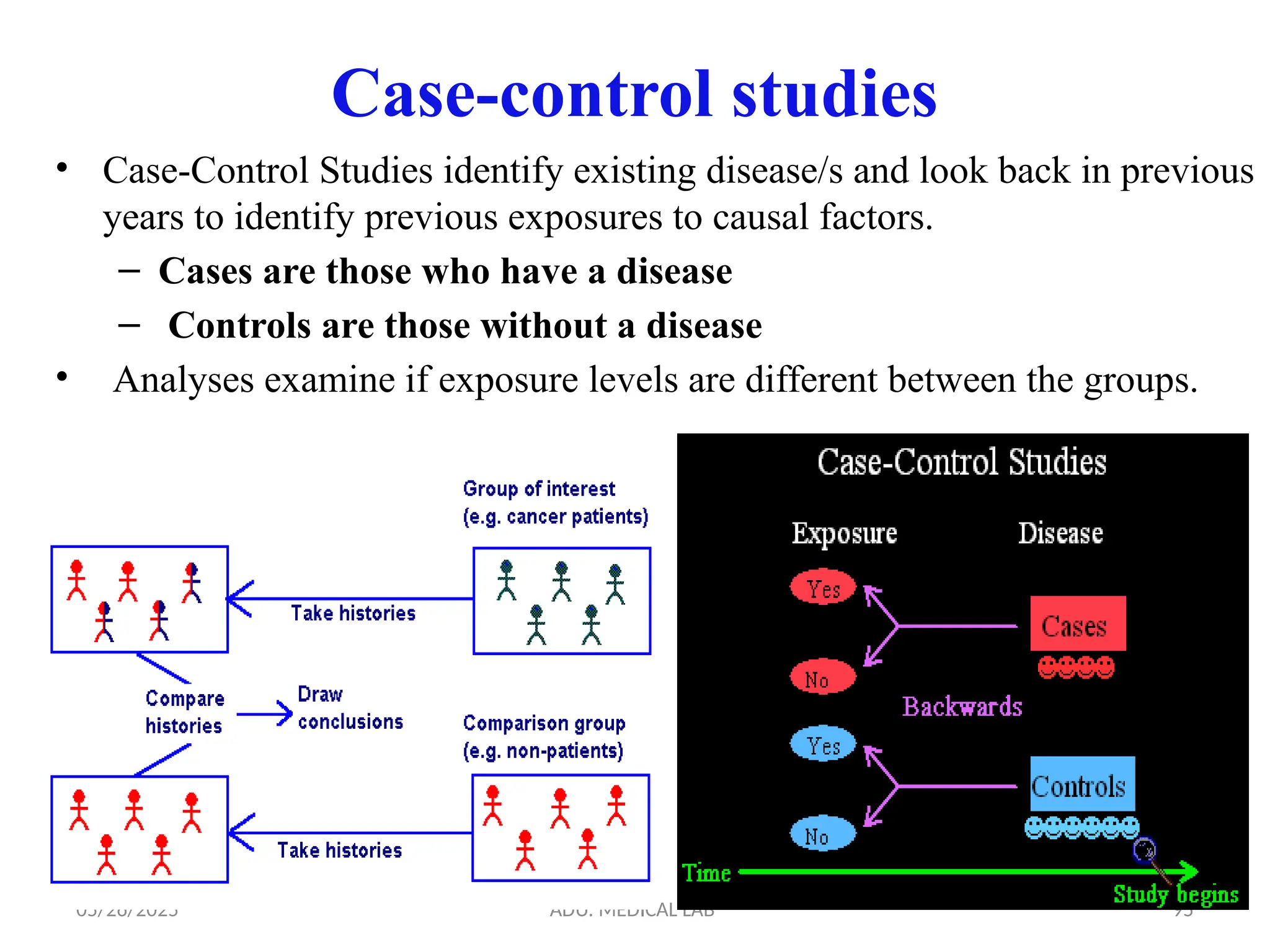
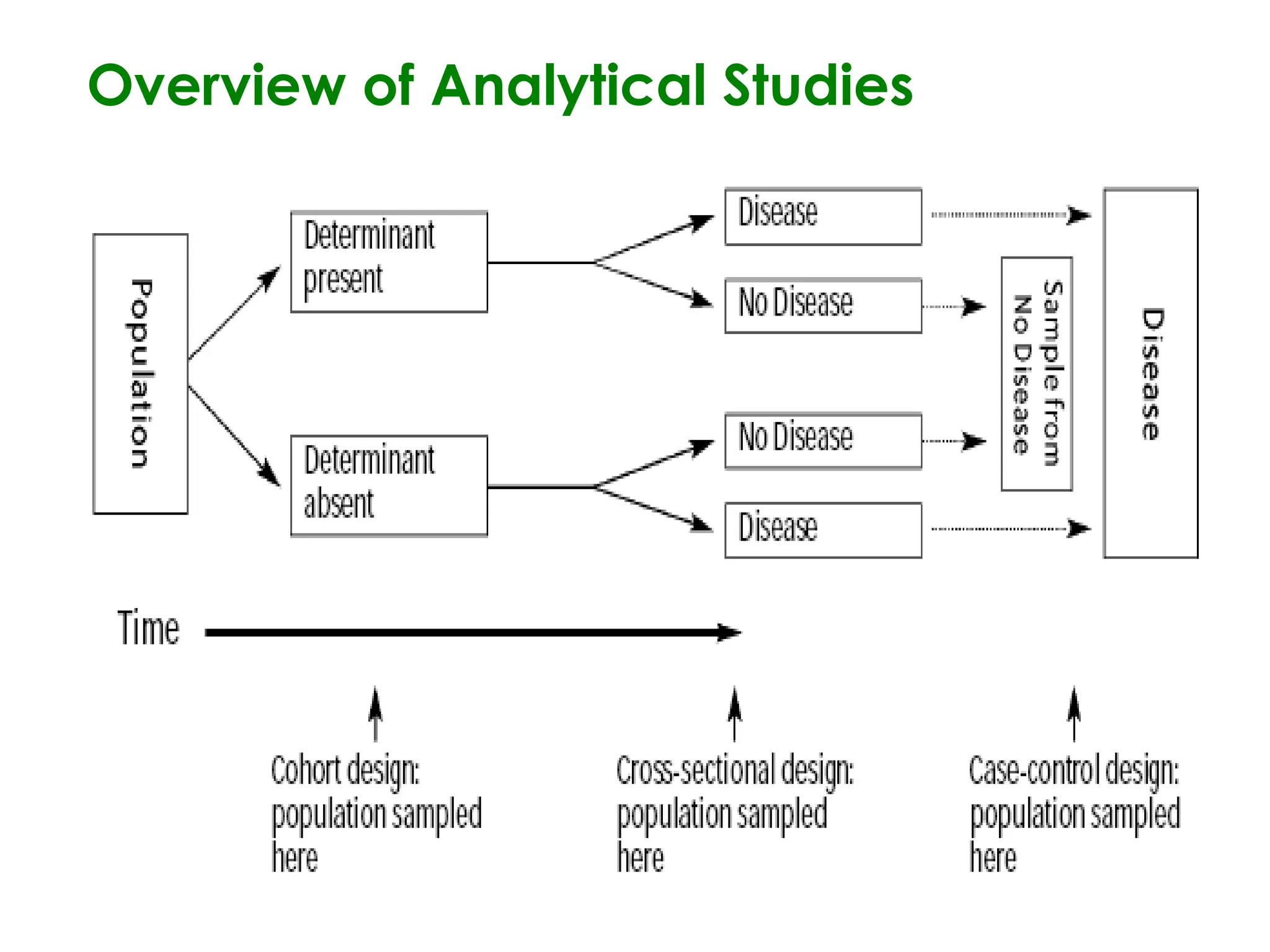
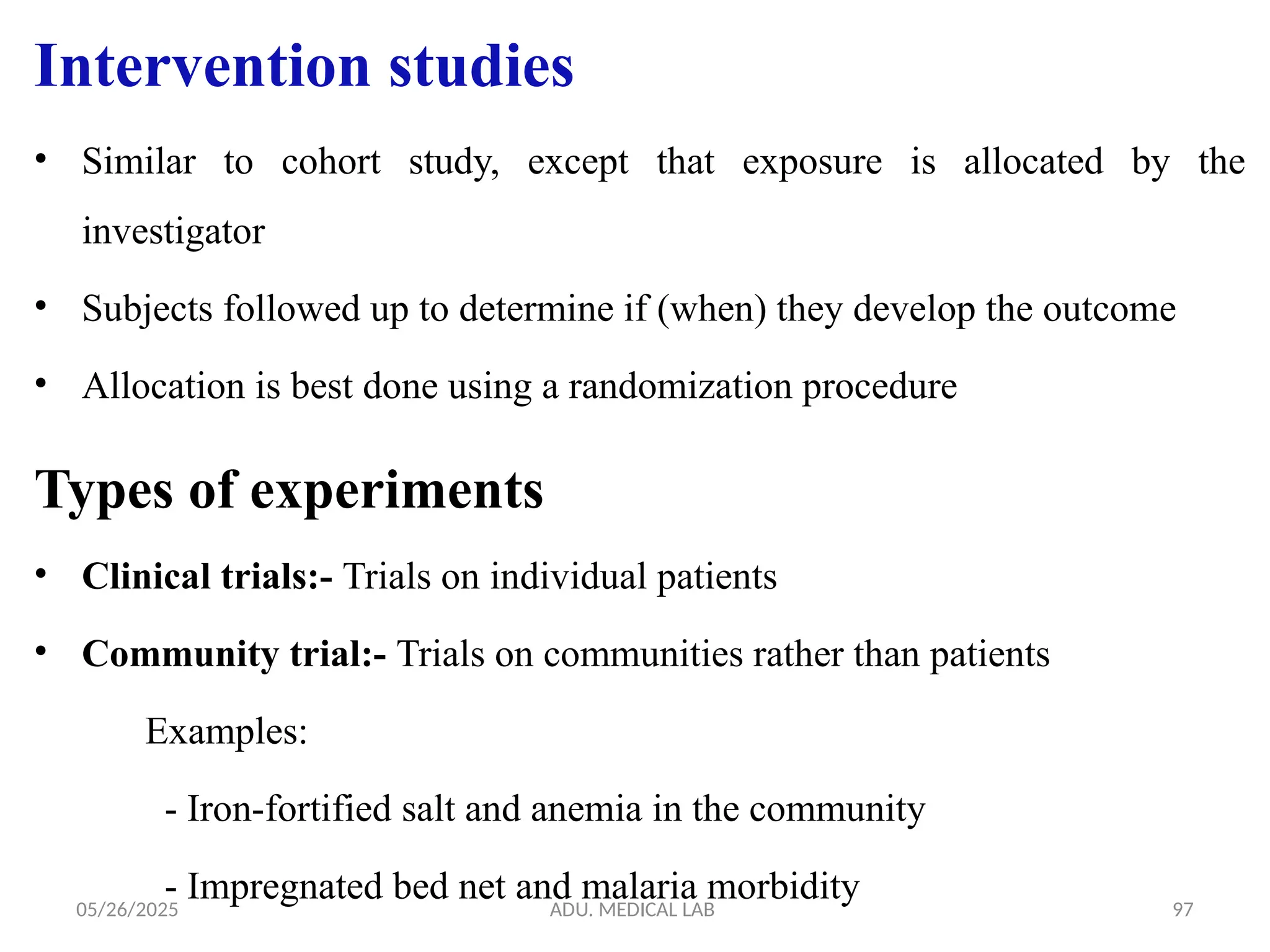
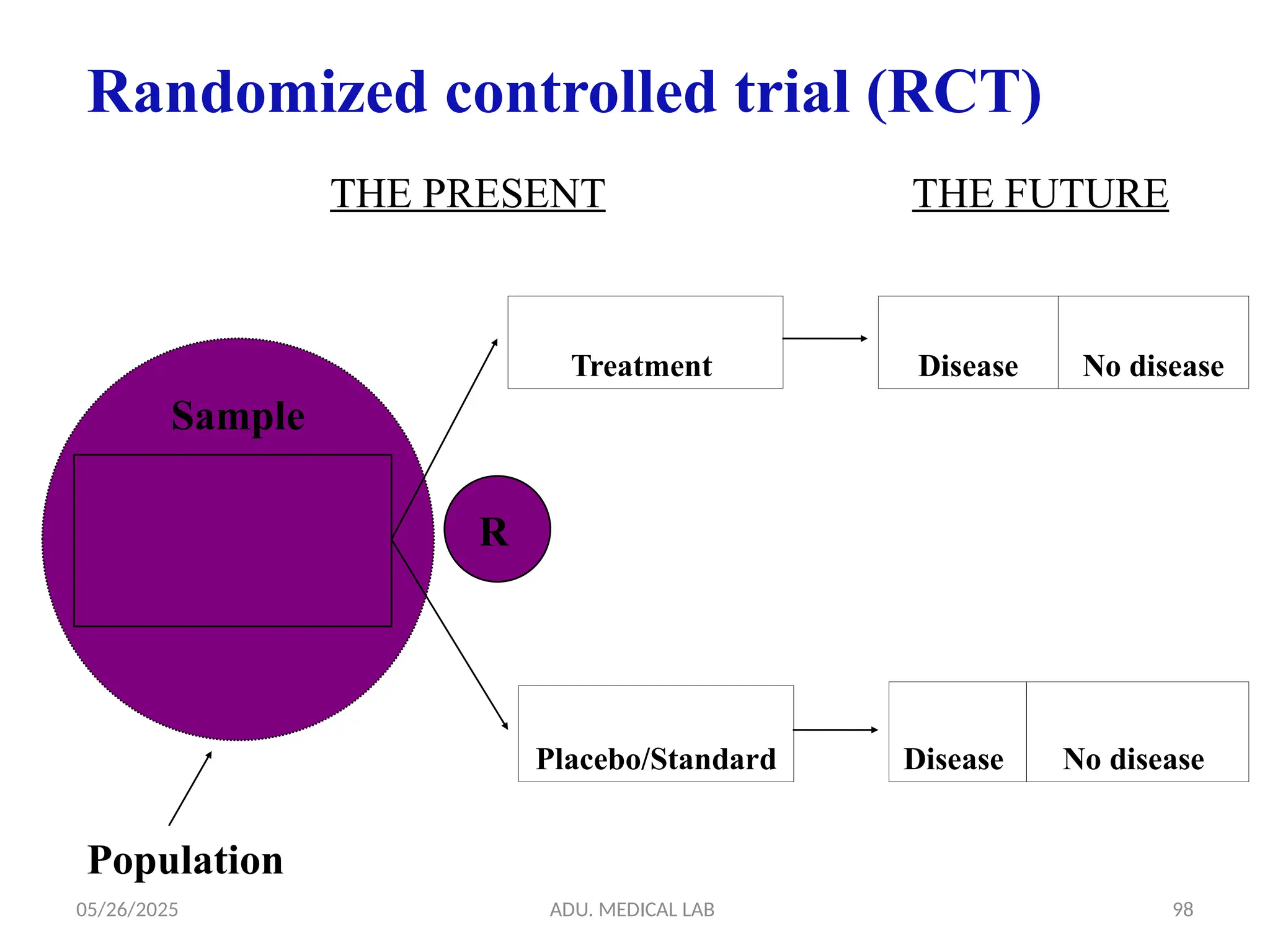
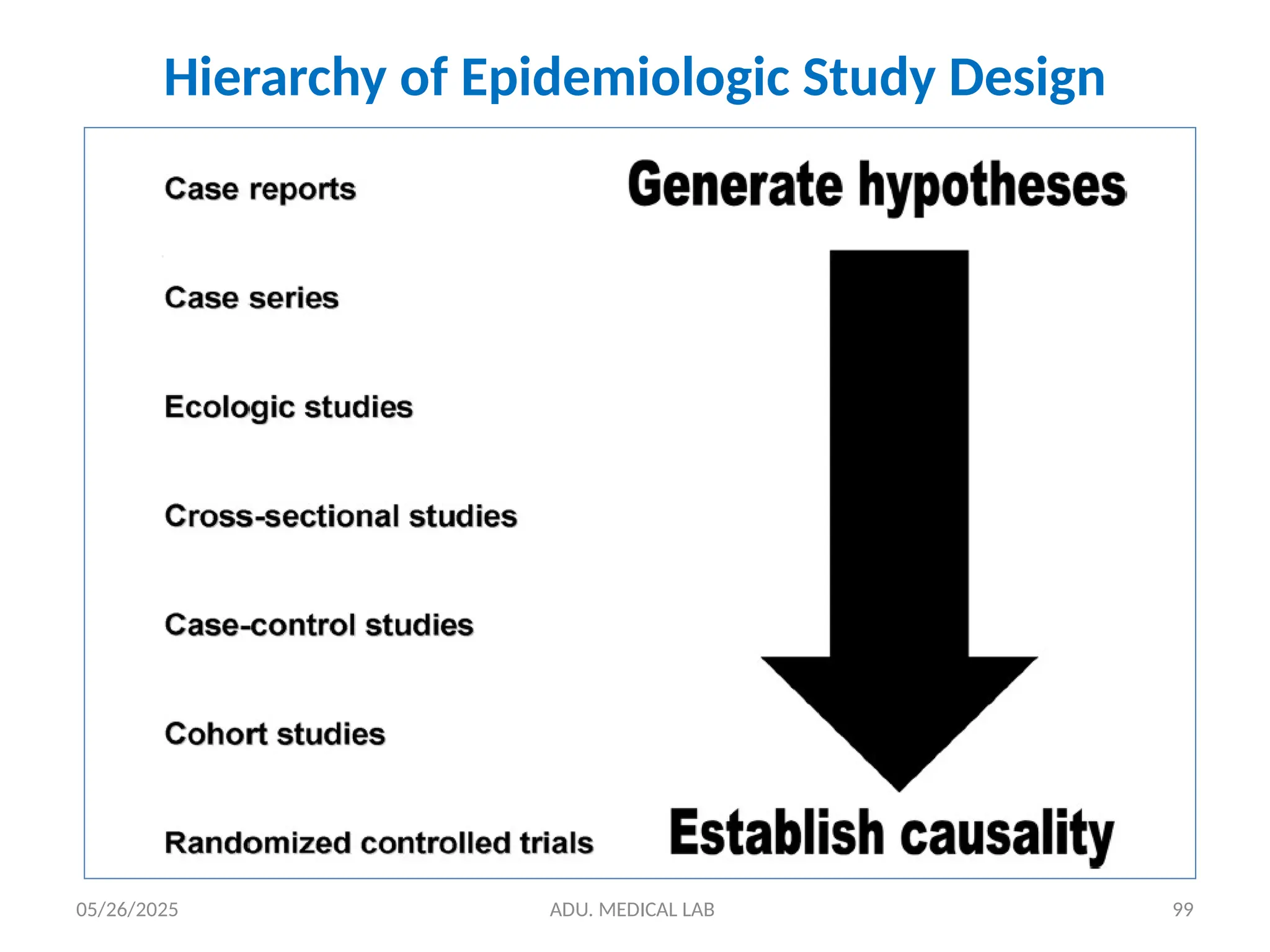
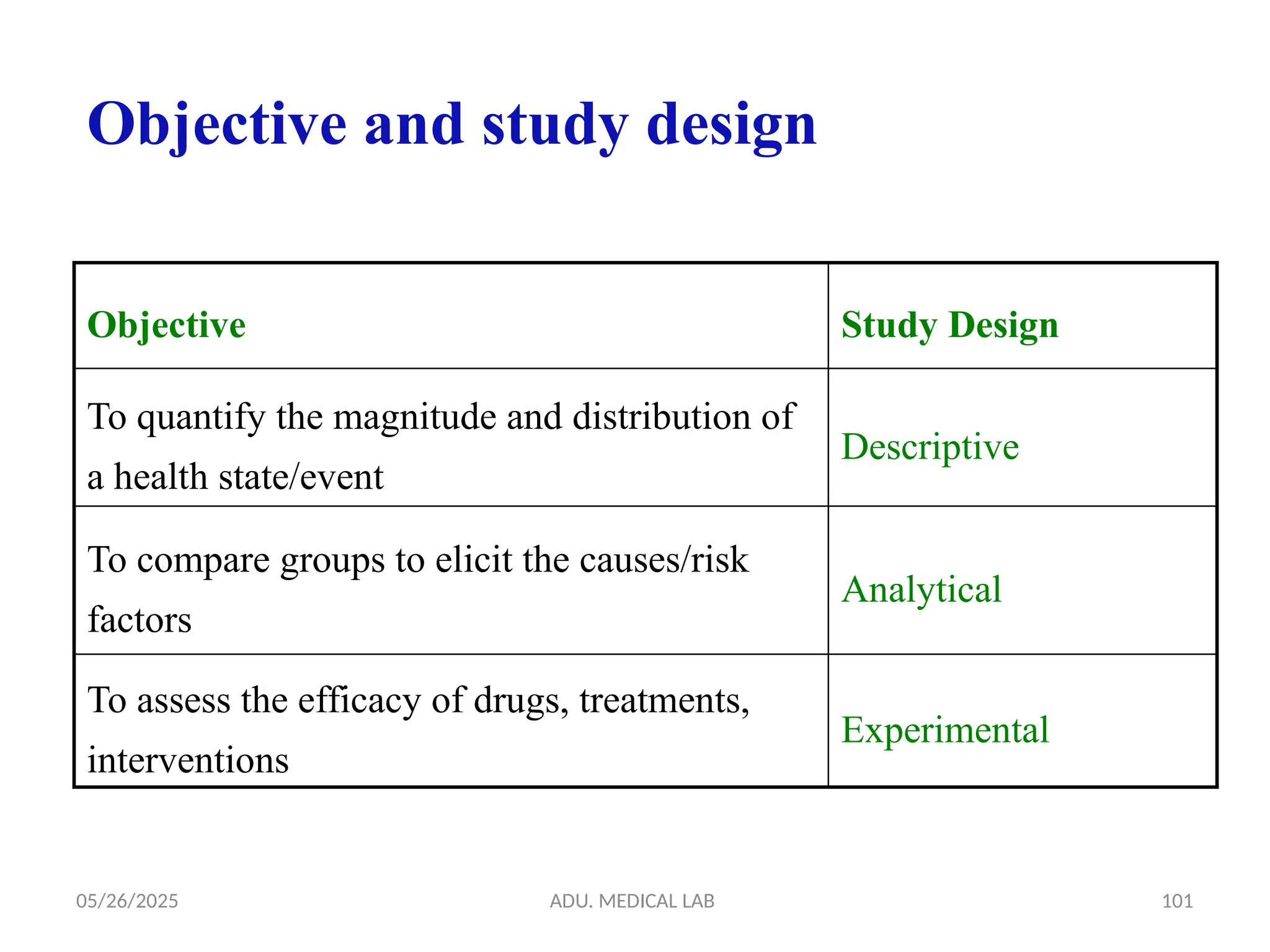
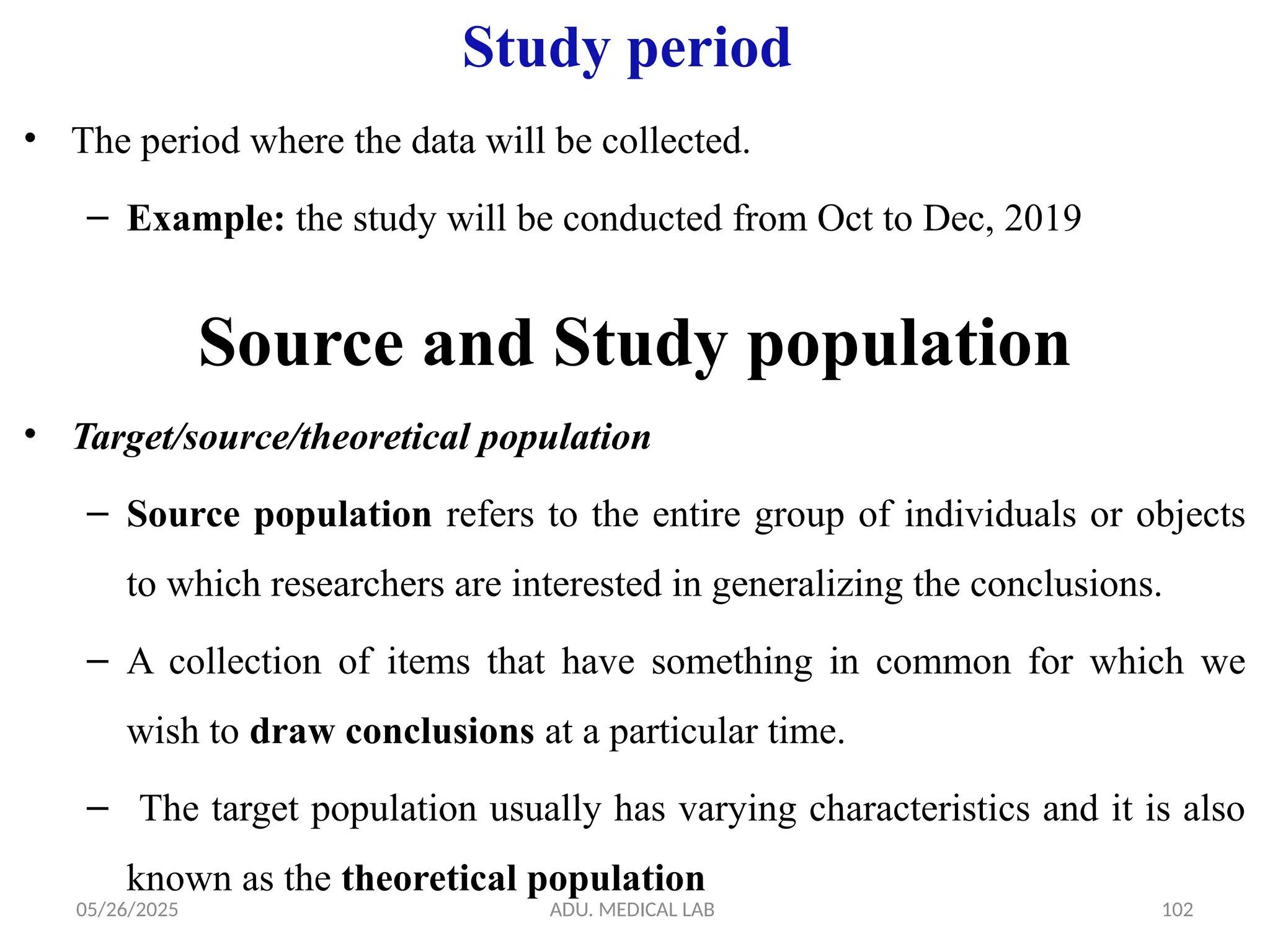
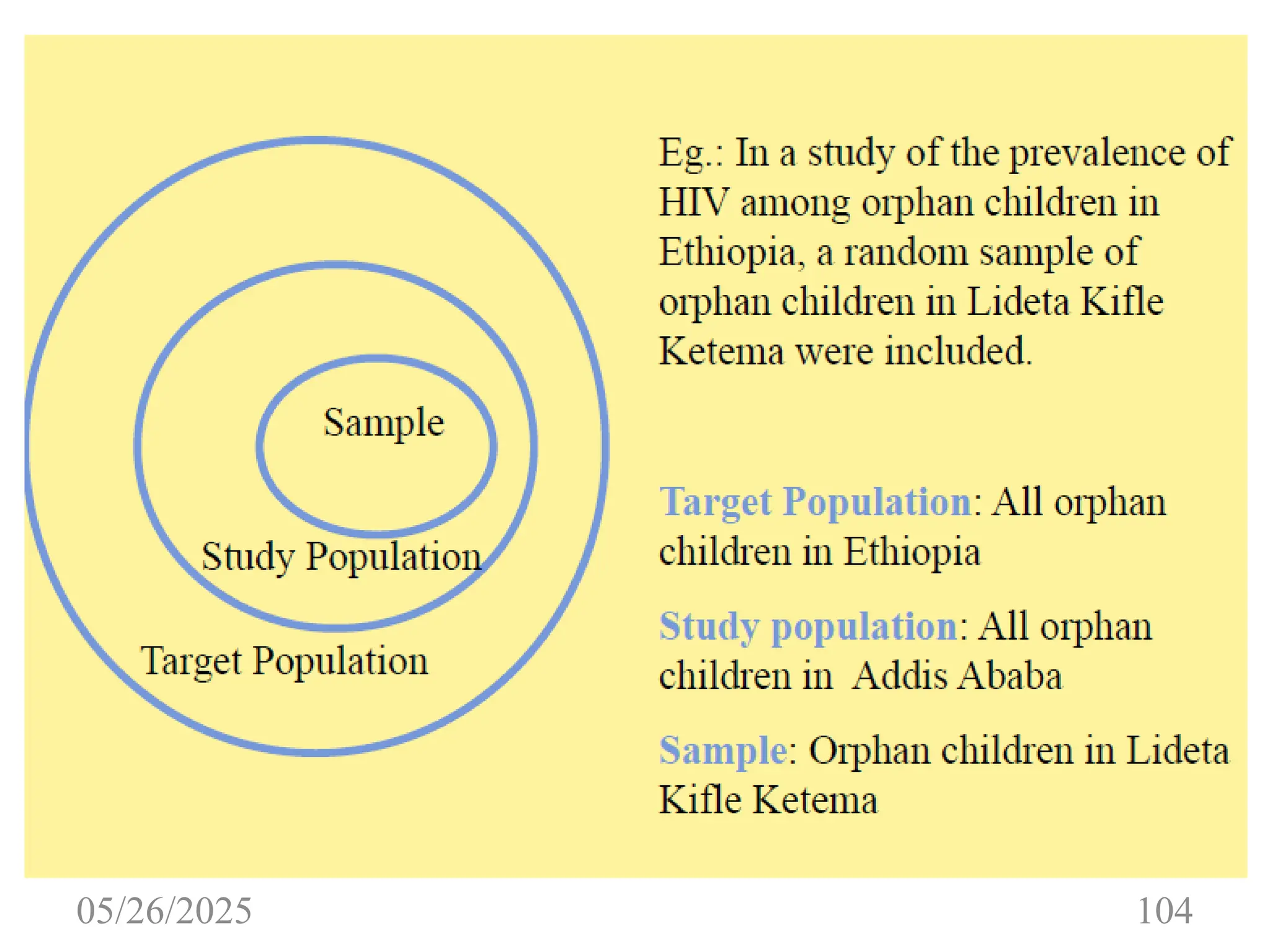
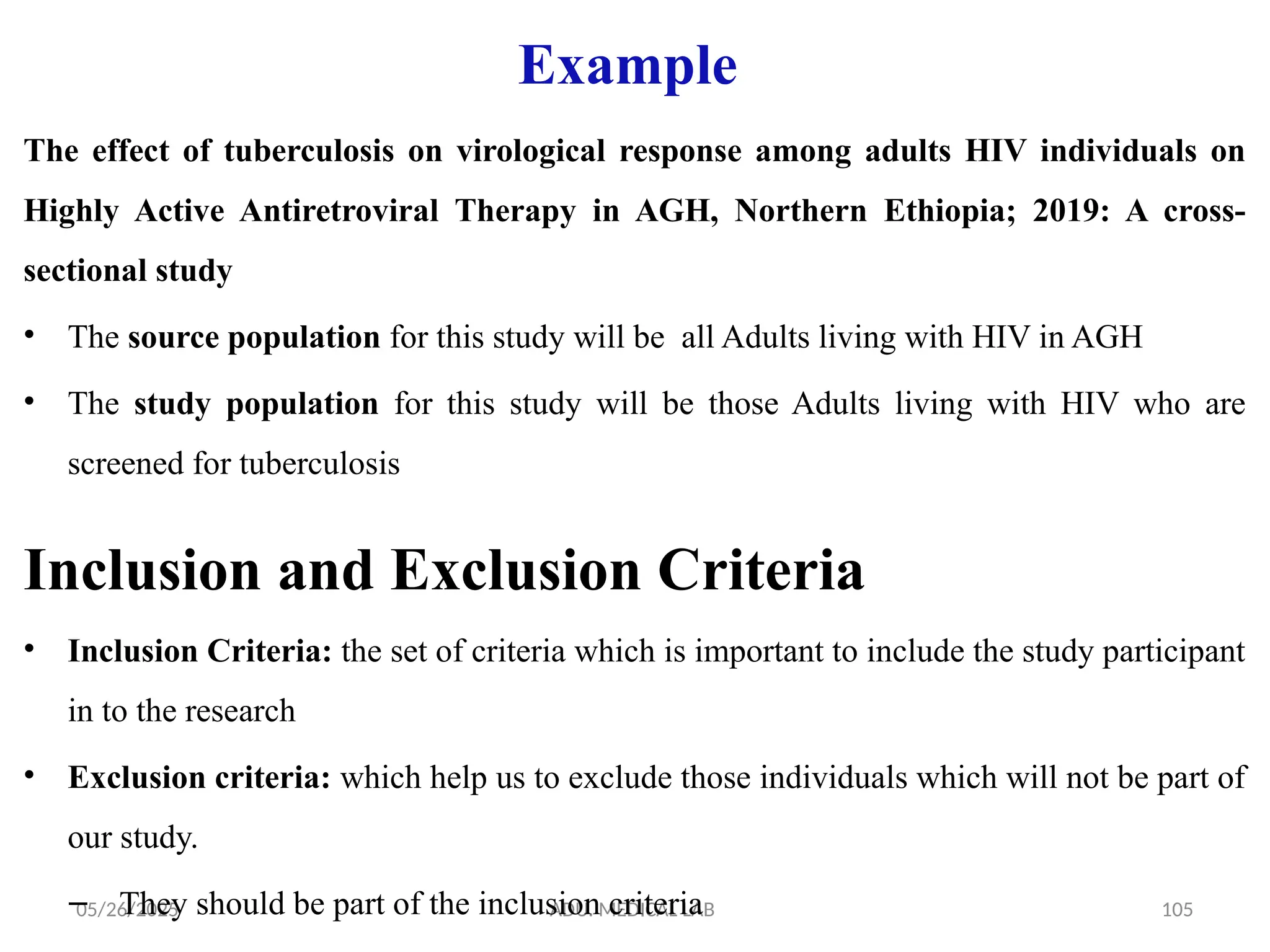
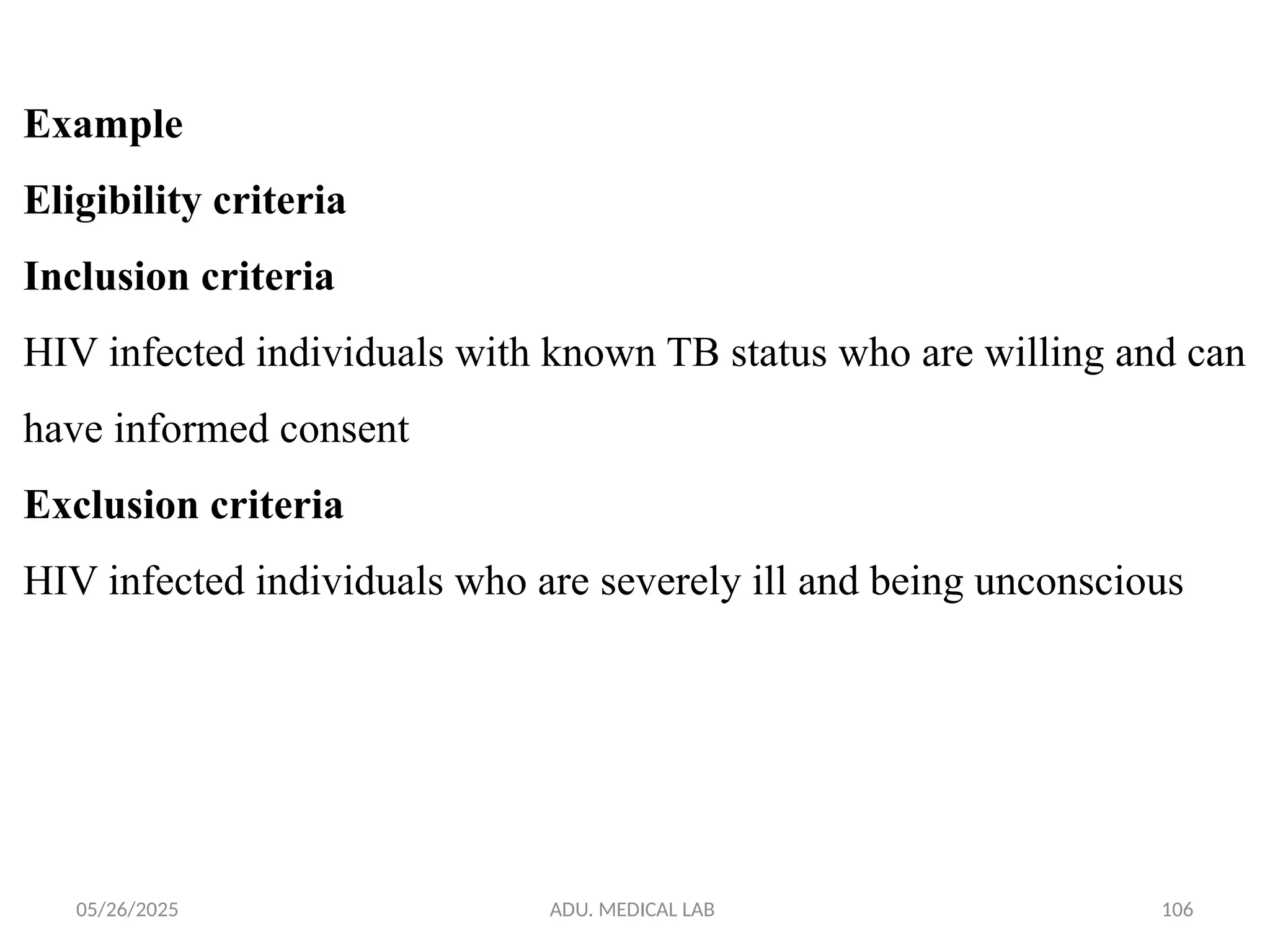
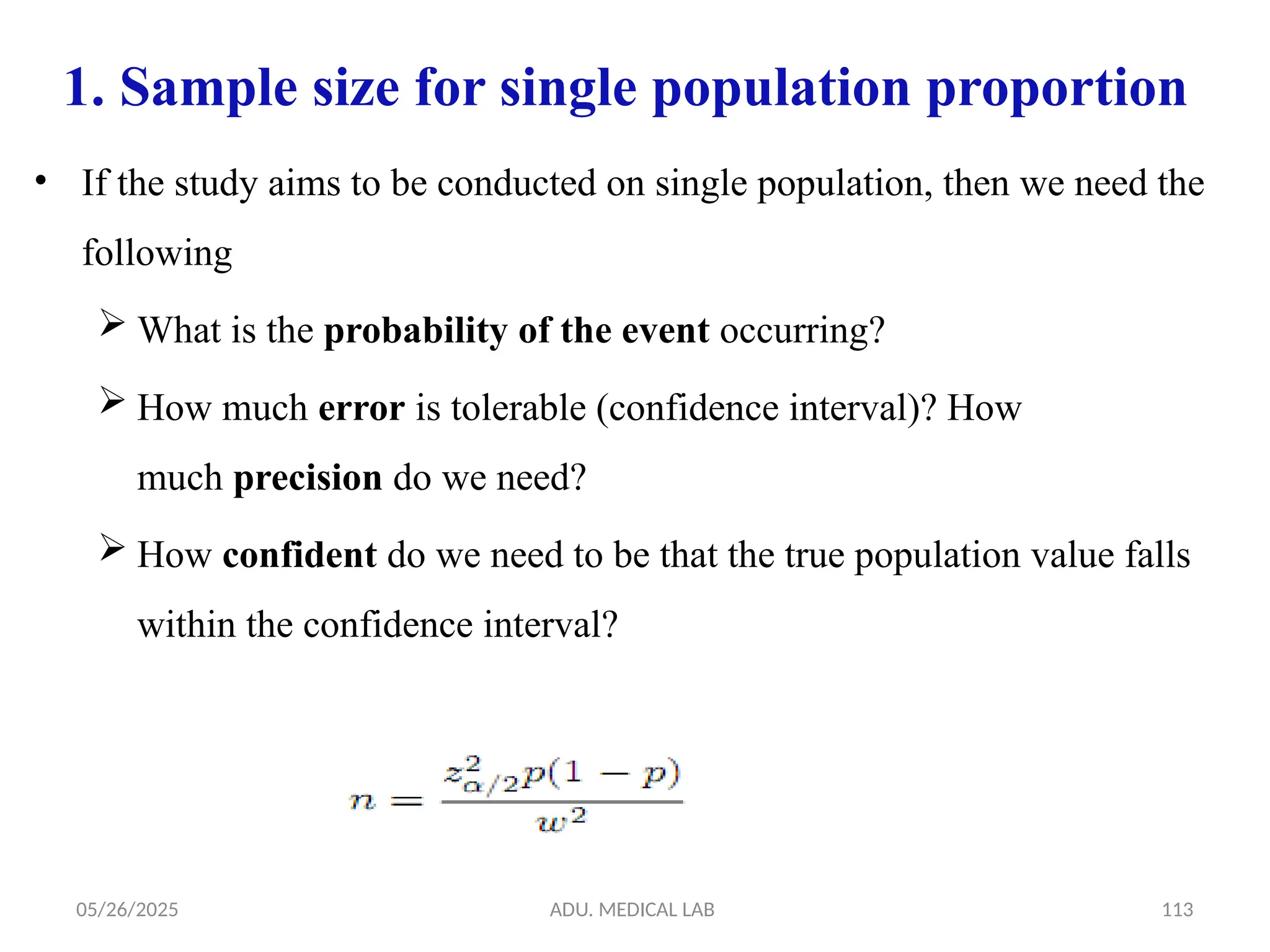
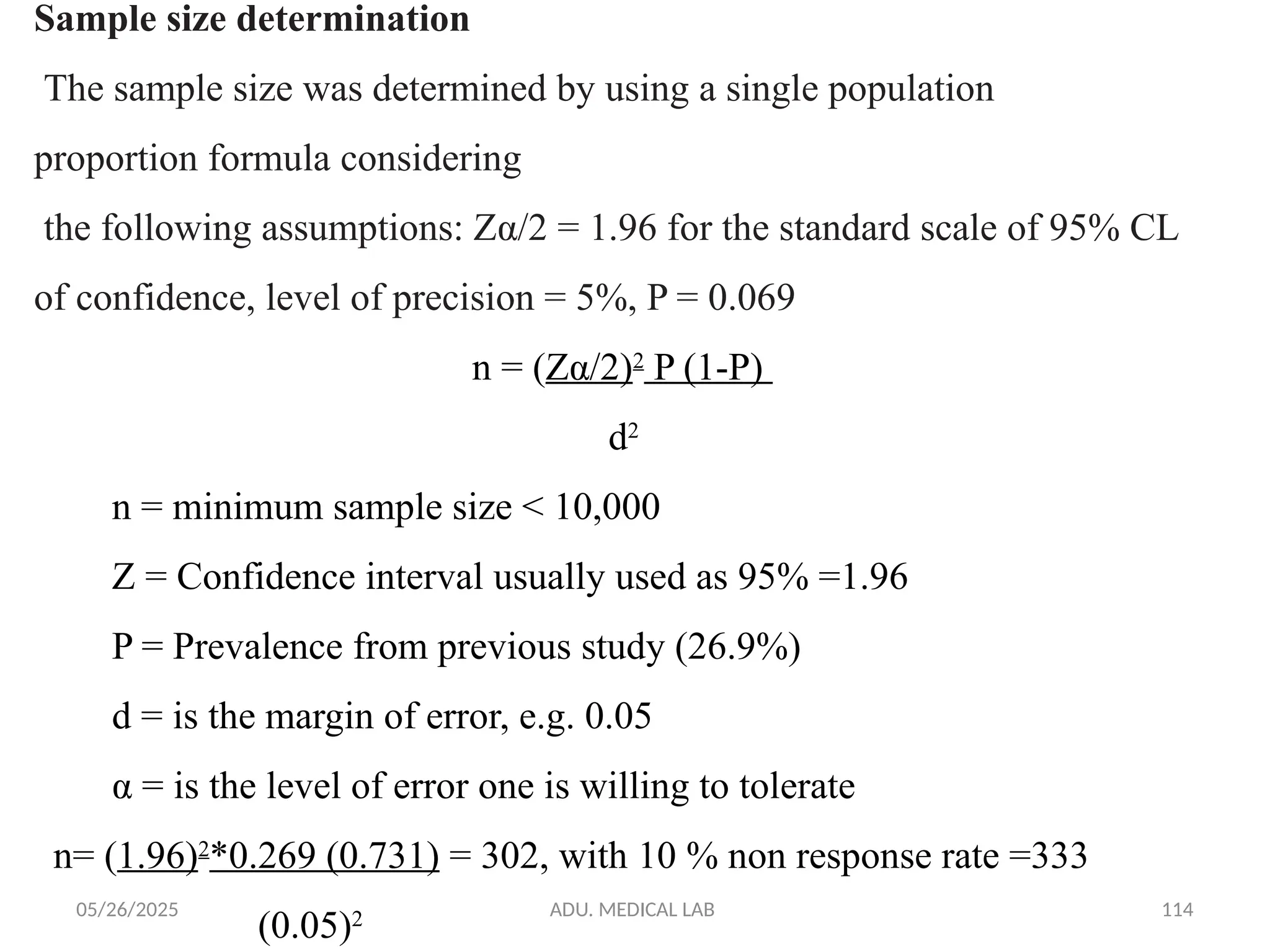
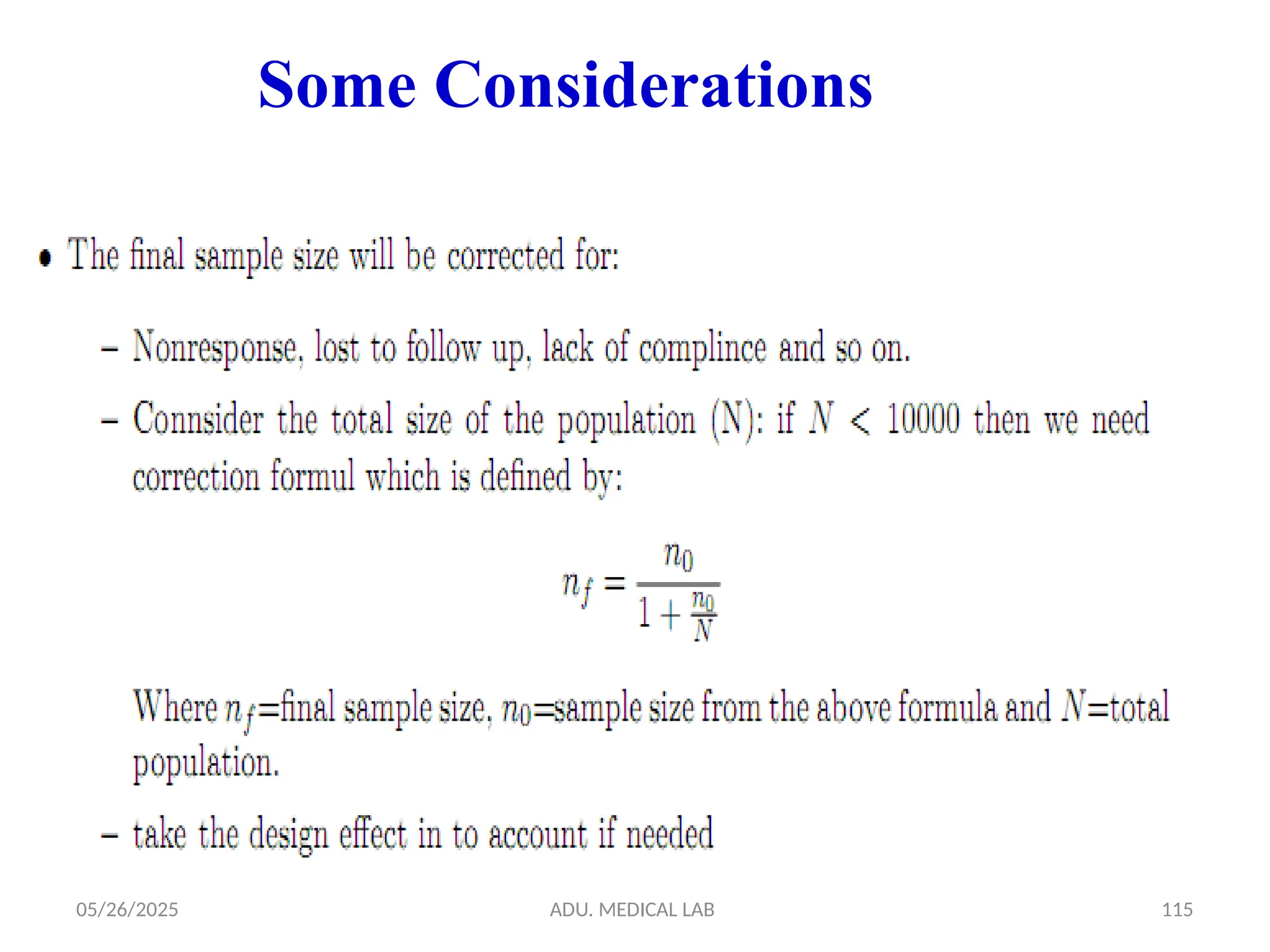
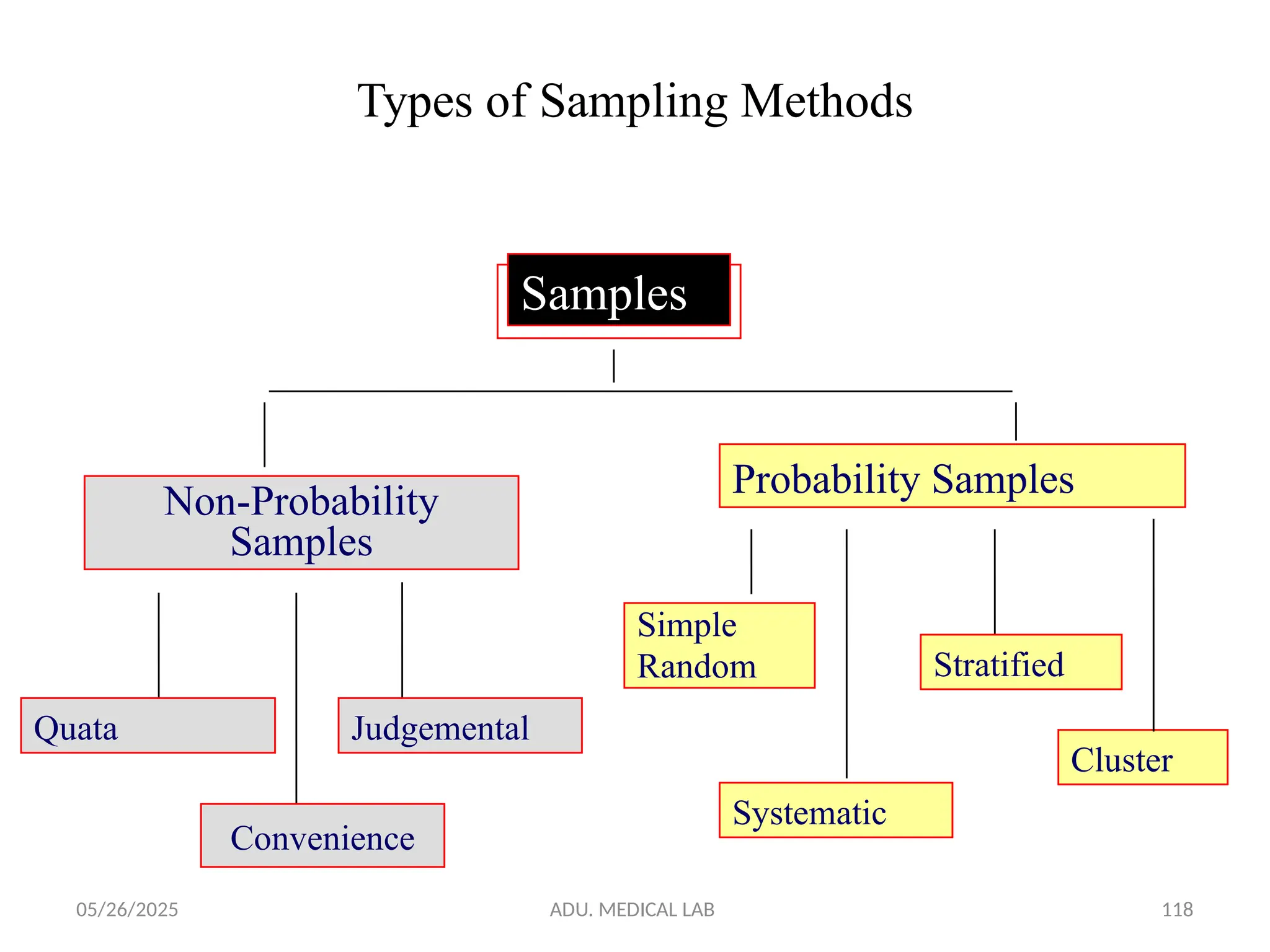
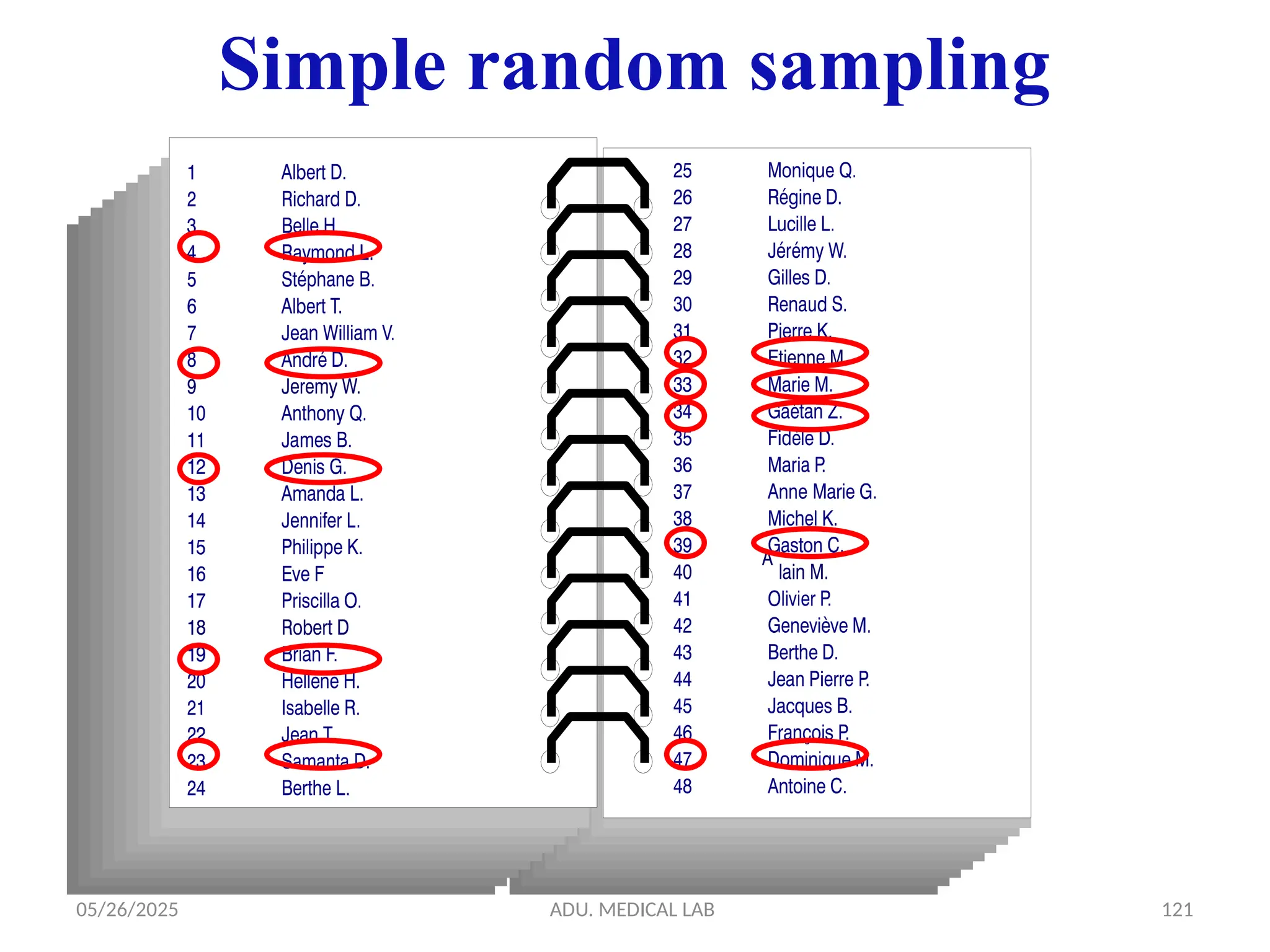
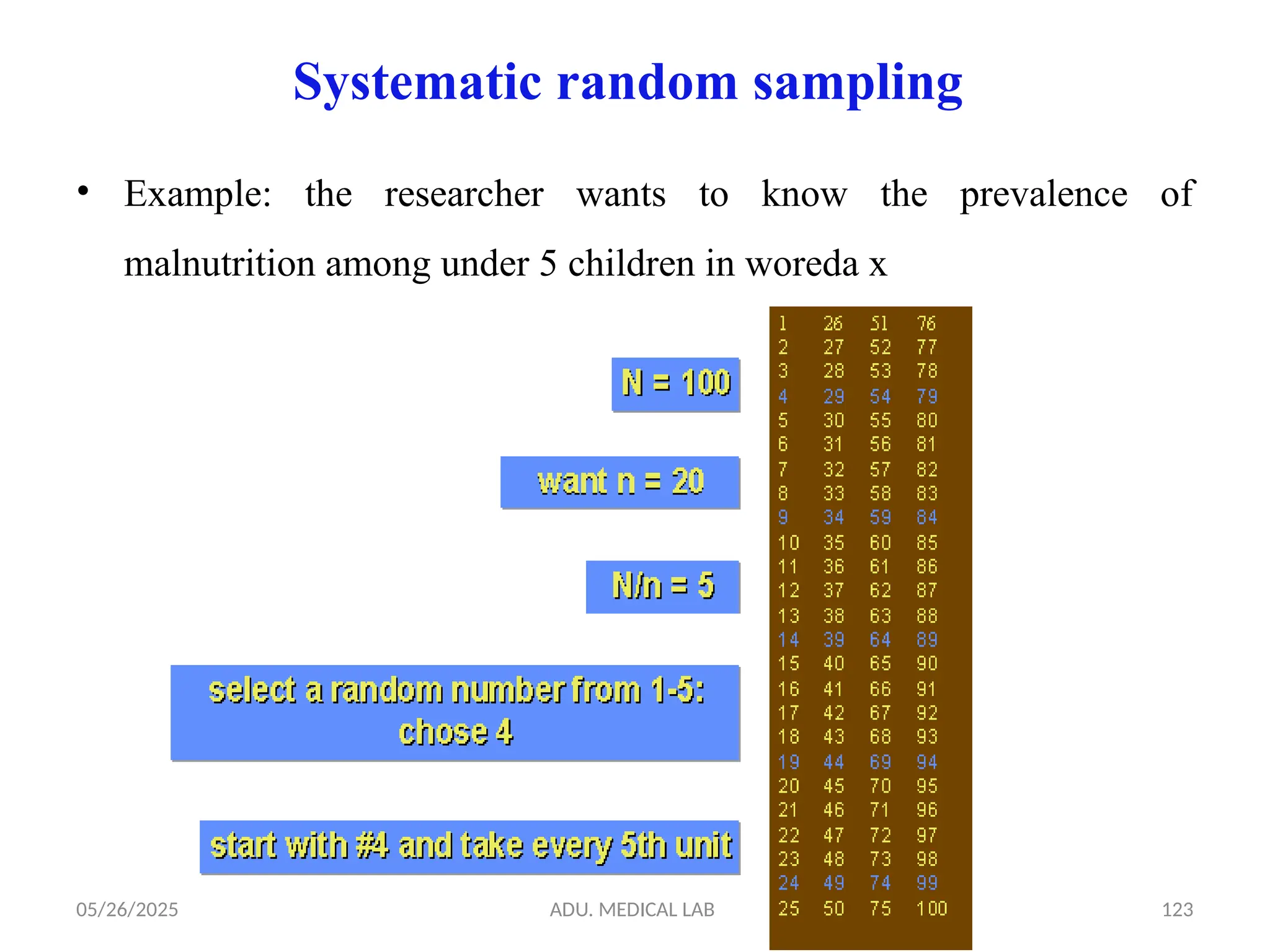
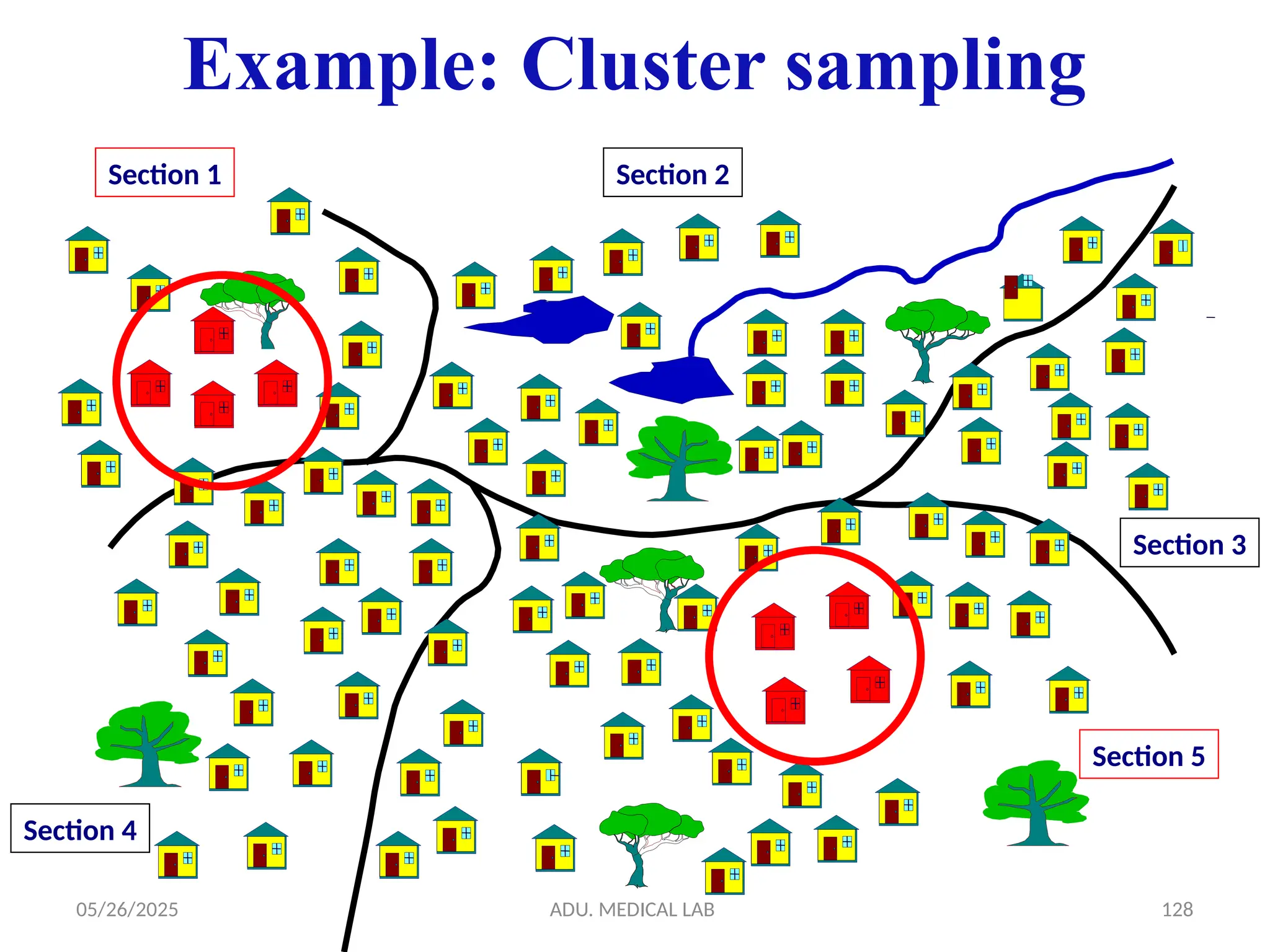
![05/26/2025 ADU. MEDICAL LAB 132
Non-probability sampling
– Every element in the universe [sampling frame] does not have
equal probability of being chosen in the sample.
– Operationally convenient and simple in theory.
– Results may not be generalized.
– When using non-probability sampling, sample size is unrelated
to accuracy, so cost benefit consideration must be used.
1. Purposive sampling:
– Critical cases](https://image.slidesharecdn.com/researchmethodologypptformls-250526190946-c9d32bc7/75/Research-methodology-PPT-for-Medical-Laboratory-Sciences-x-132-2048.jpg)