2019 Coronavirus: a quick
review of the articles issued
by WHO, CDC and other
experts
It was first noted in Wuhan City, Hubei Province, China last
December 2019 causing acute respiratory disease to the
affected patients. Investigations about the virus is still
ongoing up to now.
Just recently, Who declared the outbreak as a global health
emergency concern.
Etiology:
2019-nCoV belongs to the Coronavirus Family, which cause
illnesses to people causing the Common Colds, SARS and
MERS. It also affects animals which can rarely spread to
humans, and then causes human to humans transmission which
happened in SARS and MERS. Human to human transmission
has already been confirmed in China, Vietnam, Japan, Germany
and US.
Just recently, WHO reported one case of death related to the
2019-nCoV in Philippines, the first death outside of China.
Clinical Manifestations:
Clinically, most patients presented as a viral pneumonia which
range from mild to severe in presentation with 20% case
progression to become a severe disease.
Patients usually presents with fever, cough and shortness of
breath. There are patients who has myalgia, fatigue, sputum
production, confusion, hemoptysis, diarrhea and nausea and
vomiting. Some patient may be asymptomatic. Thirty-three percent
of cases may have complications like ARDS, Acute Respiratory
Injury, Acute Cardiac Injury, Septic Shock, AKI and even cause
Secondary Infections.
Diagnosis:
Early detection and rapid confirmation is important for
prevention of spread and giving of supportive treatment to the
affected individuals. At the triage area, implementation of
infection prevention and control measures should be done. Most
countries are already implementing isolation of suspected and
confirmed cases, during triaging of patients, they used
Screening Questionnaires as a guide and includes travel history
as a key.
ECDC Case Definition for Surveillance:
> a person with clinical signs and symptoms suggestive of
pneumonia or Severe Respiratory infection with breathlessness
AND travel to Mainland China within 14 days before the onset of
illness or
> a person with acute respiratory illness of any degree of severity
who within 14 days before the onset of illness had:
a) Been to Wuhan City or Hubei Province, China or
b) Been to Hospital in Mainland China or
c) Had a close contact with a case of 2019 Novel Coronavirus
infection
Types of Specimen:
Lower Respiratory Tract:
- Bronchoalveolar Lavage
- Endotracheal Aspirate
- Expectorated Sputum
Upper Respiratory Tract:
- Nasopharyngeal Swab
- Oropharyngeal Swab
- Nasopharyngeal Aspirate or Nasal Wash
Additional Specimen for later testing:
- when serological testing becomes available: Serum, acute
and convalescent (2-4weeks after acute phase) specimen
- other specimens to consider: blood, urine, feces
Based on the WHO, incubation period range from 2 to 10days
CXR/ Chest CT: 25% of cases showed unilateral infiltrates
and 75% with Bilateral Infiltrates.
Reverse Transcriptase-PCR (RT-PCR): is need to
confirm the diagnosis
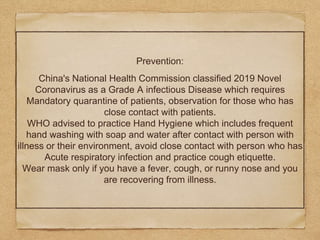
Prevention:
China's National Health Commission classified 2019 Novel
Coronavirus as a Grade A infectious Disease which requires
Mandatory quarantine of patients, observation for those who has
close contact with patients.
WHO advised to practice Hand Hygiene which includes frequent
hand washing with soap and water after contact with person with
illness or their environment, avoid close contact with person who has
Acute respiratory infection and practice cough etiquette.
Wear mask only if you have a fever, cough, or runny nose and you
are recovering from illness.
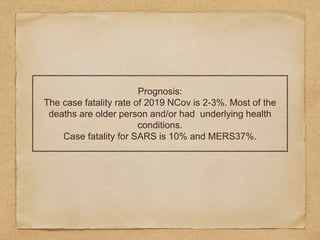
Prognosis:
The case fatality rate of 2019 NCov is 2-3%. Most of the
deaths are older person and/or had underlying health
conditions.
Case fatality for SARS is 10% and MERS37%.
Source:
WHO
CDC
BMJ
ECDC

2019 Novel Coronavirus

  • 1.
    2019 Coronavirus: aquick review of the articles issued by WHO, CDC and other experts
  • 2.
    It was firstnoted in Wuhan City, Hubei Province, China last December 2019 causing acute respiratory disease to the affected patients. Investigations about the virus is still ongoing up to now. Just recently, Who declared the outbreak as a global health emergency concern.
  • 3.
    Etiology: 2019-nCoV belongs tothe Coronavirus Family, which cause illnesses to people causing the Common Colds, SARS and MERS. It also affects animals which can rarely spread to humans, and then causes human to humans transmission which happened in SARS and MERS. Human to human transmission has already been confirmed in China, Vietnam, Japan, Germany and US. Just recently, WHO reported one case of death related to the 2019-nCoV in Philippines, the first death outside of China.
  • 4.
    Clinical Manifestations: Clinically, mostpatients presented as a viral pneumonia which range from mild to severe in presentation with 20% case progression to become a severe disease. Patients usually presents with fever, cough and shortness of breath. There are patients who has myalgia, fatigue, sputum production, confusion, hemoptysis, diarrhea and nausea and vomiting. Some patient may be asymptomatic. Thirty-three percent of cases may have complications like ARDS, Acute Respiratory Injury, Acute Cardiac Injury, Septic Shock, AKI and even cause Secondary Infections.
  • 5.
    Diagnosis: Early detection andrapid confirmation is important for prevention of spread and giving of supportive treatment to the affected individuals. At the triage area, implementation of infection prevention and control measures should be done. Most countries are already implementing isolation of suspected and confirmed cases, during triaging of patients, they used Screening Questionnaires as a guide and includes travel history as a key.
  • 6.
    ECDC Case Definitionfor Surveillance: > a person with clinical signs and symptoms suggestive of pneumonia or Severe Respiratory infection with breathlessness AND travel to Mainland China within 14 days before the onset of illness or > a person with acute respiratory illness of any degree of severity who within 14 days before the onset of illness had: a) Been to Wuhan City or Hubei Province, China or b) Been to Hospital in Mainland China or c) Had a close contact with a case of 2019 Novel Coronavirus infection
  • 7.
    Types of Specimen: LowerRespiratory Tract: - Bronchoalveolar Lavage - Endotracheal Aspirate - Expectorated Sputum Upper Respiratory Tract: - Nasopharyngeal Swab - Oropharyngeal Swab - Nasopharyngeal Aspirate or Nasal Wash Additional Specimen for later testing: - when serological testing becomes available: Serum, acute and convalescent (2-4weeks after acute phase) specimen - other specimens to consider: blood, urine, feces
  • 8.
    Based on theWHO, incubation period range from 2 to 10days CXR/ Chest CT: 25% of cases showed unilateral infiltrates and 75% with Bilateral Infiltrates. Reverse Transcriptase-PCR (RT-PCR): is need to confirm the diagnosis
  • 9.
    Prevention: China's National HealthCommission classified 2019 Novel Coronavirus as a Grade A infectious Disease which requires Mandatory quarantine of patients, observation for those who has close contact with patients. WHO advised to practice Hand Hygiene which includes frequent hand washing with soap and water after contact with person with illness or their environment, avoid close contact with person who has Acute respiratory infection and practice cough etiquette. Wear mask only if you have a fever, cough, or runny nose and you are recovering from illness.
  • 10.
    Prognosis: The case fatalityrate of 2019 NCov is 2-3%. Most of the deaths are older person and/or had underlying health conditions. Case fatality for SARS is 10% and MERS37%.
  • 11.