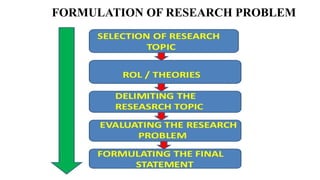
RESEARCH PROBLEM
DEFINITIONS
1. Aresearch problem is an enigmatic, troubling area or topic that needs an
enquiry to get better understanding or ultimate solution.
For example, solution of healthcare-associated infections (HAIs) in
healthcare institutions could be an enigmatic or troubling topic of the present
time.
2. According to Kerlinger, 'A problem is an interrogative sentence or
statement that asks what relation exists between two or more variables'.
3.
DEFINITIONS…
• Woodworth definesproblem as 'a situation for which we
have no ready and successful response by instinct or by
previous acquired knowledge. We must find out what to do',
that is, the solution can be found out only after an
investigation. In other words, 'a research problem is an area
of concern where there is a gap in the knowledge base needed
for professional practices’.
4.
Six components ofQuantitative research study
• Relevance of the study
• Title of the study
• Operational definitions of the variables
• Objectives of the study
• Delimitations of the study
• Scope and limitation of the study
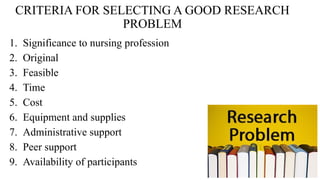
CRITERIA FOR SELECTINGA GOOD RESEARCH
PROBLEM
1. Significance to nursing profession
2. Original
3. Feasible
4. Time
5. Cost
6. Equipment and supplies
7. Administrative support
8. Peer support
9. Availability of participants
7.
CRITERIA FOR SELECTINGA GOOD RESEARCH
PROBLEM…
10. Researcher’s competence
11. Ethical considerations
12. Solvable/researchable
13. Current
14. Interesting
PROBLEM STATEMENT EXAMPLES
•AnExploratory study to assess the effectiveness of
structured teaching on renal care among patients
undergoing dialysis.
•Effect of Music Therapy on Pre-operative anxiety of
cataract patients undergoing cataract surgery.
11.
PROBLEM STATEMENT EXAMPLES…
•A study to assess the effectiveness of information booklet on the
knowledge regarding home care of patient diagnosed with bronchial
asthma in selected hospitals.
• A study to asses the effectiveness of an information booklet on
knowledge of staff nurses regarding baby friendly hospital initiative
with a view to develop an information booklet in selected hospitals at
Udaipur.
12.
VARIABLES
• Variables areanything that has quantity and quality that
varies
• Qualities, properties or characteristics of person, things or
situations that change or vary.
INDEPENDENT AND DEPENDENTVARIABLES
These are two variables that are interrelated and mainly observed in correlational,
interventional, pre-experimental, quasi-experimental and experimental research
studies.
1. Independent variable: It is a presumed cause/stimulus or activity that is
manipulated or varied by the researcher to create the effect on the dependent
variable.
2. Dependent variable: It is presumed effect/outcome or response due to the
effect of the independent variable, which researcher wants to predict or ex-
plain.
15.
EXAMPLE
• A quasi-experimentalstudy on effect of 4-hourly chlorhexidine
mouthwash on prevention of ventilator-associated pneumonia (VAP)
among patients admitted in selected ICUs. In this study, 4-hourly
chlorhexidine mouthwash is an independent variable and VAP is the
dependent variable.
16.
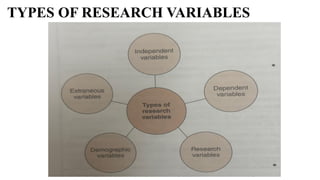
TYPES OF VARIABLES…
3.RESEARCH VARIABLE
Research variables can be defined as qualities, attributes, properties or
characteristics that are observed or measured in a natural setting
without manipulating.
4. DEMOGRAPHIC VARIABLE
Age, gender, educational status, religion, social class, marital status,
habitat, occupation, income, medical diagnosis and so on are the
demographic variables.
17.
TYPES OF VARIABLES…
•Avariable which has unwanted effect on dependent
variable and if not controlled in the study then the
researcher may falsely conclude the effect of
independent variable on dependent variable
18.
OPERATIONAL DEFINITIONS
• Inresearch, an operational definition specifies exactly how a
concept or variable is measured, observed, or manipulated within
a study. Operational definitions ensure that abstract concepts are
clearly defined, enabling researchers to measure them
consistently and accurately.
19.
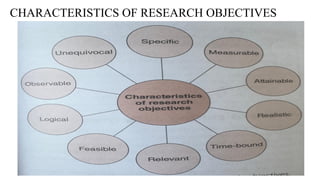
WRITING RESEARCH OBJECTIVES
•A research objective is a clear, concise, declarative statement,
which provides direction to investigate the variables.
• 'Research objectives are the results sought by the researcher at
the end of the research process, that is, what the researcher will
be able to achieve at the end of the research study.
TYPES OF RESEARCHOBJECTIVES
1. GENERAL OBJECTIVES
• broad goals to be achieved.
• Study states what the researcher expects to achieve by the study in general
terms.
• Usually less in number.
2. SPECIFIC OBJECTIVES
• Short term and narrow in focus.
• General objectives are broken into small parts to form specific objectives.
• More in number.
• They should specify what the researcher will do in the study, where and
for what purpose.
22.
METHODS OF STATINGOBJECTIVES
• The objectives should be presented briefly and concisely.
• They cover the different aspects of the problem and their contributing
factors in a coherent way and in a logical sequence.
• They are clearly phrased in operational terms, specifying exactly what
researcher is going to do, where and for what purpose.
• They are realistic considering local conditions.
• They use action verbs that are specific enough to be evaluated
23.
HYPOTHESIS
DEFINITIONS
1. Hypothesis isa tentative prediction or explanation of the relationship between
two or more variables. It implies that there is a systematic relationship between
an independent and a dependent variable.
2.Hypothesis reflects the research workers' guess as to the probable outcomes of
their experiment. Hypotheses place clear and specific goals before the
researchers and provide them with a basis for selecting samples and research
procedures to meet these goals. (Borg, 1983)
24.
DEFINITION…
3. Hypothesis asa statement of researcher's expectations about the
relationship between the variables under investigation.
(Polit and Beck, 2008)
25.
IMPORTANCE OF HYPOTHESISIN RESEARCH
• Hypothesis enables the researcher to objectively investigate new areas of
discovery. Thus, it provides a powerful tool for the advancement of
knowledge.
• It provides objectivity to the research activity. The formulation of
hypothesis provides a study with focus and guides the researcher about the
specific aspects of research problems to investigate.
• It provides the insight to the researcher about what data to collect and what
not to collect, thereby providing focus to the study.
26.
IMPORTANCE OF HYPOTHESISIN RESEARCH
• It provides link between theories and actual practical research.
• It provides a bridge between theory and reality.
• It suggests which type of research is likely to be most appropriate.
• As it is a tentative statement of anticipated results, it guides the
researcher towards the direction in which the research should
proceed.
27.
IMPORTANCE OF HYPOTHESISIN RESEARCH…
• It stimulates the thinking process of researcher as the re-searcher forms the
hypothesis by anticipating the outcome.
• It also determines the most appropriate research designs and techniques of data
analysis.
• It provides understanding to the researchers about what to expect from the
results of the research study.
• It serves as a framework for drawing conclusions of a research study.
• Without hypothesis, research would be like aimless wandering.
28.
CHARACTERISTICS OF HYPOTHESIS
•Conceptualclarity.
•Empirical referents.
•Objectivity.
•Specificity.
•Simplicity.
•Availability of
techniques.
•Purposiveness.
• Verifiability.
• Profundity of effects.
• Economical.
• Relevant.
• Testability.
• Consistency.
Types of Hypothesis
1.Simple& complex hypothesis.
2.Causal & Associative hypothesis.
3.Directional & non directional hypothesis.
4.Null & research hypothesis.
31.
1. Simple Hypothesis
simplehypothesis predicts that, there exist a
relationship between the independent variable and
dependent variable.
Example- for a fully bedridden patient two hourly positions
changing will prevent bedsore.
In the above example 2 hourly position changing is independent
variable and bedsore prevention is dependent variable.
32.
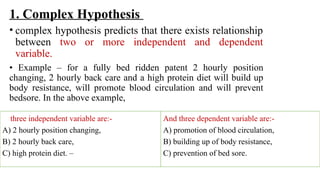
1. Complex Hypothesis
•complex hypothesis predicts that there exists relationship
between two or more independent and dependent
variable.
• Example – for a fully bed ridden patent 2 hourly position
changing, 2 hourly back care and a high protein diet will build up
body resistance, will promote blood circulation and will prevent
bedsore. In the above example,
And three dependent variable are:-
A) promotion of blood circulation,
B) building up of body resistance,
C) prevention of bed sore.
three independent variable are:-
A) 2 hourly position changing,
B) 2 hourly back care,
C) high protein diet. –
33.
2.a. Causal Hypothesis
•Causal Hypothesis predicts a cause and effects relationship or
interaction between the independent variable and dependent variable.
This hypothesis predicts the effect of the independent variable on the
dependent variable.
• In this the independent variable is the experimental or treatment
variable. The dependent variable is the outcome variable
• Example – early postoperative ambulation will lead to prompt
recovery.
34.
2.b. Associative hypothesis
•Associative Hypothesis predicts an associative relationship between the
independent variable and the dependent variable.
• When there is a change in any one of the variables, changes also occurs in
the other variable.
• The associative relationship between the independent and dependent
variables may have either.
– Positive association
– Negative association
EG: Communication skills of healthcare providers related to the satisfaction of patients.
Predicts +ve relationship among variables but not the type of relationship.
Eg: cost of care related to the satisfaction of patients. Here predicts -ve relationship among
variables.
35.
3. a. DirectionalHypothesis
• Directional Hypothesis predicts the direction of the relationship
between the independent and dependent variable.
• Example- High quality of nursing education will lead to high quality of
nursing practice skills.
3.b.Non directional Hypothesis •
• Non -directional Hypothesis predicts the relationship between the
independent variable and the dependent variable but does not specific
the directional of the relationship.
• Example- teacher student relationship influence student’s learning.
36.
4. a. Nullhypothesis (H0):
It is also known as statistical hypothesis & is used for
statistical testing & interpretation of statistical outcomes.
It states the existence of no relationship between the independent &
dependent variables.
For example, ‘there is no relationship between smoking &the
incidence of coronary artery disease’.
4. b. Research hypothesis (H1):
It states the existence of relationship between two or more
variables.
For examples, ‘there is relationship between smoking &incidence of
lung cancer