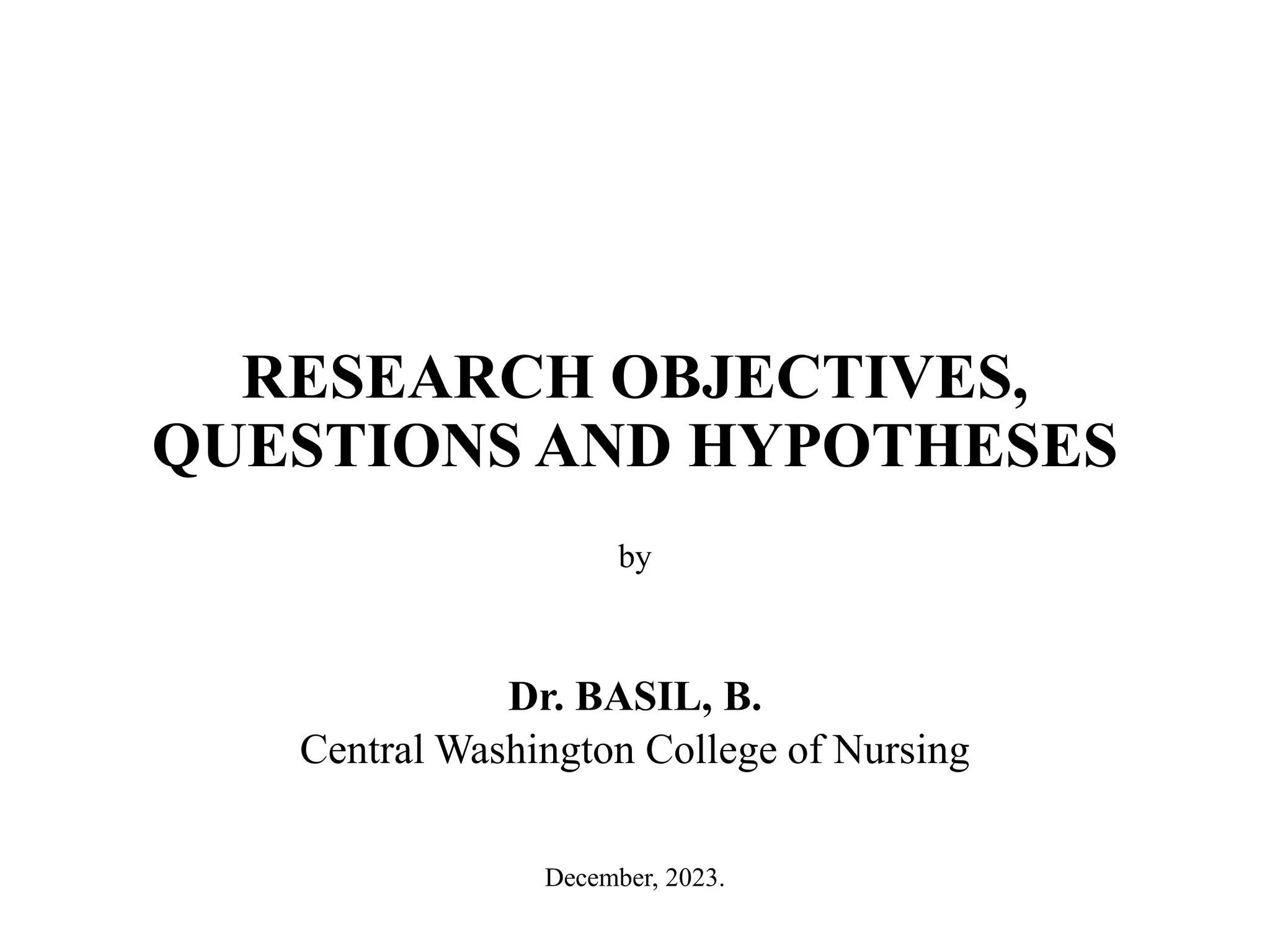
RESEARCH OBJECTIVES,
QUESTIONS AND HYPOTHESES
by
Dr. BASIL, B.
Central Washington College of Nursing
December, 2023.
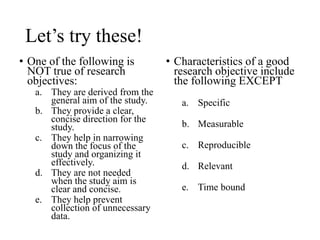
Let’s try these!
• One of the following is
NOT true of research
objectives:
a. They are derived from the
general aim of the study.
b. They provide a clear,
concise direction for the
study.
c. They help in narrowing
down the focus of the
study and organizing it
effectively.
d. They are not needed
when the study aim is
clear and concise.
e. They help prevent
collection of unnecessary
data.
• Characteristics of a good
research objective include
the following EXCEPT
a. Specific
b. Measurable
c. Reproducible
d. Relevant
e. Time bound
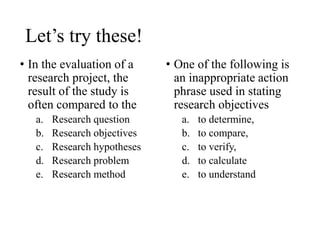
Let’s try these!
• In the evaluation of a
research project, the
result of the study is
often compared to the
a. Research question
b. Research objectives
c. Research hypotheses
d. Research problem
e. Research method
• One of the following is
an inappropriate action
phrase used in stating
research objectives
a. to determine,
b. to compare,
c. to verify,
d. to calculate
e. to understand
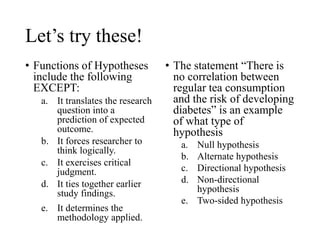
Let’s try these!
• Functions of Hypotheses
include the following
EXCEPT:
a. It translates the research
question into a
prediction of expected
outcome.
b. It forces researcher to
think logically.
c. It exercises critical
judgment.
d. It ties together earlier
study findings.
e. It determines the
methodology applied.
• The statement “There is
no correlation between
regular tea consumption
and the risk of developing
diabetes” is an example
of what type of
hypothesis
a. Null hypothesis
b. Alternate hypothesis
c. Directional hypothesis
d. Non-directional
hypothesis
e. Two-sided hypothesis
Introduction:
• The process of conceptualizing research requires creative
thinking which may take time and resources, and derives
from a perceived problem.
• Once a research problem is identified, the research aims and
objectives are determined, then formulation of a clear
research question follows.
• The nature of the research question determines the study
design, data sources and sampling strategies, data collection,
analysis and interpretation.
• A fundamental factor is addressing the research question in a
systematic, rigorous and ethical way.
Research Aim and Objectives
• Aim or General objective – the essence of the study is worded in
declarative form which gives general direction of the enquiry.
• Specific objectives – general objective is divided into smaller,
logically connected parts.
• Where a study’s aim is less specific, the research objectives are
defined as clear, concise, declarative statements articulated in the
present tense.
• Specific objectives explain what, where and for what purpose. The
formulation of objectives will help to:
• focus on the study (narrowing it down to essentials),
• avoid unnecessary collection of data and
• organize the study in clearly defined parts or phases.
• Objectives carry action phrases like; to determine, to compare, to
verify, to calculate, to describe, to establish, to demonstrate, to
prove, etc.
Research Aim and Objectives – contd:
• The results of a research project is usually compared to the
objectives – if not spelled out clearly, the project cannot be
evaluated.
• Generally, an acronym SMART is used to describe the
characteristics of a good objective:
• S = Specific (clearly defined and focused)
• M = Measurable (quantifiable criteria to track and assess progress)
• A = Achievable (realistic and attainable)
• R = Relevant (matches with the overall aim of the research project)
• T = Time bound (to be completed within a defined timeframe)
• The aim and objectives are formulated to link the research
problem and the detailed design and plan for data collection
and analysis.
Example:
• Aim:
• To describe the prevalence and nature of lower back problems among
nurses.
• The objectives are:
• To determine the prevalence of lower back pains among nurses.
• To ascertain differences between nurses with occupational back
problems and those without in relation to age, work experience and
perceived amount of lifting patients per shift.
• To determine the amount of work time lost, the change in daily
activities, the perceived precipitating factors (if any) and the setting in
which the lower back problems occur.
• To determine whether nurses have considered leaving the profession
because of back pain and problems.
• This example illustrates that the study’s objectives derive from the
research problem and purpose, and that they refine the problem
and purpose to provide greater detail on precisely what the
researcher is going to examine.
Stating the Objectives:
• In stating the objective, ensure that they:
• Cover the different aspects of the problem and its contributing factors in
a coherent way and in a logical sequence
• Are clearly expressed in measurable terms
• Are realistic considering local conditions
• Meet the purpose of the study
• Utilize action verbs that are specific enough to be measured
• Action verbs – to determine, to compare, to verify, to calculate, to
describe, to find out, to establish, etc.
• Avoid the use of vague non-action verbs such as – to appreciate, to
understand, to study, to believe, etc.
Research Questions
• Research question may be sometimes direct re-wording of the general
objective, which is phrased interrogatively rather than declaratively.
• Examples:
• General objective: To examine the relationship between high blood pressure
and BMI in bank executives.
Research question: What is the relationship between high blood pressure and BMI
in executives?
• General objective: To compare the perceived levels of stress, social support and
immune responses between healthy and asthmatic adolescents.
Research Question: Are there differences in the perceived levels of stress, social
support and immune responses between healthy and asthmatic adolescents?
• If the research problem is complex, the research question often entails
one or more questions.
• For example, a researcher working in a clinic has identified obesity in
teenagers as an area of concern. Questions that may arise include:
• What dietary patterns do obese teenagers follow?
• How effective is a weight-loss programme for these individuals?
Research Questions:
• Several specific research questions such as the following
could result:
• What eating habits do obese teenagers share?
• Is there correlation between compliance with a weight-loss protocol
and successful weight loss in obese teenagers?
• How effective is a weight-loss protocol in obese teenagers?
• How do obese teenagers experience obesity?
• Although these questions have a similar theme, each is
unique and can be studied using different approaches.
• Each has a specific focus, is clearly articulated and can give
the study direction, because they have been transformed into
a manageable, researchable questions.
• Re-formulating the research question helps the researcher to
delineate the problem.
Hypothesis
• A hypothesis is a prediction of a relationship between one or more
variables and the problem under study, that is, it specifies the
relationship among variables.
• In order to measure the relationship among variables to be studied
the dependent and independent variables need to be identified.
• It is a tentative prediction of a relationship between one or more
factors/variable and the problem under study that can be tested – it
guesses the answer to the research question.
• It is applied to majority of the observational (except descriptive)
and experimental studies.
• If any of the following terms appear in the research question, then
the study is not simply descriptive and hypothesis should be
formulated:
• greater than, less than, causes, leads to, compared with, more likely
than, associated with, related to, similar to, correlated with, different
from, etc.
Hypothesis – contd:
• Functions of Hypotheses:
• It translates the research question into a prediction of expected
outcome.
• It forces researcher to think logically.
• It exercises critical judgment.
• It ties together earlier study findings.
• A good hypothesis must be based on a good research
question.
• It should be simple, specific, capable of being tested,
unambiguous, stated in advance, and ideally worded in
present tense.
• It should state the expected relationship between the
independent (cause or antecedent) and dependent
(outcome/effect) variable.
Categories of Hypothesis:
1. Simple Hypothesis – involves one predictor (independent)
and one outcome (dependent) variable.
2. Complex Hypothesis – comprises multiple predictor or
outcome variables.
3. Specific Hypothesis – provides clarity regarding the
subject and variables, using precise operational definitions.
• For example, the use of smartphone applications to track daily water
intake, measured through a mobile app, is more prevalent in young
adults with a sedentary lifestyle (predictor variable) than in those
who engage in regular physical activity, based on self-reported data.
4. Primary and Secondary Hypothesis – The primary
hypothesis is the central hypothesis guiding the study's
design. In certain cases, such as randomized trials,
additional hypotheses may be necessary (secondary
hypothesis).
Types of Hypothesis:
• Directional Hypothesis (One Sided or One Tailed): It specifies
the expected direction of the relationship between predictor and
outcome variables.
• Non-Directional Hypothesis (Two Sided or Two Tailed): It states
only that an association exists; it does not specify the direction.
• Null Hypothesis (Statistical Hypothesis) Ho: It states that there is
no relationship/association between predictor and outcome
variable in the population. The null hypothesis is the formal basis
for testing statistical significance.
• Alternative Hypothesis (Ha): It proposes that there is an
association between predictor and outcome variable. Statistical
tests attempt to reject the null hypothesis if there is an association
in favour of alternative hypothesis. This hypothesis could be one
sided or two sided.
• The research hypothesis is essentially a specific form of the
alternative hypothesis tailored to the researcher's expectations.
Hypothesis Testing:
• In hypothesis testing, null hypothesis is either rejected or accepted
depending on whether the ‘P’ value is above or below the
determined cut-off point, known as significance level of test.
• Statistical tests are used to determine whether there is sufficient
evidence to reject the null hypothesis in favour of alternative
hypothesis that there is an association in the population.
• The standard for these tests is known as the Level of Statistical
Significance.
• If the P value is less than the cut-off point, the null hypothesis is
rejected. If the P value is more than or equal to the cut-off point,
the null hypothesis is accepted.
• It is usual to choose either 0.05 (5%) or 0.01(1%) as the level of
significance, for testing the null hypothesis.
The Research Proposal
• This is a written statement or plan of the research design
which must be submitted to gain approval in order for the
study to proceed.
• It presents the project plan to demonstrate that the researcher
is capable of successfully conducting the proposed research.
• The researcher can also use it to obtain permission for
postgraduate study or to obtain funds needed for the study.
• It is sometimes referred to as the ‘research protocol’.
• Research proposals undergo scrutiny from ethics
committees, institutional managers, colleagues, and
supervisors to identify methodological and ethical issues.
• Once accepted, the researcher can commence data collection,
with room for adjustments, especially in qualitative research.
The Research Proposal – contd:
• Questions the proposal should answer are:
1. What will I research?
2. Why am I undertaking this study?
3. What are the study’s aims and objectives?
4. What are the research questions or
hypotheses?
5. What are the ethical implications?
6. How will I collect the data?
7. Who will be involved?
8. Where will I conduct the study?
9. When will I conduct the study?
10. How will I interpret the data?
The research
proposal
forms an
integral part
of the
research
process.
A good
proposal
serves as a
working
document for
the study.
Outline of a Proposal:
• Although each institution has its own
requirements in terms of format, the outline of
the proposal should comprise these basic
elements:
• The researcher’s personal details
• Proposed Study title
• Introduction (containing an overview of the broader
topic or area of interest to contextualize the study)
• Background (providing an introduction to the more
detailed discussion of the research problem and questions,
including the rationale for the study and some literature
review on the topic)
• Aim and objectives (including the problem
statement)
• Demarcation of the field of study
Outline of a Proposal – contd:
• Research methodology, including the design,
population and sample, data collection and data
analysis
• Significance (thus persuading the reviewer of
the value and importance of the study)
• Ethical considerations
• Potential limitations
• Project outline (including the resources that are
available and those that are needed to conduct
the study, as well as the organizational plan, the
work plan, the schedule and the financial plan)
• List of references.
Can you do better now???
• One of the following is
NOT true of research
objectives:
a. They are derived from the
general aim of the study.
b. They provide a clear,
concise direction for the
study.
c. They help in narrowing
down the focus of the
study and organizing it
effectively.
d. They are not needed
when the study aim is
clear and concise.
e. They help prevent
collection of unnecessary
data.
• Characteristics of a good
research objective include
the following EXCEPT
a. Specific
b. Measurable
c. Reproducible
d. Relevant
e. Time bound
Can you do better now???
• In the evaluation of a
research project, the
result of the study is
often compared to the
a. Research question
b. Research objectives
c. Research hypotheses
d. Research problem
e. Research method
• One of the following is
an inappropriate action
phrase used in stating
research objectives
a. to determine,
b. to compare,
c. to verify,
d. to calculate
e. to understand
Can you do better now???
• Functions of Hypotheses
include the following
EXCEPT:
a. It translates the research
question into a
prediction of expected
outcome.
b. It forces researcher to
think logically.
c. It exercises critical
judgment.
d. It ties together earlier
study findings.
e. It determines the
methodology applied.
• The statement “There is
no correlation between
regular tea consumption
and the risk of developing
diabetes” is an example
of what type of
hypothesis
a. Null hypothesis
b. Alternate hypothesis
c. Directional hypothesis
d. Non-directional
hypothesis
e. Two-sided hypothesis
THANK YOU!!!

RESEARCH OBJECTIVES PROBLEMS AND HYPOTHESIS.pdf

  • 1.
    RESEARCH OBJECTIVES, QUESTIONS ANDHYPOTHESES by Dr. BASIL, B. Central Washington College of Nursing December, 2023.
  • 2.
    Let’s try these! •One of the following is NOT true of research objectives: a. They are derived from the general aim of the study. b. They provide a clear, concise direction for the study. c. They help in narrowing down the focus of the study and organizing it effectively. d. They are not needed when the study aim is clear and concise. e. They help prevent collection of unnecessary data. • Characteristics of a good research objective include the following EXCEPT a. Specific b. Measurable c. Reproducible d. Relevant e. Time bound
  • 3.
    Let’s try these! •In the evaluation of a research project, the result of the study is often compared to the a. Research question b. Research objectives c. Research hypotheses d. Research problem e. Research method • One of the following is an inappropriate action phrase used in stating research objectives a. to determine, b. to compare, c. to verify, d. to calculate e. to understand
  • 4.
    Let’s try these! •Functions of Hypotheses include the following EXCEPT: a. It translates the research question into a prediction of expected outcome. b. It forces researcher to think logically. c. It exercises critical judgment. d. It ties together earlier study findings. e. It determines the methodology applied. • The statement “There is no correlation between regular tea consumption and the risk of developing diabetes” is an example of what type of hypothesis a. Null hypothesis b. Alternate hypothesis c. Directional hypothesis d. Non-directional hypothesis e. Two-sided hypothesis
  • 5.
    Introduction: • The processof conceptualizing research requires creative thinking which may take time and resources, and derives from a perceived problem. • Once a research problem is identified, the research aims and objectives are determined, then formulation of a clear research question follows. • The nature of the research question determines the study design, data sources and sampling strategies, data collection, analysis and interpretation. • A fundamental factor is addressing the research question in a systematic, rigorous and ethical way.
  • 6.
    Research Aim andObjectives • Aim or General objective – the essence of the study is worded in declarative form which gives general direction of the enquiry. • Specific objectives – general objective is divided into smaller, logically connected parts. • Where a study’s aim is less specific, the research objectives are defined as clear, concise, declarative statements articulated in the present tense. • Specific objectives explain what, where and for what purpose. The formulation of objectives will help to: • focus on the study (narrowing it down to essentials), • avoid unnecessary collection of data and • organize the study in clearly defined parts or phases. • Objectives carry action phrases like; to determine, to compare, to verify, to calculate, to describe, to establish, to demonstrate, to prove, etc.
  • 7.
    Research Aim andObjectives – contd: • The results of a research project is usually compared to the objectives – if not spelled out clearly, the project cannot be evaluated. • Generally, an acronym SMART is used to describe the characteristics of a good objective: • S = Specific (clearly defined and focused) • M = Measurable (quantifiable criteria to track and assess progress) • A = Achievable (realistic and attainable) • R = Relevant (matches with the overall aim of the research project) • T = Time bound (to be completed within a defined timeframe) • The aim and objectives are formulated to link the research problem and the detailed design and plan for data collection and analysis.
  • 8.
    Example: • Aim: • Todescribe the prevalence and nature of lower back problems among nurses. • The objectives are: • To determine the prevalence of lower back pains among nurses. • To ascertain differences between nurses with occupational back problems and those without in relation to age, work experience and perceived amount of lifting patients per shift. • To determine the amount of work time lost, the change in daily activities, the perceived precipitating factors (if any) and the setting in which the lower back problems occur. • To determine whether nurses have considered leaving the profession because of back pain and problems. • This example illustrates that the study’s objectives derive from the research problem and purpose, and that they refine the problem and purpose to provide greater detail on precisely what the researcher is going to examine.
  • 9.
    Stating the Objectives: •In stating the objective, ensure that they: • Cover the different aspects of the problem and its contributing factors in a coherent way and in a logical sequence • Are clearly expressed in measurable terms • Are realistic considering local conditions • Meet the purpose of the study • Utilize action verbs that are specific enough to be measured • Action verbs – to determine, to compare, to verify, to calculate, to describe, to find out, to establish, etc. • Avoid the use of vague non-action verbs such as – to appreciate, to understand, to study, to believe, etc.
  • 10.
    Research Questions • Researchquestion may be sometimes direct re-wording of the general objective, which is phrased interrogatively rather than declaratively. • Examples: • General objective: To examine the relationship between high blood pressure and BMI in bank executives. Research question: What is the relationship between high blood pressure and BMI in executives? • General objective: To compare the perceived levels of stress, social support and immune responses between healthy and asthmatic adolescents. Research Question: Are there differences in the perceived levels of stress, social support and immune responses between healthy and asthmatic adolescents? • If the research problem is complex, the research question often entails one or more questions. • For example, a researcher working in a clinic has identified obesity in teenagers as an area of concern. Questions that may arise include: • What dietary patterns do obese teenagers follow? • How effective is a weight-loss programme for these individuals?
  • 11.
    Research Questions: • Severalspecific research questions such as the following could result: • What eating habits do obese teenagers share? • Is there correlation between compliance with a weight-loss protocol and successful weight loss in obese teenagers? • How effective is a weight-loss protocol in obese teenagers? • How do obese teenagers experience obesity? • Although these questions have a similar theme, each is unique and can be studied using different approaches. • Each has a specific focus, is clearly articulated and can give the study direction, because they have been transformed into a manageable, researchable questions. • Re-formulating the research question helps the researcher to delineate the problem.
  • 12.
    Hypothesis • A hypothesisis a prediction of a relationship between one or more variables and the problem under study, that is, it specifies the relationship among variables. • In order to measure the relationship among variables to be studied the dependent and independent variables need to be identified. • It is a tentative prediction of a relationship between one or more factors/variable and the problem under study that can be tested – it guesses the answer to the research question. • It is applied to majority of the observational (except descriptive) and experimental studies. • If any of the following terms appear in the research question, then the study is not simply descriptive and hypothesis should be formulated: • greater than, less than, causes, leads to, compared with, more likely than, associated with, related to, similar to, correlated with, different from, etc.
  • 13.
    Hypothesis – contd: •Functions of Hypotheses: • It translates the research question into a prediction of expected outcome. • It forces researcher to think logically. • It exercises critical judgment. • It ties together earlier study findings. • A good hypothesis must be based on a good research question. • It should be simple, specific, capable of being tested, unambiguous, stated in advance, and ideally worded in present tense. • It should state the expected relationship between the independent (cause or antecedent) and dependent (outcome/effect) variable.
  • 14.
    Categories of Hypothesis: 1.Simple Hypothesis – involves one predictor (independent) and one outcome (dependent) variable. 2. Complex Hypothesis – comprises multiple predictor or outcome variables. 3. Specific Hypothesis – provides clarity regarding the subject and variables, using precise operational definitions. • For example, the use of smartphone applications to track daily water intake, measured through a mobile app, is more prevalent in young adults with a sedentary lifestyle (predictor variable) than in those who engage in regular physical activity, based on self-reported data. 4. Primary and Secondary Hypothesis – The primary hypothesis is the central hypothesis guiding the study's design. In certain cases, such as randomized trials, additional hypotheses may be necessary (secondary hypothesis).
  • 15.
    Types of Hypothesis: •Directional Hypothesis (One Sided or One Tailed): It specifies the expected direction of the relationship between predictor and outcome variables. • Non-Directional Hypothesis (Two Sided or Two Tailed): It states only that an association exists; it does not specify the direction. • Null Hypothesis (Statistical Hypothesis) Ho: It states that there is no relationship/association between predictor and outcome variable in the population. The null hypothesis is the formal basis for testing statistical significance. • Alternative Hypothesis (Ha): It proposes that there is an association between predictor and outcome variable. Statistical tests attempt to reject the null hypothesis if there is an association in favour of alternative hypothesis. This hypothesis could be one sided or two sided. • The research hypothesis is essentially a specific form of the alternative hypothesis tailored to the researcher's expectations.
  • 16.
    Hypothesis Testing: • Inhypothesis testing, null hypothesis is either rejected or accepted depending on whether the ‘P’ value is above or below the determined cut-off point, known as significance level of test. • Statistical tests are used to determine whether there is sufficient evidence to reject the null hypothesis in favour of alternative hypothesis that there is an association in the population. • The standard for these tests is known as the Level of Statistical Significance. • If the P value is less than the cut-off point, the null hypothesis is rejected. If the P value is more than or equal to the cut-off point, the null hypothesis is accepted. • It is usual to choose either 0.05 (5%) or 0.01(1%) as the level of significance, for testing the null hypothesis.
  • 17.
    The Research Proposal •This is a written statement or plan of the research design which must be submitted to gain approval in order for the study to proceed. • It presents the project plan to demonstrate that the researcher is capable of successfully conducting the proposed research. • The researcher can also use it to obtain permission for postgraduate study or to obtain funds needed for the study. • It is sometimes referred to as the ‘research protocol’. • Research proposals undergo scrutiny from ethics committees, institutional managers, colleagues, and supervisors to identify methodological and ethical issues. • Once accepted, the researcher can commence data collection, with room for adjustments, especially in qualitative research.
  • 18.
    The Research Proposal– contd: • Questions the proposal should answer are: 1. What will I research? 2. Why am I undertaking this study? 3. What are the study’s aims and objectives? 4. What are the research questions or hypotheses? 5. What are the ethical implications? 6. How will I collect the data? 7. Who will be involved? 8. Where will I conduct the study? 9. When will I conduct the study? 10. How will I interpret the data? The research proposal forms an integral part of the research process. A good proposal serves as a working document for the study.
  • 19.
    Outline of aProposal: • Although each institution has its own requirements in terms of format, the outline of the proposal should comprise these basic elements: • The researcher’s personal details • Proposed Study title • Introduction (containing an overview of the broader topic or area of interest to contextualize the study) • Background (providing an introduction to the more detailed discussion of the research problem and questions, including the rationale for the study and some literature review on the topic) • Aim and objectives (including the problem statement) • Demarcation of the field of study
  • 20.
    Outline of aProposal – contd: • Research methodology, including the design, population and sample, data collection and data analysis • Significance (thus persuading the reviewer of the value and importance of the study) • Ethical considerations • Potential limitations • Project outline (including the resources that are available and those that are needed to conduct the study, as well as the organizational plan, the work plan, the schedule and the financial plan) • List of references.
  • 21.
    Can you dobetter now??? • One of the following is NOT true of research objectives: a. They are derived from the general aim of the study. b. They provide a clear, concise direction for the study. c. They help in narrowing down the focus of the study and organizing it effectively. d. They are not needed when the study aim is clear and concise. e. They help prevent collection of unnecessary data. • Characteristics of a good research objective include the following EXCEPT a. Specific b. Measurable c. Reproducible d. Relevant e. Time bound
  • 22.
    Can you dobetter now??? • In the evaluation of a research project, the result of the study is often compared to the a. Research question b. Research objectives c. Research hypotheses d. Research problem e. Research method • One of the following is an inappropriate action phrase used in stating research objectives a. to determine, b. to compare, c. to verify, d. to calculate e. to understand
  • 23.
    Can you dobetter now??? • Functions of Hypotheses include the following EXCEPT: a. It translates the research question into a prediction of expected outcome. b. It forces researcher to think logically. c. It exercises critical judgment. d. It ties together earlier study findings. e. It determines the methodology applied. • The statement “There is no correlation between regular tea consumption and the risk of developing diabetes” is an example of what type of hypothesis a. Null hypothesis b. Alternate hypothesis c. Directional hypothesis d. Non-directional hypothesis e. Two-sided hypothesis
  • 24.