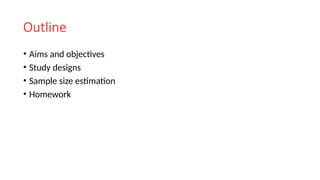
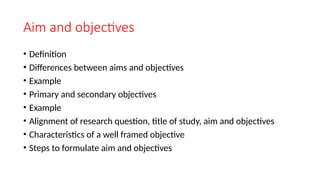
Aim and objectives
•Definition
• Differences between aims and objectives
• Example
• Primary and secondary objectives
• Example
• Alignment of research question, title of study, aim and objectives
• Characteristics of a well framed objective
• Steps to formulate aim and objectives
4.
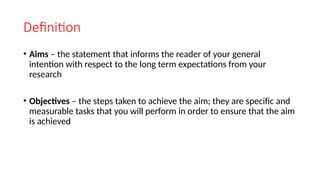
Definition
• Aims –the statement that informs the reader of your general
intention with respect to the long term expectations from your
research
• Objectives – the steps taken to achieve the aim; they are specific and
measurable tasks that you will perform in order to ensure that the aim
is achieved
5.
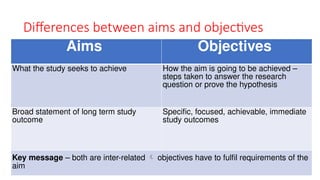
Differences between aimsand objectives
Aims Objectives
What the study seeks to achieve How the aim is going to be achieved –
steps taken to answer the research
question or prove the hypothesis
Broad statement of long term study
outcome
Specific, focused, achievable, immediate
study outcomes
Key message – both are inter-related objectives have to fulfil requirements of the
aim
6.
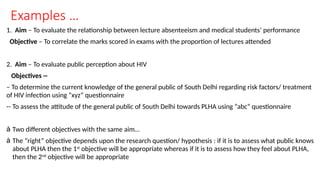
Examples …
1. Aim– To evaluate the relationship between lecture absenteeism and medical students’ performance
Objective – To correlate the marks scored in exams with the proportion of lectures attended
2. Aim – To evaluate public perception about HIV
Objectives --
– To determine the current knowledge of the general public of South Delhi regarding risk factors/ treatment
of HIV infection using “xyz” questionnaire
-- To assess the attitude of the general public of South Delhi towards PLHA using “abc” questionnaire
à Two different objectives with the same aim…
à The “right” objective depends upon the research question/ hypothesis : if it is to assess what public knows
about PLHA then the 1st
objective will be appropriate whereas if it is to assess how they feel about PLHA,
then the 2nd
objective will be appropriate
7.
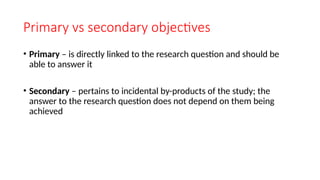
Primary vs secondaryobjectives
• Primary – is directly linked to the research question and should be
able to answer it
• Secondary – pertains to incidental by-products of the study; the
answer to the research question does not depend on them being
achieved
8.
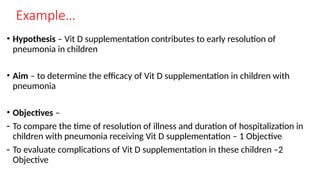
Example…
• Hypothesis –Vit D supplementation contributes to early resolution of
pneumonia in children
• Aim – to determine the efficacy of Vit D supplementation in children with
pneumonia
• Objectives –
- To compare the time of resolution of illness and duration of hospitalization in
children with pneumonia receiving Vit D supplementation – 1 Objective
- To evaluate complications of Vit D supplementation in these children –2
Objective
9.
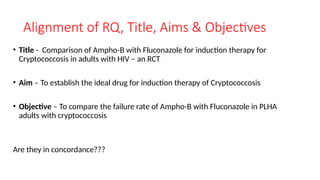
Alignment of RQ,Title, Aims & Objectives
• Title - Comparison of Ampho-B with Fluconazole for induction therapy for
Cryptococcosis in adults with HIV – an RCT
• Aim – To establish the ideal drug for induction therapy of Cryptococcosis
• Objective – To compare the failure rate of Ampho-B with Fluconazole in PLHA
adults with cryptococcosis
Are they in concordance???
10.
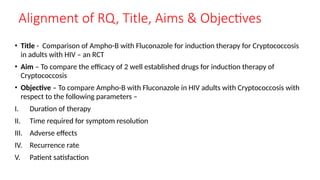
Alignment of RQ,Title, Aims & Objectives
• Title - Comparison of Ampho-B with Fluconazole for induction therapy for Cryptococcosis
in adults with HIV – an RCT
• Aim – To compare the efficacy of 2 well established drugs for induction therapy of
Cryptococcosis
• Objective – To compare Ampho-B with Fluconazole in HIV adults with Cryptococcosis with
respect to the following parameters –
I. Duration of therapy
II. Time required for symptom resolution
III. Adverse effects
IV. Recurrence rate
V. Patient satisfaction
11.
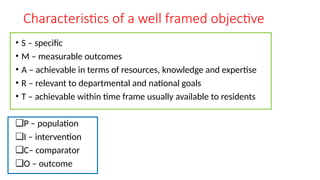
Characteristics of awell framed objective
• S – specific
• M – measurable outcomes
• A – achievable in terms of resources, knowledge and expertise
• R – relevant to departmental and national goals
• T – achievable within time frame usually available to residents
❑P – population
❑I – intervention
❑C– comparator
❑O – outcome
12.
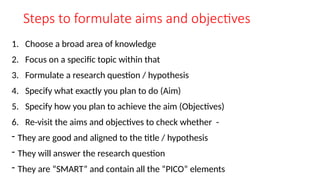
Steps to formulateaims and objectives
1. Choose a broad area of knowledge
2. Focus on a specific topic within that
3. Formulate a research question / hypothesis
4. Specify what exactly you plan to do (Aim)
5. Specify how you plan to achieve the aim (Objectives)
6. Re-visit the aims and objectives to check whether -
- They are good and aligned to the title / hypothesis
- They will answer the research question
- They are “SMART” and contain all the “PICO” elements
13.
Study designs
• Introduction
•Types of study designs
• Examples
• Features of study designs
• Research questions and their appropriate study designs
14.
Introduction
• Design ofa research project is the basic framework on which the study is
carried out
• Study is carried out on a sample from the population of interest and the
observations made are analysed and extrapolated to the entire
population of interest
• Results should be valid for the population subset actually studied in the
research (internal validity) and also for the entire population of interest
(external validity)
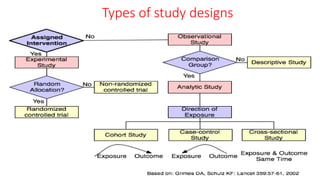
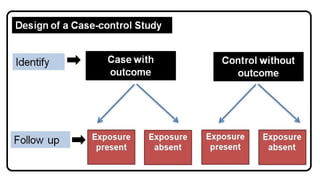
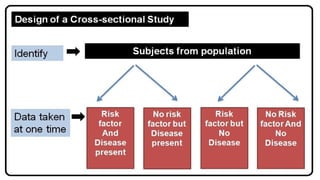
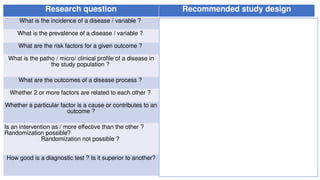
Research question Recommendedstudy design
What is the incidence of a disease / variable ? Cohort study (prospective)
What is the prevalence of a disease / variable ? Cross- sectional study
What are the risk factors for a given outcome ? Case – control study
What is the patho / micro/ clinical profile of a disease in
the study population ?
Descriptive study
What are the outcomes of a disease process ? Cohort study
Whether 2 or more factors are related to each other ? Cross- sectional study
Whether a particular factor is a cause or contributes to an
outcome ?
Cohort study
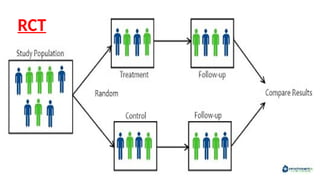
Is an intervention as / more effective than the other ?
Randomization possible?
Randomization not possible ?
Randomized controlled trial
Non- randomized trial
How good is a diagnostic test ? Is it superior to another? Studies of diagnostic accuracy
22.
Important terminologies describingaccuracy of a
test…
• Sensitivity = [TP/TP+FN]
• Specificity = [TN/TN+FP]
• Likelihood ratio [ LR+ = Sensitivity/ 1-specificity; LR- = 1-sensitivity/specificity]
• Odds ratio [ (TP/FN)/(FP/TN)] – chances of occurrence of a characteristic
compared to its non occurrence
23.
Sample size estimation
•Introduction
• Why calculate sample size ?
• Basic concepts required to be able to calculate sample size
• How to calculate sample size – formula based / software based
• Adjusting the sample size
24.
Basic concepts
• TypeI (alpha) and II (beta) errors
• Power of the study
• Effect size
• Confidence interval
• Mean & Standard deviation
• Prevalence
25.
Type I &II errors and Power of a study
• Null hypothesis – there is no difference between the 2 groups
• Truth – no difference exists or there may be a difference
• If no difference exists in reality and our study finds a difference – type I
/ alpha error committed
• If a difference existing in reality is not detected by our study – type II /
beta error committed
26.
Type I &II errors and Power of a study
• By convention, type I error fixed at 5% probability of finding a
difference where none exists in reality should be less than 5%
• Type II error taken as 20% by convention for calculating sample size
probability of not finding a difference when in reality a difference
exists should be less than 20%
• This also implies there is an 80% probability of making a correct decision
of not reporting a difference when there is no actual difference =
power of the study
[ Power = 1 – beta error = 1-0.2 = 0.8 or 80%]
27.
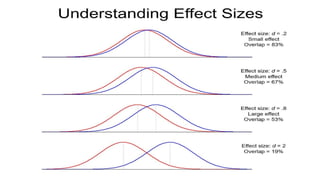
Effect size, C.I.& Mean / S.D.
• Effect size is the standardized difference in means
• Compare sample size to the magnification of a microscope – to detect small
differences you have to increase the magnification and vice versa
• To detect small effect sizes, you have to increase sample size (inversely related)
• Effect size (Cohen’s d) = [mean A – mean B]
Pooled std. deviation
29.
Effect size, C.I.& Mean / S.D.
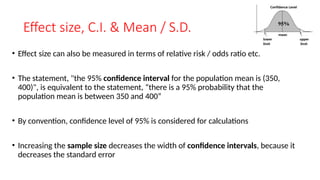
• Effect size can also be measured in terms of relative risk / odds ratio etc.
• The statement, "the 95% confidence interval for the population mean is (350,
400)", is equivalent to the statement, “there is a 95% probability that the
population mean is between 350 and 400”
• By convention, confidence level of 95% is considered for calculations
• Increasing the sample size decreases the width of confidence intervals, because it
decreases the standard error
30.
Questions to answerwhile estimating Sample size
• What is the type of study – determination of an estimate? / hypothesis testing?
• What is the primary outcome variable?
• What is the estimated value of the primary outcome variable and acceptable
precision?
• What is the acceptable amount of type I and type II errors ?
31.
Questions to answerwhile estimating Sample size
• What is the desired effect size?
• What is the estimated prevalence / baseline value of the disease
under study? [as per prior relevant studies / pilot studies]
• What is the estimated std. deviation of the variable under study? [as
per prior relevant studies]
Formula based
• Differentformulae for different study designs and types of variables
(qualitative / quantitative)
• Can be quite complex (based on type of study)
• Need to have some baseline estimates (such as estimated prevalence of a
disease etc.) in order to calculate sample size
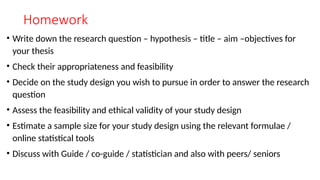
Homework
• Write downthe research question – hypothesis – title – aim –objectives for
your thesis
• Check their appropriateness and feasibility
• Decide on the study design you wish to pursue in order to answer the research
question
• Assess the feasibility and ethical validity of your study design
• Estimate a sample size for your study design using the relevant formulae /
online statistical tools
• Discuss with Guide / co-guide / statistician and also with peers/ seniors

![Important terminologies describing accuracy of a
test…
• Sensitivity = [TP/TP+FN]
• Specificity = [TN/TN+FP]
• Likelihood ratio [ LR+ = Sensitivity/ 1-specificity; LR- = 1-sensitivity/specificity]
• Odds ratio [ (TP/FN)/(FP/TN)] – chances of occurrence of a characteristic
compared to its non occurrence](https://image.slidesharecdn.com/protocoldevelopmentworkshop-ankesh-250602091934-d5382587/85/Protocol-development-workshop-presentation-22-320.jpg)
![Type I & II errors and Power of a study
• By convention, type I error fixed at 5% probability of finding a
difference where none exists in reality should be less than 5%
• Type II error taken as 20% by convention for calculating sample size
probability of not finding a difference when in reality a difference
exists should be less than 20%
• This also implies there is an 80% probability of making a correct decision
of not reporting a difference when there is no actual difference =
power of the study
[ Power = 1 – beta error = 1-0.2 = 0.8 or 80%]](https://image.slidesharecdn.com/protocoldevelopmentworkshop-ankesh-250602091934-d5382587/85/Protocol-development-workshop-presentation-26-320.jpg)
![Effect size, C.I. & Mean / S.D.
• Effect size is the standardized difference in means
• Compare sample size to the magnification of a microscope – to detect small
differences you have to increase the magnification and vice versa
• To detect small effect sizes, you have to increase sample size (inversely related)
• Effect size (Cohen’s d) = [mean A – mean B]
Pooled std. deviation](https://image.slidesharecdn.com/protocoldevelopmentworkshop-ankesh-250602091934-d5382587/85/Protocol-development-workshop-presentation-27-320.jpg)
![Questions to answer while estimating Sample size
• What is the desired effect size?
• What is the estimated prevalence / baseline value of the disease
under study? [as per prior relevant studies / pilot studies]
• What is the estimated std. deviation of the variable under study? [as
per prior relevant studies]](https://image.slidesharecdn.com/protocoldevelopmentworkshop-ankesh-250602091934-d5382587/85/Protocol-development-workshop-presentation-31-320.jpg)





![APPROACH TO FEVER IN PEDIATRICS[1].pptTT](https://cdn.slidesharecdn.com/ss_thumbnails/approachtofeverinpediatrics1-260125081456-d559e079-thumbnail.jpg?width=640&height=640&fit=bounds)


![Cells and Organs of immune system [Autosaved].pptx](https://cdn.slidesharecdn.com/ss_thumbnails/cellsandorgansofimmunesystemautosaved-260123152717-ea0cb261-thumbnail.jpg?width=640&height=640&fit=bounds)
